The Irrawaddy Magazine |
- Naga Armed Group Holds Rare Meeting with Govt
- Inspired at Death’s Door
- Myanmar’s Movers and Shakers – 2017
- 36 Fishermen Still Missing One Week After Stormy Weather in Pyapon
- Pulitzer Winners Join Call for Reuters Reporters’ Release
- Cambodia’s Hun Sen Vows to Stay in Power for at Least Another 10 Years
| Naga Armed Group Holds Rare Meeting with Govt Posted: 28 Dec 2017 06:13 AM PST YANGON — The National Socialist Council of Nagaland-Khaplang (NSCN-K) held a rare meeting with the government's Peace Commission in Yangon on Thursday in a bid to improve relations on the road to an eventual peace deal. The NSCN-K is one of 21 ethnic armed groups in official talks with the government to reach a lasting peace. Though the ethnic Naga group signed a ceasefire deal with the Sagaing Region government in 2012, it has yet to join the broader Nationwide Ceasefire Agreement (NCA). The NSCN-K last met with the Peace Commission more than a year ago and joined Thursday's meeting to improve relations with the new government's negotiators. U Kyaw Wan Sein, one of the NSCN-K's five delegates at the meeting, said the talks went well, in part because the government's negotiators included some familiar faces from prior meeting. The Peace Commission is chaired by Tin Myo Win. "We met with the [Peace Commission] because we want to have stability in our region. As long as we have a constant relationship, we can build more trust," U Kyaw Wan Sein said. He told The Irrawaddy that they discussed the need to achieve and maintain peace in contested areas during their one-hour meeting but did not talk about development or the NCA specifically. The Peace Commission's U Aung Soe said the commission urged the NSCN-K to attend the next session of the 21st Century Panglong peace conference set for late January. "There was no specific demand [from the NSCN-K]. We invited them to join the peace conference," U Aung Soe said. "We talked about coordinating to address issues relating to the lack of development in the region." The Naga are one of six ethnic groups granted self-administered areas under the 2008 Constitution and have representatives in the local parliaments. U Aung Soe said the commission would hold additional talks on developing parts of Sagaing with the Naga lawmakers. Based along Myanmar's border with India, the NSCN-K wants any agreement with the government of Myanmar to cover ethnic Naga living in India. A splinter group, the NSCN-M, has been holding separate peace talks with the government of Indian. "We have told the media many times that because Naga live in both countries we need political solutions to solve our issue," U Kyaw Wan Sein said. Naga living in Myanmar and India are known locally as eastern Naga and western Naga, respectively. But U Kyaw Wan Sein said they consider both to belong to one Naga territory despite the international border diving them. He said the NSCN-K was in talks with the government of Myanmar because it was invited. “In India we used to have such talks, but it is not going well at the moment," he said, blaming the plethora of Naga factions across the border, some of them currently fighting with the Indian army. The post Naga Armed Group Holds Rare Meeting with Govt appeared first on The Irrawaddy. |
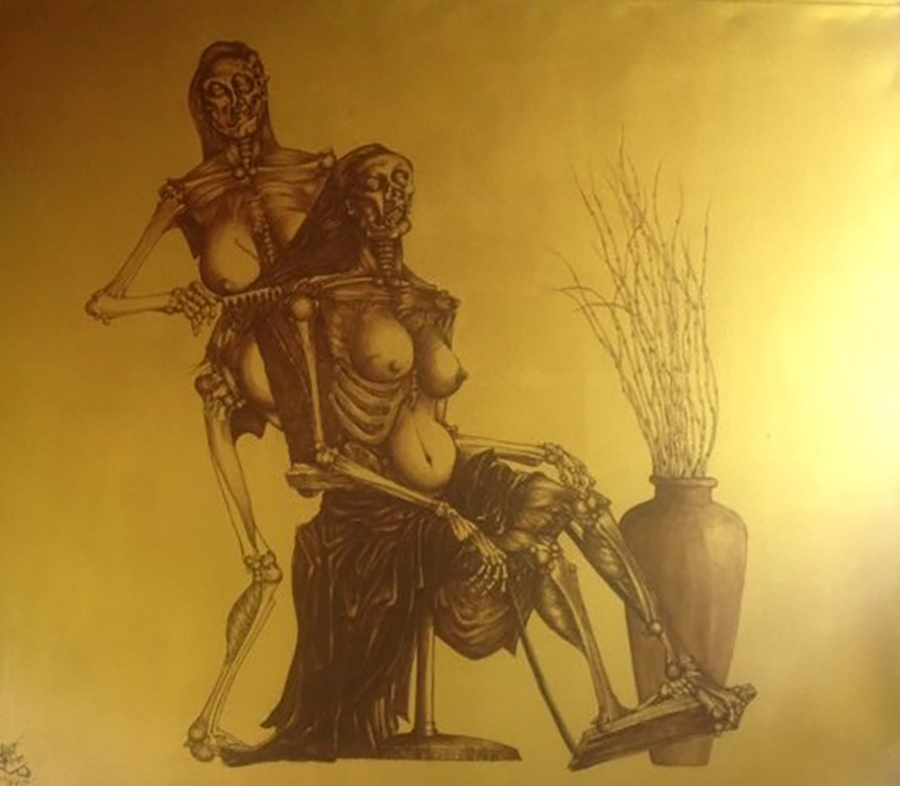
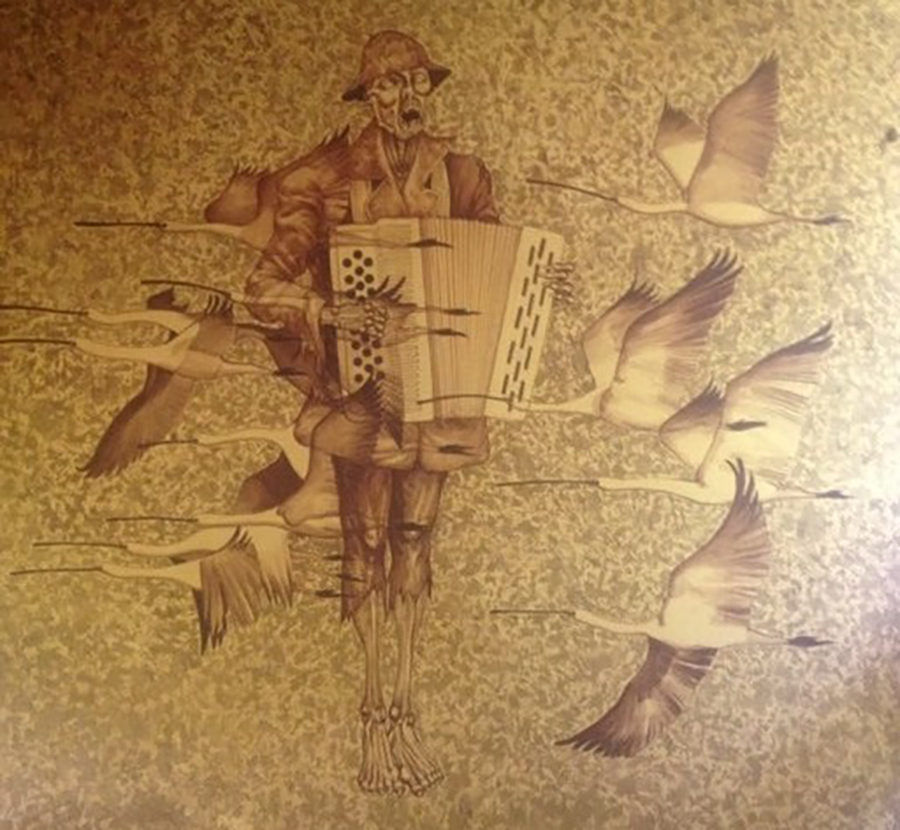
| Posted: 28 Dec 2017 04:35 AM PST Inspired by bedridden patients and death, Khit Bhone Mo, who himself has been at death's door, has painted his first solo exhibition on the last chapter of human life. The artist, who suffered from heart problems, underwent a surgery in 2014. "I didn't want to die before I could organize my own exhibition," Khit Bhone Mo, who used to be an illustrator, recalled his struggle. Lying on a hospital bed for weeks, he saw many deaths—some quick and some lingering— that left strong impressions on him. "Patients around my bed died one after another. Then, I came to realize that skins [appearances] are not important. Muscles are not important either. But without a heart, everything ceases," the artist said. Although his experience had given him some aspirations, he was not able to work on his solo show until early 2017, when he met artist Aye Ko, the founder of New Zero Art Village. Then, Khit Bhone Mo became the first person to win the artist residency award given by the New Zero Art Village, which funded and accommodated him to paint his solo art exhibition. In May, he went to a tranquil village in Hmawbi Township on the outskirts of Yangon to draw what he saw and felt some four years ago at the hospital. He was alone at a house on a spacious compound in absolute silence, and a few days later, he started to feel the need for music. "I only heard the twittering of birds those days. It was not enough. Then, I felt hungry for music." Then, a man he saw at the hospital, who had his leg amputated because of heart failure, came to his mind. "I remembered him murmuring a song while patting his thigh. He was soothing himself with music." This gave him the idea to mix death and music, as his solo exhibition features skinny figures playing different musical instruments such as piano, violin, and accordion. In one of the paintings, a woman is playing a clarinet despite being coiled by a big snake. "I would like to portray the inner strength of women against the troubles of life." The exhibition 'Deadly Rhyme' features 12 paintings, each priced at $1,500, at New Zero Art Space gallery on Alanpya Pagoda Street in Dagon Township from Dec. 29 to Jan. 11. The post Inspired at Death's Door appeared first on The Irrawaddy. |
| Myanmar’s Movers and Shakers – 2017 Posted: 28 Dec 2017 02:39 AM PST In this special edition, The Irrawaddy looks at the individuals who most influenced the news headlines both locally and internationally throughout the year — from the Rakhine conflict to the murder of prominent Muslim lawyer U Ko Ni to the journalists who were arrested just for doing their jobs to the significant first papal visit. Some of these people ended the year with their good names enhanced, others with their reputations tarnished.  Daw Aung San Suu Kyi: Leader Under Siege 2017 was a rocky year for State Counselor Daw Aung San Suu Kyi. Peace with the major ethnic armed groups in the country remains elusive despite her commitment to ending the world's longest-running civil war. Her hopes of national reconciliation with the country's powerful military are far from being realized. Western countries that once hailed her as a "saint" are now criticizing her after more than 650,000 Rohingya fled the country due to a military crackdown the UN labeled ethnic cleansing. In Myanmar's capital, Naypyitaw, she has effectively taken charge of all 24 ministries because "some ministers don't dare to make decisions by themselves," as her aide U Win Htein put it. Despite accusations of incompetence against some cabinet members, the de facto leader has yet to replace any of them. Instead, she has hailed her cabinet as corruption free. It would be more helpful for the 72-year-old if her ministers had a clear and precise vision of what they were doing apart from not being corrupt. Though her popular support in the country remains unshakable, people are starting to feel uneasy about the slow pace of change. The business community is wondering why she has neglected much-needed economic reforms. A recent survey found that business confidence among entrepreneurs had dropped from 73 percent to 49 percent over the past year due to a lack of clear economic policies. In the markets, housewives are complaining about rising commodity prices. Rule of law in the country is still uncertain. In a speech in March marking her NLD party's first year in power, Daw Aung San Suu Kyi said her government wanted to make changes together with the people. But the changes her people are now experiencing are not exactly the ones they want. On the other hand, there is no one else who has earned the public trust to lead the country as of yet. ____________________________
 U Ko Ni's Murder: A Signal from Hardliners Myanmar's community of pre-democracy activists was rocked in 2017 by the violent death of prominent Muslim lawyer U Ko Ni. He was gunned down at close range in broad daylight outside of Yangon International Airport on Jan. 29. The gunman, Kyi Lin, also fatally shot an airport taxi driver, U Nay Win, while attempting to flee. Kyi Lin was apprehended at the crime scene. U Ko Ni was a human rights lawyer and constitutional expert who had long lobbied for the drafting of a new national constitution in accordance with democratic norms. Many speculated that his agitation for constitutional change was the reason he was killed. The 65-year-old lawyer was also a legal adviser to Daw Aung San Suu Kyi's National League for Democracy (NLD) party. A trial has been going on for nine months for Kyi Lin and three other suspects accused of involvement in the assassination. However, former lieutenant colonel Aung Win Khaing, who is also on the police's wanted list as a main conspirator behind the assassination, is still at large nearly one year after the murder. Police told a Yangon court in June that they had made no progress in their effort to arrest him. The motive for the murder, according to the minister for home affairs, was a "personal grudge" on the part of the arrested suspects, who he said were "resentful" of U Ko Ni's political activities. However, many suspect the involvement of more powerful people eager to put an end to the reform efforts of the prominent NLD lawyer. ____________________________
 Kofi Annan: Adviser on Harmony In late August 2016, State Counselor Daw Aung San Suu Kyi appointed former United Nations secretary-general Kofi Annan to chair a nine-member Advisory Commission on Rakhine State. The commission was tasked with finding lasting solutions to the deep-seated problems between the Rohingya and Arakanese communities. Annan made an official visit to Myanmar in September of that year. The following month, a group of Muslim militants attacked several Maungdaw border outposts, killing nine policemen and stealing firearms on Oct. 9. During his visit, Annan conducted meetings with members of the Rakhine and Muslim communities, Muslim religious leaders and Buddhist monks across the state. These meetings formed the basis of the recommendations in the commission's final report for Myanmar's NLD-led government. However, Annan acknowledged that the attacks in October had caused trust between the Muslim and Arakanese communities to break down again. While the international community accused government security forces of committing rights violations in Maungdaw, Annan confined himself to trying to achieve the commission's main objectives — conflict resolution, humanitarian assistance, reconciliation and development — rather than compiling human rights reports. Moreover, he warned the press not to use the word "genocide" loosely. Myanmar President's Office spokesman Zaw Htay described the peace envoy as serving as a "shield" for the government in the international arena. On Aug. 24 of this year, the Annan commission issued its final report and recommended the government amend the outdated 1982 citizenship law to bring it in line with international standards, and grant birth certificates to newborn Rohingya children. The report also contained recommendations on humanitarian assistance, infrastructure development and border security issues, and called for the acceleration of the national verification process and an end to segregation between the two communities. He publicly denounced the coordinated attacks by the Arakan Rohingya Salvation Army that occurred the following day. ____________________________
 Senior-General Min Aung Hlaing: Guardian of the Constitution Myanmar Army chief Senior-General Min Aung Hlaing has received sharply split reviews for his response to the Arakan Rohingya Salvation Army's attacks on government security outposts in northern Rakhine State in August. He took the attacks as a threat to national sovereignty and security and with the government's approval ordered clearance operations against the Muslim militant group. For the first time in decades many Myanmar people united behind the military, sharing the commander-in-chief's views on the situation. But with a rising number of Rohingya refugees fleeing to Bangladesh with horrific accounts of mistreatment at the army's hands, much of the rest of the world is of a different mind. The army chief's repeated denials that his soldiers committed atrocities against Rohingya have made no difference. Sanctions on military leaders by the European Union and the United States followed. Senior-General Min Aung Hlaing's dream of creating a modern military has been shattered. The military's ostracism by the West has pushed it closer to Myanmar's neighbors, especially China, which has vast business interests in the country. On a visit to Beijing, Senior-General Min Aung Hlaing was welcomed by Chinese President Xi Jinping with firm support for military-to-military engagement and for the army's actions in Rakhine State. The recognition buttressed Senior-General Min Aung Hlaing's position and the military's role in Myanmar politics. At home, when it comes to local politics, the military chief frequently cites controversial provisions in the country's Constitution guaranteeing the military's political role and enshrining it as the sole guardian of the charter. His relationship with State Counselor Daw Aung San Suu Kyi, who wants to amend the constitution to make it more democratic, is at a low point, according to some insiders. The general's call for all ethnic armies to join the Nationwide Ceasefire Agreement is unlikely to gain much traction while his troops in northern Myanmar are shelling rebel camps. For ethnic people who fled their homes in the face of army offensives, it means they will have to spend some more time in the squalid IDP camps they have called home for years. ____________________________
 Ethnic Armed Groups: Fighting for Rights and Peace State Counselor Daw Aung San Suu Kyi spoke a lot about peace in 2017, but the peace process has lost momentum since her government took over from the U Thein Sein administration two years ago. She herself has expressed dissatisfaction with the lack of progress; since her National League for Democracy was elected, none of the ethnic armed organizations from the UNFC or the Northern Alliance has agreed to sign the Nationwide Ceasefire Agreement (NCA). The UNFC has long said it would sign the pact if the government agreed to address its eight points, but the Tatmadaw — Myanmar's military — has balked. At the last round of meetings on peace talks in October, progress was held up by differences over a single phrase in the agreement. The UNFC wants the country to be officially described as a "Federal Democratic Union," whereas the Army and government favor "Democracy and Federal Union." The UNFC believes that once all ethnic groups have equal rights under a federal system, democracy will follow, but the Army has a different view. Some UNFC leaders believe the Army is trying to deny the NLD-led government credit for achieving peace by making it impossible for the UNFC to sign the NCA. Myanmar has been through multiple peace processes and political dialogues, but they have never been entirely inclusive. According to U Khun Okkar from the Pa-O People's Liberation Organization, the Tatmadaw has conducted the process in the wrong order, writing the Constitution first, before seeking political dialogue. He said that if everybody can be brought into the talks, and a common agreement found, the country will have lasting peace and a stable constitution. In the case of the Northern Alliance, the Army wants participation in the peace process limited to the UWSA, NDAA, KIA, and SSPP, with the MNDAA, AA, and TNLA excluded. Despite the talk of peace in 2017, we will not see actual peace until the Tatmadaw gives the green light to all armed groups to participate in the peace process. ____________________________
 Dr. Win Myat Aye: Minister of Goodwill Widely recognized as a reformer, Minister of Social Welfare, Relief and Resettlement (MSWRR) Dr. Win Myat Aye has improved the image of his ministry, which was long seen as one of the least active in the government. He has developed a reputation for responding quickly to problems and engaging with civil society in order to address the issues facing his ministry—from caring for young children and senior citizens to protecting women's rights and the rights of people with disabilities, as well as disaster response. Unlike other ministers, he is always responsive to media, even amid a tight schedule. Trained as a pediatrician, he once served as rector of Magwe University of Medicine. He won an Upper House seat in Bago Division representing the NLD in the historic 2015 general election. The minister said he was told by Daw Aung San Suu Kyi before he took office that the image of the new government would depend greatly on the performance of his ministry. "We've adopted a policy that our ministry should be close to the people. We know that we have to reach out to the people. This policy is about responsiveness to public issues," he said. As the most highly regarded NLD cabinet member over the past two years, Dr. Win Myat Aye was given two important posts: chairman of the Implementation Committee for Recommendations on Rakhine State (in September) and vice chairman of the Union Enterprise for Humanitarian Assistance, Resettlement and Development in Rakhine (in October). These positions make the minister a key figure in the implementation of both short- and long-term solutions for ethnically and religiously divided Rakhine State, including the voluntary return of refugees, restoring stability, preventing human rights violations, fighting terrorism, working to achieve harmony between the different communities, and implementing economic and social reform. ____________________________
 Tycoons: Offering a Financial Lifeline The saying "a friend in need is a friend indeed" couldn't be more apt in the case of Myanmar's embattled de facto leader, Daw Aung San Suu Kyi. When the country needed money in the wake of the Rakhine conflict for large-scale rehabilitation programs, she seemed to have no one except rich businesspeople to turn to, declaring that "Big businesspeople are the strength of the country." The state counselor had called on her fellow citizens to help in Rakhine at a time when the country faces potential funding delays and cuts from international organizations due to the crisis. In response, she was showered with K17.7 billion (about USD13 million) in cash donations from the country's leading 25 business tycoons, including U Aung Ko Win of KBZ Company, U Zaw Zaw of the Max Group, and U Khin Shwe of the Zaykabar Group. Apart from money, she asked for suggestions and collaboration from the business community to solve the problems in Rakhine in the form of job-creating opportunities, infrastructure building and programs to improve transportation and agriculture. The country's leading business body, the Union of Myanmar Federation of Chambers of Commerce and Industry (UMFCCI), organized taskforces to implement the plans. Of the country's leading business executives, Nang Lang Kham of KBZ group and U Zaw Zaw of Max Group of Companies appear to be the state counselor's favorites. During her recent trip to Rakhine State, they were right beside her. Nang Lang Kham, executive director of the KBZ Group, is renowned for her activism for women's empowerment and the work she does through the Brighter Future Myanmar (BFM) Foundation—the philanthropic branch of KBZ, which she co-founded and chairs. In the government's Rakhine State rehabilitation projects, BFM was ranked as the top donor thanks to a K6.5 billion ($4.7 million) contribution. Through the foundation, Nang Lang Kham has been actively engaged in disaster relief and supporting health, sport, peace and education programs since 2007, as well as in promoting inclusivity and gender equality. 
U Zaw Zaw, once known for his close ties with the military regime, these days is mostly recognized for his backing of Myanmar soccer, a popular sport in the country. The former blacklisted tycoon once said he at least wants to try to be "a good crony". To make it happen, he began cultivating a relationship with Daw Aung San Suu Kyi shortly after her release from house arrest in November 2010.  He has been doing philanthropic projects in healthcare, education and youth development through his Ayeyarwady Foundation. In Rakhine, the foundation has donated K2.33 billion ($1.7 million). Furthermore, he has opened football academies in Yangon and Mandalay to train promising young players. When he met FIFA president Gianni Infantino in London in October this year, U Zaw Zaw discussed Myanmar's football development, even expressing his wish to one day see Myanmar host the World Cup. ____________________________
 Half the Sky: Groundbreaking Women In 2017 women featured in the news more than in years past. They now account for 13 percent of the country's 1,151 elected lawmakers. Though far outnumbered by men, female parliamentarians were more outspoken than their male counterparts. Rights advocates turned lawmakers like Daw Thandar, Naw Susana Hla Hla Soe and Daw Zin Mar Aung, and businesswomen like Daw Thet Thet Khine are among them, playing key roles in Parliament. Legislation on the prevention of violence against women and children, drafted four years ago, was at last finalized and readied for submission. Daw Thet Thet Khine questioned the transparency of revenues from the country's extractive industries in November. She pointed out that only half of more than 10 trillion kyats ($7.3 billion) in revenue went into the Union budget, the rest kept by state enterprises controlled by the Ministry of Natural Resources and Environmental Conservation. With two NLD women as chief ministers, in Karen State and Tannitharyi Region, under the country's de facto leader, Daw Aung San Suu Kyi, female leadership became more visible than ever before. Karen State Chief Minister Daw Nang Khin Htwe Myint is a veteran politician who has devoted her life to equality and federal union. She came under harsh criticism for moving forward with a coal-fired power plant project in Pa-an, the state capital. "If coal is useful for our state, I want to start using it," she said. "We won't, however, accept any development that damages the health of people and the environment." But women were most active in civil society. Tireless educators like Daw Khin Ma Ma Myo inspires other women to take part and contribute their knowledge about gender equality, peace and security. The security expert cofounded the Myanmar Institute of Peace and Security Studies. Female activists like Nang Phyu Phyu Lin and her colleagues, meanwhile, pushed for a 30 percent quota for women in the peace process. Women are traditionally known for providing social support and care for vulnerable people. Renowned physicians like Dr. Cynthia Maung, who works along the Thai-Myanmar border, have been setting an example for others. This year, Dr. Myat Sandar Thant launched the Single Mother Foundation to help pregnant young women abandoned by their partners give birth. Within six months of opening her shelter, she helped deliver 57 babies. The stories of the women who passed through her shelter drew public attention to the problem of sexual abuse against women and the lack of knowledge about reproductive health. ____________________________
 Journalists: A Job that Requires Courage It has been a tough year for journalists in Myanmar. Recent arrests have shed light on the vulnerability of journalists working in a country where authorities or individuals can target them at any time. Ko Swe Win, the editor-in-chief of Myanmar Now, is still facing trial after being hit with a lawsuit in March under Article 66 (d) of the Telecommunications Law by a Mandalay nationalist who accused him of insulting ultranationalist monk U Wirathu on social media. In June, the chief editor of The Voice Daily newspaper, U Kyaw Min Swe, and a columnist for the paper, Ko Kyaw Zwa Naing, were arrested after the military filed a lawsuit under the same telecommunications law and Article 25 (b) of the Media Law for allegedly defaming the Myanmar Army in a satirical article. The Irrawaddy's senior reporter Lawi Weng, and Democratic Voice of Burma reporters U Aye Nai and Ko Pyae Phone Aung were arrested by the Myanmar Army as they returned from an area controlled by the Ta'ang National Liberation Army in northern Shan State. The journalists were charged under the colonial-era Article 17 (1) of the Unlawful Associations Act and were kept behind bars for 67 days in Hsipaw Prison until the military dropped the charges. Turkish TRT World's Malaysian producer Mok Choy Lin, Singaporean cameraman Lau Hon Meng, and two Myanmar employees—interpreter Ko Aung Naing Soe and driver U Hla Tin—were sentenced to two months in jail under the 1934 colonial-era Myanmar Aircraft Act for flying a drone near Parliament in Naypyitaw. On Dec. 12, two Reuters journalists, Wa Lone and Kyaw Soe Oo, were arrested on the outskirts of Yangon and accused of violating the Official Secrets Act for processing confidential police reports containing detailed information about the fighting between government forces and the Arakan Rohingya Salvation Army in late August 2017. They are facing a maximum sentence of 14 years. All of the arrests are undoubtedly linked to the work of the journalists, heightening fears of a clampdown on the country's independent media. ____________________________
 Pope Francis: Mediating Voice of Moral Authority Pope Francis made the first papal visit to majority-Buddhist Myanmar at the end of November, amid unrest and a humanitarian crisis in Rakhine State. The visit was a blessing for Catholics in Myanmar, who make up some 1 percent of the more than 50 million population. However, it garnered criticism from the international community. Pope Francis first met with Army Commander-in-Chief Senior-General Min Aung Hlaing — ahead of President U Htin Kyaw and State Counselor Daw Aung San Suu Kyi. Critics noted the deviation from protocol. The Vatican acknowledged this, but the pope reported that his meeting with the senior-general — whose army has been accused of widespread human rights abuses against the Rohingya Muslims in Rakhine State — was productive in that he was able to make his message known. Pope Francis called for peace and reconciliation and urged people to use their differences to forge unity, forgiveness, tolerance and nation-building. The international community was disappointed that Pope Francis avoided using the term 'Rohingya' while in the country. He was reportedly urged by Myanmar's Cardinal Charles Bo and others to avoid mentioning the term so as not to upset the host country or trigger a backlash. According to Reuters, the Vatican defended the decision and added that the pope's moral authority was unblemished and that his presence alone drew attention to the refugee crisis. Religious leaders from Myanmar described the visit as a success, sending a message of love, peace, justice and religious harmony. ____________________________
 International Community: Friends or Foes? Muslim militants attacked several border outposts in Maungdaw in October 2016. The Myanmar Army hunted for the perpetrators, but the operations resulted in thousands of Rohingya refugees fleeing and saw dozens of Rohingya villages reduced to ash. International human rights organizations accused the government security forces of arson, extra-judicial killings and rape. In 2017, the Arakan Rohingya Salvation Army again staged attacks on border posts in three townships in northern Rakhine State. As it had in the past, the Army launched clearance operations in the region, driving out more than 650,000 Rohingyas to neighboring Bangladesh. It was widely reported as a humanitarian disaster, with the UN Human Rights Council describing the military operation as a "textbook example of ethnic cleansing." Nearly a dozen of her fellow Nobel Laureates called upon Daw Aung San Suu Kyi to condemn those responsible for the Rohingya crisis. Malala Yousafzai and Desmond Tutu were among those who expressed their disappointment at her silence on the issue. Human rights organizations published satellite images of devastated villages in Maungdaw district. Recently, Human Rights Watch accused Myanmar of setting fire to more than 40 villages and Médecins Sans Frontières estimated that more than 6,700 Rohingya had been killed by security forces. Among Western countries, Britain has been especially vocal in its criticism, even threatening to raise the issue at the UN Security Council. British institutions have been blunt in their condemnation of the state counselor for her silence on the brutal mistreatment of the Rohingya community in northern Rakhine. On the other hand, China, Russia, India and several Asian countries have supported Myanmar in votes at the UN. In October, Oxford University's St. Hugh's College removed Daw Aung San Suu Kyi's portrait from its main entrance, while Unison, the UK's largest trade union, suspended her honorary presidency. In Ireland, the Dublin City Council revoked her Freedom of Dublin award. Meanwhile, the U.S. government announced that at least one person from Myanmar would be targeted with sanctions. ____________________________
 U Phyo Min Thein: Challenger to the General In January, when U Phyo Min Thein abolished Yangon's old public bus system — notorious for its worn-out fleet and its unruly drivers and conductors — the move was heartily welcomed by city commuters. He introduced a new bus system known as YBS and imported 1,000 buses from China. But the reform was less than transparent; the tender for the Chinese buses was never made public. When a Reuters story questioned the Chinese bus deal, he was furious. The chief minister filed a complaint against the news wire service with the Myanmar Press Council, claiming the story was factually incorrect. When the council asked him to explain exactly what was wrong, he could not provide the necessary information and the case was closed. Despite his thin skin, U Phyo Min Thein has himself been annoying others, including one of Myanmar's most powerful people — military chief Senior-General Min Aung Hlaing. At a forum for civil society organizations in Yangon in July, he said the commander-in-chief occupied a position equal to a director-general and that "there are no civil-military relations in the democratic era." The military took it as an insult and called on the government to "take necessary actions" against the chief minister. Two days later, U Phyo Min Thein sent a written apology to the military chief. He has not spoken about the military in public since. ____________________________
 Nationalists: Preachers of Dhamma or Hatred? In the face of a mounting crackdown this year by the government, Myanmar's nationalist Buddhist groups are still on the move. It's a relief to see no more of the bloody communal violence of recent years, yet nationalists have continued trying to raise tensions. Since the umbrella nationalist group Ma Ba Tha was banned in 2016, nationalists have been accusing the ruling NLD of failing to promote and protect Buddhism and favoring the human rights of other groups, especially Muslims. When the Arakan Rohingya Salvation Army launched its attacks in northern Rakhine State in August, nationalists saw them as a threat to national security and interests. They interpreted the Rohingya issue as a matter of sovereignty. At the center of Buddhist nationalism is U Wirathu, known for inspiring sectarian violence between Buddhists and Muslims. In March, the 49-year-old Buddhist monk was banned from delivering sermons because of his anti-Muslim hate speech. He and other nationalists have stood by the army and its clearance operations in northern Rakhine, calling the government "useless" and the army the "last resort when it comes to nationalism." For the government, the nationalists are a serious headache. It cannot contain them heavy-handedly because nationalist organizations remain popular — especially at the grass roots — by claiming the country's Buddhist foundations are under assault and need to be protected. Given their anti-Muslim sentiments, the nationalists are also at risk of being politically manipulated by anyone who wants to make the most of the unrest. The image of a compassionate Buddhism, in which much of the country believes, has been distorted internationally by the nationalists into one that favors bigotry and antagonism. ____________________________
 Dr. Zaw Myint Maung: President-in-Waiting? With an ailing president in office, Myanmar needs someone who could take the place of President U Htin Kyaw in case of an emergency. Strongly tipped as the next person to occupy the position is Dr. Zaw Myint Maung, the chief minister of Mandalay, the country's second-biggest city. The longtime NLD member endured lengthy prison sentences under the former military regime, won successive elections in 1990, 2012 and 2015, and is believed to be highly trusted by Daw Aung San Suu Kyi. Dubbed "Myanmar's Duterte" for his resemblance to the Philippine president, the chief minister is also known for his peaceful crackdowns on anti-government protests. Apart from his ministerial position, the Mandalay native is one of the Secretariat members tasked with running the National League for Democracy now that Daw Aung San Suu Kyi is constitutionally no longer the party leader. ____________________________
 Sun Guoxiang: Interlocutor from China China's Special Envoy for Asian Affairs Sun Guoxiang has become a key player in peace negotiations between the National Reconciliation and Peace Center (NRPC) and the Northern Alliance. Throughout the year, he met with Daw Aung San Suu Kyi and Army chief Senior-General Min Aung Hlaing. While he hosted several meetings between representatives of the NRPC and Northern Alliance this year, few reports emerged about the situation on the ground in northern Shan and Kachin states. Recently, however, there have been clear signs that fighting has escalated between the Myanmar Army and Northern Alliance members in those areas. China is aware that unless a solution can be found to the long-running ethnic conflict, there will be no stability along the shared border. As such, it has no choice but to deal with both the ethnic armed groups and the Myanmar government. While some people in Myanmar have criticized China for allegedly supporting the rebels, there is in fact no great affection in Beijing for the ethnic groups. However, China believes that it can use the rebel groups and the peace negotiation process to gain influence in Myanmar. Since the beginning of the reform period, the government in Yangon has engaged more with Western countries as opposed to its neighbor, causing China to feel ignored. However, China now has a chance to play an important role in Myanmar's peace negotiations. Despite not having a formal role or much official power in the peace process, Sun has proved to be an influential actor who could bring both the NRPC and Northern Alliance to the negotiating table. Some observers believe that China has been able to bring some stability to the border area despite not being able to fully restore peace. As a result, the Kokang region has seen some peace this year compared to last year, when the Myanmar Army launched a major offensive against the Myanmar National Democratic Alliance Army (MNDAA). As long as fighting continues in northern Shan and Kachin, Sun and China will remain key players in Myanmar's peace process. The post Myanmar's Movers and Shakers – 2017 appeared first on The Irrawaddy. |
| 36 Fishermen Still Missing One Week After Stormy Weather in Pyapon Posted: 27 Dec 2017 11:57 PM PST PATHEIN — Thirty-six fishermen are still missing in Irrawaddy Region's Pyapon Township one week after a strong gale blew about 80 rafts with more than 200 fishermen out to sea. "Fisheries Department officials, fishery businesspeople, and police are searching for them together," Police Lt-Col Khin Maung Latt of the Irrawaddy Region Police Force told The Irrawaddy. More than 80 rafts with 258 fishermen aboard who were fishing some 22 nautical miles from Pyapon Township were swept out to the sea by strong winds on Dec. 21 and search and rescue teams had recovered 222 fishermen and 57 rafts as of Wednesday. Sixteen other rafts were found damaged and 13 are still missing, according to the regional police. According to local villagers, strong gales do not usually blow at this time in the delta and as a result, fishermen were caught off guard. "But these days, the wind is blowing onshore. So, we hope they will be blown toward the shore by the wind," said U Kyaw Swar, a local of Kha Pyat village in Pyapon Township. Usually, three fishermen work a raft and are supervised by a senior fisherman who has wide navigation experience and knows the currents well. It is not unusual for fishing rafts to be blown out to sea in stormy weather, said locals. In March 2011, a strong gale blew more than 10,000 fishermen from Yangon's Kawhmu and Kungyangon townships, and Irrawaddy's Pyapon and Dedaye townships out to sea, and most of them returned unharmed. In November 2014, the Myanmar Navy and passenger vessels came across and rescued more than 200 gale-hit fishing rafts in Pyapon District. Translated from Burmese by Thet Ko Ko. The post 36 Fishermen Still Missing One Week After Stormy Weather in Pyapon appeared first on The Irrawaddy. |
| Pulitzer Winners Join Call for Reuters Reporters’ Release Posted: 27 Dec 2017 11:49 PM PST YANGON — A group of 50 Pulitzer Prize winners has urged authorities in Myanmar to immediately release two Reuters reporters arrested in Yangon earlier this month and drop the charges against them. Ko Wa Lone and Ko Kyaw Soe Oo were arrested on Dec. 12 after accepting an invitation from police to have dinner on Yangon's outskirts. They had been covering the crisis in Rakhine State and were charged under the colonial-era Official Secrets Act for "illegally acquiring information with the intention to share it with foreign media." The charge carries a maximum prison sentence of 14 years. "Their arrest is an outrageous attack on media freedom. Wa Lone and Kyaw Soe Oo are brave, principled and professional journalists who were working in the public interest and were jailed simply for doing their jobs," the Pulitzer winners said in a joint statement issued Wednesday. "We call on the Myanmar government to immediately release Wa Lone and Kyaw Soe Oo, reunite them with their families, and drop all charges against them." The Pulitzer winners join several rights groups and Western governments including the US and UK in condemning the arrests as an attack on the free press and demanding their release. They are among the 11 journalists arrested in Myanmar in 2017 for defamation or other alleged crimes under some of the country's repressive and widely derided laws, some of them dating back to British rule. Wa Lone and Kyaw Soe Oo were remanded in custody for an additional 14 days on Wednesday during their first court appearance since their arrest. At the time of their arrest, the pair was reporting on the military's violent crackdown in Rakhine since militants launched a coordinated attack on security force posts in the state on Aug. 25. The army's response has driven some 650,000 Rohingya from Myanmar to Bangladesh and elicited accusations of ethnic cleansing and possible genocide from the international community. The military has denied that its forces committed any rights abuses. The post Pulitzer Winners Join Call for Reuters Reporters' Release appeared first on The Irrawaddy. |
| Cambodia’s Hun Sen Vows to Stay in Power for at Least Another 10 Years Posted: 27 Dec 2017 09:00 PM PST PHNOM PENH — Cambodian Prime Minister Hun Sen vowed to extend his more than 30 years in power by at least another decade on Wednesday, weeks after the highest court dissolved the main opposition party ahead of a 2018 general election. The Cambodia National Rescue Party (CNRP) was dissolved in November at the request of Hun Sen's government, signaling what one rights group called the “death knell” for democracy in the Southeast Asian country. Hun Sen, a former Khmer Rouge cadre who defected from the genocidal group and helped drive it from power in 1979, is credited with helping Cambodia achieve economic growth but has also been criticized for his crackdown on civil society groups and the media. China, Cambodia's biggest backer, has said it supports the government's attempts to maintain Cambodia's national security. At a speech given to thousands of garment workers on Wednesday at a pagoda on the outskirts of Phnom Penh, Hun Sen said he would stay in power for another two terms and asked workers to vote for his Cambodian People's Party (CPP). "I will continue to be the elected prime minister for another two mandates which is not less than 10 years," Hun Sen said. "I hope that you as well as your parents and grandparents, if they are alive, and your families continue to vote, to support CPP on July 29, 2018." Garments are Cambodia's biggest export by far and garment workers are a politically powerful group. In 2016, garment exports were worth $6.3 billion and reached $4.9 billion in the first seven months of 2017. Hun Sen has been courting garment workers ahead of the vote. He has promised money for female workers who give birth, among other things. "You have to remember that if you want to keep jobs … you should not give opportunity to anyone, including Cambodians and foreigners, to destroy peace," Hun Sen said. Concerns about the impact of next year's election and competition from lower-cost Asian rivals will slow the growth of Cambodia's garment industry next year, the main manufacturers group said earlier this month. The post Cambodia's Hun Sen Vows to Stay in Power for at Least Another 10 Years appeared first on The Irrawaddy. |




| You are subscribed to email updates from The Irrawaddy. To stop receiving these emails, you may unsubscribe now. | Email delivery powered by Google |
| Google, 1600 Amphitheatre Parkway, Mountain View, CA 94043, United States | |


