Monday, January 22, 2018

The Irrawaddy Magazine

The Irrawaddy Magazine


Camps Ready But Bangladesh Delays Repatriation of Refugees

Posted: 22 Jan 2018 04:35 AM PST

NAYPYITAW — Although Myanmar is ready to start repatriating Muslim refugees as of Wednesday, the Bangladeshi government has yet to complete a list of the refugees who will return as agreed under a bilateral agreement.

Abul Kalam, Bangladesh's refugee relief and rehabilitation commissioner, said on Monday that the return would have to be delayed. He did not immediately give a new date for the repatriations to begin.

"There are many things remaining," he told Reuters by phone. "The list of people to be sent back is yet to be prepared, their verification and setting up of transit camps is remaining."

In late November, the two countries signed a memorandum of understanding (MoU) and agreed to form a joint working committees within three weeks to work on repatriating the more than 620,000 Rohingya who fled to Bangladesh after a military crackdown triggered by Arakan Rohingya Salvation Army attacks on security posts in northern Rakhine State in late August.

Tents, buses, food and water supply and food have been prepared for the refugees at repatriation camps in Taungpyoletwe and Nga Khu Ya in Maungdaw, said Social Welfare, Relief and Resettlement Minister Dr. Win Myat Aye.

"According to the agreement, repatriation is set to begin on Jan. 23. So, we have made preparations. If we get the list, we can start tomorrow. But we have not yet received it," the minister told reporters at parliament on Monday.

By the second week of January, the Myanmar government had verified over 1,200 refugees—750 Muslims and more than 500 Hindus—as refugees entitled to return. Under the MoU, the Bangladeshi government was to ask them if they were willing to return, and send the list of returnees prior to the repatriation.

According to the state-run Global New Light of Myanmar, returnees will be accommodated at a camp in Hla Po Khaung in northern Rakhine State, while their houses burned in clashes are rebuilt.

The decision from Bangladesh to delay the start of repatriation comes as tensions have risen in the camps holding the refugees, some of whom are opposing their transfer back to Myanmar because of lack of security guarantees.

In Naypyitaw, Lower House lawmaker U Aung Thaung Shwe of Buthidaung Township said the returnees would not be welcomed back in Rakhine State.

"We have not been informed by the government about what it is doing in the repatriation process. The Arakanese community doesn't want them back as they believe that problems will flare again if they come back," he said.

At the Palongkhali refugee camp, near the Naf River that marks the border between the two countries, a group of Rohingya leaders gathered early on Monday morning with a loudspeaker and a banner listing a set of demands for their return to Myanmar, Reuters reported.

These include security guarantees, the granting of citizenship and the group's recognition in Myanmar's list of ethnic minorities. The Rohingya are also asking that homes, mosques and schools that were burned down or damaged in the military operation be rebuilt.

Bangladesh army officials arrived at the protest and dispersed the crowd of 300. Witnesses said they saw the army take away one of the Rohingya leaders who was holding a banner.

Dr. Win Myat Aye, who is also vice-chairman of Union Enterprise for Humanitarian Assistance, Resettlement and Development in Rakhine (UEHRD), and Rakhine State Chief Minister U Nyi Pu inspected accommodations for returnees at repatriation centers on Jan. 15.

Additional reporting by Reuters.

The post Camps Ready But Bangladesh Delays Repatriation of Refugees appeared first on The Irrawaddy.

French-Myanmar Joint Venture To Install 500 ‘Smart’ Bus Stops in Yangon

Posted: 22 Jan 2018 04:29 AM PST

YANGON — A French-Myanmar joint venture has won an exclusive 20-year contract to sell advertising on street furniture in the commercial capital Yangon, including the installation of 500 hi-tech bus stops.

FMIDecaux—a joint venture between First Myanmar Investment Company (FMI) and JCDecaux, a worldwide outdoor advertising company based in France—signed the contract with the Yangon City Development Committee on Saturday.

JCDecaux is also a partner in a flyover art project involving the reconfiguring and redesigning of six flyovers in Yangon.

In a press release Monday, JCDecaux announced that under the new contract, the joint venture will design and install 500 new bus stops featuring advertising displays and city information panels (CIPs). The bus stops will be equipped with USB ports. LED screens on the roof will show buses' estimated time of arrival. Each of the 500 CIPs will comprise one advertising panel and one panel reserved for displaying official city information, according to a press release issued on Monday.

Some CIPs will be equipped with battery recycling receptacles and drinking fountains, it said.

The YCDC estimated that 300 existing bus stops will be replaced with new ones within 18 months from June, starting with those on the main bus routes such as Pyay and Kabar Aye Pagoda roads. All 500 new bus stops will be finished in three years.

The request for tenders for the project was made on Jan. 3, 2017. About five companies tendered bids. FMIDecaux's winning bid proposes total investment of US$13 million in the project, including operation and maintenance of new bus stops and CIPs.

FMI Company official U Tun Tun told local media at the contract-signing ceremony that 3 to 15 percent of the profit from advertising sales will go to the government.

"We would like to upgrade the bus stops in Yangon to the level of other 'smart' cities in accordance with international standards. But the 500 new bus stops will not be enough; Yangon has over 2,000 bus stops," Yangon Chief Minister U Phyo Min Thein said at the ceremony.

Upgrading bus stops is part of the Yangon regional government's plan to improve public transportation.

The chief minister said the remaining existing bus stops would be upgraded by the YCDC.

The post French-Myanmar Joint Venture To Install 500 'Smart' Bus Stops in Yangon appeared first on The Irrawaddy.

Military Court Gives Soldiers 10 Years for Murder of 3 Kachin

Posted: 22 Jan 2018 03:12 AM PST

MANDALAY — A military court in Mansi Township, Kachin State, sentenced six soldiers to 10 years in prison on Friday for the killing of three Kachin men in May, according to a relative of one of the victims.

"Chief of Staff Major Zeyar Oo, Captain Luan Moe Aung, Captain Kyaw Zin Myint, Lieutenant Myo Thu Zaw, Lance Corporal Shine Htet Aung and Private Phyo Ko were found guilty and they were sentenced to 10 years imprisonment with hard labor," said Daw Laphai Nanba, the mother of Maran Brang Seng, one of the dead men.

Relatives of the victims and a few local civil society representatives were invited to the military court for the sentencing, the first time civilians have been invited to observe a military court session.

"We only know they were sentenced like that. We are glad that the guilty are being punished; they deserved it. However, the army should give us compensation as well because our family members were the ones who looked after us," Maran Brang Seng said.

The relatives and civil society representatives said they wanted to know which prison the soldiers will be sent to so that they can make sure they are serving their sentences.

"Although it is fair enough and the military court was more transparent with this case, we also want to know at which prison they will have to serve their prison terms," said a civil society representative who asked to remain anonymous because the army told him not to speak to the media.

"We want to make sure they really serve the prison terms according to the law," he said. "We also hope that the army will stop its brutal actions in the future to avoid such sad and cruel incidents."

Nhkum Gam Awng, 31, Maran Brang Seng, 22, and Labya Naw Hkum, 27, from the Maihkawng camp for internally displaced people in Mansi, were arrested by Battalion 319 on May 25.

Their bodies were found on May 28. Within days, the office of the military's commander-in-chief announced that it was launching an investigation into the deaths.

The post Military Court Gives Soldiers 10 Years for Murder of 3 Kachin appeared first on The Irrawaddy.

Can Another Asian Fill U Thant’s Shoes?

Posted: 21 Jan 2018 11:34 PM PST

During his 10 years as UN secretary general, the late U Thant proved a straight-talking, self-assured and effective diplomat. Decades after his death, The Irrawaddy's Aung Zaw opined that the current crop of Asian leaders would be hard pressed to match his legacy in the post. On U Thant's 109th birthday, The Irrawaddy revisits this article from its September 2006 edition.

If the job goes to Asia for the first time in 35 years, the late Burmese diplomat will be a hard act to follow

Will an Asian succeed UN Secretary-General Kofi Annan when he ends his final five-year term in December?

Although there is no strict geographical rotation system for the job, many feel that it is time it went to an Asian again—for the first time since Burma's U Thant completed a double stint in 1971. US President George W Bush recently indicated that Washington will support an Asian candidate, and despite the increasing difficulties of holding the top job there is no shortage of aspirants in Asia.

They include Surakiart Sathirathai, one of Thailand's deputy prime ministers, India's Shashi Tharoor, currently the UN's under secretary-general for communications and public information, South Korean Foreign Minister Ban Ki-Moon, and Sri Lankan Jayantha Dhanapala, a former UN under secretary-general for disarmament.

The first UN secretary-general, Trygve Lie, once described the UN post as the most impossible job on earth. But that won't deter Asian candidates who sometimes audaciously lobby for the job. One of them is Surakiat Sathirathai, a former foreign minister who has backing from Asean and reportedly also from the Chinese. But he faces political troubles at home, especially from human rights groups, and where he has a reputation for confronting opponents by issuing libel actions against them.

In a late attempt to curry favor, Surakiart told Asean he would push for democratic reforms in Burma if he is chosen to replace Annan. Many Burmese would say this will not be an easy task.

Burma and the UN have had an uneasy relationship in recent years as the junta came under strong criticism, if little action, from the New York body. But 40 or so years ago, Burma's image at the UN was much brighter—thanks to the decade-long reign of U Thant as UN chief from 1961.
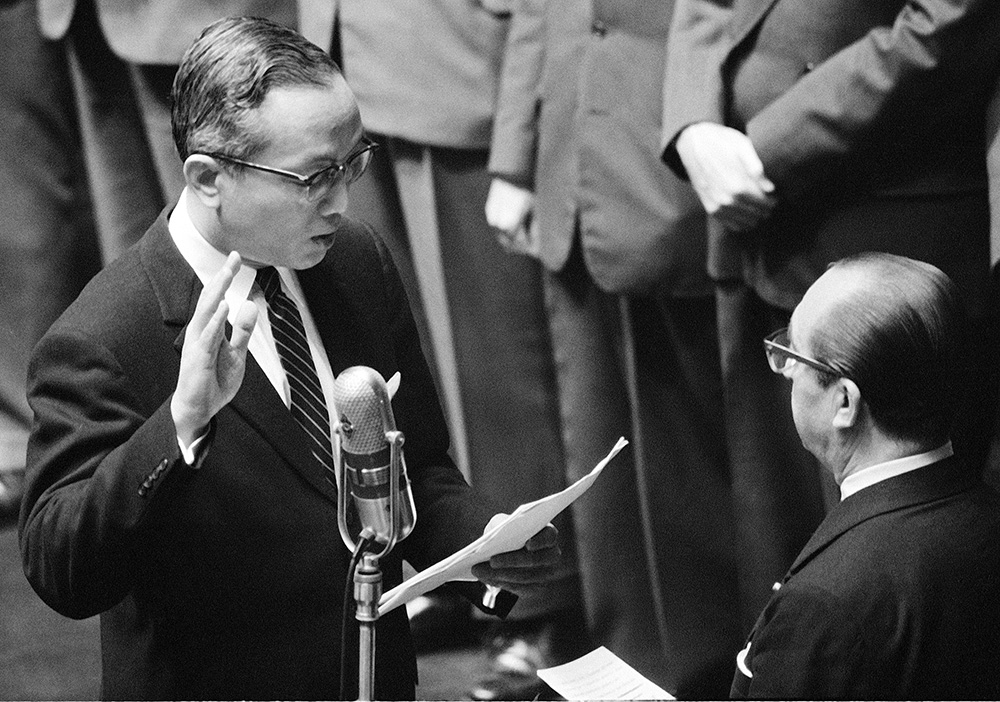
U Thant (left) takes the oath of office on Nov. 3, 1961, during a plenary meeting of the General Assembly, which unanimously appointed him acting secretary-general of the UN for a term lasting until April 10, 1963. / UN

U Thant started out as Burma's permanent representative at the UN before becoming acting secretary-general after incumbent Dag Hammarskjold died in a plane crash. U Thant, 52, subsequently held the job until 1971.

Colleagues at the UN said that Hammarskjold and U Thant came from two different worlds: one, a Swedish aristocrat, reserved and aloof; the other modest, down to earth and outspoken. Those who knew them well dubbed Hammarskjold the "eastern mystic," while U Thant was judged "direct, almost Western."

U Thant's press secretary, Rames Nassif, recalled in his book "U Thant in New York, 1961-1971," that his boss had a straight-talking but also humorous manner. For example, there was a rumor at UN Headquarters that the French disdained U Thant for being "too short" and not speaking French. U Thant heard the rumor and told his friends that he was taller than Napoleon, who did not speak English.

U Thant quickly proved to be a fine and self-composed diplomat who could easily mingle with the world's most powerful leaders — from Moscow's Soviet Premier Nikita Khrushchev, with whom he swam in the Black Sea, to Pope Paul VI.

Former UN under secretary-general Brian Urquhart once recalled: "In a series of critical situations, U Thant used his limited constitutional authority to the utmost to pre-empt or to curtail disaster."

President Suharto of the Republic of Indonesia paid an official visit to United Nations Headquarters on 28 May 1970. In the foreground are Aye Aye Myint U (U Thant’s Daughter) and Mrs. Suharto.

Indeed, several conflicts were waiting to test his skills and ability. U Thant was involved in the Cuban missile crisis, the Vietnam War, and conflict between India and Pakistan in 1965. Colleagues who traveled with him to crisis zones recalled that on many occasions U Thant made bold and single-minded attempts to restore peace.

But he was blamed for failing to solve the Middle East conflict in the 1960s, although well defended by Urquhart: "U Thant proved a useful scapegoat for the Middle East War of 1967, but it is less often recalled that he was the only world statesman who went to Cairo before that war to reason with President Nasser."

U Thant was also instrumental in securing China, emerging from world isolation, a seat in the UN. And he was media savvy and friendly to the press.

Nassif recalls: "For U Thant, the press conference was a pleasant experience. He had natural warmth towards journalists and was comfortable with them. He enjoyed thinking of himself as a former journalist, and often mentioned this. He was keenly aware that an enlightened information program was essential for the success of the United Nations."

Kofi Annan agrees.

The post Can Another Asian Fill U Thant's Shoes? appeared first on The Irrawaddy.

Mrauk-U UNESCO Coordination Meeting Postponed After Recent Protest

Posted: 21 Jan 2018 11:34 PM PST

YANGON — A work coordination meeting on the nomination of Mrauk-U to the UNESCO World Heritage List scheduled to be held from Jan. 26–27 was postponed following last week's protest in the old Arakanese capital.

On Tuesday, hundreds of Mrauk-U residents took to the streets to protest the government's ban on celebrating the 233rd anniversary of the fall of the Rakhine Dynasty. The government said it had banned the annual event because the venue was a former palace that had been listed as a national heritage site.

Seven residents were killed and 12 others were injured during the police crackdown on protestors.

"We sent invitations to the meeting. But, it is now difficult to come to the town because of security concerns. The meeting will likely be held in Yangon instead, but that has not yet been officially confirmed," said Daw Khin Than, chairwoman of the Mrauk-U cultural heritage conservation group.

The Union culture minister, the Chinese and Italian ambassadors to Myanmar, Arakanese historians, and members of UNESCO were set to attend the meeting to discuss the progress of preparations and future plans for nomination.

The draft nomination to include Mrauk-U as a World Heritage Site is set to be submitted in September with the final submission to be delivered by January 2019, according to Daw Khin Than.

The archaeology department under the culture ministry has formed 14 sub-committees to help prepare the nomination.

"I personally feel that the image of Mrauk-U is severely damaged [by the incident]. We have been trying to enhance its image to get UNESCO's recognition. While we are trying every means to make the world know Mrauk-U and there is certain progress toward this end, this incident has exerted serious impact," she said.

She believes that the inscription of Mrauk-U on the UNESCO World Heritage List will help solve the sectarian divide in Rakhine State to a certain extent.

UNESCO officials started their survey of the old Arakanese capital in February last year.

Mrauk-U is located on the Kaladan River in northern Rakhine State, some 60 kilometers inland from the state capital Sittwe.

From the 15th century to the late 1800s, Mrauk-U was the seat of Arakanese kings, who at the height of their power controlled an area covering large parts of eastern Bengal, modern-day Rakhine State and the western part of Lower Myanmar.

Much of the city's remains are well preserved and some 380 historic temples are scattered between the lush hills of northern Rakhine. Internal violence between Arakanese Buddhists and Rohingya Muslims that erupted in mid-2012 has driven down tourist numbers to the area.

Translated from Burmese by Thet Ko Ko.

The post Mrauk-U UNESCO Coordination Meeting Postponed After Recent Protest appeared first on The Irrawaddy.

A Peacemaker’s Life in Pictures

Posted: 21 Jan 2018 09:37 PM PST

U Thant, the former secretary-general of the United Nations, would have turned 109 today. During his 10-year-and-one-month tenure at the UN, U Thant criticized both West and East for actions and attitudes that he considered threatening to world peace. He helped defuse the Cuban missile crisis, which had brought the United States and the Soviet Union to the brink of nuclear war. He also helped end a civil war in Congo, among other achievements. The former secretary-general died of cancer in 1974 at the age of 65. The Irrawaddy commemorates U Thant's 109th birthday with some rare pictures of his time at the UN, with his family and with international dignitaries.

The post A Peacemaker's Life in Pictures appeared first on The Irrawaddy.

While Political Prisoners Released, Myanmar’s Judicial Reforms Stall

Posted: 21 Jan 2018 08:29 PM PST

YANGON — Hundreds of political prisoners have been released from Myanmar's jails in amnesties in recent years, including dozens freed in January 2016, days before democracy champion Daw Aung San Suu Kyi's party took power for the first time.

Former President Barack Obama announced the lifting of US sanctions in October 2016, citing the release of political prisoners and improved human rights as well as the elections that brought Daw Suu Kyi to power. Suu Kyi herself had been under house arrest for 15 years before being released in 2010.

Prison reform, however, has been put on the back burner under the new government.

A new prison law was discussed in parliament in 2015, but was not passed. It has not been taken up since then by a new set of lawmakers – most of them from Daw Aung San Suu Kyi's National League for Democracy (NLD) – who took their seats in early 2016.

The Assistance Association for Political Prisoners (AAPP), a Myanmar group formed by former detainees, says prison reform should include repealing a law that gives police broad powers of arrest and pre-trial detention.

The AAPP advocates overhauling vague or outdated rules in the Jail Manual and Penal Code, much of it written during British colonial rule.

But the AAPP and rights groups caution that any new legislation on prison reform would not stop politically motivated prosecutions, which would need to be addressed with specific judicial and legal reforms.

Daw Aung San Suu Kyi's government pardoned, released or dropped charges against hundreds of political prisoners in the month after it took office. But today, 46 people are serving prison sentences for political activities, and another 52 political prisoners are in jail awaiting trial, the AAPP says.

Other Priorities

NLD Party spokesman Aung Shin told Reuters prison reform was not yet on the legislative agenda because of other priorities.

"There are so many things to do as MPs, it may be a part of the reasons for not including prison reform in the parliament discussions," Aung Shin said.

He also said, however, prisons should be part of a broader examination of legal and judicial reform that the party and legislature was planning. He did not give a time frame for any contemplated legislation.

AAPP says that 120 former political prisoners from the NLD party are members of the national parliament or regional assemblies.

"There are so many former political prisoners in the NLD party, and even in the current Parliament," said Aung Myo Kyaw, head of AAPP's Yangon office. "It's sad they aren't considering this issue."

The military did not respond to requests for comment.

The home affairs ministry says it has improved prison conditions across the country. A ministry report in March said the Correctional Department had relaxed rules on family visits and improved education programs.

Rule of Law

Many of the political prisoners, including some today, were jailed in Insein, a 19th-century prison in the north of Yangon that had a notorious reputation for torture, hunger strikes and rioting over inhumane conditions until Myanmar began transitioning to civilian rule in 2011.

For decades, Insein prison, which has held politicians and poets alongside murderers, thieves and drug dealers, was emblematic of oppressive junta rule and Myanmar's poor record when it came to the rule of law.

Some prisoners were kept isolated or were physically and mentally abused while in jail, former inmates say. Amnesty International said misbehaving prisoners, including political prisoners on hunger strike, were still kept shackled in filth in kennels meant for dogs as recently as 2011.

Daw Aung San Suu Kyi herself was briefly held in a hut in the prison compound between spells of house arrest. Leaders of the NLD spent time there before Myanmar’s military rulers started a transition to democracy in 2011 that brought both the release of hundreds of political prisoners and an improvement to prison conditions.

Insein is where Reuters journalists Wa Lone, 31, and Kyaw Soe Oo, 27 have been detained as they face an investigation into whether they breached Myanmar's Official Secrets Act after the two were detained on Dec. 12.

Built during British colonial rule in the 19th century, Insein covers about 200,000 square meters – larger than New York's Grand Central station.

By some accounts, conditions there have gotten a lot better.

Kyaw Zwa Naing, detained in Insein for two weeks in June after writing a satirical article mocking the military, said "the prison officers treated us well."

"We could access food supply without limitation. No one threatened us," he said.

Overcrowded

After an inspection in March, the government-backed Myanmar National Human Rights Commission identified overcrowding as a problem and recommended building new dormitories.

"The unlucky ones have to sleep right next to the toilet. In Myanmar, we can't provide international standard cells for inmates," Commissioner Yu Lwin Aung told Reuters.

Political prisoners and those accused of other non-violent offences are housed with inmates both accused and convicted of violent crimes, according to the AAPP, which regularly interviews recent inmates.

Family members say the Reuters reporters each have their own cell and sleep on mats on raised platforms. However, they say the two are fearful because they are being held in the same block as both suspected and convicted criminals.

Min Tun Soe, a deputy director and spokesperson for the Prison Department said overcrowding was no longer a concern – the prison now houses 12,000 inmates after increasing its capacity to 10,000.

"There's lots of reform going on in the prisons, such as new budgets for food supplies, healthcare and education opportunities for inmates, and also reforming the moral behavior of inmates," he said.

"The situation is different than it was before," he said.

The post While Political Prisoners Released, Myanmar's Judicial Reforms Stall appeared first on The Irrawaddy.

Scandal-hit Thai Temple Helps to Stage Mass Buddhist Event in Myanmar

Posted: 21 Jan 2018 08:19 PM PST

MANDALAY — Thousands of Buddhist monks gathered in Myanmar's second largest city on Sunday for an event partly organized by a scandal-hit Thai temple whose abbot is wanted for questioning on money-laundering allegations.

The Dhammakaya temple's foundation helped organize the mass alms-giving for an estimated 20,000 monks on the runway of an abandoned airport in central Mandalay.

Thailand's largest and wealthiest temple, Dhammakaya has staged similar spectacles at its vast complex north of Bangkok, which police besieged last year in a fruitless search for its fugitive abbot.

The Mandalay event aimed to "tighten the relationship between both Myanmar and Thailand [and] unite the Theravada monkhood" in the region, according to a Dhammakaya Foundation press release.

Myanmar, Thailand and Sri Lanka are predominantly Buddhist countries that follow the religion's Theravada branch.

In Mandalay, a center for Buddhist learning crowded with temples and monasteries, monks in burgundy or orange began filing barefoot into the old airport before dawn.

Almost all the monks at the ceremony were from Myanmar and there were also thousands of local lay people attending along with about 100 monks and other Buddhists from Thailand and Sri Lanka, according to Dhammakaya temple.

Mandalay is home to the monk Wirathu, the self-styled "Buddhist bin Laden" famous for his anti-Islamic sermons, but there was no sign that he attended the mass alms-giving.

"It's such a wonderful ceremony. I live in Mandalay, and it's never happened like this before," said Ven Ya Ma, 40, who led a group of about 30 monks from the city's Ma Soe Yein monastery.

Ven Ya Ma opposed the actions of the Thai police against the Dhammakaya temple, which he said was only promoting Buddhism worldwide.

"People are worried that Buddhism is in danger," he said.

In March, Thai police abandoned a three-week siege of the Dhammakaya temple's complex, which is nearly 10 times the area of the Vatican City and centers around a giant, UFO-shaped golden stupa.

Police wanted to question the abbot, Phra Dhammachayo, about alleged money-laundering and building violations, but gave up after protests by monks and meditating devotees. His whereabouts are unknown.

Dhammakaya claims millions of followers in Thailand and around the world, and in recent years has forged closer ties with Myanmar's Buddhists.

Wirathu is a leading light in Ma Ba Tha, a religious group accused of whipping up anti-Muslim sentiment in Myanmar.

A brutal military crackdown in Rakhine State, in western Myanmar, has driven about 650,000 Rohingya Muslims over the border into Bangladesh since August.

The post Scandal-hit Thai Temple Helps to Stage Mass Buddhist Event in Myanmar appeared first on The Irrawaddy.

Rohingya Repatriation Futile Without a Strong Security Shield

Posted: 21 Jan 2018 06:34 PM PST

Even as the focus seems to have momentarily shifted to the repatriation of the Rohingya refugees, all is certainly not well in the Rohingya camps in the Cox's Bazar district of Bangladesh. While relief agencies and "camp-in-charge," the camps' administrators, report a growing number of disappearances of Rohingya elders and youths, another disturbing trend that has come to the fore is that of Rohingya youths being picked up without prior notice — allegedly by the Detective Branch of Bangladesh — for interrogation on suspicion of having links to the Arakan Rohingya Salvation Army (ARSA).

The disappearance of two siblings — Nur Kamal, 26, and Nur Kodor, 15 — from their camp in Uthiya Upazila on Dec. 14 is a case in point. According to sources, the two were returned to their camp a few days ago. No one is yet sure what could have led to their disappearance or detention for more than a month by the Detective Branch or by any other group. Just about everyone is tight-lipped about the incident, leaving it shrouded in mystery.

Missing persons cases like this one and more than a dozen others over the past five months have had the grapevine working overtime. Of the many theories making the rounds in Cox's Bazar, the two about possible links to ARSA and a growing human trafficking network have set alarm bells ringing among authorities.

The identity card of a Rohingya man who went missing at a refugee camp in Bangladesh in December. / Supplied

Could it be that the district administration of Cox’s Bazar is in possession of some solid evidence that has prompted the Detective Branch to conduct surprise raids and pick up Rohingya youths from their camps? Thus far no one is speaking up. The district authorities have refused to share information.

If there is any truth to ARSA connections either to the arbitrary arrests or to the missing persons cases, then surely it would have to do with the agreement Bangladesh and Myanmar reached recently to share intelligence on any activity related to the Jihadi militant outfit. Last year the Myanmar government is said to have provided Bangladesh with a list of 1,300 people with ARSA links. Sources working for relief agencies said camp-in-charge, magistrates and police in the Balukhali area of Uthiya Upazila have specific information on the storage of camouflage uniforms and small arms in certain huts that has led the Detective Branch to carry out surprise raids. However, this information could not be independently verified because of a lack of access to the intelligence agencies.

And so it remains extremely difficult to settle on a reason for such incidents. But what is worrying is that there has been a steady rise in the number of disappearances.

The case of Nur Alam and Nur Kodor could remain a mystery until authorities come clean. The only thing that is known is that soon after the two disappeared their parents lodged a complaint with the police and with Balukhali 1 Block B (32) camp-in-charge Mohammad Talut. They also asked for the help of international relief agencies that may have put pressure on police to track down the two young men and ensure their safe return.

Meanwhile, the other growing threats that cannot be ignored are an expanding human trafficking network and the lure of working as drug mules.  The ugly face of human trafficking is rearing its head in Cox’s Bazar, making the environment even more hazardous and unsafe for the vulnerable Rohingya refugees.

The identity card of a Rohingya man who went missing at a refugee camp in Bangladesh in December. / Supplied

This is perhaps just the beginning of what's to come. Such stories could become a fixture of the camps in Rakhine State as well when the Rohingya return from Bangladesh. A source working on the relief and rehabilitation of the Rohingya aptly summed it up like so: "The traffickers don't care where the Rohingya are as long as they can take them and sell them and get their money and they are present on both sides of the border."

Cases like that of Nur Kamal and Nur Kodor have thrown up many unanswered questions and most of them point to a growing trafficking network of drug smugglers working in collusion with Muslim fundamentalist groups such as ARSA. What is even more worrying is that Rohingya youths willing to learn and engage with international organizations on relief work and community service are being targeted by radical groups in the name of freedom and a better life.

Such incidents have been reported before. The media in Bangladesh and India have been reporting regularly on the growing menace of the trafficking of Rohingya in both Bangladesh and Myanmar. News stories about the human trafficking networks growing in tandem with the smuggling of drugs — mostly yaba, or methamphetamines — from Myanmar to Bangladesh and of drug cartels operating in these areas are not new.

Teknaf and Uthiya share a land border with Myanmar that is a known yaba smuggling corridor. A relief agency worker speaking on condition of anonymity said "it would not be surprising if most people who have disappeared have been taken through these routes as the security presence seems to be more concentrated on the riverine bordering areas and roads going out towards the rest of Bangladesh."

Groups documenting and fighting the drug- and human-trafficking trades say the problem has thrown open a Pandora's Box, corroborating reports of a nexus between the two and of Rohingya youths falling prey to the menace. It is not difficult to see the web. Those who have spent the past four months in the Rohingya camps either as relief workers or aid monitors say they fear the worst. "Vulnerable Rohingya youths and men are being used as shields for traffickers who have crossed over from Myanmar posing as refugees and have gotten mixed up with the community and live among them with absolute impunity," one of them said.

The Bangladesh media are also awash with reports on a drug cartel thriving off its connections to politicians and other high-ups in Chittagong. The role of Teknaf Upzila Chairman Jafor Alam and ruling Awami League lawmaker Abdul Rahman Bodi in the yaba trade has frequently surfaced in media reports. On Dec. 6 The Dhaka Tribune of Bangladesh reported that Jafor Alam's house was raided by a narcotics joint task force on Oct. 18 and that 31 Rohingya who had allegedly smuggled yaba across the border were detained.

More than 200 people have been arrested by security agencies in Bangladesh, most of them Rohingya men. If what the Bangladesh media have reported is to be believed, more than 500,000 yaba tablets have been seized since Aug. 25.

Law enforcement agencies have also revealed recently that more than 500 yaba smugglers have entered Bangladesh from Myanmar since Aug. 25 by posing as Rohingya refugees. The agencies also suspect that an additional 1,000 yaba mules have slipped into the country in the past three months by other means.

According to a recent report published by the Association for the Prevention of Drug Abuse, about 90 percent of yaba tablets enter Bangladesh via the Naf River. According to Arup Chowdhury, the association's founding president, "yaba is being smuggled through 43 points of the Bangladesh-Myanmar border."

So even as law enforcement agencies continue trying to solve the mystery of the missing persons and determine their fates, the governments of Bangladesh and Myanmar must ponder this growing menace as it could easily become a thorn in the side of both countries and impact the repatriation process in more ways than one.

The author is a former senior journalist who has worked for national and international news media in India and elsewhere. Currently he is a contributing editor for The Irrawaddy.

The post Rohingya Repatriation Futile Without a Strong Security Shield appeared first on The Irrawaddy.

Saturday, January 20, 2018

The Irrawaddy Magazine

The Irrawaddy Magazine


Court Accepts News Article as Evidence at U Ko Ni Murder Trial

Posted: 19 Jan 2018 09:12 PM PST

YANGON — Yangon's Northern District Court on Friday accepted as evidence a state-owned newspaper's coverage of the Home Affairs Ministry's press conference last year on its investigation into the assassination of U Ko Ni.

The prominent Muslim lawyer and legal adviser to the National League for Democracy was gunned down outside Yangon International Airport on Jan. 29 last year. Police have detained four suspects: gunman Kyi Lin and alleged co-conspirators Zeya Phyo, Aung Win Zaw and Aung Win Tun. Their trial began ten months ago.

Police allege that suspect and former military Lieutenant Colonel Aung Win Khaing, who remains at large, was the mastermind of the assassination.

During Friday's five-hour court hearing, the prosecution presented documents and photos relating to the crime scene and suspects as evidences, including statements from the President's Office, articles from state-owned papers, and prison record indicating that Kyi Lin and Aung Win Zaw had served prior prison sentences for smuggling Buddha statues.

A defense lawyer for Zeya Phyo objected to the inclusion of an article published by state-owned daily Myanmar Alinn on Feb. 26 about a press conference the day before at which the Home Affairs Ministry presented findings of its investigation into the murder, including the alleged perpetrators and their motives.

However, the trial's three judges accepted the article as evidence after nearly an hour of private discussion. They said the article contained detailed information of the police force's investigation and that the information was shared at a press conference by national level authorities overseeing the probe.

Speaking to the media after the hearing, the lawyer for U Ko Ni's family, U Nay La, said all the information shared at the ministry's press conference was in line with witness statements in court.

"The court's acceptance means it affirms that the information revealed at the press conference is true," he told The Irrawaddy. "The press conference information can be considered a public document because it concerns the public."

However, defendant Aung Win Zaw's lawyer, U Aung Khaing, argued that accepting the article did not necessarily mean accepting the information it contains as true.

"The words spoken at the press conference were not official because they were not spoken under oath like witness statements in court," he said, adding that information in a newspaper could not be assumed to be true regardless of who is quoted, whether the president or a minister or chief minister.

At the Feb. 25 press conference in Yangon, then-police chief Major General Zaw Win said U Ko Ni's assassination was motivated by a "personal grudge" and named Zeya Phyo as an alleged conspirator for the first time. According to a police statement, Zeya Phyo was a captain in the military's information department, widely known as its intelligence unit, and quit the post in 2004.

The police chief told the media that the conspirators began planning the assassination in April 2016 because Aung Win Khaing and Zeya Phyo, business partners, were "resentful" of U Ko Ni's political activities.

He said Aung Win Khaing told Zeya Phyo that he wanted to "eliminate" U Ko Ni and asked for his financial assistance to carry out the murder with the help of a former inmate of his elder brother Aung Win Zaw. Zeya Phyo, he added, handed over 100 million kyats (about $74,000) to Aung Win Khaing in August 2016.

At the same press conference, Home Affairs Minister Lieutenant General Kyaw Swe said it was highly probable that extreme nationalist sentiment also contributed to the suspects' grudge, based on the investigation and the suspects' confessions.

Three of the suspects in custody are charged with murder under Article 302 of the Penal Code. Aung Win Tun is charged with harboring a criminal under Article 212.

Zeya Phyo is also charged under Article 67 of the Telecommunications Law with possession of restricted telecommunications equipment and under Article 468 of the Penal Code for forgery of national identity cards.

In addition, two of the suspects, Kyi Lin and Aung Win Zaw, are charged under Article 19 (d) and (f) of the Arms Act for possession and transportation of illegal arms. Kyi Lin is also serving a one-year prison sentence at Insein Prison for illegally crossing the Thai-Myanmar border a few weeks before the murder took place.

Also at Friday's court hearing, U Tin Maung Swe, a senior officer with the police force's Crime Investigation Department, provided his account of the investigation. He was the 76th of 80 scheduled witnesses.

The court also decided to hold consecutive hearings on Jan. 25 and 26 to speed up the trial.

Tin Htet Paing is a freelance journalist and photographer based in Yangon. She previously worked at The Irrawaddy as a reporter for three years.

The post Court Accepts News Article as Evidence at U Ko Ni Murder Trial appeared first on The Irrawaddy.

This Week in Parliament (Jan. 15-19)

Posted: 19 Jan 2018 07:30 PM PST

The seventh regular session of Myanmar's Parliament convened this week, with the news headlines dominated by a cabinet reshuffle of the National League for Democracy-led government.

Monday (Jan.15)

Union Minister for Planning and Finance U Kyaw Win submitted a budget for the transitional period—a six-month period from April 1 to Sep. 30—ahead of the new fiscal year timeframe of October 1-September 30.

The Defense Ministry asked for a budget of more than 1.3 trillion kyats (US$1 billion) including about 2 billion kyats for its military operations—an amount higher than the combined total of the health and education budgets.


Tuesday (Jan. 16)

U Win Khaing, who was previously in charge of both the Construction Ministry and the Electricity and Energy Ministry, was assigned to lead the latter only.

President U Htin Kyaw proposed U Han Zaw as the construction minister, and appointed U Aung Hla Tun, a veteran journalist and vice-chairman of Myanmar Press Council, as the deputy information minister.


Wednesday (Jan. 17)

The Lower House agreed to debate a proposal from Yangon's Kayan Township lawmaker Dr. Aye Min to recognize outperforming civil servants with awards and entitlements such as foreign pleasure and study trips in order to boost the morale of civil servants.

Thursday (Jan. 18)

In the Lower House, U Min Thein of Taungdwingyi asked if the Construction Ministry would tar the road to Kwe Chaung Fort, a historic structure on the bank of the Irrawaddy River built by Prince Kanaung in 1863 in Magwe Township, so that it is easily accessible in all seasons for visitors. Deputy Construction Minister U Kyaw Linn replied that the road would be tarred only after the 2020-21 fiscal year.

Friday (Jan. 19)

The Union Parliament recorded the appointment of Myanaung Township lawmaker U Hla Moe Aung as the chief minister of Irrawaddy Region to succeed Mahn Johnny; and U Tha Oo as deputy transport and communications minister; and the appointment of U Han Zaw as the construction minister.

The post This Week in Parliament (Jan. 15-19) appeared first on The Irrawaddy.

Is Poor Leadership Hampering the NLD’s Policy Agenda?

Posted: 19 Jan 2018 07:22 PM PST

Kyaw Zwa Moe: Welcome to Dateline Irrawaddy! As 2018 begins, the National League for Democracy [NLD] government has started reshuffling cabinet ministers. We can conclude that the NLD intends to replace ministers with poor records with able ministers. So far, it has replaced at least three ministers and it plans to change more. We'll discuss whether the NLD government can appoint the right ministers to the right ministries and how it is likely to perform in the years to come. Political analyst Dr. Yan Myo Thein and Irrawaddy Burmese editor Ko Ye Ni join me for this discussion. I'm Irrawaddy English editor Kyaw Zwa Moe.

ဝန္ႀကီးမ်ားအေျပာင္းအလဲ ဘာထူးမလဲ

Dateline Irrawaddy : ဝန္ႀကီးမ်ားအေျပာင္းအလဲ ဘာထူးမလဲဝန္ႀကီးအေျပာင္းအလဲေတြက အစိုးရပိုင္းရဲ႕စြမ္းေဆာင္ႏိုင္စြမ္းကိုပိုမိုျမင့္မားလာႏိုင္မလားဆိုတာနဲ႔ပတ္သက္ၿပီး ဧရာဝတီ အဂၤလိပ္ပိုင္းအယ္ဒီတာ ေက်ာ္စြာမိုး၊ ႏိုင္ငံေရးေလ့လာသုံးသပ္သူ ေဒါက္တာရန္မ်ိဳးသိမ္းနဲ႔ ဧရာဝတီ ျမန္မာပိုင္းအယ္ဒီတာ ရဲနည္တို႔က ေဆြးေႏြးထားၾကတာပါ။

Posted by The Irrawaddy – Burmese Edition on Friday, January 19, 2018

The NLD government has reshuffled some regional ministers. The Irrawaddy Region chief minister was allowed to retire, while U Win Khaing, who was previously in charge of both the construction ministry and the electricity and energy ministry, will now lead only the latter. Vice-chairman U Aung Hla Tun of the Myanmar Press Council was appointed as the deputy information minister. And it is likely that there will be further changes. As I've said, the NLD seems to have had trouble putting the right people in the right posts over the past two years. Ministers may have the capacity, but seemingly have not been able to deliver on it. They have not performed well. Ko Yan Myo Thein, how do you assess these changes? Are they positive and what do you expect will happen next?

Yan Myo Thein: The NLD government's performance has come up short in certain areas over the past two years. So, we cannot give it a passing grade. In fact, the public didn't have high expectations [of the NLD government]. Some say that Rome wasn't built in a day. But the current government has had a lot of trouble fulfilling even the public's minimum expectations. Personally, I think this comes down to the capacity of individual ministers and, more importantly, the government's policies, and it is necessary to review them.

Another problem is that there is a high level of centralization, or red tape, within the government. If it reviews that and starts a deregulation drive promptly and systematically, it will be able to reduce the burden on the people in the next two or three years. But simply changing the personnel [ministers], without changing the policies and procedures, is less likely to result in tangible changes — that is, reduce the burden on impoverished people — in the next two or three years.

KZM: The public's hopes for the government weren't high, but over the past two years people and the business community have repeatedly complained that the economy continues to decline. We don't know yet about what changes will be made to the concerned ministries regarding this. What is your assessment, Ko Ye Ni? If the right people get put in the right places, would it still be still necessary to change the policies, as Ko Yan Myo Thein suggested?

YN: Firstly, the government has no clear policies for fulfilling its pledges. Its political policy is clear—its top priority is to achieve peace and end armed clashes. But it seems to have focused on that while neglecting economic reforms. Consequently, the business community and the public, the consumers, have put pressure on the government. To address the continuing economic decline, the government recently appointed U Set Aung as the deputy minister of national planning and finance. That was the first step in the cabinet reshuffle, and the most recent changes can be seen as the second step to accelerate the process.

There are certain restrictions in appointing ministers to the cabinet. When the government took office, it combined some ministries and reduced budgets. Ministers are overloaded with duties now, so the government has had to appoint deputy ministers to assist them. The problem now is that the new government has no choice but to choose from among those who worked in previous administrations to fill those positions. So, the unclear economic policy of the new government will be implemented by those who have worked in previous administrations, and I'm afraid things will be no different from what we've seen in the past two years.

KZM: Generally speaking, how old are government [ministers] internationally? The performance of a government depends on its youthfulness, I think. A government of old ministers may be highly experienced, but on the other hand it will be slow in making decisions either because of health or various other reasons. I have spotted such signs to a degree in the NLD government. How do you assess it?

YMT: As far as I recall, the average age of ministers was 66 when the NLD formed the cabinet in 2016. Later, it appointed younger ministers and the average age was still around 63, 64. The party doesn't seem to be giving important positions to younger members. Our country has experienced decades of authoritarian rule. Consequently, we've lost a generation of political activists. Therefore, we need to build up this generation under this democratic government. Similarly, members of the younger generations should be given positions and opportunities either in Parliament or in the government. For example, most of the ministers appointed are experienced persons, and are former government officials, as Ko Ye Ni has pointed out. However, they are old and the government is somewhat of an "old" government. On the other hand, can't the government appoint them as advisers to the ministries? If those who are in their 50s with strong political backgrounds were appointed as ministers, the government would be stronger, I think.

KZM: Are there any individuals with such qualifications?

YMT: Personally, I think there are. Some have studied abroad and come back to Myanmar in their 30s or 40s. But they need to get reacquainted with the history and politics of Myanmar. If they can do that and adapt well, they will become strong forces for change in our country, I think. The government, Parliament and the political parties need to rally them and groom them.

KZM: To be fair, it's not too late. The government has been in office for less than two years. It will be just two years old in March. If the government puts the right people in the right places and embarks on new changes, it can still do a lot in the next three years. It was said during U Ne Win's government that he chose "good and able men, rather than able and good men," for his government. This means he valued loyalty over ability. To him, loyalty was the first priority and ability the second. In fact, those who are both good and able should be appointed to the government. Ko Ye Ni, how do you assess the appointments made by the current government in the context of these criteria?

YN: The successors of U Ne Win's government, including the current government, haven't been able to escape that formulation of "good and able men." Because governments need people who are loyal to them.

KZM: Loyalty is important, isn't it?

YMT: But what is really important is they must be loyal to the people. They must serve the interests of the people. Loyalty to the government doesn't mean rubber-stamping whatever the government does. If the policies and procedures of the government put a burden on the people, they must stand by the people and point out and fix the government's mistakes as necessary.

YN: Intellectuals and the intelligentsia are necessary to rebuild the state. For example, Irrawaddy Region Chief Minister Mahn Johnny is loved by the people. He is honest and is not reluctant to roll up his sleeves and get his hands dirty and is willing to go through thick and thin with the people. But the question is whether honesty is enough to reform the agriculture and livestock breeding sectors as promised by the NLD in the [2015] election. Daw Aung San Suu Kyi always tells her ministers to have goodwill and empathy. But the question is whether goodwill and empathy alone can result in successful reforms. Maybe she wants to move to the next stage, and hopefully will replace those honest people with technocrats.

KZM: Loyalty to the people, impartiality and moral goodness should be the foundation. And based on that foundation, the capacity of technocrats is important. In fact, ministers are like corporate CEOs. They need to accomplish their duties in a timely manner. I think it is capacity, mainly, that is needed to effect change.

YMT: Another issue is the nature of technocrats. They don't really seek ministerial or deputy ministerial positions. They want recognition. If you ask me whether most previous governments gave scholars important positions and also recognized them, I think they did. They give important positions to scholars, but only those who listen to them, do as they're told and show total loyalty. What we expect from a popularly elected government is not scholars who consent to everything, but a government that brings together different perspectives and points of view. Only with a large gathering of such scholars will our economic reforms take off.

KZM: To summarize our discussion, ministers need to have the foundation that we've mentioned. Ministerial portfolios are political positions. They [ministers] hold positions of leadership and must make decisions. The vision of each minister will be important in that regard. Ko Yan Myo Thein, Ko Ye Ni, thanks for your contributions.

The post Is Poor Leadership Hampering the NLD's Policy Agenda? appeared first on The Irrawaddy.

Friday, January 19, 2018

The Irrawaddy Magazine

The Irrawaddy Magazine


Recalling Former UN Sect-Gen’s Legacy and Development

Posted: 19 Jan 2018 04:33 AM PST

If he were alive today, U Thant would be 109 years old.

Long before the country became known for military oppression and pro-democratic struggle, Myanmar (then known as Burma) made international headlines when, at the height of the Cold War, he took the highest position at the United Nations. As the third secretary-general of the United Nations from 1961 to 1971, the educator-turned-civil servant became the first non-European to hold the position.

During his 10-year-and-one-month tenure at the UN, U Thant criticized both West and East for actions and attitudes that he considered threatening to world peace. He helped defuse the Cuban missile crisis, which had brought the United States and the Soviet Union to the brink of nuclear war. He also helped end a civil war in Congo among other achievements.

U Thant died of cancer in 1974 at the age of 65. The Myanmar public viewed him and his contribution to world peace with pride, but this was not shared by the country's former dictator Ne Win, who ruled Myanmar from 1962 to 1988. Ne Win never took U Thant seriously; he was envious and suspicious of U Thant's local and global popularity. As a result, the former UN secretary-general was denied a state funeral, and his biography was excluded from school curriculums in Myanmar.

At the initiative of his grandson, Dr. Thant Myint-U, a writer, historian and the chairman of Yangon Heritage Trust (YHT), U Thant House, a museum dedicated to the life and work of the former UN leader, opened to the public in Yangon four years ago.

On the eve of his grandfather's 109th birthday on Jan. 22, Dr. Thant Myint-U talks to The Irrawaddy about U Thant's legacies, both globally and in Myanmar, his memories of his grandpa, what made U Thant a successful UN leader, and other topics.

What are your fondest memories of your grandfather when he was secretary-general of the UN?

I was 8 years old when he died.  And I remember him very well, as we lived together in the same house outside Manhattan — my parents, grandparents and my little sisters.  I remember swimming together in our pool at home, seeing him reading and writing in his study, watching cartoons on TV in his bedroom, a portrait of Mahatma Gandhi behind him.  I remember only once visiting him at his office at the UN, and that was in 1969 when the Apollo 11 astronauts, including Neil Armstrong, came to see him, though I was so young I didn’t really know who they were.

The Apollo 11 astronauts pose with then UN Secretary-General U Thant and his family on July 20, 1970. From left: Neil Armstrong, Michael Collins, Edwin Aldrin; U Thant; Thant Myint-U; the secretary-general's daughter Aye Aye Myint-U; and her husband Dr. Tyn Myint-U. (Photo: UN)

He was a provincial school teacher and later served as secretary to then Prime Minister U Nu. How did he get to become the unanimously elected leader of the UN? 

He arrived in New York as Burma's Permanent Representative to the UN in August 1957.  By the time Dag Hammarskjold, his predecessor, was killed in a plane crash four years later, he had already established himself as one of the more dynamic and capable diplomats in New York, chairing for example the Non-Aligned Movement's committee on Algerian independence. He was very active on all decolonization issues and Hammarskjold, who believed the next secretary-general should come from the "Third World", had identified him as one of two possible successors. "Third World" and "Developing World" were actually terms Hammarskjold and U Thant came up with together. Burma was then of course a neutral country in the Cold War and in November 1961 he emerged as the only person acceptable to both the Americans and the Soviet Union.

What do you think set your grandfather apart from other UN secretaries-general?

He was the first non-Westerner ever to hold a senior international position. He was the first person from a recently decolonized country to lead world debates on peace and development. In many ways he continued the seminal work of Dag Hammarskjold. And he depended very much on the Nobel Laureate Ralph Bunche, the African-American civil rights leader who had been Hammarskjold's key deputy, as well. But a difference was that he brought to the top job the perspective of the very young governments of Asia and Africa; many like Burma, [were] then desperately trying to hold their countries together. He placed great importance on development cooperation, setting up the UNDP and many other funds and programs. He placed great importance on human rights, saying that nothing was more important than "individual human dignity."

Defusing the Cuban Missile Crisis and ending the civil war in Congo are U Thant's milestone achievements as secretary-general. In your opinion, what qualities allowed him to handle those successfully?

His personal courage and integrity were very important. He did what he thought was right and took responsibility for his actions, never blaming others. People knew they could trust him and trust that he was acting on behalf of the principles of the United Nations and nothing else. And he knew to take the advice of those more experienced and knowledgeable than himself on many issues. He was a good listener and he delegated authority to his many capable aides, like Ralph Bunche. I think he was also a person who was at peace with himself, with a clear mind, who could go home at the end of the day, swim, watch TV and have dinner with his family.

How much do you know about the relationship between U Thant and the late General Ne Win? Why did their relationship turn sour?

They of course knew each other well in the 1950s but they were not particularly close in any way. General Ne Win had a good trip to the UN in 1965 on the sidelines of his visit to President Johnson in Washington. I think the relationship soured in the late 1960s after U Nu set up his government in exile with the aim of overthrowing the Revolutionary Council, and General Ne Win suspected U Thant was colluding with U Nu. U Thant and U Nu had of course been close friends since university days.

As secretary-general, he was of course restricted from being involved in any way in Burmese politics, but he did meet U Nu when U Nu came through New York in 1968 and spoke to journalists at the UN Correspondents Club, calling for revolution. I'm sure General Ne Win was not happy.

U Thant (center in white jacket) is seen at the Ministry of Information (now the YHT office) in Yangon in the early 1950s.(Photo: Thant Myint-U)

What are his legacies for the world and Myanmar today?

His role during the Cuban missile crisis was indispensable, and helped bring the world back from the brink of nuclear war.  There were many other successful mediation efforts, some so successful, for example in Yemen in 1962 and Bahrain in 1968, that barely anybody remembers them today. He made development a key focus of international cooperation. And he brought environmental issues front and center, speaking out against what he saw even then as the destruction of the planet.

In Burma he represented a liberal tradition that has since almost disappeared. And as Burma's ambassador to the UN he showed that this was a country that could make a real contribution on the international stage.

If he were alive today, what would be his contribution to rebuilding our country?  

Well, he would be extremely old, so I hope he would just be retired and enjoying life. If things were different and he was still alive but somewhat younger, I think he would first and foremost be a voice for "individual human dignity," apart from issues of ethnic and group identity and politics.  He would also be a strong advocate of education.  I'm sure he would see any progress towards democratic government depending largely, if not entirely, on progress in education. He would doubtless be heartbroken to see the violence that has taken place and continues to take place in Burma and to see so many in the country still so poor at a time when Asia was becoming so prosperous. And he would have spoken out very clearly on the importance of a free and spirited media.

Given the situation Myanmar faces today at the international level, how would he respond if he were at the UN now?

I’m not sure. On the one hand he increasingly saw himself as a global citizen and wanted people to rise above nationalism and understand the importance of global cooperation, of finding global solutions to problems. On the other hand,

as someone who had lived through colonialism and had worked in a post-independence government, I don't think he would have been an interventionist, or at least he would have seen the limits of outside intervention. He would likely have placed a high value on quiet diplomacy, a quiet search for how the UN could be useful.

The post Recalling Former UN Sect-Gen's Legacy and Development appeared first on The Irrawaddy.

Three Years On, Still No Progress in Rape and Murder of 2 Kachin Teachers

Posted: 19 Jan 2018 03:34 AM PST

Three years since the rape and murder of two Kachin schoolteachers from Kaung Kha village in Kutkai Township, northern Shan State, justice still waits to be served, due to an inability to identify and bring charges against the suspects.

On Jan. 19, 2015, two volunteer teachers, Maran Lu Ra and Tangbau Hkawn Nan Tsin, who were both 20 years old and worked with the Kachin Baptist Convention (KBC), were raped and killed in their hut. At the time of the incident, soldiers from the Myanmar Army's Infantry Battalion (IB) 503 were present in the small village and 28 soldiers were suspected of involvement in the double murder.

On Friday, a third memorial service for the two victims was held at the Nawng Nang prayer hill in Myitkyina, where the two victims are buried.

A Truth Finding Committee set up after the killings continues to pursue the case, although there has been no progress on the legal front, said KBC secretary the Rev. Dr. Hkalam Sam Sun.

"It was shocking to see how the victims were brutally murdered and raped," recalled Dr. Sam Sun, noting that he counted 41 stab wounds in Maran Lu Ra’s body and 37 in Tangbau Hkawn Nan Tsin's body when he saw their corpses on Jan. 20, 2015. "We could sense that the two teachers struggled to defend themselves."

He told the mourners gathered to pay their condolences on Friday that “we want to know who committed this brutal act, and we want to know the truth. If we know, we can forgive them. The Tatmadaw [Myanmar Army] leaders have told us that whenever we talk about this case, it damages the Tatmadaw’s dignity. We understand their concerns and we have explained to them that we do not implicate all Tatmadaw soldiers, just those few inhuman actors.”

“Why are they so afraid to reveal the truth even though the leaders know it — it is not a very difficult case to solve,” he told The Irrawaddy.

"The Military Northern Commander told us they had tested all the solders and the DNA did not match,” said Dr. Sam Sun, recalling a meeting with Lt Gen Tun Tun Naing, who is now head of the Bureau of Special Operations No.1 under the Ministry of Defense.

The case has still not yet been brought to the judiciary even though complaints were filed with the Muse Township police. "There have been no developments regarding the case," said Brang Dee, a lawyer from the Kachin Lawyers Network who is providing legal advice to the KBC.

The Muse District police head the investigation team but have rejected the KBC’s request to talk to soldiers about the case.

Questioning of the villagers was conducted long ago, the lawyer said, but the KBC's representatives were not allowed to meet and interrogate the soldiers of IB 503 who were in the village.

During Myanmar's more than 60 years of civil war, sexual violence and rape against women allegedly by Tatmadaw soldiers in the conflict zones has rarely been brought to justice.

However, a number of horrific rapes and killings have received increased public attention in the past seven years.

One case involved Sumlut Roi Ja, who was abducted by members of the Tatmadaw's IB 321 in Loi Jel town in northern Kachin State on Oct. 28, 2011. Her whereabouts remain a mystery more than six years later and she is presumed to have been raped and murdered. Her family filed a case with the courts but the Supreme Court rejected it in March 2012, citing a lack of evidence. "That case [Sumlut Roi Ja] is still pending as only our application of writ was rejected. We will talk to the family for their decision," said U Mar Khar, the lawyer helping Sumlut Roi Ja's husband in the case.

Since the war broke out in 2011 in Kachin and northern Shan State between the Myanmar Army and ethnic armed organizations such as the Kachin Independence Army, Ta'ang Nationalities Liberation Army and the Arakan Army, "the violence against women, including Maran Lu Ra, Tangbau Hkawn Nan Tsin, Sumlut Roi Ja, Ja Seng Ing, persists and women still lack protection," said Khon Ja, the coordinator of the Kachin Peace Network. Ja Seng Ing was a 14-year-old girl who was shot and killed on Sept. 13, 2012 by a column of Tatmadaw soldiers in Sut Ngai Yang village in Kachin State.

The use of sexual violence against women has a long history as a war tactic, as documented by international research agencies, she added. The pattern of sexual violence has never changed and the perpetrators are still at large, as detailed in the Women's League of Burma's report Same Impunity, Same Pattern, which was released in January 2014.

Khon Ja told The Irrawaddy that justice could be obtained if guarantees were provided for the safety of witnesses, the investigation was transparent and the case was forwarded to the correct legal institution.

"Even though the perpetrators have not yet been brought to justice, if there was a safe and protective environment for the women, and young girls did not have to suffer like them, I hope that Maran Lu Ra and Tangbau Hkawn Nan Tsin would be happy," Khon Ja said.

Sharing the views of many gender activists, Khon Ja said, "Women are also entitled to our citizen's rights to protection and safety … We have the right to choose whether we keep the same pattern [of abuses] or create a safe environment for women, elders and children or take legal action against those perpetrators."

She said a long-term protection and prevention plan for women should be implemented based on the policies set in accordance with the United Nations' Security Council Resolution on women, peace and the security sector, and by allowing media access to conflict zones.

In order for the women and the victims to recover from traumatic experiences, both long- and short-term support is crucial, as well as providing capacity-building for the related ministries and allocating funds to the relevant institutions.

Most of all, allowing meaningful participation by women in every stage of the peace-building process would result in better implementation, Khon JA said.

The post Three Years On, Still No Progress in Rape and Murder of 2 Kachin Teachers appeared first on The Irrawaddy.

Speculation Mounts over President U Htin Kyaw’s Health

Posted: 19 Jan 2018 03:24 AM PST

Speculation over President U Htin Kyaw's health is growing among politicians, army officers and diplomats. U Htin Kyaw has been receiving medical treatment in Bangkok since late last year, and plans to visit Singapore for further treatment soon.

Top army officers and diplomats have noted U Htin Kyaw's frail appearance, and the president has been advised not to attend state functions. The 71-year-old recently traveled to Japan at the invitation of Prime Minister Shinzo Abe to attend the Universal Health Coverage Forum in Tokyo. However, he also received treatment there, according to unconfirmed reports.

The president was seen eating rice soup at a state dinner. Believing this to be inappropriate, and likely to fuel concern, senior NLD leaders advised U Htin Kyaw to avoid regular state functions.

One of his most recent appearances came in the second week of this month when U Htin Kyaw, accompanied by First Lady Daw Su Su Lwin and high-ranking officials, flew to Putao, Kachin State, where he attended a bridge-opening ceremony.

In December, State Counselor Daw Aung San Suu Kyi was forced to deny speculation that U Htin Kyaw's health had deteriorated following an operation in September. Other NLD leaders said the president had undergone stomach surgery, but did not have cancer.

"There is no need to worry. We have the first lady who will take care [of the president]. So why do we need to worry when there is someone to take care of him?" Daw Aung San Suu Kyi said. This has not stopped speculation over who would replace U Htin Kyaw should he step down, however.

Pope Francis and Myanmar’s President Htin Kyaw attend a welcoming ceremony at the presidential palace grounds in Naypyitaw, Myanmar November 28, 2017. / Reuters

The son of a respected national poet, U Htin Kyaw is loyal to Daw Aung San Suu Kyi and previously served as an adviser to her and the party.

The president, himself a respected writer, holds an economics degree and studied computer science at the University of London.

He was a schoolmate of Daw Aung San Suu Kyi at Methodist English High School in Yangon. In the 1970s, he worked at the ministries of Industry and Foreign Affairs, and married Daw Su Su Lwin, a politician and NLD lawmaker since 2012.

Ineligible to be president, Daw Aung San Suu Kyi nominated U Htin Kyaw to fill the position. According to the 2008 Constitution, the president has executive power but U Htin Kyaw's role has been seen as ceremonial, with the State Counsellor wielding the real power.

He is seen as a gentleman with a soft-spoken style and few enemies; the generals don't have any issues with U Htin Kyaw and seem to respect him. A top general once said the military has no problems with the president, as he had never antagonized the Army. However, they are now closely watching what's going on in the presidential palace and with U Htin Kyaw's health.

The president has made few public appearances since taking office early last year. He appeared thin and pale when he received Pope Francis in Naypyitaw in December.

According to the Constitution, if the president passes away while in office or retires, the first vice president becomes acting president and an election must be held to elect a new vice president. The president is then elected from among the three vice presidents. Former Army General Myint Swe is the current first vice president.

It remains an open question whom Daw Aung San Suu Kyi would choose to replace U Htin Kyaw should he retire.

One of the strongest candidates is Dr. Myo Aung, a member of the central executive committee of the ruling National League for Democracy. The former physician and political prisoner was tipped for a vice presidential role two years ago. He now holds the powerful position of chairman of the Naypyitaw Council. He is considered loyal to the State Counselor and is trusted by her.

The second-most-likely candidate is Dr. Zaw Myint Maung, chief minister for Mandalay Region. His status as a potential president was the topic of speculation when he accompanied Daw Aung San Suu Kyi on a trip to China recently, but he now seems to be very much a second-choice candidate, well-informed sources said.

A more controversial candidate is Thura Shwe Mann, a former general and House speaker who was the third-most-powerful man in the former ruling State Peace and Development Council.

A one-time senior figure in the formerly ruling Union Solidarity Development Party, Shwe Mann has expressed presidential ambitions in the past. He was kicked out of the party after a long-running dispute with former President Thein Sein that began in 2012.

He was appointed in February 2015 as head of the Commission for the Assessment of Legal Affairs and Special Issues. He is seen as close to Daw Aung San Suu Kyi and is in weekly contact with her in Naypyitaw. However, Thura Shwe Mann's relationship with top army leaders is in a tailspin.

To improve relations with the armed forces the State Counselor will likely choose someone who can maintain cordial relations with top brass. More importantly, she will need someone she can trust and from whom she can expect absolute loyalty. U Htin Kyaw was a safe choice. But with his health now an issue she is no doubt developing contingency plans. Should the president retire, whoever takes the keys to the castle from U Htin Kyaw will need to have Daw Aung San Suu Kyi's full confidence.

The post Speculation Mounts over President U Htin Kyaw's Health appeared first on The Irrawaddy.

Yangon Traffic Control System To Launch This Year, Officials Say

Posted: 19 Jan 2018 03:22 AM PST

YANGON — After more than a year in limbo, the Yangon Traffic Control Center is expected to launch operations this year, according to the Yangon Region Transport Authority (YRTA).

"The system has some faults, which are still being fixed. That's why there have been delays. But it is likely that it will begin operating this year," Dr. Than Win, joint secretary of the YRTA, told The Irrawaddy.

U Thein Sein's government awarded Myanmar Shwe Ying Co. and China Railway 21st Bureau Group Co. Ltd. a contract to build a traffic control tower in People's Park. The contract with the Yangon regional government was signed in February 2016.

The tower will direct traffic through computer-controlled cameras set up at 154 traffic lights on congested streets across Yangon. The cameras will monitor traffic build-up at each light in order to better regulate vehicle flow.

The center's operations are expected to reduce Yangon's notorious traffic congestion by 30 percent, said Dr. Than Win, adding that the system should reduce the number of accidents, as it will allow for greater monitoring of traffic violations.

"According to the contract, the center should have been up and running within six months, but the company is new and had some troubles installing the system," he said.

So far, installation of new traffic lights and CCTV cameras, and construction of the control tower are 90 percent complete. Installation of underground fiber-optic cables is 80 percent complete and the improvement of road signs is 60 percent done, according to the YRTA.

Meanwhile, Myanmar Shwe Ying Co is still working on technical aspects of the CCTV camera system, said Dr. Than Win said.
There were rumors in December that the two companies had abandoned the project, but YRTA denied the rumors and announced in newspapers that the project was continuing.

"YRTA said the companies are still working with them, but admitted that [Myanmar Shwe Ying] has no experience at all," said U Than Naing Oo, a Yangon regional lawmaker from Pabedan Township.

According to the YRTA, the company is paying 100,000 kyats daily to Yangon municipality for failure to complete the project on schedule.

The post Yangon Traffic Control System To Launch This Year, Officials Say appeared first on The Irrawaddy.

Record Narcotics Haul in Shan State

Posted: 19 Jan 2018 03:10 AM PST

MANDALAY — Myanmar's Minister of Home Affairs reported a record haul of narcotics from northern Shan State's Kutkai Township on Wednesday.

Seizure of more than 12 kilos of heroin and 4,000 methamphetamine tablets from two men at a tollgate at the exit of Hseni Township, by the Lashio police force's anti-drug department on Tuesday, led to the record of 72.8 billion kyats worth of confiscated drugs.

According to a statement of the home affairs ministry, the local joint forces – the police anti-drug branch and the army – searched an abandoned house in Lwel Kan village, Kutkai Township, following the tollgate investigation of the two men.

"The joint forces seized 30 million pieces of methamphetamine tablets, 1,750 kilos of Ice, 502 kilos of heroin, and 200 kilos of caffeine, worth 72,800 million kyats, from the house of Lao Yao during the raid," said the statement.

"The amount is equal to one-fifth of total narcotics seizures in 2017," the statement continued.

Kyaw Tun and Sai Hla Kyaw, who were arrested in Hseni Township, and Yan Aae and Ku Kyan Lyan—the alleged owners of the seized drugs—were charged under anti-narcotics acts. Police are still in search of Lao Yao, the owner of the house in Lwel Kan village.

According to local lawmakers, Hseni and Kutkai regions have seen an increase in drug abuse, particularly among youth, in recent years.

"The number of youth using drugs is increasing. Even teenagers – aged 13 – have been among those arrested," said Daw Nan Khin Htar Yee, a lawmaker from Hseni constituency.

The lawmaker said there were numbers of local civil society groups that address drug dealers and users, but that those groups have never played a part in large-scale drug busts.

"There hasn't been an arrest like this before. We hope authorities arrest more drug dealers, to stop the drug abuse in the region for the future of our youth, she added.

The post Record Narcotics Haul in Shan State appeared first on The Irrawaddy.

Four ‘Lenders’ to Be Grilled Over Prawit’s Watches

Posted: 18 Jan 2018 11:18 PM PST

The National Anti-Corruption Commission (NACC) will question four people linked to the scandal over luxury watches worn by Deputy Prime Minister Prawit Wongsuwon.

NACC president Watcharapol Prasarnrajkit said Thursday the NACC has set the date for the questioning, which will be held at venues agreed upon by the individuals.

According to NACC procedures, the questioning can either be held at the NACC office or at other locations, Pol Gen Watcharapol said. But he did not give further details.

He said he had not yet seen Gen Prawit's two letters explaining the luxury watches.

Pol Gen Watcharapol, former close aide to Gen Prawit, added the NACC's Bureau of Asset Inspection in the Political Sector is investigating the matter before submitting the findings to the NACC main panel for consideration.

Asked whether Gen Prawit might have breached the rule that bars holders of political positions from receiving gifts worth more than 3,000 baht, Pol Gen Watcharapol said NACC investigators "are looking into the matter."

Gen Prawit has taken flak for owning a large collection of luxury watches and not declaring them among his assets, sparking concern about how he was able to afford them on his military salary.

He told reporters at Government House on Tuesday that he borrowed all of the timepieces from friends and only wore them infrequently.

The watches have since been returned to their owners, he claimed, saying that he was ready to resign if the NACC concludes he has committed any wrongdoing.

The public heavily criticized him for the excuse, saying it was ridiculous.

But Supreme Commander Thanchaiyan Srisuwan said Thursday the armed forces still trust Gen Prawit and believe he will get through this problem.

Gen Prawit has been spotted wearing at least 25 watches worth about 39.5 million baht, according to CSI LA, a Facebook page that has been encouraging online sleuths to submit photos detailing the expensive trinkets sported by the regime’s "big brother."

The post Four 'Lenders' to Be Grilled Over Prawit's Watches appeared first on The Irrawaddy.

The Fall and Rise of Dr. Aye Maung

Posted: 18 Jan 2018 10:57 PM PST

A combination of smart campaigning, name recognition and nationalist sentiment helped propel Dr. Aye Maung to a victory many thought unlikely in local by-elections in Rakhine State in April 2017, argued political observer Aung Myo Oo. Following the Arakan National Party lawmaker's arrest on Thursday for alleged association with an unlawful organization, The Irrawaddy revisits Aung Myo Oo's analysis of his path to victory, which originally ran on April 7.

The news of Dr. Aye Maung's electoral success in Ann Township, Rakhine State, in the April 1 by-election came as a complete surprise for many political observers who live far from the area. Putting aside judgments on partisan politics and values, and employing a closer, hands-on observation will certainly reveal that the once-beaten party leader deserves the success at this time.

I have written in a previous article that his bid to run for election in Ann Township was a reckless venture. While that statement held true to the last minute, closer observation reveals that a mix of factors influenced his victory. On a superficial level, most commentators will readily attribute this triumph to the rise of Rakhine ethno-nationalism.

Though ethno-national sentiment definitely leverages his success, there are other important factors that gave rise to the victory of Dr. Aye Maung.

Aggressive and Careful Campaign Efforts

As the leader of the powerful, ethnic Arakan National Party (ANP), the shameful loss in Manaung Township in the 2015 general election must have incurred a sense of insecurity in him and in his party. Considering that feeling, his decision to run in Ann Township for a Pyithu Hluttaw seat amazed Rakhine's political watchers. It was risky business. Dr. Aye Maung must have been stupid to be oblivious to this situation, but he was not.

In order to overcome the challenge, he gathered a large force of volunteers. Providing him with a persistent flow of workhands was one of his old allies from Taungup who lost to the rivals of National League for Democracy (NLD) during the 2015 election. The general secretary of the party and ANP Union lawmakers joined him for days and nights. Young politicians from Ann Township combined forces to navigate his campaign's direction. Individual supporters from almost all of the townships in Rakhine State arrived at Ann Township to make sure Dr. Aye Maung got a chance. He spent two months of the campaign period wisely and effectively on the ground, quite contrary to what he did in Manaung in 2015.

He likened his campaign strategy to that of the Burmese Communist Party (BCP) during an interview. He spent several days visiting the outlaying villages to gauge voters' alignment before embarking on the centers with big populations. During the final days of the campaign period, he tried to keep himself glued to his supporters. He was seen "only" in the region of his supporters—Ann region 2, where there are big population centers like Tat Taung Township, and villages Rue and Sachanmaw. This tactic is correct in that he was able to get the supporters out on election day. Campaign managers usually call this tactic 'Get Out the Vote (GOTV).' It is important that the supporting voters turn out at the polling stations. That is what matters to win an election—get your voters out.

In order to understand this dynamic, I interviewed some local political observers. They told me that during the concluding days of the campaign period, the NLD candidate and the USDP candidate spent less time on their supporter base and more on non-supporters. Although I have not independently verified that, if it is true then Dr. Aye Maung got his campaign strategy more correct than his opponents.

Brand Recognition

The interest in Ann Township election brought forth many international observers including foreign embassies. The reason behind this interest lays with Dr. Aye Maung, who they consider a hard liner—some even a rabble-rouser. Many people also think that the local interest that arose from this election was because of Dr. Aye Maung. As mentioned before, this article does not engage in value judgment of Dr. Aye Maung's political outlook and his past activities, but intends to recognize that his name has become well-known (famous or notorious) locally and internationally.

That simple fact became more visible when his rivals tried to establish name recognition and failed. One international observer told me frankly that he came to observe the by-election in Ann Township because he wanted to see how Dr. Aye Maung would do. But he had to keep looking back at his notebook to remember the names of the other candidates. One local observer even told me that a singer from an NLD music concert did not remember the NLD candidate's name.

Brand recognition is an important element in pushing a candidate to success and Dr. Aye Maung certainly enjoyed this advantage over his opponents during the by election.

The Spread of Ethnic Nationalism

This last factor serves as the backbone of Dr. Aye Maung's success. But political watchers were unable to verify how much ethno-national sentiment had spread to Ann Township—a township that is seen generally on the periphery of Rakhine's national domain. Ann people speak a dialect closer to Burmese and they recognize the people from Sittwe as Rakhine people, as if they are not Rakhine. Whether that sentiment has changed and to what extent remains to be researched and verified. But Rakhine nationalists have already celebrated the spread of ethno-nationalist sentiments to Ann Township through this by-election.

One can realize that the 2012 communal conflict in Rakhine State has injected a revived dose of national sentiment to communities living across the state's different townships. The feeling of insecurity, imagined or real, due to the "presence of foreigners" has connected the people in Rakhine State. It is tantamount to conclude that they came to express this feeling through their electoral rights. And Dr. Aye Maung is not hesitant to capitalize on the changing dynamics of the political landscape. He exhibited electoral talent and his supporters were quick to act. For these reasons, he deserves this success regardless of his political stance.

Aung Myo Oo is a native of Sittwe and an active commentator on social media about political activities in Rakhine State. He received a Master of Human Rights and Democratization from the University of Sydney.

The post The Fall and Rise of Dr. Aye Maung appeared first on The Irrawaddy.

Keeping Alive the Art of Handcrafted Danu Umbrellas

Posted: 18 Jan 2018 10:00 PM PST

Apart from its limestone caves, which enshrine thousands of Buddha images of various sizes, Pindaya, a small town in the Shan Danu Self-administered Zone, is famous for its traditional Danu umbrellas, which resemble the famous Pathein parasols of the Irrawaddy Region.

Only a few villages in Pindaya produce traditional Danu umbrellas as a cottage industry, as the majority of Danu people engage in farming for their livelihoods. But in the village of Nga-pyaw-taw, U Kyaw Shwe is the only person who has maintained this ancestral business to keep the tradition alive.

The family business is a major attraction of the village for both local and foreign visitors, said U Kyaw Shwe who also exports umbrellas to western countries, mainly France.

The traditional umbrellas are made from jute and bamboo and the whole production process is done by hand. Today, umbrellas are still used as ornaments by Danu damsels during their traditional festivals.

The Irrawaddy has captured the production process of Danu umbrellas at U Kyaw Shwe's umbrella workshop.

The post Keeping Alive the Art of Handcrafted Danu Umbrellas appeared first on The Irrawaddy.

More Rohingya Flee Myanmar as Bangladesh Prepares to Start Repatriation

Posted: 18 Jan 2018 09:15 PM PST

TEKNAF, Bangladesh — More than 100 Rohingya Muslims have crossed into Bangladesh from Myanmar since Wednesday, with the latest refugees saying army operations are continuing in troubled Rakhine State, raising doubts about plans to send back 655,500 who had already fled.

Scores more were waiting to cross the Naf river that forms the border, even as Dhaka prepares to start repatriating next week some of the Rohingya who have escaped from what the Myanmar military calls counter-insurgency operations since late August.

Bangladesh and Myanmar said on Tuesday they had agreed to complete the return of the refugees within two years, with the process due to begin on Jan. 23.

The UN has described the Myanmar military operations in the northern part of Rakhine, launched in response to attacks by militants on police and soldiers on Aug. 25, as a classic case of ethnic cleansing against the Rohingya.

One boat crossed the Naf River carrying 53 people early Wednesday, and another boat arrived from the Bay of Bengal with 60 people Thursday morning, according to a Bangladeshi intelligence official in Dhaka, and aid officials at the sprawling Rohingya camp in Kutupalong, near Cox’s Bazar.

Those waiting on the Myanmar side to cross were stuck there because they did not have enough money to pay the boatmen, the recent arrivals said. They said they paid between 30,000 and 40,000 kyat ($20-$30) a person for the nighttime trips on rickety boats to Teknaf, in the southernmost part of Bangladesh.

Most of the recent arrivals said they came from Sein Yin Pyin village in Buthidaung District, and escaped because they feared they would be picked up by the military if they left their homes to go to work.

Looting in the Forest

Mohammad Ismail, 48, and four others said two weeks ago they saw a dead body hanging by a rope in a forest where Ismail used to collect wood to sell at the market.

“After this I never went to the forest again, and all my money was gone, so my family had nothing to eat for three days,” said Ismail.

Myanmar Police Colonel Myo Thu Soe, spokesman for the military-controlled Home Affairs Ministry, said “there’s no clearance operation going on in the villages.” But, he added, “security forces are still trying to take control of the area” in northern Rakhine. He declined to elaborate.

Government spokesman Zaw Htay did not respond to requests for comment.

Myanmar’s military said in October that it was withdrawing soldiers from western Rakhine State.

Villagers from Sein Yin Pyin said a group of soldiers caught around 200 of them sleeping in the forest on their journey to Bangladesh and looted them of their belongings, including rice, phones, solar chargers and money.

They were stopped again later that day at a beach in Dongkhali village, where around 20 soldiers recorded video of them on their smartphones, while questioning the group and urging them to stay.

“Why are you leaving? You are safe here, don’t go. We will give you a car, go back to your village. If you leave, you will not be able to come back again,” Arif Ullah, 20, said the soldiers told the group.

More than two dozen refugees that Reuters interviewed recounted a similar version of events.

“First their men looted us, and then they stopped us again to ask why we were leaving,” said Umme Habiba, 15. “We left because we were scared.”

Fayazur Rahman, a 33-year-old laborer from southern Buthidaung, said 12 soldiers barged into his home two weeks ago and sexually assaulted his 18-year-old sister. “Day by day, things were getting worse,” he said.

Reuters could not independently confirm the accounts the new arrivals gave. Myanmar has denied most allegations of abuses leveled against its security forces during the operations in Rakhine.

Repatriation Start Date?

In Dhaka, a senior foreign ministry official told Reuters that the deadline of next Tuesday for starting the Rohingya repatriation to Myanmar “may not be possible.”

“The return has to be voluntary, safe and dignified,” said the official, who was part of a 14-member team at talks with Myanmar this week about the repatriation.

He said Myanmar would take back 1,500 Rohingya a week, “although our demand was 15,000 per week,” adding the number could be ramped up over the next few months.

They would shelter in a temporary transit camp in Myanmar before being moved to “houses as per their choices.”

“They [Myanmar] will create all kind of provisions including for their livelihood. We want to make sure there’s a sustainable solution to the crisis,” the official said.

The post More Rohingya Flee Myanmar as Bangladesh Prepares to Start Repatriation appeared first on The Irrawaddy.

Cambodia’s Hun Sen Appoints Son-in-law to Senior Police Post

Posted: 18 Jan 2018 08:49 PM PST

PHNOM PENH — Cambodia's Prime Minister Hun Sen has appointed his son-in-law as deputy national police chief, in a move apparently aimed at consolidating his power ahead of an election this year.

Dy Vichea, who is married to Hun Sen's eldest daughter, Hun Mana, was promoted to the post on Tuesday, according to a government decree seen by Reuters on Thursday.

The appointment comes amid political tension in the Southeast Asian nation, including a government clamp down on critics, civil rights groups and independent media.

"Prime Minister Hun Sen aims to cement total control over Cambodian government and business, and appointing his son-in-law as deputy police chief is part of that ongoing effort," Phil Robertson, deputy director for Asia at the Human Rights Watch group, told Reuters.

Hun Sen celebrated 33 years in power on Sunday, and has spoken of staying on for many more years.

The main opposition Cambodia National Rescue Party, which had attracted the support of a new generation of voters not content with what they see as the corruption and nepotism that has stalked Cambodia’s politics, was dissolved in November at the request of Hun Sen's government.

Exiled critics of Hun Sen recently said they had founded a new movement following the ban but signs of division have emerged over the new group.

Interior Ministry spokesman Khieu Sopheak defended Dy Vichea's appointment and compared it with how US President Donald Trump made his daughter, Ivanka Trump, his informal adviser.

"There is no law that says we can't appoint him," Khieu Sopheak told Reuters.

Business and government are entwined in Cambodia and the leadership and its family members control many of its biggest enterprises.

National police chief Neth Savoeun is married to Hun Sen's niece. Hun Sen's daughter, Hun Mana, is chairwoman of the Kampuchea Thmey Daily and Bayon TV and Radio among at least a dozen other firms.

Hun Sen's eldest son, Lieutenant-General Hun Manet, is deputy commander of the armed forces and has for years been seen as likely to follow in his father's footsteps and become a national leader.

The post Cambodia's Hun Sen Appoints Son-in-law to Senior Police Post appeared first on The Irrawaddy.

Shady Triangle: Southeast Asia’s Illegal Fuel Market

Posted: 18 Jan 2018 08:35 PM PST

SINGAPORE — An alleged oil heist in Singapore that has already led to 20 arrests, the seizure of at least one tanker and allegations that thieves siphoned thousands of tons of fuel from Shell's biggest refinery is shining a spotlight on an illegal trade worth tens of billions of dollars worldwide.

Working routes in a triangle of sea anchored by Thailand, Vietnam and Singapore and encompassing the oil facilities of Malaysia, the smugglers take advantage of a difficult-to-patrol sea and enticing black market prices, experts say.

The suspects in the latest case are accused of stealing oil from Royal Dutch Shell's Pulau Bukom refinery, often during business hours, and distributing it around the region.

Several of the men charged worked for Shell. Employees of a major Singaporean fuel trading company and a London-listed business that inspects and certifies cargos have also been charged.

"Siphoning off fuel is a common thing in Southeast Asia. There is a huge black market for it," said Ben Stewart, commercial manager of the shipping security firm Maritime Asset Security and Training, which has helped authorities in the region fight fuel theft and smuggling.

Singapore is by far the world's biggest ship refueling port, and Southeast Asia's petroleum refining hub. Hundreds of vessels pass through the small city-state's waters every day.

Security officers say the sheer amount of traffic makes checking every ship impossible, opening the door to illegal trade.

In most cases, oil is discreetly siphoned from legal storage tanks and sold into the black market. But there have also been thefts at sea and even hijackings of entire ships to steal their fuel.

Data from the Regional Cooperation Agreement on Combating Piracy and Armed Robbery against Ships in Asia (ReCAAP), based in Singapore, shows more than half of the serious shipping incidents reported in the past year have occurred off the east coast of the Malaysian peninsula.

Some officials put the value of the illegal trade in Southeast Asia at $2 billion to $3 billion per year. But Yousuf Malik, principal at security consultancy Defense IQ, estimated about 3 percent of Southeast Asia's consumed fuel is sourced illegally, worth $10 billion a year.

"The scale of the illegal oil trade varies with oil prices – when oil prices are high, so is the level of smuggling," said Praipol Koomsup, former Thai vice minister of energy and professor at Thammasat University.

Crude oil prices have risen by more than 50 percent since mid-2017 to about $70 per barrel, the highest level in over three years. That increases the black market demand in poorer Southeast Asian countries, including Vietnam and Thailand.

"Smuggled oil has been known to be sold to factories for industrial use, or unnamed roadside oil stations. Regular citizens and fishermen are involved in the smuggling," Koomsup said.

Open Sea Fuel Stations

Several fuel traders told Reuters that the illegal sale of fuel is common enough that companies plan for losses of 0.2-0.4 percent of ordered cargo volumes.

Stewart said one common method of theft involves a simple fudging of paperwork at sea: captains overstate how much fuel their ship is using, then sell the excess.

Sometimes entire ships are captured for their fuel cargo.

When fuel is stolen on such a large scale, it tends to be transferred to other ships at sea.

Legal ship-to-ship transfers frequently happen between oil tankers in registered zones. In the South China Sea, however, illegal traders use purpose-built ships – with some even disguised as fishing trawlers – to take in and distribute fuel.
According to ReCAAP, the waters around the remote Natuna Islands, which sit between peninsular Malaysia and Borneo but belong to Indonesia, are a hot spot for piracy and illegal fuel transfers.

The Atlantic Council, a policy research group, said many of the region's illegal fuel operations had links to organized crime.

Police in Thailand and Vietnam said most illegal fuel comes into the country by sea, usually transported on mid-size trawlers in unmarked drums. Smaller vessels then bring the fuel ashore for sale on the street.

"The coasts of Thailand and Vietnam are vast, and its cities big. To catch or even trace the illegal fuel in this area is virtually impossible. That’s why it happens," said one security source, speaking on the condition of anonymity, as he was not cleared to talk to media about contraband operations.

The Bukom Heist

Bukom, just south of Singapore, is an island serving just one purpose: 1.5 square kilometers (0.6 square miles) of tropical land devoted to the biggest petroleum refinery owned by Anglo-Dutch Shell. It can process 500,000 barrels of crude oil per day.

As global markets were gearing up for a new year in early January, Singapore authorities conducted coordinated raids across the city-state, arresting 20, charging 14 Singaporean and Vietnamese men, and seizing millions of dollars in cash. They even confiscated an oil tanker.

At the heart of the police operations is Bukom, where suspects, including current and former Shell employees, are accused of stealing oil worth millions of dollars in the past six months.

Singapore's biggest marine fuel supplier, Sentek, last weekend saw its marketing and operations manager, as well as a cargo officer, charged in connection with the case.

Another person charged works for Intertek in Singapore, a British-listed company specializing in quality and quantity assurance, including for fuel products.

In a statement to Reuters, Shell said, "Fuel theft is an industry problem globally and not something that anyone can solve on their own." The company added that it was working with governments and ReCAAP to address the issue.

A representative for Intertek was not immediately available for comment. Sentek declined to comment.

A lawyer representing one of the accused men said he had not yet had opportunity to obtain instructions from his client. Lawyers for some of the others charged were not immediately available for comment.

The Prime South, the small 12,000-ton Vietnamese tanker police seized, frequently shipped fuel between Singapore and Ho Chi Minh City. The ship had also recently made stops at Rayong, Thailand.

Between ports, the tanker often switched off its transponder, which every merchant vessel is required to carry.

The scale of the theft was big enough that Shell did not think it could handle the case internally. Instead, in August the company contacted authorities, triggering one of the biggest police operations in Singapore in years.

Police investigations are ongoing. The charges in court documents allege the suspects in the Singapore case stole over $5 million worth of oil.

Globally, oil theft could be worth as much as $133 billion, said Malik of Defense IQ.

"Its sheer scale and the flows of illicit cash related to oil and fuel theft and smuggling exacts a toll on virtually every aspect of the economy," Malik said.

The post Shady Triangle: Southeast Asia's Illegal Fuel Market appeared first on The Irrawaddy.