Tuesday, April 10, 2018

The Irrawaddy Magazine

The Irrawaddy Magazine


Six Myanmar Factory Workers Killed in Bus Crash in Thailand

Posted: 10 Apr 2018 08:15 AM PDT

TAK, Thailand — Six people were killed and 17 were injured when a double-decker bus carrying Myanmar factory workers veered off a highway and overturned in Thailand's Tak province late on Monday night. The crash occurred in Muang district of Tak, which borders Myanmar's Kayin State.

Of the injured, "about five" were in serious condition, according to first responders.

The accident occurred on Highway 12 (Tak-Mae Sot) at Ban Mae Ta in tambon Mae Thor, near the Myanmar border.

All 52 passengers on the chartered bus operated by Jongjaroen Capital Co. were workers recently arrived from Myanmar. They were heading for a factory in Plaeng Yao district of Chachoengsao province near Bangkok.

The bus smashed into a concrete guardrail on Doi Ruak mountain and overturned into a roadside ditch.

Rescue workers used hydraulic jacks to free the injured from the wreckage. They were taken to Somdejphrajaotaksin Maharaj Hospital in Tak's Muang district.

Police identified the bus driver as Pisit Tanapakpasit, 40. He was unhurt.

The bus left Mae Sot district on the Myanmar border at about 8.10pm on Monday. It ran off the highway on a steep, winding downhill section at about 10.50pm. The stretch of road is notorious for accidents.

Police quoted the driver as saying he was unable to slow the bus down using the brakes. He tried to use the guardrail to slow down, but to no avail. The bus plunged off the road and into a concrete-lined ditch about five meters off the highway.

The accident happened about 5 km from the spot where another double-decker bus caught fire and killed 20 Myanmar workers at the end of last month.

The post Six Myanmar Factory Workers Killed in Bus Crash in Thailand appeared first on The Irrawaddy.

State Counselor Orders that Myaungmya Bridge Be Rebuilt Within a Year

Posted: 10 Apr 2018 06:33 AM PDT

PATHEIN—State Counselor Daw Aung San Suu Kyi has given local authorities one year to replace the collapsed bridge linking Myaungmya and Labutta townships with Irrawaddy Region's capital, Pathein.

The State Counselor visited the site of the bridge, which collapsed earlier this month, after attending peace talks with locals in Myaungmya on Tuesday morning.

"The State Counselor instructed that the bridge should be completed within one year. She wants to resolve the transportation difficulties that people are facing as soon as possible. We will therefore adjust the original design and build a steel truss structure. We promised her we would complete it within one year," Irrawaddy Region Transport Minister U Win Htay told The Irrawaddy.

Two people in a truck died when the bridge collapsed on April 1. The Ministry of Construction released a statement a few days later saying that the collapse was due to a design flaw in the bridge.

Bridges in Myanmar are examined twice a year for maintenance and measures have been taken by the Ministry of Construction to prevent the collapse of any other suspension bridges, the ministry said in a statement.

The bridge was opened to the public on March 27, 1996, and collapsed after 22 years of service.

Last year, Parliament approved Myaungmya Township lawmaker Dr. Soe Moe Thu's proposal to build a new bridge in Myaungmya at a cost of over 6 billion kyats. The lawmaker said the bridge had suffered structural damage as a result of overweight aid convoys crossing the bridge in the aftermath of Cyclone Nargis in 2008.

Construction of a new bridge started in December and was originally scheduled for completion in 2020. Before then the regional government will arrange large boats for travelers and vehicles.

So far, the regional government has arranged for two big boats to carry cars across the river, but passengers have had to wait for hours because of the large number of passenger and cargo vehicles crossing the river.

"Passenger buses from Labutta, which leave there early in the morning, have to wait for the whole day in Myaumgmya to get to the other side of the river. Ferry operators are allowing passenger buses from Myaungmya to jump the queue. I would like to urge the regional government to systematize the ferry service," U Khin Maung Win, chairman of the White Hearts social organization based in Labutta, told The Irrawaddy.

The post State Counselor Orders that Myaungmya Bridge Be Rebuilt Within a Year appeared first on The Irrawaddy.

Union Minister to Tour Refugee Camps on Visit to Bangladesh

Posted: 10 Apr 2018 06:11 AM PDT

YANGON— Minister of Social Welfare, Relief and Resettlement U Win Myat Aye will inspect Rohingya refugee camps in Bangladesh during a two-day official trip, the first such visit from a senior member of the Union government.

"I will meet directly with those in the camps. I heard they are not receiving the truth about what we are doing. So I will meet them and tell them what we have done and are doing," U Win Myat Aye said.

The minister, who is also the head of the government's Implementation Committee for Recommendations on Rakhine State and deputy head of the Union Enterprise for Humanitarian Assistance, Resettlement and Development in Rakhine, said the visit was proposed by the Myanmar side to discuss the delayed repatriation process with Bangladeshi officials.

Myanmar and Bangladesh agreed to begin the repatriation on Jan. 23. But as of today, not a single refugee has been returned.

U Win Myat Aye said Myanmar had approved about 750 refugees from a list of more than 8,000 that Bangladesh provided in February for Myanmar to check their backgrounds prior to their return.

"We will discuss how we can start the repatriation immediately. It will be quick if the process is carried out as per the bilateral agreement," U Win Myat Aye said.

"If the negotiations with Bangladesh go well, the repatriation can start immediately," he added.

Despite the government's repeated claim that it is ready to start taking back some of the almost 700,000 Rohingya who have fled the country, the UN's assistant secretary-general for humanitarian affairs, Ursula Mueller, said the country is not ready to handle the return of the refugees, after completing a six-day visit to Myanmar earlier this week.

U Win Myat Aye said he did not want to respond to her comments.

"Only with cooperation with what we are doing will the repatriation succeed. But things that could cause hesitation are not good. I think cooperation is more important," he said.

Other members from the Union Enterprise, interfaith leaders and officials will also join the team.

The post Union Minister to Tour Refugee Camps on Visit to Bangladesh appeared first on The Irrawaddy.

Govt, Karenni Armed Group Agree to Formal Talks

Posted: 10 Apr 2018 05:25 AM PDT

CHIANG MAI, Thailand — The government and the Karenni National Progressive Party (KNPP) say they have agreed to hold formal talks to improve relations later this month in Loikaw, the capital of Karenni State.

Both sides told The Irrawaddy on Tuesday that they agreed to start the two-day summit on either April 23 or 24 during an informal meeting in Loikaw on Friday between the KNPP's Peace Implementation Committee and the government's Peace Commission.

KNPP liaison officer Khu Nyay Reh said Friday’s meeting included discussion of portions of the bilateral agreements they signed in 2012 and 2013 that have yet to be fulfilled.

During an informal meeting in Yangon in March, they discussed joint ceasefire monitoring, troop deployment, development of Karenni State and mining sector transparency.

Whether the KNPP decides to sign the Nationwide Ceasefire Agreement (NCA) will depend on how far the government is willing to relax its terms during the formal talks, said Khu Nyay Reh, as the KNPP was presently focused on seeing the bilateral deals fully implemented.

U Hla Maung Shwe, an adviser to the government’s Peace Commission, said the formal talks would focus on the bilateral agreements and that he expected the summit to prove productive.

The KNPP is a member of the defunct United Nationalities Federal Council and led its negotiations with the government for the past two years.

Two of the council’s four members, the New Mon State Party and the Lahu Democratic Union, signed the NCA in February. The KNPP chose not to sign at the time, in part because it accuses the Myanmar army of executing some of its soldiers in December. Khu Nyay Reh said the Myanmar army, which has claimed that the soldiers were killed in a firefight, was still investigating the deaths.

The post Govt, Karenni Armed Group Agree to Formal Talks appeared first on The Irrawaddy.

Yangon Splash Walk to Recreate Thingyan Celebrations from Different Eras

Posted: 10 Apr 2018 03:54 AM PDT

Myanmar's biggest and most popularfestival is Thingyan, the traditional New Year Water Festival, which is celebrated for four days according to the traditional Myanmar calendar. In leap years, the Thingyan festival lasts for five days.

People celebrate Thingyan in various ways, but the main feature is water throwing. People believethat Thingyan water has the power to wash away the bad habits, evil and sins of the past year.

Almost everywhere in the country during Thingyan, people party atopstructures known as pandals (or man dat) and throwwater at each other.

In Yangon, the decorated pandals are put upalong streets such as Pyay Road and Kabaraye Pagoda Road, and throughout the downtown area. Some feature traditional dance performanceswhile others stage electronic dance music (EDM) festivals.

Open-top jeeps and pick-up trucks with families and groups of friends drive by the pandals to throw water and to see the singers and dancers.

In recent years, groups of local young people have organized a different way to celebrate Thingyan: Yangon Splash Walk.

Yangon Splash Walk began in 2016.Participants walk around downtown Yangon with their own water guns, and spraying water over the crowdsof peoplewalking along the street.

About 10,000 participants in YSW 2017 walk alonga narrow roadbetween the buildings in Yangon's downtown area, splashing water on each other. (Photo: Myo Min Soe / The Irrawaddy)

"Yangon Splash Walk is just a public activity that aims to revive the old feeling of the traditional Myanmar Thingyan, and we hope everyone can participate in this festival," said Kaung Sithu, a founder of the event.

"There are many pandal that are seen as trendy places to celebrateThingyan, and charge for tickets. These are fine and some youth prefer this option. But other people prefer to celebrate Thingyan as it always was. That's whyYSW was launched; we would like to revive memories of the old,polite traditional Thingyan celebration."

Yangon Splash Walk has been held on the last day of Thingyan every year since 2016,with the walks mostly located around the downtown area. Each year the event has had a different theme.

This year YSW plans to celebrate the last day of Thingyanby highlighting the way the holiday has been celebrated in different eras.

"Thingyan has been celebrated in different ways throughout Myanmar's history and we want to highlight those this year. The eras [focused on] are the Bagan, Konbaung, colonial and contemporaryeras," he said.

There'll be four stops corresponding to these eras. Each one will be decorated accordingly, with an appropriate performance. Performers at each stop will be waiting for YSW participants at each stop, wearing costumes from the era.

"It's more like a performance, because there'll be musical performancesarranged by musician Ko Diramore. I thinkit'll be fun and enjoyable, while enabling a new generation to learn how people celebrated Thingyan in those different eras. They'll be able to see what people wore and what the traditional music of the era was like,"Kaung Sithu said.

YSW groups usually walk around the downtown area, starting from Maharbandoola Park, then moving to Kyauktada Township, Bo Aung Kyaw Road, Anawrahta Road, Maharbandoola Road and Merchant Road.

A groupof people enjoyThingyan with the YSW team last year. (Photo: Myo Min Soe / The Irrawaddy)

"This year, we considered walking around Tawmway Township, but we are still trying to get permission from authorities to walk around downtown. So, we will announce the venues on our Facebook page."

The first YSW drew about 3,000 people. The theme was Kaung Sithu;a team led participants around Yangon's colonial-era buildings, explaining the history of the structures along the way.

In 2017, Yangon didn't issue permits to build big pandals; EDM festivals like the Thingyan Music Festival (TMF), Wet Nation, Road to Water Zonic and so on were popular.

So, Kaung Sithu and the team headed to the narrow lanes between buildings in parts of the downtown area. That year, YSW drew about 10,000 participants, showing that the concept introduced the previous year had become a popular one. Kaung Sithu started YSW based on the idea that he wanted to bring back traditional Thingyan feelings, and open up Thingyan to many different types of people.

In 2017 Mandalay City also celebrated Thingyan by allowing people to walkaround the city and splash water, and it turned out to be a big celebration.

"I'm so happy about that, and hope more cities will celebrate the Thingyan like us, soeveryone can enjoy Thingyan and it will become a civilized traditional festival again," Kaung Sithu said.

So, what are you waiting for? If you don't have any ideas for this year's Thingyan, and don't want to go to a pandal, but still want to celebrate,go buy a water gun and check the updated information on Yangon Splash Walkat their Facebook page of the same name — and enjoy!

Happy Myanmar New Year!

The post Yangon Splash Walk to Recreate Thingyan Celebrations from Different Eras appeared first on The Irrawaddy.

Bangladesh Struggling to Stop Rohingya From Fleeing Camps, Country

Posted: 10 Apr 2018 02:38 AM PDT

DHAKA, Bangladesh — Authorities, aid workers and refugees say despair and strife — and the fear of repatriation, or relocation to a desolate island — are driving a growing number of Rohingya to flee Bangladesh’s refugee camps, even the country, amid tightening restrictions on their movement.

Speaking with The Irrawaddy last week, a number of Bangladeshi government officials said many Rohingya were leaving the camps in search of “better living,” and that many were trying to obtain Bangladeshi passports from various regional offices of the Department of Immigration and Passports (DIP).

On Thursday, police stopped a 16-year-old Rohingya girl from a Cox’s Bazar camp at a passport office in the port city Narayanganj, about 30 km from Dhaka.

Azizul Hoque, the inspector of the Siddhirganj police station in Narayanganj, said a 55-year-old man from eastern Comilla District arrived with the girl on Wednesday and that they went to the DIP office the next day to get her a passport.

“The man introduced himself as her father and applied for her passport,” Azizul Hoque said.

But staff saw that the girl could not speak Bangla and noticed that the application had been submitted with a false address in Narayanganj District.

The inspector said the girl had come to Bangladesh after the Aug. 25 militant attacks on security posts in Myanmar’s Rakhine State, which triggered a massive military and police crackdown on the area’s Muslim communities. Some 700,000 Muslim Rohingya have since fled Myanmar for Bangladesh.

Police filed a case against the man under the Prevention and Suppression of Human Trafficking Act, and a magistrate court placed him in pre-trial detention. The court also took a statement from the girl, who explaining how and why she was brought to the passport office. Police are still investigating to determine whether any other people were involved.

“The girl told us that she was arranging the passport for her travel to Saudi Arabia for a job. She was basically lured by fraudsters…. We found out that her mother is in a Cox's Bazar camp and we are trying to communicate with her to send her daughter back,” Azizul Hoque told The Irrawaddy on Saturday.

On March 3, police stopped another teenage Rohingya girl at a passport office in Rajshahi City in northern Bangladesh.

Humayun Kabir, the chief of Chandrima Police Station, told The Irrawaddy: “We could not catch the person who brought the girl here. The girl could not speak Bangla, so we could not get details about her. But she was brought here by a person from Cox's Bazar to arrange her passport. We sent the girl back to the camps in police protection.”

DIP officials told The Irrawaddy that similar incidents had occurred in Mymensingh, Noakhalia, Chittagong and elsewhere.

In Chittagong, passport officer Abu Noman Md Zakir Hossain said the DIP had a three-tier verification system and that his office had confiscated applications from 11 Rohingya who submitted forged documents in the past five-and-a-half months.

Of the 11 applicants, only two had arrived in Bangladesh since late August.

“Their main reason [for wanting passports] is to go abroad,” Abu Noman Md Zakir Hossain said. “We have been asked to tighten our verification process, and we decided that no passport will be issued without police verification.”

Cox's Bazar police authorities have foiled attempts by more than 50,000 Rohingya to flee the refugee camps since September, and 3,014 others have been sent back to Cox's Bazar from across the country.

“We rescued them and sent them to camps where they have to live under our supervision,” Cox's Bazar deputy police chief Afruzul Hoque Tutul said.

Since September, Bangladeshi authorities have set up several checkpoints in Cox's Bazar to monitor the movement of the Rohingya, but many have still managed to leave. Getting a passport in Cox's Bazar appears to be difficult — the local passport office has caught dozens of people trying to use forged documents — so some are trying their luck at DIP offices elsewhere, often using forged documents and fake addresses.

Most of those who have been caught and returned to the Cox's Bazar camps were not included in the registration process now underway under the supervision of the DIP

As of last week, the DIP had registered about 1,095,000 “forcibly displaced Myanmar nationals.” Three offices in the Cox's Bazar camps are continuing the biometric registration process.

“Once the registration is completed, we will blacklist their data on the server so that none of them can get a passport or other services,” said a senior Home Ministry official, speaking on condition of anonymity because of the sensitivity of the issue.

Norol Mostafa arrived in Bangladesh from Myanmar in the first week of September with eight relatives. They have been trying to leave their refugee camp ever since.

Norol Mostafa told the Irrawaddy that his father and grandmother last tried to leave in February to get his grandmother medical attention for her eyes, but the police intercepted them and sent them back. '”So we are still in the camp,” he said.

Why are Rohingya Leaving the Camps?

Bangladesh Refugee Relief and Repatriation Commissioner Abul Kalam told The Irrawaddy that the reasons the refugees are leaving the camps vary from individual to individual, but that “many of them want to move freely because the camps have become suffocating for them.”

He said most of them have become dependent on aid.

A police officer and a relief worker who interact with the Rohingya refugees regularly said they believed that internal conflicts, enmity and crime are forcing many Rohingya to leave the camps and rent housing elsewhere, though police banned renting to Rohingya back in September.

Officials with Bangladesh’s Rapid Action Battalion said they have captured 13 thieves in and around the refugee camps in Ukiya and Tekhnaf. Six of them were Rohingya who were robbing other Rohingya with the help of locals.

District police said 13 murders have taken place inside the camps since September. Investigators believe they were the result of internal feuds, disputes dating back to Myanmar or power struggles within the camps. Another 24 people have been named in arms cases.

“The Rohingya have not been given psycho-social counseling since they arrived here for the trauma they experienced,” said Abul Kashem, executive director of Help Cox's Bazar, a local charity. He said that was another reason why refugees were leaving the camps, though he added that Bangladesh was doing the best it could with its limited resources.

According to the Refugee Relief and Repatriation Commission, Myanmar has approved for return only 556 Rohingya from a list of 8,032 refugees provided by Bangladesh in mid-February and wants more time before the repatriations begin.

Bangladesh is meanwhile preparing a list of another 10,000 Rohingya, according to an April 1 report by the Daily Manabzamin.

Apart from repatriation, the government has tasked its navy with building cyclone shelters and to develop a 10,000-acre site on the island of Bhasanchar to relocate some of the Rohingya. A Foreign Affairs Ministry official has said the government would involve the UN in the relocation process.

Bhasanchar, which sits in the estuary of the Meghna River, is a one-hour boat ride from Sandwip, the nearest inhabited island, and two hours from Hatiya, one of the country's largest islands.

“Many of us say they do not want to return to their homeland, and no one wants to go to Bhasanchar, so they are trying to leave the camps in advance,” Syed Alam, a leader of the Kutupalong refugee camp, told The Irrawaddy.

He said Rohingya from Myanmar were still arriving.

“From what I've seen and heard from people — no access to health services, concerns about protection, continued displacements — conditions are not conducive to return,” Ursula Mueller, the UN's assistant secretary-general for humanitarian affairs, told Reuters after a recent six-day visit to Myanmar.

In 2012 and 2013, Shahparir Dwip island was used as a transit point to reach large fishing trawlers that would transport refugees to Malaysia through Thai waters. But Thailand has cracked down on the trafficking in recent years under international pressure.

In late September an alleged trafficker on Shahparir Dwip said that those who used to move the refugees by sea were reluctant to do so again after some of them were killed or arrested by authorities.

Between February 14 and March 4, eight people in Cox’s Bazar were sent to jail for one to six months for helping Rohingya enter Bangladesh across the Naff River, which separates the country from Myanmar.

Bangladesh Coast Guard spokesman Abdullah Al Maruf said two ships were deployed around the clock along the coastal belt to check the traffickers.

The post Bangladesh Struggling to Stop Rohingya From Fleeing Camps, Country appeared first on The Irrawaddy.

Rakhine Launches Investigation Into State Minister as Part of Impeachment Process

Posted: 10 Apr 2018 02:29 AM PDT

Sittwe—The Rakhine State Parliament has formed an investigation team to bring impeachment charges against U Kyaw Aye Thein, the state minister for planning and finance, for his alleged failure to fulfill ministerial duties.

After 12 lawmakers submitted a petition to impeach the minister, State Parliamentary Speaker U San Kyaw Hla set up the investigation team on April 9.

U Kyaw Aye Thein is accused of failing to comply with financial rules and regulations and procedures in using state funds, as well as failing to perform his ministerial duties.

"There are many wrongdoings that he has committed, especially concerning the public interest. We already have the evidence," U Nai Kywe Aye, a National League for Democracy lawmaker from Thandwe Township and the head of the investigation team, told The Irrawaddy.

The announcement about the investigation reads "the team was formed in line with Article 263 (c) of the 2008 Constitution in response to a proposal to impeach Minister U Kyaw Aye Thein, whose failure to perform his duties has resulted in significant losses from regional development works planned in respective townships in Rakhine State."

The team will start its investigation after the Thingyan festival and is due to report its findings on May 30, U Nai Kywe Aye said.

In addition to U Nai Kywe Aye, the investigation team comprises lawmakers U Aye Thein, U Oo Than Naing, U Aung Than Tin of the Arakan National Party and U Tun Hla Sein of the Union Solidarity and Development Party.

Municipal Minister U Min Aung of Rakhine was dismissed in December after being impeached by the state parliament for failure to perform his duties.

The post Rakhine Launches Investigation Into State Minister as Part of Impeachment Process appeared first on The Irrawaddy.

After Fighting in Northern Shan, Displaced Families Still Scared to Head Home

Posted: 10 Apr 2018 01:27 AM PDT

YANGON — Nearly a month since the latest round of fighting broke out between two ethnic armed groups in northern Shan State, displaced families have yet to return to their homes for fear of being recruited and extorted.

More than 800 people fled their homes in Kyaukme Township amid fighting between the Restoration Council of Shan State (RCSS) and the Ta'ang National Liberation Army (TNLA) from March 10 to 20 near the village of Tew Phe, Sai Tun Nyan, a Shan State parliamentarian, told The Irrawaddy.

"Some don't want to go back because armed groups recruit and extort money from them," he said.

The TNLA, RCSS, Shan State Progress Party and two local militia are all active in the area.

The threat of landmines is deterring their return as well, said U Tin Maung Thein, chairman of the Jivitadana social organization.

"There were casualties and damage to their houses during the fighting. They saw mortar shells falling near them and their houses burning. They were quite frightened," he said.

Locals make a living by growing tea plants, and the harvest season will end soon. But locals are too afraid to return to their plantations because of the armed groups, U Tin Maung Thein said.

"They have no money because they can't pluck tea leaves," he said.

Twenty-two locals from Mansan village, 430 from Tew Phe village and 428 from Onmwe village fled their homes for Kyaukme Town on March 13 and have been getting by on odd jobs since.

"Some of their houses were completely burned," said Sai Tun Nyan, adding that he had reported the situation to the Ministry of Social Welfare, Relief and Resettlement.

U Tin Maung Thein said he was also concerned that the fighting may escalate into racial violence between ethnic Shan and Palaung residents because of instigation on social media.

The two armed groups have been fighting on and off over disputed territory since November 2015.

Translated from Burmese by Thet Ko Ko.

The post After Fighting in Northern Shan, Displaced Families Still Scared to Head Home appeared first on The Irrawaddy.

Abstract Painter Soe Naing Says Art Can Be About ‘Nothing’

Posted: 09 Apr 2018 11:58 PM PDT

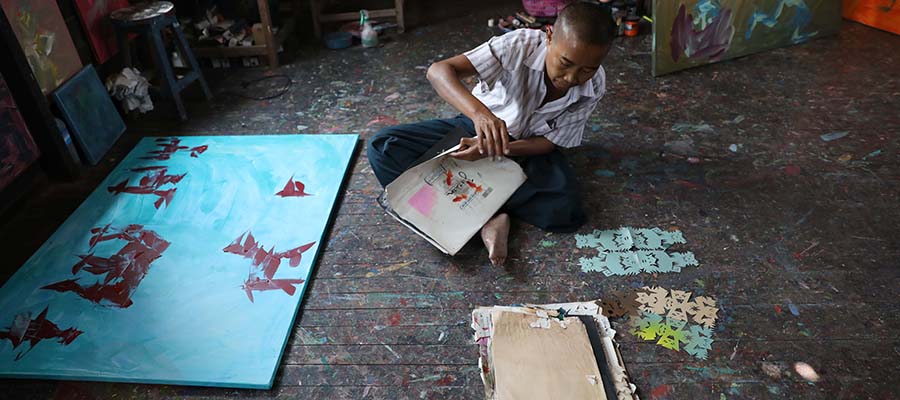
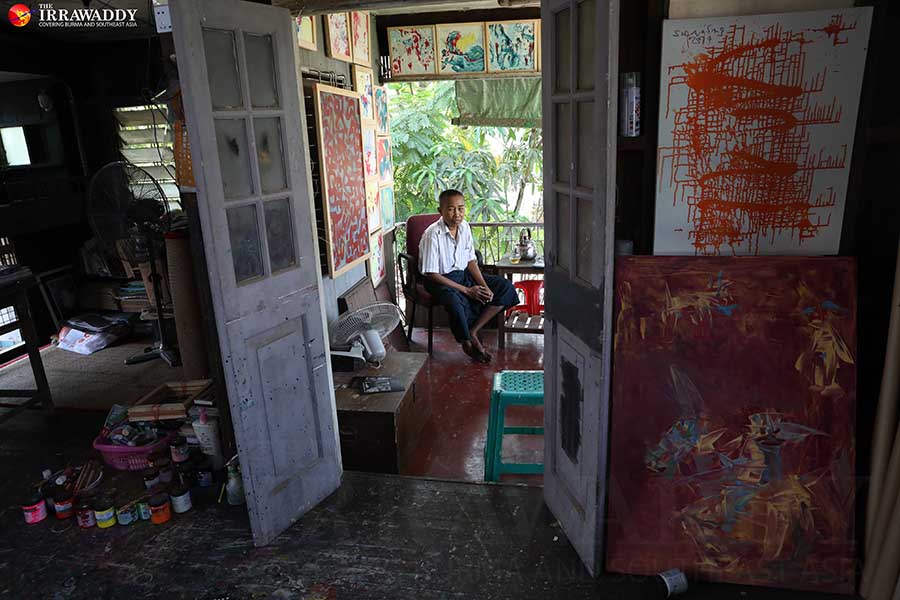
YANGON — After decades struggling as a lesser-known artist, Soe Naing can now lead a decent life. But many years of work with canvas and paint have put his home at risk.

"Will you sell your floor or shall I remove it and take it?" some of his friends and fans have joked.

To most people, the floor of his house is just a bunch of wood planks splattered with blotches of colorful paint . To his fans, it is a priceless work of art.

Soe Naing has turned the entire upper floor of his humble two-story wooden house in Yangon's North Dagon Township into his studio. There, he has created thousands of paintings. There, collectors have bought hundreds of his creations.

Today no one remembers when, some 30 years ago, Soe Naing had to walk from one magazine house to another to sell his illustrations.

Born with Thalassemia, a genetic blood disorder, Soe Naing never really enjoyed good health. But there was never a day that Soe Naing did not paint or draw.

Raised under the Burma Socialist Program Party, food and other supplies were scarce when he was young. But on the days his family cooked meat, he could not help using the leftover oil for his art.

"I would always draw something with pen or pencil. Suffice it to say that I am inspired by the unconscious obsession," Soe Naing said.

He studied zoology in the hope that he would be able to draw animals. U Thein Han was one of his first artistic mentors while he was attending university.

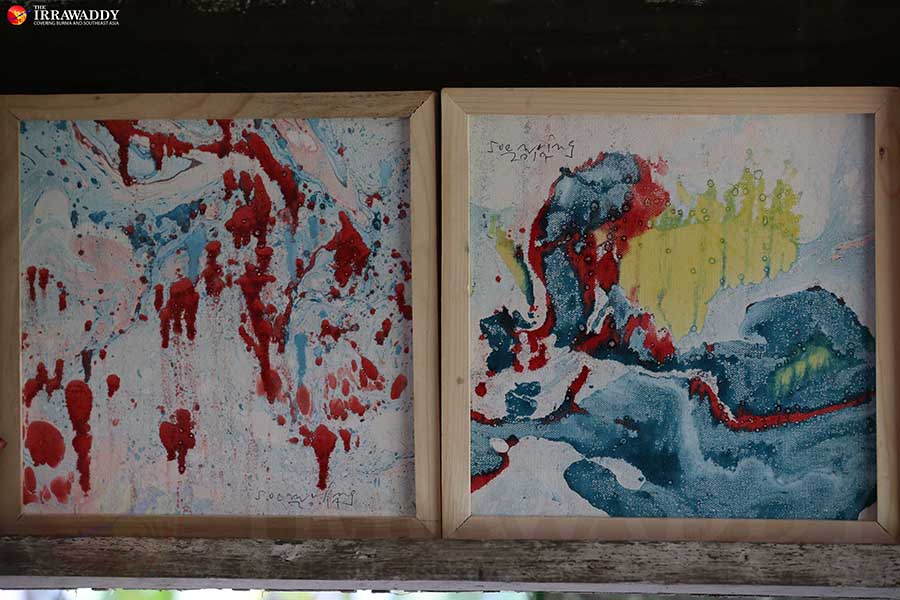
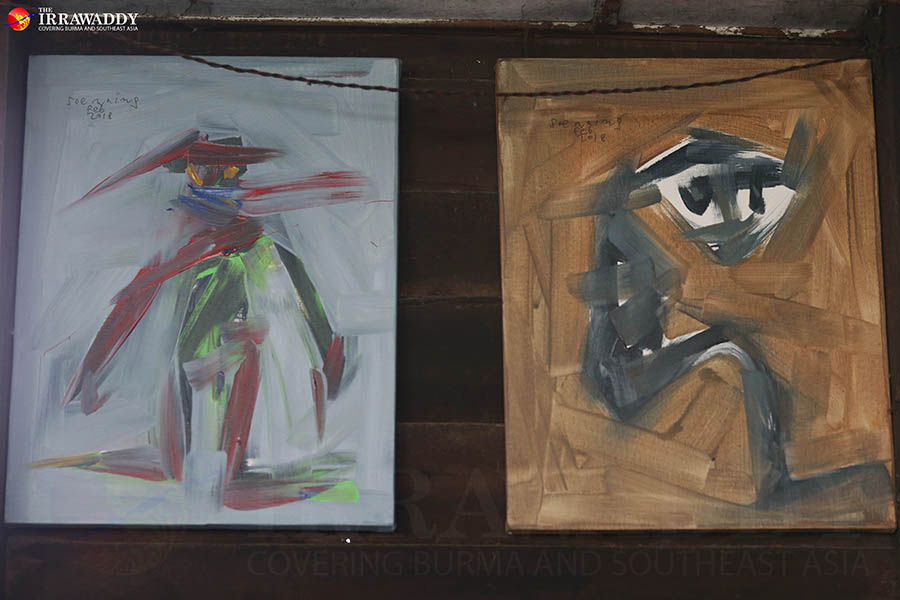
Soe Naing was inspired by abstract expressionist artists Williem de Kooning and Jackson Pollock and became a new figurative but struggling artist after his abstract depictions of humans, dogs, cats, horses and such won praise from critics.

Art and literature critic Zaw Zaw Aung said: "Soe Naing's paintings include figures of living things; they are not human figures, but sub-human figures."

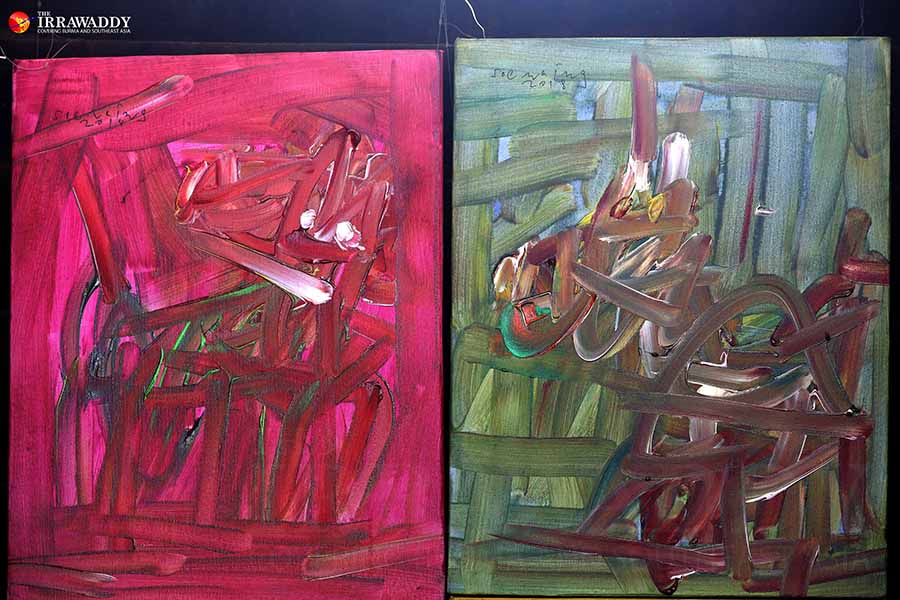
"Soe Naing has created a new trend in Myanmar modernism. He added small figures with intense and swift brush work, which was different from pure abstract works of Kin Maung Yin, Maung Di, Khin Wan and Aung Myint," contemporary artist U Aung Min wrote in his book on Myanmar contemporary art.

Though he set a new trend, his paintings were still not the most popular with collectors. Once, a member of the government’s art exhibit censorship board even asked him “to work,” thinking the artist had stopped painting.

Soe Naing, however, had been working day in, day out. His paintings finally started to sell in the 2000s.

The artist does not like people asking him what his paintings represent. "I don't like to define my paintings at all. Perhaps they think [paintings] are valuable only when they represent something. They are not satisfied when I say it is nothing," he said.

But more and more people are liking his work. Local and foreign collectors have come to his house and bought his paintings in bulk. He has also exhibited his paintings in Thailand and Singapore.

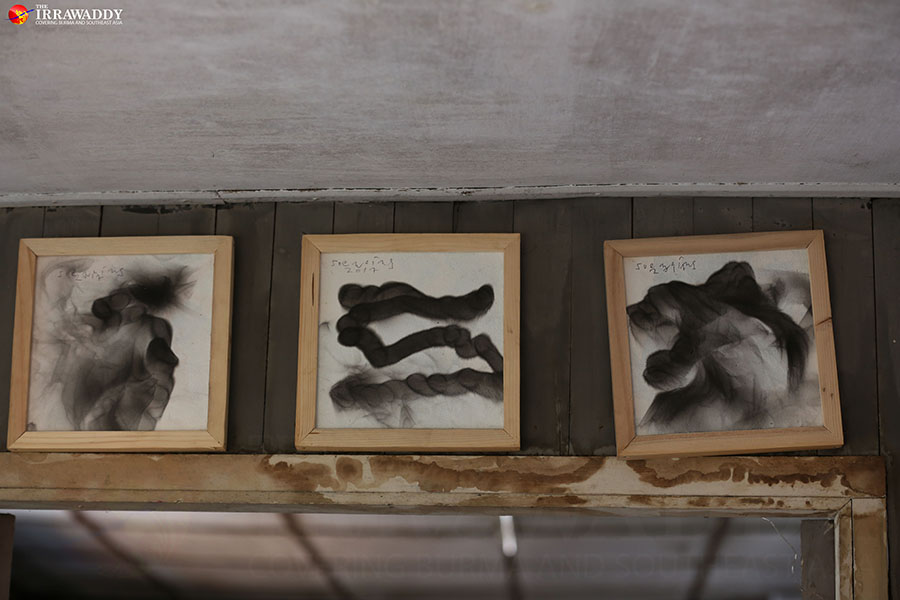
At an art exhibit last year, Soe Naing drew with pitch instead of paint to demonstrate that art can be created with anything.

"Art is close to us. It is not pretentious," he said.

Translated from Burmese by Thet Ko Ko.

The post Abstract Painter Soe Naing Says Art Can Be About ‘Nothing’ appeared first on The Irrawaddy.

Philippines Eyes Joint Exploration Deal With China in S. China Sea Within Months

Posted: 09 Apr 2018 10:10 PM PDT

MANILA — The Philippines is looking to seal a pact with China within a few months to jointly explore for oil and gas in a part of the busy South China Sea waterway claimed by both countries, a Philippine official said on Monday.

In February, the two countries agreed to set up a special panel to work out how to jointly explore for offshore oil and gas in areas both sides claim, without needing to address the touchy issue of sovereignty.

“We’re trying to see if we can achieve an agreement, hopefully within the next couple of months,” Jose Santiago Santa Romana, Philippine ambassador to the People’s Republic of China, told a news conference held on China’s island province of Hainan.

There is political willingness to land a deal, but both parties could take as much time as needed to ensure the goals are met, Santa Romana said at the event, aired live on Facebook, adding that the Philippines aimed to boost its energy security.

Beijing claims most of the South China Sea, a key trade route with areas believed to hold large quantities of oil and natural gas. Parts of it are subject to competing claims from Brunei, Malaysia, Taiwan and Vietnam, besides the Philippines.

Philippines President Rodrigo Duterte on Monday flew to China for the Boao Forum for Asia, and will meet Chinese President Xi Jinping on Tuesday.

Last month, the Philippines identified two areas in the South China Sea where joint exploration for oil and gas may be undertaken with China.

But any potential deal between Manila and Beijing should be agreed with a company and not the Chinese government, the presidential spokesman said.

The idea of joint development dates from 1986, but disputes and the sovereignty issue have kept it from materializing.

In 2016, the Permanent Court of Arbitration in The Hague ruled that portions of the contested areas were part of the Philippines’ 200 nautical mile Exclusive Economic Zone, and Manila had sovereign rights to resources there. China refuses to recognize the ruling.

The post Philippines Eyes Joint Exploration Deal With China in S. China Sea Within Months appeared first on The Irrawaddy.

Rights in Poorer Nations Must Be Upheld as Thai Firms Go Abroad, Activists Say

Posted: 09 Apr 2018 09:37 PM PDT

BANGKOK — Thailand’s businesses and its government must do more to protect the rights of vulnerable people abroad, analysts and activists said, after a landmark case filed by Cambodian farmers in a Bangkok court against a Thai sugar firm.

It is the first time plaintiffs from another country have filed a class-action lawsuit against a Thai company in a Thai court over its operations outside Thailand.

The two plaintiffs represent about 3,000 people who say they were forcibly removed from their homes and land in five villages in Oddor Meanchey Province in Cambodia’s northwest, to make way for a Mitr Phol sugarcane plantation between 2008 and 2009.

As cross-border investments in the region increase to tap resources, markets and cheaper labor, cases such as these will become more common because of differences in legislation and inadequate protections for workers and residents, experts said.

“This is about ensuring that Thai companies respect human rights in the countries they operate in, and holding them accountable for violations,” said Sor Rattanamanee Polkla at the Community Resource Center, which is representing the plaintiffs.

“There is no Thai law against irresponsible outbound investment, and countries like Laos, Cambodia and Myanmar do not have proper frameworks for environmental and social impact assessments. We had no choice but to file a suit,” she said.

The plaintiffs are asking for their land to be returned and 4 million baht ($130,000) in total compensation, she said.

Mitr Phol, the Thai sugar producer, said it had received temporary concessions in compliance with all local and national laws, and had assurances from the Cambodian government that the areas had been processed “legally and transparently.”

Mitr Phol said it had withdrawn from the project in 2014, and that it had recommended that the Cambodian government return the land to the “affected communities.”

The case, filed last month, is set to begin on June 11.

Not Binding

Cambodia awarded large economic land concessions to foreign companies — mainly from China, Vietnam, South Korea and Thailand — to operate mines, power plants and farms in order to spur economic growth and alleviate poverty.

Such deals, which covered more than a tenth of the country’s surface area by 2012, have displaced more than 770,000 people since 2000, rights lawyers say.

Following protests and pressure from rights groups, Cambodian Prime Minister Hun Sen announced a moratorium on new concessions in 2012, and promised to review old ones.

But activists say the reviews did not lead to significant changes, and that even when concessions were cancelled, the land was often retained by the government.

In the case of Mitr Phol, the villagers first filed a complaint with the Bonsucro sugarcane sustainability initiative, and then the National Human Rights Commission (NHRC) of Thailand, a government agency.

After a two-year investigation, the NHRC said rights violations had occurred, and Mitr Phol was directly responsible. It asked Mitr Phol to pay compensation in line with the United Nations Guiding Principles on Business and Human Rights.

But the NHRC’s powers are limited, Sor said, and the Cambodian farmers did not get compensation or their land back.

“The NHRC can issue recommendations, but these are not binding. Filing cases is an option, but it is always a challenge to go through the judicial system,” Angkhana Neelapaijit, a member of the NHRC, told the Thomson Reuters Foundation.

The NHRC has received more than a dozen complaints about Thai overseas investments, particularly in Southeast Asia, related to their impact on the environment and people, she said.

Negative Impacts

In response to the NHRC’s recommendations, the Cabinet issued resolutions in 2016 and 2017, calling for Thai investors to respect and protect the rights of local people, and to prevent adverse impacts on the environment and to livelihoods.

Last year, Prime Minister Prayuth Chan-ocha said the government intended to implement the UN guiding principles in a policy plan being drafted in consultation with rights groups.

But the region has proven to be a “laggard” in adopting an enforceable regional human rights system, said David Pred, co-founder of advocacy group Inclusive Development International.

“We shouldn’t hold our breath waiting for governments to adopt one. But that need not stop people from pursuing justice for business-related human rights violations in the national courts of the countries where the companies are domiciled.”

Thai outbound investment in 2017 totaled about $20 billion, according to the country’s investment board, much of it going to Cambodia, Laos, Myanmar and Vietnam.

But investors are backing projects “with little regulation and often with disregard for the human and environmental rights impacts,” according to a report from the UN Working Group on Business and Human Rights published in November.

“Negative impacts commonly include destruction of livelihoods, land grabs, and forced eviction,” it said.

Thai investors must apply the highest international standards and offer remedy for abuses, said Surya Deva, a member of the UN working group, which concluded a 10-day visit to Thailand last week.

“If Thai companies are benefiting from these investments, and outsourcing negative human rights impacts, it is critical that they also provide opportunities for any victims to file cases in Thailand if needed,” he said.

“It is a complicated process, but that option should be available,” he said.

The post Rights in Poorer Nations Must Be Upheld as Thai Firms Go Abroad, Activists Say appeared first on The Irrawaddy.

Ten Things to Do in Yangon This Week

Posted: 09 Apr 2018 08:00 PM PDT

Sai Sai Birthday Show

This is the annual fan party for pop star Sai Sai Kham Leng.

April 10, 6 p.m. to 11 p.m. Thuwunnabhumi Event Park. Tickets start at 10,000 kyats. Tel: 09-4510101789.

Yangon Central Pavilion

This is the main pavilion for Thingyan festivities in the city, organized by the Yangon regional government.

April 13 to 17, Yangon City Hall.

Arakanese Traditional Thingyan

There will be traditional Arakanese music and dance performances, as well as traditional food and souvenirs.

April 13 to16, 9 a.m. to 5 p.m. Thuwunna Stadium, Thingangyun Township.

Made in Yankin

Chit Kaung, Bobby Soxer and DJ Thaw Thaw will perform at the Yankin Thingyan pavilion.

April 13 to 16. Yankin Road, 12 Lone Tan.

Thingyan Splash Walk

There will be entertainment, free snacks, fun and much more.

April 13 to 17. U Ottama Park, by the southern gate of Shwedagon Pagoda.

Barrack Water Festival 2018

Barrack, a pavilion popular with youngsters, is back this April.

April 13 to 16. Pyay Road. Tickets start at 45,000 kyats. Tel: 09-43020145 or 09-5069595.

Thingyan Music Festival

International DJs will perform at this pavilion.

April 13 to 16. Pyay Road. Tickets start at 20,000 kyats. Tel: 09-775007750 or 09-775077500.

Water Festival at Vintage Luxury Hotel

There will be entertainment at the vintage car parking area and a buffet dinner for 9,000 kyats per person.

April 13 to 17, 6 p.m. to 11 p.m. No. 6, Botahtaung Jetty, near Botahtaung Pagoda, Seikkan Township. Tel: 09-258819911-55.

Sarpay Lawka Book Sale

Sarpay Lawka is offering a 10 percent discount on all books at all of its outlets.

Through April 12.

First Group Show 2018

Dozens of artists are showcasing more  than 300 works at this event.

Feb. 2 to April 16. New Treasure Art Gallery, Thanlwin Street.

The post Ten Things to Do in Yangon This Week appeared first on The Irrawaddy.

Monday, April 9, 2018

The Irrawaddy Magazine

The Irrawaddy Magazine


Reporter’s Notebook: Up Close and Personal in Post-Conflict Northern Rakhine State

Posted: 09 Apr 2018 06:36 AM PDT

YANGON – I was among 14 local journalists who joined a two-day government guided tour of northern Rakhine's Maungdaw district last week following accusations from international rights groups that the government was orchestrating a campaign to bulldoze the remnants of Rohingya settlements in the area to clear evidence of official wrongdoing.

The authorities scheduled a media tour of several villages including Pan Taw Pyin Muslim village, located on the outskirts of Maungdaw, the Hla Phoe Khaung refugee reception camp, and Inn Din village, where two Reuters reporters exposed mass graves, as well as Taung Pyo Let Wei town. All these villages had been previously visited by diplomats and foreign correspondents.

As usual, district officer U Ye Htut fielded questions from journalists at his office on Saturday and said that about 10 villages had been bulldozed to make way for construction of new settlements and border police regiments, while 13 village tracts out of a total 93 villages in the whole district remained intact following the late 2017 violence. But he did not provide a breakdown of how many of these were Arakanese or Rohingya villages.

Elderly Muslim men from northern Maungdaw’s Ngan Chaung village come out to meet local reporters on Sunday.(Photos: Moe Myint/ The Irrawaddy)

The UN has described the army's campaign against the Rohingya as a textbook example of ethnic cleansing while international rights defenders have called for high-ranking officers from the Myanmar military to be brought before the International Criminal Court.

U Ye Htut claimed that some Muslim villages such as Ngan Chaung, Kyae Taw Pyin and Nga Sar Kyu in northern Maungdaw had not suffered arson attacks and that the residents in almost all of them had been living peacefully despite the violence that erupted in the area.

Some reporters demanded to be taken to those locations as a matter of clarification, however the government administrative department official took them to see only one village, Ngan Chaung, which is about 27 kilometers from of the district's urban center. They were not, however, allowed to visit Nga Sar Kyu village, which is situated on the same route and only about 4 kilometers from Ngan Chaung village.

Modest houses being constructed for internally displaced persons in northern Maungdaw.  (Photos: Moe Myint/ The Irrawaddy)

Condition of remaining Rohingya villages

We saw an infantry checkpoint (Light Infantry Battalion No. 535) near Maung Hna Ma village on Sunday morning. I visited that village alone after the Oct. 9 attack in 2016 and observed that within a few months farming had been revived and commodities were being sold again in the market but it had been razed in the late 2017 violence and no one was living there now.

We then arrived at Ngan Chaung village, which is home to a decades-old white Muslim mosque that sits between two freshwater lakes. The atmosphere was completely silent as our motorcade pulled up there. Some elderly and male Rohingya came out to greet the vehicles. There were noticeably no women among the group.

Reporters were allowed to interview different sources for 10 minutes, and to take photographs. Most of the residents, however, were reluctant to speak with the journalists as the government officials, police and special police branch officers were close by photographing them.

"I can't talk freely here," a villager said. "We are terribly frightened and trapped here. We are being restricted from visiting other villages."

The village once had a population of about 5,300 residents but nearly 5,000 have now fled to neighboring Bangladesh amid fear they will be detained by security forces. Some of the 700 Rohingya still living in Ngan Chaung said they had decided to stay because it had been their home their whole lives.

An ethnic Mro woman walks toward newly constructed buildings in northern Maungdaw’s Kha Maung Seik town.(Photos: Moe Myint/ The Irrawaddy)

"I grew up here and this is my native place. Why should I flee to another country as I have done nothing wrong?" said one man who asked to remain anonymous.

Another Muslim man complained that he was arrested by border police for visiting neighboring Kyae Pin village without a recommendation letter from his village head and fined about two lakhs (200,000 kyats).

The Irrawaddy asked the Rohingya village head, U Thin Ko Ko, about the detention claim and he denied it happened. A few days later he acknowledged, however, that everyone in the village is required to have a travel permit, regardless of whether the villagers had their own proper tri-fold card, or national verification card (NVC). Multiple Muslim sources from Maungdaw described the villagers' situation in the surrounding urban areas as being similar to house arrest.

In fact, NVC holders were granted freedom of movement in Buthidaung and Maungdaw townships in early 2017. During the trip, a district administrative officer proudly told the journalists that NVC cardholders were even allowed to travel to Yangon to apply for a passport.

Rohingya out, tribes in

Along the highway of northern Maungdaw Township, we repeatedly witnessed burned-out sites, dry betel nut trees, piled-up coconut timber, the dug-up roots of raintrees, skinny dogs, villages that had been recently bulldozed to make way for new border police regiments or for new villages and a few Rakhine villages with police stations.

Our group was also brought to meet 60 families who had recently fled from Bangladesh's Bandarban hills district to Kha Maung Seik town's Oh Tan village, which is 53 kilometers from Maungdaw. Some modest brick houses have been built on the top of burned Rohingya villages while some of the displaced 43 Hindu households are now encamped near Mayu Mountain.


Minority Mro people from Bangladesh take refuge near a stream at Kha Maung Seik town.(Photos: Moe Myint/ The Irrawaddy)

Some of the ethnic Mro from the Bangladesh side can speak Arakanese. U Pun Num, a 40-year-old father of four, was one of them. He explained the Mro are officially recognized as Bangladesh citizens and have national identity cards but can't read the Bangla dialect.

The tribespeople subsist by means of shifting cultivation and farming in the hill tract region and are predominantly Buddhist. Reports about the Rohingya exodus in late 2017 have created hostilities between the Chackma and Mro and neighboring Muslim villages, as it was widely believed in majority Muslim Bangladesh that the Mro were the same as the Buddhist Arakanese and responsible for the plight of the Rohingya.

"Although we were not physically assaulted, it could happen one day and I felt we were not safe there," U Pun Num said.

To reach Kha Maung Seik village, the tribespeople had trekked for six days from Bandarban district and did not see any border guards near the frontier fence on either the Bangladesh or Myanmar side. According to Kha Maung Seik town authorities, the newly constructed houses are intended for the tribespeople.

Border crossings and citizenship claims could turn out to be the most complex part of this issue. During the trip, immigration officers told reporters that they couldn't issue citizenship cards to ethnic Mro who came from Bangladesh. But, meanwhile, the government has been constructing buildings for the new arrivals.

The authorities' position on this matter is obviously questionable, given the NVC holders or displaced Rohingya are restricted from travelling and even going shopping in downtown areas while the new arrivals from Bangladesh are allowed to move freely within the area.

The clear lack of law enforcement in the region could also fuel distrust between the Muslim and Buddhist communities. I have travelled across southern and northern Maungdaw and seen many unlawful activities being carried out by uneducated villagers, such as the looting of the burned remains of Muslim villages and the cutting down of trees for lumber. None of this is new in the conflict zone, and has been happening since September 2017.

A couple of days after we arrived back in Yangon from Maungdaw, an ethnic Mro woman was hacked to death by unidentified men near a Muslim village where eight Mro villagers were searching for plants to cook. Some Hindu sources told The Irrawaddy that the Mro entering the burned-out site was the cause of the incident.

The post Reporter's Notebook: Up Close and Personal in Post-Conflict Northern Rakhine State appeared first on The Irrawaddy.

KIA Raids Tatmadaw Base, Claims to Detain More than a Dozen Troops

Posted: 09 Apr 2018 05:33 AM PDT

More than a dozen Myanmar Army (Tatmadaw) troops, many of them badly injured, were briefly detained by the Kachin Independence Army when the latter raided a Tatmadaw base in Hpaka Township on April 6. The ethnic army released them after they themselves came under attack by two Tatmadaw helicopters, according to local sources.

The KIA attack was launched at 2 am according to the KIA. At some time after 5 am they seized the base, reportedly wounding some Tatmadaw troops.

"Our KIA troops raided their base. We were able to take control of the base, but we do not yet know the number of casualties," said Colonel Naw Bu, a spokesperson for the KIA.

The KIA raid on the Tatmadaw's Battalion 86 was launched under the command of the ethnic army's Regional Operations Command 2 based in Tanai Township, according to Col. Naw Bu.

The KIA seized dozens of guns from the Tatmadaw, including artillery pieces, as well as ammunition during their raid on the base. The Tatmadaw's Colonel Aung Aung was seriously wounded in the raid and reportedly died after the KIA left the area.

Video footage of the raid circulated on social media shows a large number of KIA troops milling about after apparently having overwhelmed the Tatmadaw base, many of whose troops appear gravely wounded.

A total of 13 soldiers including Col Aung Aung appear wounded and lying on the ground. Many of the wounded soldiers appear to have lost a lot of blood.

A medic is seen treating a wounded Tatmadaw soldier.

The KIA reported that a Myanmar Army helicopter later lunched a strike on its personnel as they were treating the Tatmadaw's wounded, so they left the area. The KIA said it did not know the fate of the wounded soldiers it was forced to stop treating.

"We injected them [with medicine] and treated their wounds. We told them that their friends would come to pick them up soon. So we told them to stay there and we left," said Col Awng Jar from the KIA's Battalion 6.

Col Awng Jar led the raid on the Myanmar Army base.

The base housed 24 Tatmadaw troops. At least eight soldiers were killed in the attack, but the KIA has suppressed the casualty count, sources within the KIA said.

Even a local ethnic Kachin man reported that eight Tatmadaw soldiers were killed, and three others detained by the KIA.

The Ministry of Defense and the Tatmadaw released no statements regarding the attack.

The KIA last week announced they would launch guerrilla attacks and plant landmines against the Tatmadaw in the Hukawng Valley. They warned illegal mine workers in the area to leave by April 10.

According to Col. Naw Bu, no fighting was reported Monday in Tanai Township, which has been another conflict flashpoint. However, fighting there is expected to escalate soon as the Tatmadaw has recently deployed more troops to the area and continues to launch attacks against the KIA.

The Tatmadaw attacked KIA-held Mansi Township on April 1-6 according to local ethnic Kachin. No fighting was reported there in the past few days.

Several rounds of peace talks between the Tatmadaw and the KIA have been held in recent years. However, they have been halted since February, when the KIA issued a statement listing conditions for further peace talks with the Tatmadaw.

Similarly, the Tatmadaw asked the KIA to withdraw at least three battalions, including Battalion 14, which was in the Tanai area, and Battalion 12 and Battalion 27 in the Mansi Township area. However, the KIA refused to withdraw, leading to sporadic clashes in these areas. It eventually withdrew from the Battalion 14 base.

More than 100,000 people remain displaced from their homes after a 17-year ceasefire between the central government and the KIA collapsed in 2011.

The post KIA Raids Tatmadaw Base, Claims to Detain More than a Dozen Troops appeared first on The Irrawaddy.

YCDC Approves Reservoir Safety Plan for Controversial Mega Project

Posted: 09 Apr 2018 04:49 AM PDT

YANGON—The city's municipal body has given permission to the developer of a controversial high-rise project to implement its proposed safety measures for a reservoir next to the project site.

Yangon City Development Committee gave the green light to Zaykabar Company, the developer of the Myayeik Nyo Royal Project, on Friday to sink bored piles and add water seals as a precautionary measure to protect the 92-year old service reservoir from damage that might be caused by construction of the US$500m project.

The approval followed a decision at a Yangon government cabinet meeting on the same day after the company submitted safety plans signed by relevant engineers.

Daw May May Thwe, a YCDC committee member, told The Irrawaddy on Monday that the permission also included approval for the construction of a three-story on-site office building and a retaining wall nearby to prevent landslides in the neighborhood.

"They are allowed to go ahead with their proposed safety plans for the reservoir, office building and retaining wall. Nothing else," she said.

Slated to be completed by 2020, the Myayeik Nyo Royal Project is now in the beginning phase and comprises the construction of 12 buildings with heights ranging from 382 feet to 412 feet. In one corner of the project's 13-acre plot lies a reservoir that distributes water to Yangon's 16 downtown townships.

Residents who live near the construction site are opposed to the project because they fear that damage to the 20-million gallon reservoir could result in their neighborhood being flooded and cause water shortages across the city.

Both the Yangon government and YCDC suspended the project in March and again last week until the developer could come up with a safety plan for the reservoir following media reports—including The Irrawaddy's— about the residents' concerns.

Located in one of Yangon's prime areas in Bahan Township, the project is named after the now-defunct Myayeik Nyo Hotel, which was run by Myanmar tycoon U Khin Shwe, who is also chairman of Zaykabar Co., one of Myanmar's largest construction companies. The project contractor is China State Construction Engineering Corporation Ltd (CSCEC).

Once covered with dense vegetation, the project area was known as Mount Pleasant during the British colonial days. Many mansions belonging to high officials, including the Mayor's Residence and the Mayor's Guest House (both are on heritage list) and the residence of the manager of Chartered Bank, were located there.

In February, the Mayor's Residence was demolished during site clearing process to make way for the project.

The post YCDC Approves Reservoir Safety Plan for Controversial Mega Project appeared first on The Irrawaddy.

Tatmadaw Kills Indigenous Karen Community Leader, Local Groups Say

Posted: 09 Apr 2018 04:03 AM PDT

CHIANG MAI, Thailand — An indigenous Karen man from Ler Mu Plaw village in Karen State's Papun district was shot dead by the Myanmar military (or Tatmadaw) on Thursday afternoon, according to local villagers and aid groups.

Fighting between the Karen National Liberation Army (KNLA) and the Tatmadaw has flared recently in the Ler Mu Plaw area, despite both sides being signatories to the Nationwide Ceasefire Agreement (NCA). Amid a persistent military standoff, some 2,300 villagers who were earlier forced to flee the area dare not to go back to their homes, as they claim the Tatmadaw has taken control of their villages.

Saw O Moo, 42, a community leader and father of seven, was reportedly shot dead while on his way home on April 5. He was driving a motorbike when he came under fire. A friend who was riding on the back of the motorcycle managed to flee the attack and survived, said a member of the Karen Environmental and Social Action Network, citing local villagers.

"The villagers returned to the scene on April 6 and saw both the body and the motorbike, but were unable to approach them as [the villagers] came under fire," said Saw Soe Doh, a spokesman for the Mutraw (Papun) Emergency Assistance Team.

He said villagers went back to the area again on Saturday and Sunday but could not retrieve the body, as soldiers were stationed nearby.

"Atee [Uncle] Saw O Moo was a good person," Saw Soe Doh told The Irrawaddy, adding that the slain man was a leader of the Mutraw (or Papun) indigenous Karen community and an advocate for indigenous Karen rights, including land and forest governance as well as peace for the Mutraw people.

The Mutraw Emergency Assistance Team was formed by members of a Karen community organization and other local groups on March 12 to help villagers displaced from the Ler Mu Plaw area, following fighting between the KNLA and Tatmadaw in early March. The clashes were triggered by the Tatmadaw's deployment of troops to the area.

The team has been providing medicine, food and shelter for IDPs. Saw O Moo worked for the team, providing peer support to villagers.

"We want his body back," Saw Soe Doh said. Villagers and relief workers are convinced he is the shooting victim, as he never returned home and would never get lost in the area, they say.

In a statement, the Mutraw Emergency Assistance Team urged President U Win Myint and State Counselor Daw Aung San Suu Kyi "to take immediate measures to protect the displaced villagers and ensure the safety of our humanitarian workers."

Their statement reads: "The murder of an innocent humanitarian aid worker by the Burmese Army seriously violates not only human rights but also the Nationwide Ceasefire Agreement (NCA)."

The Karen National Union, the political wing of the KNLA, said the Tatmadaw should halt its project to rebuild an old road that was abandoned in 2008 until trust can be restored between the two sides.

Karen civil society groups said the Tatmadaw breached the ceasefire pact by moving troops across agreed ceasefire boundaries. As a consequence, they say, some 2,300 local villagers have been displaced.

The post Tatmadaw Kills Indigenous Karen Community Leader, Local Groups Say appeared first on The Irrawaddy.

Peace Process Steering Team Form Panels to Hold Informal Talks With Gov’t

Posted: 09 Apr 2018 01:35 AM PDT

CHIANG MAI, Thailand — The peace process steering team (PPST), which comprises the leaders of the signatories of the Nationwide Ceasefire Agreement (NCA), on Friday formed two teams to hold informal talks with the government on political and security issues.

Padoh Kwe Htoo Win, the vice chairman of the Karen National Union (KNU), will lead the informal
team on the political sector, said Salai Thla Hei, coordinator of the peace process working team under the PPST.

Padoh Saw Roger Khin, also from the KNU, will lead the informal team on the security sector.

Salai Thla Hei told The Irrawaddy that the informal negotiation teams will try to meet with the government later this month after Thingyan, the Myanmar New Year holiday, which runs from April 13-17.

On April 5-6, the NCA signatories met in Chiang Mai, Thailand to discuss the current political situation, the peace process, and the upcoming 21st-Century Panglong Peace Conference (UPC).

The Tatmadaw's ongoing clashes with EAO signatories and the inability of the latter to conduct national-level dialogues have raised questions over the NCA and caused non-signatory EAOs to doubt the process.

The standoff between the Karen National Liberation Army (KNLA) and the Tatmadaw continued after fighting broke out in Papun district of Karen state last month over the Tatmadaw’s continued presence in the area, where it is rebuilding an old road. Talks between the two armies to resolve the issue have not yet been held.

Meanwhile, the Shan, Mon and Rakhine signatories have yet to implement national-level dialogues, with the third session of the UPC scheduled to be held next month.

A lack of informal talks between the government, Tatmadaw and the ethnic armed organizations is one cause of the failure of the peace process, according to some stakeholders.

"For the remaining three years, the peace negotiators on both sides need to hold more informal talks to help the formal negotiations to go smoothly," said Padoh Kwe Htoo Win, who recently spoke to The Irrawaddy.

Under the two-year-old National League for Democracy-led government, the peace process has not made much progress, struggling to reach its aims of achieving genuine peace and a federal union. On the positive side, two more groups – the New Mon State Party (NMSP) and the Lahu Democratic Union (LDU) – signed the NCA last month. Also, at the second UPC session in May last year, the Union Accord Part 1 was established. The accord agrees on 37 basic principles for a federal state. Despite these achievements, peace negotiations have almost disappeared.

According to some stakeholders close to the government, while the Peace Commission is formally chaired by Dr. Tin Myo Win, an aide to State Counselor Daw Aung San Suu Kyi, in practice ex-generals lead both the negotiations and the commission, as the chairman is seen as incompetent to lead such negotiations.

The stakeholders share the view that the NLD government's aim to achieve a democratic federal union is good, but its implementation has been weak compared to the previous government led by then-President U Thein Sein. In peace negotiations launched under U Thein Sein starting in late 2011, informal, closed-door meetings were used to help move the process forward.

The stakeholders feel that the process will not achieve its goals within the desired time frame unless the terms of the negotiations are reconsidered.

Padoh Kwe Htoo Win, who has been involved in peace negotiations since 2011, agreed that the many challenges and difficulties facing the process had kept it from achieving its goals.

"We have many stakeholders, and we have different perspectives. Although we have a common goal to build a democratic federal union, our approach may not be the same. Thus we are trying to negotiate on that," he added.

The post Peace Process Steering Team Form Panels to Hold Informal Talks With Gov't appeared first on The Irrawaddy.

Rakhine Parliament Says No to Rohingya Resettlement in Southern Maungdaw

Posted: 08 Apr 2018 11:47 PM PDT

SITTWE, Rakhine State — The Rakhine State Parliament on Friday approved a proposal to urge the union government not to resettle non-citizen Muslim refugees in southern Maungdaw Township.

Lawmaker U Tun Aung Thein, of Buthidaung Township, introduced the proposal to Parliament on Tuesday in consideration, he said, of national sovereignty, the security of the area’s mostly Buddhist ethnic Arakanese, and the rule of law.

Some 700,000 Muslim Rohingya have fled Rakhine for Bangladesh since militant attacks on security outposts in the north of the state in late August triggered a massive military and police crackdown on the area’s Muslim communities.

In November Myanmar and Bangladesh agreed to start repatriating the refugees on Jan. 22, but the process has been delayed.

Lawmakers discussed U Tun Aung Thein's proposal on Friday and approved it after there were no objections.

"The minority Arakanese people and other tribes have fled their homes because of overwhelming fears. The whole area has fallen to the hands of non-Myanmar citizens," said U Tun Aung Thein.

"Under such circumstances, resettlement of non-citizens in southern Maungdaw can harm sovereignty in the future. Locals have also released statements against resettlement of Bengalis in southern Maungdaw, and we must heed their desires," he added.

Most people in Myanmar refer to the Rohingya as Bengalis, implying that they are illegal immigrants from Bangladesh. Most have been denied citizenship even after generations in Myanmar.

Lawmakers on Friday also objected to the government's plan to establish eight Rohingya villages in southern Maungdaw as part of the repatriation process, arguing that illegal immigrants and terrorists could easily reach the area by sea.

"It is like opening a welcome center for illegal immigrants and terrorists to establish Bengali villages in southern Maungdaw because it is adjacent to the sea. The government should be especially aware that a mistake at this time could result in a big mistake that can't be compensated in the future," said lawmaker U Aung Win, of Myebon Township.

Major Aung Zin Than, a military appointee to the state Parliament, also spoke against establishing Rohingya villages in southern Maungdaw, where there is no border fence.

Rakhine State Planning and Finance Minister U Kyaw Aye Thein said he had no reason to object to the lawmakers’ discussion but asked them to recognize the international pressure the union government was under regarding the Rohingya.

Translated from Burmese by Thet Ko Ko.

The post Rakhine Parliament Says No to Rohingya Resettlement in Southern Maungdaw appeared first on The Irrawaddy.

Venerating the Past, Traditional Costume Fever Grips Thailand

Posted: 08 Apr 2018 11:27 PM PDT

BANGKOK — Business is booming for Siri Seatea’s traditional dress shop in Bangkok.

“Out of the 30 years I’ve been running this shop, this is the peak for us,” 53-year-old Siri told Reuters as she stitched a Thai sarong for a client.

History fever is gripping Thailand and a growing number of Thais are wearing traditional dress, a phenomenon encouraged by the junta and the palace, and fuelled by a popular television soap opera.

But the trend, which began with a “winter fair” initiated by King Maha Vajiralongkorn in February, has also been criticized by some as an attempt to glorify an era of absolute monarchy and gloss over the junta’s shortcomings nearly four years after it took power.

“History has long been used by the elite to maintain their status in politics,” said Anusorn Unno, Dean of the Faculty of Sociology and Anthropology at Thammasat University.

“Right now the junta is facing new challenges from a new generation of people, so they have retreated to history to say that the past is better and more suitable for Thailand.”

Among the popular costumes are those worn during the reign of former King Chulalongkorn, known as Rama V, who ruled from 1868 to 1910 and is credited with saving Thailand from Western colonialism.

Television has also played a part.

“Love Destiny,” a soap opera set during the 1656 to 1688 reign of King Narai the Great, has taken Thailand by storm.

Many Thais are visiting the ancient capital of Ayutthaya, north of Bangkok, where scenes from “Love Destiny” take place. They pose for selfies dressed in traditional garb against the backdrop of the ruins.

Prime Minister Prayuth Chan-ocha met with cast members this week at Government House and hailed the series as an example of the government’s longstanding policy of promoting “Thainess.”

Prayuth’s own cabinet has held some recent meetings in the traditional dress of a 19th century elite. He dressed in a buttoned up silk jacket, breeches and a wide sash.

A coup led by Prayuth in 2014 followed months of unrest as demonstrators supporting the urban middle class and military-backed elite demanded the resignation of then-Prime Minister Yingluck Shinawatra, whose biggest following was among the rural poor.

That long-standing division shows little sign of having disappeared despite four years of military rule.

Although the junta has now promised elections for February 2019, signs of frustration over repeated delays to the ballot have prompted protests in recent weeks.

“Costume Fever”

In Ayutthaya, 80 km north of Bangkok, visitor numbers have nearly tripled since “Love Destiny” began, according to officials quoted by local media.

“It was booming since the winter fair held by our king and then this soap opera fueled the Thai costume fever,” said Chutima Wongchiangkwang, 55, a costume vendor.

Wearing traditional clothes can get you a discount at the cinema. The country’s Major Cineplex Group announced this week a buy one, get one free promotion.

Flight attendants for national carrier Thai Airways International are also dressing up in national costumes from the reign of King Rama V this month to mark the Thai New Year festival known as Songkran.

This weekend, Thais flocked to an event initiated by the king ahead of the Thai New Year festival of Songkran — which for many has become a rowdy water-soaked affair.

The palace event, over three days, aims to revive a more sedate vision of Thailand’s culture with tribute being paid to past kings, Buddhist rites and displays of folklore.

“The public is encouraged to dress in traditional Thai period costume, wear Thai clothing or polite smart casual attire,” the Thai tourist authority’s news website said. “Water guns and baby powder pasting are discouraged.”

Back at the Siriroong Ruang shop, Maneejan Srilert, 23, an employee at the Stock Exchange of Thailand, eyed a gold and red traditional skirt to wear to an office party.

“I don’t think of it as a political thing,” she told Reuters. “For me it’s just fashion.”

The post Venerating the Past, Traditional Costume Fever Grips Thailand appeared first on The Irrawaddy.

Cambodia’s Former Opposition Leader Calls For Election Boycott

Posted: 08 Apr 2018 09:44 PM PDT

PHNOM PENH — Cambodia’s former opposition leader, Sam Rainsy, called on Sunday for Cambodians to boycott a general election set for July 29 if his dissolved party isn’t allowed to take part.

The Cambodia National Rescue Party (CNRP) was dissolved by the Supreme Court last November at the request of Prime Minister Hun Sen’s government, which alleged it was plotting to take power with the help of the United States.

The CNRP and the United States have denied the allegations, which followed the arrest of current party leader Kem Sokha on treason charges over the alleged plot. He has denied the charges and called them a ploy to help Hun Sen win re-election.

“I call on all my Cambodian fellow compatriots who believe in democracy to boycott the 29 July 2018 elections if the CNRP is not allowed to participate,” Sam Rainsy said in a tweet on Sunday.

The party had not previously called for a boycott and it was not immediately clear if Sam Rainsy was speaking on behalf of the party.

He resigned as president of the CNRP in 2017 but has for decades been a vocal critic of Hun Sen. He has lived in France since 2015 to avoid a series of convictions he says are politically motivated.

Sok Eysan, a spokesman for Hun Sen’s ruling Cambodian People’s Party, said Sam Rainsy’s call would have no impact.

“The CNRP is already dead by the Supreme Court’s decision,” Sok Eysan said. “Even if Sam Rainsy appeals until he dies, people no longer believe him.”

The ban on the CNRP prompted some Western countries to condemn the crackdown, cut aid, and impose visa bans on some ruling party members. But Japan provided Cambodia with a grant and loan agreement totaling over $90 million on Sunday, while saying it wanted to see a free and fair election.

“Everybody can have their own idea what is free and fair, but free is free and fair is fair,” Norio Maruyama, a Japanese Foreign Affairs spokesman, told a news briefing.

A former deputy president of the CNRP, Mu Sochua, said Cambodians expected Japan not to recognize any government that emerged from a “sham election.”

Japan is locked in a regional battle for influence with China, which is by far the biggest donor to Cambodia and has consistently voiced support for the government.

The post Cambodia’s Former Opposition Leader Calls For Election Boycott appeared first on The Irrawaddy.

Myanmar Not Ready For Return of Rohingya Refugees: UN Official

Posted: 08 Apr 2018 09:29 PM PDT

YANGON — Myanmar is not ready for the repatriation of Rohingya refugees, said the most senior United Nations official to visit the country this year, after Myanmar was accused of instigating ethnic cleansing and driving nearly 700,000 Muslims to Bangladesh.

“From what I’ve seen and heard from people — no access to health services, concerns about protection, continued displacements — conditions are not conducive to return,” Ursula Mueller, the UN’s assistant secretary-general for humanitarian affairs, said after a six-day visit to Myanmar.

A Myanmar government spokesman did not immediately respond to requests for comment on Mueller’s remarks.

The Myanmar government has previously pledged to do its best to make sure repatriation under an agreement signed with Bangladesh in November would be “fair, dignified and safe.”

Myanmar has so far verified several hundred Rohingya Muslim refugees for possible repatriation. The group would be “the first batch” of refugees and could come back to Myanmar “when it was convenient for them,” a Myanmar official said last month.

Mueller was granted rare access in Myanmar, allowed to visit the most affected areas in Rakhine State, and met army-controlled ministers of defense and border affairs, as well as de-facto leader Daw Aung San Suu Kyi and other civilian officials.

The exodus of Rohingya Muslims followed an Aug. 25 crackdown by the military in northwestern Rakhine. Rohingya refugees reported killings, burnings, looting and rape, in response to militant attacks on security forces.

“I asked [Myanmar officials] to end the violence … and that the return of the refugees from [Bangladeshi refugee camps in] Cox’s Bazar is to be on a voluntary, dignified way, when solutions are durable,” Mueller told Reuters in an interview in Myanmar’s largest city, Yangon.

Myanmar says its forces have been engaged in a legitimate campaign against Muslim “terrorists.”

Bangladesh officials have previously expressed doubts about Myanmar’s willingness to take back Rohingya refugees.

Myanmar and Bangladesh agreed in January to complete a voluntary repatriation of the refugees in two years. Myanmar set up two reception centers and what it says is a temporary camp near the border in Rakhine to receive the first arrivals. “We are right now at the border ready to receive, if the Bangladeshis bring them to our side,” Kyaw Tin, Myanmar minister of international cooperation, told reporters in January.

Many in Buddhist-majority Myanmar regard the Rohingya as illegal immigrants from Bangladesh. The UN has described Myanmar’s counteroffensive as ethnic cleansing, which Myanmar denies.

Asked whether she believed in government assurances the Rohingya would be allowed to return to their homes after a temporary stay in camps, Mueller said: “I’m really concerned about the situation.”

Part of the problem is that, according to New York-based Human Rights Watch, Myanmar has bulldozed at least 55 villages that were emptied during the violence.

“I witnessed areas where villages were burned down and bulldozed…I’ve not seen or heard that there are any preparations for people to go to their places of origin,” Mueller said.

Myanmar officials have said the villages were bulldozed to make way for refugee resettlement.

Mueller said she has also raised the issue with Myanmar officials of limited humanitarian aid access to the vulnerable people in the country and added, referring to the authorities, that she would “push them on granting access” for aid agencies.

The post Myanmar Not Ready For Return of Rohingya Refugees: UN Official appeared first on The Irrawaddy.

Saturday, April 7, 2018

The Irrawaddy Magazine

The Irrawaddy Magazine


A Calculated Political Shake-Up

Posted: 06 Apr 2018 08:54 PM PDT

Kyaw Kha: Welcome to Dateline Irrawaddy! Last week, the top three leaders of the country State Counselor Daw Aung San Suu Kyi, newly elected President U Win Myint and Army Chief Senior-General Min Aung Hlaing delivered addresses. We will discuss those speeches. The Irrawaddy English editor Ko Kyaw Zwa Moe and Burmese editor Ko Ye Ni join me to for the discussion. I'm The Irrawaddy Burmese chief reporter Kyaw Kha.

A Calculated Political Shake-Up

DATELINE IRRAWADDYA Calculated Political Shake-UpThe Irrawaddy discusses speeches given last week by the state counselor, army chief and new president—in light of his recent appointment.

Posted by The Irrawaddy – English Edition on Friday, April 6, 2018

We now have a new president and this shift is quite interesting. Ko Kyaw Zwa Moe, what is your view on this change?

Kyaw Zwa Moe: We can assume that Daw Aung San Suu Kyi and her National League for Democracy (NLD) government made such a big change after careful consideration, two years into their term. Before this, there was a lot of frustration with the performance of the NLD government, especially its ministries. The change was made in response to that feedback.

The reason U Win Myint was appointed is strikingly different from that of U Htin Kyaw. As everyone said, U Htin Kyaw was chosen as president because Daw Aung San Suu Kyi was barred from the presidency. But, it is different for U Win Myint. She chose him in consideration of the time after her era. Daw Aung San Suu Kyi is over 70 years old now. She seems to have chosen someone who can handle her responsibilities when she can no longer work either because of her health or age. U Win Myint must be her favorite candidate. He has shown his caliber in Parliament over the past two years. And he was elected three times [to Parliament]. I think Daw Aung San Suu Kyi made the move considering the political role of the Tatmadaw and the political privileges given to it by the Constitution.

We are now undergoing a democratic transition. In other words, a democratic transition can be defined as a gradual reduction in the role of the Tatmadaw in politics and the administration. Daw Aung San Suu Kyi, her government and the new president have made a political move based on this. We can't lose track of it.

KK: State Counselor Daw Aung San Su Kyi delivered an address on Sunday and I found an interesting point in her speech. Daw Aung San Suu Kyi said that she is committed to solving the problems facing the country with collective strength. Ko Ye Ni, what does that mean to you?

Ye Ni: There are two big challenges facing the country as well as the NLD government—peace building and the Rakhine issue. She said she would overcome those problems with collective strength. By 'collective strength,' she may refer to the public support for her party, which won the election held according to the 2008 Constitution and formed the government. But I think that when she says collective strength, there are key players like the Tatmadaw, ethnic armed organizations and ethnic people. And there are other key players—such as international partners that are helping Myanmar with the Rakhine issue and the peace process. I think she means that all of them should work together toward a common goal.

KK: I also found some interesting points in the speech of the army chief in his address on the 73rd anniversary of Armed Forces Day. Ko Kyaw Zwa, did anything from his speech stick out to you?

KZM: Overall, he focused on national politics like in his previous speeches. I assess that the Tatmadaw has shown either in the past or at present that it wants to solve problems and build peace together with the current government. But at the same time, Daw Aung San Suu Kyi, Myanmar people and political analysts understand that the Tatmadaw definitely is not yet ready to leave the political circle. It is partly because the Tatmadaw has declared itself a patriotic armed force because it was founded by Gen Aung San.

Snr-Gen Min Aung Hlaing still embraces that concept. So, the army has said that it will engage in national politics. Daw Aung San Suu Kyi and domestic political forces understand this. But it is difficult for international partners to accept. So, Daw Aung San Suu Kyi quoted President U Win Myint, and talked about three points—rule of law and improvement of the socio-economic life of people; national reconciliation and internal peace; and the amendment of the Constitution to provide a foundation for building a democratic federal republic. So, the government has set the rule of law and socio-economic improvement of people as the top priority. It understands that constitutional reforms, which need the approval of the military leadership, will take time. The Tatmadaw has the same view, I think. The Constitution must be reformed, as it doesn't meet democratic norms, but this will take time. The Tatmadaw will take its time and continue playing a part in politics.

YN: The 73rd anniversary of Armed Forces Day is worth noting. Compared to previous anniversaries, the military spent the least amount on this one. Unlike previous anniversaries, it didn't show off its military equipment, and spent on the 'Sinbyushin' military exercise instead. This is a message that the Tatmadaw is reducing its expenditures. Another thing worth noting is that the Tatmadaw seems to have changed its vision though its political stance remains unchanged.

Previously, the army chief talked about protecting race and religion. But in his message on the 73rd anniversary of Armed Forces Day, he talked about the need for hard work to catch up with fellow ASEAN countries. He did not talk about 'Union spirit' but called for 'Myanmar spirit' without racial or religious discrimination. This vision is worth noting, I think. I feel it is closer to Daw Aung San Suu Kyi's vision of equality. I think it is the outcome of Daw Aung San Suu Kyi' efforts to build trust with the Tatmadaw at the risk of her reputation on the Rakhine issue.

KK: Another interesting thing is that he talked about the ROE [Rules of Engagement]. Everyone knows that there have been human rights violations by the Tatmadaw in some regions and states, and there were calls for taking action against the perpetrators. We don't know yet what kind of punitive action will be taken. I think it will do a lot that the army's top leader has said that action would be taken for the breach of the ROE. Do you think it will have an impact?

KZM: It is good that the army chief has said so. But to what extent practical action will be taken is open to question. Frankly speaking, the Tatmadaw has been under fire for human rights violations. It has been constantly criticized by the international community for human rights violations especially regarding the Rakhine conflict, and clashes in Shan and Kachin states. To answer the criticism, it is important that the Tatmadaw take punitive action in a transparent manner on the ground. Daw Aung San Suu Kyi has said that she wants to see an army that is reliable, respected and loved by the people, in other words, a professional army. Everybody wants to see such an army. The Tatmadaw has a lot to do to build itself into that kind of army. It has much to do to improve its image internationally.

KK: I think we should welcome the army chief talking about the ROE. Ko Ye Ni, what is your view on this?

YN: Recently, when there are allegations of human rights violations, the Tatmadaw will launch an investigation and take action against perpetrators, for example, in the case of the killing of 10 persons in Rakhine State, as well as killings in Kachin State. This is a good sign. That the army chief has talked about the ROE is the first step for the Tatmadaw to change public perception of it—from an oppressive mechanism to a standard army or professional army, which in essence is a national defense force that protects the country and the people. Whether it will really become a standard army will largely depend on how much it is willing to cooperate in security sector reforms, and reform of the 2008 Constitution.

KK: Last question. It is an interesting turning point for Myanmar to have newly elected President U Win Myint. What changes can we expect that are different from the first two years of the NLD-led government? Despite the presidential change, the government still has to work within the framework of the 2008 Constitution. How much can we expect from the new president?

KZM: I think there was a lot of frustration over the past two years, including over the situation in Rakhine State. The peace process has stalled, and the economy was the worst problem. People from all walks of life—from businessmen to working-class people—have criticized the economic performance of the government. The government has to do something to achieve tangible results. It only has three years until its term ends. In fact, it has only just over two years until the 2020 election period. People don't want to wait two years.

The first thing it needs to do is to ensure rule of law and socio-economic recovery as the president and Daw Aung San Suu Kyi have said. The economy is crucially important. The change of president is good. But the question is to what extent he will be able to exert his executive power to manage each of more than 20 ministries to achieve results. How much can he handle alone? Teamwork is important. Some ministers are almost incapable. How promptly can changes be made to address this problem? Is it necessary to change ministers? The president has been switched. The president should see if the ministers can perform the duties he assigns within deadlines. It is very important. I think the commerce and tourism ministries as well as some others need changes. There is a need to assign the right men to those ministries promptly. Only then, will we be able to see significant changes in the next six months or a year.

KK: I have met three presidents in my life. Looking at the strength of their inauguration speeches and their mannerisms during the speech, I feel like the address of President U Win Myint was pithy, precise and strong. And I like the way U Win Myint spoke actively and confidently. He moved the microphone as he spoke vigorously, and that was very interesting. I feel he is more active than his predecessors. What changes can we expect during his term, Ko Ye Ni?

YN: As we've said, he was appointed for other reasons than U Htin Kyaw. U Win Myint is younger. U Htin Kyaw's presidency was largely ceremonial, and U Win Myint seems more like a working president. This is encouraging. As he took office, we had good news about the economy. An IMF report said that Myanmar's macroeconomy, which declined in the initial years under the NLD government, has started to rebound and is likely to gain momentum in the coming years. This is good news. Usually, when there is a change of leadership, the economy responds in fear of possible political changes, for example, the exchange rate may increase as a result. But in our case, the change did not affect the market much, and it remains rather stable.

An event just ended as we recorded this Dateline Program. The Ayeyarwady Bank organized a home loan expo, which sold apartments in installments. That the bank provides mortgages shows that it is willing to assume risk in the hope of economic stability or even development in the future. As I've seen some businesses and projects implemented based on the future economic prospects of the country, we can say that these are good signs. If President U Win Myint can lead a lean and capable cabinet to realize the economic potential of the country, there will be very encouraging news not only for the NLD but also for the socio-economic status of the people.

KK: Thank you for your contributions!

The post A Calculated Political Shake-Up appeared first on The Irrawaddy.