The Irrawaddy Magazine |
- Thailand Seeks Norway’s Help to Develop Rakhine State
- Five Die Following Coal Mine Explosion in Thit Chauk
- Government Accepts Asean Offer of Flood Aid
- Elephant Poaching Dips in 2018 After Years on Rise
- As She Was Dying, Maid Told Me She Had Been Tortured: Witness
- Artist Reopens “Bleeding Wounds” With Exhibition Inspired by 8888 Uprising
- Anti-Corruption Commission to Look into Decision to Drop Comedian’s Murder Case
- Prosecutor, Defendant in U Ko Ni Murder Trial Squabble Over Insult
- Philippines Nabs Cleric Over Bomb Claimed by Islamic State
- Ethical Fashion Empowering Underprivileged Women
- Pompeo Takes Indo-Pacific Vision to Mahathir’s Malaysia
- Thailand to Mark Youth Football Team’s Dramatic Cave Rescue With Museum
- General Aung San and the Nation’s Development
| Thailand Seeks Norway’s Help to Develop Rakhine State Posted: 03 Aug 2018 05:20 AM PDT YANGON – Thailand’s foreign minister sought Norway's collaboration for a development project in Myanmar's strife-torn Rakhine State during the 51st ASEAN Foreign Ministers Meeting in Singapore. Thailand's leading research institute is already involved in ongoing efforts to recruit investors. Thailand expects Norway to join the project, which includes a public health plan, an infrastructure project, community-based development and a vocational education plan, Thai Foreign Minister Don Pramudwinai told media after a sideline meeting with Norway's foreign minister, Ine Marie Eriksen Sreide, according to a press statement on the ASEAN website. The project will support economic growth and benefit local residents as well as the government, Don said. Rakhine State is one of the poorest states in Myanmar, yet it is rich in natural resources and holds potential for successful investments in agriculture, fisheries and the energy sector. Many foreign companies have already invested in petroleum and off-shore natural gas production plants there. In Rakhine State, the Kyaukphyu Special Economic Zone is set to become an important port for the Belt and Road Initiative, Chinese President Xi Jinping's signature foreign policy project, which aims to build and improve trade and investment routes connecting China with 70 other countries. The Myanmar government and the Thai-based Institute of Business Economics Research and Development (IBERD) have been discussing a pilot plan to attract investors to the region and held a series of meeting in Naypyitaw last month. IBERD has offered to act as a consultant on development plans and economic opportunities between the government and interested developers. Myanmar Social Welfare Minister U Win Myat Aye, who is also chairman of the Committee for Implementation of the Recommendations on Rakhine State, told The Irrawaddy that Myanmar does not plan to rule out foreign support for Rakhine State. But he declined to confirm that Norway has been invited to the project. "We decided to collaborate with all the alliance countries for Rakhine State, but we have an individual policy for each foreign country. We will accept each country in accordance with that country's policy," said U Win Myat Aye. Norway has not expressed any opinion to media regarding Thailand's invitation to collaborate on Rakhine State. Norway was one of the first members of the international community to contribute support to the ongoing peace process by financing development and humanitarian projects in ceasefire areas. Norwegian companies have expressed interest in Myanmar’s renewable energy sector. Recently, Norway has been putting more pressure on the Myanmar government to create the necessary conditions for the Rohingyas' return to Rakhine State, from where nearly 700,000 of them have been driven out since military clearance operations took place in late 2017. "The economic development plan aims to support the whole state, not only those affected by the conflict in Rakhine State. Whoever wants to invest in that area needs to focus on job opportunities for the local people," U Win Myat Aye said. According to U Win Myat Aye, the Rakhine Socio-Economic Development Implementation Committee has been working with an economics team from Thailand. Thailand also recently sent a team to Rakhine State to research investment opportunities. Thailand is interested in investments in fisheries and communication businesses. U Win Myat Aye said Thailand has already proposed some projects, but those projects wre still being analyzed. China and Japan have also offered to collaborate on economic development in Rakhine State, he said. The post Thailand Seeks Norway's Help to Develop Rakhine State appeared first on The Irrawaddy. |
| Five Die Following Coal Mine Explosion in Thit Chauk Posted: 03 Aug 2018 05:13 AM PDT MANDALAY—Five coal miners, including a Chinese technician, died of oxygen deprivation and four miners were injured when a coal mine collapsed near Thit Chauk village in Kalaywa Township, Sagaing Division, on Friday. According to police, the mine, operated by Shwe Pauk Pauk Co., a unit of Tun Thwin Coal Mining Co., collapsed at around at 2 a.m. Friday due to a methane gas explosion. "The rescue team found the bodies of the five miners this afternoon," said the duty officer at Kalaywa Township Police Station. The bodies were retrieved from the mine and were en route to Kalaywa, he said. The victims were identified as: Chinese technician Kang Guang Qiang; Ko Myo Naing Win, Ko Nyan Phyo Oo and Ko Htein Lin from Yamethin Township; and Ko Zin Ko Oo from Magwe. "Four people were injured trying to save the victims after the explosion occurred. They are being treated at Kalaywa General Hospital for minor injuries," the police officer said. Rescuers rushed to the mine in the morning after receiving word of the explosion in an effort to save the trapped miners, but the lack of oxygen in the mineshaft due to the methane gas blast proved fatal to the five, police told The Irrawaddy. "We didn't receive news of the collapse until the morning, so the rescue effort was slightly delayed. But the lack of oxygen in the tunnel due to the gas explosion killed the trapped miners," the duty officer said. Authorities from Tun Thwin Coal Mining told The Irrawaddy that the company was cooperating with local authorities to investigate the incident and to provide for the injured and the dead miners' families. "What I know initially from my employees is that the oxygen pipeline ruptured, causing the miners inside the tunnel to die from a lack of oxygen, not [directly] from the explosion or the collapse of the tunnel," U Maung Maung Aung, the manager of Tun Thwin Coal Mining Co., told The Irrawaddy. "We will cooperate with the local authorities to investigate the incident to ensure safety is improved in the future," he added. About six companies operate about 22 coal mines in the Thit Chauk Village area, including Htoo Mining Co. and Max Myanmar Mining Co. Most of the coal mined in this area is transported to cement factories in the Mandalay and Kyaukse regions. Mine collapses and related fatalities are nothing new to the Thit Chauk region, where mining began in 1956 under the Ministry of Mining. In the 1990s, coal mining in the area declined drastically, nearly dying out completely. Starting in 2005, however, the ministry began granting operating licenses to private companies and coal mining in the region picked up again. In 2012, mines in the Thit Chauk region produced about 87,000 metric tons of coal, according to ministry records. The post Five Die Following Coal Mine Explosion in Thit Chauk appeared first on The Irrawaddy. |
| Government Accepts Asean Offer of Flood Aid Posted: 03 Aug 2018 05:07 AM PDT YANGON—Myanmar's minister of Social Welfare, Relief and Resettlement said the country would accept humanitarian assistance from Asean in response to an open letter from the secretary of the regional grouping stating that it was ready to provide relief assistance to Myanmar after massive floods swept through several regions and states. Secretary Lim Jock Hoi said in the letter addressed to Daw Aung San Suu Kyi that the Asean Coordination Centre for Humanitarian Assistance (AHA) and the Asean Secretariat in Jakarta stood ready to support the Myanmar government in its disaster response and humanitarian aid efforts. Since early last month, floods have hit nine states and regions, killing12 people and displacing almost 150,000. Social Welfare, Relief and Resettlement Minister Dr Win Myat Aye told The Irrawaddy on Friday that Myanmar accepted the offer, which he said had been made in the spirit of Asean solidarity. "The AHA will send assistance. Ambassadors from other Asean countries called me personally to offer their support," he said. On Friday, the AHA Centre handed over 12,000 portable solar lanterns as part of its initial batch of relief assistance to U Win Shwe, director of the Yangon Department of Disaster Management, under the Ministry of Social Welfare, Relief and Resettlement. Last year, the center provided humanitarian aid to displaced people in Rakhine State. Earlier this year, it provided technical assistance to help extinguish the landfill fire in Yangon. Myanmar's International Cooperation Minister Kyaw Tin is currently attending the Asean Foreign Ministers meeting in Singapore. The post Government Accepts Asean Offer of Flood Aid appeared first on The Irrawaddy. |
| Elephant Poaching Dips in 2018 After Years on Rise Posted: 03 Aug 2018 03:15 AM PDT PATHEIN, Irrawaddy Region — More than 100 wild elephants were poached in forest reserves across the country over the past four years, according to the Ministry of Natural Resources and Environmental Conservation’s Forest Department. U Pyae Phyo Aung, head of the Forest Department in Irrawaddy Region’s Ngapudaw Township, said poachers killed a total 115 of the pachyderms over the period: seven in 2014, 20 in 2015, 18 in 2016, 59 in 2017, and 11 from January through May. "Elephant poaching was highest last year, but it has declined this year," he told The Irrawaddy. He added that 53 elephant died of natural causes from 2014 to May. Combined, Myanmar lost 168 wild elephants over the period, an average of about 40 per year. In the past, elephants were mainly poached for their tusks. But over the past few years, they are also increasingly targeted for their hide, which, like the tusks, is mostly smuggled to China. Most of the poaching takes place in Irrawaddy Region. Local police said 59 elephants were poached in the region between 2011 and May 2018. But elephant poaching in Irrawaddy Region has significantly declined this year thanks to cooperation from locals, said Ko Sai Zaw Oo of Friends of Wildlife (FOW), which is partnering with the World Wildlife Fund on elephant conservation efforts. In January, the Forest Department launched an initiative offering rewards of 3 million kyats ($2,046) to anyone who provides authorities with information leading to the arrest of elephant poachers. "Last year we were able to arrest a poaching ring due to a tip from a local resident in Ngapudaw. We awarded him 3 million kyats. And we conduct regular patrols with forestry police and departmental officials, and elephant poaching has declined in the region," Ko Sai Zaw Oo told The Irrawaddy. Combined teams comprising local police, forestry police, forest department staff, village administrators, elephant veterinarians and non-governmental organization officials conduct regular patrols across forest reserves in Irrawaddy and also educate locals about the dangers and damage of poaching. In February, the government launched the Myanmar Elephant Conservation Action Plan, a strategy for the next 10 years (2018–2027) aimed at securing viable and ecologically functional elephant populations in Myanmar for the next century and beyond with support from international and local organizations. Myanmar's elephant population is now estimated at between 1,400 and 2,000, a drastic decline from about 10,000 in the 1940s, according to the Forest Department. Translated from Burmese by Thet Ko Ko. The post Elephant Poaching Dips in 2018 After Years on Rise appeared first on The Irrawaddy. |
| As She Was Dying, Maid Told Me She Had Been Tortured: Witness Posted: 03 Aug 2018 03:07 AM PDT YANGON—A prosecution witness in the trial of a woman accused of killing a domestic worker testified on Thursday that the victim had suffered serious injuries due to torture. Khin Thandar Oo (also known as Kayin Ma), 38, a mother of four, died shortly after being sent home by her employer, Theingi Su, the wife of a military officer, in May. Prosecution witness Daw Hla Hla Htay testified about the injuries she saw on Kayin Ma's body, and said the victim told her she had been tortured. The witness "testified that Kayin Ma showed [Daw Hla Hla Htay] her injuries and that there were other people who witnessed her injuries at that time," prosecution lawyer Daw San San Myint told The Irrawaddy. Kayin Ma was working at the quarters of the military officer of the Inn Daing armored battalion in Yangon's Hlegu Township. She died within an hour of being sent home to Oh Po village in Twante Township by Theingi Su, on May 19, because she was ill. According to a post-mortem examination, the woman died of injuries to her intestines, and her death could have been averted if she had been hospitalized in time. Theingi Su was arrested for murder and is facing trial at the Yangon South District Court in Thanlyin Township. A member of Theingi Su's family threatened to sue reporters covering the trial. "They can't do that. The press has a right to report the news," Daw San San Myint said. Reporters said they had been threatened with legal action by relatives of Theingi Su at previous hearings. When asked by the reporters if the court planned to take action over the threats, U Moe Wai, the court's information officer, said he could not comment because he did not have sufficient details. Starting with the previous hearing, the Yangon South District Court barred the press from taking pictures or making video recordings of Theingi Su. The ban came after the husband of Theingi Su sent a letter dated July 7 to the court, asking it to bar the press from photographing or recording her. U Moe Wai said the ban had nothing to do with the military officer's request, but declined to explain further. The post As She Was Dying, Maid Told Me She Had Been Tortured: Witness appeared first on The Irrawaddy. |
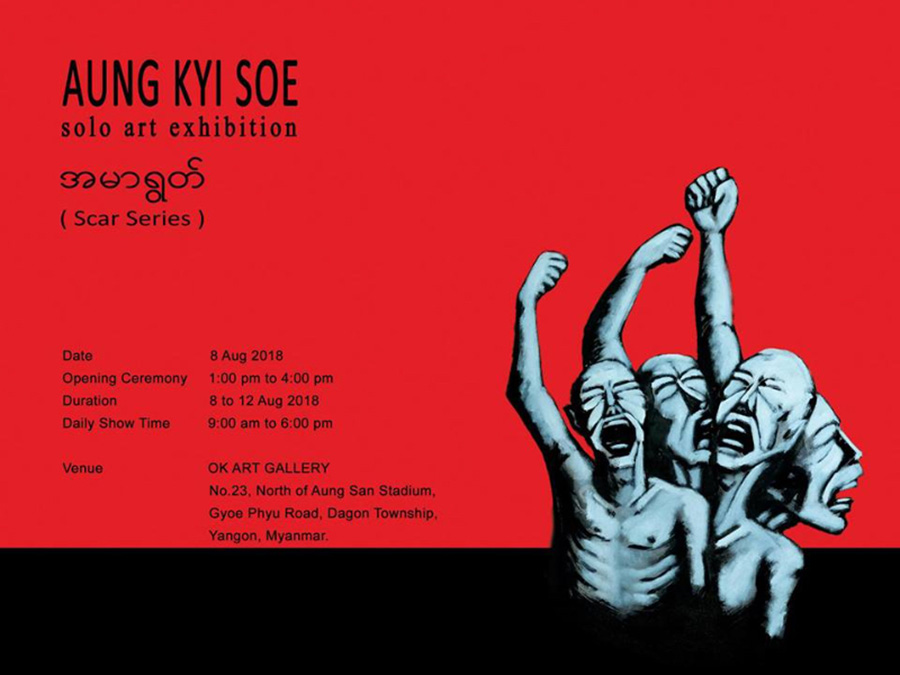
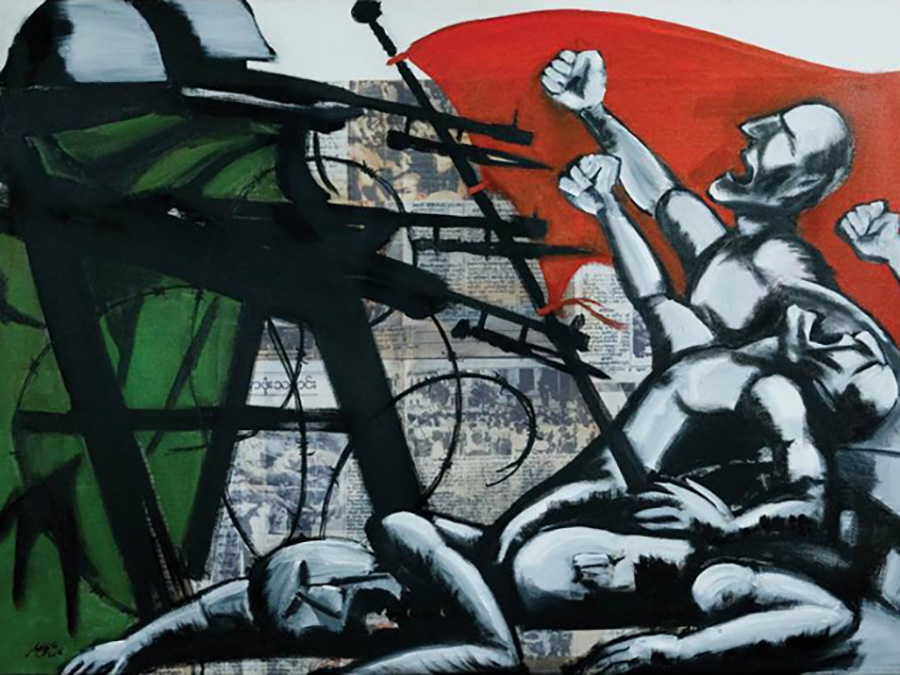
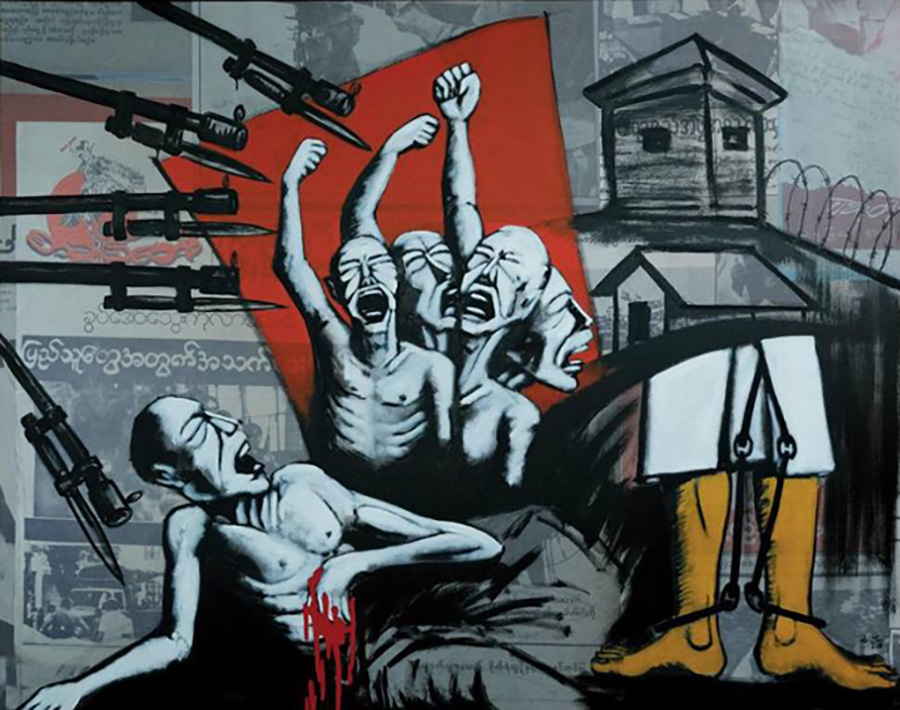
| Artist Reopens “Bleeding Wounds” With Exhibition Inspired by 8888 Uprising Posted: 03 Aug 2018 02:59 AM PDT Aung Kyi Soe describes the popular pro-democracy uprising in August 1988 as a scar. "Scars remain even after wounds heal," he said. The 8888 Uprising will mark its 30th anniversary on Aug. 8. But Aung Kyi Soe still cannot forget the bitter experiences that have left him with emotional scars.
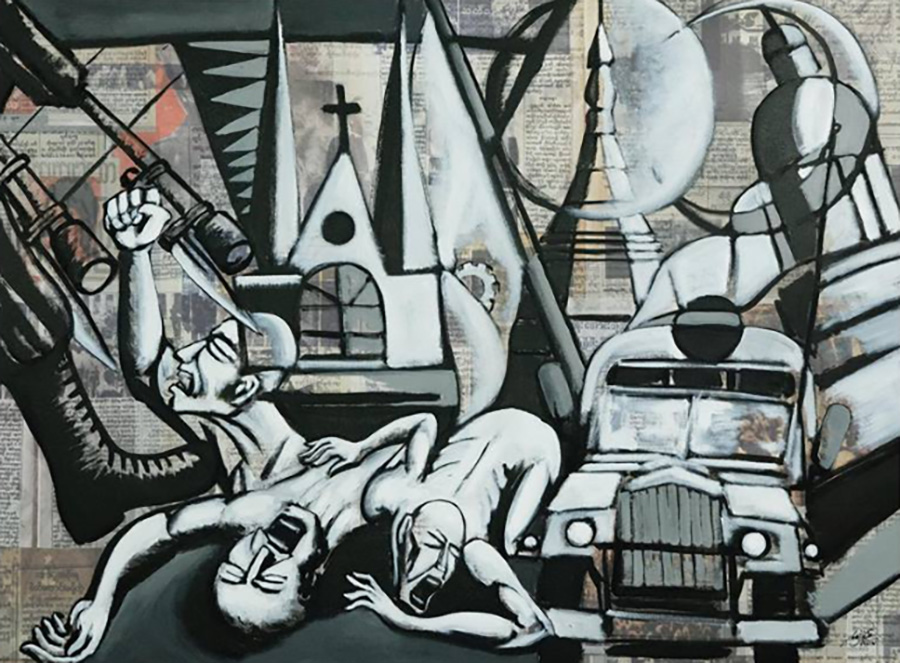
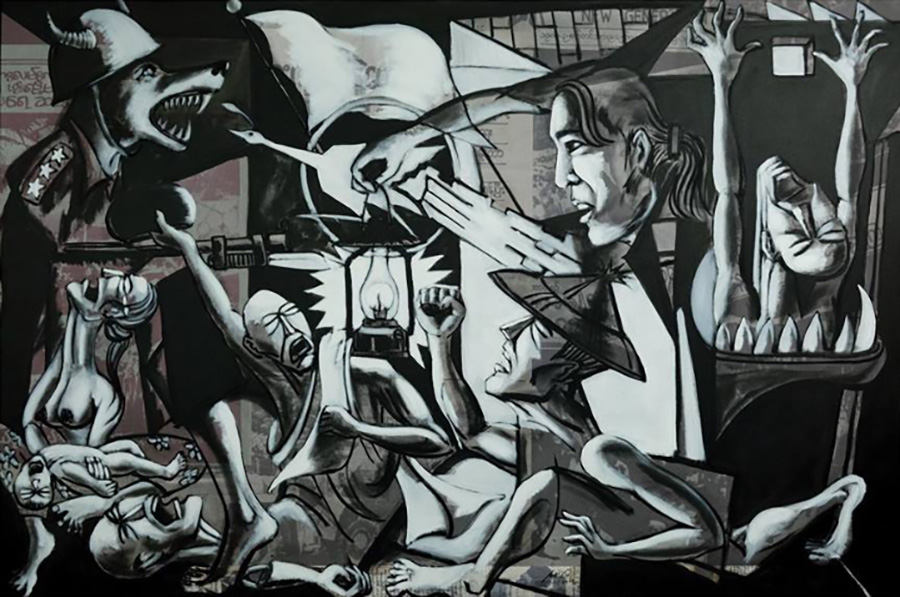
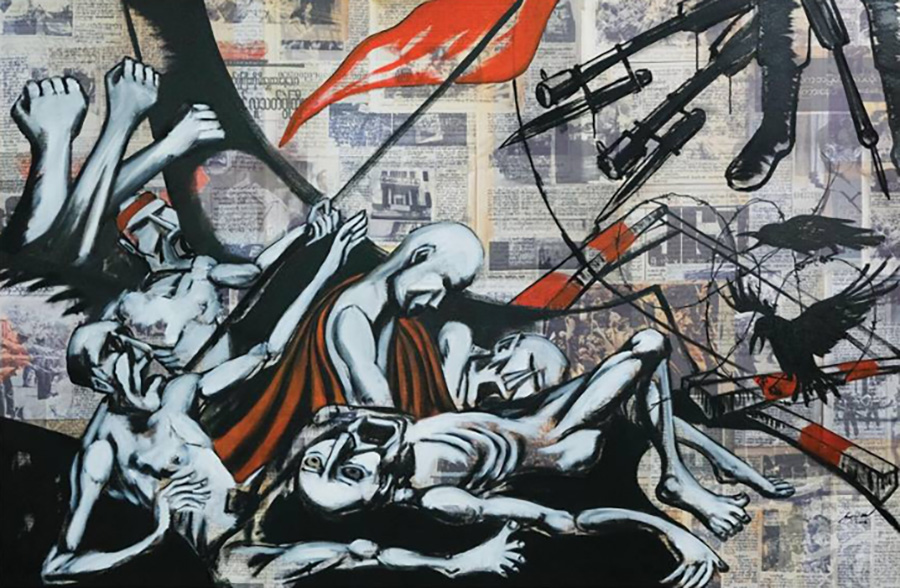
The artist has brought those scars to the OK Art Gallery in Yangon's Aung San Stadium to relive those dark days of suppression. Against a backdrop of images of newspaper pages from August 1988, Aung Kyi Soe has depicted hammers, sickles, peacocks, the flag of the Burma Socialist Programme Party, bayonets, students, monks and the crackdown. The artist said his paintings were influenced by Spanish artist Pablo Picasso's Guernica, which is regarded by many art critics as one of the most powerful anti-war paintings in history.
His works vividly portray the steely determination of the people of Myanmar to achieve democracy. Despite the bleeding wounds, people are raising their hands in defiance. Despite others being shot dead, despite others being killed with bayonets, despite others being shackled, they still demand democracy. Aung Kyi Soe's subjects are usually political or involve social issues facing the country. The artist has so far held four solo art exhibitions. His paintings are particularly popular with foreigners. More than 10 of his works will be on display at the exhibition. They are available for prices ranging from US$1,000 to US$2,000. The exhibition will be held through Aug. 12. The post Artist Reopens "Bleeding Wounds" With Exhibition Inspired by 8888 Uprising appeared first on The Irrawaddy. |
| Anti-Corruption Commission to Look into Decision to Drop Comedian’s Murder Case Posted: 03 Aug 2018 02:40 AM PDT YANGON — Myanmar's Anti-Corruption Commission will look into allegations of corruption in the controversial decision to drop an investigation into the murder of Facebook comedian Aung Yell Htwe. In a statement issued Friday, the commission acknowledged that news reports had spread suggesting the case might have resulted from corrupt activity. The agency said the commisioners had unanimously agreed on Thursday to look into the case, before deciding whether there was sufficient evidence that violations of the Anti-Corruption Law had taken place to warrant an investigation. Under amendments to the Anti-Corruption Law passed in June, the commission can initiate investigations of civil servants widely suspected to be corrupt, and news reports of such suspicions can be taken into consideration. Three suspects in the fatal beating of Aung Yell Htwe were released on July 25 as the Yangon Eastern District Court accepted an appeal from the victim's family asking to settle the case. According to leaked court documents that went viral online, Yangon Region Attorney General U Han Htoo approved the request from the victim's family to drop the case, citing a lack of evidence implicating the accused. The release of murder suspects without any charges being filed led to a public outcry and prompted calls by lawyers, lawmakers and activists to investigate officials involved in the decision to drop the case. Lawyer U Htay told The Irrawaddy on Monday that approval from the court and from the Yangon attorney general's office were required to continue investigating the case under the Anti-Corruption Law. The commission's first announcement regarding the case was released after President U Win Myint met with Union Chief Justice U Htun Htun Oo, Union Attorney General U Tun Tun Oo and Anti-Corruption Commission head U Aung Kyi on Tuesday morning at the Presidential Palace in Naypyitaw. During the meeting, the President told the Union officials to investigate the reasons for the dropping of the case and to see that justice was served in accordance with the law. On Tuesday, the Yangon Region High Court summoned the three suspects — Than Htut Aung (a.k.a Thar Gyi), Pyae Phyo Aung (a.k.a Aung Lay) and Kyaw Zaw Han (a.k.a Kyaw Zaw). The post Anti-Corruption Commission to Look into Decision to Drop Comedian's Murder Case appeared first on The Irrawaddy. |
| Prosecutor, Defendant in U Ko Ni Murder Trial Squabble Over Insult Posted: 02 Aug 2018 11:51 PM PDT YANGON — A bitter argument broke out at Yangon’s Northern District Court on Thursday between a prosecutor and a defendant in the murder trial of prominent lawyer and legal adviser to the ruling National League for Democracy U Ko Ni, who was assassinated last year. The row erupted after prosecutor U Ne La called Kyi Lin, who fatally shot U Ko Ni outside Yangon International Airport in January last year, a "yokel" and the defendants scorned the lawyer, said another prosecutor, U Robert San Aung. "Police procedure Section 138 allows shackling any dangerous criminal. So we asked the court to shackle [Kyi Lin at the trial]. Then [defendant] Zeya Phyo responded that we spoke nonsense even though we are lawyers," U Robert San Aung told reporters. He said they asked for the shackles because security arrangements were not very good at the court. "I responded because they spoke indiscreetly in violation of the law even though they are lawyers. They still talk irresponsibly even though they are lawyers. I have a record of all the things they said. Sometime in the future I will take legal action against this," Zeya Phyo told reporters. At Thursday trial, another defendant, Aung Win Zaw, was cross-examined by U Ne La and Kyi Lin's lawyer, U Kyaw Kyaw Htike. "According to questioning based on CCTV records at the [Yangon] airport, it became clear that Aung Win Zaw watched U Ko Ni leaving [the airport]. He left shortly after U Ko Ni got out [of the airport]. This is one of the key findings of the case," said U Ne La. Aung Win Zaw also testified that he did not know the whereabouts of his brother Aung Win Khaing, who is believed to be the mastermind behind the assassination. He was last seen in Naypyitaw in February 2017. U Kyaw Kyaw Htike said he mainly asked why police requested that the court remand Aung Win Zaw only after he had been detained for three days. "According to police accounts, he was held on remand only after he was detained for three days. I asked who had the authority to keep him in custody for three days. According to the law, no one shall be detained for more than 24 hours," U Kyaw Kyaw Htike told reporters. The Yangon Region High Court in June revised the charges against several of the defendants in the case. The court dropped charges relating to the import, export and possession of firearms against Aung Win Zaw. He is now facing charges of conspiracy to commit murder under Section 302 (1) (b) of the Penal Code along with Kyi Lin, who fatally shot U Ko Ni and taxi driver U Ne Win. Additionally, the charge against Zeya Phyo was changed from conspiracy to commit murder to aiding and abetting an offender. Kyi Lin is still facing a murder charge and a firearms charge. Another defendant, Aung Win Tun, is charged with harboring an offender under Article 212 of the Penal Code. The court granted him bail in March after he deposited 50 million kyats (about $37,300) to secure his release. Defense lawyers have appealed to the Union Supreme Court to revise the charges. It will deliver a ruling on the appeal on Aug. 22. Translated from Burmese by Thet Ko Ko. The post Prosecutor, Defendant in U Ko Ni Murder Trial Squabble Over Insult appeared first on The Irrawaddy. |
| Philippines Nabs Cleric Over Bomb Claimed by Islamic State Posted: 02 Aug 2018 11:01 PM PDT MANILA – The Philippine military said on Thursday it has arrested a Muslim cleric who knew in advance about a bomb that killed 11 people on Basilan Island in an attack earlier this week that raised fears of Islamic State involvement. Acting on a tipoff, scout rangers raided the home of Indalin Jainul, alias Ustadz Abdulgani, 12 hours after Tuesday’s bombing in Lamitan town. Informants told the army that the cleric, 58, knew the bomb would go off and had been helping foreign operatives reach Basilan from Malaysia, according to army spokesman Gerry Besana. A grenade was found at his home. Jainul is being charged with multiple murder and illegal possession of explosives. His family protested what they said were trumped-up charges. Islamic State claimed responsibility for the attack, which killed five militia members, a soldier, and four civilians, including a child, calling it a “martyrdom operation.” The driver of a van carrying the device also died. He was believed to have detonated the device when questioned at the checkpoint. Defense and military officials dismissed the Islamic State claim as propaganda, with Defense Secretary Delfin Lorenzana describing the claim as “just speculation.” Basilan is a stronghold of the Abu Sayyaf, a group known for its banditry and kidnapping, though it has pledged loyalty to Islamic State. The attack came days after Philippine President Rodrigo Duterte made peace overtures towards the Abu Sayyaf, following his approval for an autonomy plan sought for decades by leaders of the region’s Muslim minority. Vehicle bombings are rare in the Philippines, despite decades of separatist and Islamist violence that have destabilized the southern Mindanao region. Security experts say that although Islamic State has no known affiliate in the southern Philippines, it has ties with local extremists who have given refuge to foreign radicals, particularly from Malaysia and Indonesia. The scope of Islamic State’s influence became clearer last year when an alliance of black-clad fighters occupied Marawi City for five months, taking hostages, destroying churches and flying black flags in scenes reminiscent of Iraq and Syria. More than 1,100 people were killed. The post Philippines Nabs Cleric Over Bomb Claimed by Islamic State appeared first on The Irrawaddy. |
| Ethical Fashion Empowering Underprivileged Women Posted: 02 Aug 2018 10:32 PM PDT YANGON – Modern clothing, bags and shoes featuring fabrics in traditional patterns is an up-and-coming fashion trend in Myanmar today, one that has seen an increase in employment opportunities for women too. One particularly successful company doing just that is Virya Myanmar, a self-sustaining business which provides work benefits and safe working conditions for its female employees. Workers also benefit from high-quality training programs and an environment where young women feel financially and emotionally independent and can improve their interpersonal skills. Virya Myanmar founder Ma Pyone Thet Thet Kyaw started the business less than two years ago choosing to make causal, smart-casual, formal and special occasion wear using traditional fabrics.  She had a desire to open a social business for women and girls from underprivileged backgrounds who could benefit from their passion for designs and fashion. "Those who understand [the concept of a social enterprise] come to our shop,” said Ma Pyone Thet Thet Kyaw, adding that she gets both domestic and international customers, including buyers from Japan, Korea and Singapore. However, because Myanmar people are not so familiar with her concept, they often prefer to go to local tailors who charge less or to famous tailors where they can have high quality clothing made. Typically, Myanmar women stick to the view that traditionally woven fabrics are only suitable for traditional styles of longyi and fitted tops. Thus, the dressmaker said, it is hard for them to accept the idea of creating casual dresses using high quality traditional fabrics. "We have to explain to our customers that we use naturally dyed, quality woven fabrics," she said. "If our fabrics were of a low quality and we used under-skilled tailors, we would only produce cheap products. We always consider our customer and set fair prices."  Ma Pyone Thet Thet Kyaw started sewing at the age of 15, first learning how to sew an old style of women's shirt from her grandmother. But the idea for this social enterprise didn't occur to her until 18 years later. She was awarded a Chevening Scholarship and attended the University of Birmingham from 2011 to 2012 to study international development. Prior to moving into the social enterprise realm, she worked with the UK-funded Department for International Development (DFID) for five years as a governance advisor. Working in the development field ultimately led her to the idea of starting her own social enterprise. She combines her passion with her social enterprise concept, “so that I can be of direct support to the people who are depending on this income for their survival," she told The Irrawaddy. While running the business, Ma Pyone Thet Thet Kyaw, now 36, shares her knowledge by providing free training sessions to talented young women. She coaches and mentors them, and now who were once her trainees back when Virya began in Oct. 2016 are now employees at her shop. She wants her trainees to gain knowledge and skills in order to fill the gap caused by a lack of skilled labor in the tailoring sector. She wants them to understand both sewing and designs, as she does. "The designer profession was not popular during my youth and free sewing training was uncommon. I learned from what I saw with a handful of designers," she recalled. "When those tailors were talented with design patterns, we could make beautiful dresses. When they weren't, the design and actual dress didn't match." Virya Myanmar, originally called Virya Couture, also supports female weavers by using a fabric supply chain from the women of Sonetu Chin, Rakhine, Mro and Mon ethnic groups while her silk fabrics sourced from Inle-based weaving centers are usually used for formal and wedding dresses.  She sources the fabrics from those women weavers who are empowered to gain awareness to manage waste in their community as well as sustaining their incomes. She collaborates with the groups, providing community education including training about the natural dye process and waste management for the women of the local ethnic groups in her supply chain. "We still cannot completely control the supply chain, but we do our best wherever possible," she said. Her products are not yet available on a commercial scale globally, but Virya Myanmar can send individual products abroad if they are ordered, she said. Some international brands have approached Virya Myanmar about making clothes for them but demanded that the labels name their specific brand, which she did not accept. "Our locals work hard to create a fine product and if they are not being credited, we don't want that. When products are labelled 'Made in Myanmar' and go to the global market, the prices may go up but the producers still earn little and are kind of neglected," she said. The post Ethical Fashion Empowering Underprivileged Women appeared first on The Irrawaddy. |
| Pompeo Takes Indo-Pacific Vision to Mahathir’s Malaysia Posted: 02 Aug 2018 10:20 PM PDT KUALA LUMPUR — US Secretary of State Mike Pompeo began a four-day visit to Asia to promote a US vision of transparent, private sector-led investment with a stop in Malaysia, which has ordered a review of the sort of massive Chinese projects Washington questions. Pompeo arrived in Kuala Lumpur on Thursday evening en route to ASEAN regional meetings in Singapore. He will meet Malaysia’s 93-year-old prime minister, Mahathir Mohamad, on Friday morning to congratulate him on an unexpected May election victory that returned him to power on a pledge to clean up government. Mahathir had an often scratchy relationship with the United States and other Western countries while Malaysia’s longest serving prime minister from 1981 to 2003. However, though he often lambasted their supposed hypocrisy, underlying cooperation in areas ranging from business to security ran deep. Pompeo is the most senior US official to visit Mahathir since his election and will be looking to the present, a senior US State Department official told reporters traveling on Pompeo’s plane. “He will congratulate Mahathir,” the official said. “Secretary Pompeo is arriving in Kuala Lumpur with 2018 in mind. There’s a long history in both countries. We have a comprehensive partnership with many areas of cooperation.” He said the meeting would be an opportunity to talk about the Trump administration’s Indo-Pacific strategy and a vision for an “open, transparent, rules-based region” that Pompeo outlined in a speech in Washington on Monday. US officials say the strategy does not aim to compete directly with China’s massive Belt and Road Initiative, which involves dozens of countries in an estimated $1 trillion of mostly state-led infrastructure projects linking Asia, parts of Africa and Europe, but rather to offer a more sustainable alternative by encouraging private sector investment. This may strike a chord with Mahathir, who has called for the review of several projects signed by his predecessor, Najib Razak, who is under investigation in Washington over the scandal-ridden state fund, 1Malaysia Development Berhad. Mahathir has said Malaysia will renegotiate a $14-billion deal for a domestic rail project that is being developed by Chinese companies, saying the terms are damaging for Malaysia. He has canceled a high-speed rail link with Singapore for now. At the same time, he said his government would welcome investment “from China or any other country” if companies were willing to commit to projects that would create jobs for skilled workers in areas like technology and research and development. Perhaps less welcome for Mahathir, who is expected to visit China from Aug. 17 to 21, will be President Donald Trump’s aggressive trade stance in Asia, which has seen him launch a trade war with China and take aim at allies and partners too. “In line with our president’s objectives, it’s a trading relationship we are hoping can continue to be free and fair and we can bring about some balance to the trade deficit we have with Malaysia,” the senior US official said. Murray Hiebert, a Southeast Asia expert at Washington's Center for Strategic and International Studies, said Pompeo’s Kuala Lumpur stop would be largely a “meet and greet” to rekindle an old relationship. “He says he wants to be more firm on the South China Sea and to renegotiate these projects with the Chinese and there might be some opportunity for the US; so I think Pompeo just wants to get a measure of the man and see what they can do.” Malaysia is one of the several territorial rivals in the South China Sea, which China claims in its entirety. Among the security issues Pompeo is expected to discuss in Singapore and on a following stop in Indonesia are what Washington and its Asian allies see as China’s excessive territorial claims. The post Pompeo Takes Indo-Pacific Vision to Mahathir’s Malaysia appeared first on The Irrawaddy. |
| Thailand to Mark Youth Football Team’s Dramatic Cave Rescue With Museum Posted: 02 Aug 2018 09:59 PM PDT BANGKOK — Thai construction workers on Thursday began building a museum to commemorate the dramatic cave rescue of a youth football team in the northern province of Chiang Rai and the death of one of the divers. The 12 boys, aged 11 to 16, and their 25-year-old coach went missing on June 23 while exploring the cave complex and were rescued more than two weeks later during a perilous three-day mission by foreign and Thai divers that gripped audiences around the world. Work on the museum began after a traditional Buddhist ceremony on Wednesday at the Tham Luang cave, in which authorities asked for the blessing of local spirits. The museum, which is expected to take about five months and 10 million baht ($300,000) to build, is being funded by a Thai artist, Chalermchai Kositpipat, a Chiang Rai native. “This place will be very beneficial for our country, as it will commemorate the multinational cooperation and the hero who sacrificed his life. Tourists from around the world will visit this place,” Chalermchai said. Thai diver Samarn Kunan died after he lost consciousness during a mission to place oxygen tanks deep inside the cave. A four-meter statue of Samarn, currently being sculpted, will be placed in front of the museum. The museum will also house a 13-meter-long painting, which features rescuers, including the British divers who first found the boys. Eleven of the boys have been spending time as Buddhist novices to honor Samarn. On Saturday, they will leave the temple to return to normal life. The post Thailand to Mark Youth Football Team’s Dramatic Cave Rescue With Museum appeared first on The Irrawaddy. |
| General Aung San and the Nation’s Development Posted: 02 Aug 2018 05:46 PM PDT July 2018 marked 71 years since General Aung San was assassinated. During these years, we had the AFPFL government, the caretaker government, U Nu's Pyi Daung Su government, the revolutionary government, etc. All together, there were eight governments. All these governments performed homage-paying ceremonies at the Martyr's Mausoleum every year on July 19. It is however apparent that paying homage every year does not necessarily mean following the principles and programs of the national leader. The proof of this is that Myanmar, despite being one of the first countries in the region to attain independence, and in spite of its rich resources, presently belongs to the group of least developed countries in ASEAN, and in the world in general. This statement requires a review of the principles and the programs advocated by Gen. Aung San during his lifetime. These can be summarized as follows:
After 71 years, we find our country’s main requirements are the same two as existed in the time of Gen. Aung San. Regarding the task of national unity, the representatives of the defense forces as well as of the elected bodies of the government are ostensibly negotiating to achieve peace and tranquility for the country. Regarding development, U Aung San, during a short period of around eight months as the chief of the cabinet, initiated a development plan for the country with the objective of terminating the colonial economy and encouraging the development of the industrial sector. In 1945, Governor Reginald Dorman-Smith came back to Yangon with the "Blueprint for Burma" he and his exiled government had worked out in Simla during the war. This plan was to carry on with the 1935 Burma Constitution while separating the five states of Shan, Kayin, Kayah, Kachin and Chin from the Union. The people of the country and the AFPFL rejected Dorman-Smith's "White Paper Plan". In September 1946, following the change in British government that brought Clement Attlee to power, the new governor, Hubert Rance, arrived and Bogyoke Aung San became the head of the cabinet. In this short period, the country saw the launch of its most important plan, the "Sorrento Villa Plan", also known as the "Economic Development for Burma" plan. (Sorrento Villa is the building at the corner of Pyi Road and Hanthawaddy roundabout, presently known as the Sar-Pe-Baik Hman Building.) Bogyoke Aung San and later democratic governments understood the significance of the country’s long-term development plans and the requirement to develop the industrial sector of the country. This policy was adopted by U Nu’s AFPFL government, which applied measures to develop the industrial sector, and adopted a policy of export orientation and import substitution. Under this policy, the country exported textiles and processed foodstuffs starting from 1953 — the first time in history that Myanmar exported industrial products. In recent years, we have had politicians who say publicly that Yangon shall reach the standard of Singapore in 10 years, or that Myanmar shall overtake Singapore in 20 years. It is astonishing how some responsible persons can make such statements without any basis. In the first place, we have 14 states and divisions and over 400 towns; any sensible person would ask, "Is it fair and justified to have only Yangon be highly developed, from the standpoint of national unity?" Additionally, there are several technical issues such as: In Yangon, only 30 percent of households receive water supplied from the YCDC; only 60 percent of households have electric meter boxes; around 50 percent of the areas in Yangon suffer from floods whenever there are heavy rains, and so on. It would take more than 10 years just to overcome these basic challenges. Yangon and Singapore have similar populations, of about 5.5 million. In terms of area, Yangon is over 300 sq. miles while Singapore is slightly smaller. Singapore has about 600,000 vehicles and Yangon about half that, and yet, in peak hours, it takes about three hours to drive from the western suburb of Hlaing Thaya to Sule Pagoda in the heart of Yangon’s CBD. Just to provide some sense of the time needed to develop city infrastructure, Singapore started with the construction of the MRT (Mass Rapid Transport) system in 1987. After 26 years, in 2013, only 40 percent, or 83 km, of the line was complete. At that time it was used daily by 1 million people. The whole 200 km was completed in 2016 and it now has 3.1 million passengers daily. Regarding the statement on Myanmar overtaking Singapore in 20 years, Myanmar is a country of 2,612,200 sq. miles, while Singapore's area is 277 sq. miles — slightly smaller than Yangon's. Myanmar has a population of over 50 million and Singapore just over 5.5 million; the per capita GDP of Myanmar is around USD5,800, whereas Singapore’s per capita GDP is more than 15 times higher at USD87,900. Their circumstances and development levels are vastly dissimilar. Among ASEAN nations, more appropriate comparisons would be with Vietnam (per capita GDP USD6,400) or Laos (per capita GDP USD5,700). However, a much larger percentage of the population has electricity in Laos than in Myanmar. Even our immediate neighbor Thailand's per capita GDP of USD17,000 is three times that of Myanmar's. The attached table compares ASEAN nations' development indicators. Per capita GDP is the most important figure for this purpose. However, the percentage of the population living below the national poverty line and percentage of households with electricity are also closely related to the countries' general development. In general, statements on the country’s progress, like when and how the country’s GDP shall increase, issues on the industrial sector, on electrification, communication, unemployment, etc., should only be made based on scientific facts. Only the country’s long- and short-term plans can provide reliable and convincing information. Bogyoke Aung San started the country’s development plan during his eight months in office as the head of the cabinet. It is time for us to launch a comprehensive development plan — a requisite for a country that has suffered five decades without parliamentary democracy.
Water supply, drainage, roads, electricity, etc. are material and physical issues that can be solved within a few decades if there is money available, if we have Devas to help us with billions of dollars. Foreign companies can construct for us the underground trains, Yangon’s floods can be eradicated with underground drains and sluice gates, and so on. However, our problem is that we do not even have qualified engineers and technicians to maintain these modern systems. The main issue facing our country is "comprehensive development" — the education, morals and attitudes of our people towards society and the environment. Every day we observe our people trying to get into buses without queuing, with no consideration for pregnant women, the elderly or the handicapped. Many drivers have no respect for the traffic rules; many of us chew beetlenut and have the habit of spitting, etc. Garbage being thrown out of very expensive cars straight onto the streets is a common sight; we can therefore conclude that material wealth cannot be equated with high cultural and educational standards. The citizens of Myanmar by tradition are polite and cultured people, but five decades under dictatorship, and living with the injustice and inequality, the corruption, the deprivation of such basic rights as the right to work and the right to education, etc., have created an attitude in many of our people of self-preservation: get oneself into the bus and get oneself moving as quickly as possible. This is reflected in our environment every day. It is time we started re-educating our people about our old traditions — to respect the elderly, to give preference to the weak and the handicapped — to begin a re-education process of "the way we were". In summary, programs on education, civics and behavior-improvement should also be an integral part of the nation's development plans. We should begin with such programs because education is the most important asset we can possess, and such programs are less costly than building new cities. Dr. Kyaw Lat is an architect and urban planner who has worked with the Department of Human Settlements and Housing Development, Ministry of Construction and the United Nations Centre for Human Settlements (Habitat). He was also a professor at Yangon and Mandalay Technological universities, professor at Cologne University of Applied Sciences, Germany, and finally before his retirement an advisor to the Yangon City and Development Committee from 2011 until 2016. The post General Aung San and the Nation's Development appeared first on The Irrawaddy. |

| You are subscribed to email updates from The Irrawaddy. To stop receiving these emails, you may unsubscribe now. | Email delivery powered by Google |
| Google, 1600 Amphitheatre Parkway, Mountain View, CA 94043, United States | |


