Tuesday, August 28, 2018

The Irrawaddy Magazine

The Irrawaddy Magazine


Government Quickly Distances Itself from Facebook Bans on Military

Posted: 28 Aug 2018 08:18 AM PDT

YANGON—The government moved quickly on Monday to deny that it had any role in or advance knowledge of Facebook's decision to ban the pages and accounts of several senior Myanmar military officials including Army chief Senior General Min Aung Hlaing.

Speaking to reporters in Naypyitaw late on Monday evening, President's Office spokesperson U Zaw Htay said that soon after Facebook made the announcement, he received calls from military officials, including a number of lieutenant-generals, asking if he had any information about the account closures.

Amid heavy condemnation for failing to combat hate speech against Rohingya and other Muslims, the social media giant on Monday announced it was removing 18 Facebook accounts, one Instagram account and 52 Facebook pages of military individuals and organizations "to prevent the spread of hate and misinformation" on the platforms.

Military commander-in-chief Sen-Gen. Min Aung Hlaing and Myawady TV — the military's propaganda television network — were among those whose pages and accounts were banned.

"Neither the government nor [the government's] social media monitoring team played a part in [the decision by Facebook]," U Zaw Htay said.

"We are concerned that misunderstandings that the government played a role in the decision will hinder the government's efforts on national reconciliation," he said.

The government has asked Facebook to more fully explain the bans.

Facebook's action came hours after the UN Human Rights Council's fact-finding mission on Myanmar released its report, which found that the actions of Myanmar's military leadership against the Rohingya had "genocidal intent".

"We want to prevent them from using our service to further inflame ethnic and religious tensions," Facebook said in its announcement. The pages and accounts' content violated its Community Standards, it added.

Former Lieutenant-General U Thaung Aye, a Lower House lawmaker for the military proxy Union Solidarity and Development Party (USDP), described Facebook's move as "one-sided", given that the military had launched several investigations into accusations of human-rights violations and taken action against the perpetrators.

"The Tatmadaw [Myanmar's military] is a really strong institution in our country. Those [Facebook] accounts were used by this institution to report its good activities. Myawady TV is also a news agency reporting in line with the [media] policy for all people… To me, it is like insulting the sovereignty of our country. The government should respond decisively," he said.

Veteran journalist and Myanmar analyst Bertil Lintner said the Army chief would likely be much more upset about being excluded from Facebook than at the prospect of being brought before the International Criminal Court, because the ban is something that really impacts him directly.

Followed by millions of the Army chief's supporters and other members of the public, the removed accounts and pages were the military's main channels of communication with the people.

Some believed the Facebook ban would make it more difficult for observers to monitor the military, the military chief and the activities and interactions among its supporters. However, U Myint Kyaw, a member of the Myanmar Press Council, downplayed the move's impact, pointing out that the military already has its own websites.

He added that one positive impact of the ban is that it would remove a platform for lobbying by certain groups who were trying to influence people.

In his view, Facebook's removal of the military's accounts and pages was a political move aimed at an organization, rather than an attempt to curb hate speech and disinformation in Myanmar.

"The impact won't be significant. But it could harm their dignity. And if the military assumes the government was behind it — as there were meetings between Facebook and the Myanmar government before — it won't be good for military-government relations," he said.

Ma Mon Mon Myat, a doctoral student at the Institute of Religion, Culture and Peace at Payap University, said Facebook's removal of the blue checkmark verifying Sen-Gen. Min Aung Hlaing's account was intended as an act of "naming and shaming". She said that taking such action against an individual for being accused of human rights abuses in a UN report was childish, despite its stated aim of targeting hate speech.

However, she added that she welcomed the closure of other propaganda accounts with millions of followers that were spreading hate speech and contributed to the promotion of disinformation in the country.

Yangon regional lawmaker Ko Nay Phone Latt, a free-speech advocate who has campaigned against online hate speech, pointed out that it was a weakness that Facebook has been used as the primary official channel for news releases and public communications, adding that the government should also consider the need to strengthen the country's independent media.

He didn't think Facebook's removal of military accounts would reduce the spread of hate in the country.

"Indeed, hate speech mainly spreads via fake accounts and pages, rather than verified accounts. Without monitoring those accounts systematically and taking action against them, [hate speech] won't be reduced," he said.

Moe Moe contributed additional reporting from Naypyitaw.

The post Government Quickly Distances Itself from Facebook Bans on Military appeared first on The Irrawaddy.

Myanmar Govt Rejects UN Report on Military Human Rights Violations

Posted: 28 Aug 2018 06:07 AM PDT

YANGON—A spokesperson of the Myanmar government has rejected the UN fact-finding mission's report which calls for genocide charges against the country's military leadership for attacking Muslim Rohingya and which also blames the country's de facto leader Daw Aung San Suu Kyi for failing to intervene.

The UN Human Rights Council released its 'Report of the Independent International Fact-Finding Mission on Myanmar' on Monday. The council set up the mission in March 2017 based on its resolution "to establish the facts and circumstances of the alleged recent human rights violations by military and security forces, and abuses, in Myanmar, in particular in Rakhine State.'

A member of the mission Christopher Sidoti told media on Monday the mission has concluded that criminal investigation and prosecution is warranted, and should focus on top Tatmadaw (Myanmar's military) generals in relation to three categories of crimes under international law: genocide, crime against humanity and war crimes.

"The Security Council should act to refer Myanmar to the International Criminal Court or to establish a special ad hoc tribunal on Myanmar," he said.

The report names the Myanmar Army's commander-in-chief, Senior-General Min Aung Hlaing, and five other generals who should face justice.

A few hours after the report was launched on Monday, U Zaw Htay, the spokesperson of Myanmar President Office told media that the government had "a clear view" on the fact finding mission's report.

"Precisely speaking, Myanmar didn't accept the UNHRC's resolution, so we reject the mission's actions to implement the resolution," he said.

The spokesperson said Myanmar has dissociated itself from the UNHRC's resolution (since last year) and rejected the formation of fact finding mission.

"When the mission asked for permission to visit Myanmar, we didn't allow it and we replied we wouldn't collaborate as we didn't agree with the resolution," he said.

The report said the mission had requested in-country access four times from September last year through to March 2018 but received no official response.

"This report was shared with the government prior to its public release. No response was received," the report stated.

On Monday, the mission's chairman Marzuki Darusman told media that the single most significant factor had been addressed in the report.

"There's the role of Commander-in-Chief Min Aung Hlaing and the only way forward is to call for [his] resignation and stepping down immediately," he said.

Radhika Coomaraswamy, also a member of the mission said, "We are deeply disappointed with the State Counselor Daw Aung San Suu Kyi as [she has] not used her position or her moral authority to stand up, prevent or condemn the unfolding events in Rakhine State."

Regarding the events in Rakhine State, the report names military leaders to be prosecuted, namely Tatmadaw Commander-in-Chief, Snr-Gen Min Aung Hlaing, as well as Deputy Commander-in-Chief, Vice Senior-General Soe Win; Commander, Bureau of Special Operations-3, Lieutenant-General Aung Kyaw Zaw;  Commander, Western Regional Military Command, Major-General Maung Maung Soe; Commander, 33rdLight Infantry Division, Brigadier-General Aung Aung, Commander; and 99th Light Infantry Division, Brigadier-General Than Oo," says the report.

This is not the first call for their prosecution. In June this year, the same individuals were named in Amnesty International's report which also stated that the senior leaders along with their subordinates should be tried for crimes against humanity for the military's actions against the Rohingya community in northern Rakhine State last year.

The post Myanmar Govt Rejects UN Report on Military Human Rights Violations appeared first on The Irrawaddy.

Investigation into Land Allegedly Owned by U Thein Sein, Ex-Ministers Suspended

Posted: 28 Aug 2018 05:35 AM PDT

NAYPYITAW — An investigation into the ownership of some 900 acres (364 hectares) of land allegedly acquired illegally by former President U Thein Sein and his cabinet members in administrative capital Naypyitaw has been suspended due to legal barriers.

A task force was formed by the Naypyitaw Council to launch an investigation after 169 local farmers filed a complaint that 16 individuals including former President U Thein Sein and ex-ministers acquired lands near the village of Za Laung in Ottarathiri Township without going through the proper channels.

Under the Vacant, Fallow and Virgin Lands Management Law, the government can inspect if lands are being used or remain inactive four years after land use permits are issued. If inactive, the government can confiscate unused lands four years after permits are issued.

According to the documents seen by the task force, those lands were applied for in 2016. So, it has only been two years and it is impossible to investigate, said Upper House lawmaker U Maung Maung Swe, who is leading the task force.

The task force has therefore suggested to the Naypyitaw Council that the government's confiscated land review committee could launch an investigation, he told The Irrawaddy.

The land, located near milepost 211 on the Yangon-Mandalay Expressway, was previously owned by the Forest Department and had been used by local farmers for decades.

Ex-ministers acquired those lands in 2010, and the previous government created the Vacant, Fallow and Virgin Lands Management Law in 2012 to legitimize their acquisition of those lands, claimed U Tin Min Naing, a representative of local farmers.

"We asked the Naypyitaw Council chairman on August 21 to assign the Naypyitaw confiscated land review committee to inspect those lands," U Maung Maung Swe told The Irrawaddy.

President U Thein Sein applied for and got land-use permits, known as Form-7, said U Tin Min Naing. According to the procedure, the former president should also have applied for other forms at the concerned ward administration office to make sure there was no objection to his acquisition of those lands. But U Thein Sein got Form-7 without following the procedure, said U Tin Min Naing.

In June 2010, people living on those lands, now a mango plantation zone, were asked to leave from, apparently ordered by the former president.

Local farmers claimed that parts of their farmland along with crops and water wells were bulldozed when U Thein Sein fenced off his would-be mango plantation.

"Our farms were destroyed for no reason. About 15 acres of my land were confiscated. I had 0.5 acres of paddy fields and got a compensation of 250,000 kyats. But I didn't get compensation for land used for growing crops," said local farmer U Min Tun.

The land was permitted for growing mangos, agarwood and rubber, and a minimum 50 acres of land had to be bought at a price of 50,000 kyats ($33.25) per acre at that time, said a source close to the accused ex-ministers.

He claimed that the farmers had been compensated twice — once by the Forest Department and again by the former ministers.

"Farmers now want to get more as land prices near the expressway have increased with time," he said.

"My 20 acres of land were confiscated. I got compensation for three acres of paddy fields—1.5 million kyats. But, I didn't receive compensation for lands used for growing other crops," said U Zaw Lin.

According to locals, military officials from the ranks of captain to general as well as former government officials transferred from the military own those lands.

According to U Tin Min Naing, others who have acquired those lands are ex-ministers U Hla Tun, U Kyaw Kyaw Win, U Tin Naing Thein, U Thein Tun, U Kyaw Has, Major General Aung Than Htut, Attorney General U Aye Maung, Major General Ye Aung, Major General Ko Ko, Major General Kyaw Swe, Major General Kyaw Htay Win, Major General Htay Oo and current Labor Minister U Thein Swe.

"Farmers have not received compensation from U Soe Naing, U Maung Maung Swe, Major General Kyaw Htay Win, Major general Htay Oo, Captain Pyae Sone, Major General Ko Ko, Major General Kyaw Swe, former Home Affairs minister U Maung Oo and Major General Aung Than Htut," he said.

"Farmers want the land returned. They will only take compensation if they can't get the land back," he added.

Translated from Burmese by Thet Ko Ko.

The post Investigation into Land Allegedly Owned by U Thein Sein, Ex-Ministers Suspended appeared first on The Irrawaddy.

Govt Refuses to Allow Shan Coalition to Hold Meeting in Taunggyi

Posted: 28 Aug 2018 05:14 AM PDT

MON STATE — The Myanmar government has denied the Committee for Shan State Unity (CSSU) permission to hold a scheduled two-day meeting in Taunggyi, the capital of Shan State, Shan sources said.

The CSSU is a coalition of civil society organizations, political parties and two armed groups, the Restoration Council of Shan State (RCSS) and the Shan State Progressive Party. The organization holds periodic meetings as a forum for all ethnic Shan leaders to discuss politics, economic and social issues, security, and issues relating to land and the environment.

A director of the government's National Reconciliation and Peace Center (NRPC) informed the chairman of the CSSU yesterday by phone that the government would not allow the September meeting to proceed. The NRPC conducts peace negotiations with ethnic armed groups on behalf of the government.

"They would not give us permission for our meeting, but they did not give a reason. Why?," CSSU Chairman Sai Aik Pao said.

He said he was told the NRPC would send a letter soon explaining the decision.

The CSSU last week sent a letter to the NRPC requesting permission to hold the meeting. Planned for Sept. 3 and 4 in Taunggyi, the aim of the meeting was to support the peace process in the country, according to the coalition.

"We had already arranged a hotel for the meeting. We're really disappointed. We have no idea why they did not give us permission. We all are ethnic brothers," he said.

This is the second time the government has taken action to block a CSSU meeting. Thai authorities refused to allow a CSSU meeting to proceed in Chiang Mai last July after the Myanmar government objected to it.

Still smarting from the break-up of the meeting in Thailand, the CSSU leaders decided to hold an event in Taunggyi in September, expecting that the National League for Democracy-led government would consent to it.

The CSSU has only been given permission to hold one of the three meetings it has sought permission to hold since the NLD came to power. Sai Aik Pao said it was actually more difficult to deal with the current government than with the former government under U Thein Sein.

Many ethnic Shan leaders expressed disappointment at the decision. Some said the Myanmar government was using its power to suppress ethnic rights.

Sao Khun Sai, a political adviser to the RCSS based in Chiang Mai, said the Myanmar government gave out favors to certain groups and withheld them from others it did not like, including the Shan.

He said such actions by the government were at odds with its goal of achieving peace. He urged the government to treat all parties equally for the sake of unity.

The RCSS is a signatory to the government-brokered Nationwide Ceasefire Agreement. Sao Khun Sai said that the group signed the agreement in the belief that the Myanmar government and army would not use armed force or state power to solve political conflicts.

However, in this case the Myanmar government had used its authority to prevent the CSSU from holding the meeting, he said. Rather than taking steps to encourage ethnic Shan to strengthen ties with the Union, it seems as if the government is trying to push ethnic Shan to secede from it, he said.

The post Govt Refuses to Allow Shan Coalition to Hold Meeting in Taunggyi appeared first on The Irrawaddy.

State Counselor Tells Education Minister to Improve Library Access

Posted: 28 Aug 2018 05:04 AM PDT

CHIANG MAI, Thailand — State Counselor Daw Aung San Suu Kyi told the education minister to ensure that students always have access to libraries during a literature talk with 22 university students in Yangon on Tuesday afternoon.

This is the second literature talk she has held with university students this month. The first was in Mandalay on Aug. 11.

"Dr. Myo Thein Gyi," she said, addressing the education minister, "please make sure the libraries are not locked." She made the comment after students told her about how difficult it was for them to use libraries when they needed to, as the important books are often locked away.

The state counselor said the culture of using libraries for reading and research has been slowly fading in Myanmar's education system and in society. She said that people in Myanmar are full of enthusiasm about reading, but lack sufficient books to read. She cited her experience with the Daw Khin Kyi Foundation, established in her mother's name. Since 2012, the foundation has created libraries and distributed books.

"Books are getting rare for the public to read, it is not that they have less appetite to read," she said, adding that everyone must participate to create an environment in which books for both children and adults are available. She said children should be nurtured to love reading from early childhood.

Since the National League for Democracy came to power, it has organized a number of literature discussions for adults and kids in most towns. Daw Aung San Suu Kyi added that the government had also opened mobile libraries in 11 townships so far.

The university students, whose majors included education, medicine, information technology, architecture, foreign languages and international relations, shared their thoughts on literature and how it had influenced their lives.

The state counselor encouraged the participants to develop their analytical and critical thinking skills.

Earlier this month she urged youth to read more literature and spend less time playing games on mobile phones.

Tuesday's talk was an active one, with the participants having arrived well prepared to discuss certain talking points.

Comparing the event with previous public talks held since 2017, a commenter wrote under a live stream of Tuesday's discussion that, "This discussion has been the best."

Daw Aung San Suu Kyi has been holding talks with different groups in various locations on a range of topics including peace, youth affairs, business and literature since January 2017. She held a business talk with various economic stakeholders in Naypyitaw on Aug. 27.

As this discussion concerned literature, thoughts on poetry, novels and the role of literature in Myanmar's education system dominated.

In her introductory remarks, the state counselor said the aim of holding such literary discussions is to develop "soft power" as a tool for changing minds and attitudes. She cited the influence of Korean dramas around the world — including in Myanmar — as an example of this type of soft power. She added that it was a discussion about soft power with the information minister that led her to organize the literature talk.

The post State Counselor Tells Education Minister to Improve Library Access appeared first on The Irrawaddy.

Record Arrests in Drug Bust in Kyaukse Township

Posted: 28 Aug 2018 03:53 AM PDT

MANDALAY — Kyaukse police arrested 82 alleged drug users on Monday in a record high number of arrests for drugs in Kyaukse Township, Mandalay Region.

As part of 'Operation Eagle,' an anti-narcotic and anti-crime operation being carried out in Mandalay Region, police stormed Lattpan Village located about two miles north of Kyaukse, and arrested 74 men and 2 women, and seized a minivan and 43 motorcycles.

"We've arrested a total of 76 suspects from Lattpan village and 6 more from other areas in Kyaukse, together with some amount of drugs," said the duty officer of Kyaukse Township police office.

The police said the suspects who were found at Lattpan and Tho Tan villages had traveled there to use drugs and most of them are from Mandalay.

"Only twelve of them are from Kyaukse and the rest are from Mandalay. They are still being questioned and we will file a lawsuit against them under anti-narcotics law," said a police representative.

On Tuesday morning, police arrested a drug dealer with 2,000 yaba (methamphetamine) tablets and are currently searching for other related persons.

The seized drugs found as part of ‘Operation Eagle.'  / U Ko Ko Lwin / The Irrawaddy

"The arrest of all 83 is the highest record for Kyaukse Township so the small detention building in Kyaukse Township police station could not accommodate them," said the police officer. "We divided them into groups and sent them to police stations in Myittha, Sintgaing and Tada-U townships to keep them before we send them to Obo Prison to face the lawsuit from there."

According to the locals, Lattpan and Tho Tan villages are famous for their drug houses where users from nearby regions gather to use drugs. However, until now the police had not been able to take any action due to the risk of violence.

"Those villages are legendary for their drug houses where thugs are operating and nobody dares to approach the area. The police couldn't even approach them. There were attempts by police to storm into the area, however, they didn't arrest anyone because the news would usually get out and the drug dealers and users would run away before the police arrived," said U Ko Ko Lwin, a local member of political group 88 Generation Peace and Open Society.

He said there have been many police officers who took bribes from drug dealers and thugs and neglected addressing the drug abuses in the town.

However, movements in anti-corruption that have seen punishments for members of the Kyaukse police force who took bribes from timber smugglers have alarmed corrupt police officers.

"Thanks to President U Win Myint's instructions on anti-corruption and anti-narcotics, corruption among police officers seems to be reducing and [the police] are working more efficiently, especially on the anti-narcotics movement," said U Ko Ko Lwin.

"We hope drug abuse cases in our town will decline and soon completely vanish," he added.

The post Record Arrests in Drug Bust in Kyaukse Township appeared first on The Irrawaddy.

Restrictions on NGOs in Rohingya Camps Trouble Aid Workers

Posted: 28 Aug 2018 03:37 AM PDT

DHAKA — Reported restrictions imposed by the NGO Affairs Bureau on the operations of 41 non-governmental organizations working in Rohingya camps in Bangladesh upsets aid workers as they fear their work will be hindered without reason.

The list of NGOs was not made public but a few were listed in various dailies since Aug. 17, stating that their operations in Ukhiya and Teknaf were "banned."

NGO Affairs Bureau director-general KM Abdus Salam said the restricted 41 NGOs would be allowed to finish their ongoing projects.

"We will be strict with these NGOs when they apply for new projects," Salam said.

Abdus Salam declined to disclose the names of the NGOs or explain the reason for the restrictions.

Currently, 86 local and 36 international NGOs are implementing various projects along with 11 UN agencies at various Rohingya camps in Bangladesh.

Authorities in Cox's Bazar, however, said they only heard about the restrictions from newspapers and that they were in the dark.

Cox's Bazar deputy commissioner Kamal Hossain on Sunday said that he had heard about the ban from the media but that he had received no instructions regarding it.

"I do not know how or why the decision was made," said refugee relief and repatriation commissioner Mohammad Abul Kalam, the lead officer coordinating refugee and Rohingya issues in Cox's Bazar.

According to media reports, the 41 NGOs were operating food, sanitation and health services in the camps, where hundreds of thousands of Rohingya are living in grim conditions.

On March 6, the NGO Affairs Bureau set a framework for the local and international aid organizations to bring "transparency and accountabilities" to their activities.

In the framework, the NGOs were asked to provide all information to the Cox's Bazar district administration and the Refugee Relief and Repatriation Commission regarding development activities, project implementation, funding and employees.

The bureau also asked the organizations to focus on humanitarian activities and to not work after dark unless providing medical or emergency services.

The instruction also forbade any NGO workers from becoming involved with anti-state, anti-government or anti-repatriation activities.

Help Cox's Bazar executive director Abul Kashem said, "We had been following all instructions as prescribed and are not involved with any kind of crime. I am shocked."

"I do not know why our name is listed. This is damaging for our local organization. We are currently implementing five projects," he added.

Dhaka Ahsania Mission management reported that it was also surprised to see its name in newspaper reports. It is still continuing operations while in communication with local administrative officials.

"We have received no letter or instruction from concerned authorities. We want to work as a development partner of the government," said Ahsania Mission spokesperson Saiful Islam.

The list was prepared by recommendations from an intelligence agency, NGO workers said.

In early 2018, 12 NGOs including Gonoshasthaya Kendra, Dhaka Ahsania Mission and the Teknaf-based Society for Health Extension and Development (SHED) were barred from operating in the camps.

"We have now been given clearance although we were not told the reason behind the restriction,' said SHED executive director Muhammad Umra.

An intelligence report by the district special branch of police in Cox's Bazar in June stated that many local and international NGOs and UN agencies were indirectly discouraging the Rohingya from returning to Myanmar.

"If there are specific allegations, they should be prosecuted independently. Otherwise, NGOs should not be restricted," said human rights activist Nur Khan Liton.

Amid the confusion, 46 local and international NGOs working in Rohingya camps in a joint statement on Monday called on the Bangladesh government to "widen humanitarian space to further enable operations of NGOs delivering life-saving assistance to refugees and their host communities."

The groups also urged the government to reduce delays in granting permission for humanitarian projects, in registering NGOs and in granting visas for humanitarian workers.

"We remain committed to work with the Government of Bangladesh and the rest of the humanitarian community in country. At the same time, following the will of refugees we assist, we urge the Government of Myanmar to create conditions for their safe, dignified, voluntary and sustainable return," the joint statement read.

The post Restrictions on NGOs in Rohingya Camps Trouble Aid Workers appeared first on The Irrawaddy.

Lawmaker Resigns, Citing Lack of Trust in Regional Govt

Posted: 28 Aug 2018 01:43 AM PDT

PATHEIN, Irrawaddy Region — An outspoken lawmaker of the Irrawaddy Region Parliament has handed in her resignation, citing her lack of trust in the regional legislature and government.

Daw Myint Myint San, who represents Wakema Township Constituency 2 in the regional Parliament, submitted her resignation through a third party, confirmed the speaker of the regional Parliament U Aung Kyaw Khaing.

"I heard that she is still performing her duties as a lawmaker despite her resignation. So, we've not yet decided what to do," the speaker told The Irrawaddy.

The lawmaker applied for leave and did not attend the entire 12th regular session of the regional legislature from July 25 to August 3, according to the candidacy scrutiny committee of the regional Parliament.

The Irrawaddy was unable to contact Daw Myint Myint San. U Aung Kyaw Khaing said he would ask her about her resignation when the parliamentary session resumes next month. But he did not mention what he would do if the lawmaker does not attend.

"She is an active and shrewd lawmaker," he praised.

According to parliamentary law and by-laws, a lawmaker can resign of her own volition.

"Daw Myint Myint San has served as a lawmaker since 2012 and she is an example to us. We don't want her to resign," Daw Ni Ni Moe, a lawmaker representing Nyaungdon Township Constituency (1), told The Irrawaddy.

Daw Myint Myint San was arrested by the military regime in 2009 due to her political activities. She spent nearly three years behind bars in Insein Jail in Yangon and Katha Jail in Kachin State.

After she was released from prison in 2011, she contested the by-election for the National League for Democracy party and won a seat in the Lower House of the national legislature to represent Irrawaddy Region's Wakema Township.

Daw Myint Myint San also served as a member of the ethnic affairs committee, and the judicial, legal affairs and government's guarantees, pledges and undertakings vetting committee of the regional Parliament.

Translated from Burmese by Thet Ko Ko.

The post Lawmaker Resigns, Citing Lack of Trust in Regional Govt appeared first on The Irrawaddy.

‘Scanning’ the Imagination of a Veteran Artist

Posted: 27 Aug 2018 11:15 PM PDT

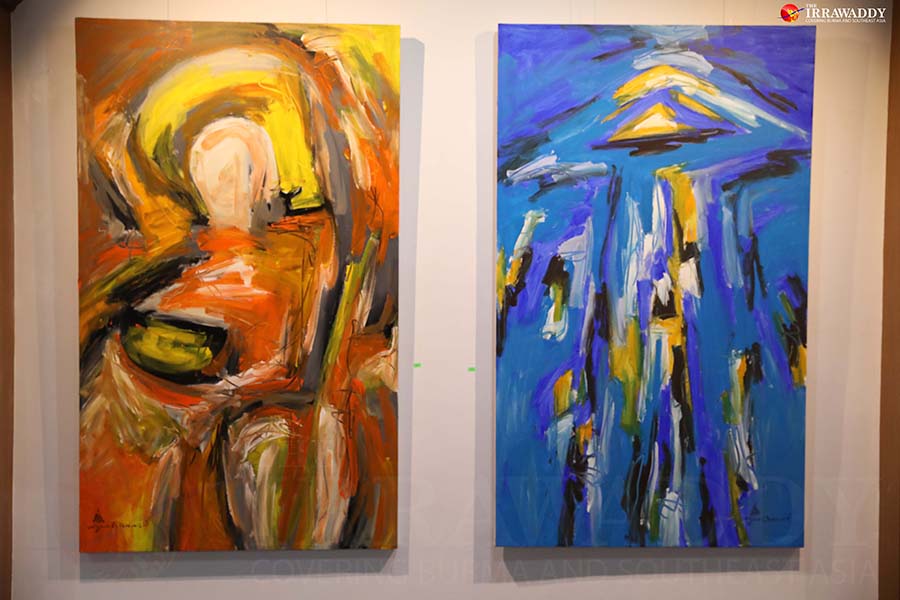
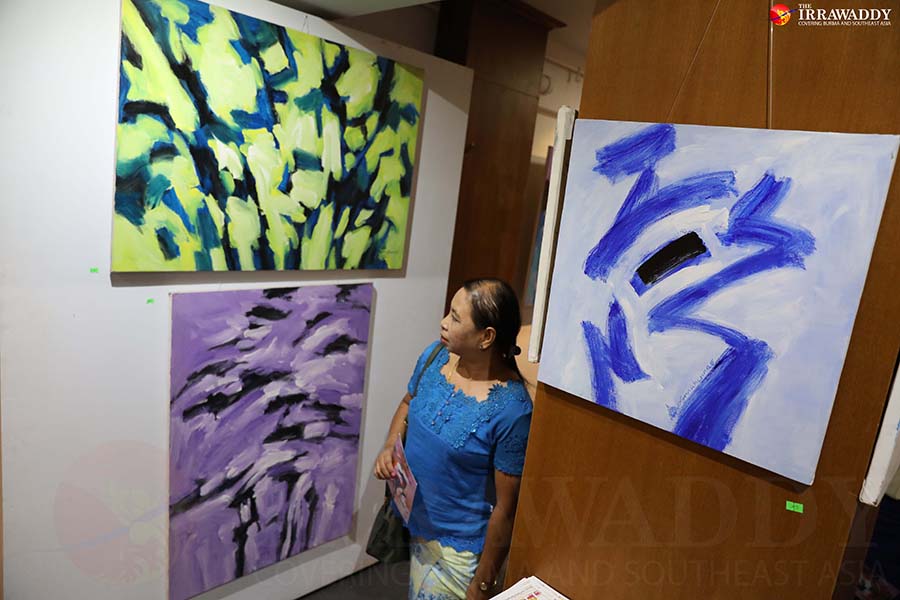
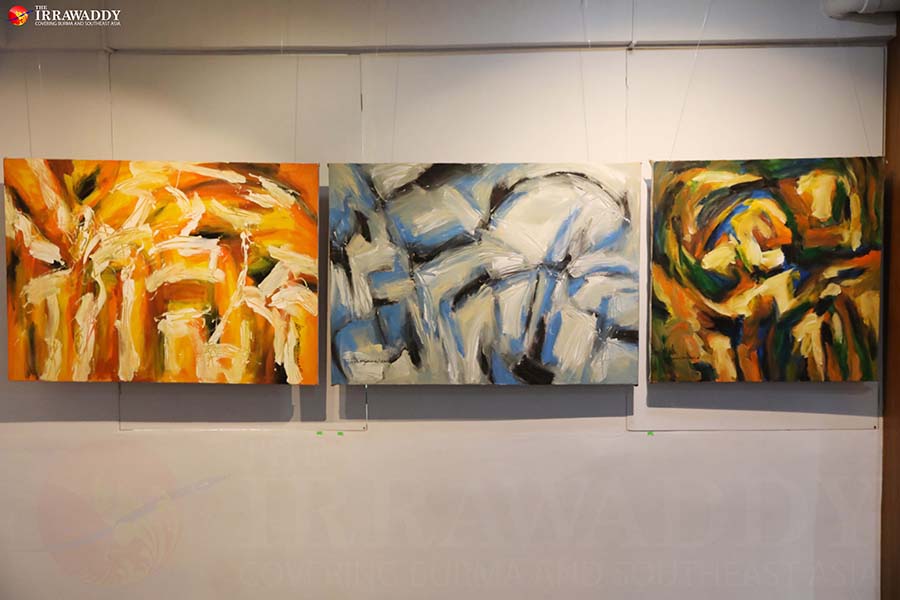
YANGON — Artist Lynn Wunna's 10th solo exhibition showcases abstract paintings he says are the products of the depths of his imagination.

"It's a record of my constantly changing mind. I have read—or 'scanned'—my mind, so I named the exhibition 'Scanning,'" the artist said.

Lynn Wunna made his name with a series of paintings drawing on Myanmar's cultural traditions, so this exhibition is something of a departure and will give the viewing public a chance to see a different side of him.

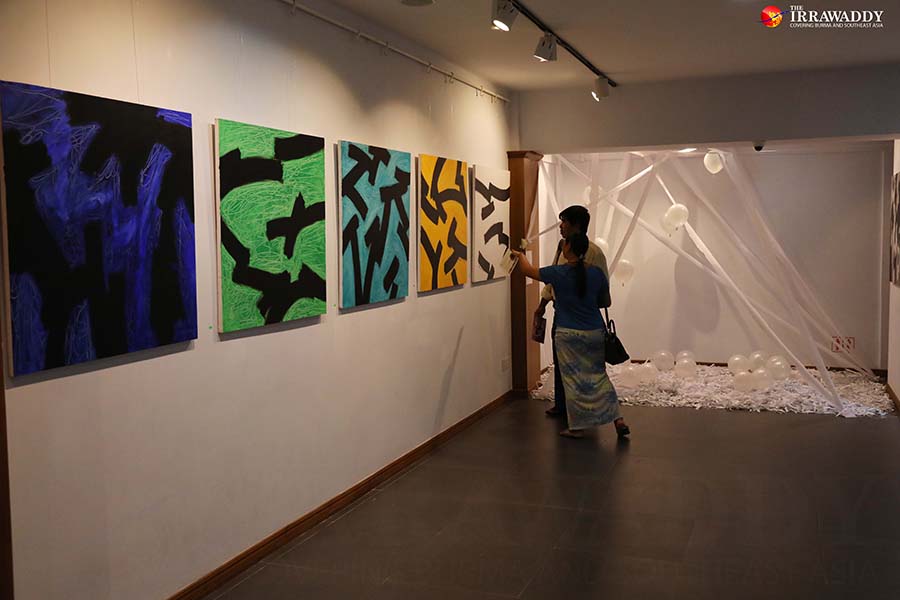
The exhibition, which will be on display at OK Art Gallery through Wednesday, features over 50 abstract paintings and two installations.

"Shake It" and "White Cave", the two installations, represent peace of mind, spiritual purity and freedom, he said.

Born in 1973, Lynn Wunna studied under Bagyi Aung Soe, widely regarded as the father of modern art in Myanmar. He held his debut solo show more than 20 years ago.

The post 'Scanning' the Imagination of a Veteran Artist appeared first on The Irrawaddy.

Experience an Aussie Dining ‘Sensation’ at Sule Shangri-La

Posted: 27 Aug 2018 10:25 PM PDT

YANGON — Sule Shangri-La is offering an "Australian Sensation" buffet prepared by Australian guest chef Mike Tafe of Mulwarra Export. The dinner buffet is available at their all-day dining venue, Café Sule, for one week only.

Modern Australia is a multicultural "melting pot" of influences and as such does not have a "traditional" cuisine of its own in the usual sense of the word.

Seafood counter. / Supplied

But in addition to indigenous ingredients and the familiar Anglo-Australian fare, the country's cooking now draws on its rich migrant history, which over the years has seen waves of immigrants from Southern and Eastern Europe, Southeast Asia and elsewhere. Dishes can be found featuring premium Australian beef, lamb, goat meat, veal, Wagyu beef, seafood, game meat, pork and specialty cheeses.

The "Australian Sensation" buffet offers diners a chance to savor a smorgasbord of these famous Australian premium ingredients, drawing on this multicultural background.

Seafood, beef, lamb, pork and vegetable dishes are served up grilled, fried, steamed and boiled, followed by a variety of desserts.

The opening night of the 'Australian Sensation' buffet at Cafe Sule, Sule Shangri-La. / Supplied

What I liked most about the buffet was the Mulwarra beef tenderloin; every bite of this medium-grilled steak was tender.

Another favorite was the roasted lamb leg. Some Myanmar people may find that lamb tastes and smells a bit too gamey, but in the hands of a chef as talented as Tafe this is not an issue; the pinkish meat was extremely tender.

Kitchen staff are on standby near the counter, ready to carve you a choice piece of roast lamb on request and serve it up with its own sauce.

Sushi and sashimi. / Supplied

Customers can choose the mashed potatoes or potato wedges to eat with the steak and roasted lamb leg—both were awesome.

Mulwarra grilled salmon was another really good choice.

The buffet costs US$39 net per person, including three dishes (all made from Australian Premium Products).

The last stop is the dessert counter. A wide range of desserts is on offer including cakes, crepes, pudding, ice cream, cookies and more. Don't forget to try at least one; Sule Shangri-La is famous for its desserts.

A wide range of desserts is available. / Supplied

The buffet is only available for dinner, from Aug. 24-30.

Mulwarra Export is Australia's leading supplier of premium Australian beef, lamb, veal, Wagyu beef, venison, seafood, game meat, charcuterie, poultry, goat meat, pork and specialty cheese to the international five-star hotel market. Chef Mike has traveled all over Southeast Asia, North Asia, Europe and the Middle East, and is known for making the best use of the very best of Australian products.

The post Experience an Aussie Dining 'Sensation' at Sule Shangri-La appeared first on The Irrawaddy.

Japan says North Korea Still Poses a Dire Threat to its Security

Posted: 27 Aug 2018 10:24 PM PDT

TOKYO—Japan said on Tuesday North Korea still posed a dire threat to its security despite a halt to ballistic missile tests and a pledge by leader Kim Jong Un to denuclearize the Korean peninsula.

“North Korea’s military activities pose the most serious and pressing threat our nation has faced,” said an annual white paper published on Tuesday by Japan’s Ministry of Defense.

The document outlines security concerns about nuclear-armed North Korea, China’s growing military might and territorial ambitions, and Russia’s intent to rebuild its power that paint a picture of Japan surrounded by potential adversaries in East Asia.

The latest security assessment also comes after US President Donald Trump abruptly cancelled a planned fourth trip by Secretary of State Mike Pompeo to Pyongyang this week as part of a fresh bid to push North Korea to abandon nuclear weapons and ballistic missiles following the unprecedented summit between Trump and Kim in Singapore in June.

Trump hailed his meeting with Kim as a success and agreed to halt joint military exercises with South Korea. The North Korean leader reiterated an earlier pledge to work towards removing nuclear weapons from the Korean peninsula.

However, negotiations have since ground to a halt with Washington demanding tangible steps and Pyongyang asking for US concessions first.

Japanese Prime Minister Shinzo Abe has said since the Singapore meeting that his country would not change its military stance towards its belligerent neighbor until it saw concrete, irreversible and verifiable steps towards disarmament.

“We need to keep a careful watch on North Korea to see what concrete action it takes to abandon its nuclear weapons and missiles,” the Japanese defense paper said.

It noted that North Korea had conducted three nuclear tests and fired 40 ballistic missiles since the start of 2016, some of which have passed over Japan.

North Korea has derided Abe’s government as a “cult” bent on derailing Pyongyang’s diplomatic outreach in recent state media comments. State-run newspapers, which once slammed Trump, have recently switched to praising the US leader.

Japan said last month it planned to buy two Aegis Ashore air defense radar tracking stations from the United States to bolster its defense against North Korean missiles. The equipment, which will be deployed along with interceptor missile batteries, could also be turned against any potential threat from China from 2023 onwards.

“As Chinese power grows, its military strength is rapidly burgeoning,” the white paper said.

The post Japan says North Korea Still Poses a Dire Threat to its Security appeared first on The Irrawaddy.

Mahathir Takes Aim at Country Garden’s Giant Development in Southern Malaysia

Posted: 27 Aug 2018 10:14 PM PDT

FOREST CITY/KUALA LUMPUR, Malaysia — Malaysian Prime Minister Mahathir Mohamad on Monday declared that foreigners will not be granted visas to live in the giant Forest City real estate project on the country’s southern tip, a major threat to the marketing strategy for the development. It is not his first broadside against the plan by Chinese developer Country Garden Holdings Co to create a new city that was envisaged to eventually house 700,000 people on reclaimed land near Singapore, but it could be his most damaging. The company has been targeting foreigners more than Malaysians for sales of the apartments.

A top official at the project told Reuters last week that in the weeks immediately after 93-year-old Mahathir came back into power, through a shock election victory in May, demand for the apartments had weakened, and that the uncertainty remained a concern.

Mahathir’s latest comments are likely to exacerbate those concerns.

“One thing is certain, that city that is going to be built cannot be sold to foreigners,” Mahathir said at a news conference on Monday in Kuala Lumpur in response to a question from Reuters. “We are not going to give visas for people to come and live here.”

Mahathir, who was Malaysia’s leader from 1981-2003, said the government’s objection was “because it was built for foreigners, not built for Malaysians. Most Malaysians are unable to buy those flats.”

Country Garden Pacificview Sdn Bhd, the joint venture between Country Garden and the Johor state government that is developing Forest City, said in a statement it is in touch with Mahathir’s office as it seeks clarification. It said it believed Mahathir’s comments “may have been taken out of context in certain media reports” as they do not correspond with the content of a meeting between the prime minister and Country Garden Holdings Chairman Yeung Kwok Keung.

In that meeting on August 16, Mahathir “reiterated that he welcomes foreign investments which could create employment opportunities, promote technology transfer and innovations that could benefit Malaysia’s economic growth and job creation,” Country Garden Pacificview said.

It also said that it has complied with all Malaysian laws and regulations concerning approvals to sell to foreign purchasers.

Shares in Hong Kong-listed Country Garden, which rose as much as 3.9 percent on Monday morning, trimmed their gains to 2.5 percent after Mahathir’s comments.

Country Garden Chinese buyers now make up about two-thirds of the owners of the Forest City apartments that have been sold so far, with 20 percent from Malaysia and the rest from 22 other countries including Indonesia, Vietnam and South Korea.

Mahathir had capitalized on popular disquiet about Chinese investment pouring into Malaysia during his election campaign. He even suggested in a speech last December that he hoped Forest City would become an actual forest with baboons and monkeys as residents, according to local media reports.

Since becoming prime minister he has put the brakes on a number of China-backed projects, including the $20 billion East Coast Rail Link project and a natural gas pipeline project in Sabah. Plans for a high-speed rail link from Kuala Lumpur to Singapore, which was expected to be a big boost to the Forest City project, have also been suspended.

“Ghost Town" Questions

Forest City’s sales have picked back up in recent weeks, and the developer has been seeking to change the project’s image. Country Garden is trying to make it appear more Malaysian and less Chinese, according to the official, Ng Zhu Hann, who is head of strategy for Country Garden Forest City.

Country Garden is also willing to acknowledge for the first time that if demand does falter it will have to slow down the building of the development. It is eventually intended to be a $100 billion city, with apartment blocks, houses, office towers, hotels and shopping centers on four man-made islands.

“If the demand is there, we will build. If it’s not there, we will slow down,” Ng said in an interview at the gleaming Phoenix Hotel, one of the finished new structures on the first of the reclaimed islands. “So there’s no worry of a ghost town, oversupply – If the demand is not there, we won’t be building.”

Mahathir’s victory is the second big threat that the development – which is a partnership between Country Garden and the Sultan of Johor – has faced in the past couple of years. Beijing’s moves to stem capital outflows imposed after the yuan plummeted in late 2016 hurt mainland Chinese demand for the apartments.

Chinese Stigma"

Ng said what he called the “Chinese Stigma” is the biggest hurdle facing the project.

“What the Malaysian government does not want is a Chinese enterprise coming to Malaysia, taking government contracts, affecting the project opportunities of local developers, making the money and going back,” Ng said.

This has prompted a change in hiring strategy as Forest City seeks to recruit more Malaysians like Ng into senior management positions.

“My predecessor was a Chinese. In the past, our management had only one Malaysian, which was head of legal. This (my) position is usually held by a Chinese, but now I’m here,” said Ng, who is ethnic Chinese but from Malaysia.

Ng said that the political uncertainty had hurt investor sentiment.

“It’s not that people don’t want to invest, but people are now: ‘Let’s wait and see. What if they change their policy again?’ Political stability is one, policy stability is another.”

After Mahathir’s comments, Ng defended the local nature of the project.

"There are many Malaysians in this project," Ng told Reuters. "1,100 out of 1,545 of the total workforce are Malaysians.”

Skyscrapers Above Mangroves

At the end of a thirty-minute drive from the crossing from Singapore through palm oil plantations and jungle, the once sleepy town of Gelang Patah known for its mangroves and fishing villages now has a skyline of skyscrapers.

This futuristic development is only half of the first of four man-made islands envisioned for the development – only 2.7 square kilometers of the planned reclamation of 20 square kilometers.

Work to build more high rise residential towers, town houses and commercial buildings is continuing full steam, with dozens of heavy duty trucks carrying sand and materials while cranes dot a skyline that is growing taller and denser as high-rise apartments rapidly approach completion.

Forest City is barely inhabited, with only a handful of staff living at its service apartments and guests at its hotel.

But earlier this month, an international school opened its doors to the first 60 students – mostly from China and also from South Korea – to its 22-acre campus planted with “vertical gardens,” an Olympic-size pool and three yoga studios.

They will be knocking about the Shattuck St Mary’s school campus designed to accommodate 1,000 students as construction roars on in the backdrop.

Liang Ri Sheng, 44, who runs an electrical services company in Guangzhou, said he hopes Forest City will be the gateway for his son to an international life, riding on the strength of China’s Belt and Road regional infrastructure push.

“It will give both eastern and western exposure for my son. I think it’s good for my son’s growth and development,” Liang told Reuters. He was speaking before Mahathir’s latest remarks.

His family will be one of the first 482 to get the keys to their new homes by September.

Another buyer, Jackie Chan (not related to the actor of the same name), who bought an apartment in Forest City last year for around $140,000, said he hadn’t expected such a twist.

“When I bought it I was betting on long-term appreciation and didn't expect there would be such a policy risk. But I'm not aiming for their immigration visa so there's no impact for me. The investment amount is small so I'm just going to keep it as a vacation home,” said Chan, who lives in Hong Kong.

The post Mahathir Takes Aim at Country Garden’s Giant Development in Southern Malaysia appeared first on The Irrawaddy.

Rising Carbon Levels Threaten Diets of Hundreds of Millions of Poor

Posted: 27 Aug 2018 10:01 PM PDT

NEW YORK — Rising carbon emissions could make vital food crops from wheat to rice less nutritious and endanger the health of hundreds of millions of the world’s poorest, scientists said on Monday.

Certain staple crops grown in open fields with elevated carbon dioxide levels had up to 17 percent lower levels of protein, iron and zinc compared to those grown amid less of the gas, according to a study in the journal Nature Climate Change.

Global emissions of carbon dioxide, largely from fossil-fuel use, are at record highs and the primary cause of global average temperature rise, which countries are seeking to curb to avoid the most devastating effects.

Nearly 200 countries reached an agreement two years ago in Paris to curb emissions.

The research found that by 2050, nearly 300 million people could lack enough zinc or protein and 1.4 billion women and children will be vulnerable to iron deficiency – all linked to carbon emissions – fuelling the risk of disease and early death.

While carbon emissions and global warming disrupt food production through extreme weather such as drought and floods, these findings warn of a direct yet mostly invisible impact on people’s diets, said Matthew Smith, an author of the study. “It’s more hidden … most people wouldn’t necessarily notice if they lost 5 percent of iron or zinc from their wheat, but it could have broad ranging health effects,” said the research associate at the Harvard T. H. Chan School of Public Health.

The main theory behind the link is that carbon dioxide makes plants grow faster and create fewer micro-nutrients, he added.

By mid-century, areas at highest risk of growing less nutritious food are some of the world’s poorest – India, Africa, the Middle East and Southeast Asia – which rely on grains most vulnerable to the effects of carbon, such as wheat and rice.

People with zinc deficiencies, especially children, can have impaired immune systems and are more susceptible to get and die from malaria and respiratory infections, Smith said.

Iron deficiency raises rates of maternal and newborn deaths and lowers cognitive abilities, while a lack of protein is linked to stunting, wasting and low birth weight, he said.

“Climate change is not good for health,” Marion Nestle, professor of nutrition, food studies and public health at New York University, told the Thomson Reuters Foundation.

“It’s more evidence that something really needs to be done to reduce carbon emissions.”

Global energy-related carbon emissions rose to a record high of 32.5 gigatons last year, after three years of being flat, due to higher energy demand and the slowing of energy efficiency improvements, according to the International Energy Agency.

The post Rising Carbon Levels Threaten Diets of Hundreds of Millions of Poor appeared first on The Irrawaddy.

Ten Things to Do in Yangon This Week

Posted: 27 Aug 2018 07:03 PM PDT

Falling Walls Lab 2018

Entrepreneurs from various fields will present their ideas at this contest.

Sept.1, 1 p.m. to 4 p.m. Goethe-Institut Myanmar, corner of Kaba Aye Pagoda Road and Natmauk Street.

Jam It!

The most exquisite underground singers and bass players will perform with the band members of Kultureshock.

Aug. 31, 6:30 p.m. to 11:30 p.m. Mr. Chan Music & Bar, Yu Za Na Garden Branch, Alan Pya Pagoda Street, Yuzana Garden Hotel. Tickets are 3,000 kyats.

Japan Culture House

There will be games and fun as the Japan Culture House celebrates its second anniversary.

Sept. 1-2, 10 a.m. to 5 p.m. Japan Culture House, Room 322B, 2nd Floor, Building C, Pearl Condo, Kaba Aye Pagoda Road. Free admission.


World Food Market

Foods from various parts of the world can be tasted.

Aug. 29, 6 p.m. to 10:30 p.m. Novotel Hotel. Tel: 09-251185989.

Music Sensation

There will be music, games and interesting programs.

Aug. 31, 7 p.m. to 1 a.m. The Beat Bar and Restaurant, corner of Bo Myat Tun Street and Merchant Street. Tel: 09-762671569.

Friday Wine Night

Free flow of wine, imported cheese, cold cuts buffet and more.

Aug. 31, 6 p.m. to 9 p.m.  Thiripyitsaya Sky Bistro, 21st Floor, Sakura Tower. Tickets are 25,000 kyats per person. Tel: 01-255277.

Book Sale

Over 40 publishing houses will offer 20 to 40 percent discounts.

Sept. 1-9. Yangon Book Plaza, Thazay Market, Lanmadaw Township.

Southern Waves Art Exhibition

Thirty artists will showcase their works.

Aug. 29 – Sept. 2, 9 a.m. to 5 p.m. MAOC Art Gallery, No. 188 Bogyoke Market.

Wild Eye Contemporary Art Exhibition

Sept. 3-8, 9 a.m. to 6 p.m. OK Art Gallery, Aung San Stadium (north wing).

Reproduction of Peace

More than a dozen artists will showcase their works in this exhibit.

Sept. 1- 3, 9 a.m. to 6 p.m. Pasuriya Gallery, Bogalayzay Street.

The post Ten Things to Do in Yangon This Week appeared first on The Irrawaddy.

Monday, August 27, 2018

The Irrawaddy Magazine

The Irrawaddy Magazine


State Counselor Offers Reassurances Amid Economic Woes

Posted: 27 Aug 2018 07:21 AM PDT

YANGON—Myanmar's State Counselor Daw Aung San Suu Kyi offered words of reassurance to the business community regarding the current economic slowdown saying that her government is working to deal with some major complaints, though the progress will take time.

At a meeting with members of the business community in Naypyitaw on Monday, Myanmar's State Counselor Daw Aung San Suu Kyi said, "We are working on the process of implementing advice from the business community, especially about the dollar exchange rate. Some work can be done during a short period. But some need to be worked on over a long-term period. We are working on it."

"We have discussed the advice [from the business community] in detail," she said.

The State Counselor said that the government's National Economic Coordination Committee (NECC) has been discussing issues such as the dollar exchange rate volatility, export-import policies and banking sector reforms as well as the relaxation of rules in the government tender process.

The meeting comes after the business community complained of chronic losses due to the instability of the exchange rate which made inflation rates rise at the fastest pace in recent years. This affected imports and also raised fuel and transportation costs and overall consumer costs in the country. A government report said that year-on-year inflation accelerated to a record 7.56 percent between May and July this year compared to 5.90 percent for the same period of 2017.

A recent survey by the Union of Myanmar Federation of Chambers of Commerce and Industry (UMFCCI) said the overall economy has declined since 2016. The survey revealed, this year has been the worst across all sectors and that the most significant reasons are higher taxations and tariffs, restrictive rules in financing and banking, depreciation of the kyat, increasing costs and inflation, unstable rules and regulations and competition from foreign companies.

In 2016, Myanmar's State Counselor Daw Aung San Suu Kyi met business executives and development partners six months after the NLD government took office in Naypyitaw. She promised transparency and accountability in the country's economic system.

However, at Monday's meeting Daw Aung San Suu Kyi made another promise that her government is completing the Myanmar Sustainable Development Plan which involves not only policies but also action plans for future economic reforms in Myanmar.

She said, the biggest deterrent for economic growth is weaknesses in collaborative relationships among the Union, regional governments and the business community. She also called for more unity among them.

In her opening speech, which lasted about 35 minutes, she asked the businesses people repeatedly to assist the government's reforms for economic growth.

"Some don't want to see our government achieve—don't act like that. If you make the government fail, you also make the country fail. Together, help this country to achieve [reform]," she stressed.

She emphasized that the NLD government needs the support of the business community in the ongoing peace and national reconciliation processes.

The government is trying to simplify the tender process which was the subject of many complaints especially over delays in the process, she said. She also added that business people need to report officials who they had to bribe for a speedy tender process.

"It is important to clear corruption in the business sector. If we clear corruption, international [businesses] will respect us, so they will want to invest in our country. For that reason, you all need to collaborate to fight corruption in the business community," she said.

She asked the attendees to collaborate on NECC activities for long-term economic growth and also to frankly give advice on the reform process.

Economic reforms are a key goal for Aung San Suu Kyi's government in order to complete Myanmar's democratic transition after almost six decades of isolation under military dictatorship. NLD lawmakers approved the Myanmar Companies Law in November 2017, which has been one of the major legislative achievements of the government. It took effect on August 1 this year, replacing the outdated Myanmar Companies Act of 1914. The law aims to favor foreign investment and make business regulations more efficient and effective, allowing local companies to accept foreign capital and expertise via joint-ventures.

The government also unveiled a 12-point policy plan in 2016 and enacted the Myanmar Investment Law to create more opportunities for foreign investment and to ensure transparency and a level playing field for all businesses.

However, according to the World Bank's 2018 report titled "Ease of Doing Business", Myanmar declined one place compared to 2017, ranking 171st of 190 countries while Cambodia ranked 141st, Laos 125th and Vietnam 68th.

Moreover, Chairman of Myanmar Investment Commission, U Thaung Tun said on Friday that foreign investments in Myanmar dropped by nearly $900 million during the 2017-2018 fiscal year compared to 2016-2017.

At the meeting, three people from the business sector advised the government to rein in the exchange rate instability, to implement some financial rules on trade, to relax taxation and import substitution which, they said, would advocate replacing foreign imports with domestic production.

The state counselor said, she could not promise to implement all the suggestions but that the government would work on the most important and practical reforms for the long-term economic growth of the country.

The post State Counselor Offers Reassurances Amid Economic Woes appeared first on The Irrawaddy.

Bangladesh: UN Helping Assess Island Relocation Plan for Rohingya Refugees

Posted: 27 Aug 2018 06:26 AM PDT

COX’S BAZAR, Bangladesh — The UN is helping Bangladesh assess the viability of a flood-prone island in the Bay of Bengal for the relocation of some of the 1 million Rohingya refugees currently sheltering in Cox’s Bazar, according to a government official.

A recent survey says most of the refugees don’t want to go.

The Prime Minister’s Office formed a 10-member committee earlier this year headed by Muhammad Mohsin, an additional secretary at the Ministry of Disaster Management and Relief, to decide if Bhasan Char island was suitable for relocation. The committee, comprised of five members each from the Bangladesh government and the UN, held its first meeting in June.

"The joint committee will inspect the island and will report to the government on whether it is habitable," Muhammad Habibul Kabir Chowdhury, head of refugee affairs at the Disaster Management Ministry, told The Irrawaddy last week.

He said the full committee has not yet held a second meeting because the chairman was abroad.

However, some Bangladeshi officials held a separate meeting with Nojibur Rahman, principal secretary to the prime minister, on Aug. 8 to review progress.

Habibul Kabir, who attended the meeting with Najibur, said refugees, journalists and others would be taken to visit the island before any relocations begin to show off the preparations being made to fortify the camp against cyclones.

The local UN office could not be reached for comment.

In November, the Bangladesh Navy floated tenders for the construction of a "rehabilitation center" on Bhasan Char for Rohingya refugees.

A senior official with the Cox’s Bazar Refugee Relief and Repatriation Commission said the new camp had not yet been tested in a real storm, so "we have to see how habitable it will be during and after it is hit by any cyclone."

"Rohingya leaders will be taken to the island to see whether or not it is habitable," said the official, who spoke on condition of anonymity because he was not authorized to talk to the media.

In late June, the Special Branch of the Bangladesh police force prepared a report for the Prime Minister’s Office on the results of a survey on whether Rohingya refugees were willing to relocate to Bhasan Char.

"Out 100 Rohingya, hardly 13 percent are willing to be relocated to Bhasan Char, while the remaining 87 [percent] are willing to stay in Ukhiya and Tekhnaf in Cox's Bazar District," the report says.

The report, seen by The Irrawaddy, gives 10 reasons why the refugees do not want to move to the island. They include the site’s isolation, which they fear will limit their access to medicine and other relief supplies and separate them from relatives.

"Many Rohingya earn their living by catching fish and collecting crabs. They believe they will not have similar opportunities when they are relocated to the island," the report says.

It adds that many of the refugees in Ukhiya and Tekhnaf also have jobs through various UN agencies that won’t be available on Bhasan Char.

"There will be a cyclone center for them with every facility,” Habibul Kabir said. “They will be given better livelihoods there. In particular, they will be given access to the justice system."

Muhammad Ali, however, the head of one of the refugee camps in Ukhiya, said most of the refugees were opposed to the move.

"Most of us do not want to go to the island, considering the cyclones and other vulnerabilities," he said. "We prefer to go back to our country with dignity and citizenship rights."

Foreign Affairs Ministry officials say they are prioritizing repatriation over relocation or resettlement in third countries.

Home Minister Asaduzzaman Khan Kamal visited the island with senior security officials on Sept. 28 to see “how the island looks.”

On Sept. 10, Disaster Management Minister Mofazzal Hossain Chowdhury Maya said his ministry was still considering relocating refugees to Bhasan Char until they can be repatriated to Myanmar.

Authorities first proposed resettling Rohingya refugees on the island in 2015 to cope with a recent influx of arrivals at Cox’s Bazar.

With the arrival of another 700,000 Rohingya driven out of Myanmar by a military crackdown in northern Rakhine State since August 2017, bringing the total refugee population in Cox’z Bazar to about 1 million, Bangladesh has asked the UN to help fund the relocation plan.

Bhasan Char, located in the estuary of the Meghna River, is a one-hour boat ride from Sandwip, the nearest inhabited island, and two hours from Hatiya, one of Bangladesh’s largest islands.

"We are not allowing anyone to visit the camp right at this moment, but we will have official visits once it is ready for Rohingya," said Habibul Kabir.

The post Bangladesh: UN Helping Assess Island Relocation Plan for Rohingya Refugees appeared first on The Irrawaddy.

Karen National Union Recommits to Peace Process at Meeting

Posted: 27 Aug 2018 05:04 AM PDT

Mon State — The Karen Nation Union (KNU) has decided to continue working toward a peace deal with the government after a three-week meeting to review the Nationwide Ceasefire Agreement (NCA), which it signed along with several other of the country’s ethnic armed groups in 2015.

Of the 55 members of the KNU’s central executive committee, 46 attended the meeting in Karen State from Aug. 6 to 24.

Committee member Padoh Saw Th’mein Tun told The Irrawaddy on Monday that the KNU decided to continue striving for a lasting peace with the government.

"Time will make a decision for the KNU. As long as the NCA exists, the KNU will continue to work on it," he said.

Padoh Saw Th’mein Tun said the KNU would engage with the government, as it has been doing, primarily through the Joint Ceasefire Monitoring Committee and the Union Peace Dialogue Joint Committee.

The KNU, he added, would also encourage other ethnic armed groups — especially the seven members of the Federal Political Negotiation and Consultative Committee — to sign the NCA, which it considers the best way for ethnic minorities to work toward their political ambitions.

"We do not yet know what our efforts will achieve. When we reach the final chapters, we would know," Padoh Saw Th’mein Tun said.

He noted, however, that the KNU’s armed wing, the Karen National Liberation Army (KNLA), would continue to defend the territory it currently holds and resist any attempt by the military to take it.

The KNLA fought with the military earlier this year when the military attempted to rehabilitate a road on land the KNLA claims without securing approval in advance. The military stopped working on the road after a meeting between KNU Chairman Padoh Saw Mutu Sae Poe and Myanmar military chief Senior General Min Aung Hlaing in May, but it has not withdrawn its troops from the area.

After its three-week meeting this month, the KNU also released a statement announcing that it would be holding a public forum to gather feedback on the peace process from ethnic Karen, though it did not say where or when.

Before signed the NCA, the KNU struck a ceasefire deal with the government in 2012, after international aid groups started cutting off support to camps for people displaced by Myanmar’s civil war along the country’s border with Thailand.

The KNU said displaced people still sheltering along the border should not be pressured to return to their communities until they feel ready to do so safely and that it would be asking aid agencies to resume supporting them.

The post Karen National Union Recommits to Peace Process at Meeting appeared first on The Irrawaddy.

John McCain Was an Outspoken Champion of Democracy in Myanmar

Posted: 27 Aug 2018 04:56 AM PDT

YANGON — US Senator John McCain, who died on Saturday, was no stranger to Myanmar. The 81-year-old was a consistent supporter of democratic change in the country and actively lobbied to impose sanctions against its former military rulers.

He first visited in 1996 and met with Daw Aung San Suu Kyi, the then opposition leader. He was subsequently banned by the military government for 15 years, not visiting Myanmar again until 2011.

"I acknowledge that this new government represents some change from the past, and one illustration of this change was their willingness to allow me to return to this country after 15 years' worth of attempts to do so on my part were rejected," he said during his second visit.

When Daw Aung San Suu Kyi was detained by the military regime following clashes between her supporters and pro-government demonstrators in northern Myanmar in 2003, the US lawmaker was furious. He took to the Senate floor to call on the US administration to take further steps to isolate the military government, calling on Congress to consider legislation banning Myanmar imports to the US and urging European parliaments to do likewise.

"The junta cannot oversee the reform and opening of Burma, for it remains the biggest obstacle to the freedom and prosperity of the Burmese people," he stressed. "Burma cannot change as long as the junta rules, without restraint or remorse."

Fast-forward to 2011, when, allowed back in the country, he held a series of meetings with officials of the then military-backed Union Solidarity and Development Party-led government as well as with Daw Aung San Suu Kyi.

After the meetings, he told the media that the new government wanted a better relationship with the US, adding that the US would respond positively if Myanmar made progress through "tangible actions."

"But as I told the government leaders … any improvement in relations will need to be built not on warm words, but on concrete actions," he said.

Since then, Myanmar has begun a democratic transition that led to the 2015 general election, which paved the way for Daw Aung San Suu Kyi's National League for Democracy to become the country's ruling party. In 2016, the US ended its sanctions against Myanmar.

But when Myanmar security forces launched operations against the Arakan Rohingya Salvation Army in late 2017, triggering the exodus of nearly 700,000 Rohingya to Bangladesh, McCain, speaking as chairman of the Senate Armed Services Committee, said he would strip language from a bill authorizing defense spending that would have expanded US military cooperation with Myanmar.

He and a group of his colleagues introduced a resolution calling on Daw Aung San Suu Kyi, now Myanmar's de facto leader, to intervene in the Rohingya issue.

"But there has been no action to date," McCain said in September last year.

More than a month before his death, he called for the release of two Reuters journalists arrested in Myanmar on suspicion of violating the Official Secrets Act. He described the charges against them as "outrageous and politically motivated."

"The bogus charges should be dropped, and these journalists should be released immediately," McCain said in a post on Twitter.

The verdict in the journalists' case was supposed to be delivered on Monday, but was postponed to next week as the judge was not well, according to a court announcement.

The post John McCain Was an Outspoken Champion of Democracy in Myanmar appeared first on The Irrawaddy.

Myanmar Generals Had ‘Genocidal Intent’ Against Rohingya, UN Says

Posted: 27 Aug 2018 04:50 AM PDT

GENEVA — Myanmar's military carried out mass killings and gang rapes of Muslim Rohingya with "genocidal intent" and the commander-in-chief and five generals should be prosecuted for orchestrating the gravest crimes under law, UN investigators said on Monday.

The civilian government led by Daw Aung San Suu Kyi has allowed hate speech to thrive, destroyed documents and failed to protect minorities from crimes against humanity and war crimes by Myanmar's Army (or Tatmadaw) in Rakhine, Kachin and Shan states, they said in a report.

In doing so, it "contributed to the commission of atrocity crimes," the report said.

A year ago, government troops led a brutal crackdown in Myanmar's Rakhine State in response to attacks by the Arakan Rohingya Salvation Army (ARSA) on 30 Myanmar police posts and a military base.

Some 700,000 Rohingya fled the crackdown and most are now living in refugee camps in neighboring Bangladesh. The UN report said the military action, which included the torching of villages, was "grossly disproportionate to actual security threats."

The UN defines genocide as acts meant to destroy a national, ethnic, racial or religious group in whole or in part. Such a designation is rare under international law, but has been used in countries including Bosnia and Sudan and in the Islamic State campaign against the Yazidi communities in Iraq and Syria.

"The crimes in Rakhine State, and the manner in which they were perpetrated, are similar in nature, gravity and scope to those that have allowed genocidal intent to be established in other contexts," said the UN Independent International Fact-Finding Mission on Myanmar.

In the final 20-page report, it said: "There is sufficient information to warrant the investigation and prosecution of senior officials in the Tatmadaw (Army) chain of command, so that a competent court can determine their liability for genocide in relation to the situation in Rakhine State."

The Myanmar government, which was sent an advance copy of the UN report in line with standard practice, has not commented. Contacted by phone, Myanmar military spokesman Major-General Tun Tun Nyi said he could not immediately comment.

The UN panel, led by former Indonesian Attorney General Marzuki Darusman, named the Myanmar Army's commander-in-chief, Senior-General Min Aung Hlaing, and five other generals who should face justice.

They included Brigadier-General Aung Aung, commander of the 33rd Light Infantry Division, which oversaw operations in the coastal village of Inn Din where 10 Rohingya captive boys and men were killed.

Reuters was unable to contact Snr-Gen. Min Aung Hlaing or Brig-Gen. Aung Aung on Monday.

The massacre was uncovered by two Reuters journalists, Wa Lone, 32, and Kyaw Soe Oo, 28, who were arrested as a result last December and are being tried on charges of violating the country's Official Secrets Act. The court had been due to deliver its verdict on Monday, but at a brief hearing earlier the proceedings were postponed until Sept. 3.

In April, seven soldiers were sentenced to 10 years in prison with hard labor for participating in the massacre.

The report said Daw Aung San Suu Kyi, a Nobel Peace Prize laureate, "has not used her de facto position as head of government, nor her moral authority, to stem or prevent the unfolding events, or seek alternative avenues to meet a responsibility to protect the civilian population."

Suu Kyi's spokesman, Zaw Htay, could not immediately be reached for comment on Monday.

The top UN human rights official, Zeid Ra'ad al-Hussein, has called the crackdown against the Rohingya a "textbook example of ethnic cleansing."

Daw Aung San Suu Kyi's government has rejected most allegations of atrocities made against the security forces by refugees. It has built transit centers to receive Rohingya returnees to western Rakhine state, but UN aid agencies say that it is not yet safe for them to return.

The UN Security Council should ensure all perpetrators are held to account, preferably by referring Myanmar to the International Criminal Court (ICC) or by creating an ad hoc tribunal, the investigators said.

The Security Council should "adopt targeted individual sanctions, including travel bans and asset freezes, against those who appear most responsible for serious crimes under international law" and impose an arms embargo on Myanmar, they said.

The four other generals the UN panel said should be prosecuted were named as the army deputy commander-in-chief, Vice Senior-General Soe Win; the commander of the Bureau of Special Operations-3, Lieutenant-General Aung Kyaw Zaw; the commander of Western Regional Military Command, Major-General Maung Maung Soe; and the commander of 99th Light Infantry Division, Brigadier-General Than Oo.

Reuters was not able to contact those four generals on Monday.

The panel, set up last year, interviewed 875 victims and witnesses in Bangladesh and other countries, and analyzed documents, videos, photographs and satellite images.

Decades of state-sponsored stigmatization against Rohingya had resulted in "institutionalized oppression from birth to death," the report said.

The Rohingya, who regard themselves as native to Rakhine State, are widely considered as interlopers by Myanmar's Buddhist majority and are denied citizenship.

"The Tatmadaw acts with complete impunity and has never been held accountable. Its standard response is to deny, dismiss and obstruct," the UN report said.

The report also criticized Facebook's response to allegations, including by members of the same UN panel in March, that the social media giant had been used to incite violence and hatred against the Rohingyas.

"Although improved in recent months, Facebook's response has been slow and ineffective. The extent to which Facebook posts and messages have led to real-world discrimination and violence must be independently and thoroughly examined," it said.

Facebook declined to comment in an emailed statement, saying it had not yet seen the report.

Facebook said in a statement issued 10 days ago following a Reuters investigative report into its failure to combat hate speech against the Rohingya and other Muslims that it had been "too slow" to address the problem in Myanmar and was acting to remedy the situation by hiring more Burmese speakers and investing in technology to identify problematic content.

International courts have a mixed record on prosecutions for genocide.

In 2008, a UN court sentenced former army colonel Theoneste Bagosora, accused of masterminding the slaughter of 800,000 people in Rwanda in 1994, to life in prison on charges of genocide and crimes against humanity. His sentence was later cut to 35 years on appeal.

In 2016, former Bosnian Serb leader Radovan Karadzic was convicted by UN judges of genocide for the 1995 Srebrenica massacre. He is appealing the conviction.

The ICC issued arrest warrants for Sudan President Omar al-Bashir in 2009 and 2010 over his alleged role in war crimes including genocide in Sudan's breakaway Darfur province in 2003. He remains in office.

The post Myanmar Generals Had 'Genocidal Intent' Against Rohingya, UN Says appeared first on The Irrawaddy.

Ex-Generals Apply to Form New Political Party

Posted: 27 Aug 2018 04:41 AM PDT

NAYPYITAW — Ex-ministers U Soe Maung and U Lun Maung have applied to the Union Election Commission to form a political party.

"They submitted the applications a couple of days ago. [According to election law], there must be at least 15 members [in a political party]. I don't remember other names. We are scrutinizing according to procedure," spokesperson of the UEC U Myint Naing told The Irrawaddy.

Their party is named the "National Political Party," he said.

Both of them are ex-generals. U Soe Maung served as the minister of the President's Office under former President U Thein Sein's government. He lost the general election in 2015.

U Lun Maung served as the auditor-general under the military regime and U Thein Sein's quasi-civilian government until he was allowed to take a rest from his duties in 2012. He has since run a restaurant in Mon State's Bilin Township.

Former chairman of the Union Civil Service Board U Kyaw Thu is also among the applicants, said ex-general U Ko Ko Naing.

"I also heard that the party is led by ex-President's Office minister U Soe Maung," he said.

U Soe Maung declined to comment on the policies of his party while the UEC has not yet made a decision regarding the proposal. "It is too early to talk about our party. We'll make arrangements," he told The Irrawaddy.

The Irrawaddy was unable to contact U Lun Maung.

U Kyaw Thu did not confirm or deny reports that he is a member of U Soe Maung's party.

"Some friends of mine who are planning to establish a political party have asked me to join them. I have personal ties to Ko Soe Maung. We have known each other for a long time. You will know when the time is appropriate," said U Kyaw Thu.

An official of the opposition Union Solidarity and Development Party (USDP), who does not want to be named, suggested that the party might be a preparation for ex-general U Shwe Mann to contest the 2020 general election. But it is quite unlikely if U Lun Maung is also included, he said.

U Shwe Mann was purged from the USDP in August 2015 in what was believed to be a power struggle between him and former President U Thein Sein. U Shwe Mann now serves as the chairman of the Legal Affairs and Special Cases Assessment Commission of Myanmar's Parliament thanks to his close ties with State Counselor Daw Aung San Suu Kyi.

U Ko Ko Naing, who is also a member of the U Shwe Mann's commission, dismissed the suggestion.

"It is not like that. The party may be led only by U Soe Maung. He may not partner with others except his close friends," said U Ko Ko Naing.

Many in the political circle believe that U Lun Maung was forced to retire under U Thein Sein's government because of U Shwe Mann, who was then the speaker of the Lower House.

According to the UEC, Myanmar now has 110 political parties including the latest, the People's Party, led by 1988 pro-democracy activist U Ko Ko Gyi.

Translated from Burmese by Thet Ko Ko.

The post Ex-Generals Apply to Form New Political Party appeared first on The Irrawaddy.

Press Freedom Faces Serious Setbacks in Myanmar

Posted: 27 Aug 2018 04:16 AM PDT

The verdict in the case of two Reuters reporters accused of breaching the Official Secrets Act was on Monday postponed until Sept. 3 because the judge overseeing the case was sick, a court official said.

But we must be loud and clear in sending a message that truth and justice cannot be postponed. In searching for the truth, the two reporters, Ko Wa Lone and Ko Kyaw Soe Oo, were just doing their job and did not commit any crime.

After the brief hearing, diplomats and journalists who had gathered at the court to hear the verdict were gratified when Ko Wa Lone told them: "We are not afraid or shaken. The truth is on our side. Whatever the situation is, we will not be shaken. They cannot make us weak."

He is right.

Many have been disappointed by the poor treatment of the press by the elected government of the de facto national leader, State Counselor Daw Aung San Suu Kyi. The administration has kept local and independent media at arm's length, choosing to speak only to international news outlets on occasion. President U Win Myint has yet to hold a press briefing or meet with any media outlets in Myanmar.

Last year, much to the chagrin of her own supporters, Daw Aung San Suu Kyi told Japanese broadcaster NHK that the two reporters "were arrested because they broke the Official Secrets Act."

She added, "We cannot say now whether they were guilty or not. That will be up to the judiciary."

The state counselor was herself locked up several times following unlawful trials staged by kangaroo courts – some sentences and extensions of her house arrest were simply meted out in her own lakeside residence, where she herself was held prisoner for decades. If she believes Myanmar's judiciary is independent and should be transparent and accountable, the two reporters should be released immediately.

It is being said with increasing frequency that Myanmar, after making a promising start at change, is now going back to the bad old days and that we are living in challenging times for journalists. As in earlier times, a climate of fear is spreading among the press. It should be said, however, that we are aware we have not yet returned to the conditions seen under Senior General Than Shwe or spymaster General Khin Nyunt.

Nonetheless, the image of the government has been seriously tarnished on many fronts, including maintaining law and order and stability, and keeping its promises of change and allowing the fourth estate to flourish.

Daw Aung San Suu Kyi was once known for standing up to the repressive military regime of the past; many had hoped that a government under her leadership would allow greater press freedom in Myanmar, but in reality the opposite has occurred.

Myanmar's reformist former President U Thein Sein eased media restrictions, scrapped the censorship board and lifted bans on exiled media and websites, including The Irrawaddy. We were allowed to operate inside the country from 2012; alarmingly, the media space we were granted then has been curtailed and press freedom has since deteriorated.

Self-censorship has replaced the notorious press censorship that was active under the military regime. We also face a serious challenge from the Ministry of Home Affairs, which is under the direct control of the armed forces and is not media friendly. To the contrary, it takes a hard line against journalists and the media.

On Sept. 3 we hope the judge will attend the session and end this drama by reading out a verdict that frees the two reporters. They deserve an official apology.

The post Press Freedom Faces Serious Setbacks in Myanmar appeared first on The Irrawaddy.

Myanmar Military Chief’s Facebook Page Deleted

Posted: 27 Aug 2018 04:01 AM PDT

YANGON — In a statement published on Facebook's official Newsroom website on Monday afternoon, it was announced that the social media giant had closed accounts and banned a total of 20 individuals and organizations who "committed or enabled serious human rights abuses in the country" including Myanmar military chief Senior-General Min Aung Hlaing.

The move also targeted Myanmar military television network Myawady and Myanmar Daily Star, a mouthpiece for military propaganda, among others. The Facebook page of the Office of the Commander-in-Chief was also shut down which, along with Snr-Gen Min Aung Hlaing's page and the page of the Myawady television network, had a combined total of more than 6 million subscribers.

The statement says Facebook is acting on a recent report by the UNHRC's Fact-Finding Mission on Myanmar that found the Facebook accounts and pages of these individuals and organizations to have directly or indirectly contributed to human rights abuses.

The UN report, published on the official UNHRC website earlier on Monday, stated:

"Myanmar's top military generals, including Commander-in-Chief Senior-General Min Aung Hlaing, must be investigated and prosecuted for genocide in the north of Rakhine State, as well as for crimes against humanity and war crimes in Rakhine, Kachin and Shan States, a report by the UN Independent International Fact-Finding Mission on Myanmar* today urged."

More than 60 other Facebook pages and accounts said to be spreading military viewpoints and untrue information without support of proper, independent research have also been shut down.

"During a recent investigation, we discovered that they used seemingly independent news and opinion Pages to covertly push the messages of the Myanmar military. This type of behavior is banned on Facebook because we want people to be able to trust the connections they make," read the statement.

The statement, which features a number of screenshots of incriminating posts from the respective Facebook pages, also admits company has been "too slow to act" on the long-reported hate- and violence-inciting accounts, adding that efforts are underway to improve technology for reporting hate speech and content review.

Meanwhile, the official Facebook pages of Myanmar's air force and navy remain live online. The Irrawaddy was not able to contact army spokesman General Tun Tun Nyi for comment today.

The post Myanmar Military Chief's Facebook Page Deleted appeared first on The Irrawaddy.

‘Thamee, I Will Be Home Very Soon’: Detained Reuters Reporter Comforts his Daughter

Posted: 27 Aug 2018 02:54 AM PDT

YANGON — Yangon’s Northern District court postponed making a final decision on the case regarding two detained Reuters reporters Ko Wa Lone and Ko Kyaw Soe Oo this morning, rescheduling announcement of the verdict for next Monday, as the associate judge U Ye Lwin has been on sick leave since August 24.

The journalists were detained on Dec. 12 last year and have been facing an ongoing trial while incarcerated at Insein Prison since then. Their arrest came within half an hour of receiving a set of documents from police officers in Htauk Kyant on the outskirts of Yangon. A number of the officers had recently been transferred from northern Rakhine’s strife-torn Maungdaw Township to Myanmar's commercial capital Yangon.

The journalists were accused of possessing classified documents and charged under the colonial-era Official Secrets Act, which carries a maximum sentence of 14 years in prison.

Dozens of journalists from both local and international news outlets arrived at the court around two hours in advance along with some diplomats including US Ambassador Scot Marciel and EU Ambassador Kristian Schmidt as well as other representatives from international organizations.

The small courtroom space with around 70 seats was crowded with journalists and diplomats. Additionally, dozens of journalists and observers were waiting outside the courtroom expecting the final decision to be made today. Some wore white T-shirts sporting the slogan “Journalism is not a crime.”

Ko Wa Lone and Ko Kyaw Soe Oo were brought in handcuffs to the courtroom at 9:40 a.m. Ko Kyaw Soe Oo’s young daughter cried when she saw her father in handcuffs. He calmly comforted his beloved daughter saying, “Thamee, I will be home very soon.”

The wife (left) and daughter of Ko Kyaw Soe Oo at Monday’s court hearing. (Photo : Htet Wai/ The Irrawaddy)

Soon after their arrival, a new male judge came into courtroom on behalf of associate judge U Ye Lwin and quickly announced that U Ye Lwin had been on sick leave since Aug. 24 and that the hearing is to be rescheduled for next Monday.

"How can we know if the judge is really sick or not? On a positive note, he will have more time to consider the judgment he is going to make, said U Than Zaw Aung, one of the defense lawyers for the journalists.

Regarding the verdict postponement, Human Rights Watch’s Asia Division, issued an urgent statement on Monday.

HRW Asia’s Deputy Director Phil Robertson wrote in that statement, "Sending these two Reuters reporters back to jail for another week just because someone else can't read an already written verdict shows again how both common sense and justice is failing in Myanmar’s judicial system.

Before the surprise arrest last December, the reporters were investigating a massacre, which took place in the Rakhine village of Inn Din where villagers, police and army soldiers executed 10 Rohingya men. In April, the army officially announced that seven soldiers had been sentenced to 10 years in prison with hard labor in a remote area of Myanmar for participating in the mass killing.

The killings took place during the military's crackdown on Rakhine State's Rohingya communities following militant attacks on security outposts. The United Nations says the military crackdown has sent nearly 700,000 people fleeing to Bangladesh.

The journalists' defense lawyers say their clients were "trapped" by police in an effort to interfere with their reporting of a massacre of Rohingya Muslims.  Moreover, a police captain Moe Yan Naing, who met with Ko Wa Lone and Ko Kyaw Soe Oo at Htauk Kyant on the night of their arrest, was initially listed as a key witness of the prosecutor but during the court hearing claimed that they had “set up” two reporters on the instructions of his superiors.

The prosecutor announced Police Captain Moe Yan Naing a hostile witness and later the home affairs ministry announced he had violated police discipline and was dismissed from his position, receiving a one-year prison sentence.

Although the government prosecutor claimed documents found in the reporters' mobile phones were top-secret documents, defense lawyer U Than Zaw Aung pointed out that contents of the documents had been publicly announced in government newspapers previously.

The hearings have been taking place since January. In total, 22 out of an initial 25 witnesses testified; three were removed from the list of witnesses, including Police Sergeant Khin Maung Lin, who was fired by the police and whose whereabouts have been unknown since May.

The post 'Thamee, I Will Be Home Very Soon': Detained Reuters Reporter Comforts his Daughter appeared first on The Irrawaddy.

Dozens of Myanmar Nationals Deported from US Arrive in Yangon

Posted: 27 Aug 2018 01:39 AM PDT

YANGON — The US has deported nearly 30 Myanmar nationals convicted of crimes, and more are expected to follow, Dr. Ro Dinga, president of the Burmese American Community Institute (BACI), told The Irrawaddy.

The US government sent a list of 47 Myanmar nationals slated for deportation to the Myanmar Embassy in Washington two months ago. Of these, 27 were deported on Aug. 22, according to the BACI.

"The government didn't want to take them back. So the US government put a visa embargo on officials at the level of director-general and above at the Home Affairs Ministry and the Immigration Department. The Myanmar government then relented and said it would take them back, and 27 Myanmar nationals were deported to Yangon," Dr. Ro Dinga said.

The US government flew the 27 back to Myanmar on a chartered flight. They arrived in Yangon on Aug. 22. Seven of them are ethnic Chin, six are Bamar and the rest are Karen.

Twenty others will also be deported but the date is not yet known, Dr. Ro Dinga said.

"I read that they were deported because they committed crimes. I don't know exactly what happened," said Ngai Sek, chairman of the Chin National League for Democracy.

The Irrawaddy was not able to obtain a comment from Immigration Department officials about the deportations.

According to BACI, some of the deported individuals committed domestic violence offenses, some overstayed their visas, some forged passports and some violated other immigration laws.

"I'm sorry for that," said Dr. Ro Dinga. "The [US] government has tightened restrictions."

The deportation was carried out by the US Immigration and Customs Enforcement agency. The agency recently deported nearly 500 Cambodian nationals.

Translated from Burmese by Thet Ko Ko.

The post Dozens of Myanmar Nationals Deported from US Arrive in Yangon appeared first on The Irrawaddy.

FDI Drops $900M in 2017-18 Fiscal Year

Posted: 27 Aug 2018 01:11 AM PDT

NAYPYITAW — Foreign direct investment (FDI) into Myanmar declined by nearly US$900 million in the 2017-18 fiscal year compared to the previous fiscal year, according to chairman of the Myanmar Investment Commission (MIC) U Thaung Tun.

"Despite the drop in investment volume, the number of foreign investors and invested businesses increased," U Thaung Tun said as he explained the MIC for 2017-18 fiscal year report on Friday in Parliament.

The chairman did not provide details about the reasons behind the decline or which sectors were hit the hardest.

In the 2016-17 fiscal year, Myanmar received US$6.649 billion from 25 countries in 138 businesses belonging to seven sectors.

Twenty-eight countries invested in the country in the 2017-18 fiscal year, and China, the Netherlands, Japan, Korea, Britain and the United States of America were the top investors.

When foreign investment was allowed for the first time in 1988 to date, China, Singapore and Thailand have been the major investors in Myanmar, according to the MIC report.

The manufacturing sector attracted a large proportion of foreign investment, accounting for 30.94 percent of total investment. This was followed by real estate development and the service sector.

Last year, US investment in developing countries around the world totaled nearly US$1.2 trillion and Myanmar received US$5 billion. Meanwhile, potential US investors retreated after the country changed its economic policies, said Lower House lawmaker U Aung Hlaing Win of Mingaladon Township.

"In the past, we received certain levels of investment because it is normal [for investors] to reap around 10 percent profit [on investments] in developing countries. And they usually get 30 percent profit in the oil and gas sector," he said.

"But these days, taxes are levied strictly and there are also industrial disputes," he added.

There have been weaknesses in implementing economic policies under successive governments, said U Aung Hlaing Win, adding that inflation, land disputes and exorbitant land prices also hinder investors.

"Lately, an investor came and said that he needed about 50 acres of land. It is not yet clear if he has to buy the land or if the government will lease it," said U Aung Hlaing Win.

"In our country, it seems that the MIC approves business proposals only when an investor has land, capital and technology.  It is impossible for investors to fulfill all those requirements. The government should help fulfill them. But it can't," he added.

The government should ease its restrictions on land utilization, for example, allowing the use of farmland for other purposes.

"If there is improved access to electricity, better transportation and political stability, things will get better," said U Kyaw Myo, general manager of CP Co.

"Investors have no confidence and dare not take risks. As there is no mass production in the country and we have to rely on imports, this allows manipulation of the cost of a dollar. There must be circulation of money in an economy. But some who seek to exploit the situation have held money in order to manipulate the price. So, there are few exports and this leads to economic decline," he said.

In the 2017-18 fiscal year, Myanmar received US$5.718 billion in 222 businesses in nine sectors. Meanwhile, the investment of citizen investors totaled almost 4 trillion kyats (US$2.6 billion).

"Foreign investors will come only when they can make a profit. Economic prospects are not very encouraging next year," U Aung Hlaing Win told reporters.

The post FDI Drops $900M in 2017-18 Fiscal Year appeared first on The Irrawaddy.

Half the World’s Schools Lack Clean Water, Toilets and Handwashing

Posted: 26 Aug 2018 10:13 PM PDT

LONDON — Nearly half the world’s schools lack clean drinking water, toilets and handwashing facilities, putting millions of children at risk of disease, experts warned on Monday.

Almost 900 million children have to contend with a lack of basic hygiene facilities during their education, putting their health at risk and meaning some have to miss school.

“You can’t have a quality learning environment without these basics,” said Dr. Rick Johnston of the World Health Organization (WHO), a lead researcher on the project.

“Children may not come to school at all if there’s no toilets … Then, when they are at school, they are not going to [be] at their very best if they [are] not able to use a decent toilet or if they are not properly hydrated.”

World leaders have signed up to global pledges to provide safe water and hygiene facilities for all and ensure every child gets a comprehensive education by 2030 under the UN’s sustainable development goals.

A lack of safe water and sanitation facilities can cause dehydration, illness and even death.

But many children are forced to risk their health to take part in classes, according to the report produced jointly by the United Nations Children’s Fund UNICEF and the WHO, the first to look specifically at provision in schools.

It found nearly a third of primary and secondary schools lacked a safe and reliable drinking water supply, affecting nearly 570 million children. Nearly 20 percent of schools had no safe drinking water at all.

Just over a third of schools lacked adequate toilet facilities, affecting more than 620 million children. Almost one in five primary schools and one in eight secondary schools were considered to have no sanitation.

Nearly half lacked proper handwashing facilities, essential for helping prevent the spread of infections and disease. Nearly 900 million children were affected, the report found.

Sub-Saharan Africa, East and Southeast Asia had some of the worst facilities.

“It’s deeply shocking,” Tim Wainwright, the chief executive of charity WaterAid, told the Thomson Reuters Foundation.

“The consequences are very broad in terms of children’s access to education, general health and state of nutrition.”

Adolescent girls in particular are often forced to miss classes when they are on their periods if there are no proper cleaning and sanitation facilities, he said.

More than a third of girls in South Asia miss school during their periods, often because they lack access to toilets or pads, according to a WaterAid and UNICEF study earlier this year.

The World Bank last year warned countries needed to quadruple spending to $150 billion a year to deliver universal safe water and sanitation.

However, experts say they are optimistic the situation can be quickly improved if leaders treat water, sanitation and hygiene as a priority.

“With political will, it really is possible to deliver good quality services,” said Johnston.

The post Half the World’s Schools Lack Clean Water, Toilets and Handwashing appeared first on The Irrawaddy.

North Korea to Expel Detained Japanese Tourist

Posted: 26 Aug 2018 09:31 PM PDT

TOKYO/SEOUL — North Korea has detained a Japanese tourist accused of breaking the law during a visit to the country and he will be expelled, the North’s official news agency has said.

Tomoyuki Sugimoto, believed to be a videographer from Shiga prefecture in central Japan, was apparently caught filming a military facility in Nampo city, Kyodo news agency and other Japanese media reported on Monday.

The North’s state-run Korean Central News Agency said on the weekend the Japanese tourist was detained and investigated for an unspecified crime.

“The relevant institution of the DPRK decided to leniently condone him and expel him from the DPRK on the principle of humanitarianism,” the news agency said, referring to the North by its official name.

It was not clear if Sugimoto had left the country.

Japan’s government said on Monday it was aware of the KCNA report.

“The government is putting in all its effort, but we refrain from commenting on details due to the nature of the issue,” Chief Cabinet Secretary Yoshihide Suga told a news conference.

Japanese media reported in early August that a Japanese man had been detained in North Korea, and government officials were trying to gather information on him.

Japan, in addition to demanding that North Korea abandon its nuclear weapons and missile programs, has also sought the return of abductees kidnapped during the 1970s and 1980s.

It has said it will not provide any economic aid to Pyongyang until that issue is resolved and normal diplomatic relations have been established.

The post North Korea to Expel Detained Japanese Tourist appeared first on The Irrawaddy.

Sunday, August 26, 2018

The Irrawaddy Magazine

The Irrawaddy Magazine


U.S. Senator John McCain, Ex-POW and Political Maverick, Dies

Posted: 25 Aug 2018 10:38 PM PDT

WASHINGTON— U.S. Senator John McCain, a former prisoner of war in Vietnam who ran unsuccessfully for president as a self-styled maverick Republican in 2008 and became a prominent critic of President Donald Trump, died on Saturday, his office said. He was 81.

McCain, a U.S. senator from Arizona for over three decades, had been battling glioblastoma, an aggressive brain cancer, discovered by his doctors in July 2017, and had not been at the U.S. Capitol in 2018. He also had surgery for an intestinal infection in April of this year.

His family had announced on Friday that McCain was discontinuing further cancer treatment.

A statement from his office on Saturday said: “Senator John Sidney McCain III died at 4:28 p.m. on August 25, 2018. With the senator when he passed were his wife Cindy and their family. At his death, he had served the United States of America faithfully for sixty years.”

No further details were immediately provided.

“My heart is broken. I am so lucky to have lived the adventure of loving this incredible man for 38 years,” Cindy McCain wrote on Twitter. “He passed the way he lived, on his own terms, surrounded by the people he loved, in the place he loved best.”

The vacancy created by McCain’s death narrowed the Republican majority in the U.S. Senate to 50 seats in the 100-member upper chamber, with Democrats controlling 49 seats. But Republican Arizona Governor Doug Ducey is expected to appoint a member of his own party to succeed McCain.

That could also give Republicans a slight edge in the battle to confirm Brett Kavanaugh to the U.S. Supreme Court in the weeks ahead, as McCain had been too ill to cast any votes this year.

Alternatively affable and cantankerous, McCain had been in the public eye since the 1960s, when as a naval aviator he was shot down during the Vietnam War and tortured by his North Vietnamese communist captors during 5-1/2 years as a prisoner.

He was edged out by George W. Bush for the Republican presidential nomination in 2000, but became his party’s White House candidate eight years later. After gambling on political neophyte Sarah Palin as his vice presidential running mate, McCain lost in 2008 to Democrat Barack Obama, who became the first black U.S. president.

Paying tribute to his onetime election opponent, Obama said in a statement that he and McCain, despite their “completely different backgrounds,” and political differences, shared “a fidelity to something higher – the ideals for which generations of Americans and immigrants alike have fought, marched and sacrificed.”

“We saw our political battles, even, as a privilege, something noble, an opportunity to serve as stewards of those high ideals at home, and to advance them around the world,” Obama wrote.

Defense Secretary James Mattis saluted McCain as a figure who “always put service to the nation before self,” and “represented what he believed, that ‘a shared purpose does not claim our identity – on the contrary – it enlarges your sense of self.'”

McCain, chairman of the Senate Armed Services Committee, remained prominent during and after the last White House race as both a frequent critic and target of his fellow Republican, Trump, who was elected president in November 2016.

McCain denounced Trump for among other things his praise of Russian President Vladimir Putin and other leaders the senator described as foreign “tyrants.”

“Flattery secures his friendship, criticism his enmity,” McCain said of Trump in his memoir, “The Restless Wave,” which was released in May.

McCain in July had castigated Trump for his summit with Putin, issuing a statement that called their joint news conference in Helsinki “one of the most disgraceful performances by an American president in memory.” He said Trump was “not only unable but unwilling to stand up to Putin.”

Sources close to McCain have said Trump would not be invited to the funeral.

Shortly after McCain’s death was announced, Trump tweeted: My deepest sympathies and respect go out to the family of Senator John McCain.”

McCain, a foreign policy hawk with a traditional Republican view of world affairs, was admired in both parties for championing civility and compromise during an era of acrid partisanship in U.S. politics. But he also had a famous temper and rarely shied away from a fight. He had several with Trump.

THUMBS-DOWN

He was the central figure in one of the most dramatic moments in Congress of Trump’s presidency when he returned to Washington shortly after his brain cancer diagnosis for a middle-of-the-night Senate vote in July 2017.

Still bearing a black eye and scar from surgery, McCain gave a thumbs-down signal in a vote to scuttle a Trump-backed bill that would have repealed the Obamacare healthcare law and increased the number of Americans without health insurance by millions.

Trump was furious about McCain’s vote and frequently referred to it at rallies, but without mentioning McCain by name.

After Trump in 2015 launched his presidential campaign, McCain condemned his hard-line rhetoric on illegal immigration and said Trump had “fired up the crazies.” Trump retorted that McCain was “not a war hero,” adding: “I like people who weren’t captured.”

After Trump became president, McCain blasted what he called the president’s attempts to undermine the free press and rule of law, and lamented the “half-baked, spurious nationalism” of the Trump era.

McCain denounced Trump’s performance at a summit meeting with Putin in July as “a tragic mistake,” adding, “The damage inflicted by President Trump's naivete, egotism, false equivalence, and sympathy for autocrats is difficult to calculate.”

MCCAIN VS OBAMA

McCain, the son and grandson of U.S. Navy admirals, was elected to the U.S. House of Representatives from Arizona in 1982 after more than two decades of Navy service.

He served four years in the House before Arizona voters elected him to the Senate in 1986 to replace Barry Goldwater, the 1964 Republican presidential nominee revered by conservatives.

In running for president in 2008, McCain tried to succeed an unpopular fellow Republican in Bush, who was leaving office with the country mired in wars in Afghanistan and Iraq and stuck in a financial crisis.

It was a stark contrast between McCain, then a 72-year-old veteran of the Washington establishment, and the 47-year-old Obama, who was offering a “Yes, we can” message of change.

McCain tried to inject some youth and enthusiasm into his campaign with his selection of Palin, Alaska’s governor, as his running mate. But the choice backfired as her political inexperience and shaky performances in media interviews raised concerns about her qualifications.

In his new book, McCain voiced regret for not choosing then-Senator Joe Lieberman, a Democrat turned independent, as his running mate.

McCain wrote that he had originally settled on Lieberman, Democrat Al Gore’s running mate in the 2000 election, but was warned by Republican leaders that Lieberman’s views on social issues, including support for abortion rights, would “fatally divide” the party.

“It was sound advice that I could reason for myself,” McCain wrote. “But my gut told me to ignore it and I wish I had.”

Obama won 53 percent of the vote to McCain’s 45.6 percent.

WAR INJURIES

During the Vietnam War, McCain flew attack planes off aircraft carriers. He was preparing for a bombing run in 1967 when a missile inadvertently fired from another plane hit his fuel tanks, triggering a fatal explosion and fire. He suffered shrapnel wounds.

A few months later on Oct. 26, 1967, McCain’s A-4 Skyhawk was shot down on a bombing mission over North Vietnam’s capital and he suffered two broken arms and a broken leg in the crash. A mob then dragged him from a lake, broke his shoulder and stabbed him.

Held at the notorious “Hanoi Hilton” prison and other sites, McCain was beaten and tortured, suffering broken bones and dysentery. He was released on March 14, 1973, but was left with permanent infirmities.

In Congress, McCain built a generally conservative record, opposing abortion and advocating higher defense spending. He supported Bush’s 2003 invasion of Iraq and criticized Obama for not doing more to intervene in Syria’s civil war.

Still, he prided himself on his reputation as a maverick and had a history of working across party lines on immigration, climate change and campaign finance reform.

He also spoke out against the Bush administration’s use of waterboarding, a torture technique that simulates drowning, and other harsh interrogation tactics on detainees in the aftermath of the Sept. 11, 2001, attacks.

He urged the closure of the prison for foreign terrorism suspects at the U.S. naval base at Guantanamo Bay, Cuba, and also sponsored an anti-torture measure that passed Congress in 2005.

In a 2002 memoir, McCain wrote, “I’m an independent-minded, well-informed public servant to some. And to others, I’m a self-styled, self-righteous maverick pain in the ass.”

McCain was born on Aug. 29, 1936, at an American naval installation in the Panama Canal Zone – U.S. territory at the time – when his father was stationed there.

He conceded he was a “smart ass” during his years at the U.S. Naval Academy and graduated fifth from the bottom of his class.

McCain divorced his wife Carol after 15 years of marriage in 1980 and weeks later married the former Cindy Henley, daughter of a wealthy beer distributor in Arizona.

A dark period for McCain came as one of the “Keating Five” group of senators accused of improperly intervening with federal regulators to help political contributor and bank executive Charles Keating, whose Lincoln Savings and Loan failed in 1989 at a cost to taxpayers of $3.4 billion.

McCain was cleared of wrongdoing in 1991, but the Senate Ethics Committee rebuked him for poor judgment.

On July 25, 2017, McCain delivered a Senate floor speech not long after his cancer diagnosis that was widely seen as his farewell address. It included a call to fellow Republicans to stand up to Trump and for all lawmakers to work together to keep America as a “beacon of liberty” in the world.

“That is the cause that binds us and is so much more powerful and worthy than the small differences that divide us,” McCain said.


The post U.S. Senator John McCain, Ex-POW and Political Maverick, Dies appeared first on The Irrawaddy.