Friday, September 28, 2018

The Irrawaddy Magazine

The Irrawaddy Magazine


To Advance Peace Process, Gov’t Urged to Build a Union All Groups Want to Join

Posted: 28 Sep 2018 08:48 AM PDT

CHIANG MAI, Thailand—To resolve the current standoff over the issue of non-secession, observers of the peace process urged the government at a stakeholders meeting in Yangon on Friday to focus its efforts on building a Union whose conditions would make it unnecessary to extract a pledge of non-separation from ethnic groups.

The Myanmar military currently demands that ethnic groups pledge never to seek secession from the Union as a prerequisite for moving ahead with the peace process. Ethnic groups have balked at the request, believing it would put them at a disadvantage as the process moves forward.

"[The secession] issue is a stumbling block, because [Myanmar's military says] that without a pledge not to seek secession, we cannot draft a state constitution. Our suggestion is that instead of asking for this promise, which is merely words on paper, what if we build a Union from which no one wants to separate in the first place?" said U Maung Maung Soe, an analyst who closely follows ethnic and political affairs.

The government invited nearly 40 people to a meeting of stakeholders in Myanmar's peace process and sought their perspectives at Yangon's National Reconciliation and Peace Center on Friday.

It was the second such meeting to be held under the National League for Democracy-led government. The first, in July 2017, was attended mainly by descendants of the signatories of the original 1947 Panglong peace agreement, along with a few other experts.

Friday's discussion was attended by some representatives of Kachin, Shan, Rakhine, Karen and Bamar political parties; civil society groups and think-tanks working on the peace process and related policy; former Myanmar Peace Center employees; and writers and journalists. They spent a day discussing the current peace process and sharing insights. All of the participants were close followers of the peace process.

The secretary of the government's Peace Commission, U Khin Zaw Oo, and State Counselor's Office director-general U Zaw Htay shared details of the government's efforts and the challenges it faces dealing with the country's ethnic armed organizations during peace talks, and offered their views on why the process has been delayed.

"After listening to the government's explanation of its efforts, I expressed my view that we must all think in terms of the whole country's sovereignty, not in terms of individual [groups'] sovereignty, so that we can move forward onthe peace building journey and build a federal state," said U Khin Maung Swe, the chairman of the National Democratic Force (NDF) party

The 29 participants in Friday's discussion shared their opinions, while the government negotiators were able to clarify some of the misunderstanding that exist regarding the peace negotiations, said U Hla Maung Shwe, an adviser to the Commission.

Some of the invitees, such as former peace negotiators U Aung Min and U Khin Yi, were not able to attend due to schedule conflicts. Others were unable to travel to Yangon.

"Every issue related to the peace process was discussed," U Hla Maung Shwe told The Irrawaddy, though he declined to discuss details.

Among the main hurdles to progress in the peace process are non-secession, prohibitions on the holding of ethnic political dialogues in Shan and Rakhine states, and the absence of negotiations between the government and northern-based ethnic armed organizations, including the Kachin Independence Army (KIA).

U Hla Maung Shwe said he was glad that Yup Zau Khawng, a leader of the Kachin Peace-talkCreation Group (PCG) based in Myitkyina, was able to participateThe PCG served as a key peace broker during talks between the KIA and the previous government.

"Such discussions are good if we can spare time for [regular] meetings," he said, because they allow the majority of participants to air their concerns, while the government gets a chance to respond.

Such stakeholder discussions were held frequently under the previous administration of former President U Thein Sein.

The post To Advance Peace Process, Gov't Urged to Build a Union All Groups Want to Join appeared first on The Irrawaddy.

New Online Comic Hero Butman Tackles Yangon’s Problems with Humor

Posted: 28 Sep 2018 08:05 AM PDT

YANGON — Superheroes wear colorful, custom-made costumes and fight bad guys, monsters and aliens to save the day with their uncanny powers. The best-known among them —Spider Man, Thor, Captain America, Batman, the Hulk, Superman, Wonder Woman — hale from either the Marvel or DC universes.

Fans of superhero comics and movies truly love the stories and have no doubts that their favorite characters will always prevail. But some aren’t satisfied with just the comics or movies and don their favorite hero’s costume; they love the stories that much.

A local group of talented designers and superhero lovers has started its own online comic label called Myanga, and its series Butman is trending with young fans.

The Butman comic series in print in the Myanmar Times. / Htet Wai / The Irrawaddy

"The Butman name and style is inspired by DC superhero Batman, but our superhero doesn't have any superpowers," said Kaung Myat Maung, 21, who leads the Myanga team and is one of the character’s creators.

"Actually, it's But….Man. That's the meaning of the hero. Even though he wants to help the city and people, he always ends up with the opposite result. So he tries, but he can't do it on his own. He's just a man."

"The characters are inspired by American comic books but the structure of the stories is inspired by Japanese Manga. Manga means comic in Japanese. So we chose the name Myanga because it’s a comic in the Myanmar language," Kaung Myat Maung said.

Kaung Myat Maung works on a drawing. / Htet Wai / The Irrawaddy

Butman mixes the serious with the comic, and the team thinks of the series as edutainment — a portmanteau of education and entertainment — because it aims to educate readers about social problems and complex issues with a heavy dose of fun.

"We have a total of 10 members in the team and everyone has their own tasks. I'm the team leader, but the story lines come from our teacher, Ko Nyi Nyi Htwe," said Kaung Myat Maung.

Nyi Nyi Htwe, who also goes by Yangon Bee, is a famous local designer and illustrator behind the Hexagon Creative Academy, a school for young people interested in graphic design and illustration. Kaung Myat Maung was one of his students and went to work for Hexagon after finishing the academy. He and Nyi Nyi Htwe started Myanga as a side-project.

Members of the Myanga team at work at the Hexagon Creative Academy. / Htet Wai / The Irrawaddy

"Ko Nyi Nyi Htwe gives us the ideas and stories, and I lead the team," Kaung Myat Maung said.

One chapter can take two weeks to produce, sometimes a month.

"It is easy to read one page or one chapter, but it isn't easy creating the characters," Kaung Myat Maung said.

The process started with the drawing team. Their drawings then get filled in with colors and finally sent to the designers.

Butman is Myanga’s second series and has already published two issues, “Rangoon City” and “The Flooded Land.”

In “Rangoon City,” piles of garbage turn into a giant, smelly monster that rampages across the city, sending the hapless populace fleeing in terror. Butman hops into his car to race to the scene, but gets stuck in traffic. The car’s GPS doesn’t work, either, because of a bad internet connection.

Kaung Myat Maung. / Htet Wai / The Irrawaddy

In “The Flooded Land,” Butman is eating breakfast while watching the news on TV. When the anchor announces that Yangon is about the flood because of a heavy rain, he quickly changes into his costume, a traditional man’s cotton shirt, a longyi for a cape and another around his waist, and slippers. His nemesis again is a monster made of the wastewater and trash in the city’s drains, clogged because of all the garbage people have thrown into the street. If you want to find out whether our hero saves the day, you’ll just have to read the story.

"We're sending a message about society's problems and we hope the audience gets it," said Kaung Myat Maung.

Butman is published online in Burmese and in English in the Myanmar Times’ weekend edition.

Myanga’s first series was “T, The Huntsman” and was inspired by Toot P, a local comic book character popular with young and old alike. T is published online in Burmese and already has three episodes under his belt.

"We are now creating a Myanga application. After that, we will publish all the stories in Burmese, English and Japanese," said Kaung Myat Maung.

"Burmese comic culture has nearly vanished, but the kids and youth still want to read them. So we want to build up the comic culture again," he said.

Hein Htet, 27, an American comic book fan, likes what he sees.

"Myanga is really cool and their ideas are awesome,” he said. “Love that web comic."

The post New Online Comic Hero Butman Tackles Yangon’s Problems with Humor appeared first on The Irrawaddy.

Analysis: History Suggests Int’l Targeting of Tatmadaw over Rohingya Is Misguided

Posted: 28 Sep 2018 05:42 AM PDT

YANGON—In its latest attempt to bring to account those responsible for atrocities against the Rohingya, the UN Human Rights Council on Thursday voted to set up a body to prepare evidence for use in any future prosecution brought by the International Criminal Court (ICC).

Earlier this week, the rights group Amnesty International (AI) plastered "wanted" pictures of Myanmar military chief Senior-General Min Aung Hlaing around New York City. The posters read: "Wanted for mass murder – Don't let him get away with it."

The public shaming campaign and the UN vote were the latest in a series of moves intended to ratchet up international pressure on Myanmar's top general for his troops' alleged atrocities against Rohingya in northern Rakhine State. In August last year, nearly 700,000 Rohingya fled to Bangladesh to escape security forces' clearance operations. The operations were triggered by a series of attacks by the Arakan Rohingya Salvation Army (ARSA) on police outposts in the area. The Myanmar government has denounced ARSA as a terrorist group.

Since then, Snr-Gen. Min Aung Hlaing has faced mounting international pressure. A recent UN Fact Finding Mission (FFM) recommended that he and his subordinates be referred to the ICC for ethnic cleansing and acting with "genocidal intent" against the Rohingya. During a visit to Myanmar two weeks ago, British Foreign Secretary Jeremy Hunt said the international community should consider referring Myanmar to the ICC over its treatment of the Rohingya if those responsible are not tried and held accountable inside the country. This was followed by AI's poster campaign and the UN Human Rights Council vote.

In its relentless lobbying for action against the leadership of the Myanmar military (or Tatmadaw) over the Rohingya's plight, the international community appears to be trying to exploit the issue to oust the military from Myanmar's politics. The country's controversial 2008 Constitution enshrines the Tatmadaw's political role by reserving 25 percent of the seats in Parliament for military appointees and handing the military the reins of three security-related ministries.

It's taken for granted that not everyone in Myanmar is pleased with the military's involvement in the country's politics. Over nearly five decades of military rule until 2011, Myanmar's citizens watched the men in uniform turn their country from the most developed nation in Southeast Asia into one of its least developed. That's why the ruling National League for Democracy (NLD) continues to push for amendments to the charter that will keep the military out of politics. It has achieved no tangible results so far, due to resistance from the military, but the country's de facto leader, State Counselor Daw Aung San Suu Kyi, said in Singapore last month that "We shall do that through negotiation and step by step, keeping in mind our need for national reconciliation."

On Sept. 24, 2018, the first day of the UN General Assembly, Amnesty International plastered "wanted" posters of Myanmar military chief Senior-General Min Aung Hlaing around New York City. /Amnesty International

By "national reconciliation", she means establishing sufficient mutual trust with the armed forces to convince military leaders that the government can be entrusted to handle pressing national issues such as the peace process and constitutional amendment.

Is it therefore realistic for the international community to treat the Rohingya crisis—probably the country's most controversial and militarily sensitive issue—as an opportunity to try to force the military out of politics using harsh measures?

"That's wishful thinking and shows a lack of understanding of how Myanmar's military officers think of themselves," said Myanmar expert Bertil Lintner, a Swedish journalist who has covered Myanmar and Asia for nearly four decades.

Lintner said he didn't think Snr-Gen. Min Aung Hlaing had much to fear, as the officer corps was loyal to him and would remain so even after he retires.

"No one is going to hand him over to any international court. And as long as he has the backing of powerful nations like China and Russia, he is safe," he said.

NLD spokesperson U Myo Nyunt said outsiders who attempt to push the military out of politics are taking the wrong approach, as the military has traditionally never kowtowed to outside pressure. History shows how defiant the Myanmar military can be. Examples can be seen in its refusal to hand over power to the NLD after the 1990 general election, as well as its crackdown on the Buddhist monk-led Saffron Revolution, the 11th anniversary of which is marked this week.

"To do so [submit to international pressure] now would be a source of shame to them," he said.

The spokesperson said trying to exploit the Rohingya crisis to oust the military from politics would be counterproductive, as most people in Myanmar stand with the military on the issue.

"Harsh measures would only turn the public against the West," U Myo Nyunt said.

Rather than using pressure, he said, the international community should cooperate with the military to expedite the process of repatriating the Rohingya to Myanmar.

"If they do so, it would be very effective [for the repatriation process]," he said, because only the military has the ability to convince the refugees that it is safe to return.

He is not the only one calling for international engagement. In its recent report on China's role in Myanmar's internal conflicts, the United States Institute of Peace recommends that

Washington consider ways to both apply pressure and appropriately engage the Myanmar military in a way that empowers democratic institutions in Myanmar, moves toward resolution of the Rakhine crisis, and continues the progress of reform inside the country.

Yangon-based political analyst U Maung Maung Soe said the international community, including the UN, should focus more on pressing issues like repatriation, rather than taking action against military leaders.

"What they are doing now is sort of inflaming the military's anger. The more they are getting pissed off, the more difficult repatriation will be," he said.

And the military leadership is showing signs of displeasure. Snr-Gen. Min Aung Hlaing last week rejected Hunt's request for a meeting and would not even allow his deputies to receive the minister. This was a break from the military leader's previous approach of painstakingly explaining the Tatmadaw's view of the Rohingya issue to nearly every international dignitary he met, insisting that his troops had followed normal rules of engagement in Rakhine. Presumably, he sees the U.K. as one of the countries lobbying for his referral to the ICC. Later that week, the armed forces chief warned against foreign interference, saying, "As countries set different standards and norms, any country, organization and group has no right to interfere in and make decision[s] over [the] sovereignty of a country." It was his first public comment on the issue since the UN fact-finding mission released its report calling for the prosecution of Myanmar's military leadership at the ICC.

U Maung Maung Soe expressed concern that the scenario could force the military to cling even more firmly to power—dimming hopes of its exit from politics.

"Even with the power they have now, they are being referred to the ICC. They fear they would be more vulnerable if they have no power," he explained.

For Lintner, the most likely scenario is that Myanmar will remain under military rule for the foreseeable future. If change ever comes, he said, it will have to come from within the military.

But he said that's not likely to happen any time soon, and even less so now while the military is under international pressure. Instead of giving up power, he added, the military will dig in, fortify its defenses even more vigorously and wait for the international criticism and condemnation to die down.

"That's exactly what they did after the massacres of pro-democracy demonstrators in August and September 1988. And it worked then."

The post Analysis: History Suggests Int'l Targeting of Tatmadaw over Rohingya Is Misguided appeared first on The Irrawaddy.

Hotels Near Bagan Temples Can Stay Put For UNESCO Bid, Minister Says

Posted: 28 Sep 2018 05:30 AM PDT

NAYPYITAW — Religious Affairs and Culture Minister U Aung Ko said hotels will not have to be moved out of the Bagan Archeological Zone in order for Myanmar to nominate it for approval as a UNESCO World Heritage Site.

He said the ministry would submit recently approved amendments to the Protection and Preservation of Cultural Heritage Regions Law to UNESCO, the UN’s culture and heritage body, by February. The amendments seek Bagan's nomination as a World Heritage Site without having to move existing hotels out of the archeological zone or prevent new hotels from going up inside.

Bagan is home to some 3,000 pagodas and temples dating from the 9th to 13th centuries —when the Kingdom of Bagan ruled over much of lowland Myanmar — and is considered Myanmar's main tourist draw, on par with Cambodia's Angkor Wat.

Since 1994, the country has sought to register the area as a UNESCO World Heritage Site. But its initial application was rejected for a lack of management plans addressing sub-standard, inauthentic restorations and because of controversial hotel developments in the archaeological zone completed under previous governments.

In 2014 the Ministry of Religious Affairs and Culture nominated Bagan for a UNESCO World Heritage Site listing again. It submitted the first draft of a new nomination dossier in 2016 and a final version in January.

The ministry says there are now 40 hotels standing or under construction in the archeological zone.

The International Council on Monuments and Sites (ICOMOS), a UNESCO advisory body, recently carried out a ground inspection of the area in order to offer its assessment of Bagan's bid.

"They surveyed Bagan for about 10 days, and they also interviewed hoteliers and local residents. They said we prepared what we stated in the dossier properly and that we passed the test, and that they would present their findings to the World Heritage Committee meeting next year," said U Aung Ko.

ICOMOS has already submitted a 2,000-page report on the pagodas, temples, murals, inscriptions and pagoda festivals of Bagan to the UNESCO World Heritage Center in France.

The 43rd session of the World Heritage Committee will decide whether Bagan should be named a World Heritage Site when it convenes in Azerbaijan in July.

Ko Kaung Myat Min, a souvenir vendor in Bagan, is optimistic.

"There will surely be more visitors if Bagan is listed as a UNESCO heritage site. The more the visitors, the more they will enjoy Bagan," she said.

Translated from Burmese by Thet Ko Ko.

The post Hotels Near Bagan Temples Can Stay Put For UNESCO Bid, Minister Says appeared first on The Irrawaddy.

Yangon Govt to Sign Deal with Swiss Company for Youth Innovation Hub

Posted: 28 Sep 2018 04:33 AM PDT

YANGON — The Yangon regional government is to sign with a Swiss-based company to implement Yangon Innovation Center (YIC), a project that aims to be an innovation and entrepreneurship hub for youth.

Yangon Region's Kayin Ethnic Affairs Minister, Naw Pan Thinzar Myo, one of the government representatives involved in negotiations on the project, said in Parliament on Friday that YIC will target the young people of the city in creating a platform for innovation, nurturing start-ups, emerging entrepreneurship and creating networks between local and international startups.

The government invited tender for the project in January, receiving six bids. The company selected was Swiss-based Seedstars, a company which has experience in entrepreneurship and international startups in 85 countries around the world, she said.

Naw Pan Thinzar Myo said, "We already prepared the contract. We also sent a draft of the contract to the Union Attorney General for his legal advice. We will sign very soon."

Yangon Innovation Center will be implemented at Nanthidar Jetty on Strand Road on the banks of the Hlaing River, also known as Rangoon River, in downtown Yangon. The construction is estimated to measure more than 930 square meters (10,000 square feet).

Naw Pan Thinzar Myo explained that the company will transform the compound of the building into an IT-accessible place for young people by upgrading both the inside and outside spaces.

The Yangon government revealed in 2016 a plan to establish a public waterfront downtown on the banks of the Hlaing River. The area currently has limited public access due to the large number of walled-in compounds of warehouses, jetties and ports scattered along the banks. In April 2017, the government announced its plan to implement the YIC project and began looking for a suitable operator.

According to the draft contract agreement, an initial sum of $20,0000 will be used to upgrade the site. The total budget for the five-year project is expected to be $1.1 million.

"We agreed that the company will hold an entrepreneurial program called Seedstars Academy for youth twice a year. The company will have to invite other external investors for the project as well," Naw Pan Thinzar Myo said.

According to the agreement with the government, she said, the company will have to persuade about 50 Myanmar startup companies to invest in YIC.

The Yangon regional government has said that, as there are more than 10 universities in Yangon which collectively produce thousands of graduates every year, the YIC is expected to be a main source of job opportunities, support youth innovations and access to IT companies.

The post Yangon Govt to Sign Deal with Swiss Company for Youth Innovation Hub appeared first on The Irrawaddy.

UWSA Detains Lahu Christian Leaders, Forces Students into Military Service, Baptist Group Says

Posted: 28 Sep 2018 04:16 AM PDT

The United Wa State Army (UWSA) has detained 92 Lahu Christian leaders and 42 Wa students in Shan State, and the students have been forced to serve as soldiers, the Christian group said.

Based in northern Shan, the UWSA is Myanmar's largest ethnic armed group.

In a statement dated Sept. 25, LBC (Lahu Baptist Convention) said that 52 churches had been closed and stripped of all Christian symbols. Three other churches were demolished, and religious schools have been shut down, it said. The LBC is based in Kengtung, eastern Shan.

"We sent our statement to [the UWSA], but they haven't replied yet," said Rev. Dr. Lazarus, general secretary of the LBC.

However, contacted after the LBC statement was released, Lashio-based UWSA spokesman Nyi Rang told The Irrawaddy that his organization had detained the group's religious leaders because there were "extremists" among them. In an earlier comment made last week, he told The Irrawaddy that the UWSA's actions against Christian groups in the area were intended to prevent extremist religious leaders from destabilizing the region.

The LBC asked other Baptist groups in Myanmar to pray for the detainees' release.

"We are very worried about our members who have been detained because we have lost contact with them. We heard that when they were taken, they were not allowed to take their clothes with them. The weather in Mong Pauk is cold," Rev. Dr. Lazarus said.

"We heard the UWSA plans to hold the detainees until the group celebrates the 30th anniversary of its ceasefire with the Myanmar government [in April 2019]," he said.

The 42 students are all ethnic Wa, according to Rev. Dr. Lazarus. The UWSA initially detained more students but released those who were not Wa. The 42 students have been pressed into military service by the UWSA, the reverend said.

"We want them to be released as soon as possible. Our Baptist members are all praying for them," he said.

The UWSA has also shut down churches belonging to the Kachin Baptist Convention and the Wa Baptist Convention, according to local sources.

The LBC is based in Mong Pauk Township, which is a majority ethnic Lahu community. There are about 400 churches in eastern Shan, according to Rev. Dr. Lazarus.

The UWSA began ordering churches in the area under its control to shut down earlier this month. It issued an order that all "illegal" churches built without its permission should be destroyed.

According to a Burmese-language translation of a UWSA statement issued in the Wa language on Sept. 13, all churches built after 1992 would be destroyed, as they had been built illegally. Only churches built between 1989 and 1992 were legal, it said.

The post UWSA Detains Lahu Christian Leaders, Forces Students into Military Service, Baptist Group Says appeared first on The Irrawaddy.

KBZ Bank to Finance Restoration of the Secretariat

Posted: 28 Sep 2018 02:15 AM PDT

YANGON — One of Myanmar's largest private banks, KBZ, announced that it would finance the entire restoration of the Secretariat, one of the most prominent historic and colonial architecturally significant buildings in Yangon.

A statement from the bank released on Thursday said the restoration was expected to be completed by the end of the year. It added that the restoration would reimagine the entire venue and create new public and commercial spaces for modern Myanmar citizens to gather, learn about their heritage and reimagine their futures.

The bank didn't disclose the amount of the loan.

U Aung Kyaw Myo, the deputy CEO at KBZ Bank, said the restoration would revitalize not just the immediate area, but also all of Yangon.

"Our shared views on the potential for the Secretariat to contribute to economic and national development were reaffirming. In addition, the developers demonstrated a strong commitment to environmental standards that are in line with our own values and criteria," he said.

Built in 1890, few colonial structures in present-day Burma are as historically important as the magisterial Victorian-era complex located at No. 300 Thein Phyu Road. It served as the headquarters for the British-Burma administration during colonial times. In 1947, Burma's independence hero Gen. Aung San, father of State Counselor Daw Aung San Suu Kyi, and his colleagues were assassinated in an upstairs room in the west wing of the complex.

An aerial view of the Secretariat, Yangon, Aug. 2016. / The Irrawaddy

Standing in the center of the Secretariat courtyard is a flagstaff where the flag of a newly independent Burma was first raised on Jan. 4, 1948. After the 1962 military coup, the complex became the Minister's Office. It was used in this capacity until 2005, when it was abandoned as the military regime suddenly made Naypyitaw its administrative capital.

Currently, renovation at the complex is now underway with a Conservation Management Plan commission by the Yangon Heritage Trust, by the Secretariat conservation group run by Myanmar Cultural Heritage Co Ltd, which is collaborating with Anaw Mar Group. The Anaw Mar Group won rights from the Myanmar Investment Commission in 2012 to restore the building's architecture and preserve it as a historical museum and arts and cultural center. The group is owned by family members of former junta general Tun Kyi.

Dr. Maung Maung Thein, director of the Myanmar Cultural Heritage Co. Ltd., said in a statement that it was an honor to be working with KBZ on the restoration project.

"Upon completion, this is a destination that all Myanmar citizens will be proud of and will refer to for generations to come," he said.

The post KBZ Bank to Finance Restoration of the Secretariat appeared first on The Irrawaddy.

Monk Accused of Defaming Military Chief Turns Self In, Released on Bail

Posted: 28 Sep 2018 01:18 AM PDT

MANDALAY — A Buddhist monk accused of defaming Commander-in-Chief Senior General Min Aung Hlaing on Facebook turned himself in to police in Mandalay on Friday and was released on bail.

Lieutenant Colonel Myo Khaing Win, who is stationed with the military’s Central Command in Mandalay, filed a complaint with police in Amarapura Township on Sunday requesting legal action against U Thawbita for Facebook posts critical of the military and commander-in-chief.

U Thawbita, who heads the Bawa Alin charity, was away from his monastery in Amarapura when police went to search for him there. The Mahagandaryone monastery expelled the monk on Tuesday, claiming he had abused its rules and regulations.

"The police stormed the monastery by force while I was away and I don't like their manners. I walked into the police station myself to face the accuser," U Thawbita told reporters at the station.

"I'm saddened by the decision of the senior abbot of the monastery to expel me,” he said, adding that the senior monks may have been pressured to kick him out by authorities.

Dozens of monks and activists were at the station to show their support for the monk, who was questioned over his alleged breach of Article 66 (d) of the Telecommunications Act, which covers criminal defamation, and released on bail.

The police will continue to investigate the case and submit a report to the local court, which will decide whether to press charges. Under recent legal amendments, anyone accused of defamation can only be sued by the party the accused allegedly defamed or the party’s legal representative.

U Thawbita denied any wrongdoing.

“What I wrote on Facebook does not defame anyone," he said.

The offending posts claim that Snr-Gen. Min Aung Hlaing may have orchestrated a prison break in Karen State earlier this month, liken the military chief to a cow, and describe the military as more destructive than a natural disaster.

U Thawbita has repeatedly posted messages on Facebook criticizing the military and supporting State Counselor Daw Aung San Suu Kyi and her ruling National League for Democracy party.

The post Monk Accused of Defaming Military Chief Turns Self In, Released on Bail appeared first on The Irrawaddy.

Yangon Public Accounts Committee Criticizes Budget Miscalculations

Posted: 28 Sep 2018 01:00 AM PDT

YANGON — The Public Accounts Committee of the Yangon Region Parliament has criticized regional government departments for budget miscalculations.

The committee submitted a report and remarks on the 2018-19 fiscal year budget bill on Wednesday, pointing out that there were large gaps between the possible costs and estimated costs in the proposed budget.

According to secretary Daw Thet Htar Nwe Win of the Public Accounts Committee, the departments get about three months to review the proposed budget after the submission of the first draft to Parliament in June.

"Most of the departments failed to calculate their proposed projects in detail, design their projects in advance, conduct relevant surveys on the ground and calculate estimated costs," she said.

State Counselor Daw Aung San Suu Kyi, according to the report of the Public Accounts Committee, has called for the careful calculation of timeframes, break-even points and cost of projects, adding that failure to undertake feasibility studies could result in unnecessary costs.

According to the findings of the committee, the Yangon Electricity Supply Corporation (YESC) asked for a budget of nearly 1.5 billion kyats for 19 projects, which have already been implemented either by the YESC itself or the Union government.

Moreover, the YESC made some miscalculations in electricity supply projects in the outskirts of Yangon. It overestimated the costs by more than 2 billion kyats in 47 projects and underestimated by more than 650 million kyats in 42 projects.

"It is important that only necessary projects are implemented because the budget is limited, and we have to use it wisely. If the same project is to be implemented in two places, we've suggested giving priority to suburban areas. We have made surveys and found that many [proposed] projects are unnecessary," said Kyauktada Township lawmaker Daw Kyi Pyar.

The Public Accounts Committee also found gaps in budgets proposed by other departments, ranging from 10-100 million kyats.

Yangon regional lawmakers say they are also not happy that the Union Parliament did not scrap a proposed $5 million investment in the Yangon City Bank by the Yangon municipality despite their bitter opposition.

The municipality proposed in June that it would invest the equivalent of US$5 million in kyats in the Yangon City Bank to provide foreign banking services. At that time, the amount was equivalent to 6.8 billion kyats, but with the weakened kyat-dollar exchange rate over the past few months, the amount is now nearly 8 billion kyats.

The Public Accounts Committee called for spending that money on development works of townships in the city if foreign banking is still unnecessary.

"That money should be used for development work instead," Dagon Township lawmaker U Kyaw Zeya told the regional Parliament.

Translated from Burmese by Thet Ko Ko.

The post Yangon Public Accounts Committee Criticizes Budget Miscalculations appeared first on The Irrawaddy.

Vietnam Jails Another Facebook User For Comments Critical of Government

Posted: 27 Sep 2018 09:56 PM PDT

HANOI — A court in Vietnam has jailed a Facebook user for 2-1/2 years over anti-government comments he posted on the social media website, police said on Thursday, as the Southeast Asian country continues its crackdown on dissent.

Despite sweeping economic reform and increasing openness to social change, Vietnam’s ruling Communist Party retains tight media censorship and does not tolerate criticism.

Thursday’s decision comes days after Vietnam jailed another Facebook user for two years and three months on the same charges.

Bui Manh Dong, 40, was convicted of “abusing democratic freedoms to infringe upon the interests of the state” at a trial in the Mekong Delta province of Can Tho, the Ministry of Public Security said on its official news website.

He was accused of writing posts on his two Facebook accounts that “distorted the guidelines and policies of the party and the state, and defamed party and state leaders,” the ministry said in the statement, citing the court indictment.

Dong’s activities “hurt the prestige and leading role of the party and the state,” police said.

Reuters could not trace contact details for Dong’s lawyer to seek comment. Calls to the court went unanswered.

Facebook’s presence in Vietnam has drawn increasing scrutiny after lawmakers approved a controversial cyber security law for global tech companies to store within the country “important” personal data on users and open offices there.

The law, which takes effect on Jan. 1, also requires social media companies to remove offending content within a day of receiving a request from the authorities.

Facebook already has a direct channel for Vietnam’s Information Ministry to seek the blocking or removal of accounts, content or posts deemed to violate the law.

Many activists have complained about growing blocking of content this year.

Not all the ministry’s requests are met, however, and Acting Information Minister Nguyen Manh Hung this month proposed to set up a working group to improve communications between the government and Facebook.

Facebook did not immediately respond to a request from Reuters for comment.

The post Vietnam Jails Another Facebook User For Comments Critical of Government appeared first on The Irrawaddy.

China says Rohingya Issue Should Not Be ‘Internationalized’

Posted: 27 Sep 2018 09:49 PM PDT

BEIJING — The Rohingya issue should not be complicated, expanded or "internationalized," China’s top diplomat said, as the United Nations prepares to set up a body to prepare evidence of human rights abuses in Myanmar.

The UN Human Rights Council voted on Thursday to establish the body, which will also look into possible genocide in Myanmar’s western state of Rakhine.

China, the Philippines and Burundi voted against the move, which was said to be supported by more than 100 countries.

Over the last year, more than 700,000 Rohingya Muslims have fled the Buddhist-majority country to neighboring Bangladesh following a military response to attacks on security posts by Rohingya insurgents.

The United Nations has called Myanmar’s actions "ethnic cleansing," a charge Myanmar rejects, blaming Rohingya "terrorists" for most accounts of atrocities.

China has close relations with Myanmar, and backs what Myanmar officials call a legitimate counter-insurgency operation in Rakhine. Beijing has helped to block a resolution on the crisis at the UN Security Council.

Speaking to Bangladesh Foreign Minister Abul Hasan Mahmood Ali and Myanmar’s minister of the office of the State Counsellor Kyaw Tint Swe in New York on Thursday, China’s State Councilor Wang Yi said the Rakhine issue was a complex, historical one.

"The Rakhine State issue is in essence an issue between Myanmar and Bangladesh. China does not approve of complicating, expanding or internationalizing this issue," Wang said, according to a Chinese foreign ministry statement issued on Friday.

China hopes that Myanmar and Bangladesh can find a resolution via talks, and China is willing to continue to help provide a platform for this communication, he added.

"The international community, including the United Nations, can also play a constructive role on this," Wang said.

The statement added that UN Secretary-General Antonio Guterres also attended the meeting, held on the sidelines of a UN summit.

The post China says Rohingya Issue Should Not Be 'Internationalized' appeared first on The Irrawaddy.

UN Sets Up Body to Prepare Myanmar Atrocity Prosecution Files

Posted: 27 Sep 2018 09:41 PM PDT

GENEVA — The UN Human Rights Council voted on Thursday to set up a body to prepare evidence of human rights abuses in Myanmar, including possible genocide, for any future prosecution.

The 47-member Council voted by 35 votes to three, with seven abstentions, in favor of a resolution brought by the European Union and the Organization of Islamic Cooperation.

China, the Philippines and Burundi voted against the move, whose backers said it was supported by more than 100 countries.

Myanmar Ambassador Kyaw Moe Tun said the resolution was based on the report of a UN fact-finding mission (FFM) that his government had categorically rejected, and which was unbalanced, one-sided and encouraged disunity of the country.

“The draft resolution is based on serious but unverified accusations and recommendations of the FFM that could even endanger the national unity of the country,” he said.

He said the resolution’s intrusive language and demands would not contribute to finding lasting resolutions to the delicate situation in Myanmar’s Rakhine State.

The resolution sets up a body to “collect, consolidate, preserve and analyze evidence of the most serious international crimes and violations of international law committed in Myanmar since 2011, and to prepare files in order to facilitate and expedite fair and independent criminal proceedings."

The new agency is to work closely with any future prosecution brought by the ICC, which said earlier this month that it had jurisdiction over alleged deportations of Rohingya Muslims from Myanmar to Bangladesh.

A year ago, government troops led a brutal crackdown in Myanmar’s Rakhine State in response to attacks by the Arakan Rohingya Salvation Army (ARSA) on 30 Myanmar police posts and a military base. More than 700,000 Rohingya fled the crackdown and most are now living in refugee camps in neighboring Bangladesh.

The FFM report said Myanmar’s military had carried out mass killings and gang rapes of Rohingya with “genocidal intent” and called for commander-in-chief Min Aung Hlaing and five named generals to be prosecuted for the gravest crimes.

In Thursday’s resolution, the Council said there was enough information to warrant a competent court “to determine their liability for genocide."

Chinese diplomat Chen Cheng told the Council that Beijing opposed the resolution because it was very likely to exacerbate the tensions. “This is in no one’s interest,” he said.

The post UN Sets Up Body to Prepare Myanmar Atrocity Prosecution Files appeared first on The Irrawaddy.

Malaysian State to Cane a Third Woman for Infringing Islamic Law

Posted: 27 Sep 2018 09:34 PM PDT

KUALA LUMPUR — A religious court in a Malaysian state ruled by an Islamist party has ordered the jailing and caning of a woman who pleaded guilty to offering sexual services, a prosecutor said on Thursday.

The woman, sentenced under Islamic laws forbidding prostitution, will be the third to be caned in the conservative eastern state of Terengganu, ruled by the Pan-Malaysian Islamic Party (PAS), following similar punishments in the past month.

“Even though the offense does not involve a victim, it has a negative impact by destroying societal institutions, introducing sexually-transmitted diseases, and has a bad influence on the youth,” said the prosecutor, Muhammad Khasmizan Abdullah.

The 30-year-old single mother, who was caught by Islamic enforcement officers at a hotel on Sept. 17, had sought leniency, saying she turned to prostitution to raise her child and received no financial support from her former husband.

The court ordered a jail term of six months and six strokes of the cane, however, said Muhammad Khasmizan, adding that the caning would be administered in prison within 14 days.

The woman could not be reached for comment and she was not represented in court.

Muslim-majority Malaysia operates a dual-track legal system, with Islamic criminal and family laws applicable to Muslims running alongside civil laws.

Women cannot be caned under civil laws but the punishment is allowed under Islamic laws in some states.

On Sept. 3, two women were whipped six times each in front of dozens of people at a Terengganu sharia court for attempting to have lesbian sex, prompting an outcry from human rights groups, who described the punishment as torture.

A Muslim women’s group, Sisters in Islam, said it was “disappointed” that the Terengganu court had again sentenced a woman to caning.

As a first-time offender, her personal hardship should have been taken into account, said Rozana Isa, executive director of the group.

“Today’s case clearly demonstrates that the humiliation experienced by women before, during and after the whipping is not considered a relevant factor of their pain, when in fact humiliation is a key aspect of the punishment,” she said in a statement.

But the humiliation caused lasting psychological trauma, she added.

The state had merely prosecuted crimes in which the offenders happened to be women, Muhammad Khasmizan said.

“Men are caned if they commit such crimes too, so the issue of gender does not arise.”

The post Malaysian State to Cane a Third Woman for Infringing Islamic Law appeared first on The Irrawaddy.

Thursday, September 27, 2018

The Irrawaddy Magazine

The Irrawaddy

The Irrawaddy Magazine


Analysis: NLD Cozying Up to Beijing as Ties with West Fray

Posted: 27 Sep 2018 07:23 AM PDT

YANGON—More than 100 members of the ruling National League for Democracy—from members of its youth wing to Myanmar State Counselor Daw Aung San Suu Kyi herself—have made the trek to China to promote bilateral relations since the party took power more than two years ago.

China has taken steps to strengthen ties with Myanmar's government and ruling party since the 2015 general election. And visits by NLD members to the neighboring country have only accelerated since the West began turning away from Myanmar in 2017 as the Rohingya crisis intensified in Rakhine State.

NLD Central Executive Committee (CEC) members, lawmakers and youth wing members are being invited to China with increasing frequency on visits whose official purposes include promoting interparty relations with the Communist Party of China (CPC), sharing parliamentary experiences, goodwill visits, short study tours and youth leadership training.

Many central committee members have visited China since 2016, according to NLD members who participated in the trips.

Last week, 18 senior NLD members including the vice president of the party, the chief minister of Mandalay and the chief minister of Magway Region, headed to China for a nine-day goodwill visit.

It is the first time such a large number of CEC members have been invited by the CPC for the purpose of "promoting interparty relations."

During the visit, the CPC showed off its achievements in the areas of international relations, rural development, agriculture, environmental protection and tax reform. The senior delegates met in Beijing with Huang Kunming, head of the CPC's Propaganda Department and a member of the party's politburo. The delegates visited the controversial Three Gorges hydroelectric dam. Spanning the Yangtze River, it is the world's largest power generation facility with an installed capacity of 22,500 MW.

Yet another delegation departed for China on Sept. 24, with nine Myanmar lawmakers embarking on a five-day "parliamentary goodwill" visit to Beijing.

In what has become a familiar pattern, the delegates visited Beijing first and will end their trip in Kunming, the capital of Yunnan province, which shares a border with Myanmar. Along the way the Myanmar delegates will study the CPC's leadership model, and China's economic and social reforms, according to NLD delegates who have visited the country.

According to the NLD's website, official Facebook pages and D-Wave party newsletter, at least 110 NLD members including key players, lawmakers and youth wing members have visited China since 2016.

China is by no means the only country that has put out the welcome mat for the NLD. Other countries, including some Western ones, have done the same. When The Irrawaddy asked the NLD for details of the total numbers of overseas visits made by its members, party spokesperson U Myo Nyunt was reluctant to give a precise figure, citing "diplomatic concerns". But the spokesperson, who has himself visited China twice and made trips to Germany and Switzerland to observe parliamentary procedures and inspect transportation systems, admitted that "China is number one among countries in terms of 'party-to-party' invitations."

National League for Democracy Vice Chairman U Zaw Myint Maung (second from left) meets with Huang Kunming (second from right), head of propaganda for the Communist Party of China, in Beijing. / NLD / Facebook

In terms of the sheer number of delegates invited, China far outpaces other countries, according to Daw Ni Ni May Myint, an NLD lawmaker and central youth working group member.

"China invites us a lot. Most countries invite only one or two delegates at a time, but China always invites more than 10 delegates from the NLD," she said.

In October, 25 members of the NLD's youth wing including leaders of its central youth working committee, will attend a six-day training session at Yunnan University in China's Yunnan Province.

The head of the 15-member NLD central youth work committee, Ma Moe San Su Kyi, told The Irrawaddy, "This is the third time that Yunnan University has invited NLD youth. The training focuses on research studies."

She has previously visited China with other senior NLD members on legal study tours.

NLD CEC member and party information officer Monywa Aung Shin told The Irrawaddy that the NLD has built a constructive relationship with China amid growing tensions with Western countries.

"Meanwhile, Myanmar's relations with China outweigh those of other countries," said Monywa Aung Shin, who recently visited China on a tour to promote interparty relations.

The CEC member admitted that China had become a good friend by showing more support for Myanmar's peace process and standing by the country as it faces pressure on human rights issues from the West and Europe. Moreover, the NLD-led government has inked investment agreements with China while struggling with a decline in foreign direct investment from other sources.

Historically, the countries' bilateral relations have been marked by Beijing's efforts to secure its interests in Myanmar and the region. After the 1990 elections, then-Chinese Ambassador Cheng Ruisheng was the first diplomat to call NLD headquarters to offer congratulations. When the electoral result was ignored by the then-military government, however, China went on to establish good relations with the dictatorship, building close ties with the military during a period of political repression. During that period, China was a key supporter of Myanmar's military, providing it with assistance despite its record of human rights abuses, land-grabbing and exploiting the country's natural resources.

After Daw Aung San Suu Kyi was released from house arrest in November 2011, China maintained stable relations with the NLD. In December of that year, Chinese Ambassador Li Junhua met with Daw Aung San Suu Kyi at her residence—her first visit with a foreign diplomat since the 1990 elections.

Since 2012, China has expanded its strategy beyond cultivating ties with the military and political parties by fostering relations with local intellectuals in Myanmar. China has invited local experts, businesspeople and journalists to Beijing to explain its projects and plans for the country.

After its success in the 2012 by-election, the NLD sent two separate delegations of CEC members to China in May and June 2013.

In its support for the successful 2015 general election, China demonstrated its willingness to work with whichever party won, in order to secure its ambitious infrastructure projects and to develop bilateral ties.

Daw Aung San Suu Kyi visited Beijing in June 2015, before Myanmar's general elections in November of that year. The rare invitation to an opposition leader appeared to signal China's belief that the NLD would win the election.

After the 2015 election, the CPC used official channels to invite NLD lawmakers and youth members on short study tours, with a focus on sharing ideas on party discipline, leadership development, the agricultural sector and rural development.

In December 2017, Daw Aung San Suu Kyi—by this time Myanmar's de facto leader with the title of State Counselor—met with Chinese President Xi Jinping in Beijing during the CPC in Dialogue with World Political Parties High-Level Meeting.

Xi promised that the CPC and the Chinese government would continue to develop bilateral relations with political parties, adhering to a policy of friendship with Myanmar and viewing bilateral ties from a strategic, long-term perspective.

Daw Aung San Suu Kyi has visited China three times since becoming Myanmar's State Counselor.

National League for Democracy delegates meet with Song Tao, the head of the International Liaison Department of the Communist Party of China, in Beijing. / NLD / Facebook

Lawmaker U Wai Phyo Aung, who served as one of the 15 leaders of the NLD's youth wing from 2014-2017, told The Irrawaddy that since the election, China has shown a willingness to build official party-to-party relations. Previously, the CPC would extend invitations to NLD delegates via Chinese provincial governors.

He said that China uses a range of different channels to invite NLD delegates, the main ones being "government-to-government", "party-to-party" and "parliament-to-parliament."

U Wai Phyo Aung led about 20 NLD youth members including some from ethnic states and regions, on a study tour to China in October 2016. He said the tour was mainly focused on youth leadership and regional development.

However, some experts expressed wariness about China's growing influence in Myanmar politics and questioned whether the CPC offers an appropriate model for Myanmar's ruling party.

"They have been trying to promote their own agenda [investments and projects] by inviting Myanmar people to visit," said Khin Khin Kyaw Kyee, a lead researcher at the Institute for Strategy and Policy-Myanmar.

"The countries have different political values; China's government is known for centralization. If the ruling party [of Myanmar] uses China's experiences as a model, it will dominate us," she said.

National League for Democracy central executive members meet with Song Tao, head of the International Liaison Department of the Communist Party of China, at the NLD's headquarters in Yangon. / NLD website

The Myanmar government has signed several MoUs with China without public hearings, and also put more restrictions on civil society organizations. These can be seen as the outcomes of the bilateral visits, Khin Khin Kyaw Kyee added.

Experts point out that while Myanmar is facing heat from the West because of the Rohingya crisis in Rakhine State, Naypyitaw has proceeded to ink numerous agreements with Beijing, most notably an MoU establishing the China-Myanmar Economic Corridor, part of Xi's Belt and Road Initiative (BRI), a vast international infrastructure development plan.

The Chinese government has also made progress on expanding other ambitious projects in Myanmar, including the Kyauk Phyu Special Economic Zone, which secures a new transportation route allowing China's oil imports to bypass the Strait of Malacca and gives China direct access to the Indian Ocean. The project will also boost development in China's landlocked Yunnan Province.

"We will have closer relations due to the [BRI]," Monywa Aung Shin, the NLD information officer, said.

According to an in-depth survey by the International Growth Center, the space that has been opened by the government since 2011 for civil society and the public to voice their opinions has resulted in an increase in anti-Chinese sentiment in Myanmar. Chinese investments are at stake; a failure to engage with local communities could make Myanmar a more difficult place for Chinese companies to do business, according to the center.

China has lobbied the government to restart the controversial Myitsone Dam project in Kachin State. The project was suspended during the administration of former President U Thein Sein amid widespread public concern about the dam's social and environmental impacts.

Experts warn that the NLD needs to understand that in general, public sentiment towards China remains negative.

However, Monywa Aung Shin said, "We understand that [Myanmar] people's feelings about China are not good. But [China's] approach has changed since the NLD government was elected; they have been more willing to engage in party-to-party relations. They are also making more effort to engage with local communities and people, as we have told them to respect local concerns and laws."

The post Analysis: NLD Cozying Up to Beijing as Ties with West Fray appeared first on The Irrawaddy.

Army Frees Shan Civilians Detained over Soldiers’ Disappearance

Posted: 27 Sep 2018 07:11 AM PDT

The Myanmar Army has released seven ethnic Shan villagers who were detained last week after two soldiers disappeared in southern Shan State's Mong Pan Township, according to local sources.

The Army (or Tatmadaw) had earlier accused the Restoration Council of Shan State (RCSS) of involvement in the soldiers' disappearance. Local residents claimed the Army had threatened the detained villagers' safety if the ethnic armed group did not release the soldiers.

Sai Hla Aung, a resident of Mong Pan town, told The Irrawaddy on Thursday that the seven civilians were released on Sept. 25 despite the fact that the soldiers, who were last seen in the township's Noung Lay village, were still missing.

"We asked [the seven] why they were released, but they said the Army offered no explanation," Sai Hla Aung said.

"[The villagers] said they were not beaten by the Army while in custody," he said.

The two soldiers from the Army's Infantry Battalion 296 left their base on Sept. 20 and have not been heard from since. On Sept. 22, the Army searched Noung Lay and detained seven residents of the village. They were held at Battalion 296's base.

The Army accused the RCSS of arresting the two soldiers and according to local residents threatened the detained villagers' safety if the RCSS did not release the soldiers immediately.

The RCSS, based in southern Shan State, denied detaining the soldiers.

RCSS spokesperson Colonel Sai Oo confirmed that the Myanmar Army had released the villagers.

"Their soldiers disappeared, but it was not because of the detained villagers. The soldiers deserted," Col. Sai Oo said.

The RCSS is an ethnic Shan armed group based in southern Shan State. The group signed the Nationwide Ceasefire Agreement with the Myanmar government, but continues to engage in periodic clashes with the Myanmar Army.

The post Army Frees Shan Civilians Detained over Soldiers' Disappearance appeared first on The Irrawaddy.

Myanmar Signs Treaty Prohibiting Nuclear Weapons

Posted: 27 Sep 2018 05:24 AM PDT

YANGON—Myanmar signed the Treaty on the Prohibition of Nuclear Weapons (TPNW) at a ceremony which took place at the United Nations headquarters in New York on Wednesday, a move given the green light by parliament last week.

According to a statement issued by the Ministry of Foreign Affairs Myanmar, Union Minister for International Cooperation U Kyaw Tin signed the treaty during the United Nations General Assembly which Myanmar representatives were attending.

In the second week of September, President U Win Myint got parliament's approval to sign the TPNW. Military representatives also voted in favor of signing the treaty.

U Kyaw Tin told lawmakers in the parliament that "the government supports nuclear disarmament." He said the Myanmar government believes nuclear disarmament is the only way to prevent the spread of nuclear weapons, and the use of such weapons, whether intentional or accidental.

Military representative to the Lower House Lt-Col Zaw Tun Oo said in parliament that signing the treaty would clear up any doubts as to whether Myanmar is developing nuclear weapons.

According to the "Signature and Ratification" terms of the Treaty, members need to follow a comprehensive set of prohibitions against participating in any nuclear weapon activities such as undertakings not to develop, test, produce, acquire, possess, stockpile, use or threaten to use nuclear weapons. The treaty also prohibits the deployment of nuclear weapons on national territory and the provision of assistance to any state in the conduct of prohibited activities.

Myanmar became a non-nuclear-weapon state party to the Treaty on the Non-proliferation of Nuclear Weapons in 1992, and signed the Southeast Asia Nuclear-Weapon-Free Zone Treaty in 1995, committing not to develop nuclear weapons. The country also signed the Comprehensive Safeguards Agreement and a Small Quantities Protocol with the International Atomic Energy Agency (IAEA) in 1995.

However, Myanmar attracted global concern in the 2000s during a time when the country's then-military rulers maintained close relations with North Korea on arms sales, nuclear missiles development and nuclear warhead technology. The Washington-based Nuclear Threat Initiative claimed Myanmar had developed relations with North Korea in the hope of receiving missile and nuclear weapon technologies.

Myanmar signed the Comprehensive Nuclear Test Ban Treaty (CTBT) in 2016 but has not yet ratified it.

A total of 67 countries have signed the treaty and 19 have agreed to sign it, including ASEAN members Indonesia, Laos, Malaysia, Brunei and Vietnam, according to the statement by the Ministry of Foreign Affairs.

The post Myanmar Signs Treaty Prohibiting Nuclear Weapons appeared first on The Irrawaddy.

Yangon Parliament Approves New Attorney General

Posted: 27 Sep 2018 04:59 AM PDT

YANGON — The Yangon Parliament on Thursday unanimously approved Daw Khin Myo Kyi as the new attorney general of Yangon Region, replacing U Han Htoo, who was arrested earlier this month for allegedly taking bribes to drop a murder case.

The chief minister of Yangon nominated her on Wednesday.

Born in Mandalay Region's Ngan Zun Township, Daw Khin Myo Kyi, 61, spent 23 years as a law officer in the region before serving as an assistant director or deputy director in the attorney general’s offices in Mandalay, Sagaing Region and Naypyitaw. She then spent two years as a director with the Union Attorney General’s Office before retiring in June.

Daw San San Myint, a member of ruling National League for Democracy's central legal support Group, welcomed the appointment. She said the long-time advocate was incorruptible and would bring a lot of valuable experience to her new job.

U Han Htoo and five other officials including a judge, policeman and three law officers were arrested on Sept. 13 for allegedly taking bribes to drop a murder case against the accused killers of Facebook comedian Aung Yell Htwe.

On Tuesday Yangon police charged them under two articles of the Anti-Corruption Law.

The post Yangon Parliament Approves New Attorney General appeared first on The Irrawaddy.

NLD to Purge Ineffective Members of Parliament

Posted: 27 Sep 2018 04:40 AM PDT

MANDALAY — The vice-chairman of the National League for Democracy (NLD) party said on Thursday that the party is planning to expel members of Parliament who they deem to be inactive and lacking empathy for their people.

U Zaw Myint Maung, who is also chief minister of Mandalay and one of the NLD's most influential members, told reporters after the parliamentary session in Mandalay that the move aims to strengthen the team of lawmakers who represent the party.

"We are reviewing the activities of every [NLD] parliamentarian looking at how they work in the field and what they have done for their constituencies. If we find members who are inactive, uncompassionate or fail to follow the party's rules and regulations, they will be expelled from their position and not allowed to participate in the upcoming 2020 election," said U Zaw Myint Maung.

In looking forward and preparing for the upcoming general election in 2020, the vice-chairman said the party wants their lawmakers to be strong, active and dutiful politicians who the public can rely on.

"We understand that we all have difficult times in the Parliament as well as on the ground. We want our lawmakers to be strong, active and dutiful people who also can strengthen the party with their work and are also able to stand firmly for the people," he explained.

"We will only keep the lawmakers who work compassionately for the people with a strong commitment to the party and who strictly follow the rules and regulations of the party," he added.

The NLD has issued warnings and expelled a number of its members and lawmakers on the grounds of breaking party rules since it was sworn in as the ruling party.

Earlier this month, Yangon regional lawmaker U Kyaw Zeya and Upper House lawmaker Daw Thet Thet Khine, both outspoken and popular lawmakers, were purged from the executive committee of their respective township chapters.

NLD's chairperson for Kayah State, U Khin Sithu; Shan State's chairperson Daw Moe Moe; youth leader U Soe Moe Thu; former army captain and representative U Nyan Lin of Shwepyithar Township in Yangon; and representative U Sein Win from Maubin in Irrawaddy Region, were all forced to leave the party during 2017.

Three more lawmakers were reprimanded in April this year including Upper House representative U Pe Chit; representative U Than Swe of Seikkyi Kanaungto constituency in Yangon; and Mon State representative and Minister for Electricity, Energy and Industry U Min Htin Aung Han.

The post NLD to Purge Ineffective Members of Parliament appeared first on The Irrawaddy.

Previous Administration In Mandalay Starts Returning Disputed Funds

Posted: 27 Sep 2018 04:27 AM PDT

MANDALAY — The Mandalay Region government says the previous administration has returned 500 million kyats ($314,000) in funds it had failed to properly account for while in power.

Mandalay Chief Minister U Zaw Myint Maung told reporters after a session of the regional Parliament on Wednesday that the payment was the first of four installments the previous administration has agreed to make.

"We've received 500 million kyats as the first payment on Sept. 5. They said they will return the money in four parts and that the last payment will be in March 2019," he said.

The chief minister said his administration has asked the central government to allow the returned funds to be used to develop Mandalay Region.

U Zaw Myint Maung revealed in June that a 2017 audit found that discrepancies and incomplete reports related to the use of the regional development fund amounted to 3.75 billion kyats ($2.35 million) between 2012 and 2016, before the current administration took office.

The following month the former chief minister, U Ye Myint, said there were no incomplete reports and that there were no missing funds to return.

On Wednesday, however, U Zaw Myint Maung said that current and former regional government officials had met several times over the past few months to discuss the disputed funds and that the previous administration had agreed to return the money by March.

Recent audits have found similar discrepancies and incomplete reports in Sagaing and Irrawaddy regions as well. The disputed funds there were returned in full in July.

The post Previous Administration In Mandalay Starts Returning Disputed Funds appeared first on The Irrawaddy.

Political Prisoners Group Joins Calls for Release of Abducted Shan Woman

Posted: 27 Sep 2018 03:38 AM PDT

CHIANG MAI, Thailand — The Assistance Association for Political Prisoners (AAPP) has urged the Ta'ang National Liberation Army (TNLA) to release Nang Mo Hom, who has been detained for 42 days, on Thursday.

In a statement it released on Sept. 27, the AAPP said, "From our own experiences while in detention, we know she could face forced confession either by threats or abuses. We, the AAPP, strongly object to this long detention of Nang Mo Hom and are concerned for her physical and mental health."

Nang Mo Hom was arrested at gunpoint by TNLA soldiers on Aug. 17 at her home in Namkham, northern Shan State. Earlier this month, the TNLA put her on trial under its own court for obstructing its troops as they attempted to collect customs duties and saying that her actions had resulted in the death of one of the officers in July 2017.

Despite calls for her release from the government's National Reconciliation and Peace Center (NRPC), the Shan Nationalities League for Democracy, the Namkham Youth Network, her family members and concerned locals, the Shan woman remains in detention.

On Sept. 17, thousands gathered to protest in Shan State's Namkham Township calling for her release.

When contacted on Thursday, TNLA spokesperson Mai Aik Kyaw said, "there is no development" on the case, which can be implied that they have no intention to release her as of yet.

He did not elaborate on details but told The Irrawaddy that they "won't comment any further unless there is an update."

"We are trying to directly communicate with the TNLA as this is a violation of human rights against a civilian. It is also a threat against a woman and it affects the rule of law in the society," said U Tate Naing, the AAPP's secretary.

However, he said, the organization is concerned for its own sake as to whether they would be charged under Article 17 of the Unlawful Association Act if they were to communicate directly with the TNLA for Nang Mo Hong's release.

"We don't know the government's perspective on this," he added, saying that the authorities and their peace-negotiating body, the NRPC, has "the responsibility to intervene on this issue."

The AAPP urged that any armed forces, including the government's Tatmadaw and the ethnic armed organizations, must work to protect the lives of civilians.

"Similarly if we ignore such arrests made at gunpoint by any armed group, it creates a worrisome situation for public safety."

The Irrawaddy contacted Dr. Tin Myo Win, the NRPC's vice-chairman and chairman of the Peace Commission, to know what efforts the group is making for the Shan woman's release on Thursday.  However, in response, Dr. Tin Myo Win said it is "not my direct job" and referred us to the peace commission's secretary for further comments. The secretary of the Peace Commission could not be reached by the time of publication.

According to a source close to the NRPC, there are no updates on efforts for securing Nang Mo Hom's release as of Thursday.

The post Political Prisoners Group Joins Calls for Release of Abducted Shan Woman appeared first on The Irrawaddy.

Lawmakers Ask President to Help Get Small-Scale Mining in Kachin Approved

Posted: 27 Sep 2018 03:25 AM PDT

NAYPYITAW — Two Lower House lawmakers have asked President U Win Myint to help secure approval for small-scale amber and gold mining in Kachin State's Tanai and Hpakant townships.

U Lin Lin Oo of Tanai and U Tint Soe of Hpakant sent their request to the president, State Counselor Daw Aung San Suu Kyi and the Ministry of Natural Resources and Environmental Conservation on Sept. 17.

Unlike large-scale mining, the use of heavy machinery is not allowed in small-scale mining.

U Lin Lin Oo said allowing individuals to mine on a small scale would create jobs and that the government could earn tax from them. He said small-scale mining has less impact on the environment and on resources than commercial mining with heavy machinery.

"According to reports from the ground, some individuals are doing small-scale mining. It might be illegal mining. According to locals, small-scale amber mining is allowed in Tanai, but not with machinery,” U Lin Lin Oo said.

Now that the Myanmar Army has wrested control of the amber mining areas in Tanai from the Kachin Independence Army (KIA), the military is responsible for working with non-governmental organizations to establish the rule of law there, the lawmaker said.

The Myanmar Army launched attacks on unlicensed amber mines in Tanai in June 2017. It is believed that illegal gold and amber mining in Kachin are among the KIA’s main sources of revenue.

Natural Resources Ministry Director General U Ye Myint Swe said the ministry has designated small-scale mining fields in response to the two lawmakers’ request. He said the Kachin State government had the authority to permit small-scale mining fields and that the ministry sent it a list of feasible sites.

Mining bylaws authorize local governments to grant individuals small-scale gold mines but not amber mines, which fall under the law on gemstones, said U Lin Lin Oo.

He said he made a direct appeal to the president because of Tanai’s unusual circumstances, apparently referring to the ongoing armed struggle for control of the area between the KIA and Myanmar Army.

"State governments are authorized to issue licenses for small-scale mining. But our region is different, so they [the Kachin State government] said they have difficulties. This is why I made a request to the president to ask the union government to intervene," the lawmaker said.

Loi Khen, a resident of Hpakant Township, said the area’s gemstones were become increasingly hard to come by.

"Almost all the gemstones have been mined now. It is not easy for individual miners to mine there. Gemstones can be found only deep in the ground, so it is not easy for us to dig," he told The Irrawaddy.

He said some prospectors have resorted to the dangerous practice of searching for gemstones in old, abandoned mines.

On Tuesday, four miners were killed when a mining waste pile collapsed on them after a downpour.

In July 2017, the Lower House approved a proposal from U Lin Lin Oo to control illegal gold and amber mining in Tanai and Hpakant.

At the time, Natural Resources Minister U Ohn Win said Kachin State should legitimize small-scale mining to ensure the safety of individual prospectors and to prevent illegal operations.

In 2016, the union government announced that it would stop renewing the licenses of jade mining companies until it completed an environmental management plan for jade mining areas in Kachin. Almost all the jade mining licenses expired earlier this year.

Translated from Burmese by Thet Ko Ko.

The post Lawmakers Ask President to Help Get Small-Scale Mining in Kachin Approved appeared first on The Irrawaddy.

Modernists Bring Elephant Dance Festival to Yangon

Posted: 27 Sep 2018 12:58 AM PDT

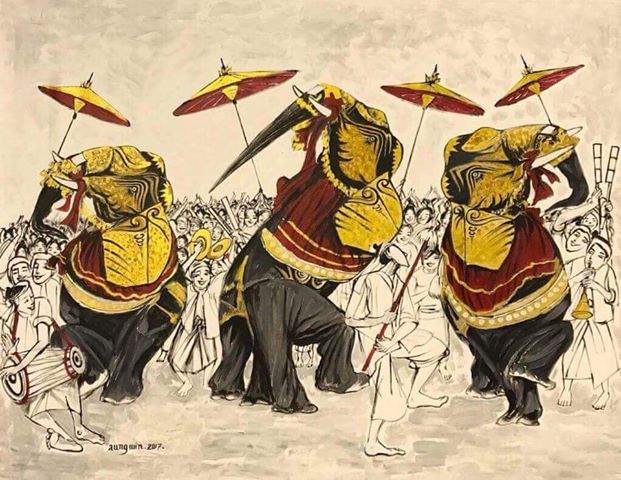
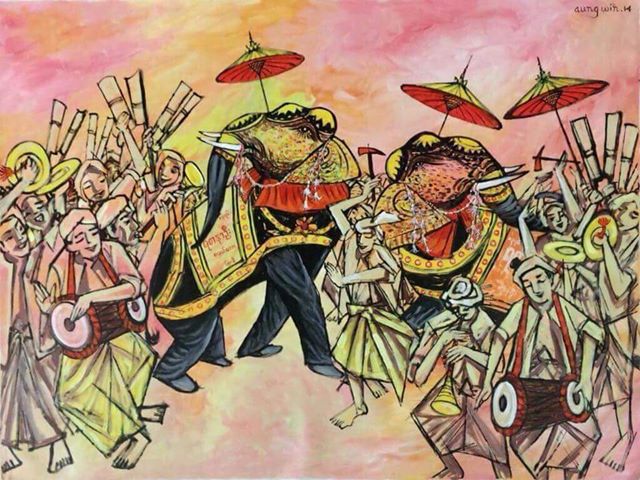
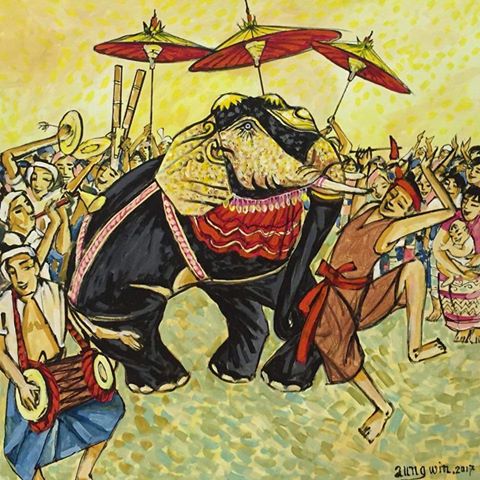
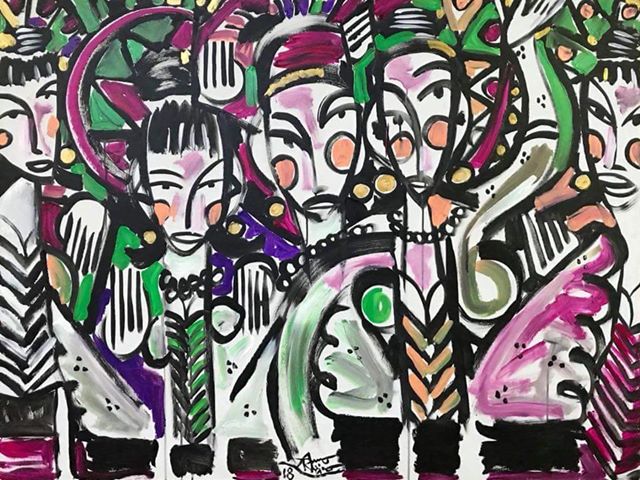
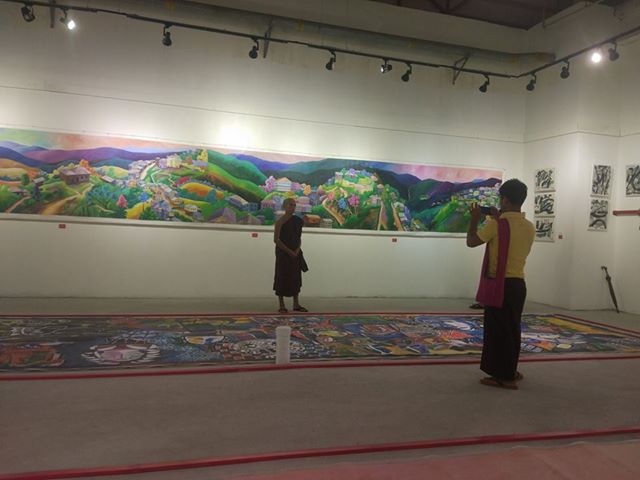
YANGON — A trio of modernist artists has brought scenes of Chin State's Falam and the famous elephant dance festival of Kyaukse to downtown Yangon.

The paintings on display at "In the Land of Giants" are not life-size but are quite massive, measuring more than 30 feet wide, hung on the walls of ArtAnt Pop-up Gallery in Junction City.

"Beauty of Falam" by Than Htay offers a stunning bird's-eye view of the Chin town. The vivid and vibrant portrayal of the Chin mountain range, Rhododendron flowers, cherry flowers, and residential houses provides aesthetic pleasure.

Rhododendrons, which sprout the state flower, grow mainly in the townships of Mindat, Matupi, Falam and Tedim, and bloom in December and January.

"I created this when I went to Falam to teach drawing. But I have changed the colors as I like," said Than Htay.

The 33-foot wide painting by Aung Win puts viewers in a festive mood, as large crowds of Kyaukse residents cheer on elephant dancers.

Every year, Kyaukse celebrates the end of Buddhist Lent by holding an elephant dance festival, which features life-size elephants made from bamboo frames, papier-mâché and fine black satin decorated with intricate, colorful embroidery.

The festival is believed to date back to the Bagan Period, beginning in the mid-to-late 9th century.

Elephants compete for the prizes in two categories – best elephant dance and best-decorated elephant.

To the accompaniment of traditional musical instruments, the dance involves three people – two dancing inside the elephant figure, and one role-playing a mahout.

Modernist Aung Khaing showcasing portraits of ogres, ethnic women, dancers, mothers, and guardian spirits.


"I am 73 now. I can still draw these figures because I am still in good health and have a strong passion for art, said Aung Khaing.

The art exhibition showcases more than 20 modernist works including three large paintings, which are sold for prices between US$250 and $15,000. The exhibition ends on Sunday.

The post Modernists Bring Elephant Dance Festival to Yangon appeared first on The Irrawaddy.

Death of a Journalist

Posted: 27 Sep 2018 12:07 AM PDT

Known as the Saffron Revolution, the monk-led antigovernment protests of August and September 2007 were, for many people outside the country, their first exposure to the brutality of Myanmar’s former military regime. The domestic upheaval became an increasingly international affair 11 years ago, when a Myanmar Army soldier shot dead the Japanese journalist Kenji Nagai, a killing that was captured on video and broadcast worldwide. This story, originally published in December 2007, offers another Japanese photojournalist’s take on the death of a colleague and countryman.

It was painful to witness the images broadcast worldwide on Sept. 27, 2007. Japanese cameraman Kenji Nagai was lying on his back on a street in Rangoon. Then there was the piercing sound of a bullet fired from the rifle of a soldier.

Kenji Nagai, a man I considered a colleague, was dead. Immediately, I thought: It could have been me. As a photojournalist, I also report on conflicts. I have covered many Asian countries, including Burma, and I imagined myself in Kenji Nagai's place, lying dead on a street in Rangoon.

But, I was in Japan, and he was in Rangoon. However, I knew the streets where the pro-democracy demonstrations occurred—the scene was very familiar to me.

For me, the shooting confirmed the true mentality of the Burmese junta, which has been killing and imprisoning the Burmese people with impunity for decades: 3,000 or more people died in 1988 alone, the year I started covering events in Burma.

On the day Kenji Nagai was murdered, I was taking photographs of exiled Burmese activists who were demonstrating in front of the Burmese Embassy in Tokyo, demanding the Japanese government stop supporting the State Peace and Development Council financially.

Later that day, my mobile phone started ringing, one call after another without a break. News agencies and newspapers were calling me to check if the unidentified Japanese journalist killed in Rangoon was me or not. One call was from Australia, from my Burmese friend who had worked as my interpreter when I made trips to Burma. He explained that he was worried about me when he heard the news.

Before long, the Japanese media confirmed the dead journalist was Kenji Nagai. His name was new to me, and we had never met.

The TV news showed video of the shooting of Kenji Nagai over and over again for several days. The Japanese public was horrified and angry. The Japanese government seemed shocked. Perhaps for the first time, the government realized the SPDC is truly an evil government.

When the funeral service was held on Oct. 8 in Tokyo, hundreds of Burmese exiles attended the service to honor Kenji Nagai. They apologized for his death on behalf of the SPDC government, which they hate. It was a natural feeling for the Burmese people who live in Japan to express their sorrow for Kenji Nagai, who was now a martyr in the Burmese struggle for democracy.

Media coverage on Kenji Nagai focused on his personality, his professional work in Iraq and elsewhere, but neglected any factual background on what had been happening in Burma under the military regime for the past 20 years. There were almost no critical questions about Japan's foreign policy toward the military junta—whether it was trying to help the country move toward democracy or helping the SPDC.

As a photojournalist, I have been critical of Japan's foreign policy, which has favored the SPDC generals rather than the democratic forces and the ethnic minorities. You can get a sense of Japan's policy toward the SPDC through various comments made by top Japanese diplomats.

For instance, the then Foreign Minister Yoriko Kawaguchi made an ignorant comment in May 2003, when she was asked about the murderous attack on Aung San Suu Kyi's motorcade at Depayin. She said, "There is no deterioration of environment for dialogue between the SPDC and Aung San Suu Kyi." She retracted her comment the next day.

In May 2006, Japanese ambassador to the United Nations, Kenzo Oshima, said, "Burma does not constitute a regional threat yet," and along with China and Russia, Japan opposed efforts by the United States and European Union to put Burma on the Security Council agenda.

The latest and most shameless comment was made by Yoichi Yamaguchi, the former Japanese ambassador to Burma (1995-97).

After the killing of Nagai, he was quoted in the Japanese media as saying several offensive comments:

"Aung San Suu Kyi's National League for Democracy gave money to the demonstrators."

"There is not a single so-called political prisoner there [in Burma] in the true sense."

"The regime has succeeded in maintaining economic growth of over 5 percent annually, earning it the widespread trust of the people."

After Kenji Nagai's death, the Japanese government took a seemingly strong stance. In New York, Foreign Minister Komura demanded an apology from the SPDC. But as time passed and the crackdown by security forces continued, the Japanese government remained quiet, simply waiting for the UN Security Council to act.

"The government will coordinate efforts with the United Nations and the Association of Southeast Asian Nations to make progress in the democratization of Myanmar [Burma]," Komura said after the UNSC's presidential statement was announced.

Later, Japan cancelled a grant of up to 552 million yen (US $4.7 million). The grant had been intended to finance the construction of a human resources center.

On Oct. 28, the People's Forum on Burma, an NGO formed in Tokyo in 1996 to support the Burmese people's struggle for democracy, made a plea for the Japanese government to fundamentally change its foreign policy toward the SPDC by giving full-scale humanitarian support to the 160,000 displaced people in refugee camps in Thailand.

The group also asked for a halt in grants to the Union Solidarity and Development Association, which was accused of taking part in the suppression of the demonstrators. In 2006, the USDA received a Japanese grant of nearly 24 million yen ($209,000) for construction of three grade school buildings. It also demanded that Japan stop humanitarian aid to subsidize Burma's health care and education budgets while the military regime allocates more than 50 percent of its national budget on the military.

The group wants to pressure the Japanese government to support the Burmese people and the pro-democracy groups, instead of helping to keep the generals in power.

A Burmese citizen in Tokyo, a former political prisoner, said Burmese exiles remember two Japanese citizens: one with hate, and one with great respect.

One is former ambassador Yoichi Yamaguchi; the other is journalist Kenji Nagai.

Yamamoto Munesuke's books include "Burma's Children" and "Burma's Great Illusions." He was deported from Burma in 1998 "for gathering news," following his exclusive interview with Aung San Suu Kyi.

The post Death of a Journalist appeared first on The Irrawaddy.

Where There’s Struggle, There’s Hope

Posted: 26 Sep 2018 11:27 PM PDT

This week marks the 11th anniversary of the Saffron Revolution, a series of mass protests led by Buddhist monks against Myanmar's military government. In this commentary from November 2007—just two months after the demonstrations—The Irrawaddy English edition editor Kyaw Zwa Moe illuminates the power of hope in the country's fight for democracy.

The September 2007 uprising was a struggle between the sons of Buddha and the forces of darkness and repression. In the struggle for democracy, hope is the key. The battle lines are drawn more clearly now than ever before.

Nothing can defeat Burma's military regime—at least to date. All attempts at peaceful or violent means including armed struggle, people's uprisings, international sanctions and political engagement have failed.

Most recently, even the Buddha's Dhamma was quashed by the guns of the ruling Buddhist generals. The streets of Rangoon were stained with the blood of monks who religiously and peacefully chanted the "Metta Sutta," the Buddha's words of loving kindness:

"Let everyone be free from harm. 
Let everyone be free from anger. 
Let everyone be free from hardship."

During the past four decades, thousands of innocent lives have been sacrificed in the hope of creating a democratic nation based on the rule of law. The road ahead sometimes looks like a repeat of the past, filled with the same sort of wishful thinking, meaningless proposals and condemnations that are repeated year after year—yet nothing changes.

For me, September 2007 seems like déjà vu. As a high school student-protester in 1988, I was frozen in my tracks by the sight of a gleaming bayonet at the end of a rifle held by a soldier with hate in his eyes, ordering me to back off. Luckily, I wasn't one of the thousands of protesters who were shot, stabbed or beaten on the street.

In September, it was clear the generals were as determined as ever to beat down anyone who protested, including monks. This time, the demonstrators, with anger and tears, stepped back before thousands were again killed.

This time, it was a battle against the Buddha's words, chanted by the Sangha—the sons of the Buddha. Leading monks repeated over and over: "It is a fight between Dhamma (justice) and Ah-dhamma (injustice)."

This time, with lightning, well-calculated moves, the pro-democracy movement was quickly beheaded as most of the seasoned opposition leaders, including prominent activist Min Ko Naing and his fellow leaders, were quickly rounded up by security forces.

The Burmese generals who are seen as "stupid," "uneducated" and "unqualified" by many of their critics have again outwitted the people of Burma and the international community.

Unlike in 1988, there were no serious discussions to continue the uprising through some other means, such as armed struggle. Various ethnic rebel groups have waged the region's longest armed struggle since the late 1940s, able in some cases to achieve a standoff, but with no hope of further gains.

The September 2007 uprising is a struggle that hasn't ended. It will continue—just ask the political prisoners who are in the junta's notorious prisons throughout the country.

I was imprisoned from 1991 to 1999, spending time in two prisons. Once you commit yourself to opposing the junta, the struggle never ends. In prison, we sat in our cells, anxiously hoping for strong UN resolutions. We hoped for strong support from regional neighbors. Unfortunately, our hopes were in vain. The UN and the neighboring countries offered no meaningful change.

Some things are different this time. I do not believe my former fellow prisoners, including some leaders of the 88 Generation Students group who are now in prison, hope for any quick fixes.

There it is: no hope for quick fixes. But as long as the people continue to struggle, there is hope.

My only true certainty is in the unwavering spirit of those committed leaders who will continue to struggle for democracy in spite of the harsh crackdown. I know that if they never stop struggling for positive change, hope will live.

For instance, a coup within the military is always a possibility. As more information floods the world, including inside Burma, there must be officers who have more enlightened liberal views, who understand that Burma has more to gain by joining the world community. The fact that such officers have not yet acted doesn't mean there's no hope.

Also, how about the leaders of China and India, two of the generals' allies that have viewed the crackdown as an "internal affair?" That type of head-in-the-sand attitude is dangerously anachronistic in today's world and is doomed to backfire. China has clout, and there is hope that it may use its power to influence the generals to move toward some form of power-sharing, even while holding on to power. That would be a step in the right direction.

So, there's still hope for the democracy movement.

Recently, I spoke with leading activists who are deeply engaged in the democracy struggle.

"We confront their bullets," said one of them. "We put our heads under their clubs. We sacrifice and do as much as we can. Soon we will be thrown in prison again. We don't know when we will come out from that hell. Who outside can carry out this task?"

That is the question the pro-democracy movement inside and outside the country and the international community must now answer.

The post Where There's Struggle, There's Hope appeared first on The Irrawaddy.

Women Masons Help Build Stronger Homes in Quake-Hit Nepal

Posted: 26 Sep 2018 10:27 PM PDT

RAIGAUN, Nepal — On a recent summer morning, Suntali Rai was busy counting and stacking zinc sheets as she prepared to lay them on the roof of the house she had started building a month earlier.

If it didn’t rain, she planned to finish the roofing in a couple of days. Within a week, she said, she should be done with the two-room concrete house.

Then her family would finally be able to move out of its wrecked wooden home, which has been almost uninhabitable since an earthquake shook the country three years ago.

“Sometimes we don’t sleep, [but] rather keep our eyes open for the entire night when there happens to be heavy rainfall, because the rainwater keeps coming inside the house,” said Rai, 28.

“We can’t stay here anymore.”

Rai’s house in Raigaun, a village in Makawanpur district, nearly 200 km southeast of Nepal’s capital, Kathmandu, has been standing only precariously since April 2015.

That is when a 7.6-magnitude earthquake killed about 9,000 people and left more than 785,000 families homeless in one of the world’s poorest nations.

The government set up the National Reconstruction Authority (NRA) to fix or rebuild the homes of all affected residents by 2020.

But progress has been slow, in part due to a lack of materials and skilled labor, with thousands of men leaving the country each week to look for work, according to the United Nations.

Tired of waiting for someone else to build her a safer home, Rai enrolled in a 50-day mason training course through the Employment Fund, a program run by the non-profit Helvetas Swiss Intercooperation Nepal.

When she was done, she joined with four other course graduates to build her family a new house. This time, it is designed to stay intact if another earthquake hits.

Launched in 2015 and due to end in 2020, the Skills for Reconstruction project teaches Nepalis in earthquake-hit areas how to build disaster-resilient houses.

The aim is to help ease the country’s labor shortage while also arming participants with masonry and carpentry experience they can later use to find jobs in construction.

In Makawanpur district, a third of trainees have been women.

For many of them, learning masonry has allowed them to break free from traditional roles of farming and caregiving and finally earn an income of their own.

“So far, I have built 15 other houses in neighboring villages and earned 250,00 rupees ($2,500), which I will spend on house furnishings and paint,” Rai said.

Designs for life

The training project is jointly financed by the Nepalese government, the Swiss Development Cooperation and Britain’s Department for International Development.

Since its launch, it has trained almost 9,000 people in the 14 districts most severely affected by the earthquake and most vulnerable to future climate disasters, said Sujan Dhoj Khadka, technical coordinator at the Employment Fund.

Trainees have rebuilt more than 3,000 houses in 10 of those districts.

In the other four, limited access to remote areas and a shortage of skilled laborers to run the training programs has stalled reconstruction, Khadka said.

“I have seen that there are women who receive training who are mostly illiterate. Some can only write their names,” she added.

“However, they are still able to apply the acquired technical skills in construction work, like measuring area, length and height.”

Many of the new homes have been built using housing grants from the NRA. In Makawanpur district, about 33,250 families are eligible to receive grants of 300,000 rupees ($3,000) each, paid out in three tranches.

In order to be eligible for a grant, new houses must adhere to one of 34 seismic-resilient designs published by the NRA, said Bhupendra Aeri, a civil engineer with the agency.

Most of the houses destroyed by the earthquake across rural Nepal were made using traditional materials of wood and stone, with no pillars for support.

The designs prescribed by the NRA for new buildings are more likely to withstand earthquakes. Builders can choose from a range of materials, techniques and layouts – from a two-story structure made of steel and bricks to a two-room home constructed from rubble, mud and wire.

“People here have mostly followed the one- or two-room model homes,” Aeri said.

Anyone living close to a river must rebuild at least 20 meters away from the riverbank to avoid floodwaters reaching their homes during the rainy season.

Aeri said some families in remote areas that the mason training program could not reach have rebuilt their homes without following the NRA’s building codes and criteria.

But “the NRA will not provide a second or third tranche of the building grant to such beneficiaries,” he said.

Slow progress

Jagat Bahadur Lama, a local leader of Makawanpur who is helping families get housing grants, said another factor slowing reconstruction efforts is lack of land ownership certificates.

He said 68 families from three wards in Raigaun had not received even the first tranche of their housing grants because they have no documentation to prove they own the land they live on.

Despite the government’s land reform program that began four decades ago, up to a quarter of the population still has no legal right to land, according to the UN’s International Organization for Migration.

“The families should be given grants based on where they have been living for many years,” said Lama. “It is not a very hard job to verify their residential status locally.”

As Nepal slowly rises from the rubble, many people who have gone through the mason training say their new homes come with a renewed sense of safety and stability.

Kanchhi Rai, a resident of Raigaun who recently graduated from the training program, is almost finished building a two-room house to replace the one that was damaged in the earthquake.

She had help from her carpenter husband, who calls it their “dream home.”

“I think I have laid a strong foundation,” Kanchhi Rai said.

The post Women Masons Help Build Stronger Homes in Quake-Hit Nepal appeared first on The Irrawaddy.

Flying News: Humanitarian Media Counter Rohingya Refugee Rumors

Posted: 26 Sep 2018 10:20 PM PDT

PHNOM PENH — As aid workers rushed to vaccinate Rohingya refugees against measles earlier this year, rumors swirled through the overcrowded camps in Bangladesh – the injections would make women sterile and convert children into Christians.

The anecdote, included in an August report from the United Nations children’s agency, UNICEF, illustrates how the refugees, who have fled Myanmar, are vulnerable to misinformation, “with little or no access to television, radio, or other media."

In response, humanitarians are trying innovative projects to counter rumors – translated as “flying news” in the Rohingya language – and to let refugees know how to access healthcare and bolster their shelters against storms, among other advice.

More than 900,000 Rohingya, an ethnic and religious Muslim minority in Myanmar, live in Bangladesh’s Cox’s Bazar district, the vast majority in camps, according to UNICEF.

About 700,000 of them arrived in the four months after deadly attacks by Rohingya insurgents on Myanmar security forces in August 2017, which were followed by military operations that the United Nations and rights groups said targeted civilians.

Myanmar has denied most of the allegations.

Aid agencies struggled to accommodate the influx of people, and a year on, the densely-populated camps remain vulnerable to storms that could strike during the cyclone season in October and November, bringing floods and disease.

“Life in the camps is hard and full of hazards,” Fiona MacGregor, a spokeswoman for the International Organization for Migration (IOM) in Cox’s Bazar, said by email.

“In such circumstances, it is very easy for rumors and misinformation to spread – and it is vitally important people get timely, accurate information about everything from health issues to weather dangers.”

Radio is a key tool for giving out that information, said MacGregor, especially as there is no formal written version of the Rohingya language.

But there are challenges, she added, as very few Rohingya used radios in their homeland across the border in Myanmar’s Rakhine State.

The IOM is distributing 60,000 radios that can be powered with a hand crank, and is setting up “listening groups” in partnership with organizations including BBC Media Action.

‘Tension is High'

In the 300 or so groups of about 25 people each, one person leads discussions after listening to programs that are usually stored on a memory stick, said Richard Lace, Bangladesh director for BBC Media Action.

The UK-based development charity coordinates with the Bangladesh state broadcaster to produce three shows a week, mostly offering practical information on issues like accessing services and preventing violence against women, said Lace.

BBC Media Action also works with a local station, Radio Naf, to produce two programs a week, as well as a panel discussion each month with a live audience of about 75 people that focuses on topics affecting both refugees and local residents.

Past panels have tackled the perception that refugees are taking jobs and undercutting wages for day labor, and the mistaken impression their arrival has been accompanied by a big jump in drug smuggling and other crimes, Lace said.

“Tension is relatively high right now, so it’s an interesting way to blow off steam,” he told the Thomson Reuters Foundation by Skype from Cox’s Bazar.

Information Exchange

Information flows both ways, as aid agencies also receive feedback from refugees about their concerns via listening group sessions and surveys.

The international media development agency Internews produces the written “Flying News” bulletin, which helps alert aid workers to rumors in the camps as well as dispelling them.

A July bulletin, for example, tackled inaccurate information going around that rice and oil distributed to refugees had expired and was making them sick.

How to prevent human trafficking and extortion also featured, alongside contact details for trafficking hotlines run by the IOM and the UN refugee agency.

“You do not have to give money, sex or other favors in exchange for land, goods, food or services,” the bulletin advised.

“Refugees have the right to complain about this, and should report incidents to the agency directly or to another agency they trust.”

The post Flying News: Humanitarian Media Counter Rohingya Refugee Rumors appeared first on The Irrawaddy.

Malaysia’s Ex-First Lady Questioned for 13 Hours in 1MDB Probe

Posted: 26 Sep 2018 10:12 PM PDT

KUALA LUMPUR — Malaysian anti-graft investigators questioned Rosmah Mansor, the wife of former Prime Minister Najib Razak, for nearly 13 hours on Wednesday over a corruption investigation at state fund 1MDB.

Najib has been charged with money laundering, abuse of power and criminal breach of trust in the investigation into how billions of dollars went missing from 1Malaysia Development Berhad (1MDB).

Najib, who has pleaded not guilty to the charges and consistently denied wrongdoing, lost a national election in May.

Last week, Azam Baki, the deputy commissioner of operations at Malaysian Anti-Corruption Commission (MACC), said he could not rule out charges being filed against Rosmah.

Rosmah, who was questioned for three hours in June, arrived at MACC headquarters at around 0200 GMT and left at 1445 GMT.

Her lawyer, K. Kumaraendran, told reporters she had completed giving her statement to the MACC. He declined to comment further. As she left, she said only: “I’m OK.”

Malaysian authorities have barred Najib and Rosmah from leaving the country. Their home and other properties linked to them have been searched by police as part of the 1MDB investigations.

The US Department of Justice has alleged more than $4.5 billion was misappropriated from 1MDB and that about $680 million ended up in Najib’s personal bank account.

The couple’s world has been turned upside down since Najib’s shock election defeat on May 9 to his one-time mentor Mahathir Mohamad, who swiftly reopened a probe into 1MDB.

Authorities have seized luxury goods to an estimated value of up to $275 million from their homes, including 567 handbags, 423 watches and – among 12,000 pieces of jewelry – 1,400 necklaces, 2,200 rings, 2,800 pairs of earrings and 14 tiaras.

Najib has said most of the items seized were gifts to his wife and daughter and had nothing to do with 1MDB.

The post Malaysia’s Ex-First Lady Questioned for 13 Hours in 1MDB Probe appeared first on The Irrawaddy.

Lawmakers Urge US to Call Myanmar’s Rohingya Campaign Genocide

Posted: 26 Sep 2018 09:37 PM PDT

WASHINGTON — Leaders of the US House of Representatives Foreign Affairs Committee called on the Trump administration on Wednesday to declare the Myanmar military’s campaign against the country’s Rohingya Muslim minority a genocide, days after a State Department report stopped short of that description.

“Making a formal determination of genocide must be the next step for the US,” Representative Ed Royce, the committee’s chairman, told a hearing on the issue. “Defining these atrocities for what they are is critical to building international public awareness — and support — to stop them.”

The US Department of State, which would make the determination, did not immediately respond to a request for comment on Royce’s statement at the hearing.

Royce held the hearing, titled “Genocide Against the Burmese Rohingya,” just two days after the State Department released a report finding that the military in Myanmar, also known as Burma, waged a “well-planned and coordinated” campaign of mass killings, gang rapes and other atrocities against the Rohingya.

But the report, which could be used to justify further US sanctions against Myanmar authorities, did not describe the actions as genocide or crimes against humanity.

US officials said use of language that stopped short of genocide was the subject of fierce debate within the administration that delayed the report for nearly a month. United Nations investigators issued a report a month ago accusing Myanmar's military of acting with "genocidal intent."

Representative Eliot Engel, the top committee Democrat, said the administration should take action, such as referring the matter to the International Criminal Court. The ICC said earlier this month it had begun an examination of whether the alleged forced deportations of Rohingya could constitute war crimes or crimes against humanity.

Many members of Congress, including President Donald Trump’s fellow Republicans as well as Democrats, have called for a stronger response to the crisis, in which almost 700,000 Rohingya have fled to neighboring Bangladesh.

A declaration of genocide by the US government could have legal implications of committing Washington to stronger punitive measures against Myanmar. This has made some in the Trump administration wary of issuing such an assessment, but pressure from members of Congress, particularly Republicans like Royce, could help influence a decision.

Several lawmakers have also asked the administration to press for the release of Reuters reporters Ko Wa Lone, 32, and Ko Kyaw Soe Oo, 28, who were convicted on Sept. 3 under the colonial-era Official Secrets Act in a case seen as a test of democratic freedoms in Myanmar.

The reporters, who pleaded not guilty, said they were handed papers by police shortly before they were detained, and a police witness testified that they had been set up. They had been investigating the killing of 10 Rohingya men and boys as part of a military response to insurgent attacks.

Separately, two members of the Senate Foreign Relations Committee, ranking Democrat Bob Menendez and Republican Todd Young, asked Secretary of State Mike Pompeo whether he had asked the Office of the Legal Adviser at the State Department for a formal legal determination of genocide.

“We ask that you provide a formal legal determination regarding the actions of the Burmese military to Congress without delay,” they said in a letter seen by Reuters on Thursday.

The State Department did not immediately respond to a request for comment on the letter.

The post Lawmakers Urge US to Call Myanmar’s Rohingya Campaign Genocide appeared first on The Irrawaddy.