Wednesday, April 11, 2018

The Irrawaddy Magazine

The Irrawaddy Magazine


AA Leader Dismisses ‘Ridiculous’ Claim that His Group Has Ties to ARSA

Posted: 11 Apr 2018 07:59 AM PDT

The Chinese delegate who is brokering negotiations between the government and the Federal Political Negotiation Consultative Committee (FPNCC) has warned the latter's members, including the Arakan Army (AA), not to associate with the Arakan Rohingya Salvation Army (ARSA) in Rakhine State.

AA commander-in-chief Major-General Tun Myat Naing talked to The Irrawaddy's senior reporter Nan Lwin Hnin Pwint about the results of the recent FPNCC meeting, the prospects for peace in Myanmar, and whether or not the AA has any links with ARSA.

China reportedly told the FPNCC not to associate with ARSA and warned that it would face harsh action if it did so. What is the stance of the FPNCC on this?

Chinese security officers came to us and enquired about ARSA. They told us not to support it. So we said that none of us would support jihadists who fight for religious causes. Ethnic armed organizations are fighting for their national demands. We assume that the other side [the Myanmar military, or Tatmadaw] has misled China into thinking that ethnic armed groups may be connected with ARSA. In fact, it is our Rakhine State and Arakanese people who have been directly impacted by ARSA. We therefore have concerns. China has also concerns, and we can say we have the same stance. It is good for us that China has concerns.

Local political analysts speculate that the AA may be secretly supporting ARSA. What would you say to that?

It is ridiculous. It is either ignorant speculation or a deliberate provocation.

What would you like to say about Rohingyas identifying themselves as one of the ethnic groups in Rakhine State?

It is quite a complicated issue. I avoid answering this question as much as I can. Regarding the question of whether they are an ethnic group or not, it depends on the government's definition of ethnicity concerning their racial identity, language, literature, customs, foods, religion and how they came to be living in Rakhine State. You can learn that from the records of the colonial period.

The reality is they are people of Bengali race living in Myanmar. And we see that the [National League for Democracy-led] government is taking steps to repatriate them after they fled to another country. 'Repatriation' means bringing somebody back to their own country. So according to my understanding, [the government] accepts that those who fled are Myanmar citizens.

If they are accepted as Myanmar citizens, they should have equal citizenship rights under existing laws. Repatriated refugees should not be kept in places like detention centers. If they are accepted, they should be treated in line with the law as Myanmar citizens. They should be allowed to travel freely throughout the country, and they should also be presented with job opportunities and rights to trade and education. If they want to go to foreign countries, Myanmar passports must be issued. Those people for their part need to respect the law and should be loyal to the country.

It is not wise for the government to address this problem superficially in response to pressure from the international community. But the government should lay down a clear policy first to solve the problem.

The international community views ARSA as a group fighting for the rights of Rohingya people, while the majority in Myanmar consider it an insurgent organization. What is your personal view of ARSA?

I don't see how their stance can be separated from religion. Assessing their earlier activities, it has acted like a jihadist movement. Ethnic armed organizations have not accepted it as a revolutionary group. The international community is overly concerned with human rights in those cases that do not directly affect their interests.

No matter how much the international community accepts them, it is more important that Myanmar people accept them. It is more important that they harmonize with Myanmar people. Whether the international community accepts them or not is only one part of the problem. It is in Myanmar that the conflict is happening, so their acceptance by Myanmar people is what matters. Ethnic armed organizations have not recognized it as revolutionary group.

What did the FPNCC discuss regarding the NCA [Nationwide Ceasefire Agreement] at the recent meeting?

We discussed what we were doing before the meeting as well as the current situation regarding the NCA, the government's view on non-signatories, its relations with signatories, and progress in implementing the NCA. We want to negotiate with the government collectively, but the government wants to hold separate talks with individual members. The government held separate talks with the Wa and Mongla [who are also members of the FPNCC]. They also presented what they discussed with the government. The government told them to sign the NCA, saying that no agreement in the world is unchangeable. We also exchanged views on it.

The FPNCC previously said that it would find an alternative approach other than the NCA to the peace process. So why did you discuss the NCA this time? Is it because of China, or some other factor?

It is because we want to review the interests of the country and all possibilities, as well as because of China. Our view is that a ceasefire and political dialogue should involve separate agreements. Even if we sign a single agreement, ceasefire and political agreements should be separately stated. They said provisions in the agreement can be changed later, and we want to make sure it is not just a gentlemen's agreement. We have previously submitted general policies and detailed demands. If they would recognize and accept them, there may be a way forward.

What stage have the FPNCC's peace talks with the government reached?

It is difficult to say for the time being. If the NCA can be changed, we will try constructively to accept it. But then, challenges remain. The government has excluded the Ta'ang, Kokang, and AA from the NCA. But China is pushing for the acceleration of Myanmar's peace process. We at the FPNCC want to move forward together as a group. If the government does not compromise, the peace process will get nowhere. But if it is willing to negotiate with us as a group, there might be a way forward.

So, the FPNCC will hold talks with the government based on the NCA?

Though China is pushing us, we will sign only when it is acceptable to us. It depends on how much the Myanmar government is willing to change [the NCA]. If they echo the military and insist the NCA can't be changed, it is finished.

What is the stance of the FPNCC on China's Silk Road project?

It is a big project for the 21st century. We believe the project can contribute to the development of the whole region and that benefits will be shared by the countries. So, the FPNCC welcomes it, and we AA also welcome it. We will see how we Arakanese people who have lagged behind can connect with the world through this project. We were forgotten in resource extraction projects including the Kyaukphyu [special economic zone] project. We will try to advance the interests of our region. We have now better military and political foundations, and will make greater efforts for the interests of our region.

The post AA Leader Dismisses 'Ridiculous' Claim that His Group Has Ties to ARSA appeared first on The Irrawaddy.

ADB Sees More Growth for Myanmar Economy, Pushes for Reforms

Posted: 11 Apr 2018 06:11 AM PDT

YANGON — Myanmar’s GDP growth rate jumped from 5.9 to 6.8 percent last year on the back of a strong agriculture sector, export growth and robust private consumption, the Asian Development Bank (ADB) said in its Asian Development Outlook 2018.

It expects the economy to maintain that pace through this year and even top 7 percent by 2019, so long as the government can manage reforms to improve the business environment.

According to the ADB, last year’s economic acceleration was aided by a turnaround in agriculture thanks to better weather and the highest rice exports Myanmar has seen in half a century. International demand for the country’s garments also stayed strong last year, while tourist arrivals grew 18 percent to 3.4 million visitors.

It noted that the latest outbreak of violence in northern Rakhine State, which has driven some 700,000 Rohingya to neighboring Bangladesh in search of refuge since late August, has had little economic effect so far.

But it said investment growth may have softened as investors awaited clarity on a pending company law.

Looking ahead, the ADB expects the agriculture sector, which accounts for 30 percent of the country’s GDP, to continue to pick up pace if drought conditions remain at bay.

It said exports would also continue to grow, but not as fast as imports, owing to continued Foreign Direct Investment (FDI) and the huge demand for public investment in infrastructure. Combined with rising oil prices, Myanmar’s current account deficit is forecast to keep growing and hit 5.5 percent of GDP by 2019.

All told, the ADB forecasts the country’s GDP growth rate to reach 7.2 percent next year, but warned that continued growth would depend on a full suite of reforms.

“The positive economic outlook depends on Myanmar augmenting limited public resources by effectively engaging development partners, foreign investors, and the domestic private sector to help finance its staggering infrastructure requirements, narrow regional socioeconomic disparities, and support the long-term development agenda. This will require legal, regulatory and institutional reform to create a more enabling environment for doing business,” it said.

“Although measures have been introduced to deepen the capital market and better regulate banks, a substantial agenda of economic, social and institutional reform remains.”

The ADB said Myanmar’s youthful workforce would continue to attract FDI to labor-intensive, export-oriented industries but added with concern that the government’s FDI regulations were, despite some recent liberalization, still more restrictive than most of its peer economies in the region.

“Encouragingly, progress in December 2017 toward enacting a new company law can assure foreign investors that corporate reform will continue,” the bank said.

“Similarly, a government initiative to formulate a 238-point economic policy agenda, set out in the draft Myanmar Sustainable Development Plan, should keep investors engaged.

“Building on these initiatives, policy makers should implement reform expeditiously and effectively to buoy investor confidence and attract sizable FDI in the years to come.”

The post ADB Sees More Growth for Myanmar Economy, Pushes for Reforms appeared first on The Irrawaddy.

Tatmadaw Claims Killed Karen Community Leader Was a Plainclothes Fighter

Posted: 11 Apr 2018 04:43 AM PDT

CHIANG MAI, Thailand – The Myanmar military, or Tatmadaw, has denied wrongdoing in the killing of a man in Ler Mu Plaw area, Papun district, Karen State, claiming he was a rebel fighter dressed in civilian clothes.

In a statement released early Wednesday, it said Tatmadaw troops "shot at two fleeing plainclothes men who were suspected of being involved in sabotage attacks and planting mines," adding that it "captured one of the men dead."

However, according to a tribute by the Karen Environment and Social Action Network on Monday, Saw O Moo, 42, was an indigenous community leader working in environmental preservation, providing support to recently displaced people in his community. He was shot dead late in the afternoon of April 5, while giving a lift to a Karen National Liberation Army (KNLA) soldier as he made his way home on his motorcycle.

The KNLA soldier, Saw Hser Blut Doh, escaped after the shooting. He had been assigned to provide security and protect Karen civilians in the Ler Mu Plaw area, the network said.

The family and friends of Saw O Moo have demanded to be allowed to retrieve his body.

The statement from the Tatmadaw's True News Information Team said that Saw O Moo, who it identified as Saw Ka Lo Par, in line with his ID card (although it is the same person), tried to flee when security forces demanded he stop for an inspection. It did not say when the incident happened. The Irrawaddy contacted the Defense Ministry about the case on Wednesday, but the spokesperson was unavailable to comment..

The military said Saw O Moo was found to be in possession of a video camera, memory cards, a recorder, and grenades.

Saw Soe Doh, a spokesman of the Mutraw (Papun) Emergency Assistance Team, told The Irrawaddy that Saw O Moo "is just a Karen indigenous community leader," who unfortunately gave the KNLA soldier a lift on his motorbike on his way back home. He was returning from a meeting to organize humanitarian assistance for some 2,300 people who have been displaced as a result of recent fighting, he said.

"As the Karen National Union and its armed wing, the Karen National Liberation Army, are no longer unlawful associations after signing the NCA in 2015, we don't think (Saw O Moo) was violating any laws," he said, adding that locals in the area do not believe they are dong anything wrong by hanging around with the KNLA soldiers.

On a related topic, the Tatmadaw's statement said there had been a misunderstanding among locals about the Tatmadaw's reconstruction of a 15-mile-long road from Khay Mu to Ler Mu Plaw, as the work was intended to provide for more convenient use of the road for locals and to ease military administrative tasks. It also claimed the Tatmadaw Southern Command had issued prior notification to the KNLA on 11 occasions before starting to re-build the road on Mar. 4.

Tensions have escalated in the last month in the area controlled by the KNU/KNLA's Brigade 5.

As it is one of the bigger ethnic armies, the KNU/KNLA's relationship with the Tatmadaw is seen as an indicator of the health of the peace process.

The Tatmadaw also blamed the KNU/KNLA for releasing a statement on Apr. 2 about the postponement of a planned meeting between KNU/KNLA and Tatmadaw representatives in Bago region, late last month.

The military said the ethnic armed force had been so worried that the road work was part of preparations to launch military operations that it attacked the troops first. It said some Tatmadaw soldiers had been killed by mine explosions and in attacks launched by KNLA units, but it did not reveal the number of fatalities.

On Wednesday, the network of Myanmar human rights defenders urged the government and the international community "to effectively protect" civilian rights workers, especially those who are providing assistance to displaced people in armed-conflict areas.

A joint statement by the Human Rights Defenders Forum (HRDF) and Rights for All expressed their condolences over the death of Saw O Moo, who, they said, had been an active peace and environmental activist since 2006.

"Protection of human rights defenders working in armed-conflict zones is really necessary, as there could be arbitrary arrests and killings," said U Aung Myo Win, a director of Equality Myanmar and a steering committee member of the HRDF.

"As the conflict zones lack the rule of law, we have heard of civilians and rights defenders being arrested as well as arbitrary killings, such as the case of the freelance journalist Ko Par Gyi [who was killed by the Tatmadaw in 2014]," he added.

Myanmar also lacks the laws and mechanisms to protect rights defenders, U Aung Myo Min said. "Therefore, it is as if armed forces in these areas have a license to freely kill civilians, humanitarian workers and rights defenders."

At present, only local organizations can individually gather evidence while institutions like Myanmar National Human Rights Commission need to work with them, added the human rights educator.

Despite viewing the MNHRC as lacking the capability to deal with complaints related to the armed-conflict zones, U Aung Myo Min added that, "We can now send our complaints to the MNHRC, but the question remains as to whether we will see any effective action taken in such cases."

The post Tatmadaw Claims Killed Karen Community Leader Was a Plainclothes Fighter appeared first on The Irrawaddy.

Wa State and Rakhine Aside, Survey Finds Living Conditions Improving Across the Country

Posted: 11 Apr 2018 04:11 AM PDT

Nay Pyi Taw—The Ministry of Planning and Finance was not able to conduct surveys in the Wa Self-Administered Division or northern Rakhine State while doing its Myanmar Living Conditions Survey 2017.

The ministry held a workshop in Nay Pyi Taw on Wednesday to publish key indicators from the draft report of the survey.

"We can say that the report covers the whole country except Wa State and northern Rakhine State. We were not able to conduct the survey in seven survey areas in Wa State and two townships in Rakhine. But we have expanded the coverage area in other places and it is fair to say that the report covers the whole country," said Daw Khin Hset Yi, assistant director of the Central Statistics Organization and the leader of the survey team.

Though there are no ongoing armed conflicts in Wa State, the area is not under the executive jurisdiction of the Myanmar government. Meanwhile, northern Rakhine State is beset with sectarian strife.

The survey offers a comprehensive study of how people everywhere in Myanmar live. It collects data on the occupations of people, their income levels, and how they use this to meet the food, housing, health, education and other needs of their families. The data collected will be used to formulate responsive policies for the future development of the country.

"The survey covers education and health conditions of families. Consumption patterns and lifestyles have changed and living conditions have also improved, according to the survey," Daw Khin Hset Yi said.

The survey, conducted from December 2016 to November 2017, is representative of the entire country and was based on input from nearly 30,000 people from over 13,000 households in all regions and states, she said. The final report is scheduled to be published by December.

According to the survey, motorcycles have largely replaced bicycles in Myanmar, while mobile phone density has also increased throughout the country since 2010. Phone ownership is now almost at the same level in rural areas as in urban areas.

"Looking at the possessions of households, the use of mobile phones and motorbikes has increased, which indicates an improvement in living conditions," Daw Khin Hset Yi said.

The survey was conducted by the Central Statistics Organization with technical support from the United Nations Development Programme and the World Bank.

The post Wa State and Rakhine Aside, Survey Finds Living Conditions Improving Across the Country appeared first on The Irrawaddy.

Court Rejects Request to Dismiss Charges Against Reuters Reporters

Posted: 11 Apr 2018 03:47 AM PDT

MANDALAY — Yangon’s northern district court on Wednesday rejected a request to dismiss the charges against two Reuters reporters accused of violating the colonial-era Official Secrets Act.

Lawyers for the two reporters — Ko Wa Lone and Ko Kyaw Soe Oo — submitted the request in late March, arguing that there was insufficient evidence to support the charges.

"The court gave no concrete reason but said it will proceed with the lawsuit and hear from the plaintiff’s witnesses, so it rejected our proposal. We were all saddened by the decision of the court," said U Than Zaw Aung, one of the lawyers representing the reporters.

"Because there was not sufficient evidence to support the charges and because the army has already taken action against the soldiers involved in the massacre at Inn Din, the court's decision shows that the accuser and the court want to put the reporters behind bars," he added.

The reporters’ lawyers said they planned to appeal the decision.

The next hearing is scheduled for April 20, at which the court will hear from the plaintiff’s remaining witnesses.

After Wednesday’s session, Ko Wa Lone told media outlets gathered at the court that he wanted to ask the government and judiciary whether they thought the charges he and his colleague were facing were fair.

"The soldiers responsible for the Inn Din massacre were already sentenced to 10 years in jail. But we, who reported about it, are facing 14 years in jail. Is that fair?" he asked. "We report to unearth the truth and we are being sued. Where is the truth for us? Where is the democracy and freedom?"

The families of the two reporters said they were hopeful that the court would decide to release them on Wednesday but were left deeply disappointed.

"Ko Kyaw Soe Oo's wife believed that her husband would be released and that her family could enjoy the New Year festival together. But the court decision saddened her and everyone else in the family who had high hopes,” said the reporter’s sister, Ma Nyo Nyo Aye.

According to the family, Ko Kyaw Soe Oo was recovering from jaundice but still in poor health.

"Although our brother said he is getting well, we still want to have a proper medical check to make sure he is in good health. But the prison still bars us from doing so," said Ma Nyo Nyo Aye.

Ko Wa Lone and Ko Kyaw Soe Oo were arrested in Yangon on Dec. 12.

They are accused of possessing confidential government papers and face a maximum sentence of 14 years in prison if found guilty.

The post Court Rejects Request to Dismiss Charges Against Reuters Reporters appeared first on The Irrawaddy.

In Ageing Thailand, Developers Race to Supply Locals and Elderly Expats

Posted: 11 Apr 2018 12:06 AM PDT

BANGKOK — At 79, Thai businessman Boon Vasin’s latest $500 million venture is a bet on a market he knows well — looking after Thailand’s rapidly growing population of old people.

Not only is Thailand ageing faster than its neighbors, but it is also becoming an increasingly popular retirement option for foreigners attracted by its agreeable climate, low living and health costs and culture of service.

“We will look after them from their waking hours until they go to sleep,” said Boon, chairman of the Thonburi Healthcare Group Pcl. “This group has big spending capacity.”

His Jin Wellbeing County is a “medical city” for Thai and foreign retirees being built across more than 2 hectares on the outskirts of Bangkok

The first of nearly 500 housing units being sold in an initial phase are being marketed for nearly $130,000, plus additional fees of 7,000-8,000 baht ($224 – $385) a month for meals and services ranging from fitness sessions to excursions.

Boon predicts care services will yield recurring profits of up to 240 million baht each year from the project, plus unit sales and medical services.

Together with China, Thailand is aging much faster than its regional neighbors. By 2040 it is expected to have the highest share of elderly people of any developing country in East Asia, according to the World Bank.

Thailand has 7.5 million people aged 65 and over, a figure projected to swell to 17 million by 2040 — more than a quarter of the expected population.

That’s partly due to improving medical care extending life expectancies, but also a fall in birth rates from an average of more than six children per woman in 1960 to 1.5 in 2015.

In the past, generations of the same Thai family lived under the same roof and elderly were cared for by their offspring. But the changing population balance as well as a shift from the countryside to towns means that’s increasingly impractical.

Real estate developers are already tapping the market.

A residential project worth $160 million by developer Magnolia Quality Development Corporation, which is scheduled to open in 2022, will include a wellness center offering elderly care services with specialists in areas such as dementia, said chief executive Visit Malaisirirat.

All the homes in SC Asset Corporation Pcl’s $350 million luxury brand are equipped with designs aimed at the elderly, the group’s marketing head, Nattagit Sirirat, told Reuters.

This includes shock absorbent floors and wheelchair access.

“We worked with Siam Cement, which designed a shock absorbing compound to use in flooring,” he said. The company was “closely studying retirement homes and communities” and was considering a partnership with a local private hospital operator to build a retirement community, he added, while declining to divulge predicted returns.

A Place In the Sun

For his care home, Boon is focusing on people with an income of over 100,000 baht a month — and not just Thais. The aim is to sell at least 20 percent of the project to foreigners, who are targeted along with locals in marketing materials.

“We have Chinese and Japanese buyers who are interested,” he said.

Boon has partnered with a Chinese agent, Shanghai Losen Sale, to sell 90 units worth 671 million baht to Chinese customers.

Thailand did not make the top ten list of International Living’s 2018 index for the best places to retire for U.S. expats. Costa Rica was at number one and neighboring Malaysia at number five.

International Living described Malaysia as “easy, English-speaking and First World.” English is still not widely spoken in Thailand, particularly outside of the major cities.

The state has tried to address this by promoting English as a second language.

Many parts of Thailand away from the well-known expatriate enclaves also fall decidedly in the developing countries category.

But it is becoming an increasing draw for retirees.

The number of foreigners over 50 who have applied for retirement visas to stay in Thailand almost doubled to nearly 73,000 in 2017 from fewer than 40,000 in 2013, according to immigration bureau data.

At the top of the list are Britons — and last year the government launched a campaign to specifically attract British pensioners once Britain leaves the European Union and closer destinations such as Spain become less attractive.

Bryan Walker, 78, is one of those retirees attracted by Thailand’s food and climate.

“It’s just so good,” said Walker, a former humanitarian aid worker who is considering a number of retirement facilities in the north of Thailand.

“I’ve lived and worked in so many countries. Here the cost of living is wonderful, the climate is superb, although it’s a bit hot at times. But the range of food is like nothing I’ve ever experienced,” Walker told Reuters.

Peter Brown, owner of the Care Resort Chiang Mai, a care facility in the northern Thai city, set up his business after seeing his mother in a care home in Britain.

“I found problems in how they do care. Basically, not enough nursing staff,” he said. “I decided on a better way to do this.”

The resort began operation in 2012 and around half the guests are now from the United States, he said. An all-inclusive stay, not including medicine, costs around $1,500 a month.

“A lot of Americans are not getting healthcare free,” he said, emphasizing the importance of Thailand’s service culture as a draw.

“You can see it everyday in the way the staff interact with the elderly.”

The post In Ageing Thailand, Developers Race to Supply Locals and Elderly Expats appeared first on The Irrawaddy.

Vietnam Activists Question Facebook on Suppressing Dissent

Posted: 10 Apr 2018 10:07 PM PDT

HANOI, Vietnam — Vietnamese human rights activists and independent media groups have written to Facebook CEO Mark Zuckerberg questioning whether the social media platform was helping suppress dissent in the communist country.

The letter, released on Tuesday by US-based human rights group Viet Tan and signed by nearly 50 other groups, said Facebook’s system of automatically pulling content if enough people complained could “silence human rights activists and citizen journalists in Vietnam.”

Despite sweeping economic reform in Vietnam, and increasing openness toward social change, including gay, lesbian and transgender rights, the ruling Communist Party retains tight media censorship and does not tolerate criticism.

Vietnam last year unveiled a 10,000-strong military cyber warfare unit, named Force 47, to counter “wrong” views on the internet.

The open letter to Zuckerberg called Force 47 “state-sponsored trolls” whom it accused of exploiting Facebook’s community policies and disseminating fake news about the activists.

“Our community standards, which outline what is and isn’t allowed on Facebook, seek to encourage expression and create a safe community on the platform,” a Facebook spokeswoman said in response.

“We will remove content that violates these standards when we’re made aware of it,” the spokeswoman added, in an email statement which said the company’s policy in Vietnam was in line with that elsewhere.

“There are also times when we may have to remove or restrict access to content because it violates a law in a particular country, even though it doesn’t violate our community standards,” it added.

Vietnam’s foreign ministry did not offer any immediate comment on the letter.

Vietnam previously said Facebook had committed to work with the government to prevent illegal content from appearing on its platform and would also remove fake accounts and fake content about senior government officials.

Activists said the frequency of takedowns had risen and Facebook had been unhelpful in restoring accounts and content, after its head of global policy management, Monika Bickert, met Vietnam Information Minister Truong Minh Tuan in 2017.

Vietnam’s government cited Facebook as having said at the time of the meeting that it would set up a separate channel to directly coordinate with the communication and information ministry on reports of illegal content.

Facebook’s process and policies for government requests did not change as a result of the meeting, the firm said on Tuesday.

“We appreciate Facebook’s efforts in addressing safety and misinformation concerns online in Vietnam and around the world,” the activists said.

“Yet it would appear that after this high-profile agreement to coordinate with a government that is known for suppressing expression online and jailing activists, the problem of account suspension and content takedown has only grown more acute.”

Vietnam this month jailed human rights lawyer and activist Nguyen Van Dai for 15 years on the charge that he “aimed at overthrowing the people’s administration,” with six more activists jailed for seven to 13 years.

Their sentences prompted responses from representatives from the United States, the United Kingdom, Germany, the Netherlands and the European delegations and rights groups.

Foreign Ministry spokeswoman Le Thi Thu Hang said, “There is no such thing as people being arrested for freely expressing opinion” in Vietnam, however.

The post Vietnam Activists Question Facebook on Suppressing Dissent appeared first on The Irrawaddy.

Seven Myanmar Soldiers Sentenced to 10 Years for Rohingya Massacre

Posted: 10 Apr 2018 09:59 PM PDT

YANGON — Seven Myanmar soldiers have been sentenced to “10 years in prison with hard labor in a remote area” for participating in a massacre of 10 Rohingya Muslim men in a village in northwestern Rakhine State last September, the army said on Tuesday.

The military said in a statement published on Commander-in-Chief Min Aung Hlaing’s office Facebook page that seven soldiers have had “action taken against them” for “contributing and participating in murder.”

The massacre was being investigated by two Reuters journalists — Wa Lone, 31, and Kyaw Soe Oo, 28 — who were subsequently arrested in December and are still behind bars facing charges of violating the country’s Official Secrets Act.

The authorities told Reuters in February the military opened an internal investigation independently and that it is unrelated to the Reuters reporters who are accused of obtaining unrelated secret government papers.

The Rohingya men from the northern Rakhine village of Inn Din were buried in a mass grave in early September after being hacked to death or shot by Buddhist neighbors and soldiers. Reuters published its story on the murder in February.

The murders were part of a larger army crackdown on the Rohingya, beset by allegations of murder, rape, arson and looting, unleashed in response to Rohingya militant attacks on security forces in late August. The United Nations and the United States described it as ethnic cleansing — an accusation which Myanmar denies.

“Four officers were denounced and permanently dismissed from the military and sentenced to 10 years with hard labor at a prison in a remote area. Three soldiers of other rank were demoted to the rank of ‘private,’ permanently dismissed from the military and sentenced to 10 years with hard labor at a prison in a remote area,” read the military statement.

It added that legal proceedings against the police personnel and civilians “involved in the crime” are still underway.

On Jan. 10, the military said the 10 Rohingya men belonged to a group of 200 militants who had attacked security forces. Buddhist villagers attacked some of them with swords and soldiers shot the others dead, the military had said.

The military's version of events is contradicted by accounts given to Reuters by Rakhine Buddhist and Rohingya Muslim witnesses published in the February story.

Buddhist villagers reported no attack by a large number of insurgents on security forces in Inn Din. And Rohingya witnesses told Reuters that soldiers plucked the 10 from among hundreds of men, women and children who had sought safety on a nearby beach.

Nearly 700,000 Rohingya have fled Rakhine State and crossed into southern Bangladesh since August, creating one of the world’s largest refugee camps.

A court in Yangon has been holding preliminary hearings since January to decide whether the two Reuters reporters will be charged under the colonial-era Official Secrets Act, which carries a maximum penalty of 14 years in prison.

On Wednesday, the judge will rule on a motion by defense lawyers for dismissal of the case.

The post Seven Myanmar Soldiers Sentenced to 10 Years for Rohingya Massacre appeared first on The Irrawaddy.

Facebook’s Zuckerberg Vows to Work Harder to Block Hate Speech in Myanmar

Posted: 10 Apr 2018 09:48 PM PDT

WASHINGTON — Facebook Chief Executive Mark Zuckerberg said on Tuesday his company would step up efforts to block hate messages in Myanmar as he faced questioning by the US Congress about electoral interference and hate speech on the platform.

Facebook has been accused by human rights advocates of not doing enough to weed out hate messages on its social-media network in Myanmar, where it is a dominant communications system.

“What’s happening in Myanmar is a terrible tragedy, and we need to do more,” Zuckerberg said during a 5-hour joint hearing of the Senate Commerce Committee and Senate Judiciary Committee.

More than 650,000 Rohingya Muslims have fled Myanmar’s Rakhine State into Bangladesh since insurgent attacks sparked a security crackdown last August.

United Nations officials investigating a possible genocide in Myanmar said last month that Facebook had been a source of anti-Rohingya propaganda.

Marzuki Darusman, chairman of the UN Independent International Fact-Finding Mission on Myanmar, said in March that social media had played a “determining role” in Myanmar.

“It has … substantively contributed to the level of acrimony and dissension and conflict … within the public. Hate speech is certainly of course a part of that. As far as the Myanmar situation is concerned, social media is Facebook, and Facebook is social media,” he said.

Zuckerberg said Facebook was hiring dozens more Burmese-language speakers to remove threatening content.

“It’s hard to do it without people who speak the local language, and we need to ramp up our effort there dramatically,” he said, adding that Facebook was also asking civil society groups to help it identify figures who should be banned from the network.

He said a Facebook team would also make undisclosed product changes in Myanmar and other countries where ethnic violence was a problem.

The post Facebook’s Zuckerberg Vows to Work Harder to Block Hate Speech in Myanmar appeared first on The Irrawaddy.

Tuesday, April 10, 2018

The Irrawaddy Magazine

The Irrawaddy Magazine


Six Myanmar Factory Workers Killed in Bus Crash in Thailand

Posted: 10 Apr 2018 08:15 AM PDT

TAK, Thailand — Six people were killed and 17 were injured when a double-decker bus carrying Myanmar factory workers veered off a highway and overturned in Thailand's Tak province late on Monday night. The crash occurred in Muang district of Tak, which borders Myanmar's Kayin State.

Of the injured, "about five" were in serious condition, according to first responders.

The accident occurred on Highway 12 (Tak-Mae Sot) at Ban Mae Ta in tambon Mae Thor, near the Myanmar border.

All 52 passengers on the chartered bus operated by Jongjaroen Capital Co. were workers recently arrived from Myanmar. They were heading for a factory in Plaeng Yao district of Chachoengsao province near Bangkok.

The bus smashed into a concrete guardrail on Doi Ruak mountain and overturned into a roadside ditch.

Rescue workers used hydraulic jacks to free the injured from the wreckage. They were taken to Somdejphrajaotaksin Maharaj Hospital in Tak's Muang district.

Police identified the bus driver as Pisit Tanapakpasit, 40. He was unhurt.

The bus left Mae Sot district on the Myanmar border at about 8.10pm on Monday. It ran off the highway on a steep, winding downhill section at about 10.50pm. The stretch of road is notorious for accidents.

Police quoted the driver as saying he was unable to slow the bus down using the brakes. He tried to use the guardrail to slow down, but to no avail. The bus plunged off the road and into a concrete-lined ditch about five meters off the highway.

The accident happened about 5 km from the spot where another double-decker bus caught fire and killed 20 Myanmar workers at the end of last month.

The post Six Myanmar Factory Workers Killed in Bus Crash in Thailand appeared first on The Irrawaddy.

State Counselor Orders that Myaungmya Bridge Be Rebuilt Within a Year

Posted: 10 Apr 2018 06:33 AM PDT

PATHEIN—State Counselor Daw Aung San Suu Kyi has given local authorities one year to replace the collapsed bridge linking Myaungmya and Labutta townships with Irrawaddy Region's capital, Pathein.

The State Counselor visited the site of the bridge, which collapsed earlier this month, after attending peace talks with locals in Myaungmya on Tuesday morning.

"The State Counselor instructed that the bridge should be completed within one year. She wants to resolve the transportation difficulties that people are facing as soon as possible. We will therefore adjust the original design and build a steel truss structure. We promised her we would complete it within one year," Irrawaddy Region Transport Minister U Win Htay told The Irrawaddy.

Two people in a truck died when the bridge collapsed on April 1. The Ministry of Construction released a statement a few days later saying that the collapse was due to a design flaw in the bridge.

Bridges in Myanmar are examined twice a year for maintenance and measures have been taken by the Ministry of Construction to prevent the collapse of any other suspension bridges, the ministry said in a statement.

The bridge was opened to the public on March 27, 1996, and collapsed after 22 years of service.

Last year, Parliament approved Myaungmya Township lawmaker Dr. Soe Moe Thu's proposal to build a new bridge in Myaungmya at a cost of over 6 billion kyats. The lawmaker said the bridge had suffered structural damage as a result of overweight aid convoys crossing the bridge in the aftermath of Cyclone Nargis in 2008.

Construction of a new bridge started in December and was originally scheduled for completion in 2020. Before then the regional government will arrange large boats for travelers and vehicles.

So far, the regional government has arranged for two big boats to carry cars across the river, but passengers have had to wait for hours because of the large number of passenger and cargo vehicles crossing the river.

"Passenger buses from Labutta, which leave there early in the morning, have to wait for the whole day in Myaumgmya to get to the other side of the river. Ferry operators are allowing passenger buses from Myaungmya to jump the queue. I would like to urge the regional government to systematize the ferry service," U Khin Maung Win, chairman of the White Hearts social organization based in Labutta, told The Irrawaddy.

The post State Counselor Orders that Myaungmya Bridge Be Rebuilt Within a Year appeared first on The Irrawaddy.

Union Minister to Tour Refugee Camps on Visit to Bangladesh

Posted: 10 Apr 2018 06:11 AM PDT

YANGON— Minister of Social Welfare, Relief and Resettlement U Win Myat Aye will inspect Rohingya refugee camps in Bangladesh during a two-day official trip, the first such visit from a senior member of the Union government.

"I will meet directly with those in the camps. I heard they are not receiving the truth about what we are doing. So I will meet them and tell them what we have done and are doing," U Win Myat Aye said.

The minister, who is also the head of the government's Implementation Committee for Recommendations on Rakhine State and deputy head of the Union Enterprise for Humanitarian Assistance, Resettlement and Development in Rakhine, said the visit was proposed by the Myanmar side to discuss the delayed repatriation process with Bangladeshi officials.

Myanmar and Bangladesh agreed to begin the repatriation on Jan. 23. But as of today, not a single refugee has been returned.

U Win Myat Aye said Myanmar had approved about 750 refugees from a list of more than 8,000 that Bangladesh provided in February for Myanmar to check their backgrounds prior to their return.

"We will discuss how we can start the repatriation immediately. It will be quick if the process is carried out as per the bilateral agreement," U Win Myat Aye said.

"If the negotiations with Bangladesh go well, the repatriation can start immediately," he added.

Despite the government's repeated claim that it is ready to start taking back some of the almost 700,000 Rohingya who have fled the country, the UN's assistant secretary-general for humanitarian affairs, Ursula Mueller, said the country is not ready to handle the return of the refugees, after completing a six-day visit to Myanmar earlier this week.

U Win Myat Aye said he did not want to respond to her comments.

"Only with cooperation with what we are doing will the repatriation succeed. But things that could cause hesitation are not good. I think cooperation is more important," he said.

Other members from the Union Enterprise, interfaith leaders and officials will also join the team.

The post Union Minister to Tour Refugee Camps on Visit to Bangladesh appeared first on The Irrawaddy.

Govt, Karenni Armed Group Agree to Formal Talks

Posted: 10 Apr 2018 05:25 AM PDT

CHIANG MAI, Thailand — The government and the Karenni National Progressive Party (KNPP) say they have agreed to hold formal talks to improve relations later this month in Loikaw, the capital of Karenni State.

Both sides told The Irrawaddy on Tuesday that they agreed to start the two-day summit on either April 23 or 24 during an informal meeting in Loikaw on Friday between the KNPP's Peace Implementation Committee and the government's Peace Commission.

KNPP liaison officer Khu Nyay Reh said Friday’s meeting included discussion of portions of the bilateral agreements they signed in 2012 and 2013 that have yet to be fulfilled.

During an informal meeting in Yangon in March, they discussed joint ceasefire monitoring, troop deployment, development of Karenni State and mining sector transparency.

Whether the KNPP decides to sign the Nationwide Ceasefire Agreement (NCA) will depend on how far the government is willing to relax its terms during the formal talks, said Khu Nyay Reh, as the KNPP was presently focused on seeing the bilateral deals fully implemented.

U Hla Maung Shwe, an adviser to the government’s Peace Commission, said the formal talks would focus on the bilateral agreements and that he expected the summit to prove productive.

The KNPP is a member of the defunct United Nationalities Federal Council and led its negotiations with the government for the past two years.

Two of the council’s four members, the New Mon State Party and the Lahu Democratic Union, signed the NCA in February. The KNPP chose not to sign at the time, in part because it accuses the Myanmar army of executing some of its soldiers in December. Khu Nyay Reh said the Myanmar army, which has claimed that the soldiers were killed in a firefight, was still investigating the deaths.

The post Govt, Karenni Armed Group Agree to Formal Talks appeared first on The Irrawaddy.

Yangon Splash Walk to Recreate Thingyan Celebrations from Different Eras

Posted: 10 Apr 2018 03:54 AM PDT

Myanmar's biggest and most popularfestival is Thingyan, the traditional New Year Water Festival, which is celebrated for four days according to the traditional Myanmar calendar. In leap years, the Thingyan festival lasts for five days.

People celebrate Thingyan in various ways, but the main feature is water throwing. People believethat Thingyan water has the power to wash away the bad habits, evil and sins of the past year.

Almost everywhere in the country during Thingyan, people party atopstructures known as pandals (or man dat) and throwwater at each other.

In Yangon, the decorated pandals are put upalong streets such as Pyay Road and Kabaraye Pagoda Road, and throughout the downtown area. Some feature traditional dance performanceswhile others stage electronic dance music (EDM) festivals.

Open-top jeeps and pick-up trucks with families and groups of friends drive by the pandals to throw water and to see the singers and dancers.

In recent years, groups of local young people have organized a different way to celebrate Thingyan: Yangon Splash Walk.

Yangon Splash Walk began in 2016.Participants walk around downtown Yangon with their own water guns, and spraying water over the crowdsof peoplewalking along the street.

About 10,000 participants in YSW 2017 walk alonga narrow roadbetween the buildings in Yangon's downtown area, splashing water on each other. (Photo: Myo Min Soe / The Irrawaddy)

"Yangon Splash Walk is just a public activity that aims to revive the old feeling of the traditional Myanmar Thingyan, and we hope everyone can participate in this festival," said Kaung Sithu, a founder of the event.

"There are many pandal that are seen as trendy places to celebrateThingyan, and charge for tickets. These are fine and some youth prefer this option. But other people prefer to celebrate Thingyan as it always was. That's whyYSW was launched; we would like to revive memories of the old,polite traditional Thingyan celebration."

Yangon Splash Walk has been held on the last day of Thingyan every year since 2016,with the walks mostly located around the downtown area. Each year the event has had a different theme.

This year YSW plans to celebrate the last day of Thingyanby highlighting the way the holiday has been celebrated in different eras.

"Thingyan has been celebrated in different ways throughout Myanmar's history and we want to highlight those this year. The eras [focused on] are the Bagan, Konbaung, colonial and contemporaryeras," he said.

There'll be four stops corresponding to these eras. Each one will be decorated accordingly, with an appropriate performance. Performers at each stop will be waiting for YSW participants at each stop, wearing costumes from the era.

"It's more like a performance, because there'll be musical performancesarranged by musician Ko Diramore. I thinkit'll be fun and enjoyable, while enabling a new generation to learn how people celebrated Thingyan in those different eras. They'll be able to see what people wore and what the traditional music of the era was like,"Kaung Sithu said.

YSW groups usually walk around the downtown area, starting from Maharbandoola Park, then moving to Kyauktada Township, Bo Aung Kyaw Road, Anawrahta Road, Maharbandoola Road and Merchant Road.

A groupof people enjoyThingyan with the YSW team last year. (Photo: Myo Min Soe / The Irrawaddy)

"This year, we considered walking around Tawmway Township, but we are still trying to get permission from authorities to walk around downtown. So, we will announce the venues on our Facebook page."

The first YSW drew about 3,000 people. The theme was Kaung Sithu;a team led participants around Yangon's colonial-era buildings, explaining the history of the structures along the way.

In 2017, Yangon didn't issue permits to build big pandals; EDM festivals like the Thingyan Music Festival (TMF), Wet Nation, Road to Water Zonic and so on were popular.

So, Kaung Sithu and the team headed to the narrow lanes between buildings in parts of the downtown area. That year, YSW drew about 10,000 participants, showing that the concept introduced the previous year had become a popular one. Kaung Sithu started YSW based on the idea that he wanted to bring back traditional Thingyan feelings, and open up Thingyan to many different types of people.

In 2017 Mandalay City also celebrated Thingyan by allowing people to walkaround the city and splash water, and it turned out to be a big celebration.

"I'm so happy about that, and hope more cities will celebrate the Thingyan like us, soeveryone can enjoy Thingyan and it will become a civilized traditional festival again," Kaung Sithu said.

So, what are you waiting for? If you don't have any ideas for this year's Thingyan, and don't want to go to a pandal, but still want to celebrate,go buy a water gun and check the updated information on Yangon Splash Walkat their Facebook page of the same name — and enjoy!

Happy Myanmar New Year!

The post Yangon Splash Walk to Recreate Thingyan Celebrations from Different Eras appeared first on The Irrawaddy.

Bangladesh Struggling to Stop Rohingya From Fleeing Camps, Country

Posted: 10 Apr 2018 02:38 AM PDT

DHAKA, Bangladesh — Authorities, aid workers and refugees say despair and strife — and the fear of repatriation, or relocation to a desolate island — are driving a growing number of Rohingya to flee Bangladesh’s refugee camps, even the country, amid tightening restrictions on their movement.

Speaking with The Irrawaddy last week, a number of Bangladeshi government officials said many Rohingya were leaving the camps in search of “better living,” and that many were trying to obtain Bangladeshi passports from various regional offices of the Department of Immigration and Passports (DIP).

On Thursday, police stopped a 16-year-old Rohingya girl from a Cox’s Bazar camp at a passport office in the port city Narayanganj, about 30 km from Dhaka.

Azizul Hoque, the inspector of the Siddhirganj police station in Narayanganj, said a 55-year-old man from eastern Comilla District arrived with the girl on Wednesday and that they went to the DIP office the next day to get her a passport.

“The man introduced himself as her father and applied for her passport,” Azizul Hoque said.

But staff saw that the girl could not speak Bangla and noticed that the application had been submitted with a false address in Narayanganj District.

The inspector said the girl had come to Bangladesh after the Aug. 25 militant attacks on security posts in Myanmar’s Rakhine State, which triggered a massive military and police crackdown on the area’s Muslim communities. Some 700,000 Muslim Rohingya have since fled Myanmar for Bangladesh.

Police filed a case against the man under the Prevention and Suppression of Human Trafficking Act, and a magistrate court placed him in pre-trial detention. The court also took a statement from the girl, who explaining how and why she was brought to the passport office. Police are still investigating to determine whether any other people were involved.

“The girl told us that she was arranging the passport for her travel to Saudi Arabia for a job. She was basically lured by fraudsters…. We found out that her mother is in a Cox's Bazar camp and we are trying to communicate with her to send her daughter back,” Azizul Hoque told The Irrawaddy on Saturday.

On March 3, police stopped another teenage Rohingya girl at a passport office in Rajshahi City in northern Bangladesh.

Humayun Kabir, the chief of Chandrima Police Station, told The Irrawaddy: “We could not catch the person who brought the girl here. The girl could not speak Bangla, so we could not get details about her. But she was brought here by a person from Cox's Bazar to arrange her passport. We sent the girl back to the camps in police protection.”

DIP officials told The Irrawaddy that similar incidents had occurred in Mymensingh, Noakhalia, Chittagong and elsewhere.

In Chittagong, passport officer Abu Noman Md Zakir Hossain said the DIP had a three-tier verification system and that his office had confiscated applications from 11 Rohingya who submitted forged documents in the past five-and-a-half months.

Of the 11 applicants, only two had arrived in Bangladesh since late August.

“Their main reason [for wanting passports] is to go abroad,” Abu Noman Md Zakir Hossain said. “We have been asked to tighten our verification process, and we decided that no passport will be issued without police verification.”

Cox's Bazar police authorities have foiled attempts by more than 50,000 Rohingya to flee the refugee camps since September, and 3,014 others have been sent back to Cox's Bazar from across the country.

“We rescued them and sent them to camps where they have to live under our supervision,” Cox's Bazar deputy police chief Afruzul Hoque Tutul said.

Since September, Bangladeshi authorities have set up several checkpoints in Cox's Bazar to monitor the movement of the Rohingya, but many have still managed to leave. Getting a passport in Cox's Bazar appears to be difficult — the local passport office has caught dozens of people trying to use forged documents — so some are trying their luck at DIP offices elsewhere, often using forged documents and fake addresses.

Most of those who have been caught and returned to the Cox's Bazar camps were not included in the registration process now underway under the supervision of the DIP

As of last week, the DIP had registered about 1,095,000 “forcibly displaced Myanmar nationals.” Three offices in the Cox's Bazar camps are continuing the biometric registration process.

“Once the registration is completed, we will blacklist their data on the server so that none of them can get a passport or other services,” said a senior Home Ministry official, speaking on condition of anonymity because of the sensitivity of the issue.

Norol Mostafa arrived in Bangladesh from Myanmar in the first week of September with eight relatives. They have been trying to leave their refugee camp ever since.

Norol Mostafa told the Irrawaddy that his father and grandmother last tried to leave in February to get his grandmother medical attention for her eyes, but the police intercepted them and sent them back. '”So we are still in the camp,” he said.

Why are Rohingya Leaving the Camps?

Bangladesh Refugee Relief and Repatriation Commissioner Abul Kalam told The Irrawaddy that the reasons the refugees are leaving the camps vary from individual to individual, but that “many of them want to move freely because the camps have become suffocating for them.”

He said most of them have become dependent on aid.

A police officer and a relief worker who interact with the Rohingya refugees regularly said they believed that internal conflicts, enmity and crime are forcing many Rohingya to leave the camps and rent housing elsewhere, though police banned renting to Rohingya back in September.

Officials with Bangladesh’s Rapid Action Battalion said they have captured 13 thieves in and around the refugee camps in Ukiya and Tekhnaf. Six of them were Rohingya who were robbing other Rohingya with the help of locals.

District police said 13 murders have taken place inside the camps since September. Investigators believe they were the result of internal feuds, disputes dating back to Myanmar or power struggles within the camps. Another 24 people have been named in arms cases.

“The Rohingya have not been given psycho-social counseling since they arrived here for the trauma they experienced,” said Abul Kashem, executive director of Help Cox's Bazar, a local charity. He said that was another reason why refugees were leaving the camps, though he added that Bangladesh was doing the best it could with its limited resources.

According to the Refugee Relief and Repatriation Commission, Myanmar has approved for return only 556 Rohingya from a list of 8,032 refugees provided by Bangladesh in mid-February and wants more time before the repatriations begin.

Bangladesh is meanwhile preparing a list of another 10,000 Rohingya, according to an April 1 report by the Daily Manabzamin.

Apart from repatriation, the government has tasked its navy with building cyclone shelters and to develop a 10,000-acre site on the island of Bhasanchar to relocate some of the Rohingya. A Foreign Affairs Ministry official has said the government would involve the UN in the relocation process.

Bhasanchar, which sits in the estuary of the Meghna River, is a one-hour boat ride from Sandwip, the nearest inhabited island, and two hours from Hatiya, one of the country's largest islands.

“Many of us say they do not want to return to their homeland, and no one wants to go to Bhasanchar, so they are trying to leave the camps in advance,” Syed Alam, a leader of the Kutupalong refugee camp, told The Irrawaddy.

He said Rohingya from Myanmar were still arriving.

“From what I've seen and heard from people — no access to health services, concerns about protection, continued displacements — conditions are not conducive to return,” Ursula Mueller, the UN's assistant secretary-general for humanitarian affairs, told Reuters after a recent six-day visit to Myanmar.

In 2012 and 2013, Shahparir Dwip island was used as a transit point to reach large fishing trawlers that would transport refugees to Malaysia through Thai waters. But Thailand has cracked down on the trafficking in recent years under international pressure.

In late September an alleged trafficker on Shahparir Dwip said that those who used to move the refugees by sea were reluctant to do so again after some of them were killed or arrested by authorities.

Between February 14 and March 4, eight people in Cox’s Bazar were sent to jail for one to six months for helping Rohingya enter Bangladesh across the Naff River, which separates the country from Myanmar.

Bangladesh Coast Guard spokesman Abdullah Al Maruf said two ships were deployed around the clock along the coastal belt to check the traffickers.

The post Bangladesh Struggling to Stop Rohingya From Fleeing Camps, Country appeared first on The Irrawaddy.

Rakhine Launches Investigation Into State Minister as Part of Impeachment Process

Posted: 10 Apr 2018 02:29 AM PDT

Sittwe—The Rakhine State Parliament has formed an investigation team to bring impeachment charges against U Kyaw Aye Thein, the state minister for planning and finance, for his alleged failure to fulfill ministerial duties.

After 12 lawmakers submitted a petition to impeach the minister, State Parliamentary Speaker U San Kyaw Hla set up the investigation team on April 9.

U Kyaw Aye Thein is accused of failing to comply with financial rules and regulations and procedures in using state funds, as well as failing to perform his ministerial duties.

"There are many wrongdoings that he has committed, especially concerning the public interest. We already have the evidence," U Nai Kywe Aye, a National League for Democracy lawmaker from Thandwe Township and the head of the investigation team, told The Irrawaddy.

The announcement about the investigation reads "the team was formed in line with Article 263 (c) of the 2008 Constitution in response to a proposal to impeach Minister U Kyaw Aye Thein, whose failure to perform his duties has resulted in significant losses from regional development works planned in respective townships in Rakhine State."

The team will start its investigation after the Thingyan festival and is due to report its findings on May 30, U Nai Kywe Aye said.

In addition to U Nai Kywe Aye, the investigation team comprises lawmakers U Aye Thein, U Oo Than Naing, U Aung Than Tin of the Arakan National Party and U Tun Hla Sein of the Union Solidarity and Development Party.

Municipal Minister U Min Aung of Rakhine was dismissed in December after being impeached by the state parliament for failure to perform his duties.

The post Rakhine Launches Investigation Into State Minister as Part of Impeachment Process appeared first on The Irrawaddy.

After Fighting in Northern Shan, Displaced Families Still Scared to Head Home

Posted: 10 Apr 2018 01:27 AM PDT

YANGON — Nearly a month since the latest round of fighting broke out between two ethnic armed groups in northern Shan State, displaced families have yet to return to their homes for fear of being recruited and extorted.

More than 800 people fled their homes in Kyaukme Township amid fighting between the Restoration Council of Shan State (RCSS) and the Ta'ang National Liberation Army (TNLA) from March 10 to 20 near the village of Tew Phe, Sai Tun Nyan, a Shan State parliamentarian, told The Irrawaddy.

"Some don't want to go back because armed groups recruit and extort money from them," he said.

The TNLA, RCSS, Shan State Progress Party and two local militia are all active in the area.

The threat of landmines is deterring their return as well, said U Tin Maung Thein, chairman of the Jivitadana social organization.

"There were casualties and damage to their houses during the fighting. They saw mortar shells falling near them and their houses burning. They were quite frightened," he said.

Locals make a living by growing tea plants, and the harvest season will end soon. But locals are too afraid to return to their plantations because of the armed groups, U Tin Maung Thein said.

"They have no money because they can't pluck tea leaves," he said.

Twenty-two locals from Mansan village, 430 from Tew Phe village and 428 from Onmwe village fled their homes for Kyaukme Town on March 13 and have been getting by on odd jobs since.

"Some of their houses were completely burned," said Sai Tun Nyan, adding that he had reported the situation to the Ministry of Social Welfare, Relief and Resettlement.

U Tin Maung Thein said he was also concerned that the fighting may escalate into racial violence between ethnic Shan and Palaung residents because of instigation on social media.

The two armed groups have been fighting on and off over disputed territory since November 2015.

Translated from Burmese by Thet Ko Ko.

The post After Fighting in Northern Shan, Displaced Families Still Scared to Head Home appeared first on The Irrawaddy.

Abstract Painter Soe Naing Says Art Can Be About ‘Nothing’

Posted: 09 Apr 2018 11:58 PM PDT

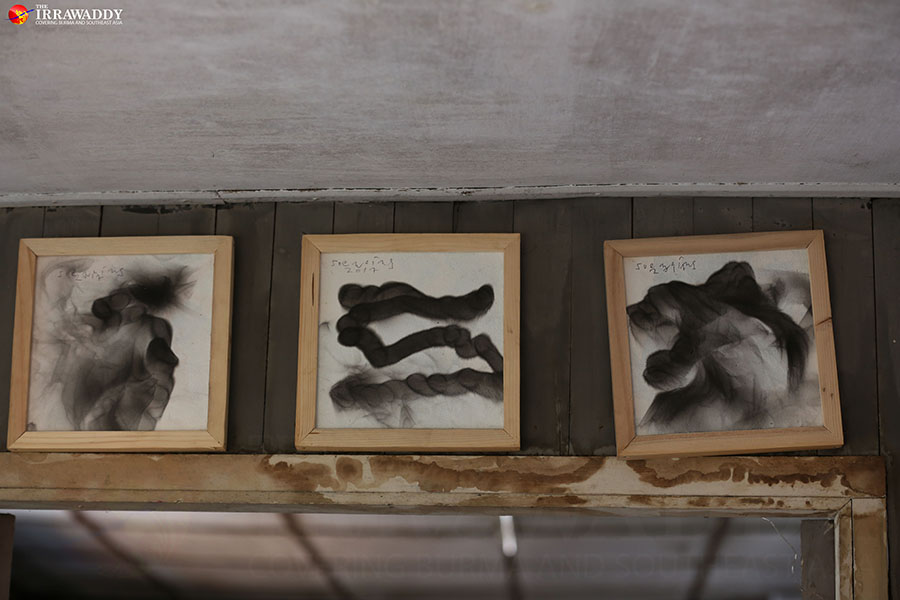
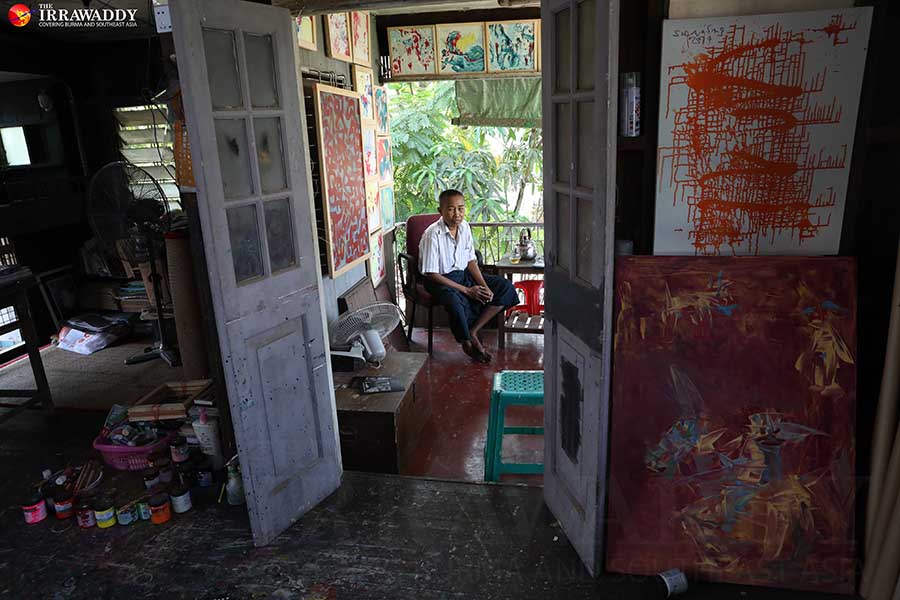
YANGON — After decades struggling as a lesser-known artist, Soe Naing can now lead a decent life. But many years of work with canvas and paint have put his home at risk.

"Will you sell your floor or shall I remove it and take it?" some of his friends and fans have joked.

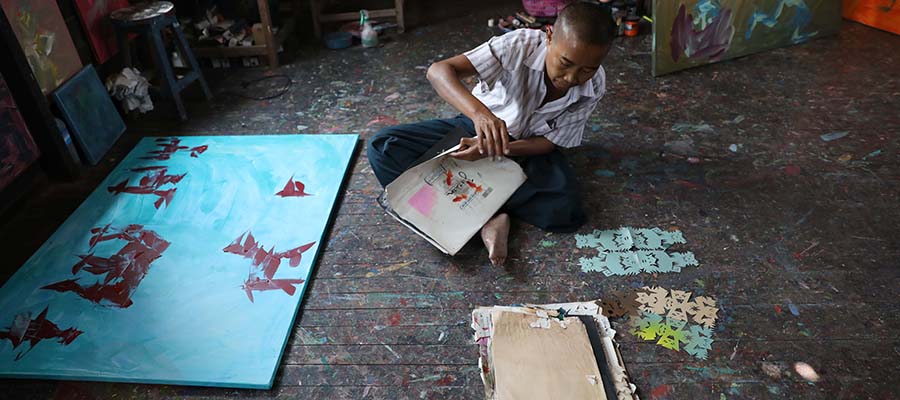
To most people, the floor of his house is just a bunch of wood planks splattered with blotches of colorful paint . To his fans, it is a priceless work of art.

Soe Naing has turned the entire upper floor of his humble two-story wooden house in Yangon's North Dagon Township into his studio. There, he has created thousands of paintings. There, collectors have bought hundreds of his creations.

Today no one remembers when, some 30 years ago, Soe Naing had to walk from one magazine house to another to sell his illustrations.

Born with Thalassemia, a genetic blood disorder, Soe Naing never really enjoyed good health. But there was never a day that Soe Naing did not paint or draw.

Raised under the Burma Socialist Program Party, food and other supplies were scarce when he was young. But on the days his family cooked meat, he could not help using the leftover oil for his art.

"I would always draw something with pen or pencil. Suffice it to say that I am inspired by the unconscious obsession," Soe Naing said.

He studied zoology in the hope that he would be able to draw animals. U Thein Han was one of his first artistic mentors while he was attending university.

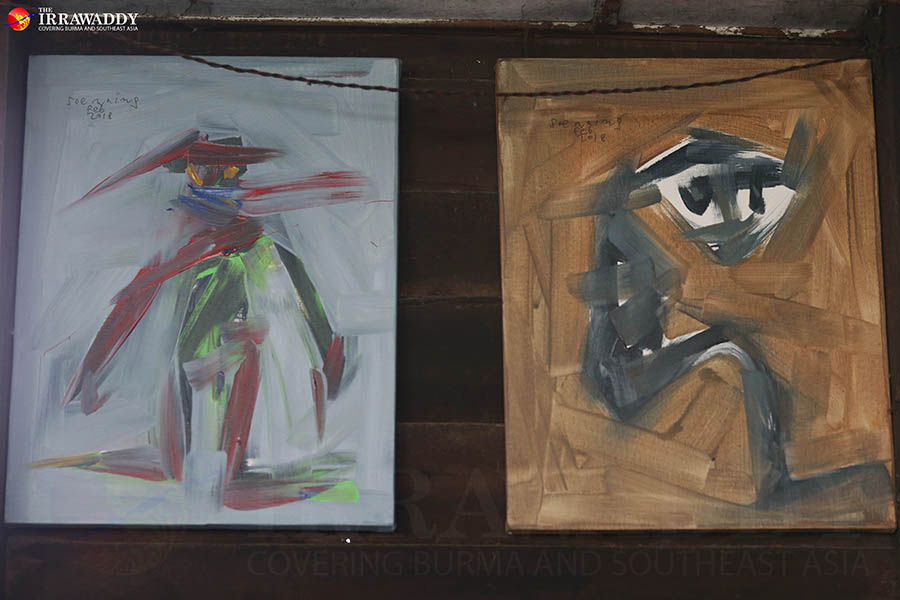
Soe Naing was inspired by abstract expressionist artists Williem de Kooning and Jackson Pollock and became a new figurative but struggling artist after his abstract depictions of humans, dogs, cats, horses and such won praise from critics.

Art and literature critic Zaw Zaw Aung said: "Soe Naing's paintings include figures of living things; they are not human figures, but sub-human figures."

"Soe Naing has created a new trend in Myanmar modernism. He added small figures with intense and swift brush work, which was different from pure abstract works of Kin Maung Yin, Maung Di, Khin Wan and Aung Myint," contemporary artist U Aung Min wrote in his book on Myanmar contemporary art.

Though he set a new trend, his paintings were still not the most popular with collectors. Once, a member of the government’s art exhibit censorship board even asked him “to work,” thinking the artist had stopped painting.

Soe Naing, however, had been working day in, day out. His paintings finally started to sell in the 2000s.

The artist does not like people asking him what his paintings represent. "I don't like to define my paintings at all. Perhaps they think [paintings] are valuable only when they represent something. They are not satisfied when I say it is nothing," he said.

But more and more people are liking his work. Local and foreign collectors have come to his house and bought his paintings in bulk. He has also exhibited his paintings in Thailand and Singapore.

At an art exhibit last year, Soe Naing drew with pitch instead of paint to demonstrate that art can be created with anything.

"Art is close to us. It is not pretentious," he said.

Translated from Burmese by Thet Ko Ko.

The post Abstract Painter Soe Naing Says Art Can Be About ‘Nothing’ appeared first on The Irrawaddy.

Philippines Eyes Joint Exploration Deal With China in S. China Sea Within Months

Posted: 09 Apr 2018 10:10 PM PDT

MANILA — The Philippines is looking to seal a pact with China within a few months to jointly explore for oil and gas in a part of the busy South China Sea waterway claimed by both countries, a Philippine official said on Monday.

In February, the two countries agreed to set up a special panel to work out how to jointly explore for offshore oil and gas in areas both sides claim, without needing to address the touchy issue of sovereignty.

“We’re trying to see if we can achieve an agreement, hopefully within the next couple of months,” Jose Santiago Santa Romana, Philippine ambassador to the People’s Republic of China, told a news conference held on China’s island province of Hainan.

There is political willingness to land a deal, but both parties could take as much time as needed to ensure the goals are met, Santa Romana said at the event, aired live on Facebook, adding that the Philippines aimed to boost its energy security.

Beijing claims most of the South China Sea, a key trade route with areas believed to hold large quantities of oil and natural gas. Parts of it are subject to competing claims from Brunei, Malaysia, Taiwan and Vietnam, besides the Philippines.

Philippines President Rodrigo Duterte on Monday flew to China for the Boao Forum for Asia, and will meet Chinese President Xi Jinping on Tuesday.

Last month, the Philippines identified two areas in the South China Sea where joint exploration for oil and gas may be undertaken with China.

But any potential deal between Manila and Beijing should be agreed with a company and not the Chinese government, the presidential spokesman said.

The idea of joint development dates from 1986, but disputes and the sovereignty issue have kept it from materializing.

In 2016, the Permanent Court of Arbitration in The Hague ruled that portions of the contested areas were part of the Philippines’ 200 nautical mile Exclusive Economic Zone, and Manila had sovereign rights to resources there. China refuses to recognize the ruling.

The post Philippines Eyes Joint Exploration Deal With China in S. China Sea Within Months appeared first on The Irrawaddy.

Rights in Poorer Nations Must Be Upheld as Thai Firms Go Abroad, Activists Say

Posted: 09 Apr 2018 09:37 PM PDT

BANGKOK — Thailand’s businesses and its government must do more to protect the rights of vulnerable people abroad, analysts and activists said, after a landmark case filed by Cambodian farmers in a Bangkok court against a Thai sugar firm.

It is the first time plaintiffs from another country have filed a class-action lawsuit against a Thai company in a Thai court over its operations outside Thailand.

The two plaintiffs represent about 3,000 people who say they were forcibly removed from their homes and land in five villages in Oddor Meanchey Province in Cambodia’s northwest, to make way for a Mitr Phol sugarcane plantation between 2008 and 2009.

As cross-border investments in the region increase to tap resources, markets and cheaper labor, cases such as these will become more common because of differences in legislation and inadequate protections for workers and residents, experts said.

“This is about ensuring that Thai companies respect human rights in the countries they operate in, and holding them accountable for violations,” said Sor Rattanamanee Polkla at the Community Resource Center, which is representing the plaintiffs.

“There is no Thai law against irresponsible outbound investment, and countries like Laos, Cambodia and Myanmar do not have proper frameworks for environmental and social impact assessments. We had no choice but to file a suit,” she said.

The plaintiffs are asking for their land to be returned and 4 million baht ($130,000) in total compensation, she said.

Mitr Phol, the Thai sugar producer, said it had received temporary concessions in compliance with all local and national laws, and had assurances from the Cambodian government that the areas had been processed “legally and transparently.”

Mitr Phol said it had withdrawn from the project in 2014, and that it had recommended that the Cambodian government return the land to the “affected communities.”

The case, filed last month, is set to begin on June 11.

Not Binding

Cambodia awarded large economic land concessions to foreign companies — mainly from China, Vietnam, South Korea and Thailand — to operate mines, power plants and farms in order to spur economic growth and alleviate poverty.

Such deals, which covered more than a tenth of the country’s surface area by 2012, have displaced more than 770,000 people since 2000, rights lawyers say.

Following protests and pressure from rights groups, Cambodian Prime Minister Hun Sen announced a moratorium on new concessions in 2012, and promised to review old ones.

But activists say the reviews did not lead to significant changes, and that even when concessions were cancelled, the land was often retained by the government.

In the case of Mitr Phol, the villagers first filed a complaint with the Bonsucro sugarcane sustainability initiative, and then the National Human Rights Commission (NHRC) of Thailand, a government agency.

After a two-year investigation, the NHRC said rights violations had occurred, and Mitr Phol was directly responsible. It asked Mitr Phol to pay compensation in line with the United Nations Guiding Principles on Business and Human Rights.

But the NHRC’s powers are limited, Sor said, and the Cambodian farmers did not get compensation or their land back.

“The NHRC can issue recommendations, but these are not binding. Filing cases is an option, but it is always a challenge to go through the judicial system,” Angkhana Neelapaijit, a member of the NHRC, told the Thomson Reuters Foundation.

The NHRC has received more than a dozen complaints about Thai overseas investments, particularly in Southeast Asia, related to their impact on the environment and people, she said.

Negative Impacts

In response to the NHRC’s recommendations, the Cabinet issued resolutions in 2016 and 2017, calling for Thai investors to respect and protect the rights of local people, and to prevent adverse impacts on the environment and to livelihoods.

Last year, Prime Minister Prayuth Chan-ocha said the government intended to implement the UN guiding principles in a policy plan being drafted in consultation with rights groups.

But the region has proven to be a “laggard” in adopting an enforceable regional human rights system, said David Pred, co-founder of advocacy group Inclusive Development International.

“We shouldn’t hold our breath waiting for governments to adopt one. But that need not stop people from pursuing justice for business-related human rights violations in the national courts of the countries where the companies are domiciled.”

Thai outbound investment in 2017 totaled about $20 billion, according to the country’s investment board, much of it going to Cambodia, Laos, Myanmar and Vietnam.

But investors are backing projects “with little regulation and often with disregard for the human and environmental rights impacts,” according to a report from the UN Working Group on Business and Human Rights published in November.

“Negative impacts commonly include destruction of livelihoods, land grabs, and forced eviction,” it said.

Thai investors must apply the highest international standards and offer remedy for abuses, said Surya Deva, a member of the UN working group, which concluded a 10-day visit to Thailand last week.

“If Thai companies are benefiting from these investments, and outsourcing negative human rights impacts, it is critical that they also provide opportunities for any victims to file cases in Thailand if needed,” he said.

“It is a complicated process, but that option should be available,” he said.

The post Rights in Poorer Nations Must Be Upheld as Thai Firms Go Abroad, Activists Say appeared first on The Irrawaddy.

Ten Things to Do in Yangon This Week

Posted: 09 Apr 2018 08:00 PM PDT

Sai Sai Birthday Show

This is the annual fan party for pop star Sai Sai Kham Leng.

April 10, 6 p.m. to 11 p.m. Thuwunnabhumi Event Park. Tickets start at 10,000 kyats. Tel: 09-4510101789.

Yangon Central Pavilion

This is the main pavilion for Thingyan festivities in the city, organized by the Yangon regional government.

April 13 to 17, Yangon City Hall.

Arakanese Traditional Thingyan

There will be traditional Arakanese music and dance performances, as well as traditional food and souvenirs.

April 13 to16, 9 a.m. to 5 p.m. Thuwunna Stadium, Thingangyun Township.

Made in Yankin

Chit Kaung, Bobby Soxer and DJ Thaw Thaw will perform at the Yankin Thingyan pavilion.

April 13 to 16. Yankin Road, 12 Lone Tan.

Thingyan Splash Walk

There will be entertainment, free snacks, fun and much more.

April 13 to 17. U Ottama Park, by the southern gate of Shwedagon Pagoda.

Barrack Water Festival 2018

Barrack, a pavilion popular with youngsters, is back this April.

April 13 to 16. Pyay Road. Tickets start at 45,000 kyats. Tel: 09-43020145 or 09-5069595.

Thingyan Music Festival

International DJs will perform at this pavilion.

April 13 to 16. Pyay Road. Tickets start at 20,000 kyats. Tel: 09-775007750 or 09-775077500.

Water Festival at Vintage Luxury Hotel

There will be entertainment at the vintage car parking area and a buffet dinner for 9,000 kyats per person.

April 13 to 17, 6 p.m. to 11 p.m. No. 6, Botahtaung Jetty, near Botahtaung Pagoda, Seikkan Township. Tel: 09-258819911-55.

Sarpay Lawka Book Sale

Sarpay Lawka is offering a 10 percent discount on all books at all of its outlets.

Through April 12.

First Group Show 2018

Dozens of artists are showcasing more  than 300 works at this event.

Feb. 2 to April 16. New Treasure Art Gallery, Thanlwin Street.

The post Ten Things to Do in Yangon This Week appeared first on The Irrawaddy.