Kyaw Zwa Moe: Welcome to Dateline Irrawaddy! This week, we'll discuss the talk of the town, which caused public anger. Union Minister of Planning and Finance U Kyaw Win was allowed to resign while being investigated by the Anti-Corruption Commission. People are speculating about the extent of his corruption and appropriate punishment for it. What urgent measures should the National League for Democracy (NLD) government take to better tackle corruption? Ko Aung Thu Nyein, a director at the Institute for Strategy and Policy, and political analyst Dr. Yan Myo Thein join me for the discussion. I'm Kyaw Zwa Moe, editor of The Irrawaddy English edition.
The Anti-Corruption Commission's investigation of Planning and Finance U Kyaw Win became the talk of the town. On May 27, the commission said the results of the investigation had been reported to the President's Office and public reports would be made accordingly. U Kyaw Win submitted his resignation and has been allowed to resign. People expect to see the NLD government's decisive action on corruption. Ko Aung Thu Nyein, what does the NLD government have to do to prove it is a clean government if its ministers have been corrupt?
Aung Thu Nyein: After the 2015 poll, people were proud that their [new] leaders were not corrupt. Recently, newly elected President U Win Myint vowed to fight corruption. People have expectations. At [a meeting at] the UMFCCI [Union of Myanmar Federation of Chambers of Commerce and Industry], economist Dr. U Myint called for going after big fish in fighting corruption and not smaller ones, and setting an example by taking a tougher stance on [cabinet] members. This was followed by action taken against a minister. So, the NLD government is starting to fight corruption. But, what is important is the political will. How much are the country's leaders determined to fight corruption? Will the government adopt a zero-tolerance policy against corruption? If yes, it needs to reaffirm this and continue walking the walk.
KZM: I remember that Daw Aung San Su Kyi said on the campaign trail in Yamethin and Hmawbi before the 2015 election that if her party was elected, it would not tolerate two things: deliberate harming and misappropriation of public funds. She said that she would visit her cabinet members in prison if they were corrupt. We don't know yet if the finance minister was actually corrupt. But, Ko Yan Myo Thein, what are the important factors in building a clean government?
Yan Myo Thein: The government for the time being should inform the public about the case in a transparent manner. And appropriate action should be taken depending on the result of the investigation. If the government takes a biased approach because ministers are appointed by it, then, it will not win the trust of the people. A government or a political party, if it fights corruption effectively on a wide scale, can win public support.
We need a mechanism that can monitor on a wide scale if government officials, lawmakers and leaders of political parties are free from corruption. And we need a body to monitor if ministers can perform their assigned duties well. Only then, will we know if they work or not and if they meet the targets, not on paper, but on the ground. Then, remedial action can be taken as necessary. There is also a need to inform the public on a wide scale. Rather than talking to the public about what it has done in a particular period, the government should work to make the people feel that it is actually working to reduce the burden on people.
KZM: Ko Aung Thu Nyein, regarding corruption, big fish were not caught under successive governments. The Anti-Corruption Commission was formed [under U Thein Sein's government] but it barely worked. The NLD government has investigated its minister. It is a good sign and can be interpreted as having political will. It is important to choose the right persons in forming the cabinet. When U Kyaw Win was nominated for the ministerial position [in 2016], many media organizations reported that his doctoral degree was a fake. However, he was appointed to the cabinet. The government has changed some ministers who underperformed, and has nominated U Soe Win for the planning and finance ministry. What criteria do you think the government should develop to get the right candidate?
ATN: According to the practice in the United States, I see two criteria. There is a Senate hearing if a minister is nominated. The nominee is grilled [about his knowledge]. He gets low marks if he can't answer questions. In our country, a list of the nominees is submitted to Parliament. But it is quick to approve them and there is no hearing like in the US. We also need freedom of the press. In the US, I think while President Obama was in office, the nominee for the secretary of the Department of Treasury was submitted. The US media investigated his background and found that he had evaded taxes. This brought into question his eligibility for the treasury secretary post. Without free media, it is difficult to find out such things. So, my opinion is, Parliament should take time in assessing the eligibility of the nominees. And a free press should also look into it. And parliamentary committees should play a greater part.
KZM: Only then, will there be public debate on the eligibility of elected ministers. As I've said, President U Win Myint took office and promised to do things that the government was not able to do over the past two years. It is less than three years until the next election. The NLD might need better policies and better ministers to achieve good results in the next election. There are criticisms that almost all of the ministries are not performing well. There is a capacity problem within the government, even though it has the political will, people have pointed out. Ko Yan Myo Thein, what is your view on this?
YMT: As far as I've seen, I'd say the only department whose performance has greatly improved is the Fire Services Department. It has become very popular among the people. Except for the fire services department, we don't see the striking development of other departments. So, I thought about why. Is it because of the high centralization in the government? If that is the case, how should centralization be reduced?
Under successive governments, from the time of the Myanmar Socialist Program Party government to the SLORC (State Law and Order Restoration Council) and the SPDC (State Peace and Development Council), there was the problem [of centralization] in that officials only had responsibility but did not have authority. Directors-general only have responsibility but no authority and it is the same for the ministers. If the higher echelons control all of the authority, it will go against the democratization process we are undergoing. Our democratization will be more meaningful only when centralization in the government, in the Parliament, and in political parties including the ruling party is reduced.
KZM: We have talked about the need for NLD appointees to steer clear of corruption. But as everyone knows, our country is one of the lowest-ranking countries regarding corruption. There is corruption not only in government but also in institutions. There was corruption among top officials of successive governments and institutions. We've heard reports about their corruption, but we do not have evidence to file complaints. It is very difficult to build a corruption-free society. No society in the world is corruption free. But it is possible to reduce corruption in the government and related institutions. What measures should the current government take to handle corruption? The Anti-Corruption Commission has also started to take action. What else can be done to fight corruption harder?
ATN: First of all, there is a need to differentiate between bureaucracy and politics. Bureaucracy is the civil servants and they will continue to exist no matter which government is in office. They will have duty as well as authority. So there may be corruption and bribery with them. Another part is politicians who are elected at the polls every five years. Some scholars said petty corruption—asking for small amounts of money at government departments—is not a problem for the country. But policy corruption—the corruption of high-ranking officials—is a problem. We want the government to focus more on policy corruption.
KZM: With high-ranking officials, you mean ministers…
ATN: Yes, ministers and directors-general, who are policymakers. Secondly, when we talk about corruption, we talk mainly about taking bribes. Power abuse is also a form of corruption. It is also an abuse of power to deny the rights that individuals are entitled to and grant rights that individuals are not entitled to. Taking and accepting bribes, making efforts and negotiating to get bribes, and offering and promising to do something in exchange for bribes are all forms of corruption. It is a vast subject.
KZM: Speaking of abuse of power, besides the abuse of power by authorities, what about the abuse of power by their children and relatives for personal gain? How can the government handle this? There are reports that children of current and former government officials have business interests in connection with their parents' positions, but those who try to expose this may get into trouble without concrete evidence.
YMT: Amendments are being made to the Anti-Corruption Law. Half of the amendments have been approved [by the Parliament]. The [Anti-Corruption Commission] should take greater initiative. It should verify reports [of corruption scandals] on social media and mass media and carry out the necessary investigations rather than wait for somebody to file a complaint. Only then will corruption be fought on a wide scale.
It is more important to monitor tigers [high-ranking officials] than flies [low-level officials] in fighting corruption. Not long after the NLD government took office, a company gave a gift in the form of money to [a President's Office official] during the Thingyan festival. The money was given back. The commission shouldn't just let it go. Now, a minister is being investigated for corruption. [The government] should go to the root; it should find out who nominated and supported that minister. It should find out and take action against those who are connected. Regarding giving gifts, there is a need for tough control among tigers in the administrative mechanism.
KZM: To summarize, as NLD government and its leader Daw Aung San Suu Kyi have said that corruption shouldn't be tolerated. Only when it takes decisive action against corruption with accountability, will it win greater support from the people. It is also important to verify and get the right people. But, they don't have much time—only two years. Thank you for your contributions!
Union ministers explained how their ministries spent loans obtained from foreign agencies such as the World Bank, Asian Development Bank, Japan International Cooperation Agency, China Export/Import Bank and official development assistance loans from Korea.
Tuesday (May 29)
In the Lower House, lawmaker U Nyan Hein of Mon State's Thanbyuzayat asked whether the military would return Shwe Phyu Yadana Golf Course in the township to the public. Deputy Defense Minister Major-General Myint Nwe replied that the locally based 31st Light Infantry Battalion has no plan to return it for public use as the area is important for security reasons.
Wednesday (May 30)
The Upper House approved a proposal by U Hla Hsan of Magwe Constituency (1) urging the Union government to disseminate knowledge of good agricultural practices to farmers across the country to ensure food sufficiency.
Thursday (May 31)
The Union Parliament approved the appointment of U Soe Win as Union minister for planning and finance. Born in 1938, he becomes the oldest minister in the cabinet, led by the National League for Democracy.
Friday (June 1)
In the Lower House, U Pe Than of Myebon Township asked whether the Union government planned to designate as gazetted public holidays those days that are of significance to ethnicities such as local New Year's and National days, to be commemorated in the states and self-administered divisions. Union Ethnic Affairs Minister Nai Thet Lwin replied that having too many public holidays would negatively impact development. He said the concerned regional and state governments and parliaments were free to act, but the Union government has no plan to designate those days as public holidays.
MANDALAY — Police in Mandalay opened fire on a group of young men who allegedly attacked them with swords on Thursday night, killing one and injuring another.
Colonel Myo Aung, the Mandalay District police chief, said the officers were set upon after arresting two suspected robbers at the Swedaw truck station in Amarapura Township.
"A group of young men with swords came and said they were angry with the police who arrested their friends and challenged the police," the chief said.
"They attacked the police when they were told to drop their weapons. Then the police had to open fire to disperse them. However, one of them died and one was injured in his cheek," he added.
Police said Ko San Htoo Aung, the injured man, was admitted to Mandalay General Hospital for treatment and that he was being sued for illegal weapons possession and attacking police.
Police also said they were searching for the other 20 men who attacked the officers but escaped.
Although the crime rate in Mandalay has not risen significantly of late, police say the area’s thieves, robbers and other criminals were growing increasingly fond of wielding knives and swords to scare their victims.
In the past week alone in Mandalay a gold shop was robbed, a group of sword-wielding men broke through the gate of a home and stole a motorcycle, and a group of men were fighting with swords in the street.
Police records say a group of men in their 20s with swords who stole at least 10 motorcycles was arrested in recent days and is being sued for theft, robbery and illegal weapons possession.
"We care about the concerns people have raised, so we've increased security, especially at night, and are cooperating with division police,” Col. Myo Aung said. “Most of the arrested people are in their twenties, and we found out that they are unemployed, have little education and have a strong desire to make easy money because they want to spend like a boss. They've admitted to the crimes."
YANGON — The Yangon regional government came under intense criticism in Parliament this week for its proposed 2018-19 budget, with MPs expressing concerns about the planned spending of billions of kyats.
U Yan Aung, an NLD regional lawmaker from Mingalar Taung Nyunt Township, said during a Friday parliamentary session the draft budget included expenses that are "unacceptable and unnecessary".
He pointed to proposed spending on office supplies, such as 800, 000 kyats for a swivel chair and 4 million kyats for woodcarved furniture, while the MPs' suggestions for funds for township development were largely ignored.
"Furniture is bought every year. Is that furniture only for one year's use? And after being used for one year, is it being thrown away?" U Yan Aung said.
The MP wondered aloud whether the furniture was actually being bought, and urged Parliament to consider whether it was necessary.
"I suggest the budget be examined carefully. If not, public funds will be squandered," he said.
The planned spending on furniture was among a number of items in the budget that MPs expressed vigorous opposition to during the debates this week.
Another hot topic was that the proposed purchase of 10 Ford cars to be used as official vehicles for the Yangon regional government at a cost one billion kyats.
The cars are intended to be used to ferry guests to regional government functions. MPs strongly criticized the proposal and stressed priority be given to the needs of the general public.
The draft budget for the upcoming fiscal year, which will start on October 1 and end on September 31, 2019, was submitted by the Yangon Regional Minister for Planning and Finance U Myint Thaung on May 25. Nearly 20 lawmakers debated the budget proposals starting on Wednesday.
On Friday, the Yangon Parliament Finance, Planning and Economic Committee proposed a set of budget cuts.
NLD regional lawmaker Daw Sandar Min, who chairs the committee, said a total of 3.6 billion kyats had been requested for the purchase of vehicles including the 1 billion for the 10 Ford sedans and for the office of the Yangon City Development Committee (YCDC).
She said the General Administration Department (GAD) had also asked for 1 billion kyats to buy 21 double-cab cars in the 2018-19 fiscal budget.
Daw Sandar Min said a total of 57 vehicles had previously been bought for the GAD.
"Given that the budget for those vehicles shouldn't be approved, to ensure necessary development of the townships is properly funded, we [the committee] would like to ask that the allotted funds be cut," she said.
The committee also proposed cutting 107.65 million kyats for various planned expenditures at Yangon City Golf Club, which come on top of 1.5 billion kyats allocated for its six-month operating budget from April to September.
The committee also asked to cut a proposal from a YCDC request for 6.8 billion kyats to invest in Yangon City Bank to allow it to provide foreign banking services, and suggested the money be used instead for township development projects.
In addition to the government's contentious expenditure proposals for the upcoming fiscal year, the lawmakers also condemned the regional government's lack of transparency.
Last month, an urban development proposal from the Yangon government regarding infrastructure, transportation, housing and economic development projects was rejected after lawmakers called for more transparency.
Lawmakers complained that the report the government had submitted to Parliament included only titles of projects and general information, making it difficult for them to approve it.
Last week, the MPs also asked the regional auditor general to examine the Yangon government's spending of 64 billion kyats on City Bank, 70 billion on Yangon Bus Service and 7.8 billion kyats for farmland repairs—which were allocated in a supplementary 2016-17 budget.
The lawmakers' heated debates over the government's proposed budget expenditures and lack of transparency were welcomed as a sign the check-and-balance mechanism between parliament and the government was working.
The Yangon Parliamentary speaker announced on Friday that the regional government would provide clarifications about its budget proposals during the Monday session.
YANGON – The Myanmar President's Office announced on Thursday a plan to establish a three-member independent commission of enquiry to investigate alleged rights violations in northern Rakhine State's strife-torn Maungdaw region, both by the Arakan Rohingya Salvation Army (ARSA) and "related abuses".
The commission is to include one international member and two local experts. The names of the appointees and a specific timeframe for the commission's mandate have not been announced. The President's Office merely stated that international and national experts would assist the team. The brief statement says the move is in accordance with the interim recommendations of the Advisory Board for the Committee for the Implementation of the Recommendations on Rakhine State, which was created in December by Myanmar's de facto leader, State Counselor Daw Aung San Suu Kyi.
That implementation committee contained five high-profile international figures and five local experts and was led by former Thai Foreign Minister Surakiart Sathirathai. One of the foreign members, veteran US diplomat Bill Richardson, quit the panel after accusing Daw Aung San Suu Kyi of a creating the panel to "whitewash" and act as a "cheerleading squad" for the government's policy. He refused to take part in the commission's first visit to strife-torn northern Rakhine after his efforts to intervene on behalf of two Reuters reporters detained for their coverage of the Rakhine issue were neglected by the State Counselor.
Also Thursday, the Myanmar government signed a Memorandum of Understanding on the Rohingya refugee repatriation process with two UN agencies, the United Nations Development Program (UNDP) and the Office of the United Nations High Commissioner for Refugees (UNHCR). The government has been discussing the agreement with the relevant parties since February 2018.
The surprise signing of a tri-party MoU with two UN agencies comes a few weeks after a visit by a United Nations Security Council (UNSC) delegation in early May to northern Rakhine, where ARSA's serial attacks on 30 security outposts in late August 2017 triggered a devastating military clearance operation by the Myanmar military that has driven some 700,000 mostly Rohingya refugees into Bangladesh amid allegations of arbitrary killings and rapes by the security forces. The UNSC delegation described the mass devastation of Rohingya villages as "ethnic cleansing". At a briefing in New York in May, the UNSC called on the Myanmar government to collaborate in a credible investigation. In response, Myanmar's permanent ambassador to the UN urged the council to investigate "atrocities" committed by the ARSA against civilians.
The government's latest move triggered a public debate on Facebook. Some Arakanese lawmakers expressed concerns, and former information minister U Ye Htut criticized what he labeled the government's "commission cycle". Since taking office in 2016, the ruling NLD government has already set up several commissions to address the deep-seated issues fueling the Rakhine crisis.
Yangon-based political and ethnic affairs analyst U Maung Maung Soe said establishing an independent commission and signing an MoU with UN agencies was likely timed to ease international pressure, especially from international rights groups who have urged that Myanmar's military leaders be referred to the International Criminal Court (ICC). The government is also being pressed by the UN to allow a fact-finding mission to Maungdaw.
U Maung Maung Soe suggested the government strive for internal unity on the Rohingya issue as a first step. Myanmar's various ethnic groups have different stances and tend to remain silent when it comes to the Army's crackdown on the Rohingya, as they have experienced similar rights violations in Kachin, Shan and other conflict zones. Without winning the collective support of the country's ethnic groups, the government's successes on the international stage will only be temporary, U Maung Maung Soe said.
"Ethnic groups should have a united position on supporting the government in solving the Rakhine issue; this is the most important thing. If the government fails to solve it, international pressure on Myanmar will harden," U Maung Maung Soe added.
Lower House lawmaker U Pe Than of the Arakan National Party (ANP) questioned why the government was offering only limited information, and had not revealed who the commission members are. And the description in the statement of the commission as "independent" is also questionable, the lawmaker said, as true independence would require the members to be able to move freely and observe the locations of alleged abuses.
"At the moment, we have very limited information about the commission. So we will wait until they reveal specific information such as the names of the members of the commission, its timeframe and who it will report to," U Pe Than said.
He speculated that if the commission dug deeply into the details of rights abuses in northern Rakhine, such as finding the perpetrators of arson attacks on villages during the clashes, it could lead to further violence in the region as both sides—the Army and Muslim villagers—accuse each other of burning houses. Moreover, consistently demanding the resettlement of Muslim villagers on southern Maungdaw's coastline for human rights reasons could prompt clashes with Buddhist Arakanese, as the Rakhine community sees this area as essential for security matters.
"The more independent the inquiry body, the more problems we are likely to face on the ground," U Pe Than said.
Executive power in Myanmar is divided between the civilian government and armed forces. As many political observers put it, there are two lions sharing a cave.
But then how can the president exercise his executive power to order the military to stop fighting in an ethnic minority region, particularly in the north?
Indeed, this is an ongoing debate among political observers and ethnic leaders.
U Win Myint is now president and believed to be focusing on fixing several critical problems. But he will also — many hope — be given more executive power from his boss, and Myanmar’s de facto leader, Daw Aung San Suu Kyi.
This debate resumed when UN Security Council members visited Myanmar (after Bangladesh) to learn about the crisis in northern Rakhine State in early May.
Senior General Min Aung Hlaing told the council delegates: "Our Tatmadaw [military] represents Myanmar, and though I am the head of the Tatmadaw, our country has the president. And we Tatmadaw act under the leadership of the president."
He was responding to a question about clearance operations in Rakhine State that have driven some 700,000 mostly Muslim Rohingya to neighboring Bangladesh.
The Tatmadaw, the army chief added, “is under the guidance of the Myanmar government. We only take action according to the mandate given by law and we are not authorized to do anything beyond the limits of the law."
We still don't know if U Win Myint has had any quality conversations about this sensitive subject with Snr. Gen. Min Aung Hlaing since he took office in March.
But it is clear who ordered the 2,000 to 4,000 troops to Rakhine State when Muslim terrorists began attacking civilians.
The deployment was ordered not by then-President Htin Kyaw, but by Snr. Gen. Min Aung Hlaing.
In August, a delegation comprising seven members of the Arakan National Party visited the army chief to discuss local concerns and called for heightened security measures in Rakhine State. They asked the military to send more troops because ARSA and other radical Muslims had slaughtered local civilians.
Who, then, ordered the clearance operations? Snr. Gen. Min Aung Hlaing or U Htin Kyaw? The answer is obvious. Interestingly, though, there was no counter-statement from the civilian administration.
This week The Irrawaddy asked a Defense Ministry official whether the military was prepared to obey if President U Win Myint were to order it to stop fighting in Kachin State.
Brigadier General Aung Kyaw Hoe, the ministry’s permanent secretary, replied: "The Tatmadaw is under the leadership of the state. The president is the head of the country. If he gives an executive order, we are ready to obey. There is no reason we won't obey it."
It is understood that his answer caused some in Naypyitaw to hit the roof. Regardless, will U Win Myint test his powers and order the military to stop fighting in Kachin?
Former President U Thein Sein, an ex-general who was lauded as a reformer, ordered the military to halt attacks on the Kachin in 2011. As a result, the fighting gradually ceased and the leaders of the Kachin Independence Army came to the negotiating table. But the generals complained that the Kachin had expanded their bases during the peace talks and the attacks resumed.
Since the National League for Democracy took control of the civilian government in early 2016, the National Defense Security Council has not met. Though the army and government have had joint security briefings, the fighting in Kachin should be discussed at a proper meeting of the council.
Ethnic leaders are frustrated with Daw Aung San Suu Kyi’s long silence on the fighting in Kachin and Shan states. She has been to Kachin and visited camps housing displaced families. But it seems she has little influence over the army chief, even after gushing that she was fond of the military as her father, General Aung San, had founded the armed forces.
But the real issue here is the 2008 Constitution, which forces two lions to share a cave and limits the civilian government’s executive powers.
As the Constitution clearly states: "The Defense Services have the right to independently administer and adjudicate all affairs of the armed forces and the commander-in-chief of the Defense Services is the supreme commander of all armed forces."
It goes on: "The Defense Services have the right to administer military affairs independently; the Defense Services are mainly responsible for safeguarding the non-disintegration of the Union, the non-disintegration of national solidarity and the perpetuation of sovereignty; the Defense Services are mainly responsible for safeguarding the Constitution."
Myanmar's fundamental power structure won't change if the military continues to play a leading role in national politics as stipulated by the Constitution. It will only serve to set the two lions on a collision course.
But wishful thinking among some political observers has it that the generals may be hinting that they are ready to compromise with the current civilian government now that they say they are under the president’s orders. Or they may simply be trying to shift the blame for the Rakhine crisis onto the civilian government with international rebuke focused mainly on them.
Some are asking why the civilian leadership is so silent and displaying a siege mentality.
At a press conference in May 2016, Snr. Gen. Min Aung Hlaing said: "The commander-in-chief is ranked below the president. Contrary to what many assume, we are working together [with the civilian government]."
So should U Win Myint order the military to stop fighting in Kachin State and see how the army responds?
Isn't it time for the president and army chief to sit down and be frank about who is telling the truth?
The government ordered a restaurant belonging to the North Korean Embassy in Yangon be shut down recently following a request from the US for Myanmar to respect a United Nations Security Council (UNSC) resolution on sanctions against North Korea.
Aryani Manring, who is assistant public affairs spokesperson for the US Embassy, told The Irrawaddy that the US had urged the government of Myanmar to comply with UNSC resolutions.
"The expulsion of DPRK laborers working at the DPRK restaurant in Yangon is part of Myanmar's compliance with DPRK-related UNSC resolutions," Manring said, referring to the country's official name, the Democratic People’s Republic of Korea.
Manring referred further questions about the closure of the restaurant to the Myanmar government.
The Pyongyang Koryo Restaurant opened on Saya San Road in Bahan Township in 2011 when Myanmar had better ties with North Korea.
A dozen young North Korean women who were all attired in similar dresses served tables at the restaurant. They could speak some Burmese and even sang Burmese language songs.
U Tin Soe, general secretary of the Bahan Township authority, told BBC Burmese language radio yesterday that the Myanmar Immigration Department had ordered the restaurant to close two months ago.
The restaurant has a new owner and is currently undergoing renovations, he said.
U Zaw Htay, chief spokesperson of the President's Office, refused to comment on the government's decision to order the restaurant shut when asked by The Irrawaddy. He suggested reporters contact the Yangon regional government for information.
Observers have speculated that the Myanmar government agreed to the US request because it wanted to show it was a good friend of the United States and respects UNSC resolutions.
In the past, the Myanmar Army bought weapons from North Korea when the two countries enjoyed better relations. When the deal was revealed, it attracted condemnation from the United States and other countries. But, today Myanmar appears to want to show that it does not have a close relationship with North Korea anymore.
NAYPYITAW — While the president has the authority to appoint the commander-in-chief of the Defense Services, determining his retirement age is the task of the 11-member National Defense and Security Council (NDSC), a senior civil servant said on Thursday.
In response to The Irrawaddy's questions about the age at which Myanmar Army chief Senior-General Min Aung Hlaing, 61, will retire, Union Civil Service Board (UCSB) spokesperson U Saw Valentines said his agency had no authority to set the retirement age of the army chief, adding that the NDSC is ultimately responsible for this according to the 2008 Constitution.
U Saw Valentines made the comments at a UCSB press conference in Naypyitaw.
Under the law, the retirement age for most civil servants is 60, but this provision does not apply to Defense Services personnel, he said. Constitutionally, the president shall appoint the military chief based on the proposal and approval of the NDSC, he said.
"We don't have authority to decide the retirement age for the commander-in-chief of Defense Services. But as far as I know, according to the 2008 Constitution, the president can appoint him with the proposal and approval of the NDSC," said U Saw Valentines.
The 11-member NDSC consists of the president, the two vice presidents, the speakers of the two houses of Parliament, the army chief, the deputy army chief, the foreign affairs minister, the border affairs minister, the home affairs minister, and the defense minister.
Chief of General Staff (Army, Navy and Air) General Mya Tun Oo said in July 2016 that the retirement age for both the army chief and deputy army chief is set at 65.
Snr-Gen Min Aung Hlaing was born on July 19, 1956. He was appointed commander-in-chief when president U Thein Sein's government was sworn into office in 2011 and was promoted to the rank of senior-general in March 2013.
Article 291 of the 2008 Constitution stipulates that relevant military laws shall be applied to military personnel because the nature of military service differs from that of the civil services.
YANGON — Ma Hla Hla Phyu was shocked to learn of her big sister’s arrest on May 23 at a government checkpoint in the Taungup Mountains of Rakhine State on the road to Yangon.
Ma Hla Hla Phyu, 19, and her sister Ma Hla Phyu, 26, also known as Ma Raw Mie, are victims of the communal riots that pitted some of Rakhine State’s Buddhist and Muslim communities against one another in 2012. It its wake, authorities evicted at least 2,000 Muslims from several quarters of southern Rakhine’s Kyaukphyu town on the grounds of preventing further violence.
Ma Raw Mie had passed the government’s high school matriculation exam in Kyaukphyu the year before, but the riots put her hopes and dreams of a brighter future on pause as the family of five was shipped off to a camp for internally displaced people (IDPs) on Kyaukphyu’s outskirts along with hundreds of others.
She started teaching at a school inside the Kyauktalone IDP camp that serves some 300 students. She also held a National Verification Card (NVC) for non-citizens, introduced by the previous government to replace the so-called white cards. So, having never been to Yangon, she decided to visit the country’s bustling commercial capital on May 23 without telling the rest of her family.
Taungup Township police officer Major Ko Ko Oo confirmed that Ma Raw Mie was arrested the same day and soon sentenced by the local court to a year in prison with hard labor for violating Article 6 (c) of the 1949 Immigration Act for possessing someone else’s National Registration Card (NRC), also known as a pink card. He declined to provide details and referred additional questions to the police station, where officers refused to comment.
The court proceedings took only two days and Ma Raw Mie was given no chance to find a lawyer. According to the police report, she tried to cross into Bago Region with the NRC of an Arakanese woman from Ramree Township, Ma Khin Moe Moe Win.
Ma Hla Hla Phyu told The Irrawaddy that authorities transferred her sister to Thandwe prison on Friday. She questioned the severity of the sentence. In 2016 a Chinese national was arrested in Mandalay for possessing a fake identity card and only fined 100,000 kyats ($73.80).
"I don't know what's going on there because we had no idea about her trip. We want to visit her and hear her explanation," she said.
A government checkpoint near Taungup Township, Rakhine State. / Moe Myint / The Irrawaddy
Form (4)
But the chances that the sisters will get to meet are low, considering how difficult it is for Muslims in Rakhine to travel, even with an NVC. Displaced Muslims in the state must secure a travel permit from the Immigration Department for any trip either in or outside of Rakhine. Securing a permit can take a week or more.
"We can't go anywhere without Form (4), even in Rakhine," said U Maung Ni, a resident of the Kyauktalone IDP camp.
Most Rohingya Muslims reject the NVC even though the government regularly promotes its supposed advantages.
Some 700,000 mostly Rohingya have fled Rakhine for neighboring Bangladesh since attacks on security posts there in late August by the Arakan Rohingya Salvation Army (ARSA) triggered a military crackdown mired by widespread reports of arson, rape and arbitrary killings by Myanmar’s security forces. The UN has accused the military of ethnic cleansing and called on the government to accept a "credible independent investigation."
In April, following a trip to the refugee camps in Bangladesh, Social Welfare Minister U Win Myat Aye said NVC holders could fill out Form (4) and secure citizenship within five months, depending on approval from the relevant government departments. The NVC does not guarantee citizenship on its own.
Immigration rules stipulate that NVC holders must use Form (4) to apply for travel permits and to access health or education services. Those who secure the travel permits cannot stay outside of Rakhine State for more than 45 days and must inform authorities of when they leave and return 24 hours in advance.
The form was created during the rule of the State Peace and Development Council under military dictator U Than Shwe and deliberately targets Muslims travelling from Rakhine to Yangon. Even former lawmaker U Shwe Maung, who ran in the 2010 elections as a candidate for the military-backed Union Solidarity and Development Party and now lives in asylum in the US, had to use the form to travel.
Broken Promises
Ma Raw Mie had applied for a travel permit several times in 2017 and 2018 but was always refused.
U Phyu Chay, who heads the Kyauktalone IDP camp’s management committee, said at least 50 NVC holders applied for travel permits in 2017 and that not one has heard back from the Immigration Department.
"Whenever we asked immigration officers, they always said they were waiting for approval from above. Then it always disappears into the air. We don't exactly understand the meaning of ‘from above,’" he said.
U Maung Ni said some of the rejected applicants had even included recommendation letters from doctors. He said immigration officials in Kyaukphyu had forwarded the applications for travel to Yangon to the state capital, Sittwe, from where they were sent on to Naypyitaw and Yangon.
Despite the social welfare minister’s claim that NVC holders who fill out Form (4) were eligible for citizenship within five months, more than 600 Muslims in the Kyauktalone IDP camp with NVCs since 2015 have yet to secure citizenship.
The Kyauktalone IDP camp on the outskirts of Kyaukphyu town, Rakhine State. / Moe Myint / The Irrawaddy
U Phyu Chay said he has had many private meetings about the displaced Muslims in Rakhine with Union ministers from both the previous and current government.
"They gave me words behind closed doors about the NVC. You know, even Union ministers are cheating us,” the camp manager said. “U Win Myat Aye also made verbal promises in several private meetings with us. But we were dreaming their words. Both the previous immigration minister, U Khin Ye, and U Win Myat Aye are the same; they never kept their word. It's all lies."
He said authorities had granted travel permits to some recent applicants but revoked them after learning that the population of the IDP camp had shrunk significantly because many residents who had already traveled to Yangon never returned. The camp was home to some 2,000 people in early 2013 but now houses only half that. Some Muslims say the government should go after those who have violated the terms of their travel permits rather than punish new applicants in their stead.
The NVCs, U Phyu Chay said, are “just for show. What a dirty game! I am totally disappointed in their behavior."
Presidential Pardon
Ma Raw Mie is not the only Muslim to be jailed for traveling without the requisite documentation. On Sunday, President U Win Myint pardoned 58 Rohingya refugees who had crossed into Myanmar illegally while returning from Bangladesh. Cases against four other arrested Rohingya were dropped.
According to a statement from the State Counselor’s office, the 58 had already served some prison time. It added that authorities would not prosecute any returnees unless they were suspected of having participated in the ARSA attacks in August, during which nearly a dozen security personnel were killed.
U Phyu Chay said that if the government can pardon people who enter the country illegally it ought to pardon Ma Raw Mie, and take into consideration her volunteer work at the government-recognized school in the Kyauktalone IDP camp. Some Buddhist activists have even joined a "Free Ma Hla Phyu" campaign on Facebook.
"I would like to ask our president to please pardon my sister," said Ma Hla Hla Phyu.
YANGON — Myanmar's President U Win Myint has instructed that interested civilians and civil society groups be included in forming anti-drug groups across the country.
In meeting with Lt-Gen Kyaw Swe, home affairs minister and chairman of the Central Committee for Drug Abuse Control, President U Win Myint on Thursday urged the formation of anti-drug committees at the township, district, regional and state levels comprised of regional authorities, civil society and civilians.
"Meth tablets are readily available across the country. The Home Affairs Ministry alone can't control this. It calls for effective cooperation from civil society organizations and locals," deputy minister for Social Welfare, Relief and Resettlement U Soe Aung, who was present at the meeting, told The Irrawaddy.
The president also called for the formation of an anti-drug task force that works under the direct command of the Central Committee for Drug Abuse Control, along with suitable penalties for drug production, distribution and dealing.
He also spoke of the need to raise awareness of the dangers of drugs, the availability of medical treatment and the rehabilitation of drug users.
In February, the Myanmar government and the United Nations Office on Drug and Crime (UNODC) launched a new national drug control policy, which aims to contribute to safe, secure and healthy communities through a policy that addresses all aspects of the drug problem.
In his address at the launch of the new drug control policy, Lt-Gen Kyaw Swe acknowledged that "our past approach was very focused on supply reduction and less on other issues, and as a result, it did not achieve everything we had planned. By working with the UNODC and adopting UN best practices, we believe we will have much better results for the people and the country.”
In the third week of May, the UNODC said that illicit drug production rages on in conflict-torn regions in Myanmar, with supplies being smuggled into nearby countries but also reaching as far as Australia.
Malaysian authorities reported their largest ever seizure of crystal methamphetamine, nearly 1.2 tons of the drug, disguised as tea in a shipment from Myanmar on May 22.
YANGON — The Yangon regional government has come under fire from regional lawmakers regarding its proposal to buy 10 Ford cars, which cost 100 million kyats each ($74,000), in its proposed budget for the 2018-19 fiscal year.
Lawmakers on Wednesday and Thursday discussed the proposed budget of the Yangon regional government for the 2018-19 fiscal year.
"Though some budget requests are necessary, I want to question if they should be prioritized. For example, is it necessary to spend 1 billion kyats to buy 10 cars to be used as office vehicles for the Yangon regional government?" questioned Hlaing Township lawmaker Daw Khaing Mar Htay.
Lawmakers U Wai Phyo Han of Insein Township, U Thein Naing of South Dagon Township, U Zaw Moe Lwin and Daw Thet Thet Mu of Kyauktan Township, U Zin Min Htwe of Dagon Seikkan Township and U Zaw Win Naing of Latha Township criticized the proposed budget.
U Wai Phyo Han of Insein Township said: "The government is an elected government, and it therefore, needs to fulfill the requirements of the people of first."
"We've found that not enough money is spent on the requirements of the people, but excessive money is spent on the requirements of departments," he added.
Besides the regional government's proposal to buy Ford cars, lawmakers also criticized the proposed expenditure of 5.1 billion kyats by the regional municipality's engineering department to build six, six-story staff quarters, and a proposed expenditure of more than 2 billion kyats by the Cooperatives Department, which hardly makes any money.
"I would say it is a spendthrift use of public funds. I am very disappointed that we have to fight with the government whenever we discuss the budget. The government can spend as necessary, but it should also give and work [for the people] as necessary," said U Wai Phyo Han.
U Zaw Moe Lwin of Kyauktan Township also criticized the proposed budget of the Cooperatives Department.
"While it has proposed more than 2 billion kyats of expenditure, its proposed projects for the 2018-19 fiscal year are unlikely to yield any profit."
The expenditure proposed for the 2018-19 fiscal year, 648 billion kyats, is almost the combined total of the budgets of the previous two fiscal years. We'd expect significant results from such increased spending," said Latha Township lawmaker U Zaw Win Naing.
"We can assume that the proposed spending increase is due to taxation. If we spend such a large amount of money, we have to make sure we have progress."
The Yangon regional government spent 336 billion kyats in the 2016-17 fiscal year, and the proposed budget for the 2017-18 fiscal year was 400 billion kyats, according to the records of the Yangon regional Parliament.
Shan State Parliament refused to discuss allegations that different armed forces had used local civilians as human shields to clear landmines in northern Shan State, according to a local lawmaker who tried to raise the issue.
Sai Htun Nyan, from the Shan Nationalities League for Democracy (SNLD) from Kyaukme Township in northern Shan, told The Irrawaddy that many people in his constituency had provided accounts of how they were forced to act as "guides," walking in front of military units through minefields. While many of the armed groups active in the area employ the practice, the Myanmar Army does it the most, he said.
Shan State Parliament was in session from May 24 to 31 when Sai Htun Nyan proposed discussing the issue with the intention to condemn the armed groups that employed the practice, but Parliament officials turned him down.
"They did not accept my proposal. They did not inform me with an official notice. Parliament officials just told me that I could not talk about it in Parliament and that the government office would not give me permission," Sai Htun Nyan said.
The lawmaker said his brief did not mention any armed groups by name although the Parliament and government probably understood whom he was going to identify, and therefore rejected his motion.
"It seemed to me that if I condemned other ethnic armed groups and mentioned particular names, they would let my proposal pass and I would be able to raise the issue in Parliament. But as it was likely to mention their army, they blocked it," he said.
Lawmakers are required to propose the issues the want to table in Parliament 10 days before they intend to talk. The parliamentary office then examines the proposal, and if they agree to it, they let the lawmaker raise the issue in Parliament for discussion.
Normally, it is the parliamentary office that is responsible for screening the suggested topics and making a decision on whether to allow them to be raised. However, in this instance the Shan State government asked local authorities to check the lawmakers' proposals, in violation of parliamentary procedure, Sai Htun Nyan said.
"I wanted to highlight the incident of a mine explosion that injured a local villager in Taw Sang," he said.
Taw Sang is a village in Kyaukme where there have been frequent clashes between the Restoration Council of Shan State (RCSS) and the Ta’ang National Liberation Army (TNLA) but it has also been the site of fighting between the Myanmar Army and the TNLA.
According to Sai Htun Nyan, a local ethnic Shan man was forced to walk ahead of a Myanmar Army infantry column in a conflict area where he stepped on a land mine on May 3. The man was wounded in his leg while some nearby soldiers were killed on the spot by the explosion. The army was in the area to investigate the scene after a clash between the RCSS and TNLA.
"It is quite usual for our Shan armed groups to use civilians as guides. If they are lucky and there is no fighting, the local person is allowed to return home. This practice has been widely used by many of the armed groups in Shan State. But, the Tatmadaw (Myanmar Army) uses it the most," Sai Htun Nyan added.
"I feel sad as I cannot talk on behalf of my constituents. I feel like I did not do my duty," he said.
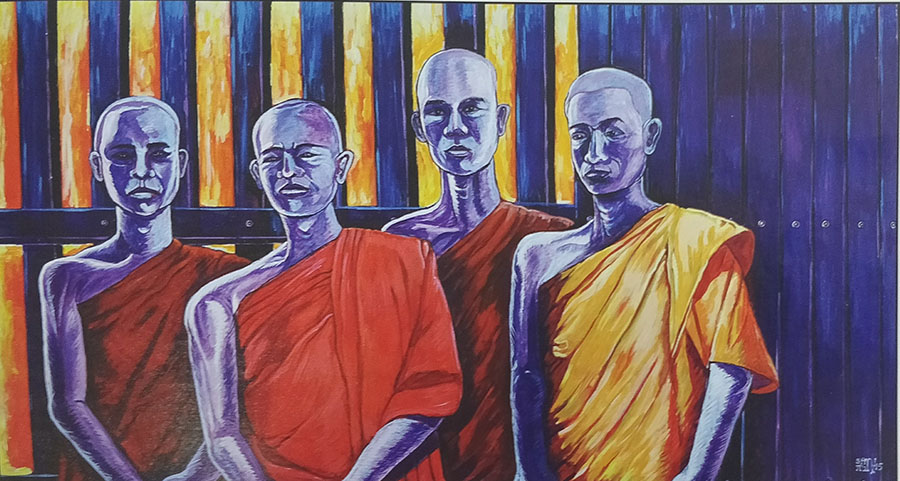
YANGON — More than four decades have passed, but artist San Minn still can't forget the darkest days of his life, spent behind bars after he was sentenced to four years in prison for his role in the U Thant funeral crisis.
When U Thant, who served as the third Secretary-General of the United Nations, died in November 1974, the government refused to hold a state funeral for the highly respected diplomat. The decision triggered a series of protests and riots in Yangon, then the country's capital.
Monks in Prison (U Thant Strike)
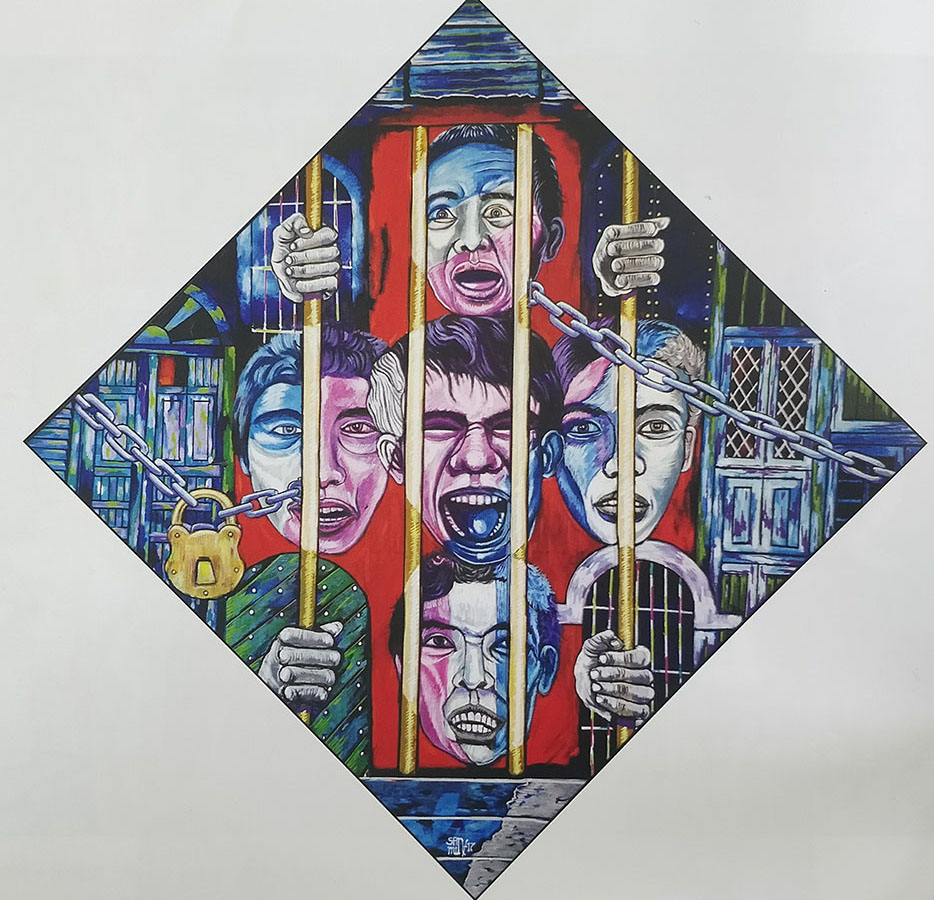
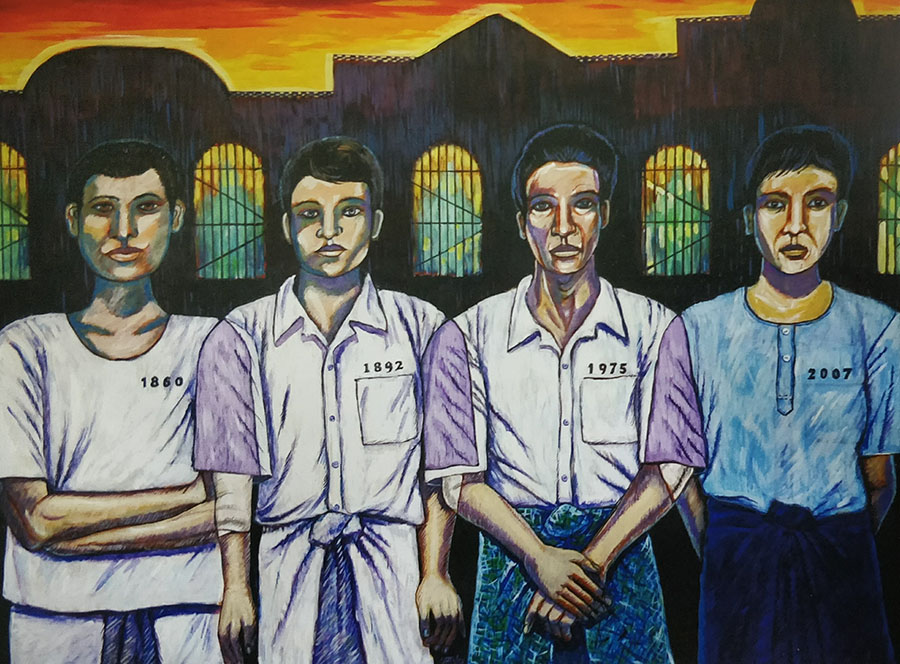
"I could never forget those experiences," San Minn told The Irrawaddy recently. Now, he has drawn on them to create a series of paintings and installations that will be displayed June 4-9 at Lokanat Gallery.
The event, his 15th solo show, is billed simply as "Prison Series." The modernist painter is known for choosing themes that reflect the political and social affairs of the day. His work is sought after by individual collectors from the US, the Netherlands, Italy, China and Singapore, and has been purchased by museums in Japan and Singapore.
The Walls Have Ears
San Minn's creations are not for those looking for pleasant, decorative scenes. His latest paintings depict the bitterness, grievances, frustration, hardship and fear experienced by prisoners.
In one of his paintings, an inmate sits smoking on a shabby mat inside a dilapidated cell while a fellow inmate relieves himself nearby. In neighboring cells, inmates eat, drink or gaze outside. Some appear to be in despair, others crying after having been tortured.
Discussing one painting depicting human ears sprouting from the walls of a prison cell, San Minn said, "Prison authorities sometimes put informants inside the prison. They would report back to the prison officials. We had to be careful about what we said."
It is Not a "Dream"
The exhibition includes an installation featuring a fighting cock's cage. Inside it are punching bags, chicken feathers and bloodstains. The work is titled "Conflict," which he said was a reference to cells housing political prisoners with differing political views. "Since they have different ideologies, they fight."
The exhibition comprises 33 paintings and five installations. "I have long wanted to put together a prison-themed exhibition. It is about the daily life of a prisoner. So I'm happy that I've been able to organize it," San Minn said.
COLOMBO — Talks between China and Sri Lanka for a free trade agreement have hit major hurdles, mainly because Beijing will not agree to Colombo’s demand for a review of the deal after 10 years, Sri Lanka’s top negotiator said.
China has invested billions of dollars building ports and roads and power stations in the Indian Ocean island nation just off the southern toe of India as part of its Belt and Road Initiative to increase its trade and other connections across Asia and beyond.
But concerns have grown in recent months that such investments can drive the country of 21 million people deeper into debt and undermine its sovereignty, prompting greater scrutiny of deals with China.
China’s exports to Sri Lanka dwarf the trade that goes in the other direction, leaving Colombo with a big deficit with Beijing.
Sri Lanka’s chief trade negotiator K.J. Weerasinghe said this week that Colombo was insisting on a right to review the free trade pact after 10 years, but China was not ready to agree that.
Ministerial level discussions about an agreement have not been held since March last year. Lower-level discussions between officials have made little progress, according to Weerasinghe.
“The talks have come to a standstill. China wants to remove the review clause,” Weerasinghe told Reuters. Beijing was opposed to such an option because it wanted longer-term stability, he said.
China's commerce ministry did not respond to Reuters requests for comment.
The review clause that Sri Lanka wants would allow it to change some of the deal terms if they were hurting the island nation's local businesses.
Another Contentious Issue
Weerasinghe said another point of contention was that China wanted zero tariffs on 90 percent of goods the two countries sold to each other as soon as an agreement is signed while Colombo would rather it started with zero tariffs on only half of the products concerned and expanded gradually over 20 years.
China has been pushing for free trade pacts with countries in the region and last year sealed an agreement with the Maldives that drew criticism from opposition political groups in the tropical islands’ nation. They said it had been rushed through parliament with less than an hour of debate.
Sri Lanka has previously said it wanted more time to negotiate the free trade deal with China as it is concerned about the economic impact of a rushed deal on its economy.
Sri Lanka imported $4.2 billion worth of Chinese goods in 2016, mostly raw materials for garments, machines and electronics, metals, transport equipment and chemicals. Its exports to the world’s second largest economy were just $211 million the same year, which included textiles, tea and vegetables, footwear and rubber.
The 2017 figures for China trade have still not been released by the Sri Lankan authorities.
The trade deficit with China accounted for nearly half of the nation’s total deficit in 2016, adding pressure on the country's current account deficit, central bank data showed.
Sri Lanka's foreign debt rose nearly 17 percent to 4.72 trillion rupees ($30 billion) last year, a fifth of that coming from loans from China to finance the massive construction program across the island.
Colombo is separately negotiating a trade pact with India, but that is also moving slowly because Sri Lankan businesses fear they will face competition from a flood of cheap goods made by Indian firms.
THE HAGUE — Hundreds of Rohingya victims have appealed to judges at the International Criminal Court to grant prosecutors jurisdiction to investigate deportations from Myanmar to neighboring Bangladesh, an ICC official said on Thursday.
The world’s first permanent war crimes court does not have automatic jurisdiction in Myanmar because it is not a member state, but the prosecutor in April asked the court to look into the Rohingya crisis and a possible prosecution through Bangladesh, which is a member.
Since August, nearly 700,000 Rohingya Muslims have fled a military crackdown in mainly Buddhist Myanmar, the United Nations and aid agencies have said.
Refugees have reported killings, rape and arson on a large scale; some countries compared the situation to the widespread ethnic cleansing seen during the Balkan wars of the 1990s.
"We are of Rohingya identity and we want justice,” the group said in a letter, demanding that the court take action. “We have been raped, tortured and killed.”
It was signed with fingerprints of the victims, mostly illiterate women from rural communities.
A submission on behalf of 400 victims was handed to the court on Wednesday, backing the earlier request from the ICC prosecutor for jurisdiction, spokesman Fadi El Abdallah said.
The families asked the court to examine allegations not only of deportation but persecution and what they called genocide by the Myanmar military against the Muslim Rohingya minority.
Myanmar has rejected the efforts to establish international jurisdiction over the matter.
Lawyers representing a group called Shanti Molhila, or Peace Women, said the court should hear the case because some of the crimes were committed across the border in Bangladesh.
In her request to judges, ICC prosecutor Fatou Bensouda argued that the ICC had jurisdiction over the deportations because of the cross-border nature of the offense
GENEVA/YANGON — The United Nations said on Thursday it had struck an outline deal with Myanmar aimed at eventually allowing hundreds of thousands of Rohingya Muslims sheltering in Bangladesh to return safely and by choice.
Since August 2017, about 700,000 Rohingya Muslims have fled a military crackdown in mainly Buddhist Myanmar, many reporting killings, rape and arson on a large scale, the UN and other aid organizations have said.
“Since the conditions are not conducive for voluntary return yet, the MoU (memorandum of understanding) is the first and necessary step to support the government’s efforts to change that situation,” the UN High Commissioner for Refugees (UNHCR) said in a statement.
Myanmar’s government said in a brief statement late on Thursday the MoU would be signed “soon” and UN agencies would “support access to livelihoods through the design and implementation of community-based interventions."
Myanmar civilian government spokesman Zaw Htay said he had nothing to add to the statement.
Myanmar and Bangladesh agreed in January to complete the voluntary repatriation of the refugees within two years but differences between the two sides persist, impeding implementation of the plan.
In a separate statement on Thursday, Myanmar’s government said it would set up an independent commission to investigate “the violation of human rights and related issues” in Rakhine State following the army operation there in response to attacks by Rohingya insurgents on security posts.
The commission will be assisted by international experts, the statement said without elaborating.
In the Bangladeshi capital Dhaka, senior UNHCR official George William Okoth-Obbo told reporters after a five-day visit to Rohingya refugee camps along the border that conditions in Myanmar did not yet allow a “safe and sustainable return."
Okoth-Obbo said an immediate challenge for humanitarian agencies was to relocate 200,000 Rohingya refugees threatened by seasonal monsoon flooding and landslides to a safer place.
The United Nations and aid agencies have described the crackdown on the Rohingya as “a textbook example of ethnic cleansing," an accusation Myanmar rejects.
The Security Council asked Myanmar in November to ensure no “further excessive use of military force” and to allow “freedom of movement, equal access to basic services, and equal access to full citizenship for all."
Myanmar has for years denied Rohingya citizenship, freedom of movement and access to basic services such as healthcare. Many in Myanmar regard the Rohingya as illegal immigrants from mostly Muslim Bangladesh.
The Myanmar government is in a bind. In order to stave off Western sanctions for its alleged mistreatment of the Rohingya minority, it is considering signing a memorandum with UN agencies that would set terms for the repatriation of Rohingya refugees from Bangladesh. But China does not want Myanmar to sign it.
Chinese officials held two days of closed-door meetings with their Myanmar counterparts in Yangon on May 29 and 30, where the two sides shared views on how to establish peace in Kachin and northern Shan states and how to solve the Rohingya refugees crisis in Rakhine State, according to a source who took part in the talks.
China, which has economic interests in Rakhine, wants to build its sway over Myanmar, and does not want to see Western countries have influence in the country.
The result is a power struggle between China and the West over Myanmar.
Myanmar has signed one agreement with the UN to allow for the repatriation of 700,000 Rohingya refugees who fled to Bangladesh after the Myanmar Army launched a military offensive in Maungdaw in Rakhine State in reprisal for attacks by the Arakan Rohingya Salvation Army (ARSA) in August last year.
Some government advisors were opposed to the signing of the agreement on the grounds that the country would have trouble meeting international standards on the repatriation. However, it was viewed as a positive initial step by the Aung San Suu Kyi government to show it wished to cooperate with the UN and the international community to solve the Rohingya crisis.
Myanmar is also close to signing an MOU with the UN Development Programme (UNDP) and the Office of the United Nations High Commissioner for Refugees (UNHCR), following months of tripartite talks that started on February, according to the same advisors.
On signing the MOU, the UN agencies would have high expectations of being able to make visits to Maungdaw to inspect conditions on the ground. They would also want to check to see if the returning refugees would be able to rebuild their old lives. The UN agencies do not want the repatriated refugees to be sent to camps and instead want them to be able to return to their homes.
If they are forced to stay in camps, the returning refugees face a fate similar to that of other Rohingya who have been stuck in camps in Sittwe for six years. But, the Myanmar government may not agree to such conditions.
While signing an MOU with the UNHCR and UNDP would help repair the image of the Aung San Suu Kyi government in the eyes of the international community, China does not want Myanmar to sign the agreement, according to a Chinese source.
China's approach to finding a solution to the Rohingya crisis is more low-key. China wants to have stability in Rakhine as it has many investments in the region, most notably a gas pipeline project in Kyauk Phyu.
China believes that if the UN agencies and international community have their way in Rakhine, ARSA may able to return to launch new attacks in the area.
But, ARSA has influence only in Maungdaw and Buthidaung townships. The Arakan Army has a presence in many areas including Kyauk Phyu. ARSA thus should not be seen as a threat to China's business interests.
China is getting close to the Myanmar government as the international community prepares to take action against Myanmar Army and government officials for human rights abuses committed against the Rohingya. China may offer some diplomatic protection to Tatmadaw generals if they are referred to the International Criminal Court when the UNSC makes a decision on the matter. The United States, Britain, and other members of the international community are prepared to impose sanctions on the Myanmar Army and the government. The Myanmar government is wondering whether to listen to China or the West.
YANGON — The last of more than 1,100 residents of Awng Lawt village in Kachin State's Tanai Township known by aid groups to have been trapped in the forest by fighting between the Myanmar military and the Kachin Independence Army (KIA) were rescued this week, according to the Kachin Baptist Convention (KBC).
Some of the villagers reported that additional IDPs remain in the forest, according to aid groups, but The Irrawaddy has been unable to confirm the reports. Aid workers said those people may have opted to travel to relatives' homes independently.
"All those [from Awng Lawt] trapped by fighting have come out of the forest. No one is left," said Hkali, a KBC official with responsibility for social affairs.
Between April 29 and this week, a total of 1,135 people were evacuated from the forest. They are taking shelter at churches in Myitkyina, Hpakant and Tanai, said Seng Nu, program director of Karuna Mission Social Solidarity, a civil society organization helping displaced persons in Kachin State.
Residents of Awng Lawt first fled en masse into the forest after artillery shells landed near their village on April 11. Among them were pregnant women, elderly and disabled persons, and young children.
They moved around the forest on foot for about three weeks before finally being taken to safety in groups starting in late April.
"Some of the displaced persons said that some people are still trapped in the forest. Some of these might have opted to go to the houses of relatives, rather than the camps. For the time being, our list only includes those taking shelter in the camps," Seng Nu said.
Naw Tawng, vice chairman of a Tanai-based Christian committee to help displaced persons, told The Irrawaddy that he could not independently confirm the reports that some displaced persons are still trapped in the forests.
Larger groups have reached camps, but smaller groups might have gone to the houses of their relatives, he suggested.
"We don't know about the latest developments. But no one is thinking of going back to their homes. They feel it is safer to stay at temporary shelters in churches," Naw Tawng said.
The clashes continued into the last week of April. At that time, the Tatmadaw distributed leaflets to displaced persons urging them to go back to their homes, and saying that it would provide food supplies for them. However, the IDPs dared not return for fear of being trapped in the forest again.
The Myanmar military (or Tatmadaw) launched attacks in Tanai in June last year, targeting illegal gold and amber mines that are an important source of funds for the KIA.
Clashes in April displaced around 6,000 people in Tanai, Mogaung, Injangyang and Hpakant townships. More than 100,000 people have been displaced since the collapse of a ceasefire between the Tatmadaw and the KIA in 2011.
Though camps for internally displaced persons have been opened in other townships in Kachin State, Tanai authorities have refused to permit such camps, saying they negatively affect the image of the town. Displaced persons have therefore been forced to seek temporary shelter in church compounds.
NAYPYITAW — The Union Solidarity and Development Party (USDP) has accused the ruling National League for Democracy (NLD) of spending public funds as if the money were its own since taking power two years ago.
USPD chairman U Than Htay also accused the NLD of distorting his party’s image, an apparent reference to the public perception that the USDP — created from the Union Solidarity and Development Association to contest the 2010 general elections — was a proxy of the military.
He said everyone from farmers and daily wage earners to top businesspeople were facing difficulties and uncertainty because the ruling party lacks clear policies.
"The public knows that [the NLD-dominated Parliament] has rejected questions by the people's representatives and that the [NLD] has infamous officials," he said in an opening address to a USDP youth conference in Naypyitaw on Tuesday.
USDP spokesman U Nanda Hla Myint said the party chairman was referring to former Planning and Finance Minister U Kyaw Win, who resigned last week amid a corruption scandal, former Magwe Region Minister U Nay Myo Kyaw, who reportedly resigned over an extramarital affair, and former Rakhine State Minister U Min Aung, who was impeached by state lawmakers.
"A Mon State minister resigned today. He was facing complaints over financial matters," the spokesman said on Tuesday.
The President's Office has accepted the resignation of Mon State’s minister for electricity, energy and industry, U Min Htin Aung Han.
"[The NLD] made the same accusations against the USDP in the past. In fact, it is only concerned with individuals. [The NLD] said its government won't embezzle at all and that all of its lawmakers are capable. But take a look at the reality. [The NLD] distorted the image of the USDP and said we embezzled and we weren’t capable," said U Nanda Hla Myint.
Monywa Aung Shin, a member of the NLD’s Central Executive Committee, said his party did not hide its skeletons in the closet and takes action against any law-breaking members.
"U Than Htay is always saying things like that. It will only contribute to his downfall and the downfall of his party. We never speak recklessly. We only talk with facts. We never talk without facts," he said.
"Our leader [Daw Aung San Suu Kyi] allows no room for error. If somebody does something wrong to the people, she will summon and warn or punish him," he added. "Everyone knows how much public funds they [the USDP] have embezzled."
Monywa Aung Shin said the NLD government was not pursuing retroactive punishment of ministers who served during the USDP’s time in power, however, in the interest of national reconciliation.
The USDP says it is still deciding whether to contest by-elections scheduled for November because it has no trust in the Union Election Commission. The NLD says it will contest all seats up for grabs.
SITTWE, Rakhine State — The Rakhine State government has not yet made a decision regarding some 70,000 acres of abandoned farmland in Maungdaw Township left behind by Rohingya Muslims who fled to Bangladesh last year.
"We're still waiting for the policy of the Union government. We'll do as it says. We don't have enough workers for 70,000 acres of farmland," the Rakhine State minister for agriculture, livestock, forestry and mining U Kyaw Lwin told The Irrawaddy.
Rice is grown twice a year in many parts of Myanmar, with rainwater in the monsoon season and irrigated water in the summer months. As monsoon season begins, farmers are preparing.
The Rakhine State government will allow Rohingya villagers who have not fled to continue working their original farms, said the minister.
Rakhine State lawmaker U Maung Ohn of Maungdaw Township said the abandoned farmlands should be leased out to local ethnic farmers and private rice-growing companies.
"It is not a good idea to leave those farmlands unattended. Local ethnic people and landless farmers should be allowed to farm there if they wish. It is also a good idea to lease it out to private companies that have agricultural machinery," said U Maung Ohn.
The Ministry of Agriculture, Livestock and Irrigation previously planned to use some 10,000 acres of the 70,000 acres of farmland. But it aborted the plan, as it is difficult to find the labor and to watch over the paddy fields, head of the Rakhine State Agriculture Department U Toe Wai told The Irrawaddy.
Minister U Kyaw Lwin denied media reports that those farmlands have been leased to private companies.
The government previously harvested those 70,000 acres of paddy fields left behind by Rohingya Muslims who fled into Bangladesh after a terror attack on police outposts in Maungdaw in August last year.
There are a total of 11 million acres of paddy fields in Rakhine with over 74,000 acres in Maungdaw, over 77,000 in Buthidaung, and over 88,000 acres in Rathedaung Township, according to the state agriculture department.
YANGON — Myanmar's Parliament has approved U Soe Win as the country's new Planning and Finance Minister on Thursday after his presidential nomination earlier this week.
The bicameral assembly of the Lower and Upper houses unanimously approved the nomination of the new 80-year-old minister.
The president nominated U Soe Win to replace the outgoing minister U Kyaw Win after his resignation last week following an investigation for corruption.
The government's Anti-Corruption Commission (ACC) began investigating U Kyaw Win days after receiving a complaint against him on May 3. The commission announced over the weekend that the findings had been reported to the president.
Before the probe was eventually confirmed, news reports had been circulating for weeks that the minister and his son were being investigated for corruption by both the ACC and the Home Affairs Ministry's Bureau of Special Investigation.
U Soe Win is currently the country managing director of Deloitte Touche Myanmar Vigour Advisory Ltd. He has more than 30 years of professional experience in international banking with the Myanmar Foreign Trade Bank (MFTB) and has been an adviser to Myanmar's taxation, investment law and banking sectors.
He is also a senior member of the NLD's Central Economic Committee. According to the independent Renaissance Institute Myanmar, U Soe Win joined the Foreign Exchange Department of the MFTB as deputy manager in 1961.
He was sent to the UK for training with the National Westminster Bank and the Bank of England in 1976. He was appointed deputy controller of foreign exchange at the MFTB in 1990 and general manager in 1993.
He left the MFTB to join Price Waterhouse Associates Ltd in 1996. In 2003, he founded Myanmar Vigour Co., Ltd, which became a member firm of Deloitte in June 2015.
U Soe Win is also a member of the Bar Council in Yangon. He was involved extensively in drafting banking laws, regulations and fiscal policies during his tenure with the state bank.
BANGKOK — Thailand is a new dumping ground for scrap electronics from around the world, say police and environmentalists, the latest country to feel the impact of China’s crackdown on imports of high-tech trash.
Police at Laem Chabang port, south of Bangkok, showed on Tuesday seven shipping containers each packed with about 22 tons of discarded electronics, including crushed game consoles, computer boards and bags of scrap materials.
Electronic refuse, or e-waste, is turning up from Hong Kong, Singapore and Japan, police said, some of it imported by companies without the required permits.
“This … shows that electronic waste from every corner of the world is flowing into Thailand,” Deputy Police Chief Wirachai Songmetta said as he showed the containers to the media.
While “e-waste” — defined as any device with an electric cord or battery — can be “mined” for valuable metals such as gold, silver and copper, it can include hazardous material such as lead, mercury and cadmium.
Police said they filed charges against three recycling and waste processing companies in Thailand. Anyone found guilty could be jailed for up to 10 years.
“The companies that we have filed charges against don’t have a quota to import even a single ton of electronic waste,” Wirachai said.
China imposed a ban on overseas trash last year, telling the World Trade Organization that it would stop accepting imports of 24 types of foreign waste, leading some to fear that the waste could end up in neighboring countries.
The ban has upended the world’s waste handling supply chain and caused massive pile-ups of trash from Asia to Europe, as exporters struggled to find new buyers for the garbage.
According to estimates in China’s state media last year, more than 70 percent of the world’s 500 million tons of electronic waste entered China in 2016.
Environmentalists say waste once destined for China is being rerouted to Southeast Asia, and new laws are needed or existing laws better enforced to prevent illegal imports.
“Especially after China’s ban, Thailand could become one of the biggest dumping grounds for e-waste,” said Penchom Saetang, director of Ecological Alert and Recovery Thailand.
Thailand ratified in 1997 the Basel Convention, which aims to control trans-boundary movements of hazardous waste. But the convention does not completely prohibit these exports from more developed to less developed countries.
“The Basel Convention cannot prevent what is happening in Thailand because it has its limitations,” Penchon said in calling for an amendment that would ban these shipments.
Thai Prime Minister Prayuth Chan-ocha vowed this week to step up nationwide inspections as part of a plan to combat illegal electronic waste. But environmentalists say they have not seen the details of how it will work.
“It isn’t clear how he will do this,” said Penchom.
MANILA — The Philippines moved a step closer on Wednesday to ending decades of conflict on its resource-rich island of Mindanao, after lawmakers approved a bill that will eventually allow self-rule for the country’s Muslim minority.
Lower house lawmakers voted 227 to 11, with two abstentions, to pass the Bangsamoro Basic Law, seen as key to forging lasting peace with separatist rebels and thwarting the rise of Islamist extremism in the nation’s poorest and most dangerous region.
The bill is the result of a 2014 peace deal between the Moro Islamic Liberation Front (MILF) and the government to end nearly 50 years of conflict that has killed more than 120,000 people and displaced 2 million.
It outlines the process to set up a self-administered territory in an area sometimes referred to as Bangsamoro (nation of Moros), encompassing mountains, islands and jungles that are home to at least 4 million people, mostly Muslim.
President Rodrigo Duterte, who was the mayor of a city on the southern island for 22 years, has stressed the importance of getting the legislation passed and certified it as an urgent bill on Tuesday to get it approved before a house recess on June 2.
The 22-member Senate has committed to Duterte to pass its counterpart version soon, before a panel of both houses combines both drafts in a version for the president’s final approval.
The previous administration met numerous hurdles and failed to pass the bill, fuelling resentment and mistrust among many minority Muslims.
Duterte has warned that another failure could be disastrous and play into the hands of extremist groups like Islamic State, which inspired a militant alliance to seize Marawi City last year for five months.
The battle for Marawi was the biggest the Philippines has seen since World War Two and stoked wider concerns that Islamic State had ambitions to turn Mindanao into a base for its operations in Southeast Asia.
Hundreds of people were killed in Marawi, more than 350,000 were displaced and half the city was left in ruins. Martial law is still in force across Mindanao.
Though some militants who fought in Marawi were former MILF members, the group has denounced radical Islam and has a good relationship with Duterte.
Mindanao, an island the size of South Korea, is the Philippines’ most underdeveloped region, but is home to most of its nickel mines and biggest fruit farms, besides vast tracts of land the government wants to convert into palm oil plantations.
But its notorious clan wars, lawlessness and conflicts with Muslim and communist rebel groups have kept investors at bay.
Once signed into law, Bangsamoro will have its own executive, legislature and fiscal powers, but the central government will continue to oversee defense, security, foreign affairs, and monetary policy.
JAKARTA — Indonesia and India pledged on Wednesday to step up defense and maritime cooperation, with plans to develop a strategic Indonesian naval port in the Indian Ocean, the leaders of the two countries said after meeting in Jakarta.
Indonesian President Joko Widodo met Indian Prime Minister Narendra Modi to discuss, among other issues, developing infrastructure and an economic zone at Sabang, on the tip of Sumatra Island and at the mouth of the Malacca Strait, one of the busiest shipping channels for global trade.
“India is a strategic defense partner…and we will continue to advance our cooperation in developing infrastructure, including at Sabang Island and the Andaman Islands,” Widodo told a news conference after the meeting at the presidential palace.
Analysts say the move comes amid concerns over China’s rising maritime influence in the region, and is part of Modi’s “Act East” policy of developing stronger ties with the Association of Southeast Asian Nations (ASEAN).
“The India-ASEAN partnership can be a force to guarantee peace and progress in the Indo-Pacific region and beyond,” Modi said in a statement read in Hindi.
Modi this year invited the leaders of all ten ASEAN nations to attend New Delhi’s Republic Day parade, the biggest such gathering of foreign leaders at the annual event.
There has been tension in Southeast Asia over the disputed South China Sea, a busy waterway claimed in most part by China.
Brunei, Malaysia, the Philippines, Taiwan and Vietnam also have conflicting claims in the area, through which about $3 trillion worth of sea-borne goods passes every year.
While not a claimant, Indonesia has clashed with Beijing over fishing rights around the Natuna Islands and expanded its military presence there. It has also renamed the northern reaches of its exclusive economic zone, to reassert its sovereignty.
Modi, who is making his first trip to Indonesia, is also set to visit the Istiqlal mosque in the capital of the world’s biggest Muslim-majority country.
The Indian leader flies to Malaysia on Thursday to meet recently elected Prime Minister Mahathir Mohamad before heading to neighboring Singapore to address a regional security forum, the Shangri-La Dialogue.
Last week, Indonesia’s chief maritime affairs minister, Luhut Pandjaitan, said the existing port at Sabang, which is 40 meters (131 ft.) deep, could be developed to accommodate both commercial vessels and submarines, according to media.
Indonesia’s transport minister told reporters on Wednesday that Sabang would get a transshipment port that could be developed over two years.
Asked about Indian investment in Sabang, Indian foreign ministry official Preeti Saran said New Delhi was interested in helping build infrastructure across Southeast Asia.
“There have been discussions about building infrastructure, it’s not just seaports, but airports,” she said. “There would be a lot of interest among Indian companies.”
Widodo and Modi also signed pacts on cooperation in the pharmaceuticals and technology industries.
YANGON — Anti-war protesters in Myanmar on Wednesday urged government leader Daw Aung San Suu Kyi to take action against police who this month broke up a peace rally and arrested them, and raised new concern about freedom of speech.
Riot police in the main city of Yangon used batons on May 12 to break up a rally called to show support for victims of fighting in northern Myanmar, arresting 17 organizers for disturbing the public and holding a protest without permission.
The scuffles between baton-wielding police and protesters have sparked an outcry among activists and lawmakers over what they see as risks to free expression under the government of Nobel Peace Prize laureate Daw Aung San Suu Kyi.
In a letter sent to top government officials including Daw Aung San Suu Kyi and President U Win Myint, eight of the rally organizers said action should be taken against the police, which come under the control of Myanmar’s powerful military.
“Police came, arrested us and beat us for no reason, and that’s why we are demanding action to be taken against police who violently handled the peaceful protest,” the eight organizers said in their letter.
“The lawless action by the authorities should be investigated for our loss of citizens’ rights,” they said.
Government spokesman U Zaw Htay was not immediately available for comment. Police spokesman U Myo Thu Soe said he was not aware of the letter and declined to comment.
A movement of mostly young anti-war activists has in recent months spread to various parts of the country, exposing frustration with Daw Aung San Suu Kyi’s struggle to fulfill a promise to end decades of war by autonomy-seeking ethnic minority guerrillas.
The military, which ruled the country for decades, oversees internal security even though a civilian-led government has been in power since 2016, after Daw Aung San Suu Kyi’s party swept an election.
More than 6,000 people have fled their homes in recent weeks since the army launched a new offensive against the Kachin Independence Army insurgent group in Myanmar’s north.
Fighting has also intensified in other ethnic minority areas.
A freedom of speech monitoring group, Athan, has said more than 42 activists across the country have been charged in May for participating in rallies protesting against the conflict.
The 17 organizers of the May 12 rally, who were detained but later released, face a month in prison and fines.