YANGON — Deputy Planning and Finance Minister U Set Aung has been appointed chairman of the Kyaukphyu Special Economic Zone (SEZ) Management Committee amid the government’s ongoing efforts to renegotiate its agreement with the project’s Chinese developer to give Myanmar a larger stake.
The appointment took effect on May 8 and was approved by Vice President and Chairman of the Central Body of Myanmar Special Economic Zones U Henry Van Thio, according to an announcement in the government gazette on Sunday. It said the management committee’s previous chairman, U Soe Win, was now a joint chairman but did not make clear whether the two chairmen would be working as equals.
The announcement could not be found on the websites of the President’s Office or the Ministry of Information, however, where government announcements are usually posted first. But Planning and Finance Minister U Tun Tun Naing confirmed to The Irrawaddy that the announcement in the government gazette was correct.
U Set Aung also currently chairs the management committee of the Thilawa SEZ, Myanmar’s first, located in the southeast of Yangon Region. His latest appointment makes him chairman of the country’s two largest SEZs.
"His performance in Thilawa has been a success. As a result, he has to take responsibility for Kyaukphyu. He has already been involved in the Kyaukphyu SEZ since the government started renegotiating [the project agreement] with China," said U Tun Tun Naing.
Located in Rakhine State, the Kyaukphyu SEZ project includes an industrial park and deep water port. China International Trust and Investment Corporation (CITIC) won the bid to develop the SEZ in 2015. The shareholders agreement struck under then-President Thein Sein gave China an 85 percent of stake in the project and Myanmar the rest.
Critics of the project have raised concerns that the deal could land Myanmar in a debt trap with China, however. The government that came to power in 2016, led by the National League for Democracy, has been in talks with CITIC to raise Myanmar’s stake to 30 percent.
Planning and Finance Minister U Soe Win recently told Nikkei Asian Review in an exclusive interview that Myanmar would try to reduce the scale of the Kyaukphyu SEZ and cut all unnecessary expenses to avoid a debt trap.
Government media reported that officials from Myanmar's Commerce Ministry met with CITIC representatives in Naypyitaw last week and that a new agreement would be announced soon.
As chairman of the SEZ’s management committee, U Set Aung is expected to have a say in what that agreement looks like.
"He's experienced in managing special economic zones. With his experiences, I hope we can expect a win-win solution for the Kyaukphyu project," said U Than Lwin, a senior adviser at Kanbawza Bank and a former deputy governor of the Central Bank of Myanmar.
U Set Aung was a deputy governor of the Central Bank of Myanmar himself until July 2017. He was also a deputy minister of national planning and economic development and an economic adviser to former President Thein Sein.
He was the founder and director of the Myanmar Development Resource Institute and the secretary of the National Economic and Social Advisory Council of Myanmar.
He earned a bachelor's degree and masters in business administration in Myanmar, a second master's degree specializing in economics, banking and finance in Scotland, and a third master's degree specializing in investment management in London.
YANGON — The government approved sites for three “economic cooperation zones” in Kachin and Shan states along Myanmar’s border with China on Thursday as part of Beijing’s ambitious Belt and Road Initiative, according to the chief minister of Kachin State.
U Khet Aung said the sites were approved at the first implementation meeting of the Economic Cooperation Zones Central Committee in Naypyitaw, and followed a recent trip to China by Commerce Minister U Than Myint.
He said the zones will be built in Kanpiketi town, in Kachin State’s Special Region 1, under the control of the New Democratic Army-Kachin militia; Chinshwehaw, in Shan State’s Laukkai Township, part of the Kokang Self-Administered Zone; and in Shan State’s Muse Township.
Chinshwehaw and Muse are already major trading hubs along Myanmar’s border with China’s Yunnan Province. Kanpiketi currently does regular trade with China as well.
"The [commerce] minister pushed us to start the projects soon. The zones will be established on both sides of the border. We already started clearing the site in Kanpiketi," U Khet Aung told The Irrawaddy on Friday.
According to a Commerce Ministry spokesman, U Than Myint visited China last week and returned on Tuesday, but the ministry has not released any more official information about the trip. According to U Khet Aung, Chinese officials told the minister that they expected the zones to not only boost border trade but help bring “peace and stability” to the restive regions.
At Thursday’s committee meeting in Naypyitaw, U Than Myint also said that the zones would create local jobs, boost small and medium businesses and support the peace process by promoting stability, and that he urged relevant ministries to support the projects, according to a statement from the Ministry of Information.
The Commerce Ministry spokesman said officials from Kachin and Shan states and from Kokang also attended.
U Khet Aung said the Kanpiketi zone was expected to receive an initial investment of $5 million and be finished by the end of this year.
In 2017 China and Myanmar signed five memorandums of understanding (MoUs), including one between their respective commerce ministries, during State Counselor Daw Aung San Suu Kyi’s visit to Beijing to attend a forum on the Belt and Road Initiative.
Since then, the details have been hammered out by a Joint Committee on China-Myanmar Border Economic Zones. Myanmar’s team is headed by U Than Myint, with the chief ministers of Kachin and Shan states and the president of the Kokang Self-Administered Zone serving as deputies.
As part of the Belt and Road Initiative, Beijing and Naypyitaw have also agreed to a 15-point MoU on the China-Myanmar Economic Corridor, the director of Myanmar’s Directorate of Investment and Company Administration, U Min Zaw Oo, told The Irrawaddy last week.
The corridor will reach from Yunnan Province to Mandalay in central Myanmar, from where it will stretch south to Yangon and west to the Kyaukphyu Special Economic Zone in Rakhine State.
Under the MoU, the two governments have agreed to collaborate in many sectors including infrastructure, construction, manufacturing, agriculture, transportation, finance, human resource development, telecommunications, research and science.
Launched in 2013, the Belt and Road Initiative is Chinese President Xi Jinping's signature foreign policy project . It aims to build and expand roads, rail lines and shipping lanes linking at least 70 countries from China to Europe through central Asia, the Middle East and Russia to boost trade and investment.
Many see Myanmar uniquely situated along the route as it sits between South and Southeast Asia and offers landlocked Yunnan Province its quickest path to the Indian Ocean.
NAYPYITAW — The Myanmar Army made a conditional offer for three rebel ethnic armed groups to sign the Nationwide Ceasefire Agreement (NCA) following a period of dialogue, according to Brig-Gen Tar Khu Lan, vice chairman of the Ta'ang Nationalities Liberation Army (TNLA), one of the groups that has yet to join the peace process.
Vice Snr-Gen Soe Win, the deputy head of the Myanmar Army, made the offer during a sidelines meeting with the leaders of the TNLA, Myanmar National Democratic Alliance Army (Kokang), and Arakan Army (AA) – on Wednesday at the Office of the Military Commander-in-Chief in Naypyitaw. The three, together with the leaders from four other groups, had flown in to the capital to join the third session of the 21st Panglong Union Peace Conference, which is currently underway.
"He invited us to sign a bilateral agreement first, and then to purse a dialogue until we could reach an agreement on terms for joining the NCA," Brig-Gen Tar Khu Lan, who attended the meeting, told The Irrawaddy on Friday.
But the offer was conditional, as the ethnic armed groups would need to make an announcement that they had agreed to disarm before signing the bilateral deal, the TNLA leader said,
Tar Khu Lan said such a commitment would be difficult to make as it's something TNLA members and the Ta'ang ethnic people are opposed to.
"I explained at the meeting that it wouldn't work if the leaders sign (such a disarmament deal) without first obtaining the consensus support of their followers. So I replied that a decision could not be made alone by our chairman but needed to involve our peace-negotiating committee, which would lead us in choosing the right wording."
The Myanmar military's request for the groups to agree to disarm is nothing new. During an informal meeting in August 2016 between the three armed groups and the government's Peace Commission, they were offered a similar terms for joining the NCA.
"They have previously asked us to release a statement [about disarmament]. But in the negotiations, the wording was a problem and now they have raised it again. If there are no changes to the wording (of the agreement) and the same terminology is used, it is not OK for us," Tar Khu Lan said.
Because of the Tatmadaw's insistence that the groups disarm, the negotiations between the Peace Commission and the three EAOs — the MNDAA, TNLA and AA — were postponed for a long time and the groups later joined the Federal Political Negotiation and Consultative Committee (FPNCC). Previously, these groups had collaborated with the now-defunct United Nationalities Federal Council, to find ways to join the NCA.
The TNLA said the meeting with the deputy army chief on Wednesday was constructive and that it would help support the peace process. The TNLA vice chair said his group also welcomed the offer to sign a bilateral ceasefire and eventually join the NCA.
"But it is the demand we pledge to disarm, as we were told previously there was no need to give up our guns until the time our desires are met," he said.
The Office of the Commander-in-Chief said on Wednesday evening that matters related to the NCA, such as trust-building and peace-building issues, were discussed during the talks.
On the Tatmadaw side, the deputy army chief was accompanied by Lt-Gen Than Tun Oo from the Commander-in-Chief's Office, other senior generals, and the secretary of the Peace Commission, former Lt-Gen Khin Zaw Oo. The TNLA's Tar Khu Lan, AA Deputy Chief of Staff Brig-Gen Nyo Tun Aung and Phone Win Naing of the MNDAA represented their groups at the Wednesday meeting.
The MNDAA, TNLA and AA are members of the FPNCC along with the United Wa State Army, Kachin Independence Army, Shan State Progress Party and Mongla's National Democratic Alliance Army. The FPNCC has instituted policies of exploring alternatives to the NCA, and to follow an allied position in political talks rather than trying to negotiate on an individual basis.
NAYPYITAW — Chinese Special Envoy Sun Guoxiang said China does not have its own interests in supporting Myanmar's peace process.
"We urge [the stakeholders] to negotiate and discuss. But our country doesn't have any interests regarding that," he told reporters in Naypyitaw’s Horizon Hotel on Thursday.
Sun Guoxiang, the special envoy of Asian Affairs under China's Ministry of Foreign Affairs, has helped facilitate peace negotiations between the Myanmar government and ethnic armed groups based along the China-Myanmar border.
He told reporters that China is committed to supporting Myanmar in achieving peace for the sake of all Myanmar nationals.
"If peace is not achieved, it is also harmful for stability," he told reporters.
He added that if the country achieved peace, the China and Myanmar border would also be peaceful and stable.
The special envoy met with the army chief Snr-Gen Min Aung Hlaing on Friday and discussed the peace process, border security, the Rakhine crisis and bilateral cooperation.
As Myanmar's largest neighbor, China has been a critical player in the peace process. Since 2013, China became closely involved through the appointment of special envoys and invitations for Myanmar leaders to come to China.
After China intervened, the northeastern-based ethnic alliance the Federal Political Negotiation and Consultative Committee (FPNCC) led by the United Wa State Army (UWSA) joined the second session of the peace conference in May of last year.
The seven members of the FPNCC are in Naypyitaw this week to participate in the third session of the peace conference. Before the conference, the alliance sought further support from China in ensuring security for the groups that are in ongoing clashes with the Myanmar Army.
The government and military met the FPNCC members separately on Wednesday and Thursday. In regards to those meetings, the State Counselor's Office said it discussed issues related to conflict reduction, peace negotiations and the Nationwide Ceasefire Agreement.
NAYPYITAW — Two senior members of the United Wa State Army (UWSA) have been hospitalized during their sojourn in Naypyitaw this week to attend the third session of the Union Peace Conference, where government, military and ethnic minority leaders are looking for ways to end the country's decades-long civil war.
UWSA liaison officer Zhao Guo An was hospitalized on Friday morning due to glucose deficiency, according to a government spokesman.
On Thursday, UWSA Vice Chairman Bao Yu Yi fainted ahead of a meeting with State Counselor Daw Aung San Suu Kyi. The spokesman attributed the episode to the vice chairman’s heart condition and the difference in climate between Naypyitaw and the cooler temperatures of Wa State.
"U Zhao Guo An is fine now. We put him in the hospital to make sure he is alright," the spokesman told media.
He said both UWSA officials were being treated at the 1,000-bed General Hospital in Naypyitaw.
"For U Bao Yu Yi, we have assigned some cardio specialists from the military [hospital] for better treatment," he added.
The UWSA is the most powerful ethnic armed group among seven that have not signed the government's Nationwide Ceasefire Agreement (NCA).
On Friday afternoon, Myanmar military chief Senior-General Min Aung Hlaing visited the two Wa leaders in the hospital to ask about their conditions, according to a press release from the commander-in-chief’s office.
Photos posted to his Facebook account show the military chief personally serving Bao Yu Yi a bowl of bird nest soup.
In his remarks at the opening ceremonies of the peace conference on Wednesday, Snr-Gen Min Aung Hlaing said the government and the military were actively engaged in the peace process not because they were weak.
Some delegates at the conference expressed concern that his decision to highlight the military’s strength, and his remarks in general, would hinder the negotiations with ethnic armed groups, both with those that have not signed the NCA and those that have.
MON STATE — Twelve Myanmar Army troops and one Restoration Council of Shan State soldier have been killed in this week's armed clashes in Mong Kung Township, according to separate reports from the organization and an aligned media outlet on Friday. An undisclosed number of RCSS troops have been injured, according to a spokesperson for the group.
Four days of fighting in Mong Kung have also forced hundreds of ethnic Shan to flee their villages, according to local sources.
The casualty figures were reported by both the RCSS and Tai Freedom, a local media organization under its control.
The RCSS also claimed to have seized some equipment from Myanmar military (or Tatmadaw) units, including a drone and artillery shield.
Lieutenant-Colonel Sai Oo, a spokesperson from the RCSS, confirmed to The Irrawaddy on Friday that according to RCSS troops, there had been casualties on the Tatmadaw side.
"Our ground troops' reports are not much different to [Tai Freedom's] reports," Lt-Col Sai Oo said.
He said one of his organization's troops was killed and a number were wounded.
The fighting began on July 9 and continued through Thursday, he said.
Tai Freedom serves as the RCSS's information department. It has reported daily since July 9 on fighting between the Myanmar Army and RCSS in Mong Kung. It has published photos showing RCSS members with seized military equipment.
Tatmadaw aircraft have been seen in the area, but they have apparently only been used to observe the conflict zone and have not fired on RCSS positions, according to a July 12 report from Tai Freedom.
Growing numbers of local ethnic Shan have fled their villages near the conflict zone, which is about 10 miles from Mong Kung town.
Local aide groups put the number of IDPs at over 600 and said they were all sheltering at a Buddhist monastery in Mong Kung Township.
"The situation is deteriorating for IDPs, as the fighting continued [on Thursday]," said a local resident from Mong Kung township who visited an IDP camp Thursday and donated some food there.
Most IDPs fled their villages suddenly and were unable to take food with them, he said.
Some local groups have distributed food to the IDPs, he added.
The RCSS is a signatory to the Nationwide Ceasefire Agreement (NCA). Some of its leaders are currently attending the ongoing third session of the 21st Century Panglong Union Peace Conference in Naypyitaw, even as their troops clash with the Tatmadaw in Shan State.
The location of the line of demarcation between the zones controlled by the Tatmadaw and the RCSS remains disputed, despite the two sides having signed a bilateral agreement to delineate a boundary, and despite the RCSS's signing of the NCA in 2015.
This has led to occasional clashes, usually involving the Tatmadaw attempting to push the RCSS out of territory it claims is disputed.
Just prior to the latest round of fighting, the Myanmar Army warned RCSS troops to return to their old bases from areas in southern Shan that the Tatmadaw claims the group is not permitted to operate in under the Nationwide Ceasefire Agreement (NCA).
More Myanmar Army troops have been deployed in RCSS areas recently, and the Tatmadaw has engaged in some large troop movements according to the ethnic organization. The Tatmadaw attack that led to the latest round of fighting was directly related to its warning last week, according to Lt-Col Sai Oo.
MANDALAY — Amid criticism over the erection of a statue of the late General Aung San in the ethnic region, Naga youth from Khamti, Sagaing Region issued a statement to show their opposition to the statue bring built in their town.
The statement issued by the Council of Naga Affairs and dated July 7 said that the committee to erect the statue did not first seek the opinion of Naga people or youth.
"Instead of emphasizing the promise of General Aung San, erecting statues of the late general without consulting ethnic minorities is just a symbol of Burmese supremacy," said the statement released by Council of Naga Affairs, which was founded by Naga University students to support the welfare of Naga youth.
The Naga youth also said in the statement that building Gen Aung San statues across the country was the opposition of reconciliation and unity in parts of the country where ethnic minorities fear the loss of their dignity and culture.
The statement then urged the Naga people living in Khamti region not to join in erecting the statue or attending the opening ceremony scheduled for July 21.
"We would like to urge the Naga people not to attend the ceremony, especially not with Naga costumes," said the statement, which circulated to the Naga Literature and Cultural Association, which said it did not agree with this view.
"The statement did not comply with our opinion. We've told the Naga people here to make their own decisions and we've given no instructions regarding the ceremony," said U Aung Htet, the president of the Naga Literature and Culture Association, based in Khamti. "The statement did not represent us, the Naga people here in Khamti, by far."
Khamti, located in the upper region of Sagaing Region, is the closest region to the Naga hills, where about 40 percent of the population is Naga.
According to the committee to build the statue of Gen Aung San in Khamti, Naga and other ethnic leaders from Khamti were included in the decision making and it does not understand why the Naga youth issued the statement.
"There were no disagreements when we formed this committee and had discussions a year ago. There were Naga elders who participated," explained U Pho San, the treasurer of the committee.
The committee told The Irrawaddy that the opposition only arose when the bronze statue of General Aung San riding a horse arrived in Khamti in July.
"The council is from Yangon and it seems they didn't know the reality in Khamti," he said.
Although the statement of the Council of Naga Affairs showed its disagreement, the committee said it would hold the opening ceremony as planned.
"Since there are no official complaints and the regional and local governments have already agreed, we will reveal the statue as planned," he added.
LONDON — The rise of robots in manufacturing in Southeast Asia is likely to fuel modern slavery as workers who end up unemployed due to automation face abuses competing for a shrinking pool of low-paid jobs in a “race to the bottom,” analysts said on Thursday.
Drastic job losses due to the growth of automation in the region — a hub for many manufacturing sectors from garments to vehicles — could produce a spike in labor abuses and slavery in global supply chains, said risk consultancy Verisk Maplecroft.
More than half of workers in Cambodia, Indonesia, Thailand, Vietnam and the Philippines — at least 137 million people — risk losing their jobs to automation in the next two decades, the United Nations’ International Labor Organization says.
The risk of slavery tainting supply chains will spiral as workers who lose their jobs due to increased robot manufacturing will be more vulnerable to workplace abuses as they jostle for fewer jobs at lower wages, said Alexandra Channer of Maplecroft.
“Displaced workers without the skills to adapt or the cushion of social security will have to compete for a diminishing supply of low-paid, low-skilled work in what will likely be an increasingly exploitative environment,” she said.
“Without concrete measures from governments to adapt and educate future generations to function alongside machines, it could be a race to the bottom for many workers,” the head of human rights at Britain-based Maplecroft said in a statement.
Farming, forestry and fishing, manufacturing, construction, retail and hospitality are the sectors in Southeast Asia where workers are most likely to be replaced by robots, Maplecroft said in an annual report, with Vietnam the country at most risk.
Workers in the garment, textile and footwear industry — mostly women in countries such as Cambodia and Vietnam — face the biggest threat from automation in the region, Maplecroft said.
The five countries the report lists are already considered high-risk for modern slavery as labor abuses are rife, wages low and the workforce dependent on low-skilled jobs, the firm said, with automation set to make things worse.
“Automation has always posed a risk to low-skilled jobs, but governments and business can determine how it impacts on workers,” said Cindy Berman of the Ethical Trading Initiative, a group of unions, firms and charities promoting workers’ rights.
“Technology can be disrupting, but it can also be part of the solution by creating opportunities for better jobs,” its head of slavery strategy told the Thomson Reuters Foundation.
SHANGHAI/BEIJING — An explosion at a chemical plant in China has killed 19 people and injured 12, authorities said on Friday, the latest deadly industrial incident in the world’s largest producer of chemicals.
It comes amid a drive to strengthen industrial safety, with China ramping up checks over the last year, in the wake of some high-profile incidents at coal mines and chemical plants.
The cause of Thursday evening’s blast at Yibin Hengda Technology in an industrial park several hours southeast of Chengdu, the capital of the southwestern province of Sichuan, is not yet known, the local government in Jiang’an county said.
The injured are in stable condition and an investigation has begun, state news agency Xinhua said.
The company, which makes chemicals for the food and pharmaceutical industries, did not immediately answer telephone calls from Reuters to seek information.
Photographs on Chinese social media showed a huge fire and plumes of smoke rising from the facility. The fire, which broke out early on Thursday evening, was put out by 11:30 p.m., the government said in its statement.
A trio of three-story buildings was reduced to its steel frames by the explosion, the Sichuan Daily newspaper said, citing eyewitness accounts.
Windows of nearby buildings were shattered by the explosion at the factory, which is surrounded by a sand and gravel plant, it added.
The plant has three production lines, making 300 tons per year of benzoic acid, which is used in food preservatives, and 2,000 tons per year of 5-nitroisophthalic acid, for medicines and dyes, the regional environmental protection bureau says.
China’s breakneck pace of economic growth during the last decade has resulted in a spate of industrial accidents.
In 2015, an explosion in a chemical warehouse in the northern port city of Tianjin killed 165 people. Last year a blast at a petrochemical plant in eastern Shandong province killed eight people and injured nine.
YANGON — The United Nations is preparing to send teams of experts into Myanmar’s Rakhine State to begin work aimed at eventually repatriating Rohingya Muslims who fled violence last year, the regional head of the UN development agency said on Thursday.
The UN agencies for development and refugees struck an outline deal with Nobel laureate Daw Aung San Suu Kyi’s government at the end of May to allow Rohingya Muslims sheltering in Bangladesh to return safely and by choice.
Haoliang Xu, the United Nations Development Program’s director for the Asia-Pacific region, said UN officials were last week allowed to travel freely around northern Rakhine for the first time since August 2017.
But an initial work plan still needed to be devised with the government before proper assessment could begin, Xu told Reuters in an interview in Myanmar’s largest city, Yangon.
“You can say we are working with an extreme sense of urgency,” he said. “We're also preparing in parallel to send in teams.”
Those teams would assess the needs of an estimated more than 200,000 Rohingya and other communities who remain in northern Rakhine, he said.
Myanmar’s main government spokesman Zaw Htay was not available for comment.
Myanmar’s military launched a crackdown in the northern part of Rakhine in response to militant attacks in August, driving 700,000 stateless Rohingya across the border to Bangladesh.
Daw Aung San Suu Kyi’s civilian administration defended what it described as a legitimate counter-insurgency operation, and denied allegations of ethnic cleansing. It says it is ready to accept back those who fled.
Xu said that the plan was designed to “create the conditions for return… by undertaking quick impact projects that will benefit the population who are still there,” such as cash-for-work projects, small-scale infrastructure improvements or agricultural schemes.
The deal between the UN and the government was not made public, but a draft was seen by Reuters and also leaked online last month.
Refugee leaders and human rights groups criticized the memorandum of understanding (MoU) for failing to give explicit guarantees that those who return will get citizenship or be able to move freely throughout Myanmar.
The Rohingya, who regard themselves as native to Rakhine State, are widely considered interlopers by Myanmar’s Buddhist majority and are denied citizenship.
Xu said tackling these issues required taking “small steps," and said Myanmar had committed to providing a “pathway to citizenship."
NAYPYITAW – The leaders of ethnic armed groups based along the northeastern China-Myanmar border expressed their position for continuing talks with the government through the Federal Political Negotiation and Consultative Committee's (FPNCC's) political paper, during their meetings with State Counselor Daw Aung San Suu Kyi on Thursday.
The state counselor held a meeting with the senior leaders of four ethnic armed organizations — the United Wa State Army, Mongla's National Democratic Alliance Army, the Kachin Independence Army (KIA) and the Shan State Progressive Party — on Thursday after Army chief Senior General Min Aung Hlaing met them for informal talks a day earlier.
She also had another meeting with the remaining three members of the FPNCC — the Ta'ang National Liberation Army, Arakan Army, and Kokang's Myanmar National Democratic Alliance Army. These three groups also met the deputy army chief, Vice-Senior General Soe Win, on Wednesday.
The seven members of the FPNCC are in Naypyitaw this week to participate in the opening of the third session of the 21st-Century Panglong Union Peace Conference (UPC), which began on Wednesday. Some of the leaders also took part in a cluster-based discussion group for EAOs on Thursday.
The government and Myanmar military, or Tatmadaw, met the FPNCC members separately and categorized the two groups as above. This is the same principle both the NLD administration and the Army have applied to meet the alliance, because they do not recognize the FPNCC, which is led by the UWSA and was established about a year and a half ago in Pangseng. When the FPNCC members visited Naypyitaw last May, the state counselor and the Army chief met them separately.
General Sumlut Gun Maw, the vice chairman of the Kachin Independence Organization, the political wing of the KIA, told reporters on Thursday after the talks that it was just "an informal" session and "we told them we want continuous discussion based on the FPNCC's principles," which the UWSA shared with the government last year.
He said, "It is too early to say whether we will sign the NCA or not," adding that this decision will have to be made later.
UWSA spokesman Kyauk Kaw Ann, who led the Pangseng alliance in this week's mission to Naypyitaw, shared views of the Nationwide Ceasefire Agreement with Daw Aung San Suu Kyi, and she in turn outlined the central government's official view, according to Gen. Gun Maw, the KIO leader.
General Say Htin, the patron of the SSPP, told The Irrawaddy that Thursday's informal meeting with Daw Aung San Suu Kyi was "very good." But he did not provide any further details.
These sideline meetings during the UPC are intended to build trust and understanding, according to a member of the Peace Commission, who was at the July 11 meeting between the Army chief and the ethnic groups.
Yangon is often the first stop for foreigners visiting Myanmar. It is the former capital, the most populous city, and the largest commercial hub in the country. As a developing urban center it is changing quickly and becoming a more international city day by day, but it is still rich in culture and offers sightseers adventure, traditional themes, colonial buildings and a host of other interesting things to see and do.
Here are some suggested places to visit while in Myanmar's No. 1 city.
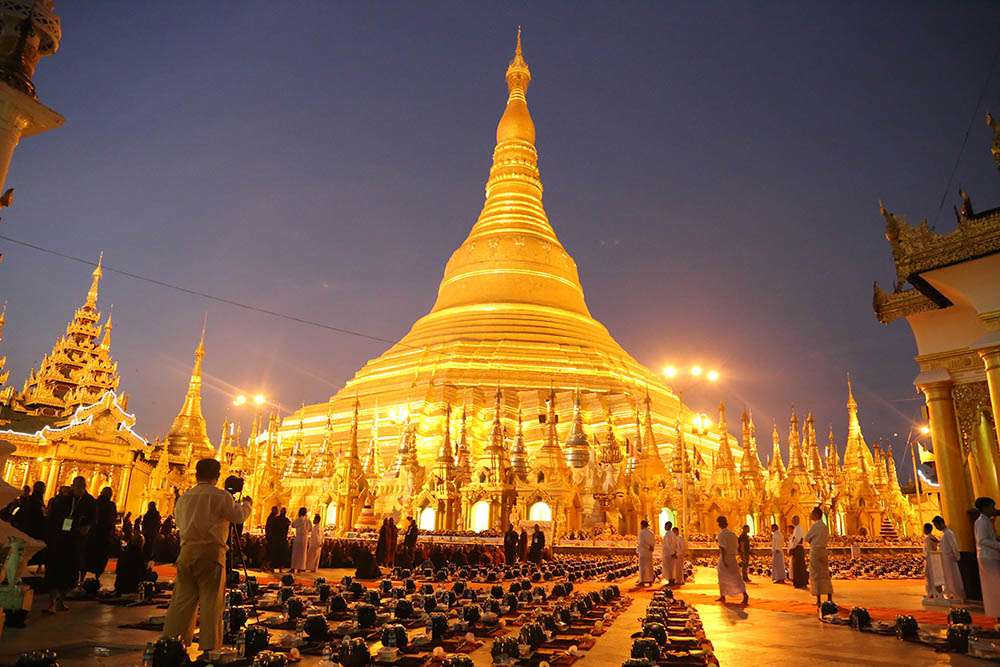
A night view of Shwedagon Pagoda in Yangon/Irrawaddy
Shwedagone Pagoda
It's said that you haven't really been to Yangon unless you visit the world famous Shwedagon Pagoda. The golden pagoda, built more than 2,600 years ago, is the most famous temple in Myanmar. It has four main stairway entrances with each one leading you to the pagoda's platform. When you reach the upper level, your breath will be taken away and you will feel absolutely peaceful.
Early in the morning or in the evening at around 6pm are the perfect times to visit. Please note that revealing clothes are prohibited and that shoes aren't allowed to be worn in the pagoda area. The pagoda is open daily from 4am to 10pm and foreigners need to pay an entrance fee of kyat 10000.
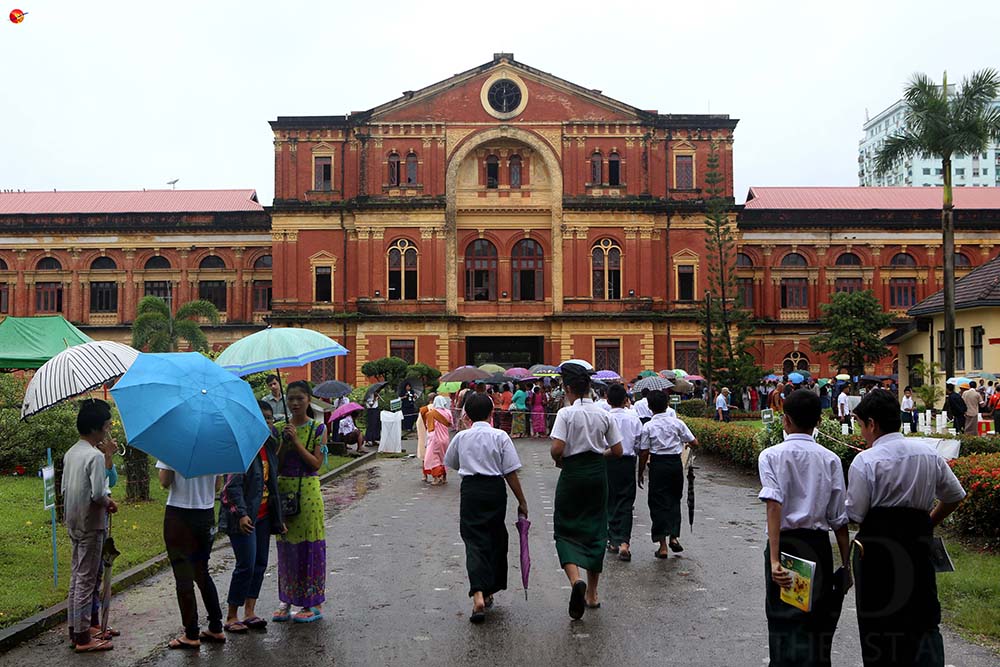
The Secretariat Building draws a crowd last Martyrs Day in Yangon/Irrawaddy
Yangon Secretariat
The 120-year-old Ministers' Office, also known as the Secretariat Building, is one of the most iconic buildings in Yangon. This historic building sits in the middle of the city and it is the place where General Aung San and another six cabinet ministers were assassinated on July 19, 1947.
The Secretariat Building has been closed for several years and is currently undergoing renovations although members of the public can still take a one-hour guided tour, from Monday to Friday. You can spend your afternoon studying this important place in the history of Myanmar although bookings are required. The designated visiting times are 9:30am, 11:30am, 1:30pm, 3:30pm on weekdays and at 9:30am on Saturdays. Tours can be booked at www.thesecretariat.com and +959 456 883 044.
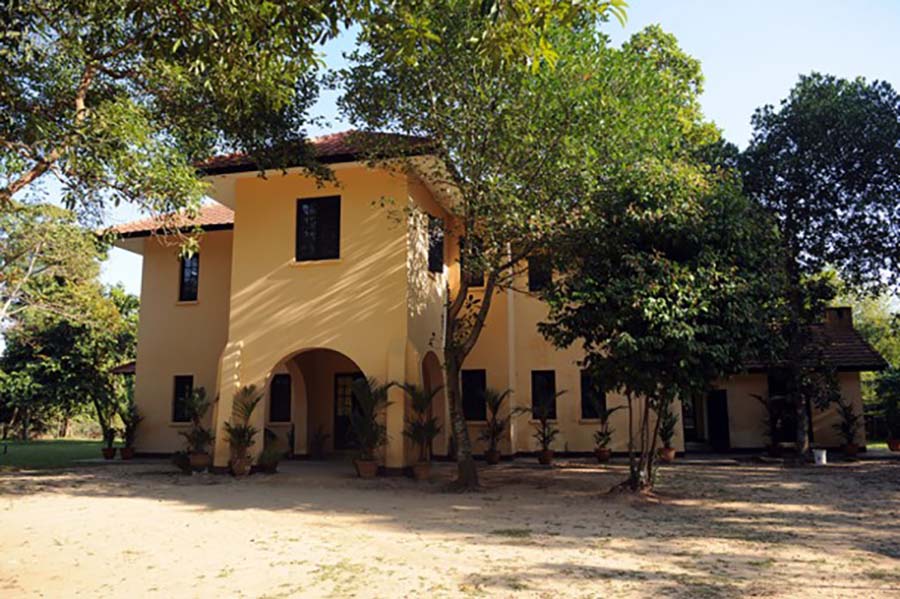
The beautifully restored U Thant House/Irrawaddy
U Thant House
U Thant was a Myanmar diplomat who served as the third Secretary-General of the United Nations from 1961 to 1971. During his tenure, he helped defuse the Cuban missile crisis, which had brought the United States and the Soviet Union to the brink of nuclear war. He also helped end a civil war in the Congo.
He and his family lived in the two-story colonial-style house from 1951-57 when he was secretary to then Burmese Prime Minster U Nu, before leaving the country to serve as Burma's Permanent Representative to the UN in New York in 1957.
In 2012, Thant Myint-U, a historian and chairman of the Yangon Heritage Trust (YHT) and also a grandson of U Thant, renovated the house for it to be used as a museum in honor of his grandfather, as well as a centre for public events, such as lectures and seminars on issues related to the former UN secretary-general's life and work.
The home now stands as a beautifully restored place where you can learn more about U Thant and buy the books written by him as well. The house is open to the public on Friday, Saturday and Sunday from 10am to 5pm. The U Thant House is located at 31 Pan Wah Lane, Kamayut Township, in Yangon.
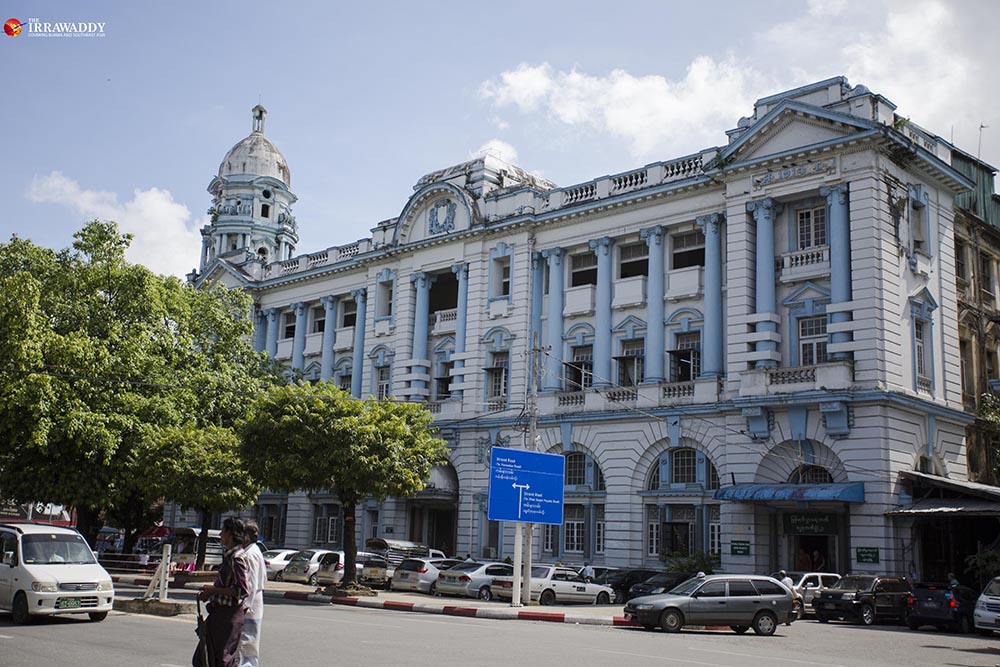
A heritage-listed colonial building in downtown Yangon. /Aung Kyaw Htet
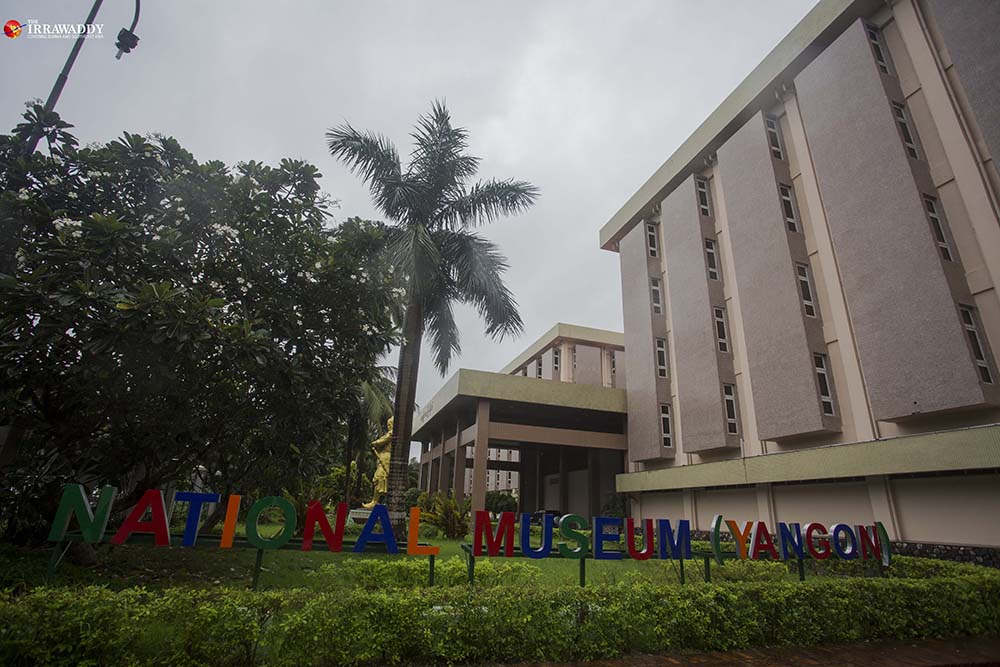
The entrance to the National Museum Yangon./Aung Kyaw Htet
National Museum
The National Museum of Myanmar, which has been open since 1952, is a place where you can learn about Myanmar's history, art, and culture. It's a huge 5-storey building that houses ancient artifacts, works of art, inscriptions and historic memorabilia, related to the history, culture and civilization of Myanmar. The museum has a total of 14 galleries. Entrance fees are US$5 for foreigners and Kyat 500 for locals. It's located at No. 66/74 on Pyay Road, Dagon Township in Yangon.
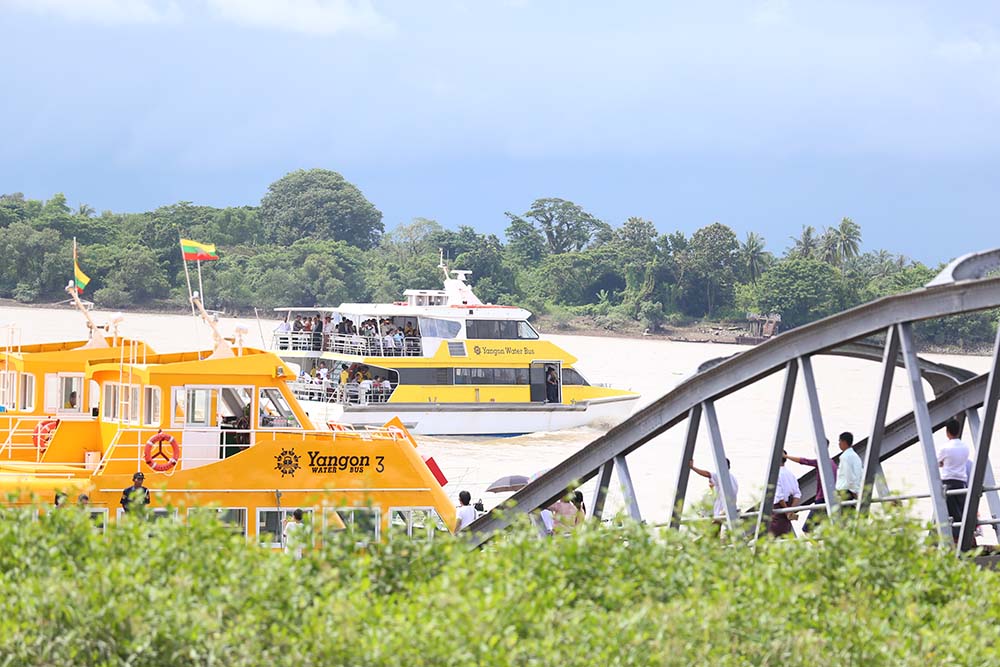
A Yangon water bus pulls in at Botahtaung Jetty in Yangon./Irrawaddy
Yangon Water Bus
The Yangon Water Bus is a new transportation option that started up last October. The "bus" services a 7 jetties: Bohtataung Terminal (Bohtataung Pagoda compound), Nan Thi Da Terminal (Pansodan Street), Lan Thit Jetty (Lan Thit Street), Kyee Myindaing Terminal (Kyee Myaing Kanar Road, near Zay Gyee Street), Hlaing Terminal (Hlaing Station Road, next to Shwe Padauk Fish Market), Punn Hlaing (Punn Hlaing Golf Estate) and Insein Terminal (Aung Zay Ya Bridge). The whole route takes about 3 hours to complete. There are different schedules that you can check at the Yangon Water Bus website (www.yangonwaterbus.com) before you go to one of its stops. The ticket price for a local is Kyat 300 and for a foreigner Kyat 1200. Along the way, you can see nice views of the Yangon riverside and even catch up with sunset in Yangon on the evening schedule. I strongly recommend you give this one a try while in Yangon.
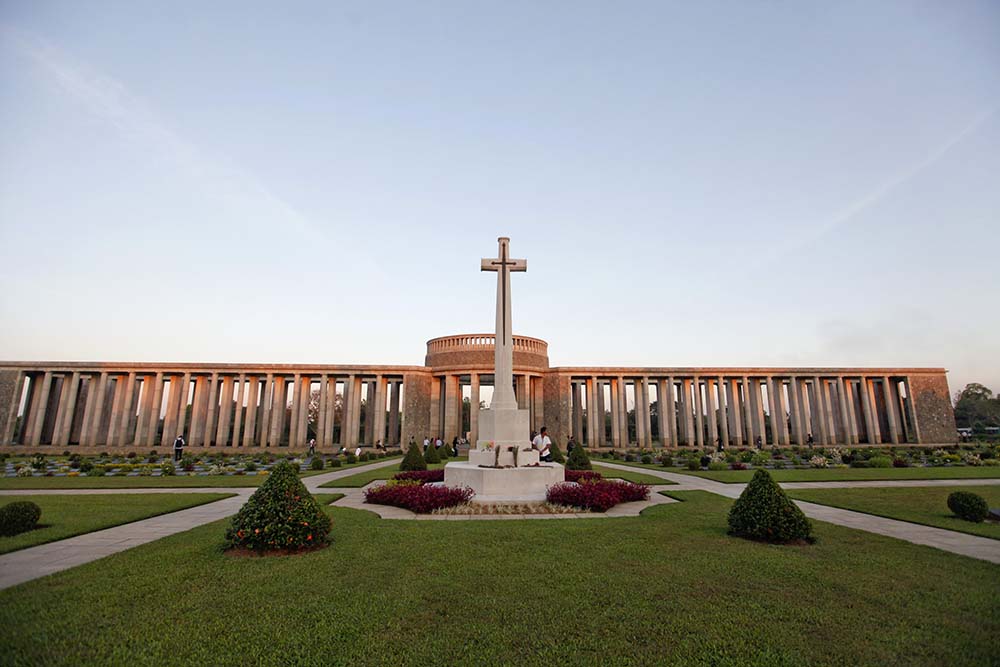
Htauk Kyant War Cemetery at Mingaladon Township./Irrawaddy
Htaukkyan War Cemetery
The Htauk Kyant War Cemetery is a cemetery for the Allied soldiers who lost their lives in Myanmar during the First and Second World Wars. The cemetery was built in 1951 and houses graves transferred from four battlefield cemeteries at Akyab (Sittwe), Mandalay, Meiktila and Bahmaw. The cemetery is located in Mingaladon Township, Pyay Road in Yangon and can be reached by bus or taxi. It takes about one hour from Yangon and it's open daily from 9 am to 5 pm.
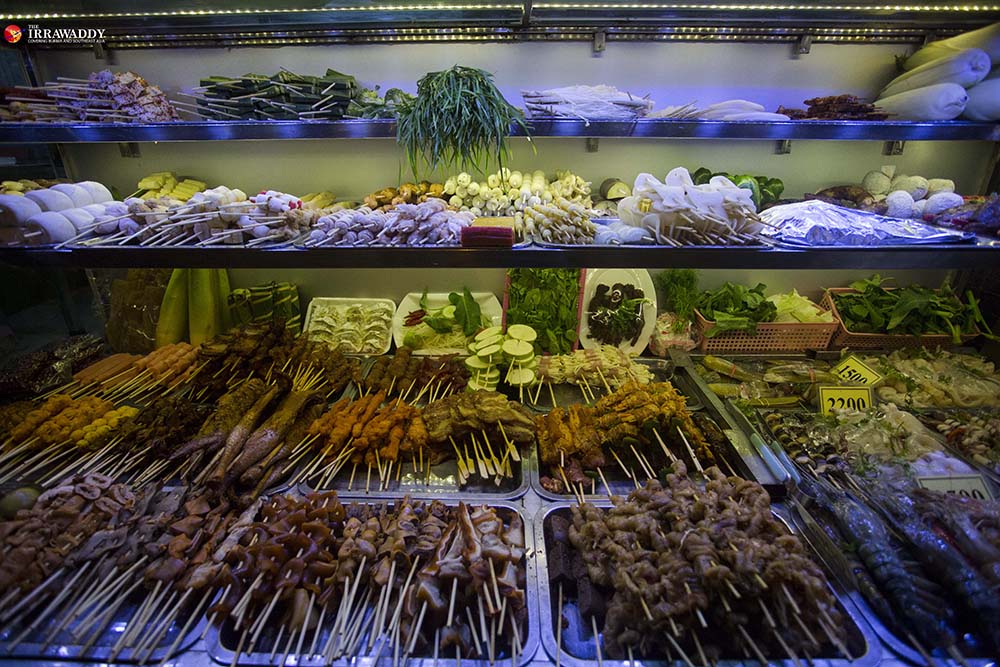
Grilled meat vendor in Chinatown. /Aung Kyaw Htet
Evening Food Tours
Chinatown is the best choice for an evening food tour of Yangon because you can get an experience of how local people live and eat, try a lot of street food, and a taste of Yangon's nightlife. 19th Street in particular offers an assortment of restaurants, beer shops, cheap small bars, stalls and barbecues that are a feature of this street. So, go to Chinatown and explore the local foods, grab some brews and enjoy the Yangon night!
Another eating option is Boyar Nyunt Street. It is not very far from Chinatown and the main difference is that Boyar Nyunt has more restaurants offering international cuisines such as Japanese, fast-food, Western and Korean. There are also bars there. So, you can have a proper dinner, a drink and then easily move on to your next stop in the area.
YANGON – Controversial comments by Arakan National Party (ANP) vice chairwoman Daw Aye Nu Sein during her speech on the first day of the third session of the 21st-Century Panglong Peace Conference in Naypyitaw on Wednesday have stirred debate among political analysts and netizens, and prompted the Union Peace Dialogue Joint Committee (UPDJC) bloc of political parties, of which the ANP is a member, to declare that the speech did not reflect its views.
The controversy found its first expression in a gesture of displeasure by State Counselor Daw Aug San Suu Kyi, who was in the audience for the speech. The three speakers who preceded the ANP vice chairwoman on the stage were all applauded by the country's de facto leader. However, the State Counselor did not applaud the ANP official's 10-minute keynote speech — a fact that was noted by political analysts and activists. The incident immediately went viral on Facebook, as broadcasters live-streamed the daylong event.
Some criticized Daw Aung San Suu Kyi for refusing to acknowledge a political speech that was critical of her, and questioned how national reunification and reconciliation are possible in such circumstances.
The National League for Democracy (NLD)-led government has convened two previous sessions of the 21st-Century Panglong Peace Conference in recent years. Wednesday's event marked the beginning of the third installment. As representatives of elected political blocs, both the ruling NLD and the military-backed Union Solidarity and Development Party have made speeches announcing party policies and preferences without consulting other representatives or agreeing on a common statement.
At the third session, the Arakan National Party (ANP) representative similarly presented its policies, highlighting the violence in northern Rakhine State last year in which tens of thousands of non-Muslim people were displaced in Maungdaw District while 700,000 Rohingya were driven out to neighboring Bangladesh by army clearance operations. Daw Aye Nu Sein also discussed the ruling party's failure, while attempting to address the crisis, to consult the local Arakanese party, which holds seats in the Rakhine State Parliament. She accused Daw Aung San Suu Kyi's government of turning Rakhine affairs into international issues.
The UN has described the widespread killings of and rights abuses against the Rohingya community by the military as "ethnic cleansing," and some international rights groups have called for Myanmar military commander-in-chief Senior General Min Aung Hlaing to be referred to the International Criminal Court to face allegations of crimes against humanity.
On Wednesday evening, the UPDJC released a brief statement in which it said the ANP's speech did not reflect the perspectives of the political bloc and that the address had been delivered without proper consultation with other parties. It also cited its own perspectives on the issues raised and said the content of the speech was irrelevant in regards to the current peace effort.
Daw Aye Nu Sein explained that she had participated in the Union peace conference regularly, but the UPDJC had never before asked the ANP to censor a keynote speech or instructed it to gather other political parties' opinions. On previous occasions, she said, the NLD and USDP had themselves ignored the perspectives of other parties, without the UPDJC raising any objection.
"It is in the nature of political culture that there will be different perspectives, and we accept this. Though we have learned of the one-sided announcements in the state-owned newspapers today and feel very upset; without doubt, there is bias," she said.
Arakanese lawmaker U Pe Than, who is also attending the Naypyitaw peace conference, complained that his party was not informed in advance about the conference agenda. Moreover, he said, it was not realistic to expect a speech to be agreed upon in a short time by 23 ethnic political parties, all of whom have different opinions. He said if the government preferred collective papers, it should have organized a roundtable discussion for political parties before the peace conference.
"They accuse us of stating policies, but we have to question why the UPDJC failed to do so. Why else would they allow a political party to take its turn on the agenda? This is contradictory, and everything has been misinterpreted. Basically, this is a result of the UPDJC's weakness."
Since peace negotiations started in 2011, fighting between the Tatmadaw and ethnic armed organizations in Kachin and Shan states has resulted in more than 150,000 people becoming internally displaced. Eight armed groups signed the Nationwide Ceasefire Agreement (NCA) with the previous Thein Sein administration, while the New Mon State Party (MNSP) and Lahu Democratic Union inked the NCA as part of the Daw Aung San Suu Kyi-led peace process earlier this year.
The United Wa State Army (UWSA), National Democratic Alliance Army-Mongla and NSCN-K all signed ceasefire agreements with the former ruling military junta. They have all expressed their willingness to engage in political dialogue but have declined to sign the NCA.
YANGON — Local residents are concerned about the lack of transparency surrounding seven proposed dam projects backed by international companies in southern Myanmar, some of which have already resulted in forced displacement, land confiscation and loss of crops without compensation, according to a report by the Karen Human Rights Group (KHRG).
The seven projects are expected to have total capacity of 2,265 megawatts. Along with the local company Asia World, the major investors are from Thailand, Japan and Norway. Many of the proposed projects are designed primarily to export electricity to Thailand or China. Construction on three of the projects is expected to begin in 2021 and be completed in 2022, the report said.
"We have no clue about the projects. The [National League for Democracy-led] government hasn't provided any information. There has been no public consultation with local people," Saw Tha Phoe, a coordinator at Karen Rivers Watch, told The Irrawaddy.
According to the report, the proposed dam projects are: Thauk Yay Hkat (1) in Thandtaung Township (120 MW); Hatgyi in Hlaingbwe Township (1,380 MW); Thawkahtar (160 MW) in Kyaukkyi Township; Bilin in Bilin Township (280 MW); Pata in Kawkareik Township (5 MW); Mehkatha in Kyain Seikgyi Township (120 MW); and Tanintharyi in Hteekhee Township (200 MW).
Some companies have started building roads and moving equipment to the dam sites and urged local people to move. Some residents have already been displaced from proposed project sites.
KHRG said Thai and Japanese companies have implemented initial construction and brought in transport equipment for some of the proposed dam projects, destroying villages and farms in Ler Muh Lah Township, Tanintharyi Region.
"People have been displaced from their villages without having a chance to discuss compensation,'' Saw Tha Phoe said.
KHRG said villagers from five of 10 investigated dam sites have reported cases of land confiscation and property damage. In all of these cases, villagers reported that compensation was not provided for land confiscation, or extensive damage to crops and natural fauna.
"Public consultations were not conducted, and rural ethnic communities were not able to negotiate for compensation," KHRG said.
According to the report, some of the projects were proposed after the Karen National Union (KNU) and the Myanmar Military signed a bilateral ceasefire in 2012. All of the projects are located in KNU-controlled areas in Karen State, Mon State and Tanintharyi Region.
"Some projects were approved under the previous government. Some were approved under the current government," Saw Tha Phoe said.
According to KHRG, when the NLD-led government declared its support for hydropower development along the Salween River, military clashes erupted between the Tatmadaw and its aligned Border Guard forces on one side, and the Karen National Liberation Army (KNLA) and Democratic Karen Benevolent Army (DKBA) on the other.
Military confrontations have occurred around the proposed dam sites; from 2014 to 2016 more than 7,400 residents of 35 villages were displaced near the proposed Hatgyi Dam project on the Salween River. If the Hatgyi Dam project is implemented, more than 30,000 people could be displaced from 50 villages upstream of the site, KHRG said.
Of the 50 large hydropower projects implemented in Myanmar to date, 42 are located in ethnic areas, according to KHRG.
The organization urged the government to ensure that implementation and planning of large-scale hydropower projects in ethnic areas is suspended until a comprehensive nationwide peace agreement is reached.
In March, more than 1,700 people living near the proposed Hatgyi Dam on the Salween River gathered to protest against the construction of dams on Myanmar's biggest rivers, including the Salween, Irrawaddy and others.
Before the proposed projects officially begin, Saw Tha Phoe said, the companies involved should discuss with local communities the payment of adequate compensation. The coordinator also urged the government to disclose all related information in order to demonstrate accountability.
YANGON — Military commander-in-chief Senior-General Min Aung Hlaing's claim that the military (or Tatmadaw) represents all Myanmar nationals in his speech to the Union Peace Conference has drawn a strong negative response from the public on social media.
Addressing hundreds of delegates from the government, ethnic armed groups, political parties and Parliament on the first day of the conference on Wednesday, Snr-Gen Min Aung Hlaing said that neither the ethnic armed groups nor the country's political parties can claim to represent the entire population of 52 million. He added that political parties only represent their own supporters.
"Our Tatmadaw, being the people's Tatmadaw born of ethnic people, is an organization representing the state and the people," he said, asserting the legitimacy of the Tatmadaw and its positions on national issues.
The senior-general's remarks went viral on social media and quickly met with objections. Many netizens began posting "The Tatmadaw doesn't represent me" on their Facebook accounts.
Human rights activist Ko Moe Thway, who wrote "The Myanmar Army doesn't represent me" on Wednesday night, said he could not agree with the military chief's words.
"[The senior general's] statement could be misinterpreted to mean that the military reflects the public's voice. That's why I wrote [my comment]," he said.
"The armed services is a profession, like other occupations in which people choose to work; it doesn't need to be elected [by the people]," the activist said. The incumbent National League for Democracy-led government was elected by an overwhelming majority in the 2015 general election, whereas the Tatmadaw is an agency of the Ministry of Defense, just like agencies under other ministries of the Union government, he said, adding that the commander-in-chief was comparing apples and oranges.
Ko Moe Thway added that the military chief's comments would have been legitimate if he had said that the Tatmadaw "comprises" rather than "represents" many different ethnicities.
Daw Myint Myint Khin Pe, co-founder of the Free Funeral Services Society (FFSS)—which is known for its free funeral services for the poor, as well as its education initiatives and free health care services—also posted "the Tatmadaw doesn't represent me."
"I just made it clear that the Tatmadaw doesn't represent us, and what he said in his speech doesn't reflect us," she said.
U Nyan Win, a member of the NLD's central executive committee, objected to the senior general's comments that political parties only represent those who support them.
"I would say it is totally wrong," U Nyan Win told reporters in Naypyitaw. He did not comment on Snr-Gen Min Aung Hlaing's comment that the military represents all Myanmar nationals.
Buddhist monk U Issariya, who played a leading role in the 2007 Saffron Revolution, also posted "the Myanmar Tatmadaw doesn't represent me" on social media on Thursday.
He said that the Tatmadaw doesn't represent the people — rather, it represents a group of people.
NAYPYITAW — The vice chairman of the United Wa State Army (UWSA), Bao Yu Yi, was rushed to hospital after he fainted before a meeting with State Counselor Daw Aung San Suu Kyi on Thursday in Naypyitaw.
The vice chairman and his team arrived in the capital along with representatives from other ethnic armed groups on Tuesday to attend the third session of the Union Peace Conference, which is now underway.
UWSA spokesman U Nyi Rang blamed the fainting on heat stroke.
"He's fine now but feeling tired," he said.
Due to Bao Yu Yi's hospitalization, UWSA's liaison officer, Zhao Guo An, joined the meeting with Daw Aung San Suu Kyi instead.
"The climate here is quite different from our Wa region, and the food as well," said U Nyi Rang.
Bao Yu Yi, 65, appeared to be feeling weak on arriving in Naypyitaw and needed assistance walking at Wednesday’s opening ceremonies for the conference.
NAYPYITAW — The third session of the 21st Century Panglong Peace Conference kicked off in Naypyitaw on Wednesday and will continue through Monday. The National Democratic Alliance Army (NDAA), also known as the Mongla Group or Shan State Special Region 4, one of the armed ethnic groups that have signed bilateral ceasefire agreements with the government, is attending the conference. U Kyi Myint, the general secretary of the NDAA, talked to Irrawaddy reporter Nan Lwin Hnin Pwint about the prospects for peace in Myanmar.
How has the Mongla Group prepared for the third session of the Panglong Conference?
We have come to attend the conference at the invitation of the government. We have come as a 22-member delegation led by Vice Chairman Hsan Per.
The objective of the Panglong Conference is to bring about national reconciliation and peace. We strongly support that objective.
We signed a ceasefire agreement with the government in June 1989. Almost 30 years have passed. The guns have been silent since then. And we're constantly engaged in developing our region. Why don't you come and see Mongla? We're enjoying the full benefits of peace.
Previously there were only dirt roads; now the roads are paved. And thatched houses have been replaced by high-rise buildings. Previously there were only monastic schools. Now we have modern schools and hospitals. Besides the 50-bed government hospital, we also have our own hospital. Things have changed a lot.
People can live an easy life now, unlike in the past. They are very sorry to see war refugees in other parts of the country. They pray for them.
So, we have come in the hope that the peace conference will bring about peace for the whole country.
The Mongla Group is an ally of the Federal Political Negotiation and Consultative Committee (FPNCC), which is a bloc of non-signatories to the Nationwide Ceasefire Agreement (NCA) led by the United Wa State Army (UWSA). Will the Mongla hold talks with the FPNCC?
The government invited us separately. The government has not yet accepted the FPNCC. All the ethnic groups based along the border are attending [the conference] with the assistance of the Chinese government.
In fact, neither we nor the UWSA have security problems. There are ethnicities living across the border. There are Kachin, Bamar, Ta'ang, Shan, and Akha, as well as Chinese people. Clashes that happen inside the country have an impact on them. China gives us a lot of support. We accept that peace is important for the country and that's why we've come here.
The UWSA, Shan State Progress Party (SSPP) and Mongla do not oppose peace, or the NCA. Both we and the Wa signed truces in 1989. It has been around 30 years, and there has not been a single clash or territorial dispute. We don't oppose the NCA.
But now the government says that while the previous agreement was signed in the presence of a few people, the new one [the NCA] will be signed in the presence of the international community, the Parliament, State leaders, military leaders and political parties, so it will last longer and be better. We and the Wa both accept it. We will sign when the time it appropriate. We can't shun that path. Nobody can fight for their whole life.
In the past, both the Wa region and our own lagged behind in development. Now things have changed a lot. Some towns and districts in the country do not even match up to us.
If that is the case, what are the prospects of you signing the NCA?
I can't predict the outcome, but we are negotiating.
Will the Mongla choose to sign the NCA or seek an alternative approach as the FPNCC has suggested?
The FPNCC was formed to hold political negotiations. But whether or not to sign the ceasefire is up to each group. Basically, there are three groups within the FPNCC: Those that have signed the truce, those that are constantly fighting [against government troops], and those who fight periodically.
There is no one-size-fits-all approach. So, we focus mainly on political dialogue. The rest will depend on discussions between us. The FPNCC was formed to persuade the groups still involved in fighting to join the peace process. It does not encourage them to continue fighting.
Critics say the Wa and Mongla support the Northern Alliance. What is your response?
That is mainly because of the Kokang Group [also known as the Myanmar National Democratic Alliance Army-MNDAA]. The daughter of [Kokang leader] U Pheung Kya-shin is the wife of our chairman, U Sai Lin. So, they are relatives. We have sheltered the [Kokang] people who have fled [clashes between the Myanmar Army and MNDAA].
We have negotiated with the Tatmadaw about sheltering them. But there are certain things we don't allow the Kokang to do [in NDAA areas], such as conducting military exercises, recruiting, and taking arms [from us] to fight [with the Myanmar Army]. The Wa have made the same request to them. We've urged the MNDAA to take the path of peace.
Thailand has done a fantastic job in rescuing the "Wild Boars" — 12 young soccer players and their coach, who were trapped deep in a cave in Northern Thailand.
It was amazing to see how Thai authorities moved quickly to mobilize army, navy and air force personnel, government officials and volunteers to help find the missing children.
When the forces assembled at the cave, the coordination, teamwork and spirit were impressive and the international community watched breathlessly to see how the Thais would organize and begin the rescue operation while maintaining their customary smiles and resilience.
In effect, we were enthralled by two simultaneous contests – one was the World Cup and the other the race against time to save the lives of the young soccer players. In the end, even FIFA could not ignore the drama and has invited the kids to the World Cup Final. To get assistance from abroad, the Thais opened their doors to foreign experts and renowned cave divers to come and join a squad of Thai Navy Seals.
Over 1,000 troops and doctors and nurses and volunteers quickly set up camp at the cave and helicopters flew in from nearby to rush the rescued boys to the hospital in Chiang Rai.
Closely watching the rescue operation from next door, Myanmar citizens could only wonder what would have been the fate of the kids if a similar emergency had happened in our country?
The contribution from Myanmar was unusual as the popular Shan monk known as Maing Hpone Sayadaw visited the Tham Luang cave complex three times to hold religious rites.
The day after his second visit, the rain that had been pouring down in the area for days stopped and the missing group was located. Many Thais believe the monk's intervention prompted the hiatus in the rain. But it was the divers and Navy Seals who did the dangerous job of rescuing the boys.
Aside from the Shan monk, we discovered that the wonderful 25-year-old-coach Ekkapol Chanthawong, better known by his nickname "Ake," is from Shan State. He has been credited with keeping the boys alive while the cave ordeal riveted the world.
Ekkapol Chanthawong (left) / Thai Navy SEALs /Facebook
In the dark and surrounded by floodwaters, Ake told the boys not to move around too much to conserve energy, and taught them meditation techniques to keep them calm. Ake spent most of the past decade as a monk in a Buddhist monastery. He then left the monastery to care for his ailing grandmother in Mae Sai, northern Thailand, and was later hired by the Wild Boars football team's head coach to train the boys in daily practice sessions. In Mae Sai–Tachilek, many children live such cross-border lives with some ending up studying in Thai schools. Of course, some of the children leave Myanmar due to the poverty and ongoing armed conflict.
This includes the ambitious but gentle 14-year-old Wa student Adun Sam-on, a.k.a Aik Lu, who was among the 12 children. He was the one who communicated with the British divers who first reached the group on July 2.
Go Shin Maung of Mae Sai Grace Church, which Aik Lu has called home for most of his life, told The Irrawaddy that he was born in Thailand to ethnic Wa parents from Myanmar's Wa Self-Administered Region. Aik Lu's parents left him in northern Thailand so that he could get a better education.
Aik Lu speaks English, Thai, Burmese and Chinese, which he learned at the church, is an all-around athlete and also plays the violin, piano and guitar. He also helps take care of his friends and teachers as well.
While the children were in the cave, some Thai media played a key role in calming the public, telling them it was not the time to blame anyone, especially the coach. Doctors and psychiatrists went to see family members to counsel them.
Inside the cave, with the water level rising, a rescue operation to extract the children was ordered earlier than planned. Everyone worked together, regardless of race or religion, as the goal was to save the lives of the young soccer players and return them home.
Much credit must go to the provincial governor, Narongsak Osotthanakorn, who demonstrated leadership skills in directing and coordinating the rescue mission.
During the operation, he told his staff, "Anyone who cannot make enough sacrifices can go home and stay with their families. You can sign out and leave straight away. I will not report any of you. For those who want to work, you must be ready…"
The 17-day rescue operation was a life and death situation — hopes rose and faded day by day. It may be quite convenient to follow and watch this news on TV but in reality the operation was carried out in difficult conditions: rising water, changing weather and a large and complex cave system.
When we learned that Saman Gunan, a 38-year-old Thai Navy Seal, had died in the cave during the rescue effort, everyone feared that the boys would not come out alive. But hope lingered.
When D-Day arrived, the media was relocated as the Thais began the final rescue. The 12 boys wore full-face scuba masks and were attached to divers as they traversed the underwater parts of the cave. The Navy Seal chief appeared to confirm reports that the boys had been sedated for the journey, telling the press briefing: "Along the way some may have slept."
The Thai government released a video clip to confirm that the 12 young soccer players and their coach rescued from the Tham Luang cave were all in good health.
Luck was on the Wild Boars' side. The emergency ended like a Hollywood movie, with the kids the winners and everyone getting to share in the happiness and joy. The world wanted to connect with the boys and to share in an inspiring story at this time of political divisiveness and uncertainty in the world. Great characters, it seemed, were in all the right places to defeat the odds.
Narongsak, who has become a national hero following the successful rescue, called the boys "a symbol of unity among mankind". He added: "Everyone worked together, regardless of race and religion, as the goal was the rescue of the youth soccer team and returning them home safely."
It was mission impossible with a happy ending.
The Irrawaddy dispatched a group of reporters to Mae Sai to broadcast live reports and stories from there to its readers in Myanmar and beyond.
NAYPYITAW — Women's advocacy groups urged delegates attending the third session of the 21st Century Panglong Peace Conference this week to push for a gender equality policy regarding women's representations across all sectors.
As many key federal principles related to equality for ethnic minorities, autonomy and the Constitution have been kept out of discussion during this round of talks, the Union Peace Dialogue Joint Committee decided that gender equality issues would help keep the process going forward.
During interviews with dozens of delegates at the peace conference that commenced on Wednesday, some people expressed their disappointment, as gender equality is the only issue under the political sector discussions, while others acknowledged that it is essential.
Some male politicians expressed that gender equality is not a key issue. But others who are involved in the ongoing peace negotiations and legislature acknowledged its importance.
"We hope a gender equality policy is agreed upon and approved after this session," said Padoh Saw Kwe Htoo Win, adding but it won't be completed at once and will need further discussion. Padoh Saw Kwe Htoo Win is the vice chairman of the Karen National Union, a signatory to the Nationwide Ceasefire Agreement. He has been involved in peace negotiations since they began in 2011.
"I think a gender equality policy could be incorporated into the Constitution," said Naw Pan Thinzar Myo, the Karen ethnic affairs minister of Yangon Region. She told The Irrawaddy that women can contribute in many sectors including development and peace negotiations but that a supportive environment is needed for that to occur.
"When women are allowed the space to contribute, they can do more," she said. "The more women who participate, the closer we will be to attaining peace."
Gender equality is a discussion that is a long time coming, some say.
"It is late now to be discussing this issue in our country," said Hket Htain Nan, a former lawmaker who is participating in the conference as a political parties delegate. He is the chairman of the Unity and Democracy Party of Kachin State.
In a joint statement released on Tuesday, the Alliance for Gender Inclusion in the Peace Process (AGIPP) and Women's League of Burma (WLB) said a gender equality policy must be in place in the future democratic federal Union.
It stated that delegates of all sectors: political, economic, social, land, and environment and security, need to include in discussions at least a 30 percent quota system; that the election system must guarantee gender equality in the Constitution; and that effective policies must be in place to protect women and children who face gender-based violence in conflict zones.
It also urged for policies that guarantee accountability and discourage gender discrimination.
"There are many people who think that gender equality is not important, but it is incredibly important, as there is extreme inequality in reality," said Htang Kai Naung of the Kachin State Women's Network, which is a member of AGIPP.
"Women have been discriminated against either because of tradition or religious beliefs," she added. "Only when women are allowed to participate in the current peace process, in which the principles for a future Constitution are being set, will the legislation provide better protection and support for them."
Members of society need to accept this and more men should help raise the issue, added Htang Kai Naung.
YANGON — U Ohn, a devoted environmentalist, died on Wednesday of natural causes at the age of 91 at his residence in Yangon's Mayangone Township, according to his family members.
"He was doing well on Tuesday night but didn't wake up the next morning. I am proud of him as a distinguished environmentalist. We've lost a scholar," Ma Khin Thuzar Tint, granddaughter of U Ohn, told The Irrawaddy.
U Ohn was born in 1927 in a rural village in Sagaing Region. He studied forestry from 1952 to 1956 at Wales University in England.
He served as a director in the Forestry Department from 1957 to 1988, and also worked as a forester in a greening project at Mt. Popa in Mandalay Region.
"He designed plans for the long-term conservation of Mt. Popa starting in 1980. He educated the locals about the importance of forests," said U Aung Hein, acting secretary of the Mt. Popa-Lovers' Group, a local non-profit organization engaged in the conservation of the mountain.
"He appointed hunters and those who earn their livelihoods by selling firewood to the forestry department to take care of Mt. Popa. He urged locals to grow perennial trees."
"And now we're enjoying the benefits. Otherwise, the forests would be gone because of the expansion of farmland and residential areas. As Popa has forests, it receives higher rainfall than other areas even though it is located in the arid zone in central Myanmar," he added.
He served as a forestry adviser from 1988 to 1993 and studied forest research, environmental conservation, and national park governance in the United States, Europe, India, Australia, New Zealand, Thailand and Singapore.
He took the lead role in the establishment of Popa, Alaungdaw Kathapa, Chatthin, and Hlawga national parks and wildlife sanctuaries under the National Park and Nature Conservation program of the United Nations Development Program.
He retired from the Forest Resource Environmental Development Association (FREDA) in 2015 because of his health, but he remained an honorary patron, according to officials of the association.
Founded in 1996, FREDA is a non-profit and non-governmental organization in the forestry sector of Myanmar. It comprises more than 400 members including foresters, botanists, agronomists, zoologists, veterinary scientists, hydro-geologists, engineers, timber businessmen, journalists, artists and more.
U Ohn won the Minamata award presented by Japan in 2005 due to his afforestation efforts at Mt. Popa from 1982 to 1986 and restoration of 2,500 acres of mangrove forests in the Irrawaddy Delta between 1997 and 2007.
He is the first person to win an environmental award in Myanmar. His funeral will be held on Friday at Yayway Cemetery.
MUMBAI — A court in Bangkok on Wednesday dismissed criminal defamation charges against workers from Myanmar who had accused a chicken farm of abuses, in a landmark ruling seen as a rare victory for migrant workers’ rights in Thailand.
The case was triggered by a complaint that 14 workers filed to Thailand’s National Human Rights Commission (NHRC) in 2016 about forced overtime, being paid under the minimum wage, confiscation of passports, and limited freedom of movement.
The workers were charged in October in a first-of-its-kind criminal defamation case, which prompted campaigners to urge better protection for migrant laborers who complain about working conditions.
On Wednesday, a judge said he believed that the workers filed the NHRC complaint against the Thammakaset chicken farm in “good faith," and without false information.
“This is a very good verdict for all migrant workers in the country,” said Nakhon Chompuchat, a lawyer for the defendants.
“It says workers need not be afraid to speak up against violations by their employers. The workers are very happy,” he told the Thomson Reuters Foundation by phone.
If convicted, the workers faced up to one year in prison and fines.
Their former employer, Thammakaset farm, which supplied the Thai food conglomerate Betagro, denied the charges from the outset and launched a lawsuit against the workers, saying the complaint has damaged its reputation.
Betagro, which sells to companies around the globe, later said it had cut ties with the farm.
The farm owner has denied any wrongdoing, and said that employees voluntarily worked nights to rack up bonuses and chose to sleep next to the chicken warehouse.
On Wednesday, the owner said he could not immediately comment on the verdict and did not answer subsequent phone calls.
Thailand has been at the center of a slew of slavery and human trafficking cases, including in its seafood sector, with migrants from Myanmar thought to suffer much of the worst exploitation, according to rights groups.
In the face of mounting global scrutiny of supply chains, Thailand has strengthened laws to crack down on labor exploitation, but activists say it is still widespread.
Wednesday’s verdict will help bolster the rights of migrant workers in the country, said Sutharee Wannasiri at the advocacy group Fortify Rights.
“The Thai court today sent a strong message to businesses that the authorities guarantee the right of alleged human rights victims to submit complaints … without fear of retaliation,” she said.
“Migrant workers’ contributions are vital to Thailand’s economic development. It is important that the Thai government adopts policies that protect their rights,” she said in a statement.
Earlier this year, the United Nations Working Group on Business and Human Rights said that Thai businesses must act to prevent rights violations, and the government must better protect migrant workers.
The verdict should encourage companies “to work collaboratively with critical voices and address legitimate grievances of migrant workers,” said Surya Deva of City University of Hong Kong who participated in the UN group.
CHIANG RAI, Thailand — The first video of the Thai boys rescued from a flooded cave after 17 days was released on Wednesday, showing them smiling and waving from their hospital beds, looking thin but fine after an ordeal that has gripped the world.
The last group of the 12-member “Wild Boars” soccer team and their coach was brought out of the Tham Luang cave, near the border with Myanmar, on Tuesday night, safely ending a dangerous rescue and evoking international relief and joy.
Rescue mission chief Narongsak Osottanakorn told a news conference the boys were just being children when they got lost and no one was to blame.
“We don’t see the children as at fault or as heroes. They are children being children, it was an accident,” Narongsak said.
A video of the boys in hospital was shown at the news conference. Some of them, wearing surgical masks, lay on their beds. Some sat and made the “peace sign” gesture for the camera.
None of the boys was heard speaking in the clips shown at the news conference.
The 12 boys and their soccer coach lost an average of 2 kg (4.4 lbs.) during their ordeal but were generally in good condition and showed no signs of stress, a senior health official said earlier.
After being brought out of the cave, one by one beginning on Sunday, they were taken by helicopter to a hospital in the town of Chiang Rai, about 70 km (45 miles) away, to stay in quarantine.
The boys would have to stay in the hospital for up to 10 days, hospital director Chaiwetch Thanapaisal told the news conference. They would then need to recuperate at home for 30 days, he said.
Parents of the first eight boys freed have been able to visit them but had to wear protective suits and stand 2 meters (7 feet) away as a precaution. Authorities are worried about the possibility of infections picked up in the cave.
Thongchai Lertwilairattanapong, a health department inspector, earlier told reporters one from the last group rescued on Tuesday had a lung infection and they were all given vaccinations for rabies and tetanus.
"Not Heroes"
Prime Minister Prayuth Chan-ocha asked that the boys be given time to recover.
“The important thing is … personal space,” Prayuth told reporters. “The best way is not to bother them and let them study.”
The group ventured into the vast cave complex in the northern province of Chiang Rai after soccer practice on June 23 and were trapped when a rainy season downpour flooded tunnels.
They were lost for nine days before British rescue divers discovered them on July 2, sitting on a ledge in a half-flooded chamber.
Getting them out – which involved teaching boys as young as 11 who were not strong swimmers to dive through narrow, submerged passages – proved a monumental challenge.
A former member of Thailand’s navy SEAL unit died during a mission in the cave on Friday.
Narongsak, giving details of the rescue, said falling oxygen levels inside the cave complex had added a sense of urgency.
The commander of the navy SEAL unit that oversaw the rescue, Rear Admiral Apakorn Yuukongkaew, hailed the international effort.
“We are not heroes. This mission was successful because of cooperation from everyone,” he said. “For SEALs, this is what we were trained for. The navy has a motto: ‘We don’t abandon the people.'
Official help came from Britain, the United States, Japan, Laos, Myanmar, China and Australia, a government document showed. There were volunteers from Denmark, Germany, Belgium, Canada, Ukraine and Finland.
Narongsak said about half of the 13 foreign divers on the crack team of 18 who rescued the boys were British. The other five on the team were Thai navy SEAL divers.
"So Strong"
The rescue has dominated front-page headlines in Thailand and beyond for days.
“Hooyah! Mission accomplished,” read one headline, echoing the rallying cry of the SEAL unit.
The hashtag #Hooyah was hugely popular on social media with people showing their support for the hundreds of rescuers, including divers from around the world, who helped to get the boys out.
The fate of the boys has even resonated as far as Russia, where soccer’s World Cup is reaching its final stages. Players from France and England welcomed news of the rescue and sent their best wishes to the “Wild Boars” on Twitter.
“This victory goes to the heroes of the day, well done boys, you are so strong,” French midfielder Paul Pogba tweeted after his team beat Belgium 1-0 on Tuesday to reach the final.
Manchester City and England defender Kyle Walker, whose team faces Croatia in the second semi-final later on Wednesday, said he wanted to send shirts to the boys.
“Amazing news that all of the Thai kids are out of the cave safely!” Walker tweeted.
A Google search on Tuesday for the words “Thai cave rescue” revealed 359 million results.
SHANGHAI — Most US businesses operating in China oppose the use of tariffs in retaliation for the challenges they face, from an uneven playing field to poor protection of intellectual property rights, a survey showed on Thursday.
Almost 69 percent of the 434 respondents to the annual China Business Climate Survey of the American Chamber of Commerce in Shanghai opposed tariffs, while just 8.5 percent backed them, the body said.
“Resolving these challenges in an equitable manner is essential for the United States and China to have a healthy long-term commercial relationship that brings benefits to both our peoples,” it said in a statement on the survey results.
The survey, conducted between April 10 and May 10, reflects the mix of key concerns and realities for American businesses in China at a time of heightened uncertainty as the Trump administration raises the ante in its trade war with Beijing.
US President Donald Trump has accused China of unfair trade practices that give its firms an advantage, while hobbling American companies and creating an outsized trade deficit for the United States.
On Tuesday, the office of the US Trade Representative said it would impose 10 percent tariffs on an extra $200 billion worth of Chinese imports, from food products to tobacco, chemicals, coal, steel and aluminum.
The survey showed that while US companies continue to face challenges in China, 34 percent of respondents felt Chinese government policies toward foreign companies had improved, up from 28 percent last year.
The number of companies that felt policies had worsened for foreign firms fell to 23 percent from 33 percent, although 60 percent of respondents felt China’s regulatory environment lacked transparency, on par with last year.
Insufficient intellectual property rights protection and the need to get licenses were the top two regulatory challenges, although slightly fewer companies found both to be a hindrance in the 2018 poll, compared with that of 2017.
To force greater market access, 42 percent of respondents favored investment reciprocity, up from 40 percent last year. But the number opposing it also grew, to 16 percent, from 9 percent last year. The number of those unsure rose to 44 percent from 31 percent.
“Despite the relative optimism our members feel guarded about the future,” AmCham said in its statement.
Concerns such as government favoritism for domestic firms and pressure on US ones in strategically important sectors to transfer technology were “stoking demand for reciprocity in the US-China trading relationship, even if our members generally oppose the use of retaliatory trade tariffs,” it added.
The biggest operational challenge of all was rising costs, an issue confronting more than 95 percent of respondents, the poll showed. More than 85 percent of respondents saw domestic competition as a challenge.
The proportion of companies expecting to be profitable was basically flat, at about 77 percent, but firms signaled they were pulling back slightly on investment.
The survey showed 53 percent of companies increased investment in 2017, down from 55 percent the year before, highlighting a trend of reduced investment growth since a 2012 peak, when 74 percent of respondents said they had boosted investment in China.