Tuesday, September 4, 2018

The Irrawaddy Magazine

The Irrawaddy Magazine


TNLA Puts Abducted Shan Woman ‘on Trial’

Posted: 04 Sep 2018 06:07 AM PDT

CHIANG MAI, Thailand — The Ta'ang National Liberation Army (TNLA) said on Monday it had put on trial a Shan woman whom it took from her home at gunpoint last month in Namhkam Township, northern Shan State.

Nang Mo Hom is being tried in the TNLA's central court for allegedly obstructing its troops as they performed their duties, the group said.

Five TNLA troops arrested Nang Mo Hom at gunpoint on Aug. 17. Since then she has not been able to meet her family, despite demands for her release by local civil society groups.  A Shan political party, the Shan Nationalities League for Democracy (SNLD), on Aug. 27 sent a letter to State Counselor Daw Aung San Suu Kyi requesting that she intervene, in her capacity as the head of the National Reconciliation and Peace Center (NRPC), to assist Nang Mo Hom.

The TNLA said in a Sept. 3 statement that Nang Mo Hom had been charged under its own authority with obstructing its troops as they attempted to collect customs duties, and that her actions had resulted in the death of one of the officers.

TNLA spokesman Mai Aik Kyaw told The Irrawaddy on Tuesday that the Palaung State Liberation Front (PSLF)/TNLA court would hear the case against the woman, who was charged by the group under Article 333 of Myanmar's Criminal Code. When it came time to hand down a verdict, the spokesman said, the TNLA court "would try to make it a public hearing held before members of the public, including the family of the woman." He did not say when the verdict was expected.

Mai Aik Kyaw said Nang Mo Hom had committed a crime under the law as enforced by the TNLA. He was referring to an incident in July 2017 when two TNLA soldiers were attacked by the Myanmar Army for allegedly extorting money from local businesses in Namhkam Township.

Relatives of Nang Mo Hom said the TNLA had been extorting money from them for two years until July 2017, when one TNLA soldier was shot dead and another arrested and imprisoned in Lashio Prison after demanding 1 million kyats from the family.

The TNLA's announcement on Monday raised eyebrows, with observers asking how an organization that itself operates outside the country's laws could justify putting a woman on trial for breaking "its laws".

Addressing this point, Mai Aik Kyaw said, "As we are an armed group and not a ceasefire group, we cannot seek justice at the official township court." Therefore, they arranged their own justice, he said.

"The hearing is ongoing. On the day of the verdict we will invite her [Nang Mo Hom's] family and relatives to attend," he told The Irrawaddy.

SNLD spokesman Sai Leik raised doubts about the legitimacy of the move. "The question is whether they have the legal and judicial authority," Sai Leik said, adding that, as the TNLA's administration lacks legitimacy, "how can we acknowledge their judgment?"

"We do not recognize their judiciary, which is illegal and run by an illegal organization," Sai Leik said, adding that the SNLD, as a registered political party, cannot directly communicate with TNLA and had therefore sought the NRPC's intervention.

However, the NRPC is unlikely to be able to intervene in the case. As with most affairs in conflict-torn Shan State, such issues usually require the involvement of the armed forces, on both the government and the ethnic groups' sides.

Sai Leik told The Irrawaddy the NRPC had not responded to their request yet, though it was submitted over a week ago.

The Irrawaddy was unable to contact NRPC vice chairman Dr. Tin Myo Win, who is also chairman of the Peace Commission and the government's chief negotiator with the ethnic armed organizations. Other members of the commission contacted by The Irrawaddy declined to comment.

Sai Leik called for an end to the fighting in Shan State, especially in the north, saying the TNLA and its allies had deliberately turned the area into a "war zone" in order to protect their interests.

"If things are allowed to develop in that direction, the chances of peace will get more remote, and this only harms the public, and social tensions between the ethnic groups will only escalate," the SNLD spokesman said.

Since the TNLA's abduction of the Shan woman, a war of words has erupted among Facebook users supporting either the Shan or Ta'ang, who accuse each other's armed forces of human rights violations. It is hard to verify whether individual social media users are actually Ta'ang or Shan, however.

Ta'ang National Liberation Army, Shan State, abductions, extortion, communal conflict

The post TNLA Puts Abducted Shan Woman 'on Trial' appeared first on The Irrawaddy.

Lawmaker Demands Accounting of Dam Maintenance Funds after Bago Flood

Posted: 04 Sep 2018 05:22 AM PDT

NAYPYITAW—Lawmaker U Tin Tun Naing grilled the Ministry of Agriculture, Livestock and Irrigation about last week's fatal dam burst in Bago Region, during Monday's session of the Union Parliament.

The lawmaker expressed doubts that the ministry had conducted the proper annual maintenance work on the dam.

At least seven people were killed after the dam on Swar Creek in Bago's Taungoo District was breached on Aug. 29.

"This shows that annual maintenance work was not carried out," U Tin Tun Naing told reporters on Monday during a break in the parliamentary session. Parliament was meeting to discuss the national planning bill for fiscal 2018-19.

The lawmaker claimed that an average of around 70 billion kyats was allotted annually from the government budget to maintain dams and reservoirs across the country.

For fiscal 2018-19, 69 billion kyats had been allocated for the purpose, he said.

"So after the Swar Dam incident, there is a question. Is that money being used properly — is it really being used for maintenance work?" he asked.

When asked to comment on the issue by The Irrawaddy, Agriculture Ministry deputy permanent secretary U Myo Tint Tun said the ministry conducts regular maintenance on the dam, but the spillway had been unable to withstand "unusual" rainfall.

"Unlike previous years, it was submerged under nearly 2 feet of water this year. The spillway could not bear the weight and burst," he said.

According to statistics issued by the Ministry of Social Welfare, Relief and Resettlement on Aug. 31, seven people were killed, three are still missing and more than 5,000 residents of Yedashe, Taunggu, Oktwin and Kyauk Gyi townships in Taungoo District were affected by flooding of the Sittaung River after the bursting of the dam.

Yedashe Township was hardest hit, with 185 houses completely destroyed. More than 300 houses and 10 monasteries were damaged.

The flooding also damaged parts of the Swar Creek Bridge on the Yangon-Mandalay Expressway, as well as the old Yangon-Mandalay road and the railroad between the cities.

Lawmaker U Tin Tun Naing asked the ministry to disclose its maintenance expenses for the Swar Creek Dam over the past five fiscal years.

Concerned ministers will be required to answer lawmakers' questions after they finish discussing the national planning bill for fiscal 2018-19.

The post Lawmaker Demands Accounting of Dam Maintenance Funds after Bago Flood appeared first on The Irrawaddy.

Hidden History: Century-Old Monasteries in Mandalay 

Posted: 04 Sep 2018 05:12 AM PDT

YANGON — Mandalay is one of Myanmar's most culturally rich cities and home to a number of listed historic monasteries, some of which are over 100 years old and remain in good condition as an example of ancient architecture.

There are some well-known monasteries that are already popular with tourists in Mandalay and can become quite busy. To avoid the well-visited monasteries and take in the designs in peace and quiet, you can visit these monasteries which are less well-known but still beautiful.

Second Shwe In Pin Monastery

There are a total of three monasteries in the Shwe In Pin collection in Mandalay and this one is technically called 'Second Shwe In Pin Monastery' but people know it as simply 'Shwe In Pin'. It is located on 89th Street between 37th and 38th streets in Maha Aung Myay Township.

One of the gate entrances to Shwe In Pin Monastery.(Photo: Zaw Zaw/ The Irrawaddy)


The monastery is 123 years old and it was built by two wealthy Chinese merchants. While the compound of the monastery is really big, the entrance is a bit small so look carefully as it is easy to miss.

Once you enter the monastery compound, you have to take off your shoes. Even in the morning, the compound is peaceful and quiet. After walking a few steps, you'll see the big, beautiful Shwe In Pin Monastery standing impressively before you.

The whole monastery is made entirely of teak wood. The roof of the monastery was built in tiers and the entrances of the building, walls, windows, doors are decorated with engravings. These engravings feature beautiful figures of people, dragons, birds, nats (spirits), flying horses and some flying humans too. All of the lines were created with a lot of detail giving it a unique elegance. It is really impressive ancient architecture.

The monastery was made using a total of 156 marble columns and the structure was originally four large separate rooms connected by a walkway.

It has a total of eight gates (the entrances are designed like gates) but some of them are really worn and not open. Visitors can go into the main monastery hall through a number of open gates. Be careful with your step because the teak floors are really old and might be weak.

In the hall, there is a big Buddha statue and some monks still worship here. The whole building is beginning to deteriorate and needs restoration works as soon as possible.

As a whole, the details of the design were just mind-blowing and I couldn't say anything except "It's so beautiful." I recommended you see it with your own eyes while you are in Mandalay.

Mahar Min Htin Monastery

Mahar Min Htin Monastery was donated by Mahar Minla Minkyaw U Min Htin in 1852. It is 165 years old and located near the famous Maha Muni Pagoda in Maha Aung Myay Township.

Entrance of the 165-year-old Maha Min Htin Monastery.(Photo: Zaw Zaw/ The Irrawaddy)

This monastery was originally built at Ava (now called Inwa) in 1852 and was moved to Mandalay in 1876. In the beginning, the monastery was built with a total of 426 teak columns but only 143 of them are left since its relocation. This means the original structure in Ava was probably three times bigger than what we see today. New wood columns have replaced the empty spots.

The monastery is famous for its huge size, ancient architectural design and a few engravings.  It is uniquely set surrounded by three small moats.

It has two main entrances but can only be entered through one as the other is badly damaged. Many parts of this monastery are damaged and have to be restored as soon as possible by architects specializing in historic design.

Kyay Myin Monastery

Kyay Myin Monastery is another wooden one and has been standing for 140 years. It is located on 62nd Street and the entrance is at the end of a narrow lane off the street.

The wooden 140-year-old Kyay Myin Monastery featuring a three-tiered roof.(Photo: Zaw Zaw/ The Irrawaddy)

The original owner was the Yanarpo Ywar Sar but it was restored by King Mindon's queen named Queen Kyay Myin so people have been calling it Kyay Myin Monastery.

The monastery's roof is three-tiered and the kinnara and kinnari (mystical half-human half-bird couple), belu (ogre) engraving works on the entrance stairs are really impressive and surely the highlight of the monastery.

Kinnari and Kinnara engraving works on the entrance stairs at Kyay Myin Monastery.(Photo: Zaw Zaw/ The Irrawaddy)

It is still in use and monks are living in the building. Visitors can go inside and see some old furniture styles of the previous century as well as some sculptures. This one is also a worthy place to visit when in town.

Kin Wun Min Gyi Monastery

This large wooden monastery was built in 1879 by Kin Wun Min Gyi U Kaung. It is located in East Daywun Quarter in Maha Aung Myay Township.

Kin Wun Min Gyi Monastery, which was influenced by western architectural design.(Photo: Zaw Zaw/ The Irrawaddy)

U Kaung was a chief minister during the reigns of King Mindon and Thibaw. During King Mindon's reign, he visited Europe and went to cities across England, France and Italy as an ambassador. This European trip inspired the design he used for Kin Wun Min Gyi Monastery and has made the building famous to the present day. It is one of the only monasteries in a Western style of the 18th and 19th centuries and doesn't have the usual tiered roof.

The building is now closed and no longer in usable condition but you can ask for the key from the monks who stay in the building compound and observe the interior structure and artwork.

Kin Wun Min Gyi Monastery.(Photo: Zaw Zaw/ The Irrawaddy)

The interesting parts of this building are its huge dimensions and the use of tall wooden pillars. Some parts of the building have been damaged over time but some ancient engraving work still remains. The inside of the monastery is really dusty but the spiral stairs and big doors are beautiful.

Pyi Min Thar Monastery

Pyi Min Thar Monastery is similar to the monastery mentioned above, with a few ancient engravings at the stair entrance. It still used by the monks.

The engraving artwork of Pyi Min Thar Monastery.(Photo: Zaw Zaw/ The Irrawaddy)

The special things about this monastery are the many ancient Buddha statues and historical artifacts kept here. There are ornamental thrones and their backdrops, book cabinets, lacquer boxes, teak boxes with Jataka inscriptions, packs of palm-leaf inscriptions, gilded glass mosaics, ancient brass bells and traditional art depicting lotus buds.

Mostly, the door is kept closed by the monks but you can ask them to study the things inside. This is a great place to observe some of Myanmar's historic Buddha statues and other ancient artifacts.

Ancient Buddha Statues and historical artifacts that are kept at Pyi Min Thar Monastery.(Photo: Zaw Zaw/ The Irrawaddy)

It was built in 1839 by the Prince of Pyi, and the 179-year-old monastery can be found near 78th Street.

The post Hidden History: Century-Old Monasteries in Mandalay  appeared first on The Irrawaddy.

Myanmar Slides on Global Rule of Law Index

Posted: 04 Sep 2018 04:58 AM PDT

YANGON — Myanmar dropped two places in a global rule of law index from last year, leaving the country second lowest in the East Asia and Pacific region.

According to the Washington-based World Justice Project's 2017-2018 report, Myanmar ranked 100th among 113 countries globally and 14th among the 15 countries in the East Asia and Pacific region included in the index. Serious corruption in the legislature, executive branch, police, military and judiciary contributed to the low ranking, according to the report.

The WJP Rule of Law Index 2017-18 presents a snapshot of the rule of law in 113 countries by providing scores and rankings based on eight factors: constraints on government powers; absence of corruption; open government; fundamental rights; order and security; regulatory enforcement; civil justice; and criminal justice.

Myanmar fared badly in all eight categories; out of the 113 countries, it ranked 107th in open government, 110th in fundamental rights, 109th in civil justice, and 107th in criminal justice.

Among the 15 countries in the region, Myanmar's fundamental rights ranking was 15th, while it ranked 14th in terms of civil justice, criminal justice and open government.

The report cited limits on the legislature and judicial system as the main areas in which government powers are constrained in Myanmar. Corruption, a lack of effective investigations and slow and ineffective adjudication are main reasons for the weakness of the criminal justice system, it said. Crime, civil conflict and violent redress are the major causes for the lack of order and security in the country, the report found.

The country scores and rankings used to compile the rule of law index are derived from more than 110,000 household surveys and 3,000 expert surveys conducted globally, according to the World Justice Project.

The post Myanmar Slides on Global Rule of Law Index appeared first on The Irrawaddy.

Local Condemnation for Reuters Journalists’ Verdict

Posted: 04 Sep 2018 04:46 AM PDT

MANDALAY — Nine Myanmar journalist networks issued a joint statement on Tuesday condemning the verdict of the two Reuters reporters and urging the government to do everything possible to achieve justice.

The statement said that since the reporters were framed and unjustly sentenced to seven years in prison, the government must act in accordance with the law and serve justice, as the verdict is a threat to press freedom.

"The government must do everything they can according to the law for the justice of the jailed Reuters reporters and promote freedom of press which is dramatically declining," said the statement.

The statement also said that press freedom is declining under the governance of the ruling party, the National League for Democracy, as since they took up office in April 2016, there have been a series of lawsuits against news agencies and journalists causing fear in journalists who are doing their job.

"In the face of the international community, Myanmar has become a country where the standard of press freedom is declining and the government should see this as a threat which affects the country's transition towards democracy," said the statement, highlighting the verdict of the two Reuters reporters under the Official Secrets Act on Monday.

The statement was signed by the Myanmar Journalist Network, Myae Latt Journalist Network, Magway Journalist Network, Taunggyi Journalist Association, Chin Media Network, Southern Myanmar Journalist Network, MJN (Ayeyarwaddy), Myanmar Women Journalists Society and Monywa Journalist Network.

The Myanmar Press Council (MPC) also issued a statement on Tuesday, saying the sentencing of the two journalists neglects the Constitution and existing media laws.

"Sentencing the Reuters reporters with a 1923 colonial-era law, which cruelly oppresses journalists, is neglecting the Constitution and the existing media laws," said the statement from MPC.

"This incident not only affects the right to information but also the flow of information to the people, which could seriously affect the image of the country," the statement added.

News of the verdict has become headline news for many local media outlets and sparked disappointment and sadness among journalists across the country.

On Tuesday, nearly every privately-run newspaper in Myanmar made the Reuters case front page news.  The 7Day Daily newspaper also showed its solidarity with the jailed reporters by putting a black column at the center of the front page of the Tuesday issue.

However, this was not the case for state-owned papers: the story was tucked inside the three newspapers published by the Ministry of Information.

Many local journalists showed their solidarity and disappointment by changing their Facebook cover photos and profile pictures to those of the two reporters, Ko Wa Lone and Ko Kyaw Soe Oo, featuring the text 'Journalism is not a Crime' or 'Free Wa Lone and Kyaw Soe Oo.'

Journalists in Mandalay and Pyay took to the streets to show their solidarity with the reporters.

In Mandalay, about 30 local journalists wearing black got together and went to Maha Muni Pagoda to pray for the release of the jailed reporters on Monday.

In Pyay, on Tuesday, demonstrators held a campaign expressing their condemnation of the sentencing of the two journalists and urging the government to free them immediately. It was led by local journalists with the participation of political activists and university students.

Meanwhile, journalists across the country are collecting signatures for a petition that will be sent to President U Win Myint calling for the immediate release of the reporters. They expect to gather 20,000 signatures from across the country from journalists, political activists and other people who want justice and freedom of the press.

The post Local Condemnation for Reuters Journalists' Verdict appeared first on The Irrawaddy.

Karenni Govt Orders CSOs to Provide 2 Weeks’ Notice of Meetings

Posted: 04 Sep 2018 03:54 AM PDT

The Karenni State government ordered non-governmental organizations, international non-governmental organizations and community-based organizations to provide two weeks' notice of any meetings or workshops they planned to hold in the region.

A statement issued by the regional government on Aug. 30 read that NGOs, INGOs and CBOs must inform township authorities two weeks prior to holding any meetings or workshops. It stated that following meetings, the groups must write a brief summary of the outcomes to send to concerned government ministers.

The Irrawaddy reporter tried to get a comment from the Karenni State chief minister, who replied that he would respond in person but not comment over the phone.

Many right activists including NGO and INGO workers criticized the statement, adding that it was not a democratic standard.

"The government wants to know all of the activities held by these groups. Their order does not uphold democratic standards," said Kyaw Htin Aung, the director of the LAIN Technical Support Group, which assists rights groups holding meetings in Loikaw.

Many civil society organizations (CSOs) in Karenni State use religious buildings or schools to hold meetings, as they do not have the budget to rent space elsewhere.

These CSOs will face difficulties if they are forced to seek permission two weeks in advance of any meetings.

Rights activists say the state government began restricting their efforts in May of last year, when they were told they needed to seek permission 10 days before any events. The government did not take serious action if this was not adhered to in the past.

After Karenni youth held a protest against the state government's project to construct a General Aung San statue in Loikaw, the government appeared to tighten its restrictions, said Khun Bernard, the general secretary of the Kayan New Generation Youth.

He said that if the government found the group's meetings threatening, it could take action.

"But our meetings are to work toward peace," he added.

Khun Bee Du, chairman of the Kayan National Party, said the state government also told people they were not allowed to protest in front of the regional parliamentary building or the Myanmar Army regional operations command base in Loikaw.

"I feel that they acted above the law," he said. "It is time for the government and CSOs to cooperate."

The post Karenni Govt Orders CSOs to Provide 2 Weeks' Notice of Meetings appeared first on The Irrawaddy.

Veteran Artists Team Up with Younger Generation at ‘Wild Eye’ Exhibition

Posted: 04 Sep 2018 03:22 AM PDT

YANGON — Veteran modernists and younger generations have teamed up to exhibit their works together in Yangon.

Twenty-seven modernists are displaying more than 50 works at "Wild Eye" contemporary art exhibition at OK Art Gallery in Aung San Stadium.

Their works are either of purely artistic creation or they reflect the contemporary history of their time.

Viewers find a painting of a woman boxer with three boxing gloves, one on her head, captivating.

"Those three boxing gloves represent luck, brain and industry, and the boxing ring is life. I mean to say that people should make use of luck, brains and hard work to win in life," said veteran surrealist San Min.

"Angry Love" depicts the angry eyes of a woman who is about to stab her lover in the back. "This painting is about the dark side of technological advancement," San Min said.

Advanced technologies have provided people with easier access to communicate with each other, but also made it easier for people to cheat on their spouses, leading to social problems, he added.

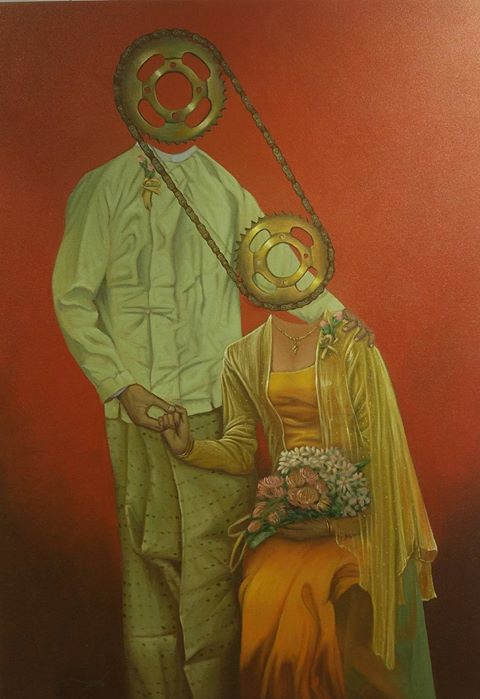
In his "Unknown Rope, Marriage Knot," young surrealist Ye Min put chains in the place of the heads of a bridegroom and bride.

Artist Than Htay used only black and green colors in his abstract painting. "In this painting, I've reduced colors and focused on speed."

"Wild Eye" is a regular art exhibition held since the 1970s by modernists. The exhibition will be held through Sunday and paintings are available for prices between US$500 and $5,000.

The works of Kin Maung Yin, Win Pe, Aung Myint, San Min, Ye Min, Ohn Khaing Zin, K2K are more are on display at the exhibition.

The post Veteran Artists Team Up with Younger Generation at 'Wild Eye' Exhibition appeared first on The Irrawaddy.

China Complicit in Blocking Aid to Kachin Refugees: Report

Posted: 04 Sep 2018 02:52 AM PDT

YANGON — A rights group's report has claimed Chinese involvement in the Myanmar government's blocking of humanitarian assistance to war refugees on the Myanmar-China border where government troops and Kachin armed groups have been fighting.

"China made their position particularly explicit that humanitarian aid organizations should not be provided access to displaced populations on the Myanmar-China border, equating these organizations with 'western' powers—namely the United States government," a recent Fortify Rights report said.

The report said that since the previous government organized peace-talks between Myanmar's military and ethnic armed groups, Chinese representatives in the meetings reportedly insisted that aid organizations not operate on the border areas in Kachin State.

A new report "They Block Everything" based on 195 interviews in Kachin state over the last five years [2013-2018], revealed how Myanmar authorities—particularly the military—have weaponized the denial of humanitarian aid in Kachin State for years. It claims China plays a role in helping Myanmar authorities to put aid restrictions on Kachin refugees.

Since 2011, when armed conflict between the Myanmar military and the Kachin Independence Army (KIA) resumed, the Myanmar government and military restricted access for humanitarian organizations to refugees in Kachin State especially access to internally displaced persons (IDP) camps in KIA-controlled areas. An estimated 120,000 people have been displaced from their homes since 2011 due to the armed conflict in Kachin State.

There are 140 IDP camps in Kachin State and 40 percent of displaced people are living in areas controlled by the KIA and related groups.

According to the report, from June 2017 to June 2018, the government of Myanmar approved approximately five percent of 562 applications for travel authorization to government-controlled areas by international humanitarian organizations.

Since 2015, some aid workers have reported government-imposed restrictions on particular types of aid, including medical supplies. As a result of the restrictions, local humanitarian aid workers rely on suppliers in China to obtain aid for the estimated 40,000 IDPs residing on the Myanmar-China border, the report said.

The report also says all activities in China relating to the IDPs are unofficial, while transporting aid over the China border presents a high risk of being arrested by the Chinese authorities. Mostly, aid workers have to avoid checkpoints, as China has increased patrols and checks for transporting humanitarian aid to the Kachin refugees. Chinese suppliers also face risk, particularly when authorities perform surprise checks of their offices.

Mary Tawn, a director of local relief agency Wunpawng Ninghtoi (WPN) based at the China-Myanmar border told Irrawaddy, "China has seriously cautioned Kachin refugees against crossing their border. They put more restrictions on us; now we can't even legally carry soap to the IDP camps."

As patrols increase near the border, we have to make meeting points where we can receive IDP supplies. We can't carry any aid supplies legally. They don't understand that we are aid workers for refugees, she said.

"We try not to take risks in some conditions. Sometimes we have to negotiate with Chinese suppliers to send supplies [like medical aid and hygiene supplies] on their own to us," she added.

According to the report, Chinese soldiers have also forcibly returned Kachin refugees back to Myanmar since the war in Kachin State resumed in June 2011. In 2013 Chinese soldiers burned down a Kachin refugee camp called Layin in Yunnan Province.

The report said China has failed to provide protection to Kachin refugees who seek protection, food, medicine and healthcare in Yunnan Province, and Chinese border guards have committed human rights violations against Kachin refugees by forcing them back into conflict zones in Kachin State.

In 2012, China only gave three days for some 30,000 Kachin refugees to move back across the border into Kachin and Shan states, Mary Tawn said.

In December 2017, China blocked Kachin refugees who suddenly fled from intense fighting near their IDP camps from crossing the border, she said.

"Stray ammunition frequently dropped in the camps. It was an urgent need to move all the people during the fighting. After the fighting ended, they intended definitely to go back to the camps. But China didn't allow the IDPs to stay on their side even for a short time. IDPs did not dare to go back to the camps and so old people, women and children had to sit near the river [at the border] that night," she added.

The relief agency said, according to the Chinese government's policy, they are not allowed to accept Kachin refugees who flee from random fighting.

"They said when fighting happens in the [border] cities, and all the people no longer can stay… they will accept us all together," Mary Tawn said.

U Hka Li, a spokesperson for Kachin Baptist Convention, one of the largest humanitarian aid providers in Kachin State, also confirmed to The Irrawaddy that IDPs in KIA-controlled locations suffer food shortages frequently as aid supplies are not allowed to pass through China territory.

U Hka Li said, "We have to find some other ways to buy rice for the IDPs since we can't transport it legally through China."

Kachin refugees in China face exploitative treatment by employers, difficult working conditions and also forced labor by Chinese soldiers while fleeing from armed conflicts, the report said.

According to the United Nations Office for the Coordination of Humanitarian Affairs (UNOCHA) in February, Myanmar authorities restricted humanitarian access to Tanai Township where an estimated 900 people were living in four churches. The authorities also restricted humanitarian access to the Ndup Yang IDP camp in Sumprabum Township in Kachin State.

U Hka Li said that Sumprabum and Tanai camps are under restricted access since two months ago. Aid workers are still not allowed to transport supplies there, especially food.

In April and May 2018, a consortium of 19 humanitarian aid organizations called on the Myanmar authorities and military to guarantee civilians safe passage out of conflict areas, and lift restrictions on humanitarian assistance in Kachin state.

The Irrawaddy requested an interview and sent questions to the Chinese embassy in Myanmar for a response regarding China's involvement in blocking humanitarian assistance for Kachin refugees but the communication officer did not respond.

The post China Complicit in Blocking Aid to Kachin Refugees: Report appeared first on The Irrawaddy.

Yangon Animal Shelters Required to Apply for Licenses

Posted: 04 Sep 2018 02:42 AM PDT

YANGON — Animal shelters including those that shelter stray dogs are required by the new Yangon municipal law to apply for a license, according to the Yangon City Development Committee (YCDC).

"According to the municipal law enacted in 2018, shelters have to apply for licenses to operate," Dr. Hla May Oo, assistant section head of the veterinary and abattoir section of the YCDC, told The Irrawaddy.

Operating an animal shelter without permission is punishable by a fine of 100,000 to 500,000 kyats under the new municipal law. A second-time violation carries a prison sentence of up to six months.

The city municipality did not issue licenses for animal shelters before the enactment of the new municipal law, so all existing shelters and pounds will have to apply for licenses, said Dr. Hla May Oo.

Daw Shu, the founder of a pound that currently is taking care of some 400 stray dogs in Yangon's Shwe Paukkan, said she is ready to apply for a license for her shelter.

"I will pay the tax if I'm asked to do so. I don't have the heart to leave behind all these dogs," said Daw Shu, who established the pound in 2013.

Ma Zin Mar, a dog lover who makes regular donations to animal shelters, suggested that authorities make regular inspection of animal shelters to ensure they comply with rules and regulations.

"They are closely connected with the health of humans. Humans can contract diseases from them. So, [authorities] must make sure rules and regulations are obeyed at animal shelters," she said.

There have been reports on social media that some people run sham pounds and cheat money from donors.

"Though it is charity work, we must make sure the way they operate meets charity procedures," said Mingalar Taungnyunt Township lawmaker U Hla Htay of the Yangon regional Parliament, who also took part in drafting and reviewing the new municipal law.

Concerned rules and regulations are in the process of being drafted, he added.

There is only one pound for stray dogs managed by the YCDC in Yangon, which is located in Hlaingtharyar Township.

Yangon has a stray dog population of more than 120,000, said YCDC, which either sterilizes or immunizes them against rabies in four downtown townships—Lanmadaw, Pabedan, Kyauktada and Latha.

The new municipal law signed by the Yangon Region chief minister on June 28 will take effect as of October 1. Meanwhile, the YCDC is educating the public.

Translated from Burmese by Thet Ko Ko.

The post Yangon Animal Shelters Required to Apply for Licenses appeared first on The Irrawaddy.

Myanmar Army Apologizes for Mistaken Photos in Book on Rohingya Crisis

Posted: 03 Sep 2018 10:57 PM PDT

YANGON — The Myanmar military issued a rare apology on Monday, acknowledging that two photographs it published in a book on the crisis over the Rohingya Muslim minority were “published incorrectly."

Reuters published an exclusive report on Friday revealing that two of the pictures in the book that aimed at illustrating the army’s account of last year’s events in the western Myanmar state of Rakhine, were in fact archive pictures of different conflicts, and one was posted with an incorrect caption.

The erroneous publication of the photographs comes amid a series of government steps against what it has seen as media abuses, including a report on army activity in an ethnic minority guerrilla zone and the flying of a drone in the capital, Naypyitaw.

On Monday, a court jailed for seven years two reporters from Reuters on a charge of violating a secrets law.

Reuters found that two of the photographs in the military book on the Rohingya crisis were actually taken in Bangladesh and Tanzania and a third was falsely labeled as showing Rohingya entering Myanmar from Bangladesh, when in reality the picture was of refugees leaving Myanmar.

The military’s official newspaper, the Myawady Daily, issued a statement on Monday from its publishing arm, which produced the book ‘Myanmar Politics and Tatmadaw: Part I’, apologizing for two of the photographs.

“It was found that two photos were incorrectly published,” the publishing arm said in a statement carried by the newspaper, referring to the photograph from Tanzania and another showing victims of Bangladesh’s 1971 war of independence.

“We sincerely apologize to the readers and the owners of the photographs for the mistake,” it said.

It did not mention the photograph incorrectly captioned as showing Rohingya entering Myanmar when the picture was of them leaving.

Myanmar government spokesman U Zaw Htay and military spokesman Maj-Gen Tun Tun Nyi could not be reached for comment.

The army’s department of public relations and psychological warfare published the book in English and Burmese in July.

‘Heinous’

Of the 80 images in the book, most were recent pictures of army chief Min Aung Hlaing meeting foreign dignitaries or other officials visiting Rakhine.

Of eight photos presented as historical images, Reuters found the provenance of three to be faked and was unable to determine the provenance of the five others.

One faded black-and-white image shows a crowd of men who appear to be on a long march with their backs bent over. “Bengalis intruded into the country after the British Colonialism occupied the lower part of Myanmar,” the caption reads.

The photo is apparently intended to depict Rohingya arriving in Myanmar during the colonial era, which ended in 1948. Reuters determined the picture is in fact a distorted version of a color image taken in 1996 of refugees who had fled the genocide in Rwanda.

Another picture, also printed in black-and-white, shows men aboard a rickety boat. “Bengalis entered Myanmar via the watercourse,” the caption reads.

Actually, the original photo depicts Rohingya and Bangladeshi migrants leaving Myanmar in 2015, when tens of thousands fled for Thailand and Malaysia. The original has been rotated and blurred so the photo looks granular. It was sourced from Myanmar’s own Ministry of Information.

The Myawady’s publishing arm, in its statement, made no mention of any alterations of images.

The prime minister of neighboring Bangladesh, where about 700,000 Rohingya Muslims have fled from a Myanmar military crackdown launched after Rohingya insurgent attacks in August last year, denounced the use of the photographs when she was asked in a news conference about them.

“What Myanmar has done is simply heinous. They have lowered their reputation,” Bangladeshi Prime Minister Sheikh Hasina told a news conference in Dhaka on Sunday.

“They are diminishing their position in the international arena.”

The 117-page book gives the army’s account of the crackdown last year which led to reports of mass killings, rape, and arson.

Much of the content is sourced to the military’s “True News” information unit, which since the start of the crisis has distributed news giving the army’s position, mostly via Facebook.

The book is on sale at bookstores across the commercial capital of Yangon.

The post Myanmar Army Apologizes for Mistaken Photos in Book on Rohingya Crisis appeared first on The Irrawaddy.

Ten Things to Do in Yangon This Week

Posted: 03 Sep 2018 10:16 PM PDT


Big Bag

Big Bag will perform.

Sept. 8, 7:30 p.m. 369 Dine & Bar, No. 369 Laydaungkan Road. Tickets 20,000 kyats at 01-578 101.

Reggae Night

Saw Phoe Kwar will perform with One Love band.

Sept. 8, 7:30 p.m. to 11 p.m. Vintage Luxury Yacht Hotel. Tel: 09-258819933. Free admission.

Business, Marketing and Digital Transformation

Leading businesspeople and economists will provide insight into the modern business world.

Sept. 8, 8:30 a.m. to 3:30 p.m. UMFCCI, Min Ye Kyaw Swa Road. Free Admission. Registration at 09-420033366.

Wathann Film Festival

Short films will be screened starting from 10 a.m. to 6 p.m.

Sept. 5-10, Waziya Cinema. Free Admission.

Full Stop: Rap Music Contest

Sixteen of the best freestyle rappers from around the country will perform.

Sept. 8, 3 p.m. to 10 p.m. Urban Asia Center, corner of Mahabandoola Road and 48th Street. Free Admission.

Melody World Grand Finale

The grand finale of a signing contest along with performances by celebrity singers.

Sept. 7, 6:30 pm. National Theater. Free Admission.

Duo Alterno

Italian concert piano and soprano performances.

Sept. 7, 7 p.m. to 9 p.m. Melia Yangon Hotel. Free Admission.

Property Expo

Luxury apartments will be up for grabs.

Sept. 8-9, 9 a.m. to 5 p.m., YSH Aung San Sales Gallery, Registration here.

Transparent Life

Watercolor artists exhibit their works.

Sept 2-6, Lokanat Gallery, corner of Merchant Street and Pansodan Street.

To The Sea

This group art exhibition will depict rural life and customs of Myanmar.

Sept. 8-12, Hninzi Myaing Art Gallery, Hninzi Myaing Home for the Aged, Kabar Aye Pagoda Road.

The post Ten Things to Do in Yangon This Week appeared first on The Irrawaddy.

Thai King’s Yellow and Blue Volunteers Boost His Support, Visibility

Posted: 03 Sep 2018 10:04 PM PDT

BANGKOK — From a distance, the volunteers cleaning up a clogged Bangkok waterway could be mistaken for Scouts, but the group, wearing yellow foulards and blue hats, are part of a volunteer program started by Thai King Maha Vajiralongkorn, 66.

The “Volunteer Spirit” scheme, which officially began in 2017, has created a new army of civilians who have pledged allegiance to the king and are boosting the image of Vajiralongkorn ahead of his formal coronation at year-end.

Vajiralongkorn’s father, King Bhumibol Adulyadej, was revered by Thais during his seven decades on the throne and the deep relationship between the monarchy and the military helped facilitate a smooth royal transition following his death in October 2016.

Since then, the new king has brought about a major shake-up of royal affairs, and some observers have said he may be seeking to distance himself from the military, which has been in power in Thailand since a 2014 coup.

Last year, Vajiralongkorn demanded unprecedented changes to a constitutional draft endorsed by the military government. He has also taken back control of royal assets formally managed by the government.

David Streckfuss, a Thailand-based independent scholar said he saw the volunteer program as an attempt by the king to create a separate power base.

“If the monarchy is … to distinguish itself from the military and attempt to bring Thailand into a democratic constitutional monarchy, then we might look at this effort by the new monarch as creating an alternative power base,” Streckfuss told Reuters.

The palace declined comment.

Vajiralongkorn however is thought to have a good working relationship with Prime Minister Prayuth Chan-ocha, who came to power following the 2014 coup.

Thamontip Puangkitja, a 50-year-old retiree turned volunteer, said the volunteer program benefits the royal household.

“It is good for society and the revered royal institution,” Thamontip said as she picked up rubbish in Bangkok.

“I joined the program because I wanted to do good for the king,” said another volunteer, Patcharaporn Husain, 61, a housewife.

More than 4 million volunteers from all walks of life have joined the scheme, according to officials in charge. They carry out a range of tasks from cleaning public spaces to helping police to direct traffic.

Their most high-profile moment came when the volunteers joined an international rescue effort to rescue 12 boys and their soccer coach from a flooded cave last month.

“We fed about four thousand people every day at the cave,” a palace official who was involved with the rescue told Reuters.

He declined to be named.

New Tradition

Volunteers have to register with the palace and go through an initiation process that involves lining up and bowing in front of the king’s portrait before being given their yellow and blue uniforms – colors associated with former King Bhumibol and Queen Mother Sirikit, Vajiralongkorn’s mother.

Once they put on their new uniforms, the volunteers do a military-style salute to the king’s portrait and, in a completely new tradition, they must line up and salute the king’s portrait every time before starting a community activity.

Some say the program reflects the mindset of King Vajiralongkorn who sees the Victorian-era court of King Vajiravudh, also known as Rama VI, as the ideal model of kingship.

“The king wants the volunteers to be a kind of ‘Sue Pa’,” Sulak Sivaraksa, a renowned scholar who has sometimes been a critic of the monarchy, told Reuters, referring to the Wild Tiger Corps – a paramilitary force founded in 1911 by Vajiravudh that was inspired by the British Volunteer Force.

He “wants the monarchy to serve the people, to protect the people, to do well for the people,” said Sulak, 86.

The volunteer force raised by Vajiralongkorn is not armed.

Bhumibol was patron to hundreds of foundations spread across Thailand, but no such volunteer program existed during his reign.

The volunteers are able to do things that the government might otherwise not be able to, because of their royal backing, said Sulak.

“If the government asked them they wouldn’t do it,” said Sulak.

“The volunteer program is one of the great successes of the new king.”

The post Thai King's Yellow and Blue Volunteers Boost His Support, Visibility appeared first on The Irrawaddy.

Asia’s Rising Appetite for Meat, Seafood Will ‘Strain Environment’

Posted: 03 Sep 2018 09:58 PM PDT

KUALA LUMPUR — Asia’s growing appetite for meat and seafood over the next three decades will cause huge increases in greenhouse gas emissions and antibiotics used in foods, researchers said on Tuesday.

Rising population, incomes and urbanization will drive a 78 percent increase in meat and seafood demand from 2017 to 2050, according to a report by Asia Research and Engagement Pte Ltd, a Singapore-based consultancy firm.

“We wanted to highlight that, because of the large population and how fast the population is growing, it is going to put a strain on the environment,” said co-author Serena Tan.

“By recognizing this and where it comes from, we can tackle the solutions,” she told the Thomson Reuters Foundation.

With supply chains ramping up to meet demand, greenhouse gas emissions will jump from 2.9 billion tons of CO2 per year to 5.4 billion tons – the equivalent of the lifetime emissions of 95 million cars – the researchers said.

A land area the size of India will be needed for additional food production, according to the report, while water use will climb from 577 billion cubic meters per year to 1,054 billion cubic meters per year.

The use of antimicrobials – which kill or stop the growth of microorganisms, and include antibiotics – will increase 44 percent to 39,000 tons per year, said the report, which was commissioned by the Hong Kong-based ADM Capital Foundation.

Overuse and misuse of antibiotics in food is rife in Southeast Asia, the Food and Agriculture Organization (FAO) said this year, warning of serious risks for people and animals as bacterial infections become more resistant to treatment.

Growing urban areas contribute to the rising demand for meat and seafood, because people there usually have better access to electricity and refrigeration, said David Dawe, a senior economist at the FAO in Bangkok.

“But income growth is the big driver,” he added.

Indonesia, Cambodia, Laos, Myanmar and Pakistan are among nations likely to contribute most to the rise in meat and seafood consumption, while countries with ageing populations, like China, will likely limit growth, Tan said.

Food producers can increase efficiency by implementing rainwater harvesting, using sustainable animal feed and capturing biogas from cattle, Tan said.

Regulators, consumers and investors can also pressure restaurant chains and producers to limit the use of antibiotics in meat supplies, she added.

At meal times, consumers can also choose plant-based foods made to look like meats as an alternative, Tan said.

“You have a lot of people in Asia who don’t get that great a diet so animal-sourced food intake will increase,” said the FAO’s Dawe.

“In many ways it’s a good thing for nutrition, but it does raise environmental issues.”

The post Asia's Rising Appetite for Meat, Seafood Will 'Strain Environment' appeared first on The Irrawaddy.

Monday, September 3, 2018

The Irrawaddy Magazine

The Irrawaddy Magazine


The Reuters Reporters’ Sentencing, as it Unfolded in the Courtroom

Posted: 03 Sep 2018 08:46 AM PDT

YANGON — For possessing the phone number of an officer in an ethnic armed group, the itineraries of visits to Rakhine by Pope Francis and Vice President U Myint Swe, and police reports of violence in northern Rakhine State, Reuters reporters Wa Lone and Kyaw Soe Oo were convicted of violating the Official Secrets Act and sentenced to seven years' imprisonment by Yangon's Northern District Court on Monday morning.

The colonial-era Inn Sein Court Building was crowded with diplomats, reporters, activists and the accused's relatives, who were on hand to see the resolution of a case that has been closely monitored by both the international and local communities since the surprise arrest of the pair in Htauk Kyant on the outskirts of Yangon on Dec. 12, 2017. Before their arrest the pair was investigating the massacre of 10 Rohingya men in Rakhine State's Inn Din village by a group of local villagers, police and Army troops. The following month, the Army announced that seven soldiers had been sentenced to 10 years in prison with hard labor in a remote area of Myanmar for participating in the mass killing.

The killings happened during the military's month-long clearance operations of Rakhine State's Rohingya communities following militant attacks on security outposts. The United Nations says the military crackdown has sent nearly 700,000 people fleeing to Bangladesh.

Since their arrests, the two journalists have appeared at numerous trial hearings. This Irrawaddy reporter was allowed to witness the handing down of the verdict in a 50-foot-wide courtroom with a CCTV camera mounted in each corner. As the session began, Northern District Court Associate Judge U Ye Lwin entered the room, then read submissions from the prosecutor and defense lawyers, statements from suspects Wa Lone and Kyaw Soe Oo, and the findings of the Criminal Investigation Department (CID). This took one-and-a-half hours.

The judge said CID officers had found on the reporters' mobile phones the travel itinerary and security deployment information relating to Pope Francis' visit in November 2017, and the travel itinerary for Vice President U Myint Swe's trip in August 2017. He said both of these were considered top secret documents.

Defense lawyers had earlier claimed that reports of the violence in northern Rakhine State and the itineraries of the pope and the vice president were not secrets as they had already been published in newspapers. The judge announced that this argument was invalid because the newspapers only carried brief announcements the visit of the vice president to northern Rakhine. He also said the classified documents of security forces referring to security reinforcements, causality reports and arson attacks in northern Rakhine’s Maungdaw Township that were found on the reporters' mobile phones had not been published in newspapers.

Police Captain Moe Yan Naing, who was a key witness in the case, earlier testified that his superior officer Brigadier General Tin Ko Ko ordered him and his colleagues to arrest the reporters and charge them with violating the Official Secrets Act, but the prosecutor declared him a hostile witness and abruptly sentenced him to one year in prison for violating police discipline.

Judge U Ye Lwin cited the News Media Law's Article (6) (a), drafted by former information minister U Ye Htut. It states that journalists can request documents from authorities with the exception of orders or instruction letters containing information on security matters, including statistics, photographs and records. He also cited the Media Code of Conduct's section (3) (b), which deals with the way media professionals handle sensitive information.

He said the classified documents from security forces found in their possession and on their mobile phones showed that the two suspects had violated both the News Media Law and Code of Conduct repeatedly. He said it also had to be taken into consideration that the content of the documents was related to security matters and could be useful, either indirectly or directly, to insurgent groups.

"The suspects did not act as ordinary journalists; they acted together with the intent of harming the interest of the state or state security," U Ye Lwin said.

He concluded that these facts, as well as the attitudes of the suspects and the submissions of the prosecutor constituted sufficient evidence that the suspects breached the Official Secrets Act's Article 3 (1) (c). He sentenced them to seven years' imprisonment for violating the Act, adding that their time in detention so far would count towards their sentence.

Myanmar Press Council (MPC) member U Myint Kyaw pointed out that Article (6) of the News Media Law enshrines the rights — rather than the restrictions or potential legal punishments — of media organizations, and suggested that perhaps the judge had interpreted the law as he wished. While acknowledging that he is not a legal expert, U Myint Kyaw said that inappropriately citing the News Media Law and Media Code of Conduct while sentencing the Reuters reporters was "dishonest".

U Myint Kyaw said, "Some lawyers say there might be a danger of classified [documents] falling into enemy hands if the arrest occurred in an armed conflict situation," as opposed to being arrested in Yangon, as the Reuters reporters were.

Within a few seconds of the announcement, police led the convicted pair away in handcuffs. As they did, the mother of Kyaw Soe Oo wept in the courtroom.

Wa Lone raised his hands and told his Reuters colleagues in the courtroom: "It's OK. You know what we did. I have no feeling [about this conviction]… I believe in justice and democracy."

Before he and Kyaw Soe Oo were escorted to Inn Sein Prison, he cried out, "We were unfairly treated" and "We are sentenced now for having the phone number of [Arakan Army (AA) official] Ko Nyo Tun Aung. And we are jailed for possessing the travel itinerary of vice president U Myint Swe [to northern Rakhine]. Is this fair for us? This is directly threatening and violating the freedom of the press in Myanmar as well as the democratic system."

AA Vice Chief of Staff Nyo Tun Aung could not be reached for comment for this article by press time on Monday.

Defense lawyer U Than Zaw Aung told reporters that the defense consistently told the judge that a map related to Pope Francis' trip in the reporters' possession was not an official document issued by the Myanmar government; in fact, it was downloaded from a German website. Moreover, details of the trip of the vice president to northern Rakhine State could easily be f0und on social media. However, the judge even included these points in his conclusions and cited them in his decision to imprison the pair for 7 years, the lawyer said.

Defense lawyers said they would appeal the decision to a higher court.

“We are total disappointed with today's conviction. This conviction shows that we are in a bad condition, despite the appearance that the country is heading for a functioning democratic system, freedom of expression and rule of law," U Than Zaw Aung said.

Criticizing the judge's citing of the Media Law and Code of Conduct in his conclusion, Myanmar Press Council (MPC) member U Myint Kyaw said that maintaining secret information is the responsibility of official organizations; being found in possession of these documents should not be a problem, he said. If a media organization publishes the information, the relevant ministry can complain about the report if it finds a factual problem.

U Myint Kyaw said the case was "apparently a trap" set by police, pointing to the fact that the documents were given to the reporters by police, who then arrested the pair immediately. Moreover, he pointed out that simply finding out the phone number of a top AA leader and the travel itinerary of Pope Francis should never be considered possession of state secrets.

"If they really label such kind of information as top secret, then more than 100 journalists could be arrested. This is nonsense. If they want to do so, they can put us all behind bars."

The post The Reuters Reporters' Sentencing, as it Unfolded in the Courtroom appeared first on The Irrawaddy.

On the Wrong Side of the Law, but On the Right Side of Truth

Posted: 03 Sep 2018 06:18 AM PDT

Myanmar's media community was hit by a powerful blow this morning. Its professionals feel sad, disappointed and under siege. Today's events have also damaged the image of the country and the integrity of the government.

On Monday morning, two Reuters reporters, Ko Wa Lone and Ko Kyaw Soe Oo, were sentenced to seven years' imprisonment for violating the Official Secrets Act. The two reporters found themselves under arrest on Dec. 12 after gathering information on the killing of 10 Rohingya Muslims in Inn Din village in Rakhine State's Maungdaw Township during a clearance operation by security forces last year.

Many people have believed since the start that the case filed by police officials was a set-up, as suggested by U Win Htein, a leading member of the ruling National League for Democracy (NLD), right after the arrest of the two reporters. Other NLD members and lawmakers agreed, believing that the journalists were just doing their jobs.

At a hearing in April, even a prosecution witness, Police Captain Moe Yan Naing, told the court that the two journalists were targeted in a police plan to entrap them by offering them "secret documents". The officer alleged that Pol. Brigadier-General Tin Ko Ko threatened police officials who failed to take steps to entrap the two reporters.

He told the court that Pol. Brig-Gen. Tin Ko Ko's actions were "unethical and damaged the integrity of the country on the international stage." However, the allegation was never investigated.

We know the case was handled by the police department, which is under the authority of the Home Affairs Ministry — one of three ministries controlled by the commander-in-chief of the military. We know that Myanmar's legal code remains clogged with many oppressive and outdated laws, like the Official Secrets Act, which dates back to the British colonial era, that are in need of repeal or amendment. We also know that the independence of the country's judicial system is very much in question — a legacy of previous authoritarian regimes. And we know that the attorney general is an ex-military official.

Together with media professionals, diplomats and various democratic institutions, however, we believe that the NLD-led government, which was elected by a majority of the people, should have done something to stand on the side of truth and justice. The government leaders, especially President U Win Myint and State Counselor Daw Aung San Suu Kyi, should understand how badly this arbitrary prosecution under their government could damage the country's image and democratic principles.

As a result, the international community, democratic institutions and media organizations have even less confidence than before in the government and its de facto leader, Daw Aung San Suu Kyi. Embassies including those of the U.S., the Netherlands, the U.K. and others have condemned the court's decision and urged the government to immediately release the two reporters.

President U Win Myint, since he took office in March, has underscored the role of the media in the country's democratic transition. In his inaugural speech on March 30, he said, "I wish to urge the media sector, which serves as the ears and eyes of the public, to understand the seriousness of their duties and to hold in high regard the public sector that they serve." But in this important case, which is pivotal for democracy, the president was nowhere to be seen.

Even if they received ambiguous information from their subordinates, there is no reason for the government's senior leaders, especially President U Win Myint and Daw Aung San Suu Kyi, to be confused about this case.

They must understand that this is case is purely about people's right to know. There is nothing wrong in what these particular Reuters reporters did; like any journalists they were simply doing their jobs by attempting to gather information so as to uncover the truth for the public.

I remember reading Daw Aung San Suu Kyi's comments in the book The Voice of Hope, a compilation of interviews with her after her release from her first house arrest in 1995: "Truth is a powerful weapon. And truth—like anything that is powerful—can be frightening or reassuring, depending on which side you are on." She added, "If you're on the side of truth, it's very reassuring—you have its protection."

Sadly, however, those who are now on the side of the truth don't have its protection under her government. This is deeply discouraging, and the blow against the reporters this morning also indicates that the few democratic gains our country has made are being rolled back.

We cannot sit idly by and allow this disgraceful return to the past. We journalists are determined to continue carrying out our mission. Meanwhile, the government must do its part.

The post On the Wrong Side of the Law, but On the Right Side of Truth appeared first on The Irrawaddy.

‘A Hammer Blow for the Rule of Law’

Posted: 03 Sep 2018 05:26 AM PDT

YANGON— The jailing on Monday of two Reuters reporters for seven years for breaching the outdated British colonial-era Official Secrets Act has been met with deep disappointment and condemned as a blow to the country's justice system, press freedom and democratic transition.

The two journalists, Ko Wa Lone and Ko Kyaw Soe Oo, had been detained for nine months since their arrest on Dec. 12 while investigating the killing of Rohingya Muslims in a village in Rakhine State.

Right groups, press freedom advocates, the United Nations, the European Union and countries including the US, UK, Denmark and Australia called for the immediate release of the two and an end to the arbitrary prosecution of journalists for doing their jobs.

Here are some reactions to the sentencing:

US Ambassador to Myanmar Scot Marciel at Yangon’s Northern District Court before the verdict was announced on Monday in the case of two Reuters journalists. / Myo Min Soe / The Irrawaddy

Scot Marciel, U.S. ambassador to Myanmar

"I am sad for Wa ‎Lone, Kyaw Soe Oo, and their families, but also for Myanmar. It is deeply troubling for everybody who struggles so hard for media freedom here. One has to ask if this process will increase or decrease the confidence that people here have in their justice system."

The Embassy of Denmark in Myanmar

"This is a tragedy for them and an injustice carried out under a government which came to office based on a strong commitment to rule of law. What we have seen today is not rule of law. The Official Secrets Act violates the right to freedom of expression, a right which many members of government and Parliament fought and went to prison for under the military regime.

"Instead of being celebrated for their efforts to expose the conduct of Myanmar's military, Wa Lone and Kyaw Soe Oo have now been found guilty in spite of the lack of evidence to support the prosecutor's claims.

"The Embassy of Denmark calls on the government of Myanmar to undo this injustice, release Wa Lone and Kyaw Soe Oo immediately and launch an investigation into allegations that they were set up by Myanmar's police force." (from a statement)

Dan Chugg, British Ambassador to Myanmar

“Speaking on behalf of the British Government and EU member states, we are extremely disappointed with this verdict and sentencing. This case has cast a long shadow over freedom of expression and the rule of law in Myanmar. In any democracy, journalists must be free to carry out their jobs without fear or intimidation; this verdict has undermined freedom of the media in Myanmar. The verdict has also struck a hammer blow for the rule of law. We have attended the trial throughout and we believe that the judge has ignored the evidence presented to him as well as ruling against Myanmar's own laws. This is a bad day for Myanmar and we call for the journalists to be released immediately." (from a statement)

The Embassy of Netherlands in Myanmar

"The Embassy of the Kingdom of the Netherlands regrets the conviction of Wa Lone and Kyaw Soe Oo and will continue to urge the government to use the means at its disposal to ensure their immediate release. This was not only a verdict to two individuals, but also a milestone verdict on the credibility of Myanmar's press freedom." ( from a statement)

Bertil Lintner in Yangon during his visit to The Irrawaddy office in 2013. / The Irrawaddy

Bertil Lintner, veteran journalist and Myanmar analyst

"It's a sad day for press freedom in Burma but, at the same time, I want to encourage Burma's many brave and good journalists to carry on their important job. Without them, there would be a great void that cannot be filled by foreign reporters."

Nicholas Coppel, Australia Ambassador to Myanmar

"Australia has watched this case very closely. Embassy staff have attended all the hearings and heard the evidence, including conflicting evidence presented by prosecution witnesses. We were therefore disappointed to hear that the journalists were found guilty.

"An independent media and an independent judiciary are both vital parts of a well-functioning democracy. Myanmar's democratic transition is not complete. Myanmar needs a strong and functioning justice system, and greater media freedom." (from a statement)

Johan Hallenborg, Minister Counsellor to Myanmar, Embassy of Sweden

“EU member states are deeply concerned about what happened today. We believe that the two journalists were merely doing their work. They shouldn’t have been put to trial in the first place.”

Former AP Correspondent Daw Aye Aye Win / The Irrawaddy

Daw Aye Aye Win, former AP correspondent

"This has confirmed that there is no press freedom in Myanmar. This Reuters case is proof of it.

"And the handing down of a long sentence will have a very negative impact upon the dignity of the government. It seems that the government does not consider [press freedom] as builder of democracy. This is the complete reverse of democratization. It is very disappointing.

"When reporters are punished for doing their job, it serves as a warning to all journalists. This will forcibly divide journalists into two groups. One will exercise extra caution [about what they write], and the other will continue writing despite the harmful consequences. [The sentencing of the two reporters] seriously threatens press freedom. Journalists will exercise more caution. As they practice self-censorship out of fear of possible retribution, this will significantly impact their reporting. I'm disappointed that the government led by [State Counselor] Daw Aung San Suu Kyi is stepping into a dark era."

U Aung Hla Tun, deputy information minister

"I feel a little sorry for them, as I once worked as a journalist. But there is still hope for them. This is not the end. They still have a chance according to the law. They can appeal to the higher courts. I pray for them. That's all I can say.

"There are laws that restrict press freedom. I recognize this fact. Those laws have been in force for years, but they are being reviewed now. On the other hand, journalists have to follow ethics. This is very important. And they must also have professional skills.

"Overall, [the press] should have patience. [Reform of these outdated laws] will not take place immediately. [Journalists] should also regulate themselves. Self-regulation is essential. I don't mean self-censorship. Self-censorship comes from fear [of possible retribution]. Self-regulation comes from self-awareness and morality.

"[Journalists] should know what they can and cannot do, aside from any possible legal repercussions. They should know the law. There is nothing to be afraid of. They [journalists] have to do their job. But they must be professional and ethical."

Stephen J. Adler, Reuters president and editor-in-chief

"Today is a sad day for Myanmar, Reuters journalists Wa Lone and Kyaw Soe Oo, and the press everywhere. These two admirable reporters have already spent nearly nine months in prison on false charges designed to silence their reporting and intimidate the press. Without any evidence of wrongdoing and in the face of compelling evidence of a police set-up, today's ruling condemns them to the continued loss of their freedom and condones the misconduct of security forces. This is a major step backward in Myanmar's transition to democracy, cannot be squared with the rule of law or freedom of speech, and must be corrected by the Myanmar government as a matter of urgency. We will not wait while Wa Lone and Kyaw Soe Oo suffer this injustice and will evaluate how to proceed in the coming days, including whether to seek relief in an international forum." (from a statement)

Ko Than Zaw Aung, defense lawyer

"It is very disappointing. This shows the critical situation facing democracy, freedom of expression and the rule of law in Myanmar, which is said to be undergoing democratization. We'll do whatever we can [to secure] the release of the two reporters."

U Sein Win, Myanmar Journalism Institute training director

"A guilty verdict without strong evidence is quite disappointing. The prosecution witness testified that the case was a set-up. It couldn't be any clearer.

"But the sentencing of the two shows that our judicial system is severely paralyzed. The message of the verdict is that, 'You should not seek the truth. Press freedom is not important. And you can be safe only by currying favor with those in power. Anything done by those in power is right.'

"You can't ignore the truth in building a country. If a murder is treated as a state secret in a country, you may realize what type of people the leaders of that country are. Aren't we going to do anything to correct the way the country is being built?"

Myanmar Press Council member-elect Ko Thalun Zaung Htet at a march on Saturday in Yangon in which people showed solidarity for jailed Reuters journalists Ko Wa Lone and Ko Kyaw Soe Oo. / MPA

Ko Thalun Zaung Htet, Myanmar Press Council member-elect

"This indicates that democracy is doomed and there is no press freedom in Myanmar, and that the NLD [National League for Democracy] has become authoritarian. Soon, we journalists will take to the streets."

Foreign Correspondents Club of Myanmar

"The Foreign Correspondents Club of Myanmar is gravely dismayed and condemns in the strongest possible terms the sentencing of two award-winning Reuters journalists to a staggering seven years in prison."

"The conviction and harsh sentence strike a blow to the journalistic profession and pose a grave threat to press freedom in Myanmar.

"We, the FCCM, would like to reiterate our call for the immediate release of Wa Lone and Kyaw Soe Oo and also call for an impartial review of the case on appeal.

"We further urge the government to ensure that journalists are allowed to carry out their profession without fear of harassment and intimidation." (from a statement)

Assistance Association for Political Prisoners

"The case raises real concerns regarding the impartiality of the judicial system in Burma. Both parliaments must review the Official Secrets Act, and make sure that the law should not be applied to journalists. The application of such law to journalists should be condemned and action taken to ensure what happened with Wa Lone and Kyaw Soe Oo cannot happen again.
Journalism is not a crime. This case is another worrying back step for freedom of expression and press freedoms in Burma. There is a need for fair and free reporting, [but] such reporting has become incredibly dangerous in the shrinking space available for freedom of expression within Burma. The government must protect such … investigative journalism and ensure journalists do not get arrested for doing their jobs.
"Burma needs a free and fair media. Wa Lone and Kyaw Soe Oo need to be released and returned to their families. Today is a dark day for freedom of expression in Burma." (from a statement)

U Ye Naing Moe, founding director of Yangon Journalism School (Photo: Yangon Journalism School/ Facebook)

U Ye Naing Moe, founding director of Yangon Journalism School

"The sentencing of the two Reuters reporters shows that this society is going in the wrong direction. To imprison two journalists is the very opposite of building democracy. Democracy needs an ecosystem to thrive in, and journalists are a necessary part of that ecosystem.

"There must be a free and independent judicial system in society for journalists to be able to do their job. Without judicial independence, how can journalists have the courage to risk their lives to make investigative reports? The imprisonment of the two reporters has called judicial independence into question.

"Every journalist who hears about this morning's sentence of seven years' imprisonment will now be placed under considerable pressure [making it difficult] to conduct investigative journalism to serve the people with good intentions. Without judicial independence that guarantees the freedom of journalists, it is very hard to conduct investigative journalism. This creates a chilling effect and spreads fear. Frankly, it is a threat to journalists to step back."

Brad Adams, Asia director at Human Rights Watch

"The outrageous convictions of the Reuters journalists show Myanmar courts' willingness to muzzle those reporting on military atrocities. These sentences mark a new low for press freedom and further backsliding on rights under [State Counselor Daw] Aung San Suu Kyi's government.

"Myanmar's leadership should immediately quash the verdicts and release Wa Lone and Kyaw Soe Oo." (from a statement)

Federica Mogherini, spokesperson of the EU High Representative for Foreign Affairs and Security Policy  

"Today's court decision to sentence Reuters reporters Wa Lone and Kyaw Soe Oo to seven years of imprisonment undermines the freedom of the media, the public's right to information and the development of the rule of law in Myanmar.

"Their sentencing and imprisonment under the Official Secrets Act of 1923 for covering allegations of serious human rights violations in Rakhine State also serve to intimidate other journalists who will fear harassment and undue arrest or prosecution for merely doing their jobs.

"We therefore reiterate our expectation that the authorities ensure adequate conditions for journalists to carry out their work. The prison sentences of Wa Lone and Kyaw Soe Oo should be reviewed and the two journalists be released immediately and unconditionally." (from a statement)

The post 'A Hammer Blow for the Rule of Law' appeared first on The Irrawaddy.

Ways Ahead in the Peace Process?

Posted: 03 Sep 2018 05:16 AM PDT

Between Aug. 30 and Sept. 1, the Myanmar Army (44th Division, 1st and 2nd Battalion) launched attacks in Dwe Lo Township in the Karen National Union (KNU)'s Papun District (Brigade 5), forcing more than 200 civilians to flee. These machine-gun and mortar attacks followed similar Tatmadaw (Myanmar military) ceasefire violations in the Ler Mu Plaw area between March and June, in which 2,500 villagers were displaced.

‘The Tatmadaw seems determined to take control of the last remaining KNU-controlled areas "in a campaign of a thousand cuts". This is despite the fact that the KNU signed a bilateral ceasefire with the government in January 2012, and was the leading Ethnic Armed Organization (EAO) to sign the Nationwide Ceasefire Agreement (NCA) in October 2015.

Elsewhere, the militarized state is also pushing into previously autonomous ethnic nationality-populated areas, for example through road-building projects. For now, across most of southeast Myanmar various ceasefires are still holding, and a tenuous negative peace allows villagers to begin rebuilding their lives after decades of conflict. However, in the Papun hills, state-directed violence has increased since the present government took office in 2016. Unsurprisingly therefore, many Karen and other ethnic nationality stakeholders are deeply skeptical about the peace process and fear that widespread fighting may break out again.

The KNU and Karen activist and aid groups are alert to the possibility of further Tatmadaw incursions. This year, Tatmadaw attacks on KNU positions and civilians in Papun District have been by assiduously documented, followed by the speedy publication of hard-hitting advocacy statements. This proactive strategy ensures that Tatmadaw aggression will be costly for the military politically, at a time when the Tatmadaw is under international pressure because of abuses committed against the Rohingya in Rakhine State, and against other civilians in the Kachin conflict.

However, such humanitarian advocacy and activism can only go so far. Salvaging a failing peace process also requires clear political strategy from EAOs and political parties.

Daw Aung San Suu Kyi and her advisers reportedly plan to hold one or two more Union Peace Conferences, and then declare the “21st Century Panglong Process” finished. The resulting (so-called) Union Peace Accord would go to Parliament and form the background to election campaigns in 2020. Despite the NLD's reduced popularity among ethnic communities and urban-based political elites, and in the western and international community, the NLD will probably win the next elections.

Once the Union Peace Accord is completed, the Tatmadaw would likely call more strongly for EAOs to disarm and demobilize. This would be virtually impossible for the main EAOs to accept.

Unlike the U Thein Sein government, which invested significant energy and political capital in trust building, the NLD government seems not to regard EAOs as legitimate political actors. Aung San Suu Kyi and colleagues see political legitimacy as a product of participation in elections; in contrast, most EAOs derive their legitimacy from the long years of armed struggle. Although not universally popular among the country's ethnic nationality citizens, the major EAOs do nevertheless enjoy significant support among the communities they seek to represent.

The NLD government inherited a peace process framed by the NCA and seems determined to see this through—not least because that is what the Tatmadaw wants. Therefore, the government (and presumably the Tatmadaw) need NCA-signatories and other EAOs to support the “21st Century Panglong Process”. For the EAOs, pulling out would be a high-risk move, exposing them to accusations of sabotaging the peace process. However, NCA-signatory groups should be getting more out of the process. The principles agreed so far in the last two UPCs are very weak, and do little to address ethnic grievances and self-determination goals. Key stakeholders have agreed on the need to re-negotiate the 'Framework for Political Dialogue', with an ambitious plan to achieve federalism and security sector reform by 2030. However, given limited interest on the government or the Tatmadaw side, any renegotiation could end up with another messy and complex framework, which doesn’t really work (or benefits the government and military, which is almost the same thing).

Therefore, it could be useful to identify a small number of political priorities, which would help to deliver on some of the ethnic stakeholders' key aims. These could be negotiated by EAOs and political parties in a “fast-track” manner, in exchange for continuing to participate in political dialogue, resulting in a Union Peace Accord which could benefit the government and ethnic stakeholders.

Another area for possible progress is "Interim Arrangements", as defined in Article 25 of the NCA. Myanmar's main EAOs (both NCA signatories and non-signatory groups) control sometimes extensive territory and deliver services to civilian populations, often in partnership with CSOs. In these areas, EAOs constitute the local government and generally enjoy more legitimacy locally than the Naypyitaw government or Tatmadaw, which are often considered alien, violent and predatory forces. EAOs' service delivery and governance functions should be supported, because these are often the only state-like entities providing public goods to vulnerable communities on the ground, in remote and conflict-affected areas. However, the government does not seem to recognize EAOs as governance actors, instead engaging with them underground merely as service providers (similar to CSOs), and/or as private businesses. This contradicts the NCA and undermines the possibility of peace-building efforts that could transform political and economic structures that have driven ethnic violence in Myanmar for decades. Supporting Interim Arrangements could be a key element in building 'federalism from below' in Myanmar.

If EAOs are to continue participating in the 21st Century Panglong Process, they should demand concrete progress on key issues. Benchmarks or indicators would need to be established, and should be kept simple. Areas for possible progress could be education and language policy (recognition of and funding for EAOs' extensive school systems; 'mother tongue' teaching in government schools); land issues (recognition of land title documents provided by EAOs; revision of unjust existing land laws; compensation and restitution for people who have had their land unfairly taken); and equitable natural resource management. Furthermore, EAOs should demand that the government and Tatmadaw respect Interim Arrangements as previously agreed in the NCA.

None of the above would prevent other ethnic stakeholders from continuing to campaign for federalism, including changes to the 2008 Constitution. In parallel, they could aim for some short-term political objectives, which could build trust and momentum in the peace process. These “peace dividends” would help ethnic communities, and also reinforce faltering local support for EAOs; in exchange, the government might be able to deliver a credible peace process. Otherwise, NCA-signatory groups should seriously consider withdrawing from a failing political dialogue.

Ashley South is a Research Fellow at Chiang Mai University, Center for Ethnic Studies and Development. (See www.AshleySouth.co.uk)

The post Ways Ahead in the Peace Process? appeared first on The Irrawaddy.

Ma Ba Tha Changes Name, Still Officially Illegal

Posted: 03 Sep 2018 04:36 AM PDT

NAYPYITAW — The Buddha Dhamma Charity Foundation, formerly called the Association for Protection of Race and Religion, which was better known by its Burmese acronym Ma Ba Tha, will fade away without government intervention, said Union religious affairs minister U Aung Ko, reaffirming its illegitimacy.

"Despite the name change, the illegal organization remains illegal," the minister told reporters at the Upper House on Friday.

Ma Ba Tha was born in 2012 out of the 969 movement, a nationalist campaign that called for the boycott of Muslim-owned businesses. In 2013, 969 members rebranded the group as the Association for Protection of Race and Religion, which came to be better known as Ma Ba Tha.

The nationalist group was successful in advocating former president U Thein Sein to approve a controversial set of four laws on race and religion that imposed restrictions on interfaith marriage, birth spacing, polygamy and conversion, believed to be targeted at Muslims.

The row between Ma Ba Tha and the National League for Democracy (NLD) government erupted when Yangon Region Chief Minister U Phyo Min Thein described the group as "unnecessary" while addressing a gathering of Myanmar residents in Singapore in June 2016.

Later the state-backed cleric organization Ma Ha Na announced that Ma Ba Tha was an unlawful organization and in May 2017, it banned the group from operating under its current name and ordered that its signboards be taken down across the country by July 15 of last year.

Since then, Ma Ba Tha has rebranded itself as the Buddha Dhamma Charity Foundation. However, some Ma Ba Tha chapters in Mandalay and Karen State's Hpa-an refused to take down their signboards and still operate under the name "Ma Ba Tha."

U Aung Ko said he has no plan to forcibly take down the Ma Ba Tha signboards in Mandalay and Hpa-an, saying that unlawful organizations that do not win public support will fade away over time.

He also criticized a rally of Buddhist nationalists in Yangon in the second week of August against Ma Ha Na's order to the Buddha Dhamma Charity Foundation to take down its signs within 45 days.

"They held the rally because there are no supporters or there are only a few supporters," said U Aung Ko.

Ashin Sopaka, the foundation's spokesperson, told The Irrawaddy: "Our association will never fade away. We will continue working for our race and religion like we are doing now."

The association is working in line with the law, and therefore, nothing can be done to it, said the monk.

"I have nothing to say if the foundation is formed with good intentions and it does not incite racial or religious hatred," said U Thant Zin Tun, NLD lawmaker of Naypyitaw Union Territory's Dekkhinathiri Township.

Translated from Burmese by Thet Ko Ko.

The post Ma Ba Tha Changes Name, Still Officially Illegal appeared first on The Irrawaddy.

Legal Aid Center Opens in Naypyitaw

Posted: 03 Sep 2018 04:03 AM PDT

NAYPYITAW — A legal aid center opened in administrative capital Naypyitaw's Pobbathiri Township on Saturday.

The justice center is the sixth of its kind in Myanmar, implemented as part of the My Justice Program, funded by the European Union in partnership with International Bridges to Justice (IBJ).

The centers offer free legal services to anyone who's been charged with a crime and can't afford to hire a lawyer, anyone who is under the age of 18, minorities, and those who are disabled or discriminated against, according to the non-governmental legal aid group.

"This center is intended to assist the poor, as Dekkhinathiri District court is close to it," said Jim Taylor of the IBJ.

So far, justice centers have been opened in Mandalay, Shan State's Taunggyi and Kalaw, Bago's Toungoo and Karen State's Hpa-an.

Since before its official opening, the center provided legal advice for defendants in 23 cases including rape, drug, murder and robbery cases, said Daw Wint Wint Aye, an official with the center.

"If those charged with crimes are too poor to hire a lawyer, they can ask for our help. We will assist them for free," she said.

Justice centers aim to improve access to justice and legal aid for the poor and vulnerable, develop the legal capacity of justice sector professionals and strengthen selected rule of law institutions to better fulfill their mandates, according to the IBJ.

According to the justice center, anyone whose monthly income is less than 120,000 kyats is eligible for services. And the monthly income of the family members of the defendants must also be less than 120,000 kyats per month in order to receive assistance from the legal aid group.

"They only provide legal services for defendants, and not plaintiffs. Their intentions are good," said Naypyitaw-based lawyer U Khin Maung Zaw.

Translated from Burmese by Thet Ko Ko.

The post Legal Aid Center Opens in Naypyitaw appeared first on The Irrawaddy.

Koh Tao Murder Convicts Living in Fear After Thailand Resumes Executions

Posted: 03 Sep 2018 03:58 AM PDT

MON STATE — Two Myanmar migrant workers sentenced to death by a Thai court for the murder of two British backpackers are living in constant fear after Thailand resumed executing death row prisoners earlier this year, the head of an NGO assisting migrant workers said.

Win Zaw Htun and Zaw Lin were detained in 2014 by Thai police for the murder of a British couple on Koh Tao island, and for raping the woman. They were sentenced to death in May 2016 despite their claims that Thai police coerced their confessions. They are currently detained in Bangkok's Bang Kwang Prison awaiting the result of their final appeal.

According to U Sein Htay, the director of the Migrant Workers Rights Network (MWRN), Zaw Lin has been under a lot of stress and constantly worried about the possibility of being executed since June, when Thailand put to death its first prisoner in nearly a decade. To make matters worse, Zaw Lin has been held in solitary confinement for more than a month after a fight with a prisoner.

"They are really scared by what they have seen in prison. Especially Zaw Lin, who is in solitary confinement and is left alone with his thoughts; he is really frightened [of being executed]," he said.

U Sein Htay and his team visited Win Zaw Htun and Zaw Lin in prison on Aug. 22. At first, prison authorities told them they would only be allowed to speak via a video call. However, after repeated requests from the team, the authorities allowed them to meet in person. U Sein Htay said both men told him they fear execution.

The NGO director added that Zaw Lin asked him to inform the Myanmar Embassy in Bangkok that he was being held in solitary confinement beyond the one-month punishment period. He said he was being punished for fighting a Thai prisoner who repeatedly cursed his mother.

"He requested that the Myanmar Embassy talk to the Thai prison authorities about transferring him back to a normal cell," U Sein Htay said.

The MWRN sent a letter to the Myanmar Embassy conveying Zaw Lin's request, U Sein Htay said.

An official from the Myanmar Embassy usually visits Zaw Lin and Win Zaw Htun every 90-120 days, but no visits have been made since Zaw Lin's solitary confinement began.

Zaw Lin also requested urgent support from a team from the Lawyer's Council of Thailand (LCT) that has been assisting the two migrant workers' defense in the Koh Tao murder case, asking them to liaise with the Myanmar Embassy to ensure his immediate release from what he claims is his unfair and unlawfully extended solitary confinement.

Andy Hall, international advisers to MWRN and the LCT's Koh Tao case legal defense team also wrote a letter to the Myanmar Embassy asking it to provide consular assistance to Zaw Lin.

The defense team for the two convicts—comprising members of the LCT and members of labor-rights NGOs—submitted a 319-page appeal to Thailand's Supreme Court in August 2017.

U Sein Htay said the defense team is still waiting for the Supreme Court to rule on the appeal.

The post Koh Tao Murder Convicts Living in Fear After Thailand Resumes Executions appeared first on The Irrawaddy.

Reuters Case Timeline

Posted: 03 Sep 2018 03:37 AM PDT

On Monday, the verdict on the case of two Reuters journalists, Ko Wa Lone and Ko Kyaw Soe Oo, was given at Yangon's Northern District Court. After almost nine months of being shuffled back and forth between prison and the courtroom, the pair was found guilty of violating the colonial-era Official Secrets Act and each sentenced to seven years' imprisonment. The Irrawaddy looks back at the major developments in the case since they were arrested on Dec. 12.

Dec. 12, 2017: Two Reuters journalists, Ko Wa Lone and Ko Kyaw Soe Oo, are arrested in northern Yangon at around 9 p.m.

Dec. 12, 2017: At around 10 p.m., northern district police chief Lt-Col Yu Naing seeks permission from the President's Office to prosecute the journalists under the Official Secrets Act.

Dec. 13, 2017: Acting President U Myint Swe grants Lt-Col Yu Naing authority to prosecute Ko Wa Lone and Ko Kyaw Soe Oo under the Official Secrets Act. The same day, the two journalists are sent to the Aung Tha Pyae Interrogation Center. They are to remain there until Dec. 26.

Dec. 14, 2017: The government announces the arrest in state-run newspapers, saying the two journalists will be prosecuted for violating the Official Secrets Act for possessing important and secret government documents relating to Rakhine State and security forces. The Information Ministry says they had "illegally acquired information with the intention to share it with foreign media." The announcement says the two police officers, Capt. Moe Yan Naing and Sgt. Khin Maung Lin, will be charged with the Official Secrets Act and the Police Disciplinary Act for their interaction with the journalists.

Dec. 27, 2017: The two journalists are brought to court for the first time to have their detention for interrogation extended by another 14 days and to allow them to meet their families and a lawyer.

Jan. 8, 2018: Home Affairs Minister Lt-Gen Kyaw Swe approves an order to prosecute the journalists under Article 3 (1) ( c ) of the Official Secrets Act. The article says: "If any person for any purpose prejudicial to the safety or interests of the State…obtains, collects, records or publishes or communicates to any other person any secret official code or password, or any sketch, plan, model, article or note or other document or information which is calculated to be or might be or is intended to be, directly or indirectly, useful to an enemy; he shall be punishable with imprisonment for a term which may extend, where the offence is committed in relation to any work of defense, arsenal, naval, military or air force establishment or station, mine, minefield, factory, dockyard, camp, ship or aircraft or otherwise in relation to the naval, military or air force affairs of [the State] or in relation to any secret official code, to fourteen years and in other cases to three years."

Jan. 10, 2018: Prosecutors ask the court that Ko Wa Lone and Ko Kyaw Soe Oo be charged under the Official Secrets Act.

Jan. 23, 2018: Lt-Col Yu Naing tells the court that Capt. Moe Yan Naing and Sgt. Khin Maung Lin were not detained in his district.

Feb. 6, 2018: A prosecution witness who was part of the police team that arrested the journalists, 2nd Lt. Tin Htwe Oo, tells the court that he had burned the notes he made at the time but offers no explanation as to why.

Feb. 14, 2018: Another prosecution witness who was also part of the arrest team, 2nd Lt. Myo Ko Ko, tells the court he was not familiar with police procedures for recording arrests. When asked where the arrests took place, he says it was on a street lined with factories. His answer contradicts a map, previously produced by police and submitted to the court, that shows stores and tea shops but no factories.

March 28, 2018: Defense lawyer U Khin Maung Zaw submits a request to have the case dismissed on grounds of insufficient evidence.

Apr. 11, 2018: Judge Ye Lwin rejects the defense's request to have the case dismissed, stating that there is "a proper reason" for the accusations against the two reporters and that "they should not be released."

Apr. 20, 2018: As a prosecution witness, Capt. Moe Yan Naing tells the court that police Brig-Gen Tin Ko Ko ordered officers to "trap" the Reuters reporters arrested in December, instructing them to meet the journalists at a restaurant and give them "secret documents."

Apr. 23, 2018: The Myanmar National Human Rights Commission sends the Ministry of Home Affairs a letter urging it to ensure that Capt. Moe Yan Naing's rights are not violated.

Jul. 9, 2018: Yangon district judge U Ye Lwin charges Ko Wa Lone and Ko Kyaw Soe Oo with breaching the colonial-era Official Secrets Act. Both journalists plead “not guilty” to the charges, telling the judge they “followed journalistic ethics”.

Jul. 16-24, 2018: Both Ko Wa Lone and Ko Kyaw Soe Oo testify about their arrest and police interrogations.

Aug. 20, 2018: Yangon district judge U Ye Lwin announces he will deliver his verdict on Aug. 27.

Aug. 27, 2018: The verdict is postponed to Sep. 3 due to the judge's ill health.

Sept. 3, 2018: Both Ko Wa Lone and Ko Kyaw Soe Oo were sentenced to seven years' imprisonment for breaching the Official Secrets Act. Their lawyer said they will apply to the upper court for appeal.

The post Reuters Case Timeline appeared first on The Irrawaddy.

Seasonal Illness Claims Four Young Lives in Naga Zone

Posted: 03 Sep 2018 03:19 AM PDT

CHIANG MAI, Thailand — Four children, in the village of Lan Pan near Don Hee town in Nanyun Township of Sagaing Region's Naga Self-Administered Zone, have died of seasonal flu in the past week, with at least four other villages also suffering from a wave of the seasonal illness for the past two weeks.

Four children aged between one month and 10 years old died of acute cases of influenza on Aug. 25, 26 and 28, and Sept. 2, according to Sing Maung Yawngva, the Sagaing regional lawmaker for Nanyun Township.

“Even though it is regarded as seasonal flu, the malnutrition of the children causes them to be too weak to fight against the illness and thus subsequently leads to loss of life,” explained the lawmaker.

Almost all of the villagers are suffering from seasonal illnesses, with 357 out of the total 425 villagers currently sick with the flu, he added, after visiting villagers of Lan Pan, some 80 miles away from Nanyun Township.

A one-and-a-half-year-old girl died on Sunday. She was brought back from Lahe Township hospital after a day, as the hospital could not help her, he told The Irrawaddy on Monday.

The Naga Self-Administered Zone Office released a statement on Thursday, Aug. 30, saying that treatments and necessary medicines are being provided to the villagers of Wan Yote Village near Don Hee from where information about the illness was first received on Aug. 20. It said treatments have been given to the villagers suffering from sicknesses and there should be no more concern in Wan Yote. However, no information has yet been released about the village of Lam Pan.

The regional government and civil society groups such as the Eastern Naga Development Organization have rushed to provide medicine and healthcare support to the villagers.

Lam Pan and Wan Yote villages are about 10 miles apart and do not yet have telecommunication accessibility.

Road access to those villages near Don Hee is very difficult and it takes at least three hours to drive on motorbike from the town of Don Hee to Lan Pan, locals told The Irrawaddy.

U Lautu, a resident of the town of Don Hee said that as the town has a hospital with healthcare staff and both civilian and military physicians, the residents are generally free from such health threats.

As well as the lack of access to healthcare, transport and communication in these remote villages, the regional lawmaker said, unhealthy lifestyles and a lack of knowledge on hygiene contribute to making the illness worse.

On Monday, Sing Mawng Yawngva said the villagers in Wan Yote, Lam Pan and Ha Houng villages are recovering from their illnesses but healthcare provisions will still be needed for at least a week or so.

"We need to wait and see, only when healthcare experts confirm the situation and we can be sure the disease is under control," the lawmaker said.

Two years ago, 80 children in the Naga region reportedly died from a measles outbreak, however, the official figure on the death toll was only 41.

The post Seasonal Illness Claims Four Young Lives in Naga Zone appeared first on The Irrawaddy.

Embassies and Rights Groups Denounce Reuters Convictions

Posted: 03 Sep 2018 03:10 AM PDT

YANGON — International embassies and rights groups denounced the convictions of two Reuters journalists as "devastating" and "deeply troubling" while calling the government to immediately release the journalists and review the case.

Yangon's Northern District Court on Monday sentenced Ko Wa Lone and Ko Kyaw Soe Oo to seven years in prison for breaching the Official Secrets Act.

In a statement released on the same day, the US Embassy said "the conviction of journalists Wa Lone and Kyaw Soe Oo under the Official Secrets Act is deeply troubling for all who support press freedom and the transition toward democracy in Myanmar."

The two reporters were arrested in December last year for possessing important and secret government documents relating to Rakhine State and security forces. At the time of the arrest, the pair was investigating the killing of Rohingya villagers. Despite the government's accusation of violating the Official Secrets Act, a prosecution witness, Capt. Moe Yan Naing told the court that a police brigadier-general ordered officers to "trap" the Reuters reporters arrested in December, instructing them to meet the journalists at a restaurant and give them "secret documents."

The US embassy said the clear flaws in the case raise serious concerns about rule of law and judicial independence in Myanmar, and the reporters' conviction is a major setback to the government of Myanmar’s stated goal of expanding democratic freedoms.

"We urge the Government of Myanmar to release Wa Lone and Kyaw So Oo immediately, and to end the arbitrary prosecution of journalists doing their jobs," said the statement.

Dan Chugg, the British Ambassador to Myanmar, said on behalf of the British Government and EU member states that they were extremely disappointed with the verdict and sentencing and called the journalists' immediate releases.

"We have attended the trial throughout and we believe that the judge has ignored the evidence presented to him as well as ruling against Myanmar's own laws. This is a bad day for Myanmar and we call for the journalists to be released immediately."

The European Union High Representative for Foreign Affairs and Security Policy said the conviction "undermines the freedom of the media, the public’s right to information and the development of the rule of law in Myanmar."

The representative Federica Mogherini said in a statement that the European Union and EU Member State diplomats were among the many international observers present at every court hearing since the journalists’ arrest on Dec. 12, 2017, and they have continuously raised the matter with the Myanmar government.

"We therefore reiterate our expectation that the authorities ensure adequate conditions for journalists to carry out their work. The prison sentences of Wa Lone and Kyaw Soe Oo should be reviewed and the two journalists be released immediately and unconditionally," said the statement.

The Embassy of Denmark said the sentencing day was a "dark day for press freedom and rule of law in Myanmar" and called on the government of Myanmar to "undo this injustice, release Wa Lone and Kyaw Soe Oo immediately and launch an investigation into allegations that they were set up by Myanmar's Police Force."

"This is a tragedy for them and an injustice carried out under a government, which came to office based on a strong commitment to rule of law.  What we have seen today is not rule of law," said the statement.

Meanwhile, rights groups like Human Rights Watch and Amnesty International called the convictions "politically motivated" and HRW urged the government to immediately quash the verdict and release Wa Lone and Kyaw Soe Oo.

Amnesty International said the politically-motivated decision has significant ramifications for press freedom in Myanmar.

"It sends a stark warning to other journalists in the country of the severe consequences that await should they look too closely at military abuses. This amounts to censorship through fear."

The post Embassies and Rights Groups Denounce Reuters Convictions appeared first on The Irrawaddy.

Two NLD Lawmakers Dismissed from Executive Committee

Posted: 03 Sep 2018 02:30 AM PDT

YANGON — Two outspoken lawmakers of the ruling National League for Democracy (NLD) were purged from the executive committee of their concerned party township chapter.

The decision was made during a central executive committee meeting of the party on Aug. 25. The two – Yangon regional lawmaker U Kyaw Zeya representing Dagon Township (2) and Upper House lawmaker Daw Thet Thet Khine representing Dagon Township – however, remain party members.

"Any party member has the right to disagree but they are not allowed to deviate from the policies and guidelines adopted by the party," NLD spokesperson Dr. Myo Nyunt told The Irrawaddy.

"The two have faults in this regard and were disciplined accordingly," he added.

The two lawmakers have been critical of the NLD-led government, which has garnered popularity with some voters.

In an interview with a local media agency in the second week of the August, Daw Thet Thet Khine voiced criticism of the government's economic policy while speaking about the weakening kyat-dollar exchange rate and country's declining exports.

The interview went viral on the social media and was shared by hundreds of thousands of netizens.

"I only want to work for the country. I will continue working in whatever capacity I am allowed," Daw Thet Thet Khine told The Irrawaddy.

Dr. Myo Nyunt said that party leaders had verbally warned Daw Thet Thet Khine several times regarding her criticism of government policies.

"I have no comment. I was not warned in advance. They should have told me if I was doing something wrong," said U Kyaw Zeya, who has been vocal in his criticism of the Yangon regional government's urban planning.

Daw Thet Thet Khaing is a member of the Lower House's Banks and Monetary Development Committee and U Kyaw Zeya is on the economic committee of the Yangon regional parliament.

"We have had numerous reports about their actions [deemed to violate party policies]. We waited to see if they would change but they didn't so we terminated their duties," said Dr. Myo Nyunt.

Translated from Burmese by Thet Ko Ko.

The post Two NLD Lawmakers Dismissed from Executive Committee appeared first on The Irrawaddy.

Japan Braces for Likely Landfall from Strong Typhoon Jebi

Posted: 02 Sep 2018 09:29 PM PDT

TOKYO — Japan braced on Monday for the arrival of strong typhoon Jebi as the storm churned north towards the islands, the latest in a series of harsh weather events to strike Japan this summer, meteorologists said.

Jebi – which means “swallow” in Korean – strengthened to super-typhoon status last week but weakened as it moved north and will likely be a Category 2 or 1 typhoon when it hits Japan on Tuesday, probably near the second-largest city of Osaka in western Japan.

Parts of western Japan are likely to see up to 300 mm (11 inches) of rain in the 24 hours to Tuesday morning, the Japanese Meteorological Agency said, with wind gusts of up to 216 km/h (134 mph) once the storm makes landfall.

Jebi’s predicted course could bring it close to parts of western Japan hit by deadly rains and flooding that killed more than 200 people in July. However, it is set to speed up once it makes landfall, minimizing the amount of rain that will fall in one place.

Japan has been hit by extreme weather since the beginning of July that included record-breaking heat as well as devastating floods and landslides. Typhoon Cimaron sliced across western Japan less than two weeks ago, dumping heavy rain before heading out to sea.

The post Japan Braces for Likely Landfall from Strong Typhoon Jebi appeared first on The Irrawaddy.

As India Adds 100 Smart Cities, One Tells a Cautionary Tale

Posted: 02 Sep 2018 09:22 PM PDT

LAVASA, India — When David Cooper and his wife were looking for somewhere to retire, they wanted a place by a river or a lake, away from Mumbai’s congested streets, worsening pollution and vanishing green spaces.

They did not have to go far: they bought a two-bedroom flat in a complex for senior citizens in Lavasa, a private city that was being built in the hills a four-hour drive away, and touted as India’s first Smart City.

But their retirement dream quickly took a turn for the worse as Lavasa’s developer, after battling for environmental clearances and surviving a yearlong shutdown, ran out of cash.

“When we moved in, it was absolutely pristine. The roads were like race tracks, we could drink water out of the tap, there were no power outages, and we felt absolutely secure,” said Cooper in a cafe in Lavasa.

“Now, there is litter everywhere, buildings are half done, roads are potholed, and there are break-ins because few security staff are left. Our dream has turned into something else,” he said.

With rapid urbanization, governments across the world are making cities “smarter” by using data and digital technology in security, healthcare, energy, mobility, water and waste management for more efficiency, sustainability and livability.

Nowhere is this more urgently needed than in India, which is forecast to overtake China by 2022 as the world’s most populous country, according to United Nations data.

But Lavasa’s abandoned buildings and cratered roads are a far cry from the blueprints for a city modeled after the colorful Italian seaside town of Portofino, with facilities for about 250,000 people to live, learn, work and play in.

In its decline, Lavasa serves as a cautionary tale for India’s $7.5 billion plan to turn 100 urban centers into Smart Cities by 2020, with high-speed internet and modern transportation systems, analysts say.

The federal program does not address structural issues such as poor design, and ignores the needs of low-income and marginalized groups, according to planners and rights groups.

“Without fixed targets and no clear-cut delivery or assessment plan, there is a lot of confusion over what makes a city ‘smart’,” said Saswat Bandyopadhyay, a professor at CEPT University in Ahmedabad, who teaches a course on smart cities.

“A city can install 1,000 CCTV cameras or 100 solar-powered street lights and call itself smart. But that is not it,” he told the Thomson Reuters Foundation.

Satellite Cities

The UN forecasts the world’s urban population to grow to 70 percent by 2050 from 55 percent now.

India will add about 300 million people to its urban centers over the next 20 years, and requires investment of $1.2 trillion to handle this transformation, according to consultancy McKinsey.

“Planned urbanization is required rather than the ad-hoc, unplanned urbanization that we have seen so far,” said Shirish Sankhe, a McKinsey senior partner in India.

“The Smart Cities Mission is good and necessary, but we need it in addition to other efforts to improve urban centers.”

As areas are upgraded in each city, they create “islands of excellence” that need to be scaled up extensively so everyone can benefit, he said.

One solution is to build at least 25 new satellite cities for up to 1 million people each, near the country’s biggest urban centers, Sankhe said. They would benefit from proximity to the large cities, as well as careful planning, he said.

But from ancient Constantinople to Myanmar’s Naypyitaw, there are few examples of successful purpose-built cities.

India’s western state of Gujarat alone had planned 24 new smart cities before the federal plan was launched in 2015.

Few of these have materialized, however.

Amaravati, India’s first greenfield capital in decades, has been hailed as a model planned city.

But it is well behind schedule, and criticized for ignoring protests of displaced farmers, and the ecological impact of building on farmland close to the river.

“Purpose-built cities are often just glorified gated communities. A city must grow organically, with a mix of people and purposes,” said Raj Cherubal, chief executive officer of Chennai Smart City, which oversees the upgrade of the southern city.

“Smart Cities are not just about technology; they’re about a better quality of life. And a better quality of life should not be for just a small section of people,” he said.

Limited Focus

But most cities in India’s Smart Cities Mission are only upgrading small areas totaling an average of less than 5 percent of the city’s total area, according to advocacy group Housing and Land Rights Network (HLRN) in New Delhi.

That will impact less than a quarter of India’s urban population of about 400 million people, said Shivani Chaudhry, HLRN’s executive director.

“It is a restrictive approach to urban development, with a limited focus on marginalized groups including indigenous people, women and other minorities,” she said.

Focusing on technology may widen inequality, while the upgrades raise the risk of gentrification and evictions, she said.

Evictions of slum dwellers have already been seen in about a third of the planned smart cities, she said.

Rahul Kapoor, director of the Smart Cities Mission, said that the program combines integrated planning and implementation of urban renewal initiatives aimed at citywide benefits.

The result will be inclusive cities that provide “a decent quality of life to every city dweller irrespective of their economic status, background, gender, age or disabilities," he said.

In Lavasa, the other risk of greenfield cities is apparent: housing just a fraction of its intended population, its formerly posh clubhouse and convention center look decrepit, and its technology and infrastructure are visibly crumbling.

A spokesman for Lavasa Corporation, a unit of Hindustan Construction Co., did not respond to emails seeking comment.

“Building a city from scratch is tough. It needs time to grow,” said Jimmy Shaw, who runs several restaurants and a hotel in Lavasa.

“Those of us who have homes here, we still love it. Though it’s hard to watch our dream city deteriorate,” he said.

For the hundreds of villagers who gave up their land for the city, their very livelihoods are at stake.

Many were resettled in pucca, or permanent homes, and found jobs in the newly built houses and businesses. Their children joined the free English-language school run by the developer.

But with funding drying up, the school’s future is uncertain, and those who work as security guards – like Satish Pasalkar, a former farmer – have not been paid in months.

“When Lavasa came, our lives improved – we had new opportunities and the option of a different future,” he said.

“We can only do well if this city thrives.”

The post As India Adds 100 Smart Cities, One Tells a Cautionary Tale appeared first on The Irrawaddy.

Myanmar-Thailand Highway Branded ‘Ecological and Social Disaster’

Posted: 02 Sep 2018 09:17 PM PDT

PHNOM PENH — Community and conservation groups in Myanmar have branded a planned highway linking a port project to Thailand an “ecological and social disaster," saying it would uproot indigenous people from their homes and farms.

Critics said an environmental and social impact assessment for the road project, approved by the Myanmar government in June, failed to adequately specify compensation for loss of land and livelihoods, among other problems.

“This is a road to an ecological and social disaster (in Myanmar),” said Christy Williams, Myanmar director for the World Wide Fund for Nature (WWF), an international conservation group.

The highway is considered strategically important to both nations as it would link Thailand to a deep-sea port and planned Special Economic Zone (SEZ) in Dawei, a town on the Myanmar side of an isthmus divided between the two countries.

The industrial complex would serve as a gateway to Southeast Asia’s markets, with goods trucked between Dawei and Thailand, avoiding the need for ships to sail southward through the Malacca Straights, the world’s busiest shipping lane.

But Williams said the planned road would pass through a region of “huge ecological importance with rich biodiversity."

The assessment looked only at the effects on people and the environment within 500m (550 yards) of the road, he added, but the impact will affect a much wider area.

He said WWF had been working with communities and provided “extensive recommendations and solutions” to the Myanmar government and Myandawei Industrial Estate Co. Ltd, the Thai firm developing the road and SEZ, but these had “been ignored."

The impact assessment failed to address many issues brought forward by residents during consultation sessions, said Thant Zin, director of the Dawei Development Association, a local civil society group.

“Our main concerns over the project are forced relocation of thousands of local indigenous people, potential industrial pollution … land grabbing and livelihood issues, and human rights violations in project area,” he said.

A spokesman for Myanmar’s environment ministry did not respond to repeated requests for comment.

Gunn Bunchandranon, a spokesman for Myandawei Industrial Estate Co. Ltd, said the highway’s impact assessment was in line with the laws of both Myanmar and Thai.

He said people from affected communities who attended public consultations did not raise any concerns about compensation for loss of land.

However, a 2015 draft of the impact assessment provided by conservation group EarthRights International included the minutes of one such meeting where the land compensation question was raised.

Risk of Conflict

Myanmar residents have also expressed fear that the highway could reignite conflict between the government and Myanmar’s oldest armed group, the Karen National Union (KNU), according to Ben Hardman of EarthRights International.

Those concerns did not make it into the impact assessment, Hardman said.

The KNU signed a ceasefire agreement with the military in 2012, ending six decades of fighting. In 2015 it signed a national ceasefire agreement (NCA), along with other armed ethnic groups.

But relations with the government remain tense and the KNU claims control over territory the highway would pass through.

Saw Tah Doh Moo, the group’s secretary general, said the NCA required that the KNU be consulted about any development projects in areas under its control.

However, neither the company nor the government have officially discussed the road project with them, he said.

“I don’t want to say what would happen, but it would undermine the NCA,” he told the Thomson Reuters Foundation by phone. “We have to think about how to respond.”

The post Myanmar-Thailand Highway Branded 'Ecological and Social Disaster' appeared first on The Irrawaddy.