Tuesday, October 24, 2017

The Irrawaddy Magazine

The Irrawaddy Magazine


Tears in Rain as Thais Gather for Late King’s Funeral

Posted: 24 Oct 2017 06:07 AM PDT

BANGKOK, Thailand — Somber crowds began gathering to pay final respects to Thailand's late King Bhumibol Adulyadej, braving a tropical downpour to camp out along the funeral procession route for a monarch who died last year and was revered by some as a demi-god.

The five-day Buddhist ceremony, which begins on Wednesday, has taken nearly a year to prepare and 3 billion baht (US$90 million) has been set aside to pay for the funeral.

Arriving a day early to guarantee their place for a funeral that is expected to draw 250,000 people, mourners pitched flimsy tents in the middle of Bangkok's old quarter to provide some protection from the torrential rain.

Hotels in the old town neighborhood have been booked up weeks in advance, and a national holiday has been declared for Oct. 26, the day of the cremation.

Although he was a constitutional monarch, King Bhumibol Adulyadej has been credited with reviving the prestige of the monarchy.

Aged 88 when he died, the king was viewed by many people a pillar of stability in the politically turbulent Southeast Asian country, where a military junta currently holds power.

The king's cremation site, which features gold-tipped pavilions built for the occasion, is a stone’s throw from the Grand Palace, popular with foreign tourists.

Even though the funeral had yet to begin, many of the people gathering had tears in their eyes and were visibly emotional. Hunched beneath a makeshift tent made of cloth and string, Chalermporn Paebutr, a 72-year-old woman from northern Thailand, described her determination to bid farewell to a much-loved monarch.

"I traveled here two days ago so that I could be the first to get a good spot," she told Reuters. "We only have to brave the rain for a few days. This is worth it if we can be near him one last time."

Around 1,000 people had camped overnight in the downpour, police said on Tuesday. Some only had their plastic raincoats for protection.

Thailand has suffered floods since Oct. 10. Nine people have died, and 19 of the country’s 77 provinces have been hit affected.

"The floods will not affect the cremation ceremony in any way," interior minister Anupong Paochinda told reporters.

New King Maha Vajiralongkorn, the late king's only son, will lead the cremation ceremony.

Thailand has a harsh law, known as Article 112, against insulting the monarchy, and prosecutions have skyrocketed since the junta came to power following a coup in 2014.

The United Nations has voiced concern over the use of the law to clamp down on free speech and has repeatedly called on Thailand to amend it.

The post Tears in Rain as Thais Gather for Late King's Funeral appeared first on The Irrawaddy.

Rakhine Crisis in Numbers

Posted: 24 Oct 2017 05:58 AM PDT

YANGON — Since Arakan Rohingya Salvation Army (ARSA) attacked police outposts in northern Rakhine State on Aug. 25, security personnel and hundreds of militants have been killed, but undoubtedly civilians have been hit hardest.

The militant attacks and ensuing military operations have thrown scores of Hindus, Arakanese and self-identifying Rohingya Muslims into turmoil. The Irrawaddy illustrates the crisis in the following infographics, which show the total death toll of the crisis, high number of abductions, alleged mass killings, and the stream of Muslim refugees fleeing for Bangladesh—now at more than 600,000.

Outposts Under Attack and Mass Destruction

The map below shows the locations of 30 border police outposts attacked by ARSA on Aug 25 in the entire Maungdaw district. It also provides the positions of villages burnt down in the aftermath of the attacks. International organizations, rights groups, and fleeing self-identifying Rohingya say the military and local Arakanese are behind the arson. The military and government says the culprits are militants and even the Muslim homeowners themselves.

Civilian Deaths Allegedly by Militants

Although ARSA has denied targeting civilians, The Irrawaddy reporters have spoke with Hindus who have given first-hand accounts of an ARSA attack. In addition to Hindus, this bar graph shows the rising number of Muslims and Arakanese reportedly killed by militants prior to the Aug. 25 attacks.

Abductions in Northern Rakhine State

These are the numbers of Hindus, Muslims and Arakanese believed to have been abducted by ARSA for collaborating with the government from 2016 October to 2017 October.

Rakhine Crisis Death Toll

The death toll among ARSA fighters, civilians and government troops based on statistics collected by the UN and the government.

Exodus of Muslims and non-Muslims

Militant violence has displaced nearly 30,000 non-Muslims in Maungdaw district—mainly Arakanese sub-ethnic groups Mro, Thet and Daingnet as well as Hindus. Meanwhile, more than 603,000 self-identifying Rohingyas—locally known as "Bengalis"—have fled to Bangladesh to escape military clearance operations.

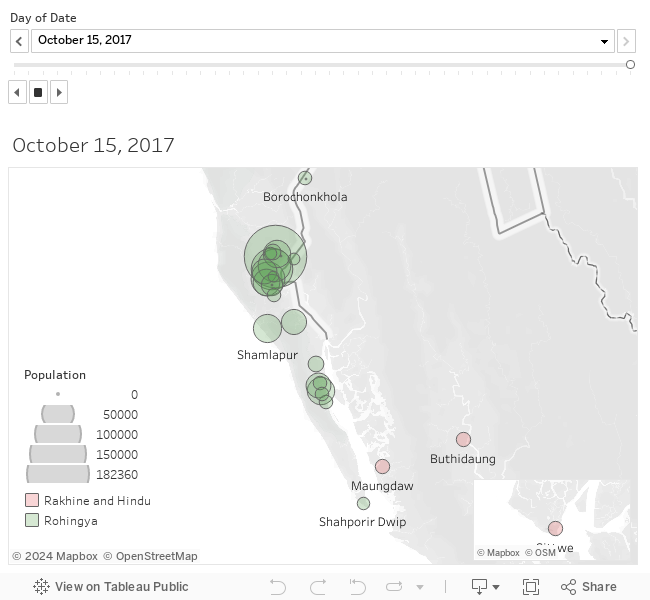
Within a few weeks of Aug. 25, the total number of Muslim refugees climbed to a half million on the Bangladeshi border. The Irrawaddy visualizes the beginnings of the mass exodus in the following map using UN statistics.
Refugee Elsewhere

Myanmar's problem of internally displaced people (IDPs) and refugees is not only confined to Rakhine State. The Internal Displacement Monitoring Centre documented in 2014 an increase of 140,000 IDPs after 2012 communal riot in Rakhine State.

Moreover, civil wars between the government army and dozens of ethnic armed organizations have resulted in at least 500,000 IDPs in Shan, Kachin, Karen, Mon, Kaya, Bago, and Tanitharyi areas in 2014.

The post Rakhine Crisis in Numbers appeared first on The Irrawaddy.

Military, USDP Lawmakers call for Rethink on Fiscal Year Change

Posted: 24 Oct 2017 05:44 AM PDT

NAYPYITAW — Military representatives to Parliament and lawmakers of the opposition Union Solidarity and Development party (USPD) have called for reconsideration of the changing of the fiscal year.

Lawmakers debated at the Union Parliament on Monday the President's proposal to change the fiscal year originally from the period of April 1 to March 30, to the period of October 1 to September 30.

Military representative Maj. Thaung Htike Soe argued against the proposal, saying that the current fiscal year has been practised for the past 40 years, and the change would lead to inconvenience.

"Under the current fiscal year, we can disburse agricultural loans to farmers, which constitute 70 percent of the country's population, prior to the cultivation season [before the rainy season]," he said.

"Now we share the same fiscal year with Japan, one of our donors, and we therefore can receive assistance from it. With the current fiscal year, we don't need to change the Union budget law," he said.

U Thaung Aye, USDP MP in the Lower House, spoke of the risks of scrapping an established system.

"When the new government took office, it reduced the number of existing ministers and combined some ministries. So it was difficult to know the real situation of each department," he said.

"People now are facing financial hardship, limited job opportunities and climate change so it is not yet a good time to change the fiscal year."

According to the President's proposal, the new fiscal year allows construction work to be started immediately after the beginning of the fiscal year and continued for eight consecutive dry months.

However, Maj. Thaung Htike Soe said the current fiscal year keeps balance because construction works can be divided into two periods in a project's lifecycle—six months for preparation and procurement of materials, and another six months for implementing the operation.

The President's proposal also argued that the beginning of the budget year is immediately followed by Thingyan public holidays under the current fiscal year system.

However, Maj. Thaung Htike Soe said Thingyan public holidays have been reduced to five days as of this year, and that period has no significant impact on functions of the fiscal year.

"When a fiscal year starts doesn't matter. What matters is people and departments. If departments which are responsible for administration of the country and all the people can perform their duties in unity and in line with rules and regulations, there won't be any difficulty," said U Aung Min, chairman of the Lower House Public Accounts Committee.

Currently, 12 countries including the United States of America, Thailand and Laos practise the Oct-Sept fiscal year.

Translated from Burmese by Thet Ko Ko.

The post Military, USDP Lawmakers call for Rethink on Fiscal Year Change appeared first on The Irrawaddy.

Arrest Warrant Stalls for Alleged Sex Predator Who Claimed to be Next Buddha

Posted: 24 Oct 2017 04:37 AM PDT

MAWLAMYINE, Mon State — A 25-year-old man who reportedly postured as the next Buddha in order to seduce young girls is yet to be detained despite state government calls for his arrest.

Khun Tan of Mon State's Thaton Township convinced local Pa-O people he was the reincarnation of influential and respected Pa-O monk Alantaya Sayadaw Ashin Sakka, according to reports.

With many parents in the area believing that their daughters sleeping with Khun Tan would be a blessing, he is said to have seduced hundreds of girls, mostly aged around 15.

Mon State government was planning to issue an arrest warrant against him but was stalled as none of the girls reportedly targeted by Khun Tan has reported him to police for rape or sexual assault.

"Khun Tan is not on the arrest warrant list of the government because no one filed a lawsuit against him," said Daw Khaing Khaing Lei, the chairperson of Mon State Parliament Women and Child Rights Protection Committee.

Khun Tan holding a gun in a jungle in Karen State. (The Irrawaddy)

Khun Tan arrived when he was seven in Thaton, where Pa-O custom advises that a bride thought to be born ill fated can be rebalanced by nominally marrying a man who has good astrological influence.

"I can't establish a case as a guardian of my daughters. My wife and daughters have given him their lives and virginity. If they say Khun Tan didn't even touch them, it is difficult for me to file complaint," said U Win Nyunt, whose two daughters had nominal marriages with Khun Tan.

After the nominal marriage ceremony, Khun Tan took his two daughters to Shan State for about 10 days. In his ward alone, there were seven girls who had nominal marriages with Khun Tan.

"Some parents were even upset that Khun Tan didn't marry their daughter," said U Win Nyunt.

The head of Thaton central police station confirmed to The Irrawaddy that the police station has not received any complaint against him over the last two months or in the past.

In August, Mon State government arrested five monks, who were the members of Alantaya Pagoda Board of Trustees and supporters of Khun Tan, after they defied the order of the Mon State Sangha Maha Nayaka Committee—the state Buddhist authority—to stop repairing the pagoda without official permission.

Alantaya Pagoda. (The Irrawaddy)

The trustees were remodeling the pagoda after Yangon's Shwedagon Pagoda. The state government has sought permission from Ministry of Religious Affairs and Culture to arrest two more trustees of the pagoda.

"Complaints were only filed against the trustees, and not against Khun Tan. So, Khun Tan was not under warrant," said Daw Khaing Khaing Lei.

Khun Tan reportedly fled to his native Hopong in Shan State's Taunggyi District some two months ago after the arrest of the trustees.

Thaton District General Administration Department is interrogating the administrator of Zayit Chaung village in Alantaya Religious Area for allegedly covering up a rape case committed by Khun Tan, according to the district commissioner.

Translated from Burmese by Thet Ko Ko.

The post Arrest Warrant Stalls for Alleged Sex Predator Who Claimed to be Next Buddha appeared first on The Irrawaddy.

US Says it is Considering Sanctions Over Myanmar’s Treatment of Self-Identifying Rohingya

Posted: 23 Oct 2017 10:33 PM PDT

WASHINGTON, United States — The United States is taking steps and considering a range of further actions over Myanmar's treatment of its self-identifying Rohingya Muslim minority, including targeted sanctions under its Global Magnitsky law, the State Department said on Monday.

"We express our gravest concern with recent events in Myanmar's Rakhine state and the violent, traumatic abuses Rohingya and other communities have endured," it said in a statement.

It added: "It is imperative that any individuals or entities responsible for atrocities, including non-state actors and vigilantes, be held accountable."

Self-identifying Rohingya Muslims have fled Myanmar in large numbers since late August when Muslim insurgent attacks sparked a ferocious military response, with the fleeing people accusing security forces of arson, killings and rape.

Secretary of State Rex Tillerson said on Wednesday the United States held Myanmar's military leadership responsible for its crackdown on the self-identiRohingya Muslim minority.

Tillerson stopped short of saying whether the United States would take any action against Myanmar's military leaders over an offensive that has driven more than 600,000 self-identifying Rohingya Muslims out of the country, mostly to neighboring Bangladesh.

The State Department made the announcement ahead of US President Donald Trump's maiden visit to the region early next month when he will attend a summit of ASEAN countries, including Myanmar, in Manila.

It marked the strongest US response so far to the months-long self-identifying Rohingya crisis but came short of applying the most drastic tools at Washington's disposal such as reimposing broader economic sanctions suspended under the Obama administration.

Critics have accused the Trump administration of acting too slowly and timidly in response to the self-identifying Rohingya crisis.

The State Department said on Monday: "We are exploring accountability mechanisms available under US law, including Global Magnitsky targeted sanctions."

Measures already taken include ending travel waivers for current and former members of the military in Myanmar, also known as Burma, and barring units and officers in northern Rakhine State from US assistance, it said.

"We have rescinded invitations for senior Burmese security forces to attend US-sponsored events; we are working with international partners to urge that Burma enables unhindered access to relevant areas for the United Nations Fact-Finding Mission, international humanitarian organizations, and media," the statement said.

In addition, Washington is "consulting with allies and partners on accountability options at the UN, the UN Human Rights Council, and other appropriate venues," it said.

Aimed at top generals?

Interviews with more than a dozen diplomats and government officials based in Washington, Myanmar's capital, Yangon, and Europe have revealed that punitive measures aimed specifically at top generals were among a range of options being discussed in response to the self-identifying Rohingya crisis.

Such measures could include the possibility of imposing asset freezes and prohibiting American citizens from doing business with them.

Washington has worked hard to establish close ties with Myanmar's civilian-led government led by Nobel laureate and former dissident Aung San Suu Kyi in the face of competition from strategic rival China.

Forty-three US lawmakers urged the Trump administration to reimpose US travel bans on Myanmar's military leaders and prepare targeted sanctions against those responsible for the crackdown.

The Magnitsky Act, originally passed in 2012, imposed visa bans and asset freezes on Russian officials linked to the 2009 death in prison of Sergei Magnitsky, a 37-year-old Russian whistleblower. It has since been expanded to become the Global Magnitsky Act, which could be used against the generals in Myanmar.

The post US Says it is Considering Sanctions Over Myanmar's Treatment of Self-Identifying Rohingya appeared first on The Irrawaddy.

Ten Things to do in Yangon This Week

Posted: 23 Oct 2017 09:43 PM PDT

Radio Festival

Famous singers will be performing at Myanmar's first radio festival.

Oct. 28, 4 pm. Myanmar Event Park.  Free tickets available at 4 TV Main Showroom at the corner of Pyay Road and Hanthawaddy Street until Oct. 27 between 10 am and 5 pm.

Myanmar Color Festival

Select your favorite colored powder to amazing DJ's and artists from Myanmar and around the world.

Oct. 29, 4 pm. Kandawgyi Park.  Tickets—8,000 kyats per person— available at Parami Pizza restaurants & Union Bar and Grill.

Sai Sai Kham Leng Show

Sai Sai Kham Leng will meet his fans to mark the one-year anniversary of branded cosmetics with his name.

Oct. 29, 1 pm. Junction Square. Free Admission.

Ni Ni Khin Zaw's New Album Promotion

Ni Ni Khin Zaw is releasing her third solo album and will sing for her fans.

Oct. 29, 3 pm. Hledan Center. Free Admission

Employment Fair

More than 30 companies will be hiring at this event.

Oct. 29, 9 am to 4 pm. Rose Garden Hotel, Upper Pansodan Street.

50th Street Halloween

There will be a costume competition with prizes.

Oct. 27, 8 pm to 1 am.  50th Street Café Restaurant Bar.

Wearing Yukata

If you are learning Japanese and want to understand more about the country's culture, you may try wearing Yukata, a casual summer Kimono.  Only 20 persons—male and female—will be allowed. Registration on the Facebook page of the Japan Culture House.

Oct. 27, 11 am, and 2 pm. Japan Culture House, Room 322B, 2nd Floor, Building C, Pearl Condo, Kabaraye Pagoda Road.

World Police Band Concert

Police bands of Myanmar, Japan, Singapore and Vietnam will perform as part of the 22nd World Police Band Concert.

Oct. 28-29. Along Sule Pagoda Road, Strand Road and Bogyoke Aung San Road.

Moon Light: Art Exhibition

Paintings of U Ngwe Kai, U Ba Kyi, Paw Oo Thet, Kin Maung Yin—some of Myanmar's most renowned and respected late artists—will be showcased.

Oct. 21-27. Moon Art Gallery, 35th Street (Middle Block)

The 5th Grand Art Stream 2017: Lun Family Art Exhibition

This exhibition will feature over 100 paintings by artist Lun Gywe and his family members.

Oct. 28-30. Yangon Gallery.

The post Ten Things to do in Yangon This Week appeared first on The Irrawaddy.

Monday, October 23, 2017

The Irrawaddy Magazine

The Irrawaddy Magazine


State Counselor Calls for Unity, Asks Business Community to Help Rakhine Rehabilitation

Posted: 23 Oct 2017 06:12 AM PDT

NAYPYITAW— In her recent speech to the people across the country, Myanmar State Counselor Daw Aung San Suu Kyi said no matter what difficulties the country faces, they can be overcome by the unity of her people.

In her call for people's assistance, the State Counselor urged businesspeople to give a hand in rehabilitation works in Rakhine State, in a ceremony to accept donations for the restive state in Naypyitaw on Friday.

Many in Myanmar would argue she has a right to believe so as history has proved it was the people's unity that turned her National League for Democracy from an opposition party to the current ruling one.

Now with mounting international pressure on the Rakhine State issue, the 72-year old has called on the people's collaboration again.

In the northwest of Myanmar, rehabilitation works are urgently in need after Muslim militant attacks and counter military clearance operations have sent more than 600,000 self-identifying Rohingya Muslims fleeing across the border to Bangladesh and displacing internally nearly 30,000 ethnic Arakanese and others.

She encouraged businesspeople to provide input, admitting that measures taken in the past to address the issue were not sufficient. She called for collaboration so as to identify new approaches in solving the problem.

"Big businesspeople are the strength of the country. The government is also the strength of the country, and so are the people. I assume that the sound foundation of the Union's project for Rakhine State was laid today with these three strengths," said Daw Aung San Suu Kyi.

"Rather than financial help or material support, we are asking for mental help—I mean both from your head and heart. I would call it goodwill. I would urge cooperation for the country," she added.

The government formed the Union Enterprise for Humanitarian Assistance, Resettlement and Development in Rakhine on Oct. 15 to engage in humanitarian and rehabilitation works. Businesspeople donated nearly 18 billion kyats on Friday.

"I'd like to urge the businessmen to provide frank suggestions. We may not be able to accept all the suggestions, but we'd choose the most appropriate ones and implement them. In sorting out priorities, we also have to choose low-hanging fruit, and there are certain things that need to be implemented in the long-run," she said.

"We businesspeople stand by the government. We don't want to lose democracy from our hands. And we don't want to lose the Rakhine and border with Bangladesh. The government should adopt a firm plan and we'd like to provide funds for it," said U Khin Shwe, chairman of Zay Kabar Co.

U Aung Ko Win, chairman of Kanbawza, made the largest contribution of 3 billion kyats. U Maung Weik, chairman of Sae Paing Co, gave1.5 billion kyats, and other businessmen such as U Zaw Zaw, U Chit Khaing, U Tun Myint Nang, U Htay Myint and U Khing Shwe also made contributions.

The event was in response to a request made by the businesspeople at the 2nd anniversary of nationwide ceasefire agreement signing on October 15 in Naypyitaw to provide assistance in Rakhine issue, U Zaw Htay, director-general of State Counselor Office told the reporters.

"There are three priorities, first is repatriation and resettlement, second is rehabilitation and the final one is development and ensuring of conflicts in the long-run," said U Zaw Htay.

The post State Counselor Calls for Unity, Asks Business Community to Help Rakhine Rehabilitation appeared first on The Irrawaddy.

Breaking: Two Men Shot Dead in Northern Rakhine

Posted: 23 Oct 2017 06:04 AM PDT

YANGON – Four men were shot and two are dead in an attack in Aung Tha Pyay village in Rakhine State's northern Maungdaw Township this morning, according to a border police major.

Maj. Aung Win of Kyee Kan Pyin border police headquarters said the men were Daingnet—a sub-ethnicity of Arakanese—but declined to comment further, saying he has not received a full report of the crime.

Staff at Buthidaung General Hospital said locals and police brought two men with bullet wounds to the hospital on Monday morning. Hospital supervisor Kyaw Naing Oo said the men were in a critical condition.

Northern Rakhine State has been reeling from violence since Arakan Rohingya Salvation Army (ARSA) attacked police outposts in August, which intensified Myanmar Army operations, causing more than 600,000 self-identifying Rohingya Muslims to flee for Bangladesh.

Estimates put the death toll of self-identifying Rohingya past 1,000 while about 30,000 Arakanese and Hindus fled militant violence, with reports saying the militants had targeted civilians.

Thudatha Naka, abbot of Aung Tha Pyay monastery, told The Irrawaddy over the phone on Monday that the four Daingnet men—Maung Ngay Hla, Shwe Thein Maung, Sein Hla Maung and Maung Ngay Tun—went hunting for boar in the forest in the Mayu mountain range on Sunday evening.

They crossed paths with Muslim militants and were shot, he said. Maung Ngay Hla and Shwe Thein Maung managed to escape and are receiving treatment at the hospital.

"The two men who escaped told me a group of Bengali terrorists shot at them and two were killed on the spot," he said, using a term said locally and across the country to describe the self-identifying Rohingya.

The Irrawaddy phoned Buthidaung Township police officers, but they decline to comment and directed calls to border police officials, as the Border Guard Force controls the area.

The post Breaking: Two Men Shot Dead in Northern Rakhine appeared first on The Irrawaddy.

Art in Remembrance of Zaw Lu Min

Posted: 23 Oct 2017 05:58 AM PDT

Even while suffering from severe liver failure, artist and sculptor Zaw Lu Min did not give up his lifelong passion for the arts.

The disease had restricted his dexterity but not his love and enthusiasm for creativity—he was drawing small pictures despite his disease.

After he became too feeble to paint even small pictures, he created a small sculpture of a robot. It was not made of stone or wood or metal. It was made with paper from packing boxes of liver medicine and vitamin supplements, caps of small water bottles, and small batteries.

He died at the age of 65 in 2016, having devoted his entire life to art. To mark the one-year anniversary of his death, an art and sculpture exhibition is being held in his remembrance until Oct. 25 at OK Art Gallery.

Together with Myanmar's modernists Win Pe, Kin Maung Yin, Paw Thame and San Min, Zaw Lu Min entered art world in 1970s.

"Ko Zaw Lu Min was art crazy since he was young. He used to draw on various things that came across his eye. He didn't even spare pots and plates and stones. What is distinct with his creation is that they reflect his craziness for art," said artist Win Pe.

The exhibition also showcases an oil portrait of Zaw Lu Min painted by Kin Maung Yin in 1971. Zaw Lu Min had turned stones into faces, elephants, frogs and so on, and also incorporated calculators, ball pens, water bottles, and dried tree branches into his paintings.

His Myanmar-style modernist paintings also attract viewers. There will be over 30 paintings and five sculptures at the exhibition priced between US$ 200 and 700.

Artist Ko Sai who came to the exhibition said: "We knew each other some ten years ago. He created the forms and colors in his mind into paintings freely. He was really crazy for art."

The post Art in Remembrance of Zaw Lu Min appeared first on The Irrawaddy.

Seizure of Firearms Raises Security Concerns for The Lady

Posted: 23 Oct 2017 04:59 AM PDT

Daw Aung San Suu Kyi remains the most popular politician and a public figure among the Myanmar public inside and outside of the country. But, like her late father who was assassinated by his rivals in 1947, she has no shortage of enemies.

The issue of her safety has been discussed among the Myanmar public for decades and recently the seizure of illegal firearms and illicit drugs at Naypyitaw's airport again raised concerns for the safety of the State Counselor.

Phyo Ko Ko Tint San, son of the sports minister who served under president U Thein Sein, and two ACE employees were detained before boarding a Yangon-bound Myanmar National Airlines flight. Police found them with illegal firearms and drugs.

Like many spoiled children of former generals, Phyo Ko Ko Tint San, chairman of ACE Company, enjoyed privileges and sweet business deals.

And, like perhaps many before them walking into the airport with illegal firearms, they suspected they could pass the x-ray scanner without any problems. This time, however, they were caught.

Police, under pressure from the public to follow up the case, searched ACE hotel in Naypyitaw and a house belonging to Phyo Ko Ko Tint San in Yangon where they found more weapons including eight firearms, bullets, a camouflage jacket bearing his name and the Myanmar national emblem, one long-sleeved black shirt with the Myanmar national emblem and skull and crossed bones emblem, two sniper scopes, a military green compass, a walkie-talkie, a gun sight, and two bullet-proof jackets.

What was he planning to do?

According to the police investigation, Phyo Ko Ko Tint San, who is now in custody, was planning to establish a security company. The badges and logos discovered in his property, however, are problematic. "National Security Council" a letter in badge showed. He had obviously stockpiles firearms, police said. He had been doing it without any legal permission.

Police have so far detained 12 people in connection with the case, and reportedly seized over 20 firearms and thousands of bullets at his house, company offices, and hotel in Naypyitaw and Yangon. There are surely more suspects and arrests in the pipeline if police are instructed to clampdown on these criminals, informed sources also believe that more firearms are yet to be found.

Senior police officers who were involved the case said the seizure of firearms was not directly related to the security of Daw Aung San Suu Kyi but it is learned that the military has warned the State Counselor over her security arrangements and she has replied that she would take extra caution.

One of the camouflage jackets discovered is identical to that of Daw Aung San Suu Kyi's bodyguards. This has caused concern among her supporters and National League for Democracy party members.

The government spokesperson said that security has been increasingly tightened for the State Counselor since 2016 after her name appeared on a hit list sent by the militant group the Islamic State in Iraq and Syria to police in Malaysia.

In any case, foreign terrorists may take aim at Daw Aung San Suu Kyi due to the crisis in Rakhine Region in which hundreds of thousands of self-identifying Rohingya fled to a neighboring country due to the military's clearance operation, but many also assume that Daw Aung San Suu Kyi's real threat could come from within.

Some politicians and oligarchs who once enjoyed lucrative business opportunities and political power but have lost vested business interests under the current administration may have a plan to harm her. Many powerful groups associated with former generals and business cronies are no doubt unhappy with her and her administration.

Some pro-Suu Kyi political observers suspect that a group of once wealthy and powerful people have been trying to create instability since her party came into power. They may think the instability in the country can pave a way for the military to step in and retake power.

Phyo Ko Ko Tint San is a member of the Union Solidarity Development Party and contested, in the 2012 by-election, Irrawaddy Region's Myaungmya Township seat. Security concerns for Daw Aung San Suu Kyi have also been raised as several young privileged delinquents who actively use social media also posted photos of firearms and made threats to kill her.

Union Solidarity Development Association (known as the USDA) was established in 1993 under the guidance of the military junta and its patron Snr-Gen Than Shwe. The association became a legal political party before the 2010 general election and contested the rigged election that year then it became ruling party.

Many of her supporters and colleagues are genuinely and deeply worried for the safety of Aung San Suu Kyi, who is now under the protection of the police and special forces who are under the control of the Ministry of Home Affairs.

Under the previous regime, when she was opposition figure, there were several attacks on Daw Aung San Suu Kyi.

In 2003, state-sponsored mobs attacked her convoy in Sagaing Region and dozens of people were killed as a result, but Daw Aung San Suu Kyi and some top leaders narrowly escaped harm. But the leaders were placed under house arrest for many more years though they did not commit any crime. The incident was known as the Depayin massacre as it took place near Depayin village.

After the attacks, western nations tightened sanctions against the Than Shwe regime and neighboring governments openly condemned the attacks.

It was Snr-Gen Than Shwe and his close associates who masterminded the attacks. He ordered two of his trusted generals—Gen. Soe Win who was later prime minister between 2004 and 2007 and Gen Ye Myint—to mobilize criminals, members of the then USDA, and mobs to conduct the attacks.

Myanmar's most feared intelligence chief and former prime minister Gen Khin Nyunt mentioned in his memoirs about the infamous Depayin massacre and conceded that top leaders were involved in the assassination plan but took credit that his intelligence officers had save Daw Aung San Suu Kyi's life.

This time the tough job will come to the Ministry of Home Affairs, which is under the direct control of the armed forces according to Myanmar's constitution.

The public has not been satisfied with the police's slow reaction to this case. What's more, who caught the assassin of National League for Democracy legal advisor U Ko Ni at the Yangon International Airport? Not police but a group of taxi drivers who were hailed as heroes.

"The most important thing is to seize remaining weapons and arrest accomplices," Deputy Home Affairs Minister Maj-Gen Aung Soe told reporters in Naypyitaw. "So, we are working to make sure they don't escape."

He needs to keep his promise and words. The world will have to watch how Myanmar's police department under the home affairs ministry—who have received funding and training from western nations including EU under U Thein Sein period—will show they are working around the clock to keep tracking those criminals who are at large but also making ongoing investigation transparent.

Many still see Daw Aung San Suu Kyi's life as indispensable in this fragile transition period and failing state in the country. Citizens also witnessed the untimely departure of Aung San and his cabinet, they can't afford to see it again at a time when the country faces internal and external threats and mounting pressure to solve pressing issues at home.

The post Seizure of Firearms Raises Security Concerns for The Lady appeared first on The Irrawaddy.

Food Running out for Displaced Shan

Posted: 23 Oct 2017 02:06 AM PDT

YANGON — One of six refugee camps on the Thailand-Myanmar border in Shan State has run out of food supplies and five others only have enough food to last until the end of October, according to camp organizers.

The six camps—Gawng Mung Mong; Loi Kaw Wan; Loi Tai Leng; Loi Lam; Loi Sarm Sip; and Koung Jor—provide shelter for more than 6,200 internally displaced persons (IDPs).

Koung Jor ran out of food supplies at the end of September. The other five camps have enough food to last until the end of October.

Koung Jor camp organizer Lung Sai Lieng said food was last delivered in September.

"But we've got nothing this month. We are surviving on leftovers from last month. People at the camp are expecting to get farming jobs in Thailand, but work hasn't started yet because of heavy rains," he said.

The Border Consortium (TBC)—a coalition of INGOS from the US, Britain, Ireland, Canada, Denmark, Sweden, Netherlands, Australia and Norway—has been providing assistance for accommodation, food and education of IDPs at Loi Kaw Wan; Loi Tai Leng; Loi Lam; Loi Sarm Sip; and Koung Jor.

TBC informed camp organizers in February that it would stop providing assistance to the camps at the end of October although it has been informing camp leaders of the likelihood of this happening since 2015.

A 60-year old woman in Loi Kaw Wan suffered a mental breakdown leading to her death on hearing news of the cuts, said Lung Sai Pieng, secretary of the Shan State Refugee Committee.

"Camps are short on food as October is ending soon," he said. The committee has contacted potential donors to ask for donations. "Some have provided help, but it is short-term assistance. But then it is better than having no food at all," he added.

Moreover, it is risky for IDPs to cross the border and work in Thailand because they don't have legal permits, he said.

"I'd like to urge the government to provide help for IDPs here," he said.

The homes of IDPs have been occupied by the United Wa State Army (UWSA), Tatmadaw and militia, according to the Shan State Refugee Committee. Meanwhile, there is little land available for farming near the camps.

The Shan Human Rights Foundation released a statement in August detailing the background and plight of IDPs in Shan State, saying that IDPs only get seasonal jobs at farms in Thailand and earn much lower wages than Thai workers. Some IDPs find it difficult to leave the camp and work, said the statement.

Yet no international donor has come forward to provide food for the camps, said Lung Sai Lieng.

"I don't think it will be useful to talk to the government. It has no attention for IDPs because it focuses on political issues and relations with the military," he said.

The Irrawaddy asked officials of Nationwide Ceasefire Agreement (NCA) signatories, members of political parties and government officials about repatriation of IDPs, but none of them gave clear answers.

"That will be the part of the rehabilitation and social plan. But so far, we've not discussed it yet," said Kwe Htoo Win, vice-chairman of ethnic armed group and NCA signatory Karen National Union (KNU).

Officials of some other NCA signatories said it is the responsibility of the government to ensure IDPs are able to return home with dignity.

"What we can say is the peace process is still ongoing. It concerns trust building, and we are trying," said U Hla Maung Shwe, member of the government's peace commission, on the plight of the IDPs.

Students at two Karreni IDP camps are facing difficulties because of declining international support, said secretary U Bwe Sae of the Karen Refugee Committee.

Loi Tai Leng Camp was established in 1999, Loi Kaw Wan in 2001, Koung Jor in 2002, and Loi Lam and Loi Sarm Sip in 2006, and Gawng Mung Mong in 2007. They shelter people who fled clashes between the Tatmadaw and Restoration Council of Shan State (RCSS), and alleged torture by the military.

The eight ethnic armed groups that signed the NCA—the KNU; Chin National Front; Arakan Liberation Party (ALP); All Burma Students' Democratic Front (ABSDF); Restoration Council of Shan State (RCSS); Karen National Union/Karen National Liberation Army (Peace Council) (KNU/KNLA PC); Democratic Karen Buddhist Army (DKBA); and the Pa-O National Liberation Organization (PNLO)—are based along the Myanmar-Thailand border, and have been holding political dialogue with the government for two years.

The issue of IDPs is included under the "social sector"—one of five topics under discussion between the government and NCA signatories, but the parties are yet to reach any agreement.

Translated from Burmese by Thet Ko Ko.

This report originally stated TBC informed camp organizers in July that it would stop providing assistance to the camps at the end of October. Actually, it informed camp organizers in February but had told them of this likelihood since 2015. It stated TBC provided assistance to Gawng Mung Mong. TBC has not provided assistance to Gawng Mung Mong. The original report also cited secretary U Bwe Sae of the Karen Refugee Committee that food supplies to Karen IDPs would be reduced or stopped in 2018. This was removed, as a decision is yet to be made on the matter. 

The post Food Running out for Displaced Shan appeared first on The Irrawaddy.

Two Pilots of Missing Military Training Jet Confirmed Dead

Posted: 23 Oct 2017 12:50 AM PDT

PATHEIN, Irrawaddy Region — Two pilots aboard a missing military training jet found last week some 12 miles south of Gwa Township in Rakhine State after going missing last month were confirmed dead by the Tatmadaw medical team last week.

The search and research team found the body of pilot Maj. Kaung Htike near the wreckage. Though the body of co-pilot Capt. Thaw Zin Soe was not recovered, the team found his personal belongings at the scene.

Two pilot seats attached with parachutes, and two survival kits were found at the scene, according to a statement from the Office of the Commander-in-Chief of Defence Services.

"Though the body of Capt. Thaw Zin Soe was not found, his personal belongings including his watch were found. So the medical team confirmed the death of both pilots," a senior military officer who participated in search and rescue operation told The Irrawaddy.

"A military funeral will be held for Maj. Kaung Htike at the scene and we'll take back the ashes," he added.

The G-4 military training aircraft disappeared during a training exercise over Pathein, Gwa, Hinthada, and back to Pathein, the capital of Irrawaddy Region, on Sept. 5. The plane lost contact about 36 miles northwest of Pathein. Parts of the aircraft were discovered last Wednesday on the 44th day of the search and rescue operation.

The training jet had been used by Maj. Kaung Htike to train new pilots for the last three years.

He passed the No. 64 piloting training from Namhsan Pilot Training School in Shan State, and was assigned to Mingalardon Air Base. Since 2007, he had been stationed at Pathein Air Base.

He was survived by his wife and a daughter, and so is the case for Capt. Thaw Zin Soe.

The training jet was a military training aircraft manufactured by Yugoslavia in 1984. The full name of the aircraft is SoKo G-4 Super Galeb, and it was worth US$4.2 million according to 2010 prices.

From 1984 to 1991, Yugoslavia manufactured 85 G-4 aircrafts, and Myanmar Air Force has procured six of them. Serbian military still use the planes.

The post Two Pilots of Missing Military Training Jet Confirmed Dead appeared first on The Irrawaddy.

Abe to Push Reform of Japan’s Pacificist Constitution After Election Win

Posted: 22 Oct 2017 11:19 PM PDT

TOKYO, Japan — Japanese Prime Minister Shinzo Abe's ruling bloc scored a big win in Sunday's election, bolstering his chance of becoming the nation's longest-serving premier and re-energising his push to revise the pacifist constitution.

Abe's Liberal Democratic Party-led (LDP) coalition won a combined 312 seats, keeping its two-thirds "super majority" in the 465-member lower house, local media said.

A hefty win raises the likelihood that Abe, who took office in December 2012, will secure a third three-year term as LDP leader next September and go on to become Japan's longest-serving premier. It also means his "Abenomics" growth strategy centred on the hyper-easy monetary policy will likely continue.

Final official results from the election, which coincided with an approaching typhoon, are expected early on Monday.

The U.S.-drafted constitution's Article 9, if taken literally, bans the maintenance of armed forces. But Japanese governments have interpreted it to allow a military exclusively for self-defence.

Backers of Abe's proposal to clarify the military's ambiguous status say it would codify the status quo. Critics fear it would allow an expanded role overseas for the military.

Abe said he would not stick to a target he had floated of making the changes by 2020. "First, I want to deepen debate and have as many people as possible agree," he told a TV broadcaster. "We should put priority on that."

The LDP's junior partner, the Komeito, is cautious about changing the constitution, drawn up after Japan's defeat in World War Two. Several opposition parties favour changes, but do not necessarily agree on details.

Referendums Risky

Amendments must be approved by two-thirds of each chamber of parliament and then by a majority in a public referendum.

"Now that pro-constitutional change parties occupy more than two-thirds of the parliament, the constitution will be the most important political issue next year," said Hidenori Suezawa, a financial market and fiscal analyst at SMBC Nikko Securities.

"And as we saw in the U.K. … a referendum could be tricky. So while Abe is likely to be prime minister for the time being, it is too early to say whether he can stay in power until 2021." Abe declined to say if he would run for a third term.

Abe had said he needed a new mandate to tackle a "national crisis" from North Korea's missile and nuclear threats and a fast-aging population, and to approve his idea of diverting revenue from a planned sales tax hike to education and child care from public debt repayment.

He called the poll amid confusion in the opposition camp and an uptick in his ratings, dented earlier in the year by scandals over suspected cronyism and a perception he had grown arrogant after nearly five years in office.

Abe has backed U.S. President Donald Trump's tough stance towards North Korea, which has test-fired missiles over Japan, that all options, including military action, are on the table. Trump is to visit Japan Nov. 5-7 to reaffirm the leaders' tight ties.

Abe's Gamble Pays Off

Abe's snap poll gamble had seemed risky—some early forecasts saw the LDP losing a significant chunk of seats—after Tokyo Governor Yuriko Koike, often floated as possibly Japan's first female premier, launched her conservative Party of Hope.

That party absorbed a big chunk of the failed main opposition Democratic Party, which abruptly decided to run no candidates of its own. But voter enthusiasm soon waned despite its calls for popular policies such as an exit from nuclear power and a freeze on the planned sales tax rise.

Koike did not run for a lower house seat herself – she was in Paris for a climate change event on Sunday – and failed to say whom her party would back for prime minister.

"We had sought to put policies first. But we ended up with a very tough outcome, so I deeply apologise for that," Koike told NHK.

A new Constitutional Democratic Party of Japan (CDPJ), formed by liberal former DP members, got 54 seats, beating the 49 seats of Koike's party to become the biggest opposition group, although both have just a fraction of the LDP's presence.

"Day by day, we felt we were getting more voter support for our call to revive more decent politics, and not fret about whether it's right or left wing," said CDPJ lawmaker Tetsuro Fukuyama.

Several experts noted the ruling bloc's win was less a victory for the conservative, long-ruling LDP than a defeat for a divided opposition.

"Simply put, this was the self-destruction of the opposition," said Zentaro Kamei, a senior research fellow at think tank PHP Institute and former LDP lawmaker.

Shinjiro Koizumi, the LDP lawmaker son of popular former Premier Junichiro Koizumi, warned against LDP complacency.

"It's not just that our party has become arrogant and complacent. People are also getting increasingly fed up with us," he told NHK.

Abe, 63, has already led the LDP and its partner, the Komeito, to four landslide wins since he took the helm of the party. But turnout has been low and the LDP has typically won with about 25 percent of eligible votes. Others either stayed home or backed opposition parties.

Kyodo news agency estimated turnout on Sunday—when heavy rain from powerful Typhoon Lan lashed much of Japan—at 53.7 percent, 1 point above the record low in the last lower house election in 2014.

The post Abe to Push Reform of Japan's Pacificist Constitution After Election Win appeared first on The Irrawaddy.

Returning Self-Identifying Rohingya may Lose Land, Crops Under Myanmar Plans

Posted: 22 Oct 2017 10:45 PM PDT

SITTWE, Myanmar, Oct 22 — Self-identifying Rohingya Muslims who return to Myanmar after fleeing to Bangladesh are unlikely to be able to reclaim their land, and may find their crops have been harvested and sold by the government, according to officials and plans seen by Reuters.

Nearly 600,000 self-identifying Rohingya have crossed the border since Aug. 25, when coordinated Muslim insurgent attacks on security posts sparked a ferocious counter offensive by the Myanmar Army.

The United Nations says killings, arson and rape carried out by troops and ethnic Arakanese Buddhist mobs since late August amount to a campaign of ethnic cleansing against the self-identifying Rohingya.

Civilian leader Aung San Suu Kyi, who has no control over the military, has pledged that anyone sheltering in Bangladesh who can prove they were Myanmar residents can return.

Reuters has interviewed six Myanmar officials involved with repatriation and resettlement plans. While the plans are not yet finalized, their comments reflect the government's thinking on how Suu Kyi's repatriation pledge will be implemented.

Jamil Ahmed, who spoke to Reuters at a refugee camp in Bangladesh, is one of many who hope to go back.

Describing how he fled his home in northern Rakhine State in late August, Ahmed said one of the few things he grabbed was a stack of papers—land contracts and receipts—that might prove ownership of the fields and crops he was leaving behind.

"I didn't carry any ornaments or jewels," said the 35-year-old. "I've only got these documents. In Myanmar, you need to present documents to prove everything."

The stack of papers, browning and torn at the edges, may not be enough, however, to regain the land in Kyauk Pan Du village, where he grew potatoes, chili plants, almonds and rice.

"It depends on them. There is no land ownership for those who don’t have citizenship," said Kyaw Lwin, agriculture minister in Rakhine State, when asked in an interview whether refugees who returned to Myanmar could reclaim land and crops.

Despite his land holdings, Myanmar does not recognize Ahmed as a citizen. Nearly all the more than 1 million self-identifying Rohingya who lived in Myanmar before the recent exodus are stateless, despite many tracing their families in the country for generations.

Officials have made plans to harvest, and possibly sell, thousands of acres of crops left behind by the fleeing Muslims, according to state government documents reviewed by Reuters.

Myanmar also intends to settle most refugees who return to Rakhine State in new "model villages," rather than on the land they previously occupied, an approach criticized in the past by the United Nations as effectively creating permanent camps.

The government has not asked for help from any international agencies, who are calling for any repatriation to be voluntary and to the refugees' place of origin.

'Ownerless Crops'

The exodus of 589,000 self-identifying Rohingya—and about 30,000 non-Muslims—from the conflict zone in northern Rakhine has left some 71,500 acres of planted rice paddy abandoned and in need of harvesting by January, according to plans drawn up by state officials.

Tables in the documents, reviewed by Reuters, divide the land into paddy sown by "national races"—meaning Myanmar citizens—or "Bengalis," a term widely used in Myanmar to refer to the self-identifying Rohingya, but which they reject as implying they are illegal migrants from Bangladesh.

Kyaw Lwin, the state minister, confirmed the plans, and said there was a total of 45,000 acres of "ownerless Bengali land."

Two dozen combine harvesters operated by officials from the agriculture ministry will begin cutting stalks this month in areas under military control.

The machines will be able to harvest about 14,400 acres according to official calculations contained in the plans. It is unclear what will become of the remaining crop, but officials told Reuters they would try to harvest all the paddy, recruiting additional labor to harvest manually if necessary.

An acre of paddy in Myanmar typically makes more than US$300 at market, meaning the state will gain millions of dollars worth of rice.

The harvested rice will be transported to government stores, where it would either be donated to those displaced by the conflict or sold, Rakhine state secretary Tin Maung Swe told Reuters by phone.

"The land was abandoned. There is no one to reap that, so the government ordered to harvest it," he said.

Human Rights Watch (HRW) deputy Asia director Phil Robertson, said the government should at least guarantee that the rice would be used for humanitarian support and not for profit.

"You can't call a rice crop 'ownerless' just because you used violence and arson to drive the owners out of the country," he said.

'Model Villages'

Many refugees are fearful to return and are skeptical of Myanmar's guarantees. Those who do decide to cross back into Myanmar will first be received at one of two centers, according to government plans reviewed by Reuters, before mostly being relocated to model villages.

International donors, who have fed and cared for more than 120,000 mostly self-identifying Rohingya "internally displaced persons" (IDPs) in supposedly temporary camps in Rakhine since violence in 2012, have told Myanmar that they will not support more camps, according to aid workers and diplomats.

"The establishment of new temporary camps or camp-like settlements carries many risks, including that the returnees and IDPs could end up being confined to these camps for a long time," said UN spokesman Stanislav Saling in an emailed response.

Satellite imagery shows 288 villages, mostly self-identifying Rohingya settlements, have been fully or partially razed by fires since Aug. 25, according to HRW.

Refugees say the army and Buddhist mobs were responsible for most of the arson. The government says self-identifying Rohingya militants and even residents themselves burned the homes for propaganda.

The hamlets where self-identifying Rohingya farmers lived were "not systematic," and so should be rebuilt in smaller settlements of 1,000 households set out in straight rows to enable development, said Soe Aung, permanent secretary at the Ministry of Social Welfare, Relief and Resettlement.

"In some villages there are three houses here, four houses over there. For example, there's no road for fire engines when fire burns the villages," Soe Aung said.

Identity Checks

Those who decide to cross back into Myanmar will first be received at one of two centers, according to government plans reviewed by Reuters.

At the centers, officials said, the returnees will fill out a 16-point form that will be cross-checked with local authorities' records. Immigration officials have for years visited self-identifying Rohingya households at least annually for checks, photographing family members.

For refugees who lost all their documents, the government would compare their photos to those that immigration authorities have on file, said Myint Kyaing, the permanent secretary at the Ministry of Labour, Immigration and Population.

Officials will accept as evidence "national verification" cards handed out in an ongoing government effort to register self-identifying Rohingya that falls short of offering them citizenship. The card has been widely rejected by Rohingya community leaders, who say they treat life-long residents like new immigrants.

"We are not going to go back like this," said Mushtaq Ahmed, 57, a farmer from Myin Hlut village now living in the Tenkhali refugee camp in Bangladesh, where Jamil Ahmed is also staying.

"If I can go back to my house, and get my land back, only then I will go. We invested all our money into those paddy fields. They are killing so many of us with swords and bullets, and killing the rest of us like this."

The post Returning Self-Identifying Rohingya may Lose Land, Crops Under Myanmar Plans appeared first on The Irrawaddy.

Saturday, October 21, 2017

The Irrawaddy Magazine

The Irrawaddy Magazine


Dateline Irrawaddy: Haul of Firearms in U Phyo Ko Ko Tint San Case

Posted: 20 Oct 2017 08:52 PM PDT

Ye Ni: Welcome to Dateline Irrawaddy. This week, we'll discuss the current talk of the town—the arrest of U Phyo Ko Ko Tint San who was found with firearms and illegal drugs at Naypyitaw Airport. Lawyer U Than Zaw Aung and The Irrawaddy Burmese editor U Yan Paing join me to discuss this. I'm Irrawaddy Burmese editor Ye Ni.

As you know U Phyo Ko Ko Tint San, the son of former sports minister U Tint San, was recently arrested at Naypyitaw Airport for illegal possession of firearms and drugs. Police also discovered guns at his ACE Hotel. And again, guns, accessories and things believed to be drugs paraphernalia were also discovered at his hotel and company headquarters in Thaketa and Bahan townships in Yangon. Police have charged him for drugs and illegal possession of firearms. Ko Than Zaw Aung, how do you assess this case?

Dateline Irrawaddy :ေနျပည္ေတာ္ေလဆိပ္မွာ မိတဲ့ လက္နက္နဲ႕ မူးယစ္ေဆးဝါးအမႈအေပၚ သုံးသပ္ခ်က္ဒီတပတ္ ဒိတ္လုုိင္းအစီအစဥ္ကေတာ့ ေနျပည္ေတာ္ေလဆိပ္မွာ မိတဲ့ လက္နက္နဲ႕ မူးယစ္ေဆးဝါးအမႈ ကိစၥနဲ႔ပတ္သက္ၿပီး ဧရာဝတီသတင္းဌာနရဲ႕ ျမန္မာပုုိင္းအယ္ဒီတာ ရဲနည္၊တရားလႊတ္ေတာ္ေရွ႕ေန ဦးသန္းေဇာ္ေအာင္နဲ႔ ဧရာဝတီသတင္းဌာနရဲ႕ ျမန္မာပုုိင္းအယ္ဒီတာ ရန္ပုုိင္ တုုိ႔ကေဆြးေႏြးထားၾကတာပါ။

Posted by The Irrawaddy – Burmese Edition on Tuesday, October 17, 2017

Than Zaw Aung: Guns were seized from him before he boarded a plane in Naypyitaw. Further investigation led to the seizure of more guns at his house and hotel in Yangon. So, why does he keep firearms? Police have stated that he was preparing to establish a security company. The name of the company is interesting. Words such as 'special force', 'national security council' are interesting. We should ask if a private security company is allowed to use the terms such as 'national' and 'council.' Again, 'special force' is a term normally used by armed organizations, and authorities should carefully investigate the reasons behind it. Law enforcement personnel should efficiently handle the case and find out his intention.

YN: Do the charges brought by the police against them match the crime or do you see any suspicious aspects of the case? Because netizens have speculated that the case is politically motivated and there is a mastermind behind.

TZA: There will be a lot of speculation and wild guesses on social media. But, the responsibility lies on the Ministry of Home Affairs to investigate. If the ministry alone is not enough, assistance should be sought from military agencies in the investigation process. Usually most of the [drug] cases pale into insignificance over time [after the initial drug bust]. And drug and weapons are like husband and wife, they come in pairs. At the moment, it is difficult to say the motive behind. There are speculations, but it is the responsibility of the concerned authorities to investigate.

YN: What Ko Than Zaw Aung pointed out is interesting. Speaking of illegal arms, U Ko Ni's assassination, which happened not long ago, involves illegal arms. The gun used in assassination was reportedly brought through the Thailand-Myanmar border. And there is another case in which a motorbike rider was killed by a bullet in Mandalay. No one knew what happened. But it is obvious that he was shot by someone. Ko Yan Paing, do you think police are working hard enough to investigate drug and illegal firearms cases?

Yan Paing: Rather than discussing if the police are working, what I'd like to know, as a journalist, is about the routes through which firearms are brought in. Police must investigate those routes and the arms dealers. And the case of the death of a motorbike rider in Mandalay is minor compared to the big haul of firearms in Naypyitaw—the first of its kind there. Not long ago, firearms were seized reportedly from a vehicle in Thazi Township [in Mandalay], and there are many firearms in border areas. I think those cases are concerned with arms smuggling. But the case in discussion is different; many firearms were seized in a place like Naypyitaw, and in a place like Yangon, guns like the M16 were discovered—it is a serious weapon. And as U Than Zaw Aung has pointed out, guns and drugs come in pairs. If he is high on drugs and shoots at something with those guns, it is very dangerous. So, I think police should give greater attention than they did in previous cases.

YN: Drugs and weapons usually come in pairs, but the amount of drug seized from him and discovered during police search [of his house and hotel] is not much. So, it can be concluded that he is just a drug user [as opposed to a dealer]. But talking of firearms, police stated that he was planning to establish a security company. As far as I'm concerned, there is still no law that allows for [armed] security service. But what I'd like to know is if the laws allow civilians to keep firearms, or specify the circumstances in which civilians can keep specific types of firearms. As far as I'm concerned, gun licenses were issued under the government of the Burma Socialist Programme Party (BPSS).

TZA: There were gun licenses issued under the BSPP government starting from 1977 but only to those who were fully-fledged party members and serving on duty in BSPP. They were allowed to keep three weapons including handguns, such as non-military rifles. But after the 1988 pro-democracy uprising, [the military] revoked gun licenses and recalled guns. There are three existing laws in Myanmar regarding weapons—the Arms Act 1878, which is an Indian act, the Arms Act (Temporary Amendment) 1951, and the Arms Emergency Punishment Temporary Act 1949. According to these existing laws, ordinary citizens are not allowed to keep firearms. Lawmakers asked about the keeping of firearms at the parliament probably under the previous government. At that time concerned officials replied that ordinary citizens are not allowed to keep firearms. Security guards of security companies are allowed to use handcuffs and rubber batons. They are not allowed to keep guns.

YP: Besides what Ko Than Zaw Aung has said, as you see police usually carry out checks on ordinary citizens who go out late at night by car or motorbike, and even seize swords and sticks from them if they carry any. Therefore, I think the case is more than establishing a security company or a hobby.

YN: This seizure of guns, camouflage jackets and military accessories reminds me of the previous case of such a seizure in the alleged plot of U Aye Ne Win and U Kyaw Ne Win for high treason. And this case has aroused concerns. And there are concerns for the security of State Counselor Daw Aung San Suu Kyi. Talking of illegal possession of arms, there are armed groups in our country in ethnic regions. After they held peace talks [with the government], their members were allowed to come into [government-controlled] towns with guns for a certain period of time though carrying guns in towns is totally banned now. However, the case proves again the speculation that guns are still brought into towns by one way or another. Ko Than Zaw Aung, what measures do you think should be taken to control this?

TZA: As I have said, it is important to find out intentions in crimes. In the case we're discussing, it is the accused who has to prove that he does not intend to commit high treason. The Arms Act (Temporary Amendment) stated that despite any contrary provision in any other existing laws, it shall be presumed that a person found to be in possession of arms has the intention of committing the offence of high treason. So in this case, the accused has to prove that he has no intention of committing high treason.

YN: What do you think, Ko Yan Paing?

YP: Mainly that the home affairs ministry should work harder, I think. Things are different from the past now. Nowadays, illegal arms will come into the country from various places—drug dealers, China border, Thai border. Recently, guns were discovered on the Thai border and I heard that police even seized air guns that use metal balls. But the question is if police can always do like that? As illegal arms have been found in Naypyitaw and Yangon, laws should be amended as necessary and the Ministry of Home Affairs should make greater efforts to gather intelligence and find out the network of accomplices.

YN: Thank you for your contribution!

The post Dateline Irrawaddy: Haul of Firearms in U Phyo Ko Ko Tint San Case appeared first on The Irrawaddy.