Saturday, November 11, 2017

The Irrawaddy Magazine

The Irrawaddy Magazine


Dateline Irrawaddy: When Religiosity Leads to Sexual Exploitation

Posted: 10 Nov 2017 08:25 PM PST

May Sitt Paing: Welcome to Dateline Irrawaddy. This week, we'll discuss sexual exploitation of girls in Alantaya in Mon State's Thaton Township by a man called Khun Tan, also known as Zat Lite, which was reported last month. It came under the spotlight on social media and also attracted the attention of authorities after the father of one of the victims filed a complaint. According to locals and authorities, Khun Tan sexually exploited at least six girls between 2014 and 2016 in Alantaya. However, such cases happen not only in Alantaya, but across the country. Director of Rainfall Gender Studies Organization Ma Pyo Latt Han and The Irrawaddy's senior reporter Ko Kyaw Kha will join me to discuss this. I'm May Sitt Paing of The Irrawaddy.

Dateline Irrawaddy: အမ်ိဳးသမီးအေပၚ လိင္အျမတ္ထုတ္ခံေနရမႈ ဘယ္လိ…

Dateline Irrawaddy: အမ်ိဳးသမီးအေပၚ လိင္အျမတ္ထုတ္ခံေနရမႈ ဘယ္လိုကာကြယ္ေပးမလဲဒီတပတ္ ဒိတ္လိုုင္းအစီအစဥ္ကေတာ့ အမ်ိဳးသမီးအေပၚ လိင္အျမတ္ထုတ္ခံေနရမႈ ဘယ္လိုကာကြယ္ေပးမလဲ ဆိုုတာနဲ႔ပတ္သက္ၿပီး ဧရာဝတီ ျမန္မာပိုုင္း သတင္းေထာက္ မေမစစ္ပိုင္၊ ကိုေက်ာ္ခနဲ႔ Rainfall Gender Study Organization ရဲ႕ Board of Director မပ်ိဳးလက္ဟန္တိုု႔က ေဆြးေႏြးထားၾကတာပါ။

Posted by The Irrawaddy – Burmese Edition on Friday, November 10, 2017

Regarding the Alantaya case, there were reports of sexual exploitation of girls by Khun Tan who took advantage of their religiosity. Ko Kyaw Kha, to what extent do you think such cases may exist across the country besides Alantaya?

Kyaw Kha: I have contacted women organizations and inquired about the incidence of such cases in order to collect reports. Khun Tan's case came under the spotlight only because it drew widespread attention. But there are many other cases that have gone unreported. Apparently, such cases exist in communities of all religions in the country as a result of religiosity being exploited by religious leaders. In some cases, families of the victim try to hide their pregnancy by sending them away. There are many cases of sexual exploitation in connection with religiosity that happen both in areas of Central Myanmar and ethnic regions, not only in Alantaya.

MSP: In those cases, women are sexually exploited due to their religiosity. But some of them are not aware that they are being exploited and they continue to follow their exploiter. And some continue to cling to [the exploiter] despite the knowledge that they are being exploited. What do you think should be done to educate them?

Pyo Latt Han: Before talking about educating, I'd like to mention the number of rape cases in 2016. According to official sources, there were 1,100 rape cases nationwide and 671 of them were child rape cases. So, considering this national figure, the security of women and children is a subject for concern. Again, speaking of religiosity-related abuses, in fact some cases are not related with religiosity. Especially, regarding culture, we usually view it as a fixed set of principles. But it fact, it is a man-made thing. And we have come to notice cases of sexual exploitation only after the case of Khun Tan came under the spotlight. In fact, women in society are exploited daily in different ways. For example, there is a notion of 'women' being viewed as the 'object' and 'men' being the 'subject.' Such notion makes both sexes believe that women are submissive. Women themselves willingly accept that notion. First of all, we need to address the circumstances that make women accept that notion. This is also a problem of misguided belief. For example, that women willingly accept that they are inferior to the male sex is a form of misguided belief. So we need to question all forms of discrimination on the basis of sex in our daily lives. And speaking of educating, many people think that the educator is superior and the receiver of the education is inferior. In fact, we need to work together to find answers to those problems in question. The way such cases happen differs from one place to another and the problems and difficulties facing women are different from place to place. Problems facing women in urban areas are different from those facing their counterparts in rural areas. We need to take different conditions into account. Speaking of sexual exploitation, some usually do blame the victim, saying that they deserve it because they are naïve. But why don't they question the norms that make them willingly accept the notion they are submissive? So rather than differentiating the roles of educator and receiver in educating, we should take time and make questions and find answers together. Then, we will be able to see certain change, I think.

MSP: You've made a good point. So you argue that established norms and customs contribute to exploitation. But such attitudes are rather deep-rooted in society. What actions do you think should be done to shatter the glass-ceiling?
PLH: First of all, we should view ourselves the same rather than viewing as 'they' and 'us.' We were all oppressed under the same system. So, I think no one is better to take the role of educators. The structure of our society appears to have two levels of hierarchy. We should question this structure and, as I've said earlier, we should think together about how to solve the problem. Again rather than viewing the problem as a 'women only' issue, we must be aware that it is an issue that concerns all of us. Both men and women are subjected to exploitation by cultural norms in the name of religion. But women are more vulnerable because of the concepts that women are the inferior and weaker sex. This is a view that women have willingly accepted. We should identify the causes of this, and forget the hierarchy of educator and receiver, and all come together and think how to solve the problem, then there will be a certain change, I think.
MSP: Ko Kyaw Kha, how do you assess it?

KK: Those cases, I think, are resulted from low levels of education, lack of knowledge and religiosity. The media should expose such cases. Some women organizations have information about abuses that involve religious leaders, but are concerned about the possible impact if they reveal those cases because religion is a very sensitive subject and disclosing those cases can exacerbate the tensions. I have made many reports about women being sexually abused by religious leaders. The media should make thorough investigative reporting of such cases. Likewise, the government should take harsh actions against the perpetrators, and then we'll be able to solve it. Mostly, such cases tend to happen in places of low levels of education and religiosity. So, there is a need to disclose those cases and take tough actions.
MSP: Do you think such cases happen more in ethnic areas than urban areas? The way women in ethnic areas are exploited is different from urban areas. Women in urban areas have a certain degree of awareness, but their peers in rural areas are very honest and simple. What are the differences in patterns of exploitation between urban and rural areas?

PLH: A Karen female friend told me yesterday that she didn't like being called an honest ethnic woman, and that she felt like by honest, it was implied that she was naïve and being exploited. The way women are exploited is different [between rural and urban areas], but it is very difficult to say in which area abuse cases are more frequent. Anyway, there are more opportunities in urban areas; there are media and greater chances to read—I mean, more factors that encourage us to report abuses. I'm afraid it would be somewhat imperious, just my opinion, to say women in rural areas are exploited because of low levels of education. Taking a look at the education system of our country, one of its objectives is to establish a fairer and more just society. And we should also be aware that we have no space to question the fairness of the current situation.

As I've said, it is difficult to say in which area exploitation is more frequent. There are two forms of exploitation—one is visible, like Khun Tan, and another is invisible, for example the stereotypical description in advertisements of women as housewives who have to do household chores, and women mainly responsible to do daily chores for their children, and films and movies also promote the notion that good women make sacrifices [for their family]. This is also a form of exploitation. So, though the patterns of exploitation are different, women of both urban and rural areas are exploited. And it is difficult to say which area is more vulnerable.

MSP: These days, there are also male activists alongside female activists who demand women's rights besides the prevention of sexual abuses. To what extent do you think the measures to change widely-held perceptions have gained progress?

KK: It will depend on the degree of cooperation. For example, education campaigns will be required to prevent sexual exploitation like in the case of Khun Tan. Especially, women's organizations, non-governmental organizations [NGOs] and the government should work together to educate women against sexual exploitation in those areas. If there is cooperation of the government, it would be fine. In fact, such cases of sexual exploitation should not happen in Myanmar. Frankly speaking, the cooperation of government is not that active. NGOs and women's organizations mostly have to work on their own. The cooperation of government is essential to get rid of such exploitation. It is time education campaigns were undertaken. There are other types of abuses besides sexual abuse. For example, probably in 2015, the case of the witch doctor who killed children in Twante Township. So, there is a need to conduct effective education campaigns. The government should take an active part in cooperation with NGOs and women's organizations.

MSP: Ma Pyo Latt Han, what measures, including education and legal protection, do you think should be taken to prevent sexual exploitation of women and protect their rights?

PLH: We need to cooperate with legal experts. And it is important to understand clearly that we have to protect women not because they are weak and ignorant, but we have to protect them against things and circumstances that make them weak. Again it is critically important that the decision makers who would enact the laws are knowledgeable about women's issues and can view things from a feminist perspective. So, the scale of legal protection for women depends on their decision. And we should better prevent than cure. As I've said, the issues facing women are different from place to place across the country. So the government should take a lead role and in cooperation with women's organizations and media, and think about how to listen to the voices of women.

MSP: Thank you for your contributions!

The post Dateline Irrawaddy: When Religiosity Leads to Sexual Exploitation appeared first on The Irrawaddy.

Friday, November 10, 2017

The Irrawaddy Magazine

The Irrawaddy Magazine


Child Rights Groups Campaign Against Corporal Punishment

Posted: 10 Nov 2017 04:15 AM PST

YANGON — For the first time, child rights groups in Myanmar will conduct a campaign to raise public awareness about eliminating all corporal punishment against children from Nov. 11 to 18, ahead of Universal Children's day.

Daw Ni Ni Hla, Head of Program of Child Rights Governance of Save the Children, told The Irrawaddy that the campaign hopes to raise public awareness of positive alternative methods for the benefit of children as opposed to the physical or mental abuse sometimes inflicted.

"It seems like it's no big deal. But it could undermine self-value and self-respect of children and make them grow fearful…If they don't learn to respect themselves, they won't respect others. The physical admonition is just being used as a means to assert authority."

Hitting or beating children— in other words, corporal punishment—and verbal abuse for indiscretions are regarded as normal behavior among many adults in Myanmar society.

But with a handful of cases of harsh punishment against children going viral on social media, netizens voiced anger over the disciplinary method.

In a recent case, a teacher at a primary school in Bago Region gave two girls and three boys in her classroom the punishment of standing in front of the class half naked. In another case in 2015, a household maid repeatedly beat a naked 8-year-old girl living in the home of a military lawmaker in Bahan Township of Yangon.

The "Stop Corporal Punishment Campaign," which was organized by the NGOs Child Rights Working Group (NCRWG) will start on social media platforms, sharing campaign posts and videos on Save the Children in Myanmar page and local artists' pages, from Nov. 11 to 17.

As part of the campaign, an estimated 1,000 to 3,000 campaigners will also gather at Mahabandoola Park in Yangon from 3 p.m. to 5 p.m. on Nov. 18. The campaign will also be conducted in Karenni and Shan states, and Magwe Region along with Yangon.

Daw Ni Ni Hla from the Save the Children said under the draft bill of the revised 1993 Child Law, corporal punishment against children is prohibited. Physical or mental abuse against children, including beating or any kind of punishment, by anyone including parents, teachers or employees will bring a month to two years imprisonment or a fine of between 300, 000 kyats and 500, 000 kyats, or both, as penalties.

The child or the representative in respect of his or her rights can file complaint under the law.

Daw Ni Ni Hla stressed that public awareness of the law and the directive issued by the government that said corporal punishment shouldn't be used at schools needs to be raised widely.

"When the public shares incidents of child abuse, they also need to be aware that they should cover the kids' private areas and faces. But most aren't aware," she added.

She said the rights groups will consult with the parliamentary Bill Committee in the coming weeks ahead of the revised Child Law going to Parliament.

NCRWG, formed in 2009, is a working group of more than 50 child-focused INGOs and local NGOs that work together to fulfill the rights of children in Myanmar.

The post Child Rights Groups Campaign Against Corporal Punishment appeared first on The Irrawaddy.

Analysis: How will the Myanmar Army React to US Sanctions?

Posted: 10 Nov 2017 03:56 AM PST

YANGON — It has been nearly a month now since the EU and US State Department issued announcements on taking action against Myanmar's military leadership and the consideration of targeted sanctions. But the military is yet to officially respond.

Both the EU and US suspended invitations to the Commander-in-Chief of the Myanmar Armed Forces and other senior military officers and pledged to review all practical defense cooperation due to the disproportionate use of force against Rohingya Muslims in northern Rakhine State.

The military leadership has remained tight-lipped on the US sanctions. The Facebook page of the military chief Snr-Gen Min Aung Hlaing has been radio silent on the issue.

The page normally posts important statements as well as lengthy meeting minutes between the Snr-Gen Min Aung Hlaing and international dignitaries in which the army chief talks about the Rakhine issue and how the army is operating on the ground.

Only the country's defence minister Lt-Gen Sein Win told the media at a sideline interview that they were not concerned about the restrictions against the military leadership on Oct 15, one day before the EU's announcement to cut ties with the Myanmar military.

"We are not much worried about what other people said [about the sanctions] as we are doing right things to defend the country," he said.

The State Counselor Office's director-general U Zaw Htay told The Irrawaddy that the US actions could hinder the government's ongoing peace process, development and democratization as a whole.

"Their actions are not compatible with where we are heading now. Ordinary people are the most vulnerable when it comes to sanctions," he said.

Analysts said the sanctions were meant to shame the Myanmar military in to pursuing the army's accountability for human rights abuses in Rakhine State.

On the other hand, it's interesting to know if the sanctions would put more strain on relations between the Myanmar military leadership and Daw Aung San Suu Kyi.

It has been reported that the government and the military—the most powerful and established institution in Myanmar—are not stable. When asked in an interview with Radio Free Asia, Daw Aung San Suu Kyi described relations as "normal." But other signs suggest relations are not good, the most recent example being the declaration of a state of emergency in Rakhine State.

For the recent sanctions, the military leadership would surely feel annoyed, for they have been identified in the Rakhine issue as a main culprit of the atrocities there. The military has historically been suspicious of the Lady given her proximity to the West. What if they think Daw Aung San Suu Kyi is behind the sanctions against them in an effort to divert mounting international pressure on the Rohingya issue?

If they really have that impression, the national reconciliation between the armed forces and the Daw Aung San Suu Kyi-led government would be rockier.

Once again, State Counselor Daw Aung San Suu Kyi would be walking a difficult tightrope, as she can't officially defend the military against the sanctions.

Any act to stand with the army on the Rakhine issue would severely tarnish her global reputation, one that has already been tainted due to her silence on the Rohingya issue. But she is also in danger of being seen as an accomplice in the sanctions.

So far, she hasn't made any comments about the issue. The strongest statements she has made about the army operation was in her diplomatic briefing in September: "Human rights violations and all other acts that impair stability and harmony and undermine the rule of law will be addressed in accordance with strict norms of justice."

Next week will see Rex Tillerson's visit to Myanmar, where he is supposed to meet with the country's leaders, including Snr-Gen Min Aung Hlaing. It should be taken for granted that the army chief and the secretary of state will discuss the sanctions in more detail.

Actually, they already had a conversation right after the US sanction announcement, but the outcome hasn't been publicized yet. Hopefully, next week's meetings in Naypyitaw will shed more light on the issue, and the US will learn more about how the Myanmar military really feels about the return of sanctions.

The post Analysis: How will the Myanmar Army React to US Sanctions? appeared first on The Irrawaddy.

Police Confirm Protest Ban in Downtown Yangon

Posted: 10 Nov 2017 02:57 AM PST

YANGON — Yangon police have confirmed that demonstrations and rallies will no longer be permitted in the city's downtown and other dense urban areas, according to an order from the Regional Home Affairs Ministry.

The 11 townships covered by the protest ban are Kyauktada, Pabedan, Latha, Lanmadaw, Botahtaung, Bahan, Sanchaung, Dagon, Ahlone, Mingalar Taung Nyunt and Pazundaung.

The areas are in critical parts of the city and have thoroughfares used by the public and VIPs. Rallies interrupt commuter traffic, cause a nuisance to the public, and raise safety concerns, the directive said.

Groups applying to hold rallies within the 11 townships will be directed to Hit Taing field in Tamwe Township. Police officials from Botahtaung and Pabedan townships confirmed to The Irrawaddy that they had received the order on Wednesday.

Yangon's City Hall is located in Kyauktada Township in the heart of downtown and is one of the most concentrated areas in the city. Most rallies and demonstrations are held outside Mahabandoola Park, which is located in front of City Hall, to draw attention from the public.

The latest gatherings to be held in front of City Hall were an interfaith peace rally organized by the Yangon chapter of the ruling National League for Democracy (NLD) party on Oct. 31 and attended by Divisional Chief Minister U Phyo Min Thein, and a pro-military and nationalist rally, in which thousands of people participated.

The rallies caused severe traffic congestion and attracted complaints from commuters.

U Kyaw Zay Ya, a regional lawmaker representing Dagon Township, told The Irrawaddy that the move would inconvenience those who wanted to hold rallies.

"Prohibiting protests in specific areas where there is a school or government offices is acceptable but restricting them in a whole area [township] is not logical," he said.

Myanmar's Peaceful Assembly and Procession Law requires demonstrators to notify local authorities 48 hours in advance of staging a protest or rally in a public area.

The post Police Confirm Protest Ban in Downtown Yangon appeared first on The Irrawaddy.

Journalists Sentenced Under Unexpected Charge for Flying Drone Over Parliament

Posted: 10 Nov 2017 02:41 AM PST

YANGON — Two foreign journalists and two Myanmar nationals were sentenced to two months in jail at a Naypyitaw court today under an unexpected charge after attempting to fly a drone near Myanmar's Parliament.

Journalists Lau Hon Meng from Singapore and Mok Choy Lin from Malaysia along with interpreter Aung Naing Soe and driver Hla Tin were charged under the colonial-era 1934 Myanmar Aircraft Act.

The four also face charges under the 2012 Export and Import Law for illegally bringing the drone into the country, which carries a penalty of up to three years in jail. They have been in custody since Oct. 27 and will face the charge in the next trial on Nov. 16.

The defendants and their lawyers were aware of the export/import charge, but the plaintiff's lawyer informed the court today of another complaint under the aircraft act.

Mok Choy Lin asked the judge of the punishment for breaching the aircraft act, who replied it would be either three months' imprisonment or a 50,000 kyats fine, according to U Khin Maung Zaw, the lawyer for Aung Naing Soe, Hla Tin and Mok Choy Lin.

Mok Choy Lin and Lau Hon Meng agreed to each pay the fine and admitted to the charge. Initially, Aung Naing Soe and Hla Tin rejected the complaint, arguing they were not journalists.

The judge told the driver and interpreter he would call for witnesses and investigate whether they breached the aircraft act, which would lengthen the court process.

On the advice of their lawyer, the pair then accepted the complaint. However, the judge sentenced the four to two months' imprisonment.

"We did not expect this charge," said the lawyer, who had prepared a defence only for the export/import charge. This case is the first time the aircraft act has been used to penalize drone flying.

When The Irrawaddy asked the lawyer whether it was legal to add a new charge during the trial, he replied: "They can do it based on the rule of law in Burma."

The journalists were working for Turkish state broadcaster TRT World, which stated Lau Hon Meng, a camera operator, and producer Lau Hon Meng had entered Myanmar on journalist visas on Oct. 21. The journalists had already informed authorities about their plans to film beforehand, according to TRT World.

Attending the trial were the families of Lau Hon Meng, Aung Naing Soe and Hla Tin, and a friend of Mok Choy Lin. It was the first time relatives and friends could see the defendants since their arrest, as authorities blocked visits due to the "ongoing investigation."

Rights activists criticized the refusal of visiting rights, saying the defendants had not been charged with a serious crime. Previous cases against media members, including under the Unlawful Association Act, have also barred visitors.

The two foreign journalists were being held at No. 1 Police Station in Naypyitaw and the two Myanmar nationals were being held at Pyinmana Prison, also in Naypyitaw. After the trial they were taken to No. 1 Police Station and will be transferred to Yamethin Prison in Mandalay Region later this evening, according to Ko Ye Htoo, a close friend of Aung Naing Soe.

The sentencing marks the first time the authorities have taken action against journalists since the outbreak of the latest Rohingya crisis in late August.

Aung Naing Soe is well respected among Myanmar's journalistic community as a fixer, photographer and cameraman. As a Muslim, he has faced anti-Muslim sentiment while working—including being blocked entry to some hardline nationalist monk meetings.

The post Journalists Sentenced Under Unexpected Charge for Flying Drone Over Parliament appeared first on The Irrawaddy.

1 of 24 State-owned Factories Operating at a Loss Starts to Yield Profits

Posted: 09 Nov 2017 11:43 PM PST

NAYPYITAW — The National League for Democracy (NLD)-led government has made one of 24 state-owned factories operating at a loss profitable, said Union Industry Minister U Khin Maung Cho.

A textile factory in Myingyan Township of Mandalay Region has started to yield profits after 18 months of overhaul and partnership with a private company, said the minister.

"We had to innovate in order to improve product quality and design for customer satisfaction. The process took around a year and a half," said the minister.

However, the minister did not disclose the detailed profits and losses of the factory.

The parliamentary Investment and Industrial Development Committee has formed two teams comprised of officials from the Planning and Finance Ministry, Ministry of Industry and representatives of the Union of Myanmar Federation of Chambers of Commerce and Industry (UMFCCI) to inspect these state-owned factories to assess their financials.

"We have invited expression of interest from businesspeople to operate these factories. We'll discuss with interested parties and privatize some, turn some into joint ventures, and terminate some as necessary," said U Aung Kyaw Kyaw Oo, who is a member of the parliamentary committee.

The Ministry of Industry has partnered with private companies to operate 12 of 24 of the factories operating at a loss. The rest are currently suspended, said minister U Khin Maung Cho.

Steel plants in Mandalay Region's Myingyan and Shan State's Pangpet, paper mills in Irrawaddy Region's Thabaung Township, and heavy industry in Bago Region's Thagara are among the biggest factories to be inspected, said Myingyan Township lawmaker U Paw Khaing, who is also the secretary of the parliamentary committee.

"Those factories were not able to produce products beneficial to the country. The product portfolio just didn't fit the needs of the country," said minister U Khin Maung Cho.

"We the new government will try to manufacture practical products for the country. And we are cooperating [with the private sector] to acquire technology," said U Khin Maung Cho.

The minister also wants to re-operate the suspended Myingyan Steel Plant, and is waiting for the approval of the parliament.

"The steel plant is ready [for resumption]. It is a massive investment, and we don't want to waste it. We will run it again to make up for losses. We have hired international experts, and they have recommended [resumption]," said the minister.

According to the minister, his ministry will also cooperate with Japan's Hitachi Co for power generation from tidal waves, which is the latest in energy technology, in Mon State's Thaton Industrial Zone.

Translated from Burmese by Thet Ko Ko.

The post 1 of 24 State-owned Factories Operating at a Loss Starts to Yield Profits appeared first on The Irrawaddy.

Rohingya row to Bangladesh as Myanmar’s Suu Kyi Runs Summit Gauntlet

Posted: 09 Nov 2017 08:48 PM PST

COX'S BAZAR/YANGON — Blessed by calmer seas, several hundred more Rohingya Muslims on Thursday joined a multitude of refugees in Bangladesh, as calls grew for upcoming regional summits to exert more pressure on Myanmar's Aung San Suu Kyi to stem the crisis.

A Myanmar military operation has driven out more than 600,000 Rohingya since late August and the latest refugees to find sanctuary in predominantly Muslim Bangladesh say many thousands more are still trying to leave.

Ariful Islam, of Bangladesh's Border Guard, said about 200 people arrived on Thursday morning on the stretch of coast he commands at Teknaf, at the southern tip of Cox's Bazar district.

More than 200 Rohingya have drowned in the strong currents and high surf trying to reach Bangladesh from Buddhist-majority Myanmar over the past two months.

But the sea was fairly flat on Thursday morning as Abdus Sabir came ashore at Shamlapur along with a large group of Rohingya after a six-hour boat journey to complete an escape begun weeks ago.

"We fled because the military is still burning our houses," Abdus, who had abandoned his home in the Rathedaung region of Myanmar's Rakhine State, told Reuters.

Nearby, Husain Shorif, from the Buthidaung region, said he had rowed for four hours to help bring across 56 people on a raft cobbled together from bamboo and plastic jerrycans.

"Some boatmen were asking for huge money we didn't have. So we made our own boat and came," Shorif said, adding that thousands more Rohingya were still stranded at Pa Nyaung Pin Gyi at the mouth of the Naf river.

Reuters was unable to verify that claim as Myanmar's military has restricted access to northern parts of Rakhine, where it launched a clearance operation it says was aimed at Rohingya militants behind attacks on 30 security posts on Aug. 25.

UN officials described the operation as "ethnic cleansing," an accusation Myanmar has denied.

The storm of opprobrium over the humanitarian crisis will expose Myanmar to more diplomatic pressure, at least from leaders of Muslim-majority countries and the United States, during three summits hosted by Vietnam and the Philippines.

Suu Kyi, the de facto leader of Myanmar's less than two-year-old civilian administration, left on Thursday to attend the Asia-Pacific Economic Cooperation (APEC) summit in Vietnam’s central seaside resort of Danang.

Awarded the Nobel Peace Prize for standing up to the generals who had ruled the country for nearly half a century, Suu Kyi now has to share power with them, under a constitution drawn up in 2008 when junta was still in control, and has little control over what they do.

After Friday's APEC gathering, Suu Kyi will meet leaders of the Association of Southeast Asian Nations (ASEAN) grouping in Manila on Sunday, followed by an East Asia Summit in Angeles, just north of the Philippine capital.

Outcry

Setting up a regional trade block, and concerns over North Korea's ambitions to become a nuclear-armed state are priorities, but New York-based Human Rights Watch beseeched the Asian leaders to ensure stronger action by Myanmar to end the crisis.

US Secretary of State Rex Tillerson will meet Suu Kyi on Nov. 15 for talks on the Rohingya crisis, and they are expected to hold a joint news conference.

"World leaders shouldn't return home from these summits without agreeing to targeted sanctions to pressure Burma to end its abuses and allow in independent observers and aid groups," Brad Adams, Asia director of Human Rights Watch, said in a statement that referred to Myanmar by its old name.

Desperate for help to cope with the massive influx of people, Bangladesh is lobbying furiously for pressure to be put on Myanmar.

"We want international communities to continue building pressure on Myanmar. Otherwise, they won't resolve the crisis," a foreign ministry official in Dhaka told Reuters, adding that ministers from Germany, China, Japan and Sweden were expected to visit both countries later this month.

HRW's Adams said leaders meeting Asia should discuss how to investigate alleged rights abuses and atrocities in Rakhine, and refer them to the International Criminal Court in the Hague.

The rights group also urged the Security Council to impose an arms embargo, economic sanctions and travel bans targeting Myanmar military officials.

Some US senators are pressing for the United States to impose its own sanctions, also targeting the military.

The Security Council this week opted for a strongly worded statement scolding Myanmar, as diplomats said China and Russia would have vetoed any resolution.

China has publicly supported the Myanmar government's efforts to "maintain stability" in Rakhine. The stance taken by China and other Southeast Asian governments fighting insurgencies by Muslim militants should spare Myanmar from any harsh spotlight in the summits' final communiques.

"On the Rohingya, the leaders will agree that there is no quick fix to the long-standing inter-communal problem with deep historical roots that needs to be carefully managed," an ASEAN diplomat told Reuters, adding that the group aimed to deliver US$500,000 of relief supplies to Myanmar.

The post Rohingya row to Bangladesh as Myanmar's Suu Kyi Runs Summit Gauntlet appeared first on The Irrawaddy.

Trump Praises “Highly Respected” Xi; China Media Says Visit Set New Blueprint for US-China Ties

Posted: 09 Nov 2017 08:31 PM PST

BEIJING — US President Donald Trump praised Chinese leader Xi Jinping as "highly respected" on Friday as he left Beijing for Vietnam, ending a visit which Chinese media declared set a "new blueprint" for handling US-China relations and differences.

Trump pressed China to do more to rein in North Korea and said bilateral trade had been unfair to the United States, but lauded Xi's pledge that China would be more open to foreign firms.

The two also oversaw the signing of about $250 billion in commercial deals, but there was little progress reported on US firms' complaints about market access or US government probes into issues like intellectual property theft.

Shortly before flying off to Vietnam, where he will attend the APEC summit of Asia Pacific leaders, Trump tweeted: "My meetings with President Xi Jinping were very productive on both trade and the subject of North Korea."

"He is a highly respected and powerful representative of his people. It was great being with him and Madame Peng Liyuan!" Trump added, referring to Xi's wife.

Trump reiterated comments from the previous day that he didn't blame China for the trade difficulties between the two countries.

"I don’t blame China, I blame the incompetence of past Admins for allowing China to take advantage of the US on trade leading up to a point where the US is losing $100's of billions. How can you blame China for taking advantage of people that had no clue? I would've done same!"

China lavished attention on Trump and his wife Melania during their visit, with Xi personally chaperoning them on a tour of the Forbidden City, part of what the Chinese government referred to as a "state visit plus."

There were no obvious gaffes, and Trump and Xi seemed to enjoy being in each other's company.

At a banquet on Thursday in the Great Hall of the People, Trump and Xi dined on coconut chicken soup, spicy chicken, stewed beef with tomatoes and grouper fillets.

Trump came to China pledging to ask Xi to play a bigger role in reining in North Korea, whose repeated nuclear and missile tests have angered both Washington and Beijing.

Xi, at least in public, went no further than reiterating China's determination to achieve denuclearization through talks.

Chinese state media on Friday said the tone and outcome of Trump's visit had been largely positive, saying Trump and Xi were setting a new blueprint for handling relations and managing their differences.

"China has tried its utmost, even at the sacrifice of Sino-North Korean relations," influential tabloid the Global Times wrote in its editorial.

"Trump has gradually learned that Beijing is indeed making selfless contributions to promoting the denuclearization of the peninsula. He can't demand more."

China has repeatedly said it is committed to enforcing United Nations sanctions against North Korea, which does some 90 percent of its trade with China, but that more efforts need to be made to get everyone back to the negotiating table.

"Although the differences that had been pestering bilateral ties have not instantly disappeared, the most important takeaway from their talks in Beijing has been the constructive approach to these issues the two leaders demonstrated," the official China Daily said in an editorial.

"Both expressed their willingness to work with, instead of against, the other in dealing with the differences between their two countries, in particular over trade and the Democratic People's Republic of Korea's nuclear program," it added, using North Korea's formal name.

Su Xiaohui of the Foreign Ministry think-tank, the China Institute of International Studies, wrote in a front page commentary of the overseas edition of the ruling Communist Party's People's Daily that Sino-US cooperation was the only correct choice for both countries. "A new blueprint for China-US relations is gradually unfolding," Su wrote.

The post Trump Praises "Highly Respected" Xi; China Media Says Visit Set New Blueprint for US-China Ties appeared first on The Irrawaddy.

Thursday, November 9, 2017

The Irrawaddy Magazine

The Irrawaddy Magazine


Two Years After Election, a Mixed Report Card for NLD

Posted: 09 Nov 2017 06:46 AM PST

YANGON — Two years ago, on Nov. 8, 2015, a majority of Myanmar voters gave the National League for Democracy (NLD) led by Daw Aung San Suu Kyi a mandate to form a new government, amid much speculation over what changes the party would bring to the country after nearly six decades of rule by the military and its proxy party.

That mandate saw an NLD-dominated Parliament convene on Feb. 1, 2016, and the country's first NLD-led government sworn in on March 30 of the same year.

The NLD got off to a good start, releasing hundreds of political prisoners — including detained student activists — downsizing ministries, scrapping oppressive laws that had long been used by military rulers to jail political dissidents, amending other controversial laws and issuing guidelines limiting the gifts civil servants may receive.

Well-known human rights activist U Aung Myo Min from the rights group Equality Myanmar said the legal amendments introduced during the period were mostly satisfactory.

"In the legislature, we have seen lawmakers become more active, with more discussions on how to change repressive laws and enact new laws in Parliament," the activist said.

Parliament revoked the 1975 State Protection Law and the 1950 Emergency Provisions Act — which were widely used to jail individual political dissidents under successive military administrations.

It also abolished provisions of the Ward or Village Tract Administration Law requiring citizens to report overnight guests to authorities. The measures had been used to hunt down political activists.

Parliament is also working to revise the 1993 Child Law and to enact a long-awaited bill that would take steps to protect women against violence.

Ko Htin Kyaw Aye, a research director at Open Myanmar Initiative, a think-tank and research center monitoring Parliament, told The Irrawaddy last month, "The NLD's political objective seems to be to increase citizens' rights in general." The researcher cited the party's enactment of a new law protecting citizens' privacy and security, and an amendment to the telecoms law enacted in response to calls from the media and rights groups.

Ma Mie Mie, a former political prisoner and member of student activist group 88 Generation Peace and Open Society, credited the executive branch with achieving some improvements in health care. The NLD has increased health spending since taking office.

On her government's first anniversary, State Counselor Daw Aung San Suu Kyi cited this significant progress in the public health care sector, adding that the international community had acknowledged it.

She said significant progress had been made in the fight against three diseases: tuberculosis, malaria, and HIV/AIDS. Myanmar, once ranked near the bottom in terms of global efforts to fight against the three diseases, is now near the top, Daw Aung San Suu Kyi said.

The Global Fund established to fight the three diseases has commended Myanmar's achievements in this area and pledged US$500 million to fund the effort for the next three years.

During the government's first year, the State Counselor said that the aspect of the administration's track record she was most proud of was the fact that her ministers were free of corruption.

The country's de facto leader has repeatedly spoken out publicly against corruption and called for the public to submit complaints against corrupt government officials, ensuring the confidentiality of all submissions.

However, former Yangon Regional lawmaker Dr. Nyo Nyo Thin has accused the government of failing to effectively tackle corruption, with graft reportedly still rampant in the lower levels of the administration.

"Despite their vow to tackle bribery, the new government has yet to replace members of the anti-corruption commission whose terms expired along with that of the ex-president," Dr. Nyo Nyo Thin said.

Political commentator Dr. Yan Myo Thein added that the NLD-led government had failed to improve the economy during the past more than one-and-a-half years.

U Ye Min Oo, a member of the NLD's economic committee, responded that the economy had been in decline since 2014. Between 2015 and 2016, as the election was held and the new government assumed power, investors and business owners adopted a wait-and-see approach, he said.

In 2016 and 2017, the new government was preoccupied with downsizing the number of ministries from 36 to 21, and couldn't focus much on economic development, and thus the economy continued to deteriorate, he said.

He added that the unexpected escalation of unrest in Rakhine State, where the Arakan Rohingya Salvation Army launched organized attacks against military targets on Aug. 25, had some economic consequences as well.

While the crisis hasn't had a direct impact on businesses, as the area affected by the conflict was limited, it had influenced international opinion and that had consequences for investment flows into the country, he said.

"[The economic decline] didn't just start under the NLD. It has been going on for years. Commodity prices didn't fall; they increased every year. But we need to manage the increases to support income generation for businesses in the country," U Ye Min Oo said.

At the same time, he acknowledged the need to strengthen the rule of law in the country, saying that economic development required the support of a robust legal system.

"The rule of law needs to be the same for all, including for those who have a duty to maintain it, and action needs to be taken against those who break it. But I have seen an inconsistent approach to this issue among those [in positions of authority]."

NLD Yangon Regional lawmaker Ma Kyi Pyar lamented there had been no significant improvement in the judicial system.

She said the Rakhine crisis had also slowed the government's work in other sectors. She stressed that the country "is still in a period of struggle," noting how cabinet ministers had to cope with an old bureaucracy inherited from former governments while trying to strictly follow the new government's policies.

"If you asked me whether I am satisfied, I am and the nation is too. Because the party that [the people] wished to see win, won," U Ye Min Oo said.

He said people enjoyed more freedom under the civilian government than during the years of military rule, which could be seen in both the mainstream media and social media, where people are not afraid to criticize government officials.

Several people interviewed by The Irrawaddy shared the view that the Constitution remained a major barrier to developing the country's democracy.

Dr. Nyo Nyo Thin said the NLD-led government had failed to deliver on election promises to the people, including amendments to the Constitution.

Political analyst U Maung Maung Soe concurred: "I don't see much to be satisfied with — only the fact that a civilian government took power," he said.

"It is good to see a civilian government after the junta had ruled for so long. But in reality, the military remains a powerful influence under the 2008 Constitution."

Constitutional reform is no easy task for the NLD, as the military — the country's most powerful institution — sees its main duty as safeguarding the charter, which guarantees that it maintains an important leadership role.

Constitutionally, 25 percent of seats in all national and regional parliaments are reserved for the military. It also holds three key ministerial portfolios — Defense, Home and Border Affairs — and appoints a vice president.

Prior to the election the NLD pushed to amend the undemocratic, military-drafted Constitution through a nationwide signature campaign that collected more than 5 million signatures. In Parliament, it has proposed changes to the constitutional article that gives the military veto power over proposed amendments to the charter and to the article barring Daw Aung San Suu Kyi from the presidency.

Both of these efforts have been thwarted by the military. Nonetheless, the NLD has vowed to reform the Constitution before the current government's term expires in 2020.

Myanmar still has many hurdles to overcome to achieve full-fledged democracy, U Maung Maung Soe said, adding that without constitutional amendments to bring the charter in line with democratic norms, it will be hard to move forward to the democratic federal union the NLD promised to establish.

The post Two Years After Election, a Mixed Report Card for NLD appeared first on The Irrawaddy.

Myanmar Documentaries Head to Southeast Asian Festival

Posted: 09 Nov 2017 05:35 AM PST

Thursday, November 9, 2017

YANGON — Two documentaries that shine light on the struggles faced by Myanmar people both in and outside the country will be shown at the Unesco town of Luang Prabang, Laos in December as part of a Southeast Asian cinema showcase.

In Exile directed by Myanmar filmmaker Tin Win Naing, and Burma Storybook directed by Czech-born Petr Lom will form part of the eighth Luang Prabang Film Festival, where 32 feature films from 10 regional countries will be screened from 8-13 December.

In Exile (Pyi Pye in Myanmar) documents the plight of Myanmar refugees and migrant workers who fled civil war and political persecution to Thailand. The festival will be its second Southeast Asia screening following its home premiere in September at the Wathann Festival.

The documentary was also shown at several international film festivals including Busan and Toronto last year.

Director Tin Win Naing said showing his film in Laos is important, as the majority of Thailand's migrant workers are from there, as well as Myanmar and Cambodia.

"I want the audience [in Laos] to know how badly those who are in exile for many different reasons and working in foreign countries want to go home," he told The Irrawaddy.

He also stressed that the film would help people understand the extent of labor exploitation migrant workers face in Thailand.

Another film, Burma Storybook, highlights the resilience of people in Myanmar emerging from years of dictatorship. It features the works of several Burmese poets along with their brief portraits and expressions of struggle through poetry.

A still from the film Burma Storybook. (Supplied)

Produced by Dutch filmmaker Corinne van Egeraat, the film focuses on 70-year-old dissident poet Maung Aung Pwint, who has been suffering from Parkinson's disease after spending several years behind bars.

The film gives a glimpse into the world of contemporary Myanmar, touching on many issues the country faces during its transition from total military rule, including outdated public transportation and booming Internet use.

Petr Lom told The Irrawaddy that he and his partner are honored that their film was recommended for the festival and delighted to show the film in another regional country at one of the most important festivals in Southeast Asia.

Luang Prabang Film Festival motion picture ambassadors picked the festival's selections. Thaiddhi, an independent filmmaker and co-founder of Myanmar's pioneering film festival Wathann, chose two documentaries focusing on contemporary political and social issues in Myanmar and the region, the festival's statement said.

Thaiddhi said both documentaries reflect on political themes through a personal lens.

Burma Storybook weaves together the personal life of a poet and the challenge of freedom of expression in Myanmar, he said. In Exile director Tin Win Naing has fled political persecution and was once an illegal migrant worker in Thailand. Because of these experiences, the director intimately presents the struggles of Myanmar migrant workers on the country's border with Thailand, added Thaiddhi.

Box office hits and successful independent films such as Bad Genius and Railway Sleepers from Thailand and Die Beautiful from Philippines will also be shown at the film festival.

The post Myanmar Documentaries Head to Southeast Asian Festival appeared first on The Irrawaddy.

Yangon Art Expo Showcases Decades of Myanmar Art

Posted: 09 Nov 2017 04:47 AM PST

YANGON — Yangon, the commercial capital of Myanmar, has hosted various expos from building materials and furniture to automobiles and industrial machinery. But an ongoing expo on the 21st floor of Junction City is the first of its kind—an art expo.

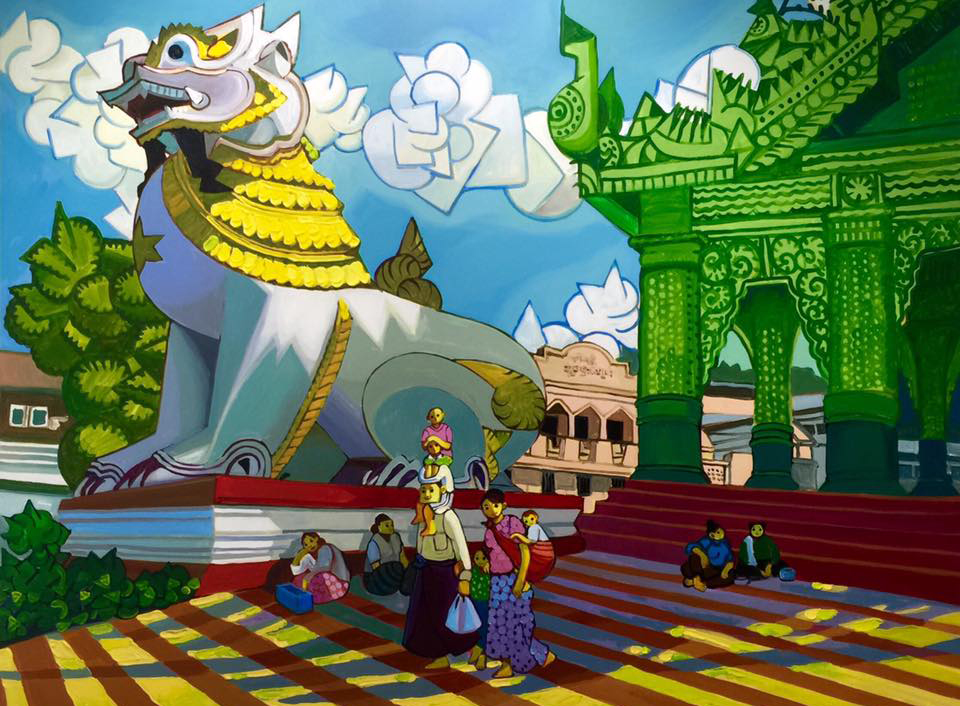
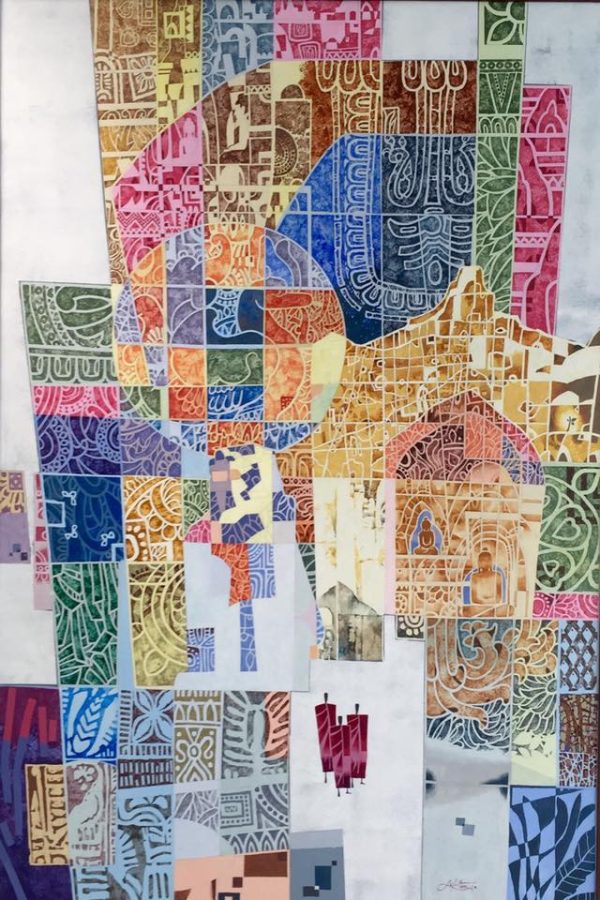
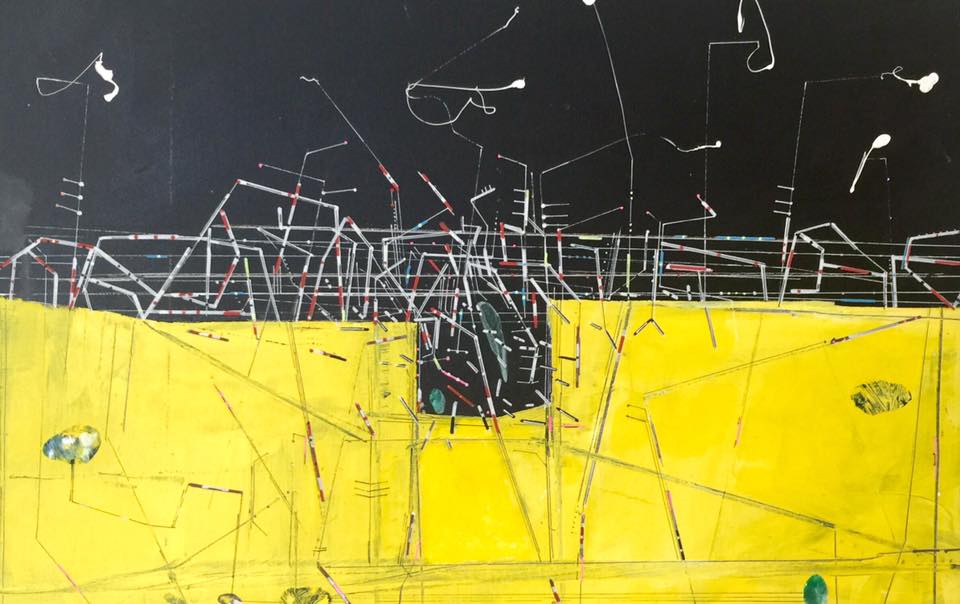
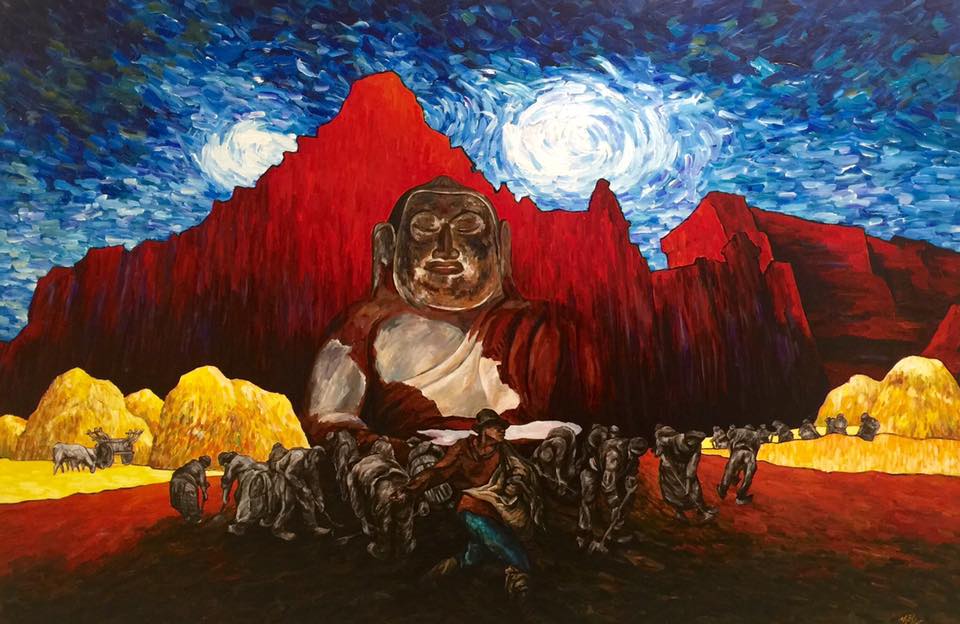
Yangon Art Expo 2017 has gathered the works of 72 artists from the past 60 years. This is a rare opportunity for art lovers to observe how Myanmar's art movement changed over time.

The exhibition organized by Culture 2 All, an Italy-based cultural promotion organization, showcases the trademark impressionist works of U Lun Gywe, typical Myanmar cultural works by celebrated watercolor artist U Marlar, paintings of Sandar Khaing, who is known for her nude series, installation works by Myat Kyawt, and street art by Ko Ko Maung.

Yangon Art Expo 2017 has gathered the works of 72 artists from the past 60 years.

"This expo intends to provide aesthetic delight by creating a vibrant, open and independent urban environment," said Mauro Salvemini, chairman of Culture 2 All, at the opening ceremony of the expo on Saturday, which was also attended by the Italian ambassador to Myanmar, and Union minister for Religious Affairs and Culture U Aung Ko.

Culture 2 All also curated the works of 10 Myanmar artists in Milan last year.

Yangon Art Expo 2017 has gathered the works of 72 artists from the past 60 years.

"People barely collect contemporary art in our country while even our neighbor Thailand has a contemporary art museum. I am pleased with this expo, which comes at a time when we are trying to showcase our contemporary artistic creations to the world. I want the government to collect those paintings and establish a museum," said artist Ni Po Oo.

The exhibition will be held until Nov. 12. A total of 144 paintings are on display, priced between US$500 and $15,000. The painters receive 70 percent of the proceeds and the remaining 30 percent will be spent on a cultural heritage and villages program, one of the projects of Culture 2 All to be carried out next year.

The post Yangon Art Expo Showcases Decades of Myanmar Art appeared first on The Irrawaddy.

Tatmadaw Troops Killed and Wounded in Arakan Army Ambush

Posted: 09 Nov 2017 02:26 AM PST

YANGON — At least 11 Myanmar Army troops were killed and 14 wounded during a clash with the Arakan Army (AA) in the western township of Paletwa in Chin State, according to military sources in Parliament.

Retired Myanmar Army Lt-Gen Thaung Aye, a Lower House lawmaker, confirmed the causalities and injured. Two army officers and nine troops from other ranks died, he said.

"It was not a good situation," he added.

Lt-Gen Thaung Aye explained the troops were ambushed while traveling by boat along the Kaladan River, which runs through Chin and Rakhine states from east India.

One university student was killed and four women were injured in the attack, as they were also on board the military boat, according to local sources.

"[The AA] should not act like that. It is time for the government to make a strong decision to eliminate them," said Lt-Gen Thaung Aye.

Fighting between the two sides has escalated since the first week of November, with clashes on Wednesday north of Paletwa in Nom Bu and Nge Chest villages, where the AA issued a message to locals on Nov. 5. It said the Tatmadaw has intensified offensives in the area and warned people only to travel if necessary.

The AA attacked three Myanmar Army, or Tatmadaw, boats on Wednesday, according to a statement posted on the AA Facebook page, but the message did not mention any casualties or wounded.

The ethnic armed group targeted the Tatmadaw's Light Infantry Battalion 563 under the control of the Western Command, based in Rakhine State, according to the statement, adding that clashes have broken out in several places on the India-Myanmar border.

"We heard 10 Tatmadaw battalions were coming as reinforcements. They came by boats," said lawmaker U Kwe Thang of Kanpetlet constituency in Chin State.

The Irrawaddy was unable to verify reports of ground fighting. Defense ministry spokesperson Gen Aung Ye Win declined to comment.

About 300 civilians in Paletwa fled the clashes on Nov. 3, according to local sources, and sought shelter at a Buddhist monastery.

Paletwa is an ethnic Chin township that borders Rakhine State. The AA uses the area as a base, crossing the Kaladan River to enter Rakhine.

Many Chin locals dislike the AA using the township as a base, but the area has become a strategically important location for the group, which mainly stays in Kachin State's Laiza town—the headquarters of the Kachin Independence Army.

The AA has not signed the nationwide ceasefire agreement nor does it have a bilateral ceasefire agreement with the Tatmadaw. It is part of ethnic bloc the Northern Alliance and bases itself in Kachin and northern Shan states.

The Tatmadaw does not officially recognize the AA and in statements refers to it as a "Northern Alliance member."

The ethnic armed group has joined conflicts against the Tatmadaw in Kokang territory and Kachin State, where the AA recruited many members in the jade mining area of Hpakant. Arakanese migrant workers in Mongla near the Chinese border and northern Shan State are also a source of recruitment for the group.

The post Tatmadaw Troops Killed and Wounded in Arakan Army Ambush appeared first on The Irrawaddy.

Lower House Approves Internet-monitoring Body to Curb ‘Fake News’, Hate Speech

Posted: 09 Nov 2017 12:03 AM PST

NAYPYITAW — Myanmar's Lower House approved a motion on Wednesday establishing a body to monitor racial and religious hate speech online, and curb the spread of disinformation on social media. The body will be overseen by the Ministry of Transportation and Communications.

"We'll form a monitoring body in coordination with the President's Office and the Attorney-General's Office. We will ensure that the monitoring doesn't infringe on the privacy or fundamental rights of citizens as enshrined in the [2008] Constitution," minister U Thant Sin Maung told lawmakers.

Facebook is the most popular social media platform in Myanmar, with nearly 14 million users, according to a ministry estimate. Concerned that the site is becoming an organ for disseminating hate speech, the ministry has been negotiating with Facebook officials to find a way to monitor use of the platform, the minister said.

The minister said that everyone has an obligation to use social media responsibly, adding that the government cannot fight hate speech alone.

Facebook claims users in Myanmar do not properly read the platform's terms and conditions of use before creating accounts, and has urged the government to educate the public on the proper use of social media.

The motion to establish the monitoring body was brought before the Lower House late last month by Daw Yin Min Hlaing, the National League for Democracy (NLD) lawmaker for Magwe Region's Gangaw Township. The lawmaker argued that irresponsible use of the Internet could disrupt law and order and corrupt morals—a view shared by the transportation and communications minister.

"It is not about levying a tax [on Facebook users], invading people's privacy, or denying the right to information. It is about limiting the spread of disinformation, hate speech and racial and religious incitement," the NLD lawmaker told reporters on Wednesday.
Military representative to the Lower House Maj Ne Win proposed registering SIM cards and Facebook users as additional measures to tackle hate speech. He called for legal action against those who intentionally spread false news on social media.

NLD lawmaker U Win Win of Minbu Township stressed the need for safeguards to ensure Internet surveillance does not violate the law protecting citizens' privacy and security, which was enacted by the previous session of Parliament.

According to data released by the Transportation and Communications Ministry, as of September Myanmar's SIM card usage stood at 56.127 million, equivalent to 108.56 percent of the population. Internet usage was 46.39 percent, with the vast majority of that occurring on social media platforms including Facebook, Messenger, Viber, and Twitter.

"Attempts to blacken the name of individuals or organizations or instigate racial and religious sentiments disrupt law and order and destabilize the country," the minister said.

Translated from Burmese by Thet Ko Ko

The post Lower House Approves Internet-monitoring Body to Curb 'Fake News', Hate Speech appeared first on The Irrawaddy.

Trump to Talk Trade and North Korea with Chinese Leader Xi

Posted: 08 Nov 2017 10:06 PM PST

BEIJING — North Korea and trade will likely top the agenda when US President Donald Trump and Chinese President Xi Jinping sit down for formal talks on Thursday, a day after Trump warned Pyongyang of the grave danger of developing nuclear weapons.

In a show of the importance China puts on Trumps first official visit, Thursday mornings welcoming ceremony outside Beijing's Great Hall of the People overlooking Tiananmen Square was broadcast live on state television – unprecedented treatment for a visiting leader.

Trump and Xi hit it off at their first meeting in April at Trump's Mar-a-Lago resort in Florida and continued their "bromance" on Wednesday with an afternoon of sightseeing together with their wives. However, deep divisions persist over trade and North Korea.

And while Xi is riding high after consolidating power at a twice-a-decade Communist Party Congress last month, Trump comes to China saddled with low public approval ratings and dogged by investigations into Russian links to his election campaign.

Trump has ratcheted up his criticism of China's massive trade surplus with the United States – calling it "embarrassing" and "horrible" last week – and has accused Beijing of unfair trade practices, fuelling worries of increased tension between the world's two largest trading countries.

For its part, China says US restrictions on Chinese investments in the United States and on high-tech exports need to be addressed.

Roughly $250 billion in deals with US companies are expected to be announced during the visit, people familiar with the matter said, with several corporate CEOs in Beijing as part of a delegation led by US Commerce Secretary Wilbur Ross.

Some in the US business community have expressed worry that contract wins could come at the expense of resolving long-standing complaints over market access restrictions in China.

"This shows that we have a strong, vibrant bilateral economic relationship, and yet we still need to focus on leveling the playing field because US companies continue to be disadvantaged doing business in China," said William Zarit, chairman of the American Chamber of Commerce in China.

Trump railed against China’s trade practices during the 2016 US presidential campaign and threatened to take action once in office. But he has since held back on any major trade penalties, making clear he was doing so to give Beijing time to make progress reining in North Korea.

A US official said both sides are "in sync" about wanting to minimize friction during the visit and recreate the positive tone of the Mar-a-Lago summit.

Trump is principally pressing China to tighten the screws further on North Korea and at least modest progress is hoped for, although there are no immediate signs of a major breakthrough, the official said.

Trump was not expected to put much emphasis in his talks with Xi on thorny issues like the disputed South China Sea and self-ruled Taiwan, claimed by China as its own, although the two presidents' aides may deal with those matters privately, the official told Reuters, speaking on condition of anonymity.

Tough Language

China has repeatedly pushed back at suggestions it should be doing more to rein in North Korea, which does about 90 percent of its trade with China, saying it is fully enforcing UN sanctions and that everyone has a responsibility to lower tensions and get talks back on track.

Trump used some of his toughest language yet against North Korea in a wide-ranging address in Seoul on Wednesday that lodged specific accusations of chilling human rights abuses, although he offered no evidence to support the accusations.
He also called on countries around the world to isolate Pyongyang by denying it "any form of support, supply or acceptance."

There was no immediate public mention of North Korea from either Trump or Xi as they wrapped up their festivities on Wednesday at the Forbidden City, where Xi gave Trump the rare honor of a personal tour of the UNESCO World Heritage site.

"Looking forward to a full day of meetings with President Xi and our delegations tomorrow. THANK YOU for the beautiful welcome China! @FLOTUS Melania and I will never forget it!" Trump said on Twitter after the visit and dinner there.

Twitter is blocked in China, and his use of the service prompted many people to comment on Chinese social media how he managed to evade China's tough internet controls. Many people use VPNs to skirt the restrictions.

Chinese state media praised the tone of the initial get-together on Thursday, part of what China has promised will be a "state visit plus" for Trump.

"Trump seems to be pragmatic on his Beijing policy, and has no interest in ideological diplomacy. He hasn't used the issue of human rights to make trouble for China so far, and this means the Sino-US relationship can focus on substantive matters," influential tabloid the Global Times said in an editorial.

The post Trump to Talk Trade and North Korea with Chinese Leader Xi appeared first on The Irrawaddy.

Myanmar Cardinal Urges Pope Francis to Avoid Use of the Term ‘Rohingya’

Posted: 08 Nov 2017 09:13 PM PST

YANGON — Myanmar's most senior Catholic prelate has urged Pope Francis to avoid using the term 'Rohingya' during a visit this month, when he is expected to raise the humanitarian crisis faced by the Muslim minority after a Myanmar Army offensive in August.

The pope is set to visit largely Buddhist Myanmar from Nov. 27 to Nov. 30, before going to Bangladesh, a predominantly Muslim neighbor where more than 600,000 Rohingya have fled to take shelter in refugee camps.

In the first visit by a pope to Myanmar, Francis will meet Daw Aung San Suu Kyi, the Nobel peace laureate who leads a civilian administration that is less than two years old, the generals it has to share power with, as well as leading Buddhist monks.

Cardinal Charles Maung Bo told Reuters the pope would raise the need to provide assistance to the Muslim minority, saying, "These are people who are suffering and these are the people in need of help now."

Francis has used the term Rohingya when he has spoken about their suffering in the recent past. But Daw Aung San Suu Kyi has asked foreign leaders not to use the term Rohingya, because in her view it is inflammatory.

Bo, appointed by Pope Francis in 2015 as Myanmar's first and only cardinal, said church leaders in the country had advised him to sidestep the divisive issue of the name.

"We have asked him at least to refrain from using the word 'Rohingya' because this word is very much contested and not acceptable by the military, nor the government, nor the people in Myanmar," Bo said in an interview in Yangon
.
It was unclear if the pope would heed the advice, Bo added, but if he did so, it would not be to politicize the issue or endorse the Rohingya right to Myanmar citizenship, "but he just wants to identify this particular group who call themselves 'Rohingya'."

Many people in Myanmar regard the largely stateless Rohingya as illegal immigrants from Bangladesh, and they are excluded from the 135 "national races" recognized by law.

Regardless of Myanmar's sensitivities, however, the United Nations and United States continue to call them Rohingya, upholding their right to self-identify.

Importance of Dialogue

Francis will highlight the importance of resolving the refugee crisis through dialogue between Myanmar and Bangladesh and with the help of the international community, Bo added.

Myanmar has said Rohingya who can prove they were residents would be allowed to return, but the two countries have still to agree how the repatriation should be carried out.

"These are the people who do not enjoy the citizenship and are somewhat unwanted in both countries," said Bo, referring to Myanmar and Bangladesh.

"They are also human beings, they have a human face and they also need human dignity, so eliminating or killing any one of them, that’s not justified…," Bo said, referring to the group as "our brothers and sisters."

Francis will celebrate a mass in Yangon that is expected to draw around 200,000 people, Bo said, adding that Buddhists, Muslims, and those of other faiths were welcome to attend.

Myanmar has about 700,000 Roman Catholics, said Bo, from among a population of more than 51 million.

The United Nations has denounced the violence in Myanmar's northwest over the past 10 weeks as a textbook example of ethnic cleansing, a charge Daw Aung San Suu Kyi's administration has denied, while saying accusations of rights abuses should be investigated.

Myanmar's military says its counter-insurgency clearance operation was provoked by Rohingya militants' attacks on about 30 security posts on Aug. 25.

In the following days, the pope spoke about "the persecution of our Rohingya brothers and sisters" and asked Catholics to pray for them, adding that they should be given "their full rights."

The post Myanmar Cardinal Urges Pope Francis to Avoid Use of the Term 'Rohingya' appeared first on The Irrawaddy.

China Says Will Keep Talking to Myanmar Over Stalled Dam Scheme

Posted: 08 Nov 2017 09:04 PM PST

BEIJING — China said on Wednesday it will continue to talk to Myanmar about a controversial stalled dam project, after Myanmar's new energy minister cast doubt over the scheme.

Valued at US$3.6 billion, the Myitsone dam project in the north of Myanmar has been a sticking point between the two countries since the previous military-backed government suspended work in 2011.

Reuters reported in April that officials in China and Myanmar were discussing alternative options that would allow Myanmar to scrap the massive project amid environmental concerns.

Big hydropower dams are not a priority in Myanmar's strategy to tackle chronic power shortages, Energy Minister Win Khaing told Reuters on Tuesday.

Speaking in Beijing, Chinese Foreign Ministry spokeswoman Hua Chunying said China's position on the Myitsone dam had not changed, which was that China had always upheld deepening cooperation with Myanmar on a mutually beneficial basis.

"The Myitsone hydropower station is a commercial cooperation project both sides have already agreed upon, and has already been through a complete approval process," Hua told a daily news briefing.

"We will continue to maintain communication with the Myanmar side and proactively and appropriately handle the problems or difficulties which arise during cooperation on the project, to allow relevant cooperation to continue to develop healthily and stably," she added.

The proposed dam, on the upper reaches of the Irrawaddy River in Kachin State, would have sent most of its power across the border to China's Yunnan province, which now has an oversupply of electricity as it switches to less energy-intensive industries amid an economic slowdown.

A government panel set up in August 2016 was still reviewing the dam, Myanmar's energy minister said, adding the government was in dialogue with the Chinese operator, State Power Investment Corp subsidiary Yunnan International Power Investment.

The post China Says Will Keep Talking to Myanmar Over Stalled Dam Scheme appeared first on The Irrawaddy.

Lonely Planet Founder Urges Myanmar Youth to Travel

Posted: 08 Nov 2017 08:58 PM PST

Lonely Planet founder Tony Wheeler first wrote about Myanmar (then Burma) in the massively successful Southeast Asia on a Shoestring, released in the 1970s.

The Irrawaddy's Zarni Mann met him at the fourth Irrawaddy Literary Festival in Mandalay held from Nov. 3-5, where they discussed Myanmar's developing tourism industry.

Tell me about your first time traveling to Myanmar.

In 1974, me and my wife Maureen flew into from Bangkok because flying was the only way in. It was when I was traveling around Southeast Asia. Back then, we could only get a seven-day visa. We weren't allowed to go to many places as well. There weren't many places to stay, too. In a week, there are only a few things we could do. So, we took a train to Mandalay from Yangon, and traveled to Bagan from Mandalay by bus. We were there for a couple of days and took a train back to Rangoon. What I remember is that the train took an incredible amount of time to reach Rangoon: it was about 24 hours or something. That was a terrible train. We took the wrong train. We should have taken another way so that we could have visited other places.

In Bagan, during that time, there were lots of little guest houses in the center of the old city. All the back packers stayed in those small guest houses. They were very nice and people were friendly. Then, the military government moved them away. They were all shifted out from central Bagan to the new area. That happened during my second visit.

Traveling around the city and other places back then, there was little transportation. The roads were empty. And most of the cars running were very old—old English cars and some Japanese cars, I think. And there were old Chevrolets.

During that time, nobody wanted to fly, because the only airline, Union Airline, was always crashing. There were so many crashes, nobody wanted to risk their lives. So people used to take the train or busses, but they are very slow and take a long time.

Are there any memorable moments from traveling during that time?

On the second visit, I heard there was a possibility of getting a small truck and to travel that way. It seemed a very good way for me, because I didn't want to wait for the trains. It was in 1983. I arrived late in Rangoon and everything was closed. I walked to my hotel, the tourist office building by Sule Pagoda. Somebody just walked in and offered me a truck for hire, late at night. We hired it to travel to Rangoon, Prome, Bagan, Mandalay, Maymyo [now Pyin Oo Lwin] and Inle Lake.

Since it was difficult to buy petrol outside of Rangoon, there were lots of petrol containers at the back of the truck. When we got to Prome, it was getting late and that man, the driver, said we were not allowed to go as Prome was not open to foreigners. But once you are inside Prome it is okay, he said. There were soldiers at the check points on the way into Prome, so he told us to lie down on the floor of the back of the truck and put a sheet of tarpaulin over us. It was quite an adventure.

Since you are also a board member of the Heritage Trust Foundation, what do you think about the conservation and restoration work of earthquake-impacted pagodas and temples in Bagan?

Bagan received very bad restoration during the military government. They wanted to paint it all gold. There are already many suggestions and messages on what is good restoration and what is bad. Hopefully the responsible person will listen and not repeat the same mistake.

If people try to ruin the ancient monuments such as by writing and painting with white inks, people need to shame them. If they keep doing it, the monuments should not be allowed to be touched and would be better fenced off. Or someone has to watch it and clean them off as soon as people put their names on them with white inks.

There was an example of a Chinese youth, who wrote something on the monuments in Egypt. People wrote about him on social media to shame him and when he was back in his country, he got into a lot of trouble.

There are rules and regulation on what people should wear visiting certain monuments. Some of the tourists do not want to follow that. We see that in many countries. If people are so stupid not to know that, you have to keep telling them or occasionally arrest them.

How does it feel to be the author of the first edition of Lonely Planet and to have traveled through so many countries over the years?

I wrote the first edition of the book, and other editions. There were also other people who helped write the books. In that first edition, there was very little information. I look back on it now and I find it wasn't very good because there was nothing else. There was only about a little bit of history, and about the limited number of the places you could stay. We could only go to Mandalay, Bagan and Yangon. I didn't even know whether they allowed people to go to Inle Lake back then. It was very restricted to travel around [the country].

I was very proud to be the first one who could do the introduction of this country through Lonely Planet. Since there was not much information, I thought I was opening doors to the world. And I believe my articles and my travel experiences have somehow brought the interest of travelers. Now, there are lots of books and the country is also open to visitors. I enjoy visiting Burma very much. Because, there is that feeling that you are going to something unknown.

In your opinion, what is needed to boost Myanmar's tourism industry?

There are still many places where people do not visit. For example, I've been to Mrauk-U and it is a very nice place. Until now, there are only a few people who visit there, maybe because there is some unrest in Rakine State. It is the same in the other places like Karen, Kachin and Chin states. If there is peace in the country, transportation and communication will be better. And if there is easy access to visit through borders this will attract more visitors.

And people who are doing business have got to be honest with the people. To be more attractive to people, there should be easy access for visitors. I'm talking about visas. Making visas easy is the biggest step for tourism.

What is your opinion on suggestions not to visit a country like Myanmar because of the sanctions, and now, the humanitarian matters relating to the unrest in Rakhine State?

There are two things: one thing is that there is not as much danger as people say there is, but sometimes where the government says it is dangerous. If you want to visit a place, you have to decide whether it is safe for you. I'm not going to tell people you should go there. But if you wanted to go there, you should look out there for stories on what has happened and what is happening there. Generally, I go.

I've been to Pakistan, which people said I should not go. But when I arrived there, things were not so bad as they said.

I would also like to say to the Burmese youth who start traveling, to go out there. See the world. You have to be wealthy to travel, of course. Travel needs a lot of money. If you do, you are going to understand more. You are going to explore more about the different aspects of people, you will learn more about other cities and countries. And from that you will enrich your knowledge.

This interview has been edited for clarity and brevity.

The post Lonely Planet Founder Urges Myanmar Youth to Travel appeared first on The Irrawaddy.