Tuesday, June 20, 2017

The Irrawaddy Magazine

The Irrawaddy Magazine


Triple-Distinction Prison Graduate: ‘I Decided Not to Give Up My Education’

Posted: 20 Jun 2017 08:14 AM PDT

MANDALAY — During the 2016-2017 academic year, Oh Bo prison in Mandalay opened the first in-prison examination center, where the inmates could prepare for matriculation exams. Eleven inmates signed up to take the exam and seven passed. Of those, five inmates passed with honors. Ma Shun Lae Wai Kyaw, 19, from Kho Leik village, in Kachin State's Shwe Gu Township, earned three distinctions, while the four others each passed with one distinction.

Ma Shun Lae Wai Kyaw is two years in to a 10-year sentence for drug charges. The Irrawaddy's Zarni Mann talked with her in Oh Bo prison on Tuesday.

How did you feel when you heard about your exam results?

I was so excited on the day the results were out. When I was told by the prison officers that I had passed the exam with three distinctions—Geography, History and Economics—I was overjoyed, because I thought that I would receive only two distinctions. At the same time, I was sad, because I am in prison and I know I will not have the chance to attend a professional university, although I scored high and am eligible for one.

The prison officers let me call my home and my parents and two elder sisters were surprised and happy for me. I take this as giving back the gratitude to my farmer parents who have worked tirelessly for me.

Will your parents come to meet you? How did they react to your success?

Since we are poor and our village is far from Mandalay, my family can come meet me only once every two or three months. Next week, the prison officers will do an honorary ceremony for all of us and then my family will come see me…My parents said they are so proud of me.

This was my second attempt to enter the exam. In the 2012-2013 academic year, I failed. I was arrested in the years after that.

What happened to you two years ago? How were you arrested?

I was working as a salesgirl at a store when the police came and seized drugs and wanted to arrest the store's owner. Since they didn't find the owner, I was arrested with 15 WY [methamphetamine] tablets and was charged under the Narcotics Law. I received [a sentence of] 10 years imprisonment. About two years have been served.

How did you feel at that time?

A: I was so afraid and so sad during the trial. When I was sentenced to 10 years, I was so disappointed and felt I had no future. After spending one year in the prison, our wardens told us we could re-enter the matriculation exam, so I joined the classes. The prison superintendent U Cho Win Tun and Warden Daw Tin Tin Maw encouraged us a lot, saying that we still could study even though we are in prison. So I decided not to give up my education.

How are the classrooms in the prison? Are there any difficulties studying there?

The prison officers made a hall into the classroom. There are many students studying, starting from Grade 6. For the matriculation class, we have a separate room. The teachers and doctors who are in prison teach us, and teachers from outside also come to us. As the exam date drew near, the prison officers gave us separate rooms to study in, and the teachers cared for us like their own children. We received every required material, from textbooks to stationery.

As you have now passed the matriculation exam with three distinctions, what would you like to do, concerning further studies?

I would like to go to the University of Economics. I believe my total marks will make me eligible to enter that university. I want to enjoy the life of a university student like the others do. I want to be a tutor in that University of Economics after I graduate. However, my dreams and my future are in the hands of the government officials, for I am a prisoner and I still have many more years to serve. I think I have to go to the University of Distance Education like my friends here.

I pray every day that the government officials will award us with a special chance to go to university like other students do. I wish for my prayers to be granted.

Most of the young people here who entered the exam, including you, were charged under the Narcotics Law. What would you like to tell others, concerning this?

I would like to urge youth to stay away from drugs. Do not use it, do not sell it. Please take us as an example for your life. Once you have a relationship with drugs, your life will become complicated and it will become a great barrier for your future goals and your dreams.

The post Triple-Distinction Prison Graduate: 'I Decided Not to Give Up My Education' appeared first on The Irrawaddy.

The Art of Politics

Posted: 20 Jun 2017 07:20 AM PDT

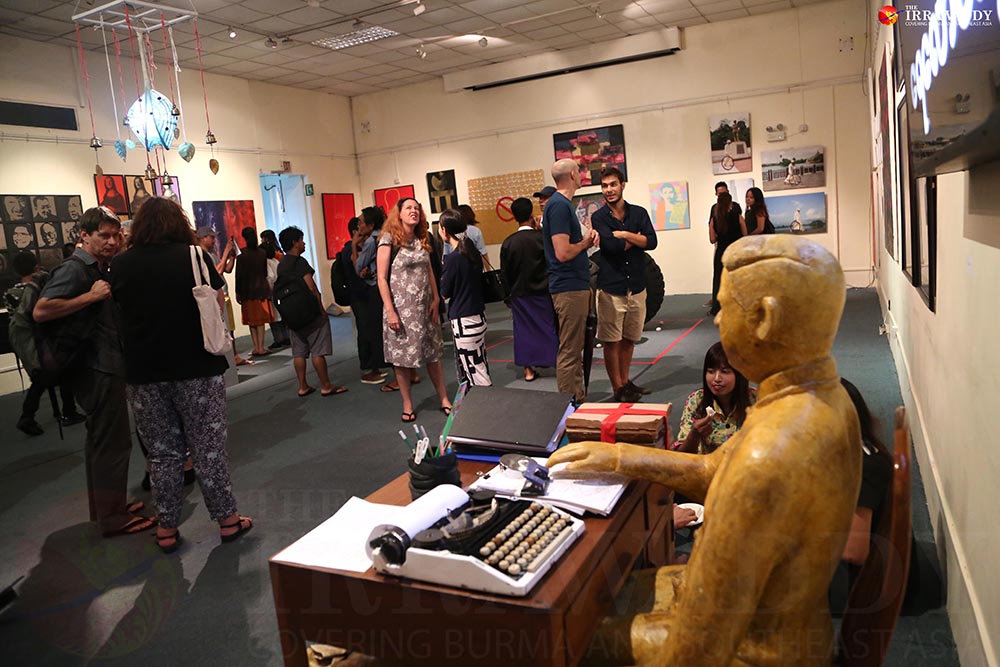
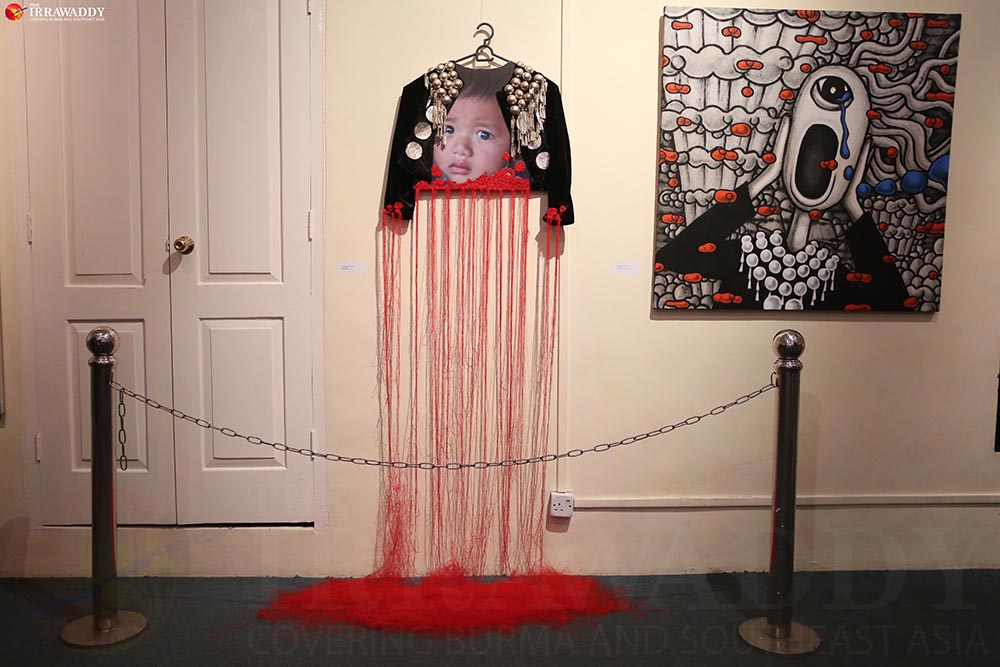
YANGON — Offering their personal reflections on political changes in Myanmar over the past decade, dozens of artists, sculptors, installation artists and photographers are showcasing a wide array of art at the American Center in Yangon.

At the entrance of the exhibition hall, Pe Nyunt Wai's paintings of Daw Aung San Suu Kyi hang on the wall to mark the birthday of Myanmar's de facto leader and State Counselor, who turned 72 on Monday.

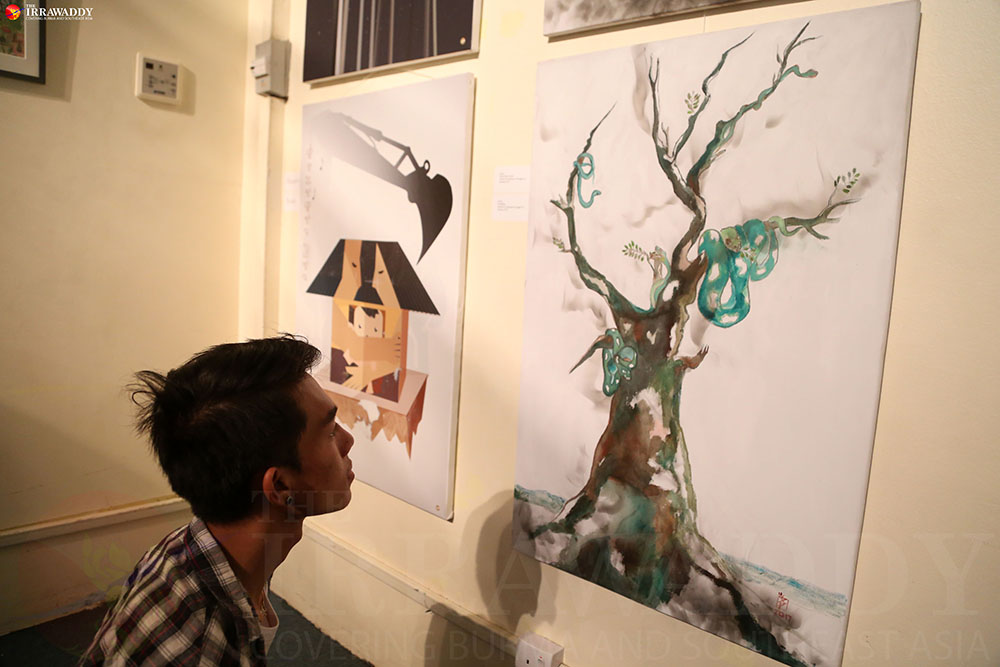
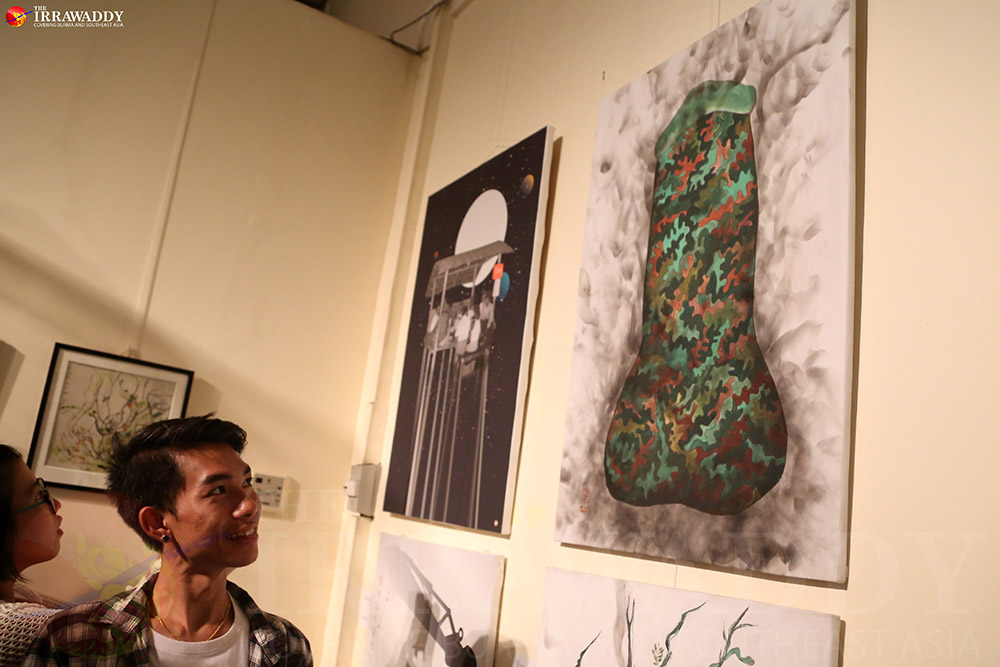
There also hang two paintings by ethnic Karen artist Zoncy that reflect the ongoing civil war that the country has experienced since its independence in 1948.

The first painting shows a penis, depicting the plight of women who were raped during the war.

The second painting shows an old, bare tree with snakes curling around it.

"This tree is situated at U Bein Bridge in Mandalay. I thought it was too dry to survive. But, whenever I go to U Bein, it is still there. That tree is like our country. The snakes on the tree eat any new buds and never leave," she said.

The art exhibition 'Artists Beyond Boundaries' is sponsored by the American Center and features the works of 25 artists. The first edition of the exhibition was held about 10 years ago at the residence of the US Chargés d' Affaires.

This exhibition showcases works that were banned by the previous government or altered fearing that the former government would not allow the originals. The exhibition continues until June 29.

Htein Lin's installation is a focal point at the exhibition, as he applies his sense of humor to highlight the deep-rooted bureaucratic practice of grease payments in government offices.

On a lightbox behind his installation is written 'Keiq-sa pi-yin, ye-laung-keh-ba' which translates as 'When your business is completed, please pour water.' This is a phrase regularly found in bathrooms to encourage users to flush. But at the same time, water is a slang term for money in everyday Burmese language.

Htein Lin put these words behind an office desk, with a long hand extending 'under the table' to shine a humorous spotlight on the ongoing challenges that Myanmar still faces in combatting corruption.

"As you know, bribery is deep-rooted in Myanmar. 'Pour water' is a phrase you can hear at government offices. And the same phrase is used in bathrooms. So, I linked the offices and toilets," Htein Lin said.

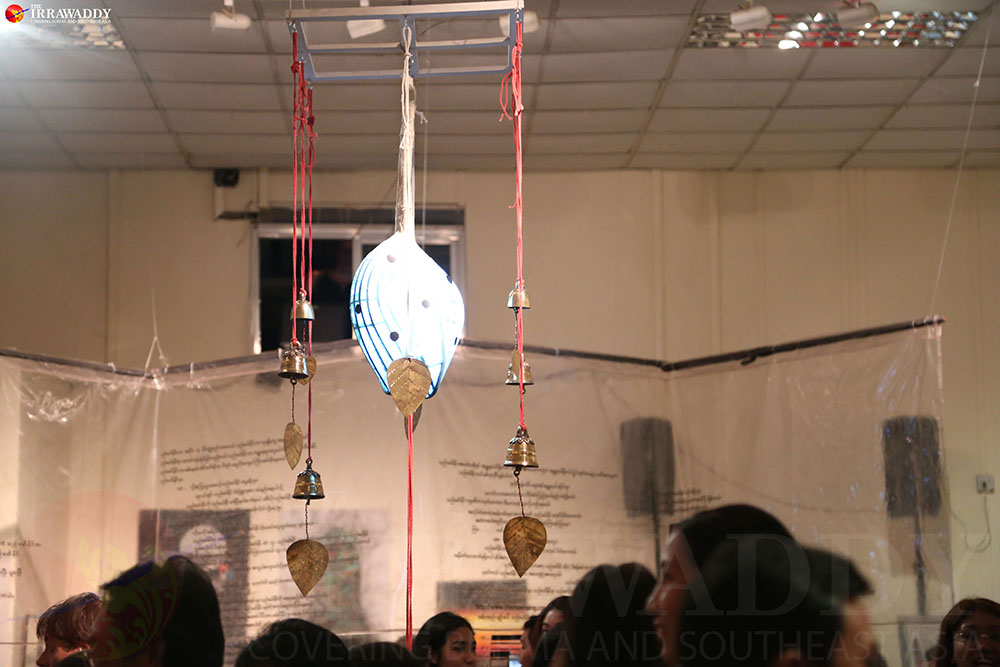
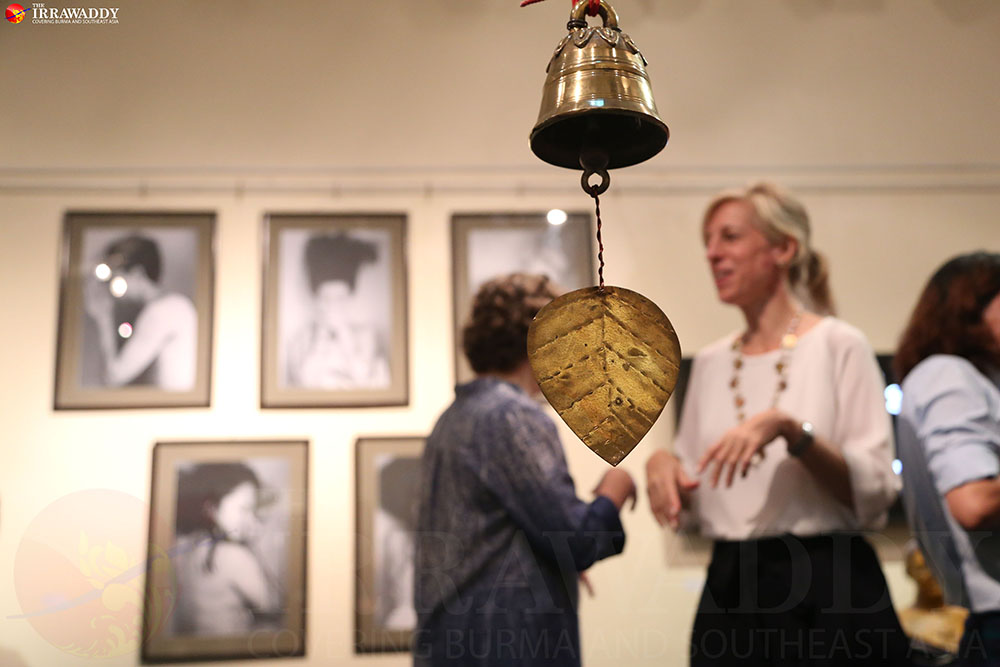
In his installation, modern sculptor Chan Aye hangs Bayan leaves and bronze bells – religious Buddhist objects – from the ceiling along with a playback of ringing bells from Shwedagon Pagoda.

"My work is in response to the negative impression of Buddhism created by some Buddhists at present," said Chan Aye, referring to the activities of some nationalist groups.

"In fact, Buddhism is an ism of loving-kindness. It is peaceful," he added.

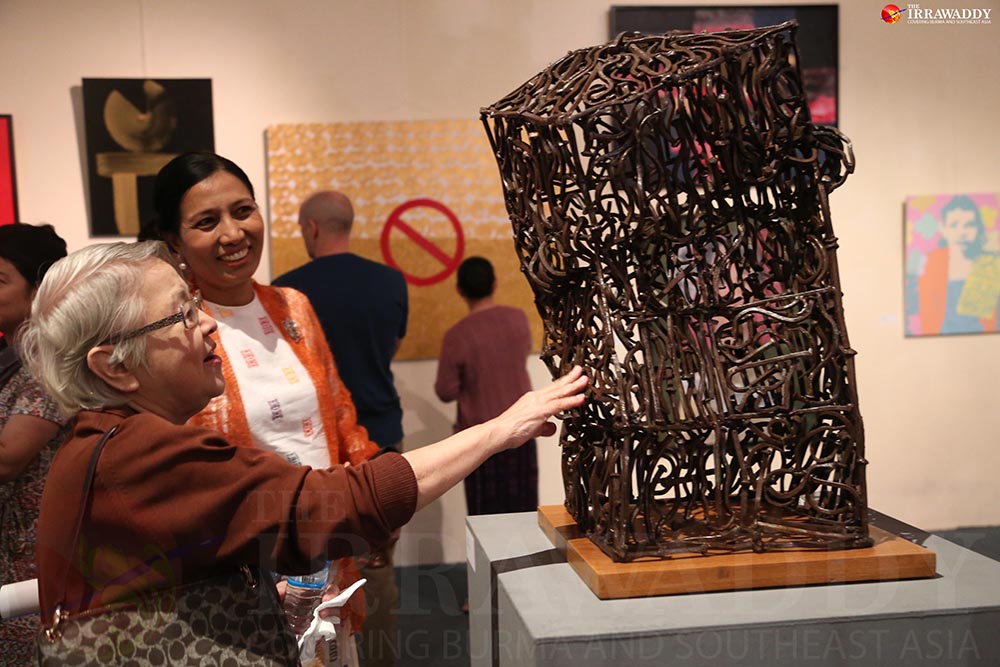
Another sculptor Sunny Nyein showcases a sculpture made of 645 iron rods, which refer to lawmakers under U Thein Sein's administration. This work reflects their absence from politics since they left Parliament.

Three iron rods are distinct in the structure, which refer to three key players—U Thein Sein, the Tatmadaw and Daw Aung San Suu Kyi.

"These three are key. It has been one year that I haven't seen former lawmakers," he said.

"We see through the exhibit that art can be a very powerful tool in expressing a community's struggle and achievements. We feel freedom of expression is a vital part of any democracy and we continue to encourage and support freedom of speech in all its forms throughout Myanmar," said Kristen F. Bauer, Deputy Chief of Mission at the US Embassy in Myanmar.

Translated from Burmese by Thet Ko Ko.

The post The Art of Politics appeared first on The Irrawaddy.

Yangon to Celebrate International Yoga Day

Posted: 20 Jun 2017 06:59 AM PDT

RANGOON— Some 400 yoga enthusiasts are expected to take part in a yoga practice in Yangon's People's Park on Wednesday morning to celebrate the third International Day of Yoga.

"We aim to promote yoga in Myanmar, which can help improve the health of our people," said Daw Kyi Kyi Lwin, an organizer of the event, adding that it will take place between 6 a.m. and 8 a.m. and is free to attend.

Daw Kyi Kyi Lwin also invited Yangonites to attend the free classes each morning at People's, Kandawgyi and Mahabandoola parks, offered by experienced Myanmar yoga trainer U Khin Maung Swe and his assistants.

The UN proclaimed June 21 each year International Day of Yoga on Dec. 11, 2014.

The Indian Embassy in Yangon, along with other yoga institutions in Myanmar, will organize a yoga demonstration on Sunday at People's Park from 8 a.m. to 10 a.m. to mark the day.

The post Yangon to Celebrate International Yoga Day appeared first on The Irrawaddy.

Displaced Squatters Allege Fraud by Village Committee

Posted: 20 Jun 2017 06:52 AM PDT

YANGON – A group of displaced squatters in Yangon's Hlegu Township have opened a fraud case against a 27-member Aung Yadana village development committee that sold them land already owned by the government, one complainant told The Irrawaddy on Monday.

Police deputy Maj Maung Maung Oo of Hlegu police station confirmed that the case was filed last week. The head of the committee, U Pyone Cho, is named in the case and is believed to be on the run.

Thousands of houses have been built in recent years along the Yangon-Naypyidaw highway, making up such villages as Yadana Aung, Aung Yadana, Sein Lan, Gant Gaw Kyun, Aung Thu Kha and Sa Khum Gyi. The authorities recognize many of the residents as "landlord squatters," or local property owners who illegally live on government land and then resell it to others.

The department of Yangon Division's director general U Yu Khaing estimated that more than 5,000 thatched houses have been constructed on government-owned land and that authorities cleared 90 percent of the structures in Hlegu within one week. The Irrawaddy reported that on June 12 alone, the authorities demolished around 400 homes in Kyauk Aing, located near the Yangon-Naypyidaw highway.

Five of the nine complainants in the Aung Yadana case, including U Thein Aung, who spoke to The Irrawaddy, went to the divisional government office on Monday morning. Accompanied by other squatters, they intended to present details to officials of how they had been misled by the Aung Yadana village development committee when they purchased land. However, police barred them from entering the building and instructed them to make an appointment.

U Thein Aung said that nearly 1,500 evicted people had constructed temporary shelters from the materials left when their homes were demolished by the authorities, while others were staying in monasteries like Ye Baw in Hlegu Township's Tar Son village, which has been providing food, transport and accommodation for displaced people.

"Hundreds of people are living on the roadside without a good roof, and parents had already registered their children at the government schools," U Thein Aung said. "We just want to know how the regional government will oversee these challenges. They are real homeless people."

The Ministry of Construction and private developer Alliance Stars Group of Companies signed a profit-sharing contract in 2016 lasting eight years. Their project in Hlegu Township, "Eco Green City," lays out plans for affordable housing, an international school, hospital, golf course, and rest area. Construction is scheduled to begin after the squatters in the area have been removed.

U San Tun, a local advocate for the homeless, was involved in the process of proposing that the Union government establish a new 100-person village in Aung Yadana. However, the efforts were reportedly interrupted when the village development committee re-sold government land plots to brokers and the community rapidly increased.

"The government should have examined who were real squatters before demolishing the houses. Now, the real homeless people have been left in the cold, including a woman who recently delivered a baby," U San Tun said.

While one member of the Aung Yadana village development committee was reportedly arrested, U San Tun said that authorities have not been able to locate the other members, and that they "absconded" before the squatter houses were destroyed.

The post Displaced Squatters Allege Fraud by Village Committee appeared first on The Irrawaddy.

Miners Flee Conflict in Kachin State

Posted: 20 Jun 2017 05:07 AM PDT


TANAI TOWNSHIP, Kachin State — With the recent fighting between the Kachin Independence Army (KIA) and the Tatmadaw, thousands of locals and workers fled seven mining areas around Tanai Township in Kachin State.

Nearly all of the small huts in the amber mining village of Noi Je Bum Patserm Maw were abandoned on June 15—the deadline given by the Tatmadaw for people to leave the area or else be recognized as "insurgents," according to leaflets dropped from the Myanmar Army's helicopters.

Some people, however, ignored the warnings and remained, in hope of working the empty mines, according to KIA mining officers. The mineshafts are lined close to each other—some run up to 150 feet—and the bodies of two men were recovered from a shaft and buried on June 15, said the mining officers.


Miners left their possessions behind in their rush to escape the conflict. (Photo: Lawi Weng / The Irrawaddy)


The pair had hidden in the jungle, waiting for the mines to become free, said the officers, but they ventured down a shaft that did not have oxygen and suffocated.

Nan Nan Aung, a mining officer, explained the usual precautions taken before mining.

"When it is rainy, there may not be oxygen," he said. "First you have to check whether there is oxygen at the bottom of the mine by putting a candle light there. If it goes out, the miner needs to blow hot air inside the hold, and then the miner can go down when there is some air to breath. But unfortunately, these two men were not aware of this procedure."

He added that deaths in mining were not unusual in the area, with electric shocks posing the biggest threat to miners.

The KIA ordered its mining officers to leave the area by June 16, but some miners did not have the money for a return trip, said the officers, and retreated to the jungle.

A mineshaft in Noi Je Bum Patserm Maw, Kachin State. (Photo: Lawi Weng / The Irrawaddy)

The village's restaurants, market, and karaoke bar shut down in June. Sellers had locked their shops, but some had been broken into. A mining officer said two of his motorbikes were stolen on the night of June 15 and predicted a wave of thefts to pass over the village soon.

The KIA generates most of its income in Tanai from mining amber and gold, the profits of which it uses to fight the Myanmar army. The ethnic armed group had owned mining areas in Kachin State's Hpakant Township, but lost a large tract of territory there to the Tatmadaw.

The KIA mining officers said they believe the Myanmar Army may want to control the amber and gold mines in Tanai in the same way they have taken many mines in Hpakant.


The post Miners Flee Conflict in Kachin State appeared first on The Irrawaddy.

More Kachin Men Charged for Holding Prayers

Posted: 20 Jun 2017 02:46 AM PDT

YANGON — Two Kachin men from Hpakant Township in Kachin State were charged under Article 19 of the Peaceful Assembly Law on Monday for leading a commemoration of the six-year anniversary of renewed Kachin conflict on June 9.

Hpakant Township court set bail for the two defendants­—Lamawng La Tawng and Lating Sau Bawm—at 1 million kyats each, said Lamawng La Tawng. Their next court hearing is scheduled for July 3.

Lamawng La Tawng said four town elders had to show proof of their properties to bail out the two men. He added that they had asked permission from local authorities to hold the ceremony but were told at the court that they had failed to act in accordance with procedure.

"We do not understand why we are being charged, because we did not march or shout any slogans; we were just praying at the Kachin Baptist Church in Hpakant," he said, adding about 500 people participated in the service.

Three men in Kachin State capital Myitkyina were also charged under the same law and each fined 30,000 kyats, according to one of the defendants, on June 13 for holding prayers to mark the anniversary.

Myitkyina Township court fined the three men after the plaintiff—Myitkyina Police Station No. 1, according to the defendants—accused them of receiving internally displaced people (IDPs) living in IDP camps.

One of the defendants recounted being told that the IDPs had walked to Manau Park, where the prayer was being held, from Myitkyina and Waingmaw townships without permission. It looked like the worshippers were marching, he added.

More than 100,000 people in Kachin State have been displaced since the 17-year ceasefire between the Tatmadaw and the Kachin Independence Army (KIA) collapsed in June 2011. Thousands more have fled their homes amid the latest tensions between the two armed forces in Tanai Township in June.

Locals and peace advocates have called for an end to Tatmadaw offensives against the KIA in the forms of protest and public events in the state and around the country since 2012.

So far this year, five people have been charged under Article 19 of the Peaceful Assembly Law in Kachin State for leading protests or prayer services. Another person was charged under the law last October.

Dashi La Seng, a lawmaker representing Hpakant Constituency No. 2, said protesters or event organizers should be aware of the legal procedures and follow the authorities' instructions in order to avoid such charges in the future.

The post More Kachin Men Charged for Holding Prayers appeared first on The Irrawaddy.

Witch Doctor Sentenced to Death for Killing 3 Children

Posted: 20 Jun 2017 02:38 AM PDT

YANGON — A witch doctor who beat three children to death in October was sentenced to death on Tuesday, police confirmed.

The Yangon South District Court sentenced Tun Naing to death plus seven years in prison for beating three children to death in a purported exorcism ritual in a village in Twante Township outside of Yangon.

The convict will be hanged, but has seven days to appeal to the Supreme Court of the Union in Naypyitaw, said state prosecutor U Myo Thein.

The 30-year-old was charged with murder, grievous bodily harm and destroying evidence.

Last October in Twante Township's Pathi Gon village, the witch doctor beat and kicked a 3-year-old boy and two girls aged eight months and two years respectively to death, while also severely beating another 4-year-old girl.

The death penalty has not been implemented in Myanmar for the past four decades.

The last death sentence was given in 1977 to Cpt Ohn Kyaw Myint – a personal staff officer of the then commander-in-chief of the armed forces Gen Kyaw Htin – who plotted along with a group of army officers including founding National League for Democracy leader Gen Tin Oo to assassinate military dictator Gen Ne Win and other state leaders.

The post Witch Doctor Sentenced to Death for Killing 3 Children appeared first on The Irrawaddy.

Drug Seizure Believed to be Largest Ever in Sagaing Division

Posted: 20 Jun 2017 12:46 AM PDT

MANDALAY — A sizeable amount of drugs including 100,000 methamphetamine tablets was found in two urban wards in Sagaing Division's Monywa Township on Monday, believed to be the largest-ever drug seizure in the division, according to the Monywa Police Force.

"It was the most we've ever confiscated in Sagaing Division. The drug squad is still assessing the value of the seized drugs," police lieutenant Ye Aung of the Monywa Police Station told The Irrawaddy.

Wrapped soap containers were discovered on Monday at noon outside a monastery in Htan Taw Ward of Monywa Township. Further investigation led to the seizure of 1,071 soap containers, each containing 10 grams of what is believed to be heroin as well as 100,000 methamphetamine tablets from eight different locations in Htan Taw and Nanda Wun wards, according to the police.

The government sets the value of heroine at 20 million kyats per kilogram.

"We'll first evaluate the value of the seizure and then search for the criminals," said police lieutenant Ye Aung.

The drug squad speculated that the drugs came from Shan State and were to be distributed to drug dealers who would sell to users working the oil fields in Monywa. But the carriers abandoned them for some reason, said the police lieutenant.

Daw Khin Pa Pa, the administrator of Htan Taw ward, told The Irrawaddy that he had never seen such a large seizure.

Translated from Burmese by Thet Ko Ko.

The post Drug Seizure Believed to be Largest Ever in Sagaing Division appeared first on The Irrawaddy.

Myanmar Contributes to Increasing Global Displacement 

Posted: 19 Jun 2017 11:12 PM PDT

Myanmar's internal conflicts left 490,000 refugees and 375,000 internally displaced persons (IDPs) by the end of 2016, according to the UN's refugee agency in Asia spokesperson Vivian Tan, adding to increasing global displacement worldwide.

Ahead of World Refugee Day on Tuesday, the UN High Commissioner for Refugees (UNHCR) said in its annual Global Trends report that 65.6 million people were forcibly displaced worldwide by the end of 2016.

"War, violence and persecution worldwide are causing more people than ever to be forcibly displaced," the report stated.

The figure of 65.6 million comprises refugees, IDPs, and asylum seekers. Major countries that produce refugees and IDPs are Syria, South Sudan, Iraq and Colombia due to wars and violence.

UNHCR Asia spokesperson Vivian Tan told The Irrawaddy: "Myanmar is the eighth-largest refugee-producing country in the world, with more than 490,000 refugees hosted mainly in countries like Bangladesh, Thailand, Malaysia and India."

There are also more than 375,000 internally displaced people (IDPs) in Rakhine, Kachin and northern Shan states as well as in southeast Myanmar, according to the spokesperson.

Despite the country's ongoing peace talks, there are concerns that fighting shows no end in northern and eastern Burma.

"As we watch the progress of the peace talks closely, we remain concerned about the continuing conflict in Kachin and northern Shan States which is entering its seventh year since the ceasefire agreement broke down in June 2011," said Vivian Tan, referring to the breakdown of a 17-year-old ceasefire agreement between the Kachin Independence Army (KIA) and the Tatmadaw.

She said decades of fighting in Myanmar's border areas have resulted in one of the longest-running refugee and internally displaced situations in the region.

Many civilians have been displaced multiple times in recent years, and still have limited access to humanitarian aid, she added.

"We hope that further progress on the peace talks can lay the groundwork for the peace and reconciliation needed for IDPs and refugees to return home voluntarily, in safety and dignity, in the near future," said Vivian Tan.

Meanwhile, there are some 120,000 people who lost their homes in the 2012 inter-communal violence in central Rakhine State and continue to live in dire conditions in IDP camps.

"We remain concerned about the impact of the violence that started in northern Rakhine State in October last year, which has forced an estimated 74,000 people to flee to Bangladesh," added Vivian Tan.

The UNHCR said in its report that "of the more than 65 million displaced, 17.2 million come under the responsibility of the UNHCR."

Syria is still the world's largest producer of refugees with an estimated 5.5 million living in Turkey and elsewhere. But, South Sudan was the biggest new factor in 2016 due to a breakdown of peace efforts in July.

Syria, Iraq, and Colombia were home to the biggest internal displacement situations. At the end of 2016, the number of asylum seekers worldwide was 2.8 million.

The UNHCR reported that "children, who make up half the world's refugees, continue to bear a disproportionate burden of the suffering, mainly because of their greater vulnerability."

The UNHCR also estimates that at least 10 million people were without a nationality or at risk of statelessness at the end of 2016.

The post Myanmar Contributes to Increasing Global Displacement  appeared first on The Irrawaddy.

Suicide Rate “Alarming” in Thai Camp for Myanmar Refugees—Study

Posted: 19 Jun 2017 10:25 PM PDT

LONDON, UK — The number of recorded suicides and attempted suicides has soared at Thailand's largest camp for refugees from Myanmar, the International Organization for Migration (IOM) said on Monday as it called for urgent action to treat high levels of distress.

Twenty-eight refugees in Mae La camp have killed themselves and 66 have attempted suicide in the last two years, more than three times the global suicide rate, according to an IOM study published on the eve of World Refugee Day.

"The number of suicides is very alarming, and we urgently need to address this," said Harry Smith, IOM's project officer in Thailand.

"There is a high level of distress in the camps which results from myriad reasons including lack of freedom of movement, uncertainty about the future, economic hardship and a lack of educational opportunities."

Mae La is the largest of nine refugee camps along the Thailand-Myanmar border, which are home to about 100,000 people. Many have spent their entire lives in the camps in what is one of Asia's most protracted refugee crises.

There were 14 suicides in Mae La in the last year compared to one in the period June 2014 to May 2015. But the IOM said the jump could be due to a change in data collection.

Men under 50 were most at risk, but one child had also taken his life and three had tried to.

Nearly four in 10 deaths were from drinking weed-killer, which is widely available in the camps where residents grow food.

Family problems were a factor in nearly half of suicides. Alcohol and substance abuse played a role in more than a third.

IOM's recommendations included training aid workers in suicide prevention and setting up a family counselling unit.

It also suggested deploying a psychiatrist and a counsellor with expertise on suicide in the camp, and limiting access to herbicides.

Refugees in the camps are feeling increasingly uncertain of their future amid a fall in resettlement to third countries and a decrease in support from the international community.

Most are ethnic Karen from eastern Myanmar who fled conflict and often persecution during decades of military rule.

A civilian government, led by Nobel Peace Prize winner Aung San Suu Kyi, took power last year. But Smith said many refugees were not confident of security if they returned, and worried about a lack of jobs and their children’s education.

The post Suicide Rate "Alarming" in Thai Camp for Myanmar Refugees—Study appeared first on The Irrawaddy.

Ten Things to do in Yangon This Week

Posted: 19 Jun 2017 07:08 PM PDT

Artists Beyond Boundaries

This group art exhibition of 25 artists will showcase paintings, sculptures, installation and photos reflecting the political and social changes in Burma.

June 17-29. American Center, Taw Win St, Dagon Tsp.

Lethwei Nation Fight | June 25

Boxers from Myanmar, Thailand, Cambodia, and Uzbekistan will fight in this Myanmar boxing event. The main event features Myanmar's Saw Gaw Mu Do and Thailand's Payak Samui. Tickets are 5,000 to 50,000 kyats at 09-73009686, 09-964400215, 09-964300215.

June 25, 1 pm. Theinbyu Boxing Ring.

World Refugee Day Film Screening | June 20

In this first ever World Refugee Day event in Yangon, the film "Cast from the Storm" will be screened. It is about three teenage refugees who found a new home in Australia and new friendships at the Treehouse Theatre, an after-school theatre group.

June 20, 7:30 pm – 10 pm. Waziya Cinema, Bogyoke Aung San Road.

Rakhine Stories | June 22 – 29

This exhibition showcases photos captured by Chiara in her journey through the forests and villages of southern Rakhine State.

June 22-29. Myanmar Dietta, No. 49, 3rd Floor, 44th St.

Medical Humanitarian Action Photo Exhibition | June 22 – 25

The exhibition retraces Médicins Sans Frontières' (MSF) past and current activities in Myanmar. It further presents unique portraits of MSF staff and patients, providing a glimpse into their everyday realities.

June 22-25. Yangon Gallery. People's Park.

2nd European Food Festival | June 24

The best European restaurants in Yangon will present a mouthwatering selection of dishes in showcasing the culinary diversity of Europe with dishes from 28 countries on offer.

June 24, 3 pm until late. Rose Garden Hotel, No. 171 Upper Pansodan St. Tickets 20,000 kyats

Fête de la Musique | June 24

The Fête de la Musique (Music Day), is an annual music celebration happening all over the world where amateur and professional musicians are encouraged to perform under the slogan  'Make Music.' Artists such as Gabriel, Ito and Darko along with many talented local musicians will be taking center stage at Myanm/art gallery for a day of experimental/indie music.

June 24, 11 am – 7 pm. Myanm/Art. No. 98, 3rd Floor, Bogalayzay St.

Win Pe Solo Show | June 20 – 24

Artist U Win Pe will showcase over 50 acrylic works at his solo exhibition.

June 20-24. Think Art Gallery, No. 23, Nawaday Street, Dagon Tsp.

Sketches of 38 Artists

This group art exhibition will feature more than 70 sketches by—you guessed it—38 artists.

June 18-25. 43 Art Gallery, 43 St.

Music Festival | June 25

Dozens of famous classical, pop and rock musicians will perform at this event. Tickets are 7,000 to 10,000 kyats at Call Center 1876: 01-392931, 01-378863.

June 25. 6 pm. National Theater, Myoma Kyaung St.

The post Ten Things to do in Yangon This Week appeared first on The Irrawaddy.

National News

National News


Ministry seeks health grads for prison healthcare plan

Posted: 19 Jun 2017 02:29 PM PDT

Health graduates who are willing to work in jails will be employed under the Ministry of Home Affairs' Prisons Department, Home Affairs' deputy minister Major General Aung Soe told Amyotha Hluttaw on June 15.

Yangon river cruise ships flounder after losing bid for jetty

Posted: 19 Jun 2017 02:25 PM PDT

Yangon cruise liner, the RV King Whale has ceased operations after failing to obtain a separate jetty for its cruise ship as well as increasing expenditure and a dearth of passengers.

Compulsory monitoring of fishing boats soon

Posted: 19 Jun 2017 02:22 PM PDT

The Vessel Monitoring System (VMS) is to be fitted on all offshore fishing vessels operating in Myanmar territorial waters, said Deputy Agriculture, Livestock and Irrigation Minister U Hla Kyaw.

Farmers compensated for seized Magwe lands

Posted: 19 Jun 2017 02:19 PM PDT

Compensation has been paid to farmers whose lands that were confiscated for building housing quarters for the Magwe Region Hluttaw's public service personnel under the previous government.

Best wishes for Daw Aung San Suu Kyi

Posted: 19 Jun 2017 02:16 PM PDT

A party for the 72nd birthday of State Counsellor Daw Aung San Suu Kyi, which falls on June 19, was held at I-12 building of Rule of Law and Peace and Stability committee in the Nay Pyi Taw parliamentary compound.

Striking workers demand better wages, cripple garment factory in Hliang Tharyar

Posted: 19 Jun 2017 02:11 PM PDT

More than a 1,000 workers of a Chinese-owned Worldwide Value backpack factory in Shwe Linn Ban Industrial Zone in the Hlaing Tharyar township of Yangon went on strike yesterday.

Two robbers nabbed in 12 hours, say police

Posted: 19 Jun 2017 02:07 PM PDT

Two people have been apprehended by police for robbery within 12 hours of committing the offence at a travel agent's office along 33rd street, Kyauktada township Yangon.

Mandalay set to rein in speed violators

Posted: 19 Jun 2017 02:06 PM PDT

Speed limits of all vehicles in Mandalay are currently being monitored with radar guns, but prosecution will only be made after the familiarisation period, answered the Regional Police Force.

Gold mining affecting villagers in Thabeikkyin township

Posted: 19 Jun 2017 01:52 PM PDT

The environmental impact caused by gold mining companies in Yehtwet village in Thabeikkyin township, Pyinoolwin district, Mandalay Region are going to be reported to Amyotha Hlutaw according to Natural Resources and Environmental Conservation Committee (Amyotha Hluttaw).

Health officials set up efforts to curb dengue in Yangon

Posted: 19 Jun 2017 01:48 PM PDT

Health officials are stepping up to control dengue fever outbreak after experts cautioned that the rate of incidents is rising this year, and the number of patients will be higher than last year.

Shan Herald Agency for News

Shan Herald Agency for News


TWO ARMED ETHNIC UMBRELLA GROUPS HOLD SEPARATE MEETING: Ethnic Armed Organizations prepare to mobilize their bargaining positions

Posted: 19 Jun 2017 09:14 PM PDT

As the debate over the success or failure of the third Union Peace Conference (UPC), which is now renamed Union Peace Conference - 21st Century Panglong (UPC–21CP),  in relation to the last month, controversial approval of first part "Pyidaungsu Accord", also known as "Union Accord",   lingers on, the two Ethnic Armed Organizations' (EAOs) blocs of United Nationalities Federal Council (UNFC) and the Federal Political Negotiation and Consultative Committee (FPNCC) are holding meetings, on how to map out their next move.

Equally, the government's Peace Commission (PC) is also not idle as it has been meeting with the UNFC and also trying to meet the FPNCC, through the good office of Sun Guoxiang, Special Envoy of Asian Affairs with China's Ministry of Foreign Affairs, according to the media.

UNFC's last ditch effort?

Different from the past, the UNFC, comprised of 7 EAOs, has invited all 21 EAOs to its bi-annual conference scheduled to be held from June 20 to 29.

"In the first section [of the conference], we will hold a meeting among the UNFC members.  The meeting with non‐UNFC members will be held in the second section. The first program  will take seven days. It will be held from June 20 to 26. The second program will be held  from June 27 to 29," according to Tun  Zaw, joint general secretary of the UNFC.

The second program would discuss about common programs for all EAOs based on the decision made in KIO controlled area, Mai Ja Yang, during the ethnic leadership meeting in 2016.

Reportedly, at the conference, apart from mapping out policy matters and conducting new election, the UNFC is expected to make decisions regarding applications for new  members, or allowing other members to resign. Two of the current seven members, the  Kachin Independence Organization/Army (KIO/KIA) and the Wa National Organization (WNA) have both submitted  resignation notices that will be discussed.

Earlier, two years ago, the Myanmar National Democratic Alliance Army (MNDAA)  and Ta'ang National Liberation Army (TNLA), both the UNFC members have also tendered resignation, due to the inability of the UNFC to help them out of armed engagements with the Burma Army or Tatmadaw, but no official approval was heard and just generally taken as being accepted.

Following the Nationwide Ceasefire Agreement (NCA) signing of the 8 EAOs in October 2015, the Chin National Front (CNF) and the Pa-O National Liberation Organization (PNLO) were also dismissed by the UNFC for not sticking to its majority decision not to sign the NCA.

But the Karen National Union (KNU) even before the NCA signing has suspended itself from the UNFC, due to the rivalry of leadership position with the KIO and as well, disagreement over the signing of the NCA.

The KNU played a leading role of the signatory 8 EAOs, in signing the NCA in October 2015.

The UNFC, which started out with 12 members now currently has 7 members, that includes the KIO, the New Mon State Party (NMSP), the Karenni National  Progressive Party (KNPP), the Shan State Progress Party (SSPP), and the Arakan National  Council (ANC), the Lahu Democratic Union (LDU) and the WNO.

The UNFC's bi-annual conference would likely seek to mobilize the EAOs' political common position so as to increase bargaining power and could also be a last ditch effort to breath fresh air in for the future survival of the umbrella organization.

Other than that, regarding the acceptance of new members into the UNFC, the government has been viewing it with skepticism, as while the KIO would leave the UNFC, its proxy Kachin National Organization (KNO) – an unarmed Kachin international setup -  would reenter the organization as a member. The KIO is now member of the Wa or Pangkham-led FPNCC.

Government's concern

The UNFC maneuvering – especially the rumor of KIO's branching out in two ethnic umbrella organizations - seems to irk the government's PC, as Zaw Htay  spokesperson of state's counselor office told the media that the government  could not accept such a development.

The KIO has already decided that it would resign from the UNFC, but leaves its proxy the KNO as a new member within the UNFC. At the earlier stage of UNFC formation,  the KNO was about to apply for its membership but somehow combined with the KIO and stands as one within the UNFC until today.

Zaw Htay told the media that in the wake of the UNFC's reorganization, he had sent Min Zaw Oo, member of the PC's think-tank, to relay the basic government's position that it only recognized the original 21 EAOs that are involved in the peace process from the beginning and would only negotiate with them.

He stressed: "If there will be more new members incorporated, that are not involved in the NCA, in the UNFC, we won't be able to talk to it any more. UNFC is scheduled to start on 20th June and we are relaying our message for them to consider ahead of the meeting," according to the 7 Day Daily report of June 17.

Latest insider reports said that the on and off meeting between the UNFC's DPN and the government's PC  doesn't seem to progress much from the "agreed in principle" posture, vague outcome. It was said that the next meeting for the sixth time, on the UNFC's 9-point proposal on the alteration of the NCA, would be in Yangon.

The UNFC's proposal of first signing a Deed of Commitment (DoC) and continue spending time to negotiate on Framework for Political Dialogue (FPD), before finally signing the NCA, was rejected by the PC. The government's position is for the UNFC to sign the NCA after reaching agreement on its 9-point proposal being included as an appendix in the NCA.

Escalation of war in Kachin State

In the aftermath of the third UPC, the war in Kachin State escalated as the Burma Army launched offensive in the Tanai, amber mining region. The KIA has been expecting the Burma Army's offensive in the mining region, including Hpakant Township, directly to the south, the epicenter of the country's lucrative jade industry.

Following the June 5 dropping of leaflets ordering the civilians' evacuation from the region or else be considered being party to the KIO, the Burma Army closed off all routes to Tanai town, as the June 15 deadline came into effect. It was said that hundreds have taken refuge at churches and monasteries in Tanai town ever since.

Meanwhile, insider sources said that recently, Khin Zaw Oo of PC, on his way back from Nepal, met General N'Ban La of KIO in Chaing Mai, where he was asked to convey message to the Commander-in-Chief Min Aung Hlaing that the KIO wanted a direct negotiation channel to talk about the ceasefire. The government side has signaled to agree to the proposal and negotiation on it seems to be in progress, although no details were forthcoming, as of this writing.

FPNCC

The FPNCC met from June 15 to 19 in Panghsang, but no news from the meeting has come out in the open yet. It was believed that the alliance might map out on how to deal with the government and as well to find ways to satisfy the Chinese demand to be more accommodating to the government's peace process initiative, which the alliance couldn't agree without altering the present NCA.

For the moment the government position is to stick on its NCA guidelines and negotiate accordingly, with the tendency to hold talks with the FPNCC members separately, which the latter insisted to only negotiate as a group together. To date, the government's deliberation seems to be stagnant and not making any headway.

Recently, Aung Soe, a member of the government's Peace Commission and a lower house lawmaker told the media that the government "will meet three northern groups together [the TNLA, the AA, and the  MNDAA] and the rest separately."
However, Tar Jode Jar, vice chairman of alliance member the TNLA confirmed to the BBC on June 19 that the PC has asked the Chinese to arrange for a meeting with the FPNCC and likely to take place after June 20, in one of the town along the border in China. However, the meeting protocol is still not clear, as the PC is insisting to meet the FPNCC separately as before. And this might become a barrier even for the meeting to take place.

Analysis

As the PC shuttling to and fro to woo the UNFC's remaining members intensified, the government's intention to get more EAOs sign up continues to be unpredictable. As of now, the PC's offer that the UNFC's 9-point proposal to alter the NCA was said to be stuck at the stage of agreeing to only include in the NCA's appendix, in return for its members signing the NCA.

The UNFC headed by the Khu Oo Reh was said to favor the signing of DoC first and take time to iron out the FPD, before inking the NCA. The PC, however, was not so enthusiastic on the UNFC's proposal and said to disagree to it.

The latest development was that instead of signing the DoC, a joint-statement between the DPN and PC would be in order, if the UNFC agrees to the solution of adding its 9-point proposal to the NCA as appendix. This would become clearer if they meet again in July for the sixth time in Yangon. Furthermore, whether the UNFC would remain a formidable organization, after the resignation of KIO and the unclear posture of SSPP that is member of both the UNFC and also FPNCC, is an open question that only time will be able to answer.

As for the interaction between the FPNCC and the PC, both the alteration proposal of the NCA and the mode of meeting between the two parties are still problematic, as the former would only like to meet as a group, while the latter is keen to meet the FPNCC members separately.

In view of the recent Amnesty International negative report, titled "All The Civilians Suffer: Conflict, Displacement, and Abuse in Northern Myanmar", on human rights violations in Kachin and Shan States by the government's troops; the on and off armed engagement in Shan State between Burma Army and the Northern Alliance – Burma (NA-B); and the escalating war in Kachin State, indicated that the situation on the ground is still not favorable and conducive for the ongoing peace process.

In sum, the overall political and military situation have not changed in the aftermath of the third UPC and could even be said as tilting towards more to the pessimistic side. The contending parties also continue to be bogged down in micromanagement of indulging in gaining political edge primarily on both sides of the political spectrum, without coming to the stage of adjusting the common visionary concept on how the country should be molded and bring forward the nation-building process that hasn't even started in earnest, after nearly seven decades of independence from the British.


Monday, June 19, 2017

The Irrawaddy Magazine

The Irrawaddy Magazine


Kyaukphyu Farmers Propose Compensation Rates for Land Lost to SEZ

Posted: 19 Jun 2017 08:31 AM PDT

YANGON – Farmers from four village tracts in southern Rakhine State's Kyaukphyu Township have demanded that the Kyaukphyu Special Economic Zone (SEZ) committee compensate seized paddy field at a rate of up to 90 million kyats per acre, according to a township administration official.

The request came after a meeting between Kyaukphyu SEZ committee chairman Dr. Soe Win and 63 farmers from Thaing Chaung, Kat Tha Pyay, Chaung Wa and Khandi villages on Monday. Dr. Soe Win reached Kyaukphyu on Sunday, held a meeting with township authorities and observed the situation on the ground in the villages of concern.

Newly appointed township administration officer U Shwe Hla Aung said farmers also asked for compensation of pastureland at 70 million kyats per acre and for 50 million kyats per acre of farmland which would be lost in the scheme. The committee did not comment on the amounts requested.

According to U Shwe Hla Aung, state-owned Chinese conglomerate CITIC had selected 250 acres of land located in the middle of the four villages to be part of the SEZ. In total, CITIC had planned to develop the industrial zone on nearly 4,300 acres of land belonging to 35 villages.

Social Development Association for Regional Farmers member U Khin Nyunt told The Irrawaddy over the phone on Monday that his organization had provided a document to SEZ committee chair Dr. Soe Win asking that job opportunities be created for locals affected by the project, that a resettlement plan be put forward for the entire community in case of evacuation, and that vocational training be provided for residents. He also recommended that an SEZ bylaw be enacted to protect villagers' legal rights.

The Kyaukphyu farmers' demands have become a topic of debate in the Rakhine community: some describe their compensation scheme as too costly, while others call the land rates reasonable, pointing to higher market prices in the state capital of Sittwe.

"The farmers can grow paddy for a lifetime, but the compensatory money can be lost any time, if they don't know how to do business," said U Khin Nyunt. "Farming is their professional career and paddy fields are irreplaceable things."

U Khin Nyunt told The Irrawaddy that he felt the meeting was too short and lamented that the village representatives were allowed to only briefly present their demands to Dr. Soe Win. He added that the Kyaukphyu SEZ committee had visited the villages last month and promised that the government was working on drafting a strategic plan for villagers.

"We want protection within legal frameworks, not a verbal promise from the committee," he said.

The Rakhine State Minister of Planning and Finance U Kyaw Aye Thein, who joined the trip with the Kyaukphyu SEZ committee, confirmed that villagers demanded compensation for farmland, new land for their village, job opportunities, and training for locals.

"We are still drafting a resettlement plan for the villages with the recommendations of experts, and will compensate the farmers in line with that which would meet international standards," he said.

The authorities did not invite any local civil society organizations (CSOs), regional lawmakers or reporters to the meeting on Monday.  The Arakan National Party's regional MP U Phoe San criticized the conduct of government as lacking transparency.

"The authorities should invite lawmakers and local organizations to the meeting and release the discussions to the public. We don't want a result in which companies pay a small amount of money to the locals and leave the village with the damages," said U Phoe San.

Planning and finance minister U Kyaw Aye Thein defended the discussion as one between the authorities and farmers, and allowed for the farmers to speak frankly.

"We will invite CSOs later. This meeting only required people who are linked to this issue. It has nothing to do with CSOs. We gave the actual farmers a chance to express their opinions," U Kyaw Aye Thein said.

In late April, CITIC Chairman Chang Zhenming visited Myanmar and conducted a meeting with State Counselor Daw Aung San Suu Kyi in Naypyidaw. Chinese official Wan Yajun also held a retreat with local businessmen from Kyaukphyu and expressed an eagerness to begin the SEZ without delay.

The post Kyaukphyu Farmers Propose Compensation Rates for Land Lost to SEZ appeared first on The Irrawaddy.

Age Matters in Politics

Posted: 19 Jun 2017 07:47 AM PDT

When Daw Aung San Suu Kyi made her first speech to a large crowd at the foot of Shwedagon Pagoda on August 26, 1988, she was 43 years old. It marked the official day she entered what would become a long journey into Myanmar politics.

In her 29-year political career, she has founded Myanmar's main and most popular political party—the National League for Democracy (NLD)—become one of the world's most well known political prisoners, and served as an international pro-democracy icon.

Today, Daw Aung San Suu Kyi is the country's de-facto leader, and has turned 72 years old. Universally, age matters in politics, but how it will play out specifically in Myanmar remains to be seen.

The ruling generals over the past decades have referred to Daw Aung San Suu Kyi derogatorily amongst themselves as kaung ma lay, which can interpreted as calling her a little "girl."  They had never before had their monopoly on power confronted or challenged by a woman, or by someone so much younger than them.

When former dictator Snr-Gen Than Shwe assumed power from his predecessor Snr-Gen Saw Maung in 1992, he was just 67. Why then did Than Shwe decide to release his iron grip on Myanmar in 2011 and hand over power to his handpicked general, U Thein Sein? Many people speculate that his age played a role—he was 76 then—and that he had the longevity of the regime in mind.

Age might have mattered then and now. In 2012, when Daw Aung San Suu Kyi competed in the by-elections and earned a seat in Parliament, she too was 67. Perhaps Than Shwe and his deputy generals assumed that the "little girl" they had long mocked had developed greater political maturity over the past three decades, after three stints and fifteen years of experience of house arrest.

When Daw Aung San Suu Kyi became the State Counselor right after her NLD government took office at the end of March 2016, she was 71.

With that in mind, she must feel that there is not an extraordinary amount of time left for her to transform her country and achieve her goals.

This issue of time must be one of the key factors in Daw Aung San Suu Kyi's prioritizing of those matters which she feels are most important for the country to change politically: reconciling with the military and restoring peace. Additional pressure comes from within, pushing to realize her aims for the country while she remains in good health.

Can Daw Aung San Suu Kyi manage to solve Myanmar's main problems during the tenure of this administration, before the next election in 2020? She will be 75. It seems thus far to be an impossible mission. But as long as she remains strong well into her seventies, her millions of supporters will likely continue to see her as someone who will achieve their aspirations for the country in time.

As The Lady's age advances, we must begin to look toward the next generation of government. Where are our younger potential leaders who can take responsibility for the unfinished duties of building the country?

Kyaw Zwa Moe is the editor of The Irrawaddy's English edition.

The post Age Matters in Politics appeared first on The Irrawaddy.

End Impunity for Rapists in Conflict, say Women’s Rights Advocates

Posted: 19 Jun 2017 05:31 AM PDT

YANGON — Advocates for women's rights stressed the challenges of obtaining justice for the survivors of violence, and called for an end to impunity for rapists in conflict, as they marked the International Day for the Elimination of Sexual Violence in Conflict.

Nang Pu, founder of the Kachin State Women's Network and director of the Kachin-based Htoi Gender and Development Foundation, said justice remains out of reach for women survivors of violence in conflict areas, during a panel discussion organized by the Alliance for Gender Inclusion in the Peace Process (AGIPP) in Yangon on Monday.

"Not taking action against the perpetrators is the same allowing them to commit rape. And also there is no security for all women [in the state]," she told the attendees.

She said impunity still reigns when rapes are committed by Myanmar Army soldiers. The survivors and their families receive threats from the perpetrators not to report the cases, she added.

Rape is continually used as a weapon in conflict, said Nang Pu. Rape threatens all women, she said, leading to their insecurity, limiting their freedom of movement, and hindering their development, compared to others.

Traditional ways of resolving rape cases stand in the way of justice, she added, explaining that most rape survivors and their families refer to guidance from a religious leader or teacher. This may lead, she said, to compensation of just 200,000 kyats and some chickens.

Or these individuals will try to comfort the survivor instead of reporting the case, she added, as the expenses of a legal process and the idea of dealing with male officers deter them.

Lower House lawmaker Nang Khin Htar Yee of the Shan Nationalities League for Democracy, who is also a member of the Shan State Women Affairs Committee, echoed her words.

She said soldiers are responsible for most rapes in Shan State, but result in no arrests, and no transparency of whether action is taken against the perpetrator.

Nay Say Hwa, a former lawmaker of Karen State's Hpa-an constituency, said rape is more common in conflict zones, which highlighted the urgent need for a separate law to prevent sexual violence against women in such areas.

Nay Say Hwa, who is also the chair of Phalon-Sawaw Democratic Party (Myanmar)'s Women Affairs Committee, said more women participation at the country's major decision-making level is needed—especially in peace and security sectors—to encourage more prevention and protection plans, as well as policies, for women in conflict areas.

Nang Pu listed recommendations: a 30 percent minimum of women participation at all levels of the peace process; the implementation of the UN Security Council resolutions 1325 and 1820—which relate to women, peace and security issues—by the government and non-governmental organizations; and security for the media to report on sexual violence in conflict.

The post End Impunity for Rapists in Conflict, say Women's Rights Advocates appeared first on The Irrawaddy.

Wa-Led Alliance: We Will Only Meet Govt Peace Team as a Bloc

Posted: 19 Jun 2017 05:07 AM PDT

YANGON – An alliance of seven ethnic armed groups based in northeast Myanmar led by the United Wa State Army (UWSA) said it would only meet with government peace negotiators as a single entity, not as separate groups.

The government's peace commission asked the alliance to attend meetings through Chinese officials last week, according to Tar Jode Jar, vice chairman of alliance member the Ta'ang National Liberation Army (TNLA), though government peace negotiators separately told The Irrawaddy it was unlikely they would meet the groups as a bloc.

"If we meet [with the government], we will only meet as an alliance," Tar Jode Jar told The Irrawaddy on Monday, referring to the new alliance of seven groups, which also includes the Kachin Independence Army (KIA) and the Arakan Army (AA).

If agreed, the meeting is likely to take place later this week somewhere along the border of Myanmar and China, according to Tar Jode Jar.

U Aung Soe, a member of the government's Peace Commission and a lower house lawmaker said, however, the government "will meet three northern groups together [the TNLA, the AA, and the Myanmar National Democratic Alliance Army (MNDAA)] and the rest separately."

Discussions could include the Panghsang Principles, an agreement signed by the seven groups at a summit in Wa self-administered territory in April, which denounce the government's nationwide ceasefire agreement (NCA).

Although the NCA—signed by eight armed groups in October 2015—is the government's chosen peace process, many powerful ethnic armed groups have shunned signing the accord and have put forward alternative approaches to national reconciliation.

Peace process observers have pointed out the need to review the NCA while others criticize the lack of informal talks prior to formal negotiations.

Alongside the second session of the 21st Century Panglong peace conference last month, State Counselor Daw Aung San Suu Kyi met separately with the seven members of the alliance—the UWSA, the KIA, the TNLA, the AA, Mongla's National Democratic Alliance Army, the Shan State Progress Party/Shan State Army North and Kokang's MNDAA.

The seven groups attended the opening session of the conference at the last minute with the intervention of China's negotiators.

The post Wa-Led Alliance: We Will Only Meet Govt Peace Team as a Bloc appeared first on The Irrawaddy.

Obo Prison Inmates Matriculate with Honors

Posted: 19 Jun 2017 04:49 AM PDT

MANDALAY — Seven inmates from Mandalay's Obo Prison passed matriculation exams in the 2016-17 academic year, five of them with honors.

A 19-year-old girl who was sentenced to 20 years on drug charges matriculated with distinctions in geography, history and economics. Four boys who passed the exam received one distinction each.

The results of the matriculation exam were announced on Saturday.

"She was from Sagaing Division's Shwebo Township. She has so far served about two years of her prison term," said U Cho Win Tun, prison superintendent of Obo Prison.

The girl was reportedly arrested in 2015 and jailed under the Narcotics Law after she was found carrying methamphetamine tablets that her aunt had asked her to deliver to a customer.

"If she is qualified for professional study and willing, the ministry will decide whether she can continue in university. We will pursue every possible measure to allow her to continue her studies," the prison superintendent said.

A total of 11 inmates from Obo Prison sat for the matriculation exam.

"If they want to continue to university, we will cooperate with the National Higher Education Department. They could possibly participate in distance education, as they still have to serve their prison terms," said the superintendent.

"We are very proud of these students for studying hard and not giving up on their education."

This was the first academic year in which Obo Prison inmates could sit the exam from inside. In past years, they had to travel to Insein Prison for the exam.

According to figures from the Ministry of Education, 41 inmates from Obo, Insein, Tharyarwaddy and Hpa-an prisons took the matriculation exam, and 16 of them passed.

According to prison officials, in Obo Prison alone, there were 38 inmates studying from grade 6 through matriculation this year. The classes were mainly taught by teachers who were also imprisoned. Teachers from local high schools helped prepare them for the matriculation exams under a program run by the education ministry.

The successful inmates will have to wait until all marks are totaled to see which universities they may be eligible to attend.

Professional universities—such as medicine, engineering, economics and information technology—accept students with the highest marks and do not allow distance learning.

The post Obo Prison Inmates Matriculate with Honors appeared first on The Irrawaddy.

Artist Toasts the Lady’s Birthday with ‘Mingalabar 72’

Posted: 19 Jun 2017 04:39 AM PDT

YANGON — While supporters and followers of Myanmar's State Counselor Daw Aung San Suu Kyi celebrated their leader's 72nd birthday on Monday with cakes and bouquets, the artist MPP Yei Myint marked the day with paints and brushes.

Instead of saying "Happy Birthday Daw Aung San Suu Kyi," he takes a more traditional approach for Myanmar, with "Mingalabar 72," wishing "prosperity, blessing or anything auspicious, joyous" for the State Counselor on her birthday and onward.

He uses the greeting as the title of his 15th solo show from June 17-21 in Yangon's Cloud 31 Art Gallery.

As the name of the show suggests, the 54 acrylic paintings open to the public are solely about the Lady—mostly close-up portraits of Daw Aung San Suu Kyi, from her younger days to campaign trails to her time as the country's State Counselor.

"I just honor her and the country she is serving. I juxtaposed the Myanmar traditional greeting word [mingalarbar] with someone we valued," explained the 64-year old artist.

Some of the paintings not only depict Daw Aung San Suu Kyi but also excerpts from her speeches as well.

Apart from the canvas, the artist uses the National League for Democracy party's flag—a white star and yellow fighting peacock on a red background—as a backdrop for the Lady's portrait and her speech extracts.

The paintings are in two different sizes: two feet by three feet, and three feet by four feet, with prices ranging from 500,000-2,000,000 kyats.

Asked if he has a birthday wish for her beyond "mingalabar," MPP Yei Myint said he wishes her good health to help her achieve the peace she so covets for her country, referring to the government's ongoing and elusive peace process with ethnic armed groups.

"Without her, I see no one to lead the peace process," he said.

The post Artist Toasts the Lady's Birthday with 'Mingalabar 72' appeared first on The Irrawaddy.

Reporter’s Notebook: Escaping the Kachin Mines

Posted: 19 Jun 2017 02:44 AM PDT

Tanai Township, Kachin State — Mining officer Myit Aung knocked on the door, stirring me from a deep sleep.

"The Kachin Independence Army [KIA] gave the order last night that we all have to leave today," he told reporters over the racket of a heavy downpour. "This is the last day we can stay in the mining areas, but journalists can stay with the KIA fighters at the frontline."

By June 16, only KIA soldiers remained in Noi Je Bum Patserm Maw, an amber mining village. All of the civilians, including the ethnic armed group's mining officers, had left the area's amber and gold mines in the expectation of a coming attack from the Myanmar Army.

Many internally displaced people (IDPs) had already experienced the violence since fighting broke out on June 6, fleeing to Tanai town in Kachin State. We discussed whether we should visit the frontline for a second time or join the mining officers on their journey back to town in Tanai Township.

The mining officers had provided us with food and transport on our first trip to the frontline. Without them, we would have had to find and cook our own food, as the KIA troops would be too occupied with the battle.

Our accommodation would have been one of the 300 or so houses in the abandoned village of Nam Kham. From there, it is at least a five-day jungle trek back to Hpakant Township, with parts of the route potentially blocked by flooding.

Besides our dearth of experience at such a trek and our heavy backpacks, there was the danger of bumping into the Myanmar Army, which had announced via leaflets dropped from helicopters on June 4 that anyone remaining in the mining areas would be recognized as insurgents.

Finally, we decided to return with the mining officers.

The KIA troops held a meeting at 8 a.m. and then set about moving all the amber, guns, and other equipment from their offices, before driving their fighters to the frontline.

KIA mining officers in front of their offices in a mining area of Tanai Township, Kachin State. (Photo: Lawi Weng/The Irrawaddy)

They told us we would be the last to leave. The Myanmar Army, also known as the Tatmadaw, was getting closer, they said, and had clashed with some KIA troops at the frontline. Fighting may break out soon, they said.

Uneasy, we rushed our meals and two bottles of a traditional Kachin drink—strong rice wine mixed with plant roots—an unmanageable feat to finish, as the troops arrived to collect us at 2 p.m.

After driving for an hour, we arrived at the boat stop and, fortunately, the Myanmar Army had not blocked the river route. We took a boat for another hour, removing our KIA army boots before disembarking.

The group has given us the boots for trekking to the frontline, but we feared Myanmar Army troops would know we had come from the frontline if they stopped us.

On the road back to Tanai town, we held our breath passing two army checkpoints, but we were not stopped—we had passed for IDPs—and, after arriving at our guesthouses, we let out a collective sigh of relief.

The post Reporter's Notebook: Escaping the Kachin Mines appeared first on The Irrawaddy.

Chin Political Parties Merge

Posted: 19 Jun 2017 02:22 AM PDT

YANGON — Two political parties in Chin State—the Chin National Democratic Party (CNDP) and the Chin Progressive Party (CPP)—agreed to merge last Thursday, almost five years after their first attempts to do so.

"Only if we merge, can we represent the desires of the people and our people can rely on us," said general secretary of the CNDP Salai Ceu Bik Thawng, who attended the meeting of executive committee members held on Thursday in Yangon, adding they had established a working committee with three persons from each party to conduct the merger.

"We aim to win every seat in Chin State in the 2020 general election," he said, after the National League for Democracy largely defeated the Chin parties in the 2015 general election.

CNDP was renamed from the Chin National Party (CNP) in February 2014. Both the CNP and the CPP were formed in 2010 before the 2010 general election and won a number of seats. The two parties have attempted to merge since early 2012.

A joint statement from the CNDP and the CPP said members from the CNDP, the CPP and the Chin League for Democracy (CLD) in Falam, Hakha, Kanpetlet, Matupi, Paletwa, Tedim, and Thantlang townships in Shan State and Kale and Tamu townships in Sagaing Division expressed their desire to merge, though the CLD had not yet reached an agreement to do so.

Chin politicians plan to prepare their new party's registration this month and aim to finalize the merger, including at township level, before July.

CLD had said in a statement released on June 5 an alliance should be first formed to build mutual trust and to collaborate on policies before holding a conference with representatives from all ethnic Chin parties in March 2018 in order to officially merge.

Ngai Sak, chairman of the CLD, told The Irrawaddy last week the party stood by the statement, while welcoming news of the merger of the CNDP and CPP.

CNDP said it expects other parties and individuals will join soon, when they are ready.

"We all have desire to collaborate, thus, I am sure we could all merge before 2020," Salai Ceu Bik Thawng said. "We understand [CLD]'s current position that they are not yet ready for this and we respect their decision."

The post Chin Political Parties Merge appeared first on The Irrawaddy.

Ministry to Legalize Myanmar Domestic Workers in Singapore

Posted: 19 Jun 2017 01:15 AM PDT

YANGON — The Myanmar government will register and legalize Myanmar national domestic workers in Singapore, said deputy director general Daw Khin Nwe Oo of the Ministry of Labor, Immigration and Population.

The ministry has so far only approved sending some 130 domestic workers to Singapore through a bilateral agreement between the two governments but it is estimated that as many as 40,000 Myanmar nationals are currently engaged in domestic work in Singapore, said the deputy director general during an event to celebrate World Domestic Workers' Day in Yangon on June 16.

"We will tally the number of workers in the first phase. We already have action plans that we will carry out depending on the number. We want to protect them," she said.

"I want domestic workers to get registered, and we'll issue official documents for them," she added.

At the event, civil society organizations (CSOs) engaged in defending and promoting the rights of migrant workers along with a network of labor organizations demanded that the Myanmar government sign International Labor Organization (ILO) Convention 189, which concerns decent work for domestic workers. But, the deputy director general replied that her ministry has no plan to sign the convention at this time.

The event also hosted a debate regarding the ban on migrant domestic workers. Daw Thet Thet Aung, leader of a CSO called the Future Light Center, said although the Myanmar government has prohibited sending domestic helpers to Singapore since 2014, 30 to 40 workers migrate every day in this capacity, and they dare not ask the Myanmar Embassy for assistance if difficulties arise as they are not there legally.

"In our country, job opportunities are fewer and the pay is less than in other countries. So, people have to go to other countries for their livelihood. Officially sending domestic workers under clear rules and regulations, and with a complaint mechanism, will help protect them," she said.

Participants recalled a recent suicide in which a Myanmar domestic worker jumped from a high-rise in Singapore, allegedly as a consequence of ill treatment by her employer and a lack of options due to Myanmar's ban.

Participants also demanded ensuring the same rights and protections enshrined in labor laws for internal and migrant domestic workers in response to recent media reports about the abuse of domestic helpers within the country.

International Domestic Workers' Day was celebrated last week for the first time in Burma with the assistance of the ILO and the Livelihoods and Food Security Trust Fund (LIFT).

On June 16, 2011, the ILO adopted a landmark treaty, the Convention on Decent Work for Domestic Workers, which set out the rights of domestic workers. The convention requires countries to guarantee domestic workers the same rights as other workers regarding daily and weekly rest periods, working hours, overtime compensation and paid annual leave; as well as adequate protection against violence.

Translated from Burmese by Thet Ko Ko.

The post Ministry to Legalize Myanmar Domestic Workers in Singapore appeared first on The Irrawaddy.

‘Psycho Zero’—Myanmar’s First Zero-Budget Movie?

Posted: 18 Jun 2017 11:10 PM PDT

YANGON—When a group of local independent filmmakers wanted to disprove a widely accepted notion in Myanmar that a quality film must, by necessity, be expensive and use good equipment, they did not just make one film, but 14 short films on a total budget of zero.

Supposedly the first of its kind in Myanmar, the omnibus film called "Psycho Zero" is a collection of 14 short films under the same theme, directed by 14 different independent filmmakers. The 85-minute film premiered at the fifth edition of the Human Rights Human Dignity International Film Festival in Yangon and was a highlight of the festival, which ran from June 14-19.

There was a total of 12 rules for directors contributing to Psycho Zero, with the most important rule being zero production costs, according to directors. The minimum duration was set at four minutes and film crews were forbidden from using a tripod, a slider, lighting equipment and other advanced filming equipment.

"It was a way of challenging ourselves because we wanted to know if we could make a film [of a certain standard] with no budget," said one of the directors Kaung Sint, who initiated the idea of making the film.

When he and his filmmaker friends wrote their film scripts for the project, the majority of the stories happened to be psychological in theme, said Kaung Sint. Since the short films are shot with zero budget and related to psychology, they titled the film "Psycho Zero," he explained.

Some shorts strikingly portrayed social frustration and struggles that people face in real life, from relationships to loneliness to traumatic experiences. Some short films consisted of no dialogue whatsoever but showcased the artistry and creativity of the directors.

Myat Noe, one of the 14 directors, told The Irrawaddy that coming up with a story idea that was suitable on "zero budget" was the most challenging part of the filming process, but figuring out how to get around the problems was also his favorite part of the process.

He said he wished the crew had had a designated script supervisor or a post-production supervisor so that the scripts could have been more fine-tuned before shooting and better edited after.

He stressed that the project was never meant to be a stunt or a "guiding light" for other people to follow, but to emphasize that a good story and script, creativity, problem-solving skills, and a practical mindset are the keys to making high-quality films.

"We just wanted to offer an alternative [film-making option]," he said. "If someone sees those alternatives by seeing this film, I personally will feel that our efforts were worth it."

The post 'Psycho Zero'—Myanmar's First Zero-Budget Movie? appeared first on The Irrawaddy.

Black Box from Crashed Plane Retrieved

Posted: 18 Jun 2017 09:33 PM PDT

YANGON — Search teams retrieved the cockpit voice recorder and flight data recorder from a Myanmarese army plane that crashed into the Andaman Sea in early June with 122 soldiers, family members and crew on board, the Myanmar military said on Sunday.

The Chinese-made Y-8-200F transport plane disappeared on June 7, while flying at 18,000 feet (5,485 metres) on a weekly flight from several southern coastal towns to Myanmar's largest city, Yangon. The cause of the crash has yet to be determined.

Since then, the military has recovered 92 bodies during its search operations and has found the personal belongings of some passengers and crew, as well as several pieces of debris.

The military said on its official Facebook page on Sunday that cockpit voice recorder and flight data recorder—both crucial to explaining what went wrong and known as the "black box"—were  found in the sea off Myanmar's southern coast.

The search for the remaining bodies and the fuselage will continue amid Myanmar's monsoon season, it added.

Some bodies pulled from the sea have been cremated as relatives and friends mourn victims in the coastal town of Dawei.

State-owned China National Aero-Technology Import and Export Corp, the manufacturer of the plane, has said it would assist Myanmar authorities fully in the investigation into the crash.

There have been several recent aircraft accidents in Myanmar, involving both civilian and military planes.

A military helicopter crashed in June 2016, killing three military personnel. Five were killed in February 2016 when an air force aircraft crashed in the capital Naypyitaw, media reports said.

The post Black Box from Crashed Plane Retrieved appeared first on The Irrawaddy.

Longtime Activist Returns to Her Studies, Aiming to Change the System for Women

Posted: 18 Jun 2017 09:23 PM PDT

YANGON — Prominent Myanmar women's rights and peace activist Ma May Sabe Phyu received a fellowship to study for a one-year Master in Public Administration (MPA) program at the John F. Kennedy School of Government at Harvard University in the US this year.

Alumni of the program include the first female president of Liberia, Ellen Johnson Sirleaf, who is also a recipient of the Nobel Peace Prize, and the former UN Secretary-General Ban Ki-moon.

Ma May Sabe Phyu, a director of the Gender Equality Network (GEN), and co-founder of the Kachin Peace Network and the Kachin Women Peace Network, won the US State Department's International Women of Courage Award for her tireless efforts toward gender equality and peacebuilding in Myanmar.

The ethnic Kachin activist said she is interested in taking the program's courses on constitutions, political economy, women leadership, political systems, taxation and national revenue management.

Before she left Yangon for her studies on June 15, she sat down with The Irrawaddy to talk about why she chose the MPA and what knowledge she expects to implement in Myanmar on her return.

Why did you decide to study the MPA?

I have advocated for gender equality and women participation for five years, and throughout this time I have put in a lot of effort, kept talking about why we need gender equality, why women participation is important.

More people have started to acknowledge there is no gender equality in Myanmar and have begun accepting women's participation. But in reality, we have not yet got the results or outcome we want, so we are surely missing something.

That is, we need to know how to integrate gender equality and women's rights into the administrative system. For that, we need to know how the overall public administrative system is running, which is why I am going to learn where and how we need to change and improve the administration so women can participate more, and we can ensure women's rights and gender equality.

What do you expect to contribute after returning from the MPA?

I will come back to the GEN. As we want gender integration from the national level to all levels, we are doing national-level advocacy a lot, but no satisfying change has been seen. I expect to push more than we are now for the implementation of that. I will be able participate more practically in peace and politics because there is always the question of how much a woman knows. If I come back from Harvard, there wouldn't be any question on how much I know.

Women activists have been pushing for women's participation in leadership. We now have a woman leading the country, despite the low number of women in the administration. What kind of difference have you seen so far?

We can't say all the faults and shortages are because of her leadership, because absolute power is not in her hands—everybody knows. We can't say the country is led completely under a woman. The military still largely holds power and there is a state in which they might order a coup at anytime. To see real change, the sovereignty of the country needs to be with the civilian government, elected by the people. If not, it will be difficult to achieve real change.

Your family and friends believe you are trying to achieve the impossible in your lifetime—gender equality. Do you think we will achieve gender equality in Myanmar?

Realistically, we can get at least 30 percent of women participation in every sector. We are pushing to get the policies to ensure that. At least, even if we don't get equality, I think I can do that in my lifetime.

In what way do you want to encourage other women?

I can go and study, as my children are becoming adults and my husband supports me, but there might be many women who can't go study because their family doesn't support them or for other reasons.

So I discussed with a senior who finished the MPA program to create a platform on Facebook on which I could stream live videos of some of the lectures, upload parts of the lectures and discussions, and also reflect on the lectures and discussions for people who are interested, like an online class. I would like to share what I learn there through that [Facebook] group but I need to negotiate with the professors.

The post Longtime Activist Returns to Her Studies, Aiming to Change the System for Women appeared first on The Irrawaddy.