The Irrawaddy Magazine |
- ‘Violence is No Answer’ Says US State Dept Official on Rakhine
- Analysis: Media, Misinformation and Misleading Photos in Rakhine Crisis
- As West Ponders Sanctions, Will Myanmar Seek Beijing’s Embrace?
- NLD Township Spokesman Arrested for Drugs
- Fifth Exhibition for 79-Year-Old Artist
- Nine Charged Over Sittwe Violence
- Memory of Sacrifice: Memory, Justice and the Saffron Revolution
- ARSA Linked to Foreign Extremist Groups: Bertil Lintner
- Rakhine State Crisis Hinders Myanmar’s Peace Process
- Rakhine Crisis Dents Myanmar Hopes of Western Investment Boom
| ‘Violence is No Answer’ Says US State Dept Official on Rakhine Posted: 22 Sep 2017 06:47 AM PDT CHIANG MAI, THAILAND – The United States has urged all stakeholders and the Myanmar security forces to ensure protection and access to humanitarian assistance to all displaced populations in Rakhine State, regardless of race or religion, said Deputy Assistant Secretary of State for Southeast Asia Patrick Murphy after his three-day visit to Myanmar. From Bangkok, Thailand, Secretary Murphy held a telephonic press conference on Friday afternoon with reporters around the world before proceeding to Singapore. His visit to Myanmar came four weeks after a crisis unfolded in northern Rakhine State. Around 420,000 self-identifying Rohingya have fled to Bangladesh in recent weeks, after clearance operations were carried out in the region by the Myanmar military, following Aug. 25 attacks on security outposts by the Arakan Rohingya Salvation Army (ARSA). Patrick Murphy told reporters, "We are really quite alarmed by the allegations of human rights abuses and we call on the Burmese security authorities to respect the rule of law and stop the violence, including that perpetrated by the local vigilantes who have taken justice into their own hands in a number of circumstances." He emphasized the United States' condemnation of the August attacks and the violence, and added that the US "remains deeply troubled by the ongoing significant clashes" in northern Rakhine. "Our appeal to the military is that while they have a legitimate need to respond to militant attacks, they equally have a need to protect civilian populations, to facilitate the delivery of humanitarian assistance, and to contribute to the lowering of tensions, and not discriminating when it comes to those who receive humanitarian assistance or the protection under the rule of law," he told The Irrawaddy. The US has announced it will offer provisions of an additional US$32 million in humanitarian assistance to urgently support those displaced, including Rohingya Muslims fleeing into Bangladesh and those internally displaced in Rakhine State. He said that the US welcomed State Counselor Daw Aung San Suu Kyi's decision to speak publicly on Tuesday about the ongoing conflict and humanitarian needs, and applauded her vision to resolve many of the immediate challenges. But implementation of long-term political solutions remains a challenge for the country, he added. Thus, he said, the US also continues to urge security forces to work with the elected government in Naypyitaw in implementing the recommendations outlined in the the Rakhine Advisory Commission report, issued on Aug. 24, noting that he had met with the armed forces' chief of staff Gen Mya Tun Oo. The Deputy Assistant Secretary, accompanied by US Ambassador to Myanmar Scot Marciel, also visited to Sittwe, the capital of Rakhine State and met regional stakeholders, including Rakhine State cabinet members, security forces, and leaders of communities and political parties. He discussed the ongoing situation in the state on Thursday. Murphy told The Irrawaddy that he saw that "the ability to coexist peacefully has been challenged," noting that "there is a lot of distrust, there is a lot of animosity, there are perceptions of motives and a lot of concerns about the future. And we hear all of these competing narratives and concerns." He described the remaining challenges as "head-spinning in their complexity." Rakhine, Myanmar's second-poorest state, suffers from underdevelopment and limited infrastructure. The country's "diverse populations in one way or another have all suffered discrimination and repression over many, many years," Murphy acknowledged, adding that the current crisis has serious repercussions for locals, as well as regional populations, including those in Bangladesh. After widespread allegations of military abuse, the United Kingdom withdrew its support to Myanmar military personnel this week. However, the US will not alter its military-to-military engagement as it is already "extremely limited," Patrick Murphy said. "Because the process of consolidating democracy [in Myanmar] is incomplete, we are not in the position to have a normal relationship with the military," he explained, adding that the US was "not considering any expansions" of this relationship. "We now have to see if there is any action we can take to encourage more responsible reactions to the developments in northern Rakhine State," Murphy explained. He also urged all affected parties to "protect the need for common respect for human dignity" and to halt the spread of hate speech and misinformation. "I must observe that one of the newest factors adding to the complexities is the platform that social media now offers," he told The Irrawaddy. "There are even campaigns to project misinformation. This has had implications for the delivery of humanitarian assistance. This has had implications of how people perceive motives." "We don't disallow that the broader political issues are complex and won't be resolved overnight. But our message is that violence is no answer. Displacement, the destruction of the property is no answer. And in fact, it inflames problems and makes them worse; it leads people to desperation," he said. The post 'Violence is No Answer' Says US State Dept Official on Rakhine appeared first on The Irrawaddy. |
| Analysis: Media, Misinformation and Misleading Photos in Rakhine Crisis Posted: 22 Sep 2017 06:42 AM PDT YANGON – Misinformation regarding the crisis in Rakhine State has attracted widespread criticism after being published in local and international media. Singapore-based Channel News Asia (CNA) published a subtitled video report on Sept. 19 that quoted refugees on the Bangladesh border as saying, "Aung San Suu Kyi gave that commitment [a diplomatic briefing] before. She came to our village and gave a speech [in northern Rakhine]. After she left, the same things happened."  Viewers pointed out that Myanmar State Counselor Daw Aung San Suu Kyi had not traveled to northern Rakhine State since the National League for Democracy assumed office in 2016. She went to southern Rakhine State once in 2015 during the election campaign. On Wednesday, Myanmar President Office's spokesman U Zaw Htay wrote a post on Facebook and tagged CNA's Myanmar correspondent May Wong. It read, "I really don’t know when our State Counsellor went to their village and how she met those people in Rakhine State. Kindly let me know please!" On Thursday, the report was removed from CNA's website. Facebook user Khin Myat Thet commented under U Zaw Htay's post, "CNA deleted the video!! But the lie that they purported has still been circling." The same day, Al Jazeera ran a story with the headline "Traitor: Rohingya refugees react to Suu Kyi's speech," which quoted refugees saying, "Suu Kyi is a traitor. A majority of the Rohingya voted for her party, the National League for Democracy (NLD) […] But once she won, she joined hands with the army-backed party [the USDP] and forgot about us. I lost everything. What's the meaning of returning back? Suu Kyi's a traitor, we can't rely on her words." Many of the self-identifying Rohingya were disenfranchised in the 2015 election as they are not recognized as citizens but as interlopers from Bangladesh.  The Muslims from Rakhine State were favored to vote in 2010 as they possessed white cards but these were revoked by former President U Thein Sein's administration when the national verification project was introduced in early 2014. On September 18, Reuters published an exclusive story titled "’We will kill you all’ – Rohingya villagers in Myanmar beg for safe passage" with a misleading photo that was taken by the same agency on the Bangladesh border. The picture shows a man holding a machete and attempting to fight someone. It was taken by a Reuters photographer on Sept. 17 when a fire broke out during the distribution of bananas in a Rohingya refugee camp in Cox's Bazar, Bangladesh.  The picture attracted complaints on social media from people who claimed that it misrepresented the situation and the story. Reuters correspondent Andrew Marshall replied to a comment and stated that there was no intention to mislead and that he had asked editors to change the photo. Other media agencies did not release apology letters until later. CNA's Myanmar correspondent declined to comment for this story. Myanmar Press Council member U Myint Kyaw said a journalist must confirm whether a source's claims are truthful and that it reporters fail to search for information from various organizations, they would be reporting with bias and violating the ethics of journalism. "Inaccurate news hurts the credibility of the media," said U Myint Kyaw. Veteran journalist Daw Aye Aye Win, an award-winning former correspondent for Associated Press (AP), corroborated the statement of press council member U Myint Kyaw and criticized that releasing articles that have not been properly fact checked lack journalistic responsibility, referring to CNA's report. Daw Aye Aye Win added that even if organizations are incorrect, they need to quickly issue corrections so these mistakes are not repeated as truth. Press council member U Myint Kyaw recommended that the readers continue fact-checking and commenting on articles they believe include inaccurate information. "Organizations need to admit their mistakes honestly, in order to maintain trust. Simply removing reports is dishonest and violates journalism ethics," said U Myint Kyaw. On September 7, one of leading local newspapers Eleven Media published an article with photos that claimed to show Muslims setting fire to their own houses. These photos went viral on social media. Netizens later pointed out inconsistencies in religious dress and others recognized some of the people pictured in the images as Hindus who were sheltering in Maungdaw. One person who spread these misleading photos was President's Office spokesman U Zaw Htay. He shared the images on Twitter and Facebook and wrote: "Bengalis setting fire to their own homes."  When the truth was revealed, he deleted the photos and posted that the government was going to investigate the controversial photos. Eleven Media published a piece the following day stating that the government was going to investigate the case but did not issue an apology or correction under the article. The post Analysis: Media, Misinformation and Misleading Photos in Rakhine Crisis appeared first on The Irrawaddy. |
| As West Ponders Sanctions, Will Myanmar Seek Beijing’s Embrace? Posted: 22 Sep 2017 04:55 AM PDT As some Western governments seriously consider sanctions on Myanmar's military and government in light of security operations in Rakhine State dogged by allegations of human rights abuses and dubbed ethnic cleansing by the UN, Beijing is ready to step in to assist its southern neighbor. There is a sense of irony to see that the West's abrupt lifting of sanctions and full support for political reform in Myanmar since 2011 is on the verge of reversing. The West didn't listen when activists and observers warned them not to drop sanctions and welcome Myanmar with open arms too quickly. Now, as Daw Aung San Suu Kyi openly warned in her diplomatic address this week, Myanmar's fragile democracy faces an uphill battle and huge challenges. Some Western governments and media take the moral high ground to bark at Daw Aung San Suu Kyi over human rights issues, but many in Myanmar say they are barking up the wrong tree. With mounting pressure in the West to re-impose sanctions and restrictions, the government under Daw Aung San Suu Kyi will seek some selected allies in the West but will be forced to rely more and more on China. The Chinese government invited Daw Aung San Suu Kyi to visit even before she became de facto leader of the government and is likely extend its political support and investment. Rumors of Beijing's hesitance over Snr-Gen Min Aung Hlaing's manoeuver to reach out to India, Japan and the West have persisted since last year; he has now visited Brussels twice, but is unlikely to return if Europe imposes sanctions. Informed sources have indicated that China invited Snr-Gen Min Aung Hlaing to visit the country's capital in the near future. He visited before to meet President Xi Jinping. This week, Min Aung Hlaing visited strife-torn Rakhine State. Next week, he will likely hold regular security meetings with top brass in Naypyitaw. He will then visit Beijing, sources told The Irrawaddy. As a sign of more restrictions and sanctions designed to punish the military's behavior, the British government suspended an educational course provided to Myanmar's military on democracy, leadership and English language—which cost around £305,000 (US$411,000) last year—until there is an acceptable resolution to the current situation. In return, the military in Myanmar issued a statement saying they will never again send officers to Britain for training. Every year, Myanmar sends its officers to Russia and China. Soon, India will also train Myanmar Army officers and allow them to study in military academies in India—the agreement was reached during Min Aung Hlaing's visit to India in July. Due to conflict in Rakhine, the United States' plan to expand military-to-military engagement with Myanmar has been halted. The EU is also considering imposing sanctions and other restrictions on the Myanmar Army. China Backs Myanmar at the UN Chinese Foreign Minister Wang Yi told UN Secretary-General António Guterres that China supports efforts by the Myanmar government to protect its national security and opposes recent violent attacks in the country's Rakhine State. "China is willing to continue promoting peace talks in its own way, and hopes the international community can play a constructive role to ease the situation and promote dialogue," Wang Yi said. As a key ally to former repressive regimes, China continues to provide diplomatic protection to Myanmar as some Western nations press the government and military on the brutal crackdown on self-identifying Rohingya that has sent 420,000 refugees fleeing to Bangladesh. Rakhine State is an important region for China. As a major investor in Myanmar, China is looking for a seaport in Kyaukphyu, Rakhine State, on the Bay of Bengal—the country clearly has strategic interest in the Indian Ocean. To Beijing, Rakhine State without western influence is better. In April, during his official visit to Beijing, Myanmar President U Htin Kyaw signed an agreement with Chinese President Xi Jinping on a partially completed crude oil pipeline between western Myanmar's Kyaukphyu and southern China's Kunming. In May, Reuters reported China was looking to take a stake of up to 85 percent in the strategically important seaport in Myanmar as part of its "One Belt, One Road" initiative. As China expands its geo-political influence and opens up an economic corridor to its southern neighbors, it needs stability in Rakhine State. China's motives in backing Myanmar are said to include a desire to expand its foothold in Myanmar and acting to limit Western influence spreading among its neighbors. Beijing has been pushing for preferential access to the deep seaport of Kyaukphyu—part of its ambitious infrastructure investment plan to deepen its links with economies throughout Asia and beyond, Reuters reported. The pipeline is part of the US$10 billion Kyaukphyu Special Economic Zone and there are also plans for a railway linking Yunnan Province and Myanmar, though it is thought to be suspended or under review. In April, Chinese Special Envoy for Asian Affairs Sun Guoxiang visited Bangladesh and offered to tackle a diplomatic row between Bangladesh and Myanmar over the flight of the persecuted Rohingya. Beijing's "Belt and Road" initiative is massive and is intended to stimulate trade by investment in infrastructure throughout Asia and beyond. The Daw Aung San Suu Kyi government is seen close to China. Asian neighbors such as Thailand, Singapore, Japan and India will not impose sanctions and never had imposed sanctions on Myanmar when under repressive regimes. Asian investors will not leave the country because of the situation in Rakhine State. The dilemma some Western nations face is whether to impose sanctions knowing it will only increase China's foothold and expands its influence. The post As West Ponders Sanctions, Will Myanmar Seek Beijing's Embrace? appeared first on The Irrawaddy. |
| NLD Township Spokesman Arrested for Drugs Posted: 22 Sep 2017 04:46 AM PDT MON STATE, Thanbyuzayat Township — A township National League for Democracy (NLD) spokesman was arrested in possession of 15 methamphetamine pills on Wednesday. U Tun Win, 42, was found carrying the pills underneath his motorbike helmet, during a stop-and-search in Mon State's Thanbyuzayat Township, according to police. The arrest of U Tun Win, the party's spokesman for Thanbyuzayat, has been reported to the NLD, according to Mon State NLD chairperson Dr. Khin Saung. NLD's central executive committee members will decide whether to take action against him, said Dr. Khin Saung. Thanbyuzayat police station filed a case against U Tun Win under 20(A) of Section 3 of Myanmar's Drugs Act. Those found guilty face three to five years in jail. The post NLD Township Spokesman Arrested for Drugs appeared first on The Irrawaddy. |
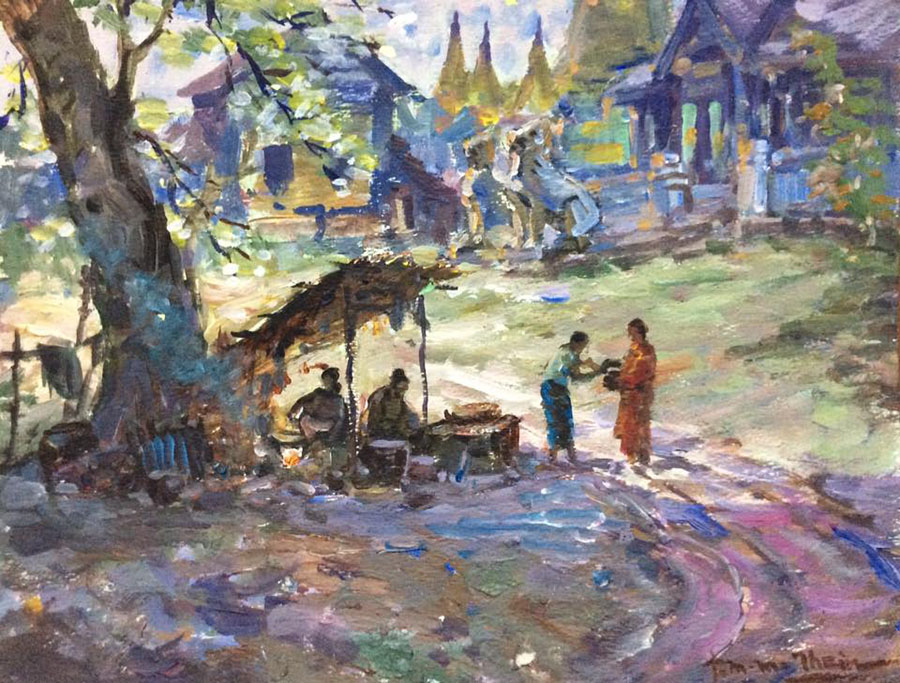
| Fifth Exhibition for 79-Year-Old Artist Posted: 22 Sep 2017 04:38 AM PDT YANGON — Artist Maung Maung Thein (Pathein) is showing his fifth solo art exhibition at Lokanat Gallery in Yangon from Sept. 18-25. The exhibition features natural scenery and traditions from different parts of Myanmar as well as scenes from Phuket in Thailand. Maung Maung Thein has been teaching painting to children since the 1950s. The 79-year old studied painting from artists of the colonial period like Saya Myit, U Maung Maung Mya and U Thet Win. He completed some of his paintings in the exhibition in the 1980s. He is also showing outdoor paintings he drew in Phuket. Prices of the 60 oil and acrylic paintings range from US$100-$700. The artist, who is not able to attend the exhibition for health reasons, said, "Every artist has his or her own style, learning basic techniques and creating one's own piece of work. Other artists' styles are their own ones. Create art with one's own style and be proud of it." The post Fifth Exhibition for 79-Year-Old Artist appeared first on The Irrawaddy. |
| Nine Charged Over Sittwe Violence Posted: 22 Sep 2017 04:13 AM PDT SITTWE, Rakhine State — Nine people have been remanded under unlawful assembly charges for their part in a mob that attacked an International Committee of the Red Cross (ICRC) aid shipment bound for conflict-torn Maungdaw in Rakhine State capital Sittwe on Wednesday, according to police. The nine people were being held in Sittwe and have been charged under six different sections of the Penal Code, including sections 143-5 which relate to unlawful assembly and sections 438 and 440 which relate to "mischief," Police Lt Kyaw Moe of Sittwe's No. 2 Police Station told The Irrawaddy. The nine men were arrested on Wednesday night when nearly 300 people gathered and threw petrol bombs at a boat laden with ICRC aid at Set Yoe Kya jetty about 8 p.m. The crowd was dispersed by some 200 police who fired rubber bullets and tear gas to restore order. The Myanmar Army's regional commander and his soldiers arrived at the jetty at 11 p.m. "At first we tried to negotiate [with the mob] but they refused to disperse, and began to ignite petrol bottles" said Lt Kyaw Moe of Wednesday's trouble. Sittwe resident Kyaw Thant Lwin told The Irrawaddy on Thursday that the clashes had frightened residents and that a lot of unconfirmed reports about the violence had been shared online, but that the situation was calm on Thursday morning. Another resident told The Irrawaddy that violence flared because the crowd believed the boat contained terrorists. According to an Information Committee statement, laborers loading the ship on Wednesday afternoon told two men that the boat was carrying ICRC aid after they inquired. At about 5 p.m., 50 men arrived at the jetty and demanded the boat captain not to leave. After the incident was reported, the district police chief and community Buddhist monk leaders tried to mediate and diffuse the situation but the boat was delayed from leaving and the mob continued to swell. The 50-ton aid shipment was organized by ICRC's local supervisor U Naing Lin Wai and included 774 solar panels, 64,071 items of clothing, 1,240 tarpaulins, 1,331 blankets, 1,331 water buckets, 3,000 mosquito nets, feminine hygiene products and kitchenware. The post Nine Charged Over Sittwe Violence appeared first on The Irrawaddy. |
| Memory of Sacrifice: Memory, Justice and the Saffron Revolution Posted: 22 Sep 2017 04:06 AM PDT Over the past few years, anniversaries of major events in the Myanmar pro-democracy movement, including the Saffron Revolution, are commemorated with the laying of memorial wreaths for those who were killed, speeches by movement leaders about the continuing struggle, and retrospective pieces in the media reflecting on how far the country has come, and how far there is yet to go. Well-known leaders of the democracy movement are lauded, but the lesser-known, ordinary laypeople and monks continue to suffer the impacts of their involvement in protests like the Saffron Revolution. Their time in prison and association with the then-banned organizations continues to stigmatize them and their families, preventing them from full participation in society. Now that leaders of the democracy movement are leading the government, they should make clear that those who fought for democracy are to be celebrated, not shunned, and take steps to enable their full participation in the social, economic and political life of the country. To the puzzlement of many outside observers, memorial events are relatively devoid of outrage and demands for justice, despite the state's brutal response to the protests. The rhetoric focuses on the bravery and sacrifice of the protesters and activists, not the horrific acts committed by those in power. Some have attributed this to a Buddhist tendency toward forgiveness, and others to a calculated political maneuvering by activists still engaged in the day-to-day struggles to consolidate and improve democracy. While both are likely factors in many cases, there is more nuance in this rhetoric. When it comes to justice for those killed, injured, tortured and detained in the Saffron Revolution, the way the events are remembered is instructive. By their words and actions, monks and lay members of the pro-democracy movement remember their fallen colleagues as heroes who gave of themselves for the betterment of the country, not as helpless victims of a brutal regime. For many, to focus on their victimhood is to belittle their bravery in the face of known risks, to retroactively invalidate their agency and the choices they made. These dynamics should not be seen as a rejection of justice, but as setting forth a framework within which demands for justice should be understood. Official recognition and commemoration, done well, may go a long way to providing justice for victims of political imprisonment and of violence against protesters, addressing some of the consequences of the violations and providing a remedy to the victims. If former political prisoners and other pro-democracy activists are celebrated publicly as heroes rather than ostracized as criminals, perhaps they will have an easier time reintegrating into their communities, finding employment and restoring family ties. For the most impact, recognition must come from the government, a more authoritative, wide-reaching source than a small group of activists holding ceremonies on anniversaries. Acknowledgment of wrongful imprisonment and recognition of activists' contribution to the society should be done on an individual basis, in a way that makes it clear to families, communities and future employers that there should be no obstacle to that person's full participation in the social, economic and political life of the country. Meaningful recognition and commemoration should also include expunging criminal records, removing notations on identity cards, restoring revoked professional licenses, and restoring citizenship and related rights to those who are still in exile. This is not to say that those who suffered do not deserve justice, whether in the form of reparation, truth, criminal justice or some combination of those objectives. In fact, when commemorating the Saffron Revolution, many have called for assistance to survivors, an apology from the government, and institutional reform to prevent recurrence. Some have demanded prosecution of those who ordered the crackdown. However, at least at this historical moment, the focus is on recognition and commemoration – as heroes of the democracy movement who unjustly but bravely suffered for the good of the country. Thousands of people throughout Myanmar made incredible sacrifices to move the country towards democracy. They braved the streets in demonstrations, spread information obtained from banned sources, rallied support for the movement's leadership, and did millions of other everyday acts of resistance. For that, they have suffered imprisonment, exile, stigmatization, unemployment and have been left otherwise unable to fully participate in their society and enjoy the gains of their struggle. Now that the leaders of that movement have power, now that the country is, in fact, moving slowly towards democracy, those who helped make that happen should be able to enjoy the benefits as well. Aileen Thomson is an independent expert on justice and human rights with a particular focus on transitional justice in Asia. She was previously the Head of Office for the International Center for Transitional Justice in Myanmar and Nepal. She has a J.D. (law) and a M.A. (international affairs) from the American University in Washington, D.C. This article originally appeared in Tea Circle, a forum hosted at Oxford University for emerging research and perspectives on Burma/Myanmar. The post Memory of Sacrifice: Memory, Justice and the Saffron Revolution appeared first on The Irrawaddy. |
| ARSA Linked to Foreign Extremist Groups: Bertil Lintner Posted: 22 Sep 2017 03:59 AM PDT YANGON — A Muslim militant organization behind the attacks on 30 police stations in northern Rakhine State last month has connections with foreign extremist groups despite their blanket denial of such accusations, according to a journalist who has been covering Myanmar and Asia for more than three decades. In his latest story about the Muslim insurgency in northern Rakhine, Bertil Lintner writes that Arakan Rohingya Salvation Army's claim on fighting for self-determination like other ethnic armed groups in the country and rejection of being branded as a terrorist organization by the Myanmar government are unfit with the realities on the ground. The Arakan Rohingya Salvation Army (ARSA) has claimed its attacks were part of a campaign to achieve basic human rights for self-identifying Rohingya Muslims living in Rakhine. However, the Myanmar Army responded to the offensive with a brutal crackdown, forcing an estimated 420,000 to flee to Bangladesh, bringing accounts of indiscriminate killing and rape by security forces. In "The truth behind Myanmar's Rohingya insurgency" published in Asia Times, the Swedish journalist cites intelligence analysts as saying the group's mentor is Karachi-based Abdus Qadoos Burmi, a Pakistani of Rohingya descent. He has appeared in videos spread on social media calling for 'jihad' in Myanmar, according to the article. "Abdus Qadoos has well-documented links to Lashkar-e-Taiba, or the Army of the Righteous, one of South Asia's largest Islamic terrorist organizations that operates mainly from Pakistan. The group was founded in 1987 in Afghanistan with funding from now deceased Al Qaeda founder Osama bin Laden. Abdus Qadoos has even appeared in meetings together with Lashkar-e-Taiba supremo Hafiz Mohammed Syed," writes Lintner. The article describes the group's leader as Ataullah abu Ammar Junjuni, also known as Hafiz Tohar, who was born in Karachi and received madrassa education in Saudi Arabia. Alleged links to foreign extremist groups contradict an ARSA statement posted on Twitter on Sept. 14, which said it has no "links to Al Qaeda, the Islamic State in Iraq and Syria, Lashkar-e-Taiba or any transnational terrorist group." ARSA added "it to be known by all states that it is prepared to work with security agencies to intercept and prevent terrorists from entering [Rakhine] and making a bad situation worse." Lintner highlights ARSA's second-ranking leader, "a shadowy man known only as 'Sharif' who comes from Chittagong in southwestern Bangladesh and does not appear in any of the group's propaganda videos." He reportedly speaks with an Urdu language accent, the official language of Pakistan. Security analysts note 150 foreigners among the ARSA rank, according to the story, as well as the likelihood of "angry and desperate young men" among the self-identifying Rohingya in Rakhine and refugee camps in Bangladesh. "Most of them are from Bangladesh, eight to ten come from Pakistan with smaller groups from Indonesia, Malaysia and southern Thailand. Two are reportedly from Uzbekistan. Trainings held in the Myanmar-Bangladesh border areas have been carried out in part by older veterans of the Afghan wars, the security analysts say," the journalist writes. In fact, the name ARSA was unknown until late last year. Even after the first attack on police outposts in October last year, the group name was unheard of. The Myanmar government said 'Harakah al-Yaqin, or "the Faith Movement' was behind the attacks. Later the group changed its name to ARSA, according to the story. "The moniker had clear religious connotations and notably did not contain the words Rohingya or Arakan (Rakhine). It was only last year it started to use the more ethnically oriented name ARSA, perhaps in an attempt to distance itself from the radical milieu in which the movement was born." Lintner also considers the tactics of ARSA to resemble the Muslim insurgents in southernmost Thailand, adjacent to Malaysia, more than Myanmar's other ethnic armies, as the fighters mingle with villagers, wear civilian clothes, and retreat across the border to neighboring Bangladesh. "They prefers to mobilize hundreds of unarmed villagers to attack state positions in the middle of the night…….The relatively small attacking party then moves in, kills the intimidated soldiers or police and escapes with their weapons. It's a style of attack familiar in South Asia but altogether foreign until now in Myanmar," he writes. The strength of ARSA, he said, quoting analysts, is much less than what the rebels as well as Myanmar military authorities claim. According to insiders, ARSA's strength is in the hundreds rather than thousands, with the total number of active trained combatants likely not exceeding 500. After the attacks on August 25, the Myanmar military claimed to have killed 400 insurgents. The Swedish journalist estimated that most likely nearly all of them would have been conscripted villagers. "If that many ARSA fighters had been killed, almost the entire organization would have been wiped out, according to security analysts monitoring the group," he writes. The post ARSA Linked to Foreign Extremist Groups: Bertil Lintner appeared first on The Irrawaddy. |
| Rakhine State Crisis Hinders Myanmar’s Peace Process Posted: 22 Sep 2017 02:04 AM PDT Myanmar, plagued by prolonged civil war for a half century, has now been forced into a tailspin. Recent violence in Rakhine State threatens to impede an already fragile nationwide peace process. After the Arakan Rohingya Salvation Army (ARSA) launched attacks on police outposts on Aug. 25, 2017, the government denounced and branded the group as extremist terrorists, and Myanmar Army security clearance operations in Rakhine State followed. Due to the clearance operations, hundreds of thousands of civilians fled to Bangladesh and other areas. The crisis has been widely debated in domestic and international communities. While the country has been grappling with continuing civil conflict in the north, the festering crisis in the Rakhine State has become a hindrance to the peace process. The United Nationalities Federal Council (UNFC) initially planned to meet with the government's Peace Commission this month but postponed to next month. The UNFC expressed that the Rakhine State conflict would stall the ongoing peace process in which the ethnic bloc has long participated to seek peace in the country. Many ethnic leaders, particularly the Kachin Independence Organization (KIO), have voiced concern that the recent violence in Rakhine would impede the peace process. A prominent official from the KIO pointed to three incidents – Rakhine in June 2012, Meiktila in March 2013 and Rakhine in August 2017 – in which he believes the Myanmar Army used these other conflicts to draw attention away from the ongoing clashes in Kachin State. In May 2012, former US Secretary of State Clinton expressed the Obama administration's concerns about the Kachin conflict when she met Myanmar's Foreign Minister Wunna Maung Lwin in Washington. Clinton, who became the first US secretary of state to visit Myanmar in more than 50 years, urged the country to end ethnic conflicts. International attention on the civil war seemed to peak when UN Secretary-General Ban Ki-moon underlined the conflicts in Kachin State during his three-day visit to Myanmar from April 29, 2012. With both domestic and international attention focused on Myanmar Army offensives in Kachin State, inter-communal violence erupted in Rakhine State in June 2012. Former President Thein Sein declared a State of Emergency in Rakhine State on June 10, 2012. The Myanmar Army, who then controlled the administration, targeted the Muslim minority (the self-identifying Rohingya) in the region through mass arrests and arbitrary violence. Another intertwined incident erupted in 2013. The Myanmar Army attacked the KIO with combined ground forces, artillery fire, and air strikes, and the KIO lost most of their strategic outposts in early 2013. When domestic and international concern was at its peak, violence again broke out between Buddhists and Muslims, leaving more than 40 people dead and entire neighborhoods razed in Meiktila in March 2013. Then President Thein Sein soon announced a state of emergency, which allowed the military to take control in the area. Last but not least, the recent attacks in Rakhine State erupted after attention had been brought to army clearance operations against the KIO in the resource-rich area of Tanai. On June 5, Myanmar Army helicopters dropped leaflets over parts of Tanai ordering residents to leave by June 15 or risk being "considered as cooperating with the terrorist group KIA [Kachin Independence Army]." The Myanmar Army soon launched offensives against the KIO in the amber and gold-rich area. Due to clearance operations, thousands of local and domestic migrants who had been working there for years were forced to flee. Many of the displaced are now staying in temporary shelters provided by churches in Tanai town. On Aug. 14, 2017, the Myanmar Army representatives assigned to Parliament reiterated that the "clearance operations' against the KIO were in line with the military-drafted 2008 Constitution and did not need government approval. With the eruption of violence in Rakhine State, both domestic and international attention again veered away from Kachin and toward Rakhine State. The ongoing fighting in Kachin and northern Shan states needs to cease, and attention needs to be put there, alongside the crisis in Rakhine State. The conflict in Rakhine not only impedes the country's peace process but also threatens to erode democracy with the declaration of a state of emergency and increased military control. ARSA's attacks have bolstered the Myanmar Army. The goverment took on its rhetoric in labelling the group a terrorist organization, which allowed for clearance operations. The army has also garnered support from virulent nationalists, some political parties, and some ethnic Arakanese from its actions in the region. This support legitimizes the army, and enables them to conduct clearance operations in other ethnic areas, furthering threatening the peace process. On Sept. 1 2017, the Myanmar Army declared that it would wipe out the Arakan Army (AA) from Rakhine State, where both sides clashed in late August 2017. This is a vow to conduct similar military operations against the AA as were done to the KIO in August 2017. It is going to take the government, the Myanmar Army and ethnic armed organizations (EAOs) to work together to build a peaceful country, and this is the time to do it. Any additional Myanmar Army offensives will only stall the peace process even further. Gen Yawd Serk, chairman of the Restoration Council of Shan State/Shan State Army-South, has said that the situation in the country will worsen if the peace process is stalled. The government has attempted to resolve both the civil war and the issues in Rakhine State but these cannot be solved by the government or the army alone. The international community, intellectuals, political parties and civil society are vitally important and must be allowed to participate in these processes. The success of Myanmar's peace process and the outcome of the Rakhine State crisis hinges on how the government, military, and ethnic armed organizations address the root causes of conflict collectively. Absent of such cooperation, the peace process will be stalled and violence in Rakhine State will not be resolved. Joe Kumbun is the pseudonym of a Kachin State-based analyst. The post Rakhine State Crisis Hinders Myanmar's Peace Process appeared first on The Irrawaddy. |
| Rakhine Crisis Dents Myanmar Hopes of Western Investment Boom Posted: 21 Sep 2017 10:47 PM PDT YANGON/HONG KONG — When officials from Myanmar's commercial capital Yangon toured six European countries in June, they were hoping to drum up investment in transport, energy and education. Instead, they were bombarded with questions about the country's treatment of the self-identifying Rohingya Muslim minority, who have long complained of persecution by the Buddhist majority in the oil-rich, ethnically divided, western state of Rakhine. "In each of every country, that issue was always brought up," Hlaing Maw Oo, secretary of Yangon City Development Committee, told Reuters after the 16-day trip. The situation in Rakhine has worsened dramatically since then, with more than 400,000 Muslims in the state fleeing to Bangladesh to escape a military counterinsurgency offensive the United Nations has described as "ethnic cleansing." Western trade and investment in Myanmar is small, but there were hopes that a series of reforms this year would prise open an economy stunted by international sanctions and decades of mismanagement under military rule. With most sanctions now lifted, an expected flood of Western money was seen as a key dividend from the transition to civilian rule under Nobel laureate Aung San Suu Kyi. Regional diplomats saw it balancing China's growing influence over its neighbor. But Suu Kyi has been beset by international criticism for saying little about human rights abuses against the self-identifying Rohingya, and lawyers, consultants and lobbyists say the European and US companies that had been circling are now wary of the reputational risks of investing in the country. Louis Yeung, managing principal of Yangon-based investment firm Faircap Partners, said one of his business partners—a listed, US-based food and beverage company—decided to hold off its plan to enter the Myanmar market for three to five years, citing factors including slower-than-expected reforms and the Rakhine crisis. "Their conclusion is that it wasn't the right time for them," he said. "They want to see more traction from the government and Rakhine is not helpful." On Hold The pressure has been growing in recent months, even on existing investors, with rights group AFD International calling on foreign firms to stop investing in Myanmar. A small group of investors in US oil major Chevron filed an unsuccessful motion at its annual general meeting urging it to pull out of its production sharing contract with a state-run firm to explore for oil and gas, while Norwegian telecoms firm Telenor, which runs a mobile network in Myanmar, issued a statement calling for human rights protection. Chevron declined to comment on its investment in Myanmar, while Telenor did not respond to several requests for comment. Bernd Lange, chair of the European Parliament Committee on International Trade, said last week his delegation postponed a visit to Myanmar indefinitely, saying the human rights situation "does not allow a fruitful discussion on a potential EU-Myanmar investment agreement." Khin Aung Tun, vice-chairman of the Myanmar Tourism Federation, told Reuters global firms planning to hold conferences in Myanmar were now considering other locations. "People were just starting to see Myanmar as a ‘good news’ story," said Dane Chamorro, head of South East Asia at Control Risks, a global risk consultancy. "Now you can imagine a boardroom in which someone mentions Myanmar and someone else says ‘hold on, I've just seen something on Myanmar on TV: villages burned down, refugees, etc’." In an interview published in Nikkei Asia Review on Thursday, Suu Kyi acknowledged it was "natural" for foreign investors to be concerned, but repeated her view that economic development was the key to solving poor Rakhine's long-standing problems. "So investments would actually help make the situation better," she said. In China's Orbit Myanmar's US$70 billion economy should be a strong investment proposition for Western firms. It boasts large oil and gas reserves and natural resources such as rubies, jade and timber. Wages are low and its youthful population of more than 50 million is eager for retail and manufacturing jobs. In April, Myanmar passed a long-awaited investment law, simplifying procedures and granting foreign investors equal treatment to the locals. A game-changing law allowing foreigners to buy stakes in local firms is expected later this year. "The investment conditions were improving," said Dustin Daugherty, ASEAN lead for business intelligence at Dezan Shira & Associates, a consultancy for foreign investors in Asia. Myanmar's economy may not suffer much, however, if Western firms shun the country—or even if their governments were to reimpose some sanctions, although that appears unlikely for now. Suu Kyi has sought to deepen relations with China at a time when Beijing is keen to push projects that fit with its "Belt and Road" initiative, which aims to stimulate trade by investment in infrastructure throughout Asia and beyond. Myanmar trades with China as much as it does with its next four biggest partners: Singapore, Thailand, Japan and India. None of that top five participated in previous sanctions. Trade with the United States is only about $400 million and US investment is just 0.5 percent of the total. Europe accounts for around a 10th of investment, while China and Hong Kong make up more than a third, and Singapore and Thailand another third. Than Aung Kyaw, Deputy Director General of Myanmar's Directorate of Investment and Company Administration, told Reuters European investors might have "second thoughts," but he expected Asian investors to stay put. China is already in talks to sell electricity to energy-hungry Myanmar and pushing for preferential access to a strategic port on the Bay of Bengal. In April, the two countries reached an agreement on an oil pipeline that pumps oil across Myanmar to southwest China. "It is going to feed Aung San Suu Kyi straight into the hands of [Chinese President] Xi Jinping," said John Blaxland, director at the ANU Southeast Asia Institute and head of the Strategic and Defence Studies Centre. The post Rakhine Crisis Dents Myanmar Hopes of Western Investment Boom appeared first on The Irrawaddy. |



| You are subscribed to email updates from The Irrawaddy. To stop receiving these emails, you may unsubscribe now. | Email delivery powered by Google |
| Google Inc., 1600 Amphitheatre Parkway, Mountain View, CA 94043, United States | |


