Friday, December 8, 2017

The Irrawaddy Magazine

The Irrawaddy Magazine


Status Of Irrawaddy Dolphin Raised To ‘Endangered’

Posted: 08 Dec 2017 06:03 AM PST

YANGON—The status of the Irrawaddy dolphin has been raised from "vulnerable" to "endangered" as its numbers have fallen by half over the past 60 years due to human activities, according to the latest Red List of threatened species produced by the International Union for Conservation of Nature (IUCN).

Despite the change in its status, the population of this species from the Irrawaddy River, one of only three habitats in the world where riverine Irrawaddy dolphins are found, has risen slightly over the last three years.

There are currently at least 69 dolphins living in the river between Bhamo and Mandalay cities, in addition to populations of approximately 80-100 left in stretches of the Mekong River in Cambodia and Laos, and in Mahakham in Indonesia, according to the Wildlife Conservation Society (WCS) in Myanmar.

Even though no wide-ranging survey has been conducted for this species globally, nor is there a synoptic estimate of the total number of Irrawaddy dolphins from local or regional surveys, the IUCN estimates that there is an abundant population of about 5,800 of the animals in Bangladesh and 77 in the Philippines.

"In the Mekong River, the majority of Irrawaddy dolphin deaths in recent years have been caused by entanglement in gillnets—'curtains' of fishing net that hang in the water," the IUCN wrote in its Tuesday report, adding that efforts to ban or at least minimize their use in many areas have been ineffective, resulting in declines of many species of whales, dolphins and porpoises.

Between 2002 and 2016, 42 dolphins were found dead in Myanmar, 29 of them in the Irrawaddy Dolphin Protected Area (ADPA). Established in December 2005, the ADPA is the first national aquatic protected area to be so designated by the Department of Fisheries in Myanmar.

The ADPA covers a 74 km-length of river starting from Mandalay Division's Mingun in the south up to Sagaing Division's Kyaukmyaung in the north. With support from the WCS, the protected area was established with an aim to reduce the threats to dolphins, which include electric fishing, gill nets and pollution, and preserve the human-dolphin cooperative fishing practice. In this mutually beneficial tradition, fishermen communicate with the dolphins with throaty calls and the dolphins drive the fish towards the fishermen's boats and signal to them on when to throw their nets.

There are at least six villages on the banks along this stretch of the Irrawaddy River, where about 60 local fishermen still preserve the practice, according to U Han Win, the officer in charge of the Irrawaddy Dolphins Conservation team of WCS Myanmar and an official at the Department of Fisheries.

The Department of Fisheries and WCS Myanmar in late 2015 launched a community-based ecotourism project in the ADPA zone, which encourages dolphin-watching tours so that humans can experience the unique human-animal interaction and hopefully contribute to the continuous rise of the local dolphin population.

"We find one or two dolphin calves annually and I suppose it's no longer a critically endangered situation [in Myanmar]," U Han Win told The Irrawaddy, noting that the population has edged higher over three consecutive years from 58 in 2015, to 65 in 2016 and to 69 in 2017.

Electric-shock fishing, especially in the ADPA zone, is prohibited by the Freshwater Fisheries Law, enacted by the Department of Fisheries, and violators face three years in prison or a fine of 300,000 kyats.

Even though electronic fishing is a major threat to the population of Irrawaddy dolphins locally, U Han Win said that other causes such as pollution in the river water, allegedly caused by illegal gold mines in upstream areas, needed to be addressed as well.

"We have done no specific surveys on the cause of dolphin deaths," he said.

The post Status Of Irrawaddy Dolphin Raised To 'Endangered' appeared first on The Irrawaddy.

Suu Kyi Dismisses Speculation of President’s Ill Health

Posted: 08 Dec 2017 05:56 AM PST

NAYPYITAW — State Counselor Daw Aung San Suu Kyi said President U Htin Kyaw was in fine health in response to speculation that his condition had deteriorated following an operation in September.

"There is no need to worry. We have the first lady who will take care [of the president], so why do we need to worry when there is someone to take care of him?" she said in reply to a reporter's question at an education development seminar in Naypyitaw on Friday.

The president underwent a successful operation in Bangkok in September to have a polyp in his colon removed, according to state media.

"The president is in good health. He is good. No need to worry," U Win Htein, a senior leader of the ruling National League for Democracy with close ties to the president, told The Irrawaddy.

President U Htin Kyaw has made few public appearances since he took office early last year. But the 71-year-old appeared to have lost weight and looked pale when he received Pope Francis in Naypyitaw late last month.

The 2008 Constitution lays out the procedures to be followed in case the country's top office holder retires before the end of his or her term, so there would be no problems if President U Htin Kyaw were to do so, said former Lieutenant General Hla Htay Win.

"According to the Constitution, the [first] vice president will become the acting president, and then an election will be held to elect a vice president. Then the president will be elected from among three vice presidents," he explained.

The President's Office, however, said on Friday that President U Htin Kyaw would soon pay an official goodwill visit to Japan and attend the Universal Health Coverage Forum in Tokyo at the invitation of Japanese Prime Minister Shinzo Abe.

Translated from Burmese by Thet Ko Ko.

The post Suu Kyi Dismisses Speculation of President's Ill Health appeared first on The Irrawaddy.

Mine Detonated On Rakhine Chief Minister’s Route

Posted: 08 Dec 2017 04:09 AM PST

YANGON – A roadside mine exploded not long after a motorcade transporting Rakhine Chief Minister Nyi Pu passed by the spot on the Ann-Myebon Highway this morning, the state's Border Affairs Minister Col. Phone Tint told The Irrawaddy.

An army truck from an unidentified unit was hit by the blast, which resulted in four soldiers sustaining minor wounds.

"The chief minister safely arrived back in Sittwe at 1 p.m. and we are now holding a meeting," Col. Phone Tint said in a phone interview.

Rakhine State Municipal Affairs Minister Min Aung, who accompanied the chief minister on a several-day long trip to Gwa, Thandwe, and Taungup Townships to observe development projects, said that Ny Pu returned from Taungup yesterday and spent a night at Ann Township, where Myanmar's Western Command is based.

He said the mine did not appear to have been targeting the cabinet members' convoy as the explosion occurred an hour after the vehicles had passed the location, and the military truck was the more likely target. The attack occurred near a Chin village about 46 miles away from Ann Township. In addition to the four soldiers who were hurt, the truck's windshield was destroyed by the explosion.

Min Aung said the army truck was not part of the security detail for the chief minister's tour, as police provided protection during the trip hours.

A local resident told The Irrawaddy under condition of anonymity that the mine went off near a bailey bridge outside Toke Chaung village, which consists of about 100 households. The majority of the residents are ethnic Chin who farm for their livelihood. The scene of the explosion is a five-minute walk from the village.

"We've never heard of [such an incident] before in this area," the villager said.

He said locals considered the mine blast a curious incident given the area is under the control of the military and no one was seriously injured. He also pointed out that the incident happened between the Western Command and the No. 9 Divisional Training School, which is located about 27 miles from Toke Chaung village and known locally known as the Kan Ne army training school.

In response to the public reaction to the mine explosion, Regional Minister Min Aung declined to comment, saying the issue is related to army affairs.

On Thursday, authorities in Mrauk-U Township, which is about 57 miles from Toke Chaung village, removed a couple of mines that had been planted under a bailey bridge.

The post Mine Detonated On Rakhine Chief Minister's Route appeared first on The Irrawaddy.

French Firm Helps Shan Farmers Turn Poppy to Coffee

Posted: 08 Dec 2017 03:10 AM PST

NAYPYITAW — A coffee growers cooperative in Shan State and a French roasting company signed a memorandum of understanding on Thursday in Naypyitaw that pledges the roaster to buy from the farmers for five years in a bid to combat opium cultivation in the region.

"We'll pay higher than the market prices. We'll buy coffee for five consecutive years. But because it's meant for the international market, it is important that quality is not compromised," Jean-Pierre Blanc, executive director of Malongo Coffee Co., said at the signing ceremony.

According to the agreement, Malongo will buy coffee from Green Gold, a cooperative of coffee growers from over 60 villages in Hopong, Loilem and Ywangan townships for the next five years.

Since 2014, the United Nations Office on Drugs and Crime (UNODC) has provided assistance, including coffee seeds and technology, to promote poppy substitute cash crops in the region.

According to Green Gold Chairman U Hla Soe, there are now 1,245 coffee growers and 953 hectares under coffee cultivation in the three townships.

"Almost all the inputs including seeds are given to us. We only have to grow on our land, and the production cost is all about labor," U Sai San Lu, a resident of Sa Nin village, told The Irrawaddy.

"But of the 80 households in our village, only 36 of them grow coffee. The others are not yet interested in it," he said.

Other coffee growers who attended the signing ceremony spoke of the same situation in their villages, which they attributed to the relative liquidity of poppy, which can be harvested about 100 days after planting. With coffee, farmers must wait three years for the first harvest.

"I am growing 10 acres of coffee now and I still grow about three acres of poppy. You can get a quick return from poppy, usually in 100 days. I can sell opium in my village," said a grower who asked not to be named.

"Since this is the first [coffee] harvest, the yield is low. Some have chosen to grow coffee because Malongo will buy all the coffee in cooperation with the UNODC. But there are people who chose to continue growing poppy," said U Khun Sein Tun, from Wankyaung village.

According to the UNODC's Myanmar Opium Survey 2017, launched earlier this week in Naypyitaw, the area under opium poppy cultivation decreased significantly in 2017 to 41,000 hectares, down 25 percent from the 55,500 hectares recorded in 2015.

Opium production has also decreased 18 percent, from 647 metric tons in 2015 to 550 tons in 2017, according to the report.

The post French Firm Helps Shan Farmers Turn Poppy to Coffee appeared first on The Irrawaddy.

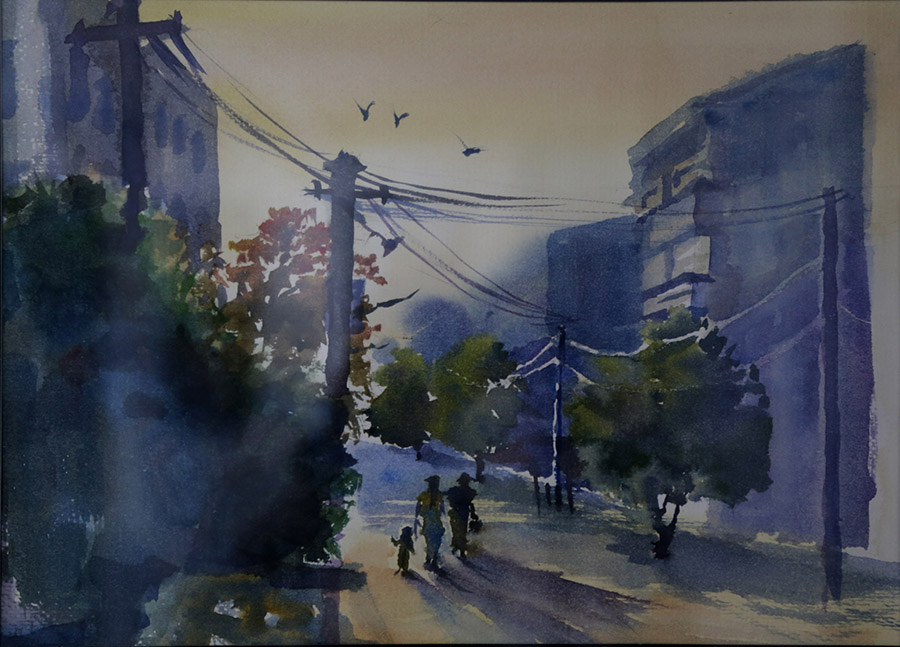
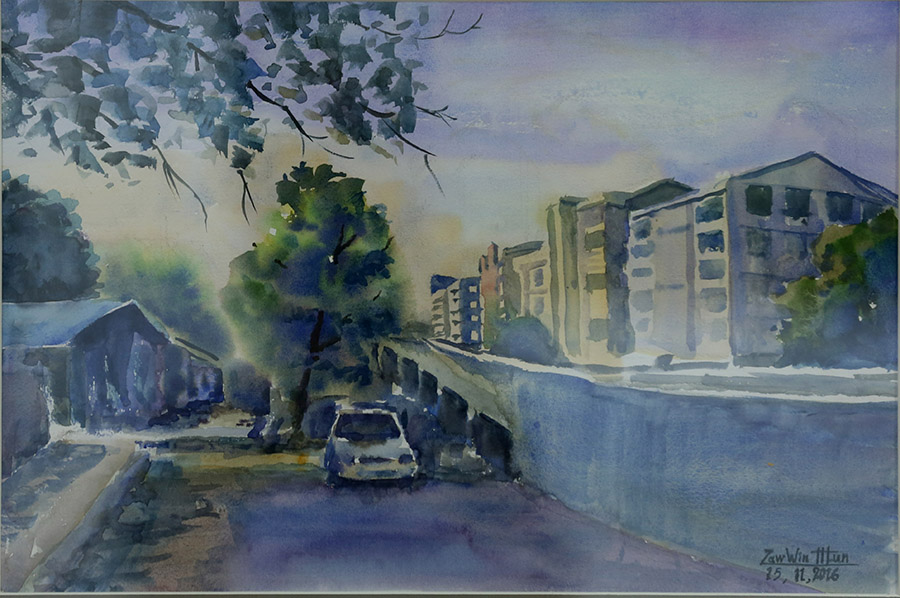
‘December Morning’ Exhibition Captures the Vibrancy of the Season

Posted: 08 Dec 2017 01:18 AM PST

When people talk about December, "sweet" is a common modifier. While Christmas and New Year contribute to the month's significance in western countries, December is synonymous with freshness and vitality in Myanmar.

In the 1960s, a group of artists including M Tin Aye, U Ba Yin Lay, Yangon Ba Swe and U Min Naing – inspired by dewy December mornings – staged an art exhibition that they called 'December Morning.' For next few decades, they captured December mornings across the country, trying to embellish the month in vibrant colors.

The exhibition runs through Monday at Moon Art Gallery on 35th Street in Yangon's Kyauktada Township.(Photo: Thet Htun Naing/ The Irrawaddy)

After the death of those veteran artists, a younger generation of artists kept the exhibition alive year after year, capturing different scenes in different places.

"This exhibition is about wishing people a happy New Year," said Ko Maung Kyaw Than, an artist who has participated in the exhibition for more than 30 years.
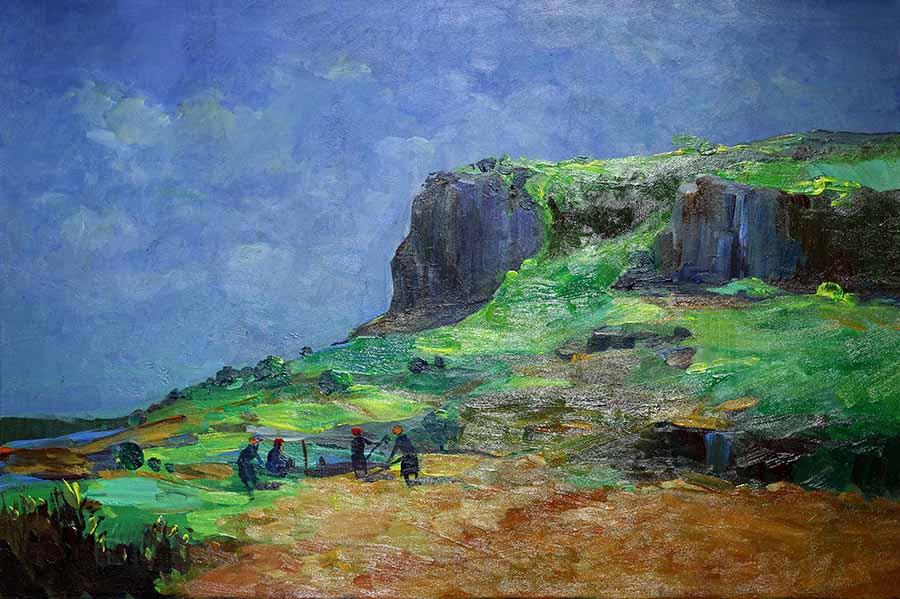
The exhibition runs through Monday at Moon Art Gallery on 35th Street in Yangon's Kyauktada Township.(Photo: Thet Htun Naing/ The Irrawaddy)

The artist, together with two younger artists Phay Than and Zaw Win Htoo, this year went to Shan State to capture colder mornings and misty mountains there.

"We went to Kalaw and Aungban. Visitors will be able to feel the cold December morning in our paintings of mountainous areas," said Ko Maung Kyaw Than.

The exhibition runs through Monday at Moon Art Gallery on 35th Street in Yangon's Kyauktada Township.(Photo: Thet Htun Naing/ The Irrawaddy)

"This is the second time I've participated in this art exhibition. I'm more keen on portraits and my paintings at this exhibition are mostly portraits of Akha, Palaung and Shan ethnic women," said Phay Than.

The exhibition, which runs through Monday at Moon Art Gallery on 35th Street in Yangon's Kyauktada Township, features more than 70 paintings that can be purchased for between US$200 and $ 1,500.

The post 'December Morning' Exhibition Captures the Vibrancy of the Season appeared first on The Irrawaddy.

Prisons to Improve Nutrition for Inmates Across the Country

Posted: 08 Dec 2017 12:32 AM PST

MANDALAY — The Correctional Department, under the Ministry of Home Affairs, said it would increase daily nutrition for inmates across the country.

A department spokesperson explained that nutrition budgets were set by the state governments.

"Before, meat curries were served only two days a week. Now, it will be four. And bean soup was served five days a week, but it will now be available every day," said U Min Tun Soe, the department spokesperson.

According to the department, an inmate previously received 600 kyat per day of food, while labor camp inmates received the equivalent of 625 kyat.

"After the increase, prison inmates will receive food equivalent to 975 kyat per day, and labor camp inmates will receives 1,000 kyat worth, as they receive additional rice," he explained.

Although it is still a meager amount for the 90,000 inmates in 46 prison and 60 labor camps, it is an improvement, said U Min Tun Soe.

Poor nutrition in Myanmar prisons was criticized widely by rights groups for years.

Many inmates whose families can afford to send food depend on that, and share their goods with others.

According to the department, Insein central prison in Yangon Region, Obo central prison in Mandalay Region and Tharyarwaddy central prison in Bago Region have also recently been funded with 5,000,000 kyats each for medical needs.
The department is also building new prisons to ease overcrowding, said the department spokesperson.

"We've opened a prison in Mohnyin, with the capacity of 1,000 inmates. It will ease the crowding in Myitkyina's prison," he added.

The spokesperson said there would be two more prisons in Kyaikmayaw in Mon State and Daik-U in Bago Region, to be opened by the end of this year.

"In some prisons, the number of inmates outnumbers the suggested capacity. We will move these prisoners once new prisons open. This will ease overcrowding and make family visits more convenient," he added.

The post Prisons to Improve Nutrition for Inmates Across the Country appeared first on The Irrawaddy.

Myanmar Govt Takes Steps to Repatriate Hindus Who Fled to Bangladesh

Posted: 08 Dec 2017 12:06 AM PST

NAYPYITAW — The Myanmar government is taking steps to repatriate more than 400 Hindus who fled to Bangladesh since August 25 after insurgent attacks on border police prompted counter-insurgency military operations in northern Rakhine State.

Union minister for Social Welfare, Relief and Resettlement Dr. Win Myat Aye on Thursday revealed the plan to reporters in administrative capital Naypyitaw at the meeting of the Union Enterprise for Humanitarian Assistance, Resettlement and Development in Rakhine State (UEHRD).

The Myanmar government has sent application forms for Hindu people to fill out in order to come back to Myanmar.
"We'll send more application forms depending on the number of houses available in the area," said Dr. Win Myat Aye, as many houses were burned down or damaged in the conflict.

On Nov. 22, the Myanmar and Bangladeshi governments signed a memorandum of understanding (MoU) on the repatriation of refugees. The two countries agreed to form a joint committee within three weeks and start the repatriation process within two months.

The Myanmar government sent application forms in response to the request of Hindu refugees, said Dr. Win Myat Aye, who is also the vice-chair of UEHRD, adding that the government would only send and accept application forms for those who were willing to come back to Myanmar of their own accord.

"We are arranging accommodation for them. For example, we are planning to build houses near Nga Khu Ya and Taung Pyo Let Wae villages where houses were burned down," the minister told reporters.

Arakanese lawmaker U Aung Thaung Shwe representing Rakhine State's Buthidaung in the Lower House has criticized the government for failing to publicize the repatriation agreement.

He suggested that Arakanese people are likely to leave their native towns if the government accepts back Bengalis—a term used by the majority of Myanmar people to refer to the Rohingya as interlopers from Bangladesh—for fear that insurgents might also infiltrate into the state along with refugees.

"Arakanese people can live together with Hindus who live peacefully. But what if insurgents come back? If they come back here, we can't live here. We dare not. We can only leave," U Aung Thaung Shwe told The Irrawaddy.

The latest repatriation agreement is a modification of a 1993 agreement between the two governments.

It is not clear if the Myanmar government has also sent applications for Muslim refugees in Bangladesh. But, the minister said that houses were being built in northern Rakhine State for their repatriation as well.

Anyone coming back will have to undergo the national verification process according to the 1982 Citizenship Law, and full citizenship and associate citizenship along with fundamental rights and freedom of movement will be granted respectively to those who are eligible, according to the minister.

The UN estimates that more than 600,000 Rohingya have fled to Bangladesh since Aug. 25, but the Myanmar government has denied those figures.

Translated from Burmese by Thet Ko Ko.

The post Myanmar Govt Takes Steps to Repatriate Hindus Who Fled to Bangladesh appeared first on The Irrawaddy.

Cambodia Goes All-in on China in Casino Port City

Posted: 07 Dec 2017 09:08 PM PST

SIHANOUKVILLE, Cambodia — Between Sihanoukville's beaches and its multiplying casinos, "Lao Qi" and Bun Saroeun run restaurants barely a hundred dusty meters apart. But their fortunes could not be more different.

For while Lao Qi is riding the Chinese boom that brought him and thousands of others from China to the Cambodian resort, Bun Saroeun's business was built on low-budget Western visitors. It is far less profitable and now he faces eviction.

Sihanoukville starkly illustrates how Cambodia's ever tightening relationship with China is transforming the country. Just as China's aid and investment have helped Prime Minister Hun Sen defy Western criticism of a crackdown on his opponents, they are also binding Cambodia’s economy ever more closely to China’s.

Sihanoukville, which has Cambodia's only deep-water port, was carved out of the jungle in the 1960s and named after former King Norodom Sihanouk. Once a playground for Cambodia's elite, it fell on hard times during the Khmer Rouge genocide and conflicts of the 1970s and 1980s before becoming a stop for backpackers and other Westerners looking for sun, sea, sand and – for some – sex.

But a steady trickle of Chinese money into its casinos has now swelled to a tide that promises to remodel a city touted by developers as the first port of call on China's "Belt and Road."

"This is like China 20 years ago. The opportunity is huge," said Lao Qi, 33, who goes by his nickname and first moved here from China's Zhejiang province to work in a casino. His noodles and fried rice can now make him hundreds of dollars a day.

Down the road at the Ecstatic Pizza restaurant, 59-year-old Bun Saroeun counts himself lucky to make over $100 a day. Rising hotel prices and the noise of construction are discouraging Western visitors and Cambodian tourists from the city, he says.

"A few Chinese came here but now they have their own restaurants," said Bun Saroeun, whose landlord is now evicting him to redevelop the prime property near the Occhuteal Beach.

The Chinese influx is very much by design. In charge of the city is governor Yun Min, the former regional military commander and a close ally of Hun Sen. He made trips to China himself to encourage investors and offer them protection.

"We want more of them to come," he told Reuters, estimating that Chinese already rent half the property in the city. "We benefit from them."

‘Macau Two'

Estimates for the numbers of Chinese now resident in the city of 250,000 run from the thousands to the tens of thousands, but no figures are made public.

Across Sihanoukville, Mandarin signs are proliferating. Supermarkets packed with Chinese goods are commonplace – the only Cambodian items tend to be beer and bottled water.

Yet the current Chinese influx into Sihanoukville is nothing compared to what is forecast. Near the once tranquil Independence Beach, concrete towers have sprouted in months, promising casinos, hotels and thousands of apartments.

"This is Macau Two," boasts Chen Hu, the 48-year-old general manager at the $200 million 38-story Blue Bay Resort development, comparing the city to the world's biggest gambling center.

At his showroom, groups of prospective condominium buyers from China admire the model. About 20 percent of at least 700 apartments have already been sold, he says. Prices range from around $125,000 to $500,000.

"A lot of people complain, but a lot of people also benefit from the injection of money from China," said William Van, 60, who owns an apartment block now filled largely with Chinese workers and has seen the value of his investment soar.

A clear attraction for all Chinese investors, developers say, has been the close Cambodia-China relationship – strengthened by Hun Sen's repeated trips to Beijing and Chinese President Xi Jinping's visit to Phnom Penh late last year.

On his latest trip to Beijing last week, Hun Sen won offers of investment of $7 billion from Chinese companies in a highway, a satellite city near Phnom Penh, and projects in education, entertainment and banking. It was unclear how new or firm the promises were, but they highlight the accelerating investment trend.

Business is following the flag China has planted in Cambodia.

"It's continuing and may even be exploding," said US-based academic Sophal Ear, co-author of a book on China's quest for resources abroad. "We are talking orders of magnitude now beyond what anyone else is doing…They're crowding out other investors with the sheer volume and scale of their activities."

Pictures of Xi and Hun Sen feature prominently in one of the glossy handouts from the Prince Real Estate Group as it markets apartments in Phnom Penh and now starts work on two projects costing $1 billion in Sihanoukville.

"It is a core location of the Belt and Road initiative," said marketing director Hu Tian Lu, referring to China's infrastructure-led development and diplomatic initiative.

A short drive from the port is an expanding Special Economic Zone, where 90 percent of the 110 companies now operating there are Chinese, enjoying tax-free imports and exports and corporate tax holidays.

China is due to build a four-lane highway to Phnom Penh, the international airport in Sihanoukville is being expanded – some 70 percent of international flights are already to Chinese destinations – and improved rail links are eventually planned under the Belt and Road program.

More Chinese Tourists

Although Sihanoukville is a focal point for Chinese investment, the phenomenon is far from localized.

More tourists to Cambodia come from China than any other nation – 635,000 in the first seven months of the year, or a fifth of the total. Cambodia hopes to draw two million Chinese tourists a year by 2020.

Chinese investment over the 2012-16 period was over $4 billion – more than 30 times that from the United States, even including a $100 million Coca-Cola plant, which opened last year. China’s $265 million in aid last year was well over twice that of Japan’s and nearly four times that from the United States.

Chinese dams provide most of Cambodia’s electricity; a third of the garment factories that produce Cambodia’s main export are Chinese.

Nearly half of Cambodia's $5.8 billion foreign debt is also owed to China – many multiples what it owes any other country.

The government's political debt to Beijing has also grown.

As Western countries have condemned the arrest of Hun Sen's main rival and the dissolution of his party ahead of next year's election, China has voiced support for Cambodia's efforts to keep order.

From Cambodia, China can count on its loyal support on regional issues, while it also gains a strategic foothold deep in Southeast Asia. Sandwiching Sihanoukville are concessions owned by Chinese companies that give them control of well over one-third of Cambodia's coastline.

The gush of money into Sihanoukville has meant a bonanza for land owners: one hotelier told how the Chinese turned up with an offer of twice what he was making to take his hotel over for casino staff. He no longer needs to work.

For anyone renting, it is a nightmare. Long term Western expatriates talk of being "Chinesed" – being turfed out because a Chinese customer has turned up willing to pay much more.

Real estate agent Thim Sothea got a harsh lesson in the way the market was trending when his landlord evicted his business, Sihanoukville Property, from a spot near the beach so a Chinese company could move in at double the rent.

"It's becoming Chinatown here," he said at a meeting at a cafe because he is still looking for a new space. "That's fine for the rich who own hotels and property, not for everyone else."

It also suits Lao Qi just fine. He already has plans to open a new restaurant, which he expects will be closer to the beach.

The post Cambodia Goes All-in on China in Casino Port City appeared first on The Irrawaddy.

Rohingya Still Fleeing from Myanmar to Bangladesh: UNHCR

Posted: 07 Dec 2017 09:04 PM PST

DHAKA — Rohingya refugees continue to flee Myanmar for Bangladesh even though both countries set up a timetable last month to allow them to start to return home, the UN refugee agency (UNHCR) said on Thursday.

The number of refugees appears to have slowed. About 625,000 have arrived since Aug. 25. Some 30,000 came last month and around 1,500 arrived last week, the UNHCR said

"The refugee emergency in Bangladesh is the fastest-growing refugee crisis in the world," said Deputy High Commissioner Kelly Clements. "Conditions in Myanmar's [Arakan] State are not in place to enable a safe and sustainable return … refugees are still fleeing."

"Most have little or nothing to go back to. Their homes and villages have been destroyed. Deep divisions between communities remain unaddressed and human access is inadequate," she said.

Bangladesh and Myanmar agreed on Nov. 23 to start the return of Rohingya within two months. It did not say when the process would be complete.

Myanmar’s security forces may be guilty of genocide against the Rohingya Muslim minority, according to the top UN human rights official this week. Mainly Buddhist Myanmar denies the Muslim Rohingya are its citizens and considers them foreigners.

The UNHCR would make a fresh appeal to donors for funds after the end of February, Clements said.


The post Rohingya Still Fleeing from Myanmar to Bangladesh: UNHCR appeared first on The Irrawaddy.

Thai Police Arrest Hells Angels Gang Members

Posted: 07 Dec 2017 08:57 PM PST

BANGKOK — Thai police have arrested four members of a Hells Angels biker gang accused of drug crimes, violence and posing a threat to society, the Tourist Police said on Thursday.

Three Australians and a Canadian were arrested on Wednesday in Pattaya, a major tourist resort with a reputation as a hub for foreign gangs, drug dealing and the sex industry.

Piyapong Ensarn of the Pattaya Tourist Police told Reuters that two of the accused gang members would be deported and the two others would be charged with drug offenses.

"Traces of cocaine were found on them," he said.

Reuters was unable to contact either the accused or their lawyers for comment. Pattaya is 100 km (60 miles) southeast of the Thai capital, Bangkok.

Police said they were still looking for three Australians believed to be members of the gang. A British member of the gang had fled the country before he could be arrested, Piyapong said.

The gang made headlines in 2015 when one of its members was murdered by an Australian man, who was sentenced to death in February for the killing.

The post Thai Police Arrest Hells Angels Gang Members appeared first on The Irrawaddy.

Thursday, December 7, 2017

The Irrawaddy Magazine

The Irrawaddy Magazine


Muslim village-head killed in Rakhine’s Maungdaw District

Posted: 07 Dec 2017 06:56 AM PST

YANGON – A Muslim village headman, Shaw Feik Amen, from Rakhine State's southern Maungdaw Township, was shot dead in his house by unidentified armed men on Tuesday night, a border police officer confirmed on Thursday.

Police Major Aung Win, citing testimonies of witnesses, said a group of residents from the same village of Du Nyaung Pin Gyee had allegedly burst into the victim's home to attack Shaw Feik Amen with guns and swords. The police officer, however, declined to provide the names of the suspects.

Du Nyaung Pin Gyee village is located about five kilometers from downtown Maungdaw and consists of more than 1,000 households. After the Arakan Rohingya Salvation Army (ARSA), under its former name, Harakah al-Yaqeen (Faith Movement), attacked several dozen police border outposts in the surrounding area in late August, the majority of its residents fled to neighboring Bangladesh. However, some, including Shaw Feik Amen, chose to remain.

A primary school teacher, U Mg Tun, who lives in Kin Chaung village, not far from Du Nyaung Pin Gyee, told The Irrawaddy over the phone that he had heard some of the attackers crossed the river on a schooner from Bangladesh in order to kill the village administrative official for collaborating with the government.

Police Major Aung Win remarked that some Du Nyaung Pin Gyee residents had also come to a similar speculative conclusion but it was too soon to make an official statement as the case was still in the investigative stage.

U Mg Tun said Du Nyaung Pin Gyee village was mostly left alone during the Myanmar army's clearance operations and only a few houses were torched. Several hundred Muslims villagers had continued to live there despite the widespread armed clashes that had erupted across Maungdaw district following the ARSA raids. Moreover, nearly 700 villagers from Buthidaung Township had also temporarily sought shelter there.

During a government-sponsored diplomatic tour to Maungdaw Township in early October, which The Irrawaddy was also invited to attend — some Hindu and Arakanese villagers told the foreign envoys that residents had been warned by an unidentified group — believed to be ARSA members or supporters — to leave the village or they would be killed in the next round of attacks.

The threats came after Myanmar State Counselor Daw Aung San Suu Kyi called on the international community to seek the full story of the conflict-torn region as many Muslim villages continued to live in peaceful conditions.

Daw Aung San Suu Kyi has delivered diplomatic briefings and televised speeches twice in recent months calling on Muslim religious leaders to participate in the government's reconciliation effort in Rakhine State as well as to convince Muslims to apply for the National Verification Card (NVC).

On Nov. 27, the All Myanmar Moulvi (Ulama Al Haqe) Organization released a statement encouraging Muslims who do not possess any kind of official documents such as associated or naturalized citizenship papers or a "white card" to apply for the NVC.

The group's statement urged Muslims who live in Myanmar to hold at least one identity card issued by the authorities in line with existing laws.

Kyaw Soe, Ulama Al Haqe's secretary-general, said that the statement was directed at the entire Muslim population of Myanmar rather than just the Rohingya people in Rakhine State and they purposefully stressed the effort was being carried out in the national and public interest. He assumed that many Muslims could be living in Myanmar without any identity papers as they are unfamiliar with government procedures on applying for them.

"I can guarantee that our statement emphasized the interest of the public as well as the government," Kyaw Soe said.

However, the prospect of dealings with the government remains fraught with fear for many Muslims. Forty-eight Muslims were brutally beheaded by a suspected militant group between October 2016 and August 2017 and a further 20 went missing after collaborating with the government.

In response to a question on whether the Ulama Al Haqe's effort could be effective on the ground as many people were killed for assisting government officials, Kyaw Soe said that although the group didn’t know the exact perpetrators of the crimes, his organization was adamantly opposed to the violent conduct of ARSA.

"We don't accept ARSA. All these things happened after they started the problem," he said of the unrest, which has resulted in more than 620,000 Muslim refugees fleeing to Bangladesh.

He added that if government officials invite his organization to help, they could explain details of the NVC application process to Muslims in local areas.

The post Muslim village-head killed in Rakhine’s Maungdaw District appeared first on The Irrawaddy.

US Grant to See Restoration of 19th Century Church Through

Posted: 07 Dec 2017 05:02 AM PST

YANGON — Restoration work on the 190-year-old Judson First Baptist Church in the Mon State capital of Moulmein will continue thanks to a second round of financial support from the US Ambassadors Fund for Cultural Preservation and help from conservation experts with the World Monuments Fund.

Built in 1827 by Adoniram Judson, an American missionary who spent nearly 40 years in Myanmar in the early 19th century, the church will receive an additional US$100,000 for its preservation. The church received US$125,000 in February 2016 from the same program. The World Monuments Fund aims to use the new grant to complete the two-year project.

Scot Marciel, the US ambassador to Myanmar, will announce the grant at the church on Saturday together with Mon State Social Welfare Minister Htein Linn and the church's pastor, Reverend David, the US Embassy's press invitation reads.

With hospitals and community organizations bearing the Judson name, the First Baptist Church represents America's longstanding engagement with Myanmar, the embassy said in a November statement. It added that the Ambassadors Fund for Cultural Preservation has provided some US$225,000 to preserve cultural heritage sites in Myanmar since 2015. In 2013, US$500,000 was awarded for the restoration of the Shwenandaw Kyaung Monastery in Mandalay.

According to the World Monuments Fund, the restoration of Judson's church will be "an educational opportunity to introduce a cadre of local tradespeople, students and officials to cultural and architectural heritage conservation methods, building skills among Myanmar professionals that can be applied to similar sites in Moulmein and throughout the country."

In late September, leading members of Yangon Heritage Trust (YHT) — an advocacy group founded in 2012 for heritage protection in the country's commercial capital — visited heritage buildings in Moulmein at the request of Mon State Chief Minister Aye Zan, who envisions the founding of a local conservation group similar to YHT. He has also asked for technical assistance from YHT for the restoration of other historical buildings in Moulmein.

Besides the First Baptist Church, other significant heritage buildings in Moulmein include a 19th century Buddhist monastery, the 120-year-old Yadanabon Myint Monastery built by King Mindon's consort Sein Tone, the residence and tomb of the fourth daughter of Myanmar's last monarch King Thibaw, the forestry office of the Bombay Burma Trading Corporation built in 1897, a cannon built in 1827 featuring the emblem of Britain's King Edward, and a watchtower built in 1912.

The post US Grant to See Restoration of 19th Century Church Through appeared first on The Irrawaddy.

Drug Czar Rebukes Anti-narcotics Deal Between Yunnan, Wa Army

Posted: 07 Dec 2017 01:00 AM PST

NAYPYITAW — The chief of Myanmar's counter-narcotics police force has criticized the signing of an agreement between China's Yunnan Province and the United Wa State Army (UWSA) to cooperate on drug eradication.

Yunnan Province government officials and UWSA leaders signed an agreement on Friday in Panghsang, the capital of the Wa Self-Administered Division, to work together to eradicate drugs and grow substitute crops in the division.

"The Yunnan government's decision to sign an agreement directly with the UWSA can cause misunderstanding between the two countries," Brigadier General Mya Maung told reporters in Naypyitaw at the launch of the UN's Myanmar Opium Survey 2017.

At a meeting on drug eradication efforts in November in Kunming, China, Myanmar made it clear that China should consult with the Union government before signing any bilateral deals to fight drugs with Myanmar's subnational authorities along its border.

"We've said very clearly that they can sign [memorandums of understanding] and letters of agreement on growing poppy-substitute crops only with the Union government," Brig-Gen Mya Maung said. "They can't sign agreements with self-administered regions and state governments unless they are approved by the Union government."

"Perhaps there is some misunderstanding about the policies of the Union government and political practices in areas that share a border with China," he added.

He said China's team at the meeting in November was led by the deputy standing general secretary of the National Narcotics Control Commission of China and included officials from Yunnan's provincial government. The two countries, he said, agreed to get started on a poppy-substitution project in relatively stable parts of northern Shan State.

Political analyst Yan Myo Thein said the agreement between the UWSA and the Yunnan government was not unusual because the UWSA has been viewed as a distinct entity in Myanmar for a long time.

And because they share a border, he added, they may be cooperating in other areas as well.

"Unless political problems are solved through political means, the UWSA will remain a distinct entity," he said. "We need to build a true federal democratic Union promptly. Only then can similar problems and challenges be reduced."

The UWSA signed a ceasefire deal with the military regime in 1989. But it opted out of signing the Nationwide Ceasefire Agreement (NCA) with the government of U Thein Sein in 2015, saying it was unnecessary because the truce it reached with the previous government was holding.

It boasts of the largest and most powerful army among Myanmar's ethnic armed groups with an estimated 30,000 troops and leads other armed ethnic groups along the Myanmar-China border in the Federal Political Negotiation and Consultative Committee, which is demanding an alternative to the NCA.

The head of the UN Office on Drugs and Crime in Southeast Asia and the Pacific, Jeremy Douglas, who attended the report launch, urged armed ethnic groups to join Myanmar's fight against the illicit drug trade.

The total area of opium poppy cultivation in Myanmar has decreased significantly in 2017 to 41,000 hectares, down 25 percent from the 55,500 hectares recorded in 2015, according to the report.

The report also reconfirms the link between conflict and opium cultivation in Myanmar, and that insecure areas with active insurgencies continue to produce at levels similar to 2015

Myanmar's opium cultivation reached a low in 2006 but increased in 2013 before starting to decline again the following year, said Home Affairs Minister Lieutenant General Kyaw Swe.

In June, the UWSA claimed opium poppy fields had been completely eradicated from the southern part of the area it controls along the Thai border, more than a decade after it adopted policies to combat drug production.

Translated from Burmese by Thet Ko Ko.

The post Drug Czar Rebukes Anti-narcotics Deal Between Yunnan, Wa Army appeared first on The Irrawaddy.

ICG Urges World to Stay Engaged with Myanmar

Posted: 07 Dec 2017 12:44 AM PST

YANGON — The International Crisis Group suggested on Thursday that policymakers in the West should resist the urge to disengage with Myanmar, while warning of potential negative consequences of any punitive action taken against the country.

Myanmar has faced international criticism for its army's recent campaign against Rohingya Muslims in the western part of the country, where more than 600,000 Muslims have fled across the border to Bangladesh. The army has been condemned for committing human rights violations including torching homes, arbitrary killing and rape.

In the wake of the exodus, the European Union and the United States imposed sanctions against Myanmar's military leadership. Last month, US Secretary of State Rex Tillerson labeled the army's sweep through Rakhine State as ethnic cleansing, after a visit to the country.

The warning by the Brussels-based NGO, which monitors democratic transitions worldwide, urged international policymakers not to lose sight of the distinction between the government and the people, "who should not pay the price for the actions of a military that is constitutionally outside of democratic control."

"People-to-people exchanges with the West through academic, cultural and commercial interactions and tourism are crucial for a country that was isolated for so many decades," the report says, while warning that the Myanmar people's aspirations for "a better economic future must not be forgotten" as the country is home to millions of the poorest people in Southeast Asia.

Among the four action points suggested by the group were maintaining development assistance and non-military engagement, and leaving in place recently reinstated trade preferences by the EU and US, which it said were "critical in supporting manufacturing jobs in the country and shouldn't be revoked."

As the US was considering imposing economic measures against those responsible for the atrocities committed against the Rohingya, the report also calls on the international community to work carefully to minimize the collateral impact of any targeted sanctions.

"Recent experience in Myanmar shows, however, that ostensibly targeted sanctions can have broader systemic impacts on the economy that should be avoided," it says.

The ICG said that based on its contemporaneous research, until 2012 Myanmar was under some of the most stringent bilateral sanctions of any country and these did almost nothing to influence the then military regime "but caused significant damage to the general economy and the fortunes of ordinary people."

The report also urges the international community to do all it can to mitigate the humanitarian disaster in Rakhine State and influence the situation in other ways, including providing substantial humanitarian support to Rohingya refugees, to reduce the risks of a further humanitarian catastrophe. Plus, it said, the international community should push Myanmar for a political decision to implement key recommendations of the Annan commission, including its suggestions on discrimination, segregation and citizenship.

"Meaningful progress on these issue is vital to creating an environment conducive to voluntary repatriation, and giving international credibility to Myanmar's efforts," the ICG said.

Given China's support for Myanmar on the Rohingya issue due to its significant economic interests in Rakhine State, the NGO also cautioned Naypyitaw against taking the country's northern neighbor's blanket support for granted. China doesn't want this to come at the cost of its important relations with Bangladesh and the wider Muslim world, it said, which was part of the reason why it allowed the recent UN Security Council presidential statement to be issued.

Security Risk

Despite their organized raids in August, the Arakan Rohingya Salvation Army has not launched any new attacks since.

Based on interviews with ARSA members in camps in Bangladesh in September and November, the ICG says it appears most of the group's organizers and fighters are now in the camps, having fled along with the rest of the population.

The report says the group may thus shift to cross-border attacks as acquiring operating space in Bangladesh is a more realistic option given Bangladesh's anger and frustration towards Myanmar.

"If ARSA launches cross-border attacks, it could aim at opportunistic security targets in northern Rakhine or turn to attack any non-Muslim villagers resettled on Rohingya lands," the report said.

"New ARSA attacks would reinforce anti-Rohingya sentiment within Myanmar and prompt heightened security measures that would further diminish prospects for an eventual refugee return."

The post ICG Urges World to Stay Engaged with Myanmar appeared first on The Irrawaddy.

Myanmar Army Restrictions Leave Tanai Residents Lacking Basic Commodities

Posted: 06 Dec 2017 10:59 PM PST

CHIANG MAI, Thailand — As the Tatmadaw has restricted the transportation of basic commodities in conflict-torn Tanai Township, Kachin State, locals have run out of fuel and are suffering a rice shortage.

The Tatmadaw (Myanmar Army) has restricted the transportation of goods in the region for more than a year, but the situation worsened after June 3, when the Kachin Independence Army (KIA) and the Tatmadaw renewed fighting and displaced hundreds of locals from N'Ga Ga and Nambyu villages.

Tanai residents told The Irrawaddy on Wednesday that diesel fuel ran out a few days ago, as fuel trucks from Myitkyina have been stuck at military checkpoints.

Only gasoline can be bought, and one Tanai resident said the price is up to 6,000 kyat per gallon in some places where previously it had been about 4,200 kyat.

Locals also said the price of rice sacks had risen to double or triple the going rate in Myitkyina, the capital of Kachin State. They now costs 40,000 to 60,000 kyats per sack depending on quality, and they average around 20,000 in Myitkyina.

The Kachin State security and border affairs minister Col Thura Myo Tin told the Kachin State Parliament on Monday – in a response to a question by lawmaker U Zaw Win – that the Tatmadaw's Northern Command scrutinizes the transport of rice and petrol in order to obstruct gold and amber miners who pay extortion money to the KIA in areas without rule of law.

U Zaw Win, a National League for Democracy lawmaker representing Tanai Constituency No. 2, questioned Parliament on Monday as to what the government was doing in regards to his urgent motion – in which he proposed that the government allow free transport of these goods, as was passed in March.

Despite the state security and border affair minister stating that the transport of such goods is now permitted following scrutiny, lawmakers insisted and showed evidence to Parliament that people were facing difficulties in obtaining these basic goods.

"There has been a food shortage in the state because people have been unable to farm due to the frequent fighting. Now, with the Tatmadaw controlling the delivery of goods, locals' lives have gotten harder," said Kachin State lawmaker Maran Ja Seng Hkawn.

Renewed fighting, following the breakdown of a 17-year ceasefire, broke out between the KIA and Tatmadaw in June 2011. More than 100,000 people have been displaced, including villagers from Tanai Township.

Local pastor Mung Dan said that villagers used to be able to buy rations of rice and fuel arranged at the township, village and ward levels but that this had stopped this week due to a shortage for unknown reasons.

"We don't know why, but the quota system is no longer available and we are short of these supplies."

Lawmaker Maran Ja Seng Hkawn said the government would have to tackle this situation wisely, so that people aren't taking advantage of those in hardship.

The Tatmadaw's actions seem to undermine the image of the NLD, said Tanai resident U Zaw Tan, as this crisis happened soon after the NLD governance began.

"Now the residents of Tanai have lost trust in the government and everyone is saying that the government cannot do anything," he said, adding that even without fighting in the town, locals are neither free to travel nor trade.

The post Myanmar Army Restrictions Leave Tanai Residents Lacking Basic Commodities appeared first on The Irrawaddy.

Myanmar’s Opium Crop Plummets, But No Victory Over Asia’s Narco-boom: UN

Posted: 06 Dec 2017 09:14 PM PST

BANGKOK — A "dramatic" drop in opium cultivation in Myanmar underscored a regional boom in demand for illegal synthetic drugs such as methamphetamine, which many Asian countries are struggling to combat, a senior UN official said on Wednesday.

The area under opium poppy cultivation dropped by a quarter between 2015 and 2017, the UN Office on Drugs and Crime (UNODC) said in a report released on Wednesday.

"The drop in opium production is welcome, but it is not a victory," Jeremy Douglas, the UNODC's chief in Southeast Asia and the Pacific, told Reuters.

"It appears to confirm that the shift in the regional drug market to synthetic drugs is well underway, and that the opium economy is being disrupted."

China and most Southeast Asian countries have reported growing demand for methamphetamine – a highly addictive synthetic drug also known as speed, shabu and yaba – and the Philippines is waging a bloody "war on drugs" to tackle it.

Meanwhile, regional demand for heroin, which is derived from opium poppies, has remained stable or decreased, with many younger drug users preferring methamphetamine, according to UNODC data.

The UNODC estimated that Myanmar's Shan and Kachin states cultivated 41,000 hectares of opium poppy in 2017, a 25 percent drop from the 54,500 hectares reported in its last survey in 2015.

For the previous decade, opium cultivation had increased annually before stabilizing at high levels, according to UNODC data.

The area under cultivation in Afghanistan, the world's biggest opium producer, hit a record high of 328,000 hectares in 2017, the UNODC said last month.

Myanmar's interior minister, Kyaw Swe, said in a statement released by the UNODC that his government was "pleased to see progress" and would support programs that provide alternative livelihoods to opium-growing communities.

Myanmar is the source of most of Southeast Asia's methamphetamine, which is mostly produced in lawless border regions outside the government's control.

Douglas also said it was "reasonable to assume" that Asian organized crime groups were making or planning to make fentanyl, a synthetic opioid many times more potent and profitable than heroin.

Shifting Market

In October, President Donald Trump said "the flood of cheap and deadly fentanyl" in the United States was fuelling a public health emergency of opioid addiction and death.

"People like to stretch profits in any business, and fentanyl is the ultimate profit-stretcher," said Douglas. "You can cut out the poppy farmers completely."

Growing opium poppies employs or provides incomes for hundreds of thousands of people in Myanmar, most of them in remote, mountainous areas of Shan and Kachin states.

Cultivation and production of opium poppies continued to flourish at 2015 levels in conflict-plagued areas of those states, which remained a "safe haven for those who run the drug trade," said Douglas.

Government troops have been fighting insurgencies by various ethnic minority guerrilla groups for decades, and both sides have been implicated in the drug trade.

According to the UNODC survey, opium cultivation plummeted in 2017 despite the government scaling back its poppy-eradication efforts.

Myanmar destroyed 3,533 hectares of opium poppies in 2017, down from 13,450 hectares in 2015.

Its giant neighbor China remained the largest market for the heroin made from Myanmar's opium.

But China was also reporting what Douglas called "a significant shift in market dynamics," with demand for heroin dropping alongside rising demand for methamphetamine.

"The regional drug market is changing, and governments need to change how they deal with it," he said.

He urged countries to increase their focus on synthetic drugs and the precursor chemicals used to make them, and to do more to tackle demand through prevention campaigns and voluntary, community-based rehabilitation programs.

The post Myanmar's Opium Crop Plummets, But No Victory Over Asia's Narco-boom: UN appeared first on The Irrawaddy.

Wednesday, December 6, 2017

The Irrawaddy Magazine

The Irrawaddy Magazine


Civil Society Organizations Seek Greater Participation in Panglong Peace Conference

Posted: 06 Dec 2017 07:10 AM PST

YANGON—Civil society organizations (CSOs) specializing in conflict resolution have asked that they be allowed to send delegates to the 21st Century Panglong Peace Conference and called for an equal opportunity to participate in discussions on all topics related to peace.

The CSOs made the request in an open letter to leaders of the peace process including State Counselor Daw Aung San Suu Kyi and military chief Senior General Min Aung Hlaing.

Some 145 representatives of 92 CSOs participated in the 17th Civil Society Forum for Peace (CSFoP) in Yangon on Dec. 4-5. They discussed key developments and challenges facing the 21st Century Panglong Peace Conference, including women's and security affairs, as well as the current conditions faced by people living in the country's various states and regions.

In the open letter published Wednesday, the representatives made more than a dozen recommendations concerning the 21st Century Panglong Peace Conference, military affairs and joint monitoring of ceasefires.

Mi Kun Chan Non, a spokesperson for the Mon Women's Organization and a delegate to the CSFoP, told The Irrawaddy that CSFoP representatives should be entitled to delegate status at the Panglong conferences, rather than their current role as observers

"CSO members include many resourceful individuals with expertise in different sectors. They are able to provide input and suggestions for all five sectors — political, economic, social, security, and land and environmental affairs — of the Union Peace Dialogue Joint Committee," Mi Kun Chan Non said.

The government has been criticized for failing to recognize CSOs' contributions to the peace process.

The open letter also called for a review of the Nationwide Ceasefire Agreement (NCA) in order to further its goals of national reconciliation and peace. The CSO representatives urged the leading stakeholders to publicize the results of their meetings and the records of political dialogues held at each stage.

It also urged the Tatmadaw — the Myanmar Army — and all ethnic armed organizations (EAOs) to declare a joint nationwide ceasefire. A similar ceasefire proposal has been put forward for negotiation by a separate bloc of EAOs, the United Nationalities Federal Council. The UNFC has proposed eight points for discussion that would allow its members to sign the NCA if the government and Tatmadaw agree to its terms.

The third session of the 21st Century Panglong Union Peace Conference is scheduled to convene in the last week of January, according to the 6th Joint Implementation Coordination Meeting held in late November.

The post Civil Society Organizations Seek Greater Participation in Panglong Peace Conference appeared first on The Irrawaddy.

Rakhine Lawmakers Push for Regional Minister’s Impeachment

Posted: 06 Dec 2017 05:33 AM PST

YANGON—Rakhine State Lower House Speaker San Kyaw Hla on Monday established a five-member team to investigate lawmakers' claims that state Municipal Affairs Minister Min Aung has failed to perform his duties properly.

Lawmakers said they were not properly consulted on the state budget the minister presented to Parliament, and have raised concerns about what they claim are his careless comments on sensitive issues.

On Nov. 29, 17 members of the state Parliament from the Arakan National Party (ANP), the National League for Democracy (NLD) and Union Solidarity and Development Party (USDP) lodged a letter of complaint against Min Aung. San Kyaw Hla has declined to disclose the lawmakers' identities or specific charges.

Of the seats in the Rakhine Parliament, nine are held by the NLD, three by the USDP, 21 by the ANP, one by an independent and 12 are reserved for the military.

In accordance with parliamentary procedure, the House speaker established an investigative panel that includes at least one representative of each political party. According to an official announcement released by Parliament, lawmakers have demanded the minister be impeached, claiming his dereliction of duty has harmed the nation and the public interest.

Responding to the move, Min Aung said, "I have no idea about the accusations. I will be able to tell you more after Parliament resolves it." The minister will get a chance to defend himself when the state Parliament resumes its regular session on Dec. 19.

NLD-appointed Min Aung is the first regional government minister to be targeted for impeachment since the current Union government took power two years ago. He is also the spokesperson for the State Government, frequently appearing alongside Chief Minister Nyi Pu.

A member of the investigation team, NLD lawmaker Naing Kywe Aye, told The Irrawaddy over the phone on Wednesday that lawmakers would submit details to the House speaker during the forthcoming parliamentary session to assist the panel in establishing whether the minister is guilty or not.

The lawmaker cited the dissatisfaction expressed by MPs during a parliamentary session earlier this week after Min Aung presented the government's budget for fiscal 2018-19 and announced a tender for a project to develop three-story markets in Gwa, Tungup, and Kyauktaw without seeking parliamentary approval for the projects.

Asked by The Irrawaddy whether the regional minister had violated parliamentary procedure, Naing Kywe Aye said, "Of course. Even after the regional Parliament approves the fiscal year budget, it still needs the approval of the Union Parliament. After that, a tender process can start. I think lawmakers will add that as one of the topics [to be investigated]."

Naing Kywe Aye admitted that Parliament had received several complaints related to Min Aung's lack of transparency in handling construction project tenders.

"To verify the cases, we will summon some of the losing bidders who filed complaint letters," he said.

Online, there has been much discussion of the fact that this is not the first time tension has flared between the ANP and the NLD. In March 2016, Arakanese lawmakers walked out of Parliament to protest Nyi Pu's was appointed chief minister.

Several outspoken lawmakers have complained that state Cabinet members consistently ignore the role of elected civilian lawmakers.

"Whenever Cabinet members are called on to answer questions in Parliament, one regional minister attends and offers incomplete answers to lawmakers' questions on behalf of the other ministers. Then they decline to answer follow-up questions from legislators," Naing Kywe Aye said.

Than Maung Oo, an independent Arakanese lawmaker representing Ramree constituency (2), said a rift had developed between lawmakers and state-level Cabinet members over the ministers' refusal to provide comprehensive answers to lawmakers' questions.

He corroborated Naing Kywe Aye's claim that the 2018-19 fiscal year budget was drafted by government officials and submitted to the Parliament without going through a consultation process involving lawmakers.

Lawmakers oppose the proposed budget, claiming government bureaucrats have allocated huge sums to their departments, in amounts that exceed the development budget for the entire state.

Than Maung Oo said there were not enough ministers in the current state government to properly handle all of the Cabinet portfolios. "Take the Agriculture and Livestock Ministry, for example. It has 12 directors general. So one minister cannot keep track of what their staff are doing on the ground," the lawmaker said. After coming to power, the NLD consolidated the state Cabinet, reducing the number of ministries to six (not including the Ministry of Border Affairs, which is fully controlled by the Myanmar Army). As a result, each minister has to manage nearly a dozen departments, stretching the capabilities of less experienced ministers in particular, critics of the policy say.

Lawmakers also accuse Min Aung of having been careless on several occasions in his comments about sensitive questions raised in Parliament.

"Speaking in Parliament on behalf of the border affairs minister, he recklessly answered questions regarding an incident that left a number of local people dead before the Aug. 25 serial attacks," Than Maung Oo said.

The post Rakhine Lawmakers Push for Regional Minister's Impeachment appeared first on The Irrawaddy.

Two Northern Alliance Members Reportedly Clash in Shan State

Posted: 06 Dec 2017 03:49 AM PST

Clashes broke out on Tuesday night between members of the Northern Alliance armed groups the Ta'ang National Liberation Army (TNLA) and the Shan State Army-North (SSA-N) in Namtu Township, according to local sources.

Two army officers from the SSA-N, the armed wing of the Shan State Progressive Party (SSPP), told The Irrawaddy that fighting continued throughout the night.

"We heard our troops clashed with the TNLA, but we do not yet know the exact reason why," said Col Sai Su and Col Sai Phone Han from the SSA-N.

"We will provide detailed information when we get the ground report," said Col Sai Su.

The clash broke out around 9 p.m. near Mong Yin, where TNLA troops came to launch an anti-drug campaign, according to local sources in Namtu town.

Shan and Palaung (Ta'ang) people live in Mong Yin, but the majority are Shan, according to Tar Hla Kyaw, a resident in Namtu.

"We heard that the Shan disliked that the Palaung came to launch an anti-drug campaign," said Tar Hla Kyaw.

Locals say that tension escalated over the past few days leading to the clash.

However, the TNLA's Information Department issued a statement that fighting broke out between the TNLA and the Myanmar Army in the Mong Yin area but did not mention fighting between the two Northern Alliance members.

The TNLA report stated that fighting broke out at 10 a.m. in Mong Yin between the TNLA and Infantry Battalion 344 of the Myanmar Army.

Brig-Gen Tar Phone Kyaw of the TNLA told The Irrawaddy that he did not hear about clashes between his troops and the SSA-N.

The TNLA and SSPP are both members of the Northern Alliance bloc. They have joint forces in northern Shan but ground troops occasionally clash due to territory disputes.

The TNLA and SSPP have not signed nationwide ceasefire agreement yet. The two groups have had numerous clashes with the Myanmar Army in northern Shan State.

The post Two Northern Alliance Members Reportedly Clash in Shan State appeared first on The Irrawaddy.

Nationalist Group Members’ Bid to Form Political Party Rejected

Posted: 06 Dec 2017 02:49 AM PST

NAYPYITAW — The Union Election Commission (UEC) has rejected an application to form a political party filed by a group of laypersons belonging to the ultranationalist Buddhist association Ma Ba Tha.

The UEC rejected the application at its meeting on Nov. 23, saying some of the group's members were not in compliance with the Political Parties Registration Law.

"We'll ask [the UEC] what 'not in compliance with the Political Parties Registration Law' means. The UEC said some [members] are not in compliance. So, we'll ask who they are. For example, if there are three members who are in violation, can we replace them and resubmit the application? We'll ask it for clarification within a few days," Maung Thway Chon, one of the leaders of the proposed party, told The Irrawaddy.

Maung Thway Chon accused the UEC of discriminating against Ma Ba Tha, which has locked horns with the National League for Democracy (NLD)-led government several times over the past year.

"Their denial of our request to form a party, before we have had a chance to act [as a party], is a suppression of nationalism and goes against democratic norms," Maung Thway Chon said.

Ma Ba Tha grew out of 969, a nationalist movement established in 2012 to organize boycotts of Muslim-owned businesses. In 2013, 969 members rebranded the group as the Association for Protection of Race and Religion, commonly known by its Burmese acronym Ma Ba Tha.

The row between Ma Ba Tha and the government erupted when Yangon Region Chief Minister U Phyo Min Thein described the group as "unnecessary" while addressing a gathering of Myanmar residents of Singapore in June 2016.

Ma Ba Tha demanded that President Htin Kyaw and State Counselor Aung San Suu Kyi take action against the chief minister over the criticism. Their demand was ignored and the state-backed clerical organization Ma Ha Na announced that Ma Ba Tha was not a "lawful monks' association" as "it was not formed in accordance with the country's monastic rules."

Ma Ba Tha has since accused the government of favoring Muslims and failing to protect Buddhism. Some of its leading members, including U Wirathu, have preached anti-Muslim sermons, while Ma Ba Tha has produced a number of publications, overseen by Maung Thway Chon, that regularly feature anti-Muslim articles.

In May, Ma Ha Na banned Ma Ba Tha from operating under its current name and ordered that its signboards be taken down across the country by July 15. Since then, Ma Ba Tha has rebranded itself as the Buddha Dhamma Charity Foundation.

In late May, as Ma Ba Tha celebrated its fourth anniversary, Maung Thway Chon unveiled a plan to form a political party that he said would work for the national interest, unity and sovereignty.

He said Ma Ba Tha had 10 million members in nearly 300 townships across the country.

"It doesn't mean they all have to be members [of the new party]. If they want to protect race and religion, they are welcome. Non-members are encouraged to join as well," he told The Irrawaddy in May.

He said the party would work separately from Ma Ba Tha, and would be a distinct entity engaged solely in politics.

"If the UEC rejects us again, we will submit a writ," he said.

U Ye Htun, a former Lower House lawmaker representing Shan State's Hsipaw Township, said the UEC might be concerned that the party intends to exploit religious feelings for political purposes, which is banned under the 2008 Constitution.

"I don't know which provisions their members are not in compliance with. The UEC needs to clarify this. At the same time, political parties must steer clear of religion," said U Ye Htun.

Asked about the reason for the rejection, UEC chairman U Hla Thein referred The Irrawaddy to the agency's letter to Ma Ba Tha and declined to comment further.

Lower-ranking UEC officials said the decision was made by the UEC leadership, adding that they did not know the reason for the rejection.

There are currently 95 political parties in Myanmar, according to the UEC's website.

The post Nationalist Group Members' Bid to Form Political Party Rejected appeared first on The Irrawaddy.

Govt, Employers, Employees Set to Meet to Discuss Minimum Wage

Posted: 05 Dec 2017 11:47 PM PST

YANGON — The government will meet with employer and employee representatives later this month in hopes of bridging the wide gap between the two groups' competing proposals for a new minimum wage.

"We plan to hold a forum in the third week of December in Yangon. Parliamentary committees will also be present," U Win Shein, director-general of the Directorate of Labor at the Ministry of Labor, Immigration and Population, told The Irrawaddy.

Employees have proposed a new rate of 5,600 kyats (about $4.11) for an eight-hour work day, a significant increase over the current rate of 3,600 kyats. Employers have proposed a new rate of approximately 4,000 kyats.

U Khin Maung Aye, chairman of a garment manufacturers association at the Hlaing Tharyar Industrial Zone, called the employees' proposal "unreasonable."

"Roughly speaking, it should be fine to pay around 4,000 kyats. We can't afford to pay more than that. If we do, we will go into the red," he said.

However, the average daily expense of an individual worker is around 6,600 kyats, according to a survey by the Confederation of Trade Unions of Myanmar (CTUM).

"We will hold discussions and propose a rate based on that fact," Ko Win Zaw, a CTUM central executive committee member, told The Irrawaddy.

On Sunday, hundreds of workers staged protests in Yangon and Mandalay to demand a 5,600 kyats minimum wage.

In February, the National Minimum Wage Committee, tasked with determining the minimum wage, was reformed with economists, officials of relevant ministries and representatives from labor and employer groups.

Since then it has met three times. It met most recently in October, when minimum wage committees from the regions and states discussed their survey results and tentatively agreed to a new rate of between 4,000 and 4,800 kyats.

According to the Directorate of Labor, the coming meeting is likely to finalize the rate, which will then be sent to Parliament for approval.

The Minimum Wage Law was enacted in March 2013. The current wage of 3,600 kyats came into effect on Sept. 1 the same year.

It applies nationwide to workers across all sectors, except small and family-run businesses that employ fewer than 15 people.

According to the law a new rate must be set every two years.

The post Govt, Employers, Employees Set to Meet to Discuss Minimum Wage appeared first on The Irrawaddy.

Myanmar Forces May Be Guilty of Genocide Against Rohingya, UN Says

Posted: 05 Dec 2017 08:58 PM PST

GENEVA — Myanmar's security forces may be guilty of genocide against the Rohingya Muslim minority and more of them are fleeing despite a deal between Myanmar and Bangladesh to send them home, the top UN human rights official said on Tuesday.

The United Nations defines genocide as acts meant to destroy a national, ethnic, racial or religious group in whole or in part. Such a designation is rare under international law, but has been used in contexts including Bosnia, Sudan and an Islamic State campaign against the Yazidi communities in Iraq and Syria.

Zeid Ra'ad al-Hussein, U.N. High Commissioner for Human Rights, was addressing a special session of the Human Rights Council which later adopted a resolution condemning "the very likely commission of crimes against humanity" by security forces and others against Rohingya.

Myanmar's ambassador Htin Lynn said his government "disassociated" itself from the text and denounced what he called "politicization and partiality."

Zeid, who has described the campaign in the past as a "textbook case of ethnic cleansing," said that none of the 626,000 Rohingya who have fled violence to Bangladesh since August should be repatriated to Myanmar unless there was robust monitoring on the ground. He described reports of "acts of appalling barbarity committed against the Rohingya, including deliberately burning people to death inside their homes, murders of children and adults; indiscriminate shooting of fleeing civilians; widespread rapes of women and girls, and the burning and destruction of houses, schools, markets and mosques."

"Can anyone – can anyone – rule out that elements of genocide may be present?" he told the 47-member state forum.

Shahriar Alam, Bangladesh's junior foreign affairs minister, told the session in Geneva that his country was hosting nearly one million "Myanmar nationals" following executions and rapes.

Mainly Buddhist Myanmar denies the Muslim Rohingya are its citizens and considers them foreigners.

These crimes had been "perpetrated by Myanmar security forces and extremist Buddhist vigilantes," Alam said, calling for an end to what he called "xenophobic rhetoric..including from higher echelons of the government and the military."

Criminal Investigations

Prosecutions for the violence and rapes against Rohingya by security forces and civilians "appear extremely rare," Zeid said.

Marzuki Darusman, head of an independent international fact-finding mission on Myanmar, said by video from Malaysia: "We will go where the evidence leads us."

His team has interviewed Rohingya refugees, including children in the Bangladeshi port city of Cox's Bazar, who recounted "acts of extreme brutality" and "displayed signs of severe trauma."

Myanmar has not granted the investigators access to Rakhine, the northern state from which the Rohingya have fled, Darusman said. "We maintain hope that it will be granted early in 2018."

Pramila Patten, special envoy of the UN Secretary-General on sexual violence in conflict, who interviewed survivors in Bangladesh in November, said: "I heard the most heart-breaking and horrific accounts of sexual atrocities reportedly committed in cold blood out of a lethal hatred of these people solely on the basis of their ethnicity and religion."

Crimes included "rape, gang rape by multiple soldiers, forced public nudity and humiliation, and sexual slavery in military captivity," Patten said.

Myanmar denies committing atrocities against the Rohingya. Its envoy Htin, referring to the accounts, said: "People will say what they wanted to believe and sometimes they will say what they were told to say."

Kelley Currie, US ambassador to the UN Economic and Social Council, said the Rohingya's lack of Myanmar citizenship was "the fundamental root cause of this crisis," adding: "Stop denying the seriousness of the current situation."

The post Myanmar Forces May Be Guilty of Genocide Against Rohingya, UN Says appeared first on The Irrawaddy.