The Irrawaddy Magazine |
- Corruption-Tainted Planning and Finance Minister Resigns
- Women Photographers Tell Life Stories Through Images
- ICRC Ready to Help With POW Handover If Asked
- General Turned Restaurateur No Longer Has Time for Golf
- Elderly Artists Defy Stereotypes With New Group Show
- US House Backs Measures to Sanction Myanmar’s Military, Nudge Gem Sector Reform
- Ultranationalist Sued for Hate Speech
- Dhaka, UN to Coordinate Contraception Campaign in Rohingya Camps
- Military Officer’s Wife Detained for Alleged Murder of Domestic Worker
- ‘Trump Formula?’ N Korea Says Still Open to Talks After Summit Canceled
- Thailand Arrests Senior Monks in Temple Raids to Clean Up Buddhism
- India State Banks’ Bailout Stumbles as Losses Mount
- Cheap Rides at Risk in Drive to Clean up Southeast Asia Streets
| Corruption-Tainted Planning and Finance Minister Resigns Posted: 25 May 2018 08:02 AM PDT YANGON — Myanmar Planning and Finance Minister U Kyaw Win's resignation has been accepted after the Anti-Corruption Commission confirmed that he was under investigation for corruption, the President's Office announced on Friday evening. His resignation is the first since President U Win Myint vowed to make the fight against corruption a priority in his inauguration speech in March. U Kyaw Win is the most senior official in the National League for Democracy (NLD)-led government official to be investigated on corruption charges so far. The President's Office said the minister was allowed to resign from his post of his own volition, in accordance with the Constitution and the Union Government Law, which state that a Union minister or deputy minister may resign from office voluntarily before his term expires after submitting a written resignation to the president. The Union minister submitted his resignation to the president on Monday, sources close to the matter told The Irrawaddy. Since last week, news reports have circulated alleging that the minister and his son are being investigated for corruption by the commission and the Bureau of Special Investigation, which is under the Home Affairs Ministry. Their home in Yangon was searched and U Kyaw Win has also been banned from leaving the country, according to reports. When the ruling NLD listed its nominees for ministerial positions in March 2016, it emerged that the doctoral degree in finance listed by U Kyaw Win on his publicly released CV was fake. The investigation into the minister stirred public interest and much talk about whether the Anti-Corruption Commission is making good on its vow to go after "big fish." In his meeting with the commission on April 11, President U Win Myint instructed its members not to be influenced by powerful figures in undertaking their duties and to carry them out decisively. The Anti-Corruption Commission was the first governmental body to meet the new president after his inauguration on March 30. In recent cases, Food and Drug Administration Director General Dr. Than Htut was arrested and sued under Section 56 of the Anti-Corruption Law for allegedly demanding bribes worth more than 15 million kyats from a construction company, while an administrator in Mandalay's Pyin Oo Lwin Township and another local official were both sentenced to 10 years' imprisonment for taking bribes from villagers in return for registering their land. The post Corruption-Tainted Planning and Finance Minister Resigns appeared first on The Irrawaddy. |
| Women Photographers Tell Life Stories Through Images Posted: 25 May 2018 07:08 AM PDT YANGON — Thuma Collective, a group of Myanmar women photographers, is holding its debut exhibition, "Us and Beyond", at the Myanmar Deitta Gallery in Yangon through June 2. The exhibition features works by Thuma Collective members Khin Kyi Htet, Rita Khin, Shwe Wutt Hmon, Tin Htet Paing, and Yu Yu Myint Than. Each of the women has created a photo essay to be displayed in the exhibition, many of which draw on deeply personal aspects of their or others' lives in an effort to communicate with the audience, said Rita Khin, a member of the collective.  "We have all tried our hardest to put this exhibition together. It took about eight months to make it happen; it hasn't been easy," she said. Thuma Collective was launched in October last year. The group includes seven women but two were busy with other work and are not participating in "Us and Beyond".  "After launching the group, we started to choose topics. Then, we had to think about how to tell these stories through photos; that was the really difficult part," Rita Khin said. Through her photo essay, "Body and Soul", she hopes to convey the message that trans men, trans women and gay people are as human as anyone else and deserve to be respected. "I have two main characters in my photo essay; one is a trans man and the other is a trans woman. I wanted to show that regardless of what type of body they were born into, their inner mind or soul may correspond to the opposite gender," said Rita Khin.  She added, "This series brings to light the nuances of emotional and physical expressions of transgender people as they transition toward their pursued identities." The main trans man featured in the exhibit is her cousin. The cousin and the family didn't know how to address his identity at first. When the photographer asked her cousin, he said he wanted to be addressed as her brother. "We can't criticize them for their body type; we should respect the gender appearance they choose," Rita Khin said. Tin Htet Paing's photo essay, "More Than My Blindness," centers on a blind girl. The photographer said she is interested in the lives of visually impaired people, and the ways they engage with others.
Shwe Wutt Hmon chose to tell what she described as "the beautiful love story" between her grandparents in her photo essay "Life in a Love", while Yu Yu Myint Than's collection "Letters to Love" combines her photography with handwritten letters she has penned to various recipients: her boyfriend, members of the next generation, and even herself. Thuma Collective has released a photo book to accompany this exhibition, available for preorder. The book includes all of the photos on display at the gallery, along with numerous others, creating a different feel than the exhibition, Rita Khin said. The book costs USD35. The exhibition runs till June 2 at Myanmar Deitta Gallery from 11 a.m. to 5 p.m. The gallery is closed on Mondays. The post Women Photographers Tell Life Stories Through Images appeared first on The Irrawaddy. |
| ICRC Ready to Help With POW Handover If Asked Posted: 25 May 2018 05:24 AM PDT YANGON — The International Committee of the Red Cross (ICRC) said it was ready to assist with the handover of prisoners of war, reacting to comments by the Arakan Army (AA) that it wanted the aid group to help with the return of three Myanmar military soldiers. "The Arakan Army, they knows the service we provide, so they know that we can play forward as what we call a neutral intermediary. So they know about this and they already expressed their interest in releasing the detainees," Fabrizio Carboni, the head of the ICRC delegation in Myanmar, told The Irrawaddy on Friday. The AA says it captured the three soldiers on Sunday during fighting with the military’s Light Infantry Battalion 263 in Buthidaung Township, Rakhine State, near the Myanmar-Bangladesh border. AA spokesman Khine Thukha told The Irrawaddy on Thursday that the ethnic armed group would like the ICRC’s help in handing the soldiers over, as it did nearly three years ago. In July 2015, the ICRC helped facilitate the release and handover of two soldiers held by the AA in Bangladesh. Carboni said the ICRC's role was strictly humanitarian and that it did not take part in negotiations between hostile parties. He said the ICRC could help with the soldiers' release should a request come from both sides. Neither the military nor the AA has contacted the ICRC for help. "Now we don't have any details. We have not been approached," Carboni said. “I believe it's more of an internal discussion to the Arakan Army than a dialogue with us." The AA said the three soldiers include a lance corporal and two privates and that nine soldiers were killed during Sunday’s fighting. The military has not released any information about the incident and could not be reached by The Irrawaddy for comment. Khine Thukha said the captured soldiers were being detained in accordance with the Geneva Conventions, which Myanmar is a signatory to. Article 3 (a) of the 1949 Geneva Conventions states that persons taking no active part in the hostilities, including members of armed forces who have laid down their arms and those placed “hors de combat” by sickness, wounds, detention or any other cause shall in all circumstances be treated humanely, without any adverse distinction founded on race, color, religion or faith, sex, birth or wealth, or any other similar criteria. Carboni said ICRC procedures included interviewing prisoners before a handover and following up with them afterward. "We tend to follow what happened to the people when they are back. This is part of our protection work,” he said. “In the case of people who are released, we always do interviews with them. We ask them if they want to go back. We expect the people to know all the consequences of them going back, so we will never take somebody against their will. We have the interview before the handover, we share all the information we have, and we make sure that the person takes the decision knowing the consequences of his decision." There have been no cases of Myanmar’s military handing back the captured fighters of ethnic armed groups. Fighters who have been arrested have all been prosecuted, convicted and sentenced by the courts. Nan Lwin Hnin Pwint contributed to this report. The post ICRC Ready to Help With POW Handover If Asked appeared first on The Irrawaddy. |
| General Turned Restaurateur No Longer Has Time for Golf Posted: 25 May 2018 04:24 AM PDT As The Irrawaddy is celebrating its silver jubilee, we revisit some of our magazine stories published over 25 years. Here is a one on a general turned restaurateur from July 2013. BEE LIN, Mon State — Former Gen Lun Maung wants nothing more than to let bygones be bygones, taking what he knows to the grave. Wearing a olive green vest and longyi the man cleaning tables at a roadside diner in southern Burma seems a world away from his life over the past 40 years. He told The Irrawaddy of his dramatic and unexpected fall from grace. "I don't want to talk about it because it's not good for anyone concerned," he said, referring to the main reason he was forced to leave one of Burma's most powerful jobs last year. At the height of his power under the former military regime, Lun Maung was the military inspector general and the regime's national auditor general. In 2011, when current President Thein Sein came to power, he was reappointed auditor general. But just one year later he found himself watching the television in shock, as it was announced he had been "allowed to take a rest from his duties," which is a common official euphemism for getting fired. "It caught me by surprise on the TV news," Lun Maung recalled. Far from the halls of power, the former general now serves customers at the restaurant he owns in Bee Lin, a provincial town in southern Burma's Mon State. Many with knowledge of the matter believe he was let go because he made detailed records of corrupt officials siphoning off money from government departments, which he was to submit in his annual audit. But he allegedly submitted an informal audit directly to Lower House Speaker Shwe Mann, a report that is meant to be sent directly to the President. The report found massive corruption in six ministries to the dismay of Thein Sein, and the report was leaked to the media. "Despite all of my hard work, the way I did it could have had a negative impact on the country," he told The Irrawaddy. "Even though what I did was right, it turned out to be wrong." Lun Maung came from a poor ethnic Shan family, growing up not speaking Burmese. His parents, he says, beat him as a child when they discovered he was taking Burmese language lessons at school, fearing he would lose his native tongue. In the 1960s he applied to officer training at Burma's Defense Services Academy at the same time as future President Tin Aung Myint Oo. Shwe Mann was a year above Lun Maung at the academy and Htay Oo, current vice president of the ruling Union Solidarity and Development Party, signed up two years later. After their time together at the academy, Lun Maung found he had different ideas from Shwe Mann and Htay Oo, who also went on to positions of leadership in the ruling junta. "I am not in the habit of socializing with someone who is not my type," he said. After leaving the auditor general's office, he returned with an empty wallet to be with his wife, who runs the Aung Pyae Sone restaurant in Bee Lin. He is an anomaly among retired generals in Burma, many of whom leave office with lucrative business interests and amassed wealth gained often in less than ethical ways. As former chief government auditor, he says he knows who has misused government funds, and he dislikes the abuse of power for personal gain. "It's pointless to talk about it," he said, referring to naming corrupt officials. "I don't want to harm anyone involved." Meanwhile, he seems content among the dishes and diners at this modest restaurant in Mon State, occasionally barking orders at the staff in-between waiting tables and working the cash register. Waking early, he works until midnight, always wearing a worn-out olive green vest — sign, perhaps, that he is not ready to forget the past completely. "I have work throughout the day. When I was a general, I had time to play golf," Lun Maung jokes. "Now I can't imagine having spare time for pleasure" "But the life I'm living now is quite simple." Mya Mya Sein, Lun Maung's wife, chimes in: "We are happy now with what we have. We can forgive anyone for what they have done to us. We regard it as retribution for bad things we did in the past." Business looks good. The restaurant business in Bee Lin is treating Lun Maung well, and the restaurant gets about 500 customers each day, he says. Is the food good? "Yes, it's great, because my wife prepares all of it." Additional reporting by May Kha. The post General Turned Restaurateur No Longer Has Time for Golf appeared first on The Irrawaddy. |
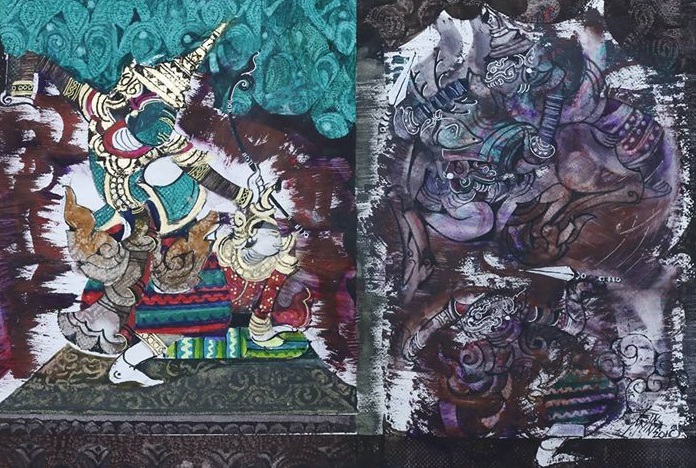
| Elderly Artists Defy Stereotypes With New Group Show Posted: 25 May 2018 04:13 AM PDT YANGON — In Myanmar there is a saying that when people get old they go to a monastery and pray the rosary. It means that the elderly in Myanmar prefer to seek peace of mind over an active lifestyle. But the saying hardly applies to the versatile artists Win Pe and Dr. Ko Ko Gyi, both of whom are in their 80s. Despite the knee pain and hearing loss that has come to them in old age, the two stay busy with brush and canvas in their studios. Artist Ko Thike and Sein Myint, both in their 70s, are also still as eager as bridegrooms about their abstract drawings and Myanmar-style modern paintings.  Joined by fellow artist K2K, they have come together for “Moment of Expressions” at the Yangon Gallery in People's Park. Last year, Win Pe and K2K organized the exhibition in Mandalay. This year, Dr. Ko Ko Gyi, Sein Myint and Ko Thike have brought it to Myanmar’s commercial capital. Win Pe has created paintings depicting Zawgyi, a creature or demigod in Myanmar myth. "Zawgyi is not important. Other figures are also not important. My paintings are just about lines and colors, and I am happy with it,” he said. Dr. Ko Ko Gyi earned a doctorate in psychology in Hungary and is a retired professor at Mandalay University. He was exposed to international art through museums in Europe and is also a close friend of Myanmar’s modernists. He has participated in art exhibitions since the 1970s and is showcasing his abstract expressionist paintings, which he has created over the past 40 years.  Ko Thike is showcasing his abstract paintings as well. "My paintings are about village life and culture, pagoda festivals, traditional dance and drama, puppet shows and nat pwe [spirit festivals],” said Sein Myint, who is known for his Myanmar-style modernism. K2K has created his paintings based on tarot cards. "I love the figures in tarot cards. I add things based on those figures. Mainly I play with colors," he said. Over 70 paintings will be on display at the exhibition, which runs Saturday through Monday. Prices range from $100 to $3,000. Translated from Burmese by Thet Ko Ko. The post Elderly Artists Defy Stereotypes With New Group Show appeared first on The Irrawaddy. |
| US House Backs Measures to Sanction Myanmar’s Military, Nudge Gem Sector Reform Posted: 25 May 2018 03:54 AM PDT YANGON — The US House of Representatives has approved measures that call for targeted sanctions against more of Myanmar's military leaders over human rights abuses in Rakhine State and encourage further reform of the country’s murky gemstone industry. The measures, added as amendments to the National Defense Authorization Act by the House in Washington on Wednesday, received strong bipartisan support. In December, the US imposed sanctions on General Maung Maung Soe — who oversaw the military's crackdown in Rakhine State last year — that effectively shut him out of the US financial system. The crackdown was triggered by militant attacks on security posts in Rakhine in late August and has driven nearly 700,000 mostly Rohingya Muslims to neighboring Bangladesh in what the UN and US have labeled a case of ethnic cleansing. The amendments call on the US president to impose asset freezes and travel restrictions on other senior officials of Myanmar’s military or security forces who ordered or carried out any serious human rights abuses or impeded the investigation of allegations of serious abuse by subordinates, "including against the Rohingya community in the state of Rakhine." The amendments do not name any specific military officials, though a version of the measures the Senate Foreign Relations Committee passed in February singles out Senior General Min Aung Hlaing, the military’s commander-in-chief, and Major General Khin Maung Soe. "Let me say that since August of 2017, the Burmese military has inflicted horrific violence against the Rohingya in Burma's Rakhine State, and is today using the same tactics against the Kachin," US Representative Eliot Engel, who sponsored the measures, said on the floor of the House, using another name for Myanmar. "This is a man-made crisis — ethnic cleansing, perhaps genocide. And to date, there has been no accountability," Engel said. "This measure would change that." A spokesman for the military could not be reached for comment. The military has denied committing rights abuses in Rakhine and said its actions were part of a legitimate counter-insurgency operation against terrorists. In April, however, it said seven soldiers had been sentenced to 10-year prison terms for their part in the massacre of 10 Rohingya men in Rakhine in September. In a statement issued Friday, Myanmar's main opposition, the military-backed Union Solidarity and Development Party, accused the US of seeking to "influence" and "interfere" in the country's internal affairs. The party said it strongly condemned the measures and urged the government to do the same "in consideration of the reputation and long-term interests of the country." Erin Murphy, founder and principal of the Inle Advisory Group, a business consultancy that monitors US policy on Myanmar, said the measures add to the authorities and criteria the US already uses to designate sanctions targets. The targets include entities owned or controlled by rights abusers, their immediate family members, and anyone they provide significant financial or material support to or receive support from. "I think it also does encourage (and remind) the Trump administration of what authorities he has…and to focus on the issue and know what is available to them to address atrocities," she said. "I think Congress has been frustrated by the lack of engagement by the Trump administration on the issue and on Asia policy writ large." The amendments added to the defense bill Wednesday also limit US military cooperation with Myanmar and call on the State Department to report back to Congress on the rights abuses in Rakhine State last year and determine whether they amount to not only ethnic cleansing but also crimes against humanity or genocide. In April, Reuters reported that the State Department had already begun an intensive investigation of alleged atrocities against the Rohingya for the possible prosecution of Myanmar’s military, interviewing hundreds of refugees about reports of murder, rape and beatings by soldiers. "The government is trying to avoid censure and this would send a clear message that the US is taking steps to address those concerns," said Paul Donowitz, lead Myanmar campaigner for rights group Global Witness. "This sends a message that the US is not satisfied with the current direction of the government." But more than seeking to target specific generals over the violence in Rakhine, Donowitz added, the amendments are "looking much more broadly at the military's outsize role in politics and the economy." To that end, the amendments seek to encourage reform of Myanmar's lucrative but opaque gemstone sector by having the State Department draw up a list of producers who meet strict transparency standards on ownership, licensing and revenue. It would exclude any producers connected to the military or security forces and allow the list to be rescinded if Myanmar caries out certain sector-wide reforms. A 2015 report by Global Witness called Myanmar's jade industry possibly "the biggest natural resource heist in modern history," a "vast slush fund" for the country’s military elite that generated as much as $31 billion in 2014 alone and continues to fuel a decades-long civil war.  Last year, the non-government Natural Resource Governance Institute (NRGI) placed Myanmar's mining sector near the very bottom of a list of 81 countries it ranked on the management of their natural resources. It placed Myanmar in the lowly company of countries with "almost no governance framework to ensure resource extraction benefits society." Donowitz said Global Witness was consulted on the gemstone industry measures in the amendments and was supporting them over similar measures in the Senate, which would see sanctions on jade — but not rubies — from Myanmar that were lifted in 2016 snap back in place. The House measures would only nudge US importers to source from the State Department’s list of vetted producers. “The Senate does not recognize that there is a reform process in Myanmar,” Donowitz said, which he described as "midstream." Since the National League for Democracy took power in 2016, the government has stopped issuing new gemstone mining licenses or extending existing ones and started drafting a new policy for the industry with input from non-government groups. "We believe that finding ways to incentivize reform…is the right way to go," Donowitz said. "It's not a panacea…. it's part of a process in reforming the sector. Right now we have nothing." Though the vast majority of Myanmar's jade exports currently heads across the border — often illegally — to China, he said the promise of broader access to a new market, and with it higher prices, could help spur reform. NRGI Country Manager U Maw Htun Aung said he also supported the House's approach to reforming the industry "because it's not black and white, because the gemstone sector is complicated and the blanket sanctions did not work." He said the number of active licenses in the gemstone sector has plunged by more than half since the freeze to less than 10,000 and that incentives were more likely to spur further reform than the return of sanctions. "If there is a benefit to being a good company…then it could have a chain of reactions in the long term. I don't think it's going to be a short-term solution," he said. But U Maw Htun Aung said he saw little chance of the US becoming a major importer of Myanmar's jade any time soon and that enforcement would be key to ensuring that gemstones headed to the US, rubies especially, were not being laundered through Thailand or Hong Kong, as they often are "It's very easy to hide the country of origin, especially once it's polished," he said. "And if there [are] no penalties, I don't see how it's going to work. U Than Zaw Oo, deputy director of Myanmar Gems Enterprise, the government's gemstone sector regulator, said the measures being proposed in the US, whether incentives or sanctions, would make little difference because US restrictions on money transfers with Myanmar were still in place. "So nothing is going to be new for us; it's just adding black on black," he said. "Even if there were new sanctions imposed on Myanmar, it would not impact us much because Western countries mostly buy rubies and sapphires rather than jade." The deputy director played down the military's share of the gemstone sector and said the industry was much more transparent than it used to be. “The gem industry is now taking part in the EITI [Extractive Industries Transparency Initiative] process, which is very tough because you have to submit revenue, company income and all of a company's projects, as well as project validity and expiration dates," he said. He also lauded last week's launch of an open data website on Myanmar's jade mining sector by NRGI. Open Data: Myanmar Jade visualizes several years' worth of official data on the country's jade sector with interactive charts and makes the data easy to search. "This sort of situation was impossible in the past," U Than Zaw Oo said. "You can't access such data on other industries." By drawing exclusively on official data, though, the site fails to capture the large volumes of jade still believed to be smuggled out of the country. The next hurdle for the proposed military sanctions and gem sector reform measures in the US is making it into the Senate's own version of the National Defense Authorization Act. Donowitz, of Global Witness, said the massive defense policy bill was considered "must pass" legislation and that US President Donald Trump has indicated that he would sign what Congress sends him. But he sees an obstacle in Senate majority leader Mitch McConnell, who opposes measures that could compromise the position of Myanmar's de facto leader, Daw Aung San Suu Kyi. Much of the international community has criticized the pro-democracy icon for not doing more to hold the country's still powerful military to account for last year's violence in Rakhine State. Some analysts say a more forceful approach could jeopardize the country's ongoing transition from military dictatorship to civilian rule. Murphy, of the Inle Advisory Group, noted that even if similar measures do make it into the Senate's defense bill, their final form could change once the House and Senate hash out any differences in the two bills before sending it to the president. "The House vote [Wednesday] could convince the Senate about the need for this provision, or something close to it, to be in the final product," she said. "There are a lot of ifs, but certainly a lot of bipartisan support for accountability on the violence occurring in Myanmar. Myanmar policy has typically not fallen on political lines; any policy moves have been bi- or non-partisan and this is another example of that." Additional reporting by Moe Myint. The post US House Backs Measures to Sanction Myanmar’s Military, Nudge Gem Sector Reform appeared first on The Irrawaddy. |
| Ultranationalist Sued for Hate Speech Posted: 25 May 2018 02:46 AM PDT YANGON — Ultranationalist Maung Thway Chun has been sued under Section 505(b) of the Penal Code in connection with religious hate speech during Dhamma talks in March in the village of Kyauktan in Sagaing's Mingin Township. U Naing Naing Zaw, the deputy township administrator of Mingin Township, filed a complaint with the township court on Monday, said U Kyaw Hsan, regional lawmaker of Mingin Township. U Wirathu, the high-profile leader of the ultranationalist religious organization better known by its Burmese acronym Ma Ba Tha, also delivered sermons during these Dhamma talks. The monk has returned to giving sermons after a one-year preaching ban against him expired in March. Maung Thway Chun, a staunch Ma Ba Tha supporter and the chief editor of its weekly and monthly publications, delivered hate speech at these Dhamma talks. "He spoke with disregard for the current government. His speech could mislead people and he apparently has an intention to incite a riot. So, he was sued under Section 505(b)," said U Kyaw Hsan. In a video clip that went viral on social media, Maung Thway Chun said that although it has been only 70 years since Myanmar got independence, Myanmar will soon be subjugated again, and this time, it is bound to lose its race, religion and territory. "The Republic of the Union of Myanmar will be changed to Myanmarnistan or Myanmarnesia," said Maung Thway Chun, referring to Muslim-majority countries Pakistan and Indonesia. "There won't be Buddhism in the country, and mosques and churches will replace pagodas and temples," he added. He further argued that speakers in both houses of Myanmar's legislative branch are Christians, and that the race and religion protection laws – that largely target certain Muslim religious and cultural practices – endorsed by Ma Ba Tha may be scrapped soon. "One of the vice presidents [Henry Van Thio] is Christian. And [the government] is being instigated by Muslim Kalars," he said, using a racial slur for those of South Asian descent often used against Muslims. "Christians and Muslims have joined up and started a scheme to annihilate Buddhism. No, not just started, they are already implementing it. And we and Sayadaw (U Wirathu) are defending against this," he said. U Kyaw Hsan said it took awhile to file the lawsuit, as he had to seek the approval of the regional government. When asked by The Irrawaddy, Maung Thway Chun said that he has not been informed about the complaint. "Reports spread online that I have been sued. But [the court] in Sagaing's Mingin has not notified me," said Maung Thway Chun. He said he would face trial if he were sued under Section 505(b), adding that what he said during the talks was not as harsh as what he wrote in Ma Ba Tha publications. He said he only talked about the reality of preventing the danger imposed by the 'Bengalis,' a term used by nationalists to refer to Rohingya Muslims, implying that they are interlopers from Bangladesh. "I have time to hide if I want to. And there are many places where I can hide. I could even hide until the government's term ends. But I won't. I would face the trial," he said. Penal Code Section 505(b) states that whoever makes, publishes or circulates any statement, rumor or report, with intent to cause, or which is likely to cause, fear or alarm to the public or to any section of the public whereby any person may be induced to commit an offense against the State or against the public tranquility; shall be punished with imprisonment which may extend to two years, or with fine, or with both. Translated from Burmese by Thet Ko Ko. The post Ultranationalist Sued for Hate Speech appeared first on The Irrawaddy. |
| Dhaka, UN to Coordinate Contraception Campaign in Rohingya Camps Posted: 25 May 2018 02:25 AM PDT DHAKA — Bangladesh and the United Nations Population Fund (UNFPA) have agreed to cooperate on providing contraception to Rohingya refugees from Myanmar as the estimated population of the camps housing them has now passed 1 million. An agreement between the Bangladesh Family Planning Directorate (DGFP) and the UN agency signed on April 17 lays out 13 "areas of cooperation" in providing reproductive health and family planning information and services to the "Rohingya refugees and host communities in Cox's Bazar district without discrimination and with dignity and respect." According to a copy of the agreement seen by The Irrawaddy, the agencies will adopt policies and guidelines for providing both short- and long-acting reversible contraceptive services, maternal health services, and record keeping and reporting, and will strengthen coordination and collaboration with agencies working with the host communities and refugees in Cox's Bazar to ensure culturally sensitive quality healthcare information and services are provided without "discrimination, and with dignity and respect." According to the bilateral agreement, the UNFPA will procure and supply long-acting reversible contraceptives, including intrauterine devices (IUDs) and implants, to the DGFP based on the needs of the Rohingya refugees. "We have already procured 8,600 implants and 600 other IUDs following the agreement," Abu Sayed Hasan, a family planning specialist at the UNFPA, told The Irrawaddy. He said the agencies had decided to include long-acting methods of contraceptives because the dropout rate for short-acting methods including pills and condoms was high. DGFP chief Kazi Mustafa Sarwar said many Rohingya are reluctant to use condoms and pills, adding that "they threw the condoms away when our staff supplied them with the items." "Many of them have been given short-acting injectable [contraceptives] with three-months' effectiveness, but we want to introduce long-acting methods that last three years and 10 years," Mustafa said. Between October 2017 and mid-May, Cox's Bazar family planning officials said the displaced Rohingya population was administered only 3,223 condoms, compared to 15,500 short-acting injectable contraceptives. A total of 19,456 strips of oral contraceptive pills were also distributed, according to the district family planning office. In September and October 2017, 1,000 condoms and 3,000 strips of pills were distributed and 3,900 women were given birth control injections. The DGFP has permitted other NGOs employing trained providers to offer long-acting reversible contraceptives as long as they obtain prior permission from the DGFP, the Bangladeshi officials said. The DGFP, with financial support from the UNFPA, will recruit two full-time doctors to provide sexual reproductive health services in Rohingya camps in Cox's Bazar. Once the doctors are recruited DGFP plans to withdraw its seven mobile medical teams from the refugee camps. The DGFP chief said the funding for this came from the UNFPA and there would be additional funding from the World Bank. According to the Bangladesh National Institute of Population Research and Training, better known as NIPORT, Bangladesh's maternal mortality ratio (the annual number of female pregnancy-related deaths per 100,000 live births) declined by 40 percent from 322 in 2001 to 194 in 2010. According to their latest statistics, the total fertility rate (TFR) in Bangladesh declined from 2.7 in 2007 to 2.3 in 2014. According to the World Health Organization (WHO), TFR "refers to the total number of children born or likely to be born to a woman in her life time if she were subject to the prevailing rate of age-specific fertility in the population." "But," said family planning specialist Hasan, "we have conducted a survey in [Rohingya] camps and found that their rate is higher than the host community." Since Aug. 25, 2017, nearly 700,000 Rohingya have fled across the border from Myanmar into Cox's Bazar. Bangladesh has so far completed registration of 1.1 million Rohingya, including some who have been living in Cox's Bazar for several decades. According to the Bangladesh Refugee Relief and Repatriation Commission, 35,355 Rohingya were already registered in two official camps in Cox's Bazar district by June 2014. The number had risen to 38,455 by August 2017. According to NIPORT, the contraceptive prevalence rate in Bangladesh increased from 56 percent in 2007 to 62 percent in 2014, while the use of modern contraceptive methods increased from 48 percent to 54 percent in the same period. In mid-May, the United Nations Children's Emergency Fund said in a statement that more than 16,000 Rohingya babies had been born in camps and informal settlements in Cox's Bazar in the previous nine months. About 100,000 Rohingya children are expected to be born in Bangladesh in 2018, according to a projection by the WHO. Religious Beliefs Pose a Challenge Family planning is a sensitive subject in Muslim Rohingya communities, according to both Bangladeshi and UNFPA officials. Bangladesh's top family planning official Kazi Mustafa Sarwar told The Irrawaddy that motivating Rohingya people to use contraception is a big challenge. "We plan to recruit eight interpreters who can provide counseling to convince them [about the benefits of family planning services]. It's our main challenge, as we have yet to make them convinced [that they would benefit from receiving the services]. Many of them were not at all aware of family planning in Myanmar." Regarding the beliefs of Rohingya people, he said, "They are conservative in their religious beliefs. Many of them are madrassa educated." A madrassa is an Islamic religious school. In fact, views in the camps toward contraception are somewhat mixed, with a spectrum of cultural and religious beliefs apparent among refugees. Aminul Islam, a religious teacher based in Bangladesh's Rajshahi district, believed any temporary method of contraception that protects a woman's health is acceptable, but that permanent birth control procedures were in conflict with the faith. Hafez Abdul Wahab, 43, came to Bangladesh 27 years ago and is a registered refugee in the Kutupalang camp. He and his wife have 11 children. Wahab said on Friday that in the past he had been reluctant to use birth control, describing the process as "difficult". However, he is now in poor health and said he would be willing to follow family planning methods if the government or an agency approached him about it. "Of course religious belief is an issue… Some Rohingya also believe that they need large families if they are to survive," said another family planning officer in Dhaka who did not want to be named as he is not authorized to speak to the media. Hasan, the UN family planning specialist, said the size of the average family in the camps was 5 to 6 members. The UNFPA plans to recruit 40 more midwives and deploy 10 paramedics to provide family planning counseling in the Rohingya camps, taking the total to 100 in the Rohingya-populated Ukhia and Teknaf sub-districts of Cox's Bazar. The UN agency in partnership with NGOs will also recruit 100 community volunteers to build awareness of the need for family planning, maternal health and safe delivery procedures among the Rohingya refugees. Under the agreement between Dhaka and the UN, Pintu Kanti Bhattacharjee, the head of the family planning office in Cox's Bazar district, will supervise and coordinate the areas of cooperation on behalf of the Bangladesh government. Pintu criticized NGOs operating in the area for focusing too much on financial and infrastructure assistance to Rohingya and neglecting the issue of birth control. He said his office had held a series of meetings with donors and charity agencies to discuss ways of increasing coordination and bringing the population of the camps under control. "Now, we are hopeful about our progress," said Pintu, adding that a voluntary sterilization plan was also being considered as a way of tackling the high birth rate among the Rohingya. The U.S. Embassy in Dhaka announced on March 28 that in response to a request from the Bangladesh Health and Family Welfare Ministry, the U.S. Agency for International Development (USAID) had on March 25 supplied 622,800 doses of injectable contraceptives to Bangladesh, bringing the total contribution from the U.S. to nearly 1 million doses. USAID mission director Janina Jaruzelski said that "USAID remains committed to helping the most vulnerable Rohingya refugees gain access to essential and life-saving health commodities." A family planning official in Dhaka said last week that a report by Agence France-Presse on the possible introduction of voluntary sterilization in the camp had resulted in a delay in the approval of the introduction of long-term contraceptive methods, as the government feared the report cast its assistance activities for the Rohingya people and others in a bad light. In October, the AFP reported that Bangladesh was planning to introduce voluntary sterilization in its overcrowded Rohingya camps after efforts to encourage birth control failed. Many of the refugees interviewed for that report told AFP they believed a large family would help them survive in the camps, where access to food and water remains a daily battle and children are often sent out to fetch and carry supplies. Others had been told that contraception was against the tenets of Islam. Bangladesh has for years run a successful domestic sterilization program, offering 2,300 taka ($28) and a traditional lungi garment to each man who agrees to undergo the procedure. Every month 250 people undergo sterilization in the border town of Cox’s Bazar. But performing the permanent procedure on non-Bangladeshi nationals requires final approval from a committee headed by the health minister, according to the AFP report. "But, we finally got approval," the family-planning official in Dhaka said. Bangladeshi officials believe sterilization of males is the best way to control the population, as it permanently removes a man's ability to reproduce, regardless of how many wives he has. An official at an Ukhiya-based NGO working on gender-based violence told The Irrawaddy that many Rohingya males have multiple wives in various camps, adding that once a wife becomes pregnant the male often goes to stay with another for sexual relations. The post Dhaka, UN to Coordinate Contraception Campaign in Rohingya Camps appeared first on The Irrawaddy. |
| Military Officer’s Wife Detained for Alleged Murder of Domestic Worker Posted: 25 May 2018 12:24 AM PDT YANGON — A domestic worker at the quarters of a military officer of the Inn Daing armored battalion in Yangon's Hlegu Township died of intestinal injuries, according to a post-mortem examination. Khin Thandar Oo, also known as Kayin Ma, 38, a mother of four children, died within an hour after she was sent back to her home in Oh Po village in Twante Township by the wife of the military officer on May 19, citing her ill health. Dr. Ne Win Thwin of the Twante Township Health Department who conducted the post-mortem examination confirmed that the woman died of injuries to her intestines. "She would not have died if surgery was done in time to patch up the wounds in her intestine. Because the wounds were not treated for three, four days, her body could not absorb food and got dehydrated. Her belly was swollen with intestinal fluid. What's more, feces spread in her body and became toxic. That's the cause of death," Dr. Ne Win Thin told The Irrawaddy. He also found bruises that he claimed were likely due to being hit with a blunt object on her head and belly, as well as cuts on other parts of her body. The woman told her neighbors before she died that she had been tortured by her employer, said U Wunna Soe, administrator of the village tract where she was from. "She asked her neighbors to bring me to her home immediately. I went to the police station and reported it. I saw that she was injured on her left eyebrow and had bruises on her back, chin, pelvis, chest and left leg," U Wunna Soe told The Irrawaddy. The victim was sent back by Theingi Su, 31, the wife of the military officer, saying that she was suffering from a swollen abdomen and hemorrhoids, said administrator U Aye Thaung of Oh Po village. "She said before she died that she was accused of stealing a necklace and beaten," he said. Ka Luak Chaik police station in Twante Township confirmed that Theingi Su has been arrested for murder. "Bail is not granted for murder. So, we have detained her at our police station. We cannot provide details as the investigation is still ongoing," police lieutenant Myo Chit Swe told The Irrawaddy. The victim was buried the day after she died, said U Wunna Soe. The husband of Khin Thandar Oo died four years ago and the victim is survived by four children aged between 10 and 16. Translated from Burmese by Thet Ko Ko. The post Military Officer's Wife Detained for Alleged Murder of Domestic Worker appeared first on The Irrawaddy. |
| ‘Trump Formula?’ N Korea Says Still Open to Talks After Summit Canceled Posted: 24 May 2018 10:26 PM PDT SEOUL — North Korea responded on Friday with measured tones to US President Donald Trump’s decision to call off a historic summit with leader Kim Jong Un scheduled for next month, saying Pyongyang hoped for a “Trump formula” to resolve the standoff over its nuclear weapons program. On Thursday, Trump wrote a letter to Kim to announce his withdrawal from what would have been the first-ever meeting between a serving US president and a North Korean leader in Singapore on June 12. “Sadly, based on the tremendous anger and open hostility displayed in your most recent statement, I feel it would be inappropriate, at this time, to have this long-planned meeting,” Trump wrote. Trump’s announcement came after repeated threats by North Korea to pull out of the summit over what it saw as confrontational remarks by US officials. Friday’s response by North Korean Vice Foreign Minister Kim Kye Gwan was more conciliatory, specifically praising Trump’s efforts. “We have inwardly highly appreciated President Trump for having made the bold decision, which any other US presidents dared not, and made efforts for such a crucial event as the summit,” Kim said in a statement carried by state media. “We even inwardly hoped that what is called ‘Trump formula’ would help clear both sides of their worries and comply with the requirements of our side and would be a wise way of substantial effect for settling the issue,” he said without elaborating. North Korea has sharply criticized suggestions by Trump’s national security adviser John Bolton and Vice President Mike Pence that it could share the fate of Libya if it did not swiftly surrender its nuclear arsenal. Libyan leader Muammar Gaddafi was deposed and murdered by NATO-backed militants after halting his nascent nuclear program. Trump had initially sought to placate North Korea, saying that he was not pursuing the “Libya model” in getting the North to abandon its nuclear weapons program. White House Press Secretary Sarah Huckabee Sanders also said: “This is the President Trump model. He’s going to run this the way he sees fit.” Kim Kye Gwan said its recent criticisms against certain US officials had just been a reaction to unbridled American rhetoric, and that the current antagonism showed “the urgent necessity” for the summit. “His sudden and unilateral announcement to cancel the summit is something unexpected to us and we can not but feel great regret for it,” Kim Kye Gwan said, while noting that North Korea remained open to resolving issues with Washington “regardless of ways at any time.” “The first meeting would not solve all, but solving even one at a time in a phased way would make the relations get better rather than making them get worse. The US should ponder over it,” Kim said. Nuclear Site Decommissioned Trump’s letter came just after North Korea announced it had completely dismantled its Punggye-ri nuclear test facility “to ensure the transparency of discontinuance of nuclear test.” Footage of the event broadcast by South Korean media showed explosions throwing huge clouds of dust and debris as they destroyed tunnel entrances as well as multiple wooden structures around the site. Other images showed North Korean officials displaying a map of the site, including several major tunnel complexes they said were unused and completely operational prior to being collapsed. Analysts worried the canceling of the talks could prompt a resumption in hostilities on the Korean peninsula, including renewed shorter-range missile tests or stepped-up cyber attacks by Pyongyang and increased sanctions or deployment of new military assets by Washington. Trump, in scrapping the June 12 summit in Singapore, sounded a bellicose note, warning Kim of the United States’ greater nuclear might, reminiscent of the president’s tweet last year asserting that he had a "much bigger" nuclear button than Kim. Speaking later, Trump said the US military stood ready if Kim were to take any “foolish” action, and that the United States would continue its “maximum pressure” campaign of sanctions to press North Korea to give up its nuclear weapons. South Korean President Moon Jae-in, who worked hard to help set up the summit and urged Trump at a White House meeting on Tuesday not to let a rare opportunity slip away, said he was “perplexed” by the cancellation. He urged Trump and Kim to talk directly. US Secretary of State Mike Pompeo and his South Korean counterpart, Kang Kyung-wha, held a phone call and agreed to continue working toward creating the right conditions for the United States and North Korea to talk, the South’s foreign ministry said in a statement on Friday. Pyongyang had not responded in recent days to queries by the United States about the leaders’ summit, Pompeo told a Senate hearing. Japanese Foreign Minister Taro Kono said Tokyo understands Trump's decision to cancel the Singapore summit, Kyodo News reported. "It's meaningless to have talks that don't achieve results," Kono told reporters on a visit to Mexico City, the news agency said. Japanese Defense Minister Itsunori Onodera also played down the significance of the canceled meeting. “The important thing is not the US-North Korea meeting itself, but that the meeting becomes an opportunity to move forward in the issues of denuclearization and abductions,” he told reporters in Tokyo. The post ‘Trump Formula?’ N Korea Says Still Open to Talks After Summit Canceled appeared first on The Irrawaddy. |
| Thailand Arrests Senior Monks in Temple Raids to Clean Up Buddhism Posted: 24 May 2018 10:20 PM PDT BANGKOK — Thai police raided four Buddhist temples on Thursday, arresting several prominent monks and worshippers in the year’s biggest such operation amid a crackdown on illegal financial dealings by temples. The raids are the military government’s latest bid to reform Buddhism, which is followed by more than 90 percent of Thailand’s population of 69 million, but whose image has been tarnished by money and sex scandals involving monks. “This is the investigation stage… it will all come down to facts and evidence,” police official Thitiraj Nhongharnpitak, of the Central Investigation Bureau, which is investigating the monks, told reporters. More than 100 police commandos raided four temples in Bangkok, the capital, and the adjacent central province of Nakhon Pathom, in the early hours of Thursday. Among those arrested was Phra Buddha Issara, 62, an activist monk who led street protests in 2014 and launched a campaign to clean up Buddhism, but gained enemies by publicly naming other religious leaders he accused of wrongdoing. Buddha Issara was formally stripped of his position as a monk and sent to Bangkok remand prison to await trial on charges of robbery, forgery, and illegal detention of officials during the protests, his lawyer, Theerayuth Suwankaesorn, told Reuters. Phra Phrom Dilok, 72, a member of the Sangha Supreme Council, which governs Buddhist monks in Thailand, was also arrested over alleged embezzlement of temple funds, police said. Two other senior monks, Phra Sri Khunaporn and Phra Wichit Thammaporn, both assistant abbots of Bangkok’s Golden Mount temple, were also arrested over alleged embezzlement, they added. Representatives of the three monks did not immediately respond to Reuters’ telephone calls to seek comment. Deputy Prime Minister Prawit Wongsuwan said the arrests were about getting to the bottom of the allegations. “This is part of the investigation,” Prawit said. Thailand’s temples, which earn billions of dollars every year from donations, have been embroiled in scandals ranging from murder, sex and drugs to shady financial dealings. Under pressure from the junta, Thailand’s body of Buddhist monks has been trying to clean up its own act since last year, by enforcing tougher discipline for more than 300,000 monks. The military took power in a 2014 coup it said was needed to restore order after months of anti-government protests, and has promised to hold elections next year, despite postponing the date several times. Buddhist monks are highly respected in Thailand and taking action against them was historically considered taboo. But recent scandals have forced authorities to rethink how they handle allegations against Buddhist religious leaders. The post Thailand Arrests Senior Monks in Temple Raids to Clean Up Buddhism appeared first on The Irrawaddy. |
| India State Banks’ Bailout Stumbles as Losses Mount Posted: 24 May 2018 10:03 PM PDT MUMBAI — When the Indian government announced a surprise $32 billion bailout plan for the nation’s state-controlled banks last October, credit rating firms and the nation’s central bank saw it as a huge step to getting the industry back to robust health – and lending more to businesses and consumers. But their optimism may have been majorly misplaced judging by the latest numbers coming out of the banks. And that may in turn crimp economic growth in Asia’s third-largest economy. Thirteen state banks have reported combined losses of $8.6 billion for the year to March – including $6.5 billion in the last quarter – and their non-performing loans have surged nearly a fifth from end-December levels. Two state banks have reported modest profits and six are still to report. While many of the banks, including top lender State Bank of India, have said the worst is probably over, they still see one or two more quarters of pain. That means more bad loans getting disclosed and loss provisions shooting up as a central bank order will cause more debt defaulters to be dragged into bankruptcy. “The government capital is only going to just plug the hole, there is definitely no growth capital,” said Udit Kariwala, an analyst at Fitch Ratings’ India Ratings & Research. He said smaller state lenders with limited ability to raise capital from the market will have to curtail their lending. The 21 state lenders hold two-thirds of India’s banking assets, and accounted for the bulk of the record $150 billion of soured loans in the banking sector last year. The banks, which have been blamed for indiscriminate lending to sectors such as metals and power that turned sour, can still be held responsible for much of the balance sheet carnage. A more than $2 billion fraud at India’s second-biggest state lender, Punjab National Bank, disclosed less than four months ago, not only left a hole but also underlined how weak the banks’ grip on risk is. Exacerbating the problems is a move in February by the Reserve Bank of India, the nation’s central bank, to withdraw half a dozen loan restructuring schemes that banking experts said were helping banks to avoid disclosing dud loans. It also tightened other rules governing bad loan accounting. In addition, the RBI this month banned Dena Bank, a loss-making smaller state-run lender, from making any new loans. Days later, Allahabad Bank, another smaller state-run lender, said it had been asked by the regulator not to increase the number of risky loans and costly deposits on its books due to its capital and leverage position Bank analysts say more state banks could come under similar restrictions aimed at conserving limited capital. The RBI already has 11 state lenders under its “prompt corrective action” framework that restricts them from expanding. That is not all. Capital needs will also be exposed by global banking rules fully kicking in by March 2019. They mandate banks to have a minimum core capital ratio of 8 percent, and at least six banks, including PNB are short of that number. Election Agenda Under New Delhi’s recapitalization plan – aimed mainly at driving credit growth in an economy where bank loans are the main source of funding for everything from buying a car to building a port – the government has already injected about 880 billion rupees ($13 billion) into 20 banks as of end-March. It has 650 billion rupees to inject in the current fiscal year, and the banks themselves were supposed to raise 580 billion rupees through share and asset sales. Some, including SBI and PNB, last year raised funds from share sales, but several others have postponed such plans. Kariwala at India Ratings estimates the banks now need 800 billion to 1 trillion rupees to fund soured-asset provisions and maintain minimum capital ratios alone, which means there will be little left from the bailout for lending growth. Some bank analysts say the government may have to increase the size of the bailout. Certainly, bank lending – and its impact on growth – will be on Prime Minister Narendra Modi’s agenda ahead of a general election that has to be held within a year. “Given how the stocks are doing, the nearly 0.6 trillion rupees banks need to raise looks difficult. So, the government may have to slightly increase the amount they are planning to inject,” said Srikanth Vadlamani, vice president of the Financial Institutions Group at Moody’s Investors Service. Moody’s said this week that PNB alone would need 120-130 billion rupees of new capital in the year to March to achieve an 8 percent core capital ratio. At the end of the last quarter it was at just 5.95 percent. Importers' Funding Channel Shut Businesses, especially the smaller ones, are already complaining of not getting the loans they want. In February to March, lending to small businesses dropped 0.2 percent, though overall lending grew 5.9 percent. For importers, a major channel of funding – overseas credit through letters of undertakings from Indian banks – has been shut after the PNB fraud, forcing those businesses to depend more on domestic rupee loans. The Indian government will ensure that all state banks including the weaker ones meet the minimum regulatory capital ratio, said Rajeev Kumar, the top bureaucrat overseeing the banking sector at the finance ministry. He also said with the planned recapitalization some of the banks will have room to grow, while bad loan recoveries in the bankruptcy process will further aid banks’ bottom lines, He said he expects the banks woes to subside in a quarter or two. “Whenever you do the cleaning part, a bit of dust, a bit of pain, upfront is okay,” said Kumar. “It’s only one quarter that you have to just wait.” The post India State Banks' Bailout Stumbles as Losses Mount appeared first on The Irrawaddy. |
| Cheap Rides at Risk in Drive to Clean up Southeast Asia Streets Posted: 24 May 2018 09:35 PM PDT MANILA — From Manila’s iconic jeepneys to Kuala Lumpur’s motorbike taxis, Southeast Asian capitals are on a drive to clean their streets of vehicles that cause pollution and traffic jams, while experts defend the vital role they play in cities without adequate public transit. The Philippines this year began rolling out electric vans, which officials say will replace jeepneys older than 15 years with safer, more environment-friendly vehicles by 2020. But operators and drivers of the 270,000 jeepneys that ply the country’s choked roads are resisting the plan, saying the strict conditions and high cost of the new vehicles will push them out of business and raise prices for commuters. “It will definitely send transport workers and their families into poverty and dangerous desperation,” said Daisy Arago, executive director of the Center for Trade Union and Human Rights in Manila. “Modernization is acceptable only when rights and welfare are at the center of the program, she said, adding that privatizing operations may increase fares and hurt poorer residents. Jeepneys, known endearingly as “Kings of the Road”, have for decades been the cheapest option in a country where millions struggle with inadequate public transport. Cobbled together initially from surplus army jeeps left behind by the US military after World War II, jeepneys have evolved into cultural icons, brightly painted and decorated with religious symbols, pithy slogans and luxury logos. At a cost of 8 pesos ($0.15) for 4 km (2.5 miles) in Manila, even the city’s poorest residents can afford them. Manila aims to phase out about two-thirds of jeepneys. But the government denies it is unfairly targeting drivers and operators. “We assure Filipino jeepney drivers that this initiative of the government to improve our public transport sector will not put them out of business,” presidential spokesman Harry Roque said in a statement. “In fact, the program aims to strengthen and guarantee the profitability of the jeepney business,” he said. ‘Disastrous' In Metro Manila, one of the world’s most densely populated urban areas with nearly 13 million people, jeepneys are the preferred transport option, ferrying millions of commuters everyday. Each vehicle packs in 15 to 20 people, who sit knee-to-knee on twin benches without seat belts or air-conditioning. Drivers are known to speed, stopping randomly to pick up and let off passengers. They make between 200 and 400 pesos a day, and pay a portion of their earnings to the owner. Most vehicles run on heavily-polluting diesel, which is the main reason they must be replaced, according to officials. The government also wants to set new routes with fixed drop-off and pick-up points, and consolidate vehicle ownership, which officials say will streamline operations and improve earnings. But drivers say the new vehicles, priced at about 1.8 million pesos ($34,000), are too expensive, and that the government subsidy of 80,000 pesos is inadequate. Anyone who wants to buy a franchise must have a market capitalization of at least 7 million pesos and a fleet of 20 units, which would bar thousands of small and independent operators who now make a living from jeepneys, Arago said. “Providing efficient and affordable public transportation services is a principal obligation of the state to its citizens,” she said. “Handing public transportation services over to private corporations would be disastrous to public interests, particularly commuters and wage earners,” she added. The government will offer subsidized loans to help buy new vehicles, according to Roque. Priority Lanes Elsewhere in the region, motorcycle taxis – the fastest way to get around grid-locked streets – face an uncertain future, as do all motorbikes in some cities, even as car sales boom. Kuala Lumpur last year banned motorcycle taxi services due to safety concerns. In Bangkok, drivers face increasing restrictions from the military government including on parking on sidewalks, said Chaloem Changtongmadun, president of the motorcycle taxi association, which has long sought designated parking zones. City officials have said that motorbike taxis clutter sidewalks and cause accidents with their rash driving. Thailand’s road death rate is the highest in the world apart from war-ravaged Libya, according to a 2015 World Health Organization report. Meanwhile, Indonesia’s Supreme Court earlier this year lifted a ban on motorcycles on Jakarta’s main thoroughfares, following a petition by a motorcycle taxi driver who argued that it was discriminatory. Hanoi has vowed to ban all motorcycles by 2030 to unclog its streets and reduce emissions. These moves are misguided when public transport systems in the region are still inadequate, said Rene Santiago, at the Transportation Science Society of the Philippines. “Instead of posing hurdles, governments should work with operators and help them become more efficient to solve urban transit problems,” he told the Thomson Reuters Foundation. In Manila, priority lanes for jeepneys, passenger shelters and digital booking systems similar to ride-hailing apps can help relieve congestion while also serving drivers and commuters, he said. “They are seen as a traffic hazard, but really, we must acknowledge they play a very vital role in urban transit.” The post Cheap Rides at Risk in Drive to Clean up Southeast Asia Streets appeared first on The Irrawaddy. |







| You are subscribed to email updates from The Irrawaddy. To stop receiving these emails, you may unsubscribe now. | Email delivery powered by Google |
| Google, 1600 Amphitheatre Parkway, Mountain View, CA 94043, United States | |


