Friday, November 9, 2018

The Irrawaddy Magazine

The Irrawaddy Magazine


No Apology From Journalists as Yangon Govt Drops Incitement Suit

Posted: 09 Nov 2018 04:49 AM PST

YANGON — The Yangon Region Government on Friday dropped its incitement suit against three Eleven Media Group journalists but was denied the apology it wanted from the reporter and two editors, who maintain that their coverage was accurate.

President U Win Myint last month ordered the regional government to drop its lawsuit against the trio — managing editors U Kyaw Zaw Lin and Nari Min and chief reporter U Phyo Wai Win — and adhere to the Media Law, which says the Myanmar Press Council should try to resolve complaints against the media before they reach the courts.

The council’s own rules preclude it from mediating a dispute that is being litigated in order to avoid accusations of contempt of court.

The government’s move to withdraw the suit comes three weeks after the council urged it to follow the president’s order.

Yangon Chief Minister U Phyo Min Thein has demanded that Eleven Media apologize for an article about the regional government’s alleged financial mismanagement because it contained false information. He warned that legal action would resume if the Myanmar Press Council could not settle the dispute.

U Kyaw Zaw Lin said on Friday that the trio had nothing to apologize for because the story was accurate and based on credible sources.

The story in question was based primarily on what lawmakers had said during a session of the regional legislature about an official audit of the Yangon government’s 2016-17 fiscal year budget. Lawmakers themselves insisted the story was accurate.

"How can we apology for something that we didn't do wrong?" said U Kyaw Zaw Lin.

He said the company took full responsibility for the story and would defend how and why it was written before the Myanmar Press Council.

The Yangon government sued the three journalists in early October under Article 505 (b) of the Penal Code. They were arrested on Oct. 10 and detained at Yangon's Insein Prison before being released on bail Oct. 26.

Additional reporting by The Irrawaddy’ Zue Zue.

The post No Apology From Journalists as Yangon Govt Drops Incitement Suit appeared first on The Irrawaddy.

Fire Kills Two Novices at Monastery in Southern Shan State

Posted: 09 Nov 2018 03:57 AM PST

YANGON—Two novices died and two others were injured in a fire at a monastery in southern Shan State on Wednesday night. Residents of Mong Pan Township's Pan Pi village, where the blaze broke out after 11 p.m., accused Restoration Council of Shan State (RCSS) members of deliberately setting the fire, a claim the group immediately rejected.

The novices who died were aged 12 and 13. The two injured boys are 10 and 12.

A resident of Pan Pi told The Irrawaddy that the fire "Was not caused buy a candle. The monastery fire happened after a group of people arrived in the village. We thought they were ordinary villagers."

RCSS spokesman Lieutenant-Colonel Sai Oo denied the accusation, and speculated that the fire was caused by young novices mishandling candles on the night of the new moon, when there is no moonlight.

"It is not true and it was just [an accidental] fire. We heard they were playing with fire near a bottle of petrol, and thus the fire started," he said.

The monastery in Pan Pi village is home to over 30 novices aged 10-14, and two monks, including the abbot.

Pan Pi has a population of more than 2,000, with over 400 households. The majority of residents are PaO, but the village is also home to ethnic Shan and Lahu.

Locals told The Irrawaddy that they needed emergency assistance, but no administrative officials or lawmakers had arrived to provide relief.

Troops from the RCSS/Shan State Army South and PaO Nationalities Liberation Organization/PaO Nationalities Liberation Army operate near the village and clashed as recently as Oct. 16.

The RCSS also said the Myanmar military (or Tatmadaw) had deployed troops and built outposts near the village recently.

The RCSS spokesman said the accusation that the RCSS was involved in the monastery fire was intended to create misunderstanding about the organization among the public, to create disunity and aggravate the conflict in the area. He said the organization had already explained that it had nothing to do with the fire via its "Tai Freedom" online media outlet.

Sai Oo added that, "Actually, fires can happen out of ignorance. It is true that we were engaged in fighting before. But we are Buddhists too, and we do not target monks, monasteries or the public. We never think of engaging in such bad actions and we are not allowed to do so. We even provide support for building new monasteries in villages, regardless of the residents' different ethnic backgrounds, whether they are Shan or PaO."

"This allegation against us is an attempt to inflame the problem. It will cause disunity among our community. The locals know that we are not [that sort of people]."

Both the RCSS and the PNLO are signatories to the Nationwide Ceasefire Agreement (NCA). Article 9 of the NCA calls for the protection of civilians and prohibits destruction and causing damage to any public properties—including schools, hospitals, clinics and religious buildings—for any reason by any armed group. It also prohibits the deployment of troops and calls for signatories to promote public safety and development in ceasefire areas.

The post Fire Kills Two Novices at Monastery in Southern Shan State appeared first on The Irrawaddy.

Church Accuses Karenni Chief Minister of Stealing its Land

Posted: 09 Nov 2018 03:53 AM PST

CHIANG MAI, Thailand — A Catholic church is accusing Karenni State Chief Minister L Phaung Sho of stealing a piece of its land in Mese Township and of preparing to fence it off.

At a press conference in Yangon on Thursday, Father Richard Thura Tun said the chief minister had stolen the land — less than half an acre — in 2014, when he was a Mese Township assistant education officer, and secured a lease for it last year.

He said he decided to finally come forward with the claim after the chief minister started clearing the land for his home and, as of last month, was preparing to build a fence in front of the church’s entrance to mark it off.

The chief minister could not be reached for comment.

Father Richard Thura Tun said the 14-acres church compound was recognized as a religious site by township authorities in 1994 and obtained a license for the property from the Department of Land Registration in 2006.

He said the church has asked the President’s Office and the ruling National League for Democracy (NLD) for help settle the dispute but so far to no avail.

 "We also met with him [L Phaung Sho] twice before we sent our first letter in July 2017, but he refused to give the land back," he told The Irrawaddy. 

 "The chief minister seized the land to use to build his home," he added. "It is a misuse of his power.”

Father Richard Thura Tun said the secretary of Karenni State’s General Administration Department, U Tin Maung Soe, had tried to broker a compromise that would see the church regain two-thirds of the disputed land and let the chief minister keep the rest. But he refused because he thought the offer was not fair.

He said church authorities met with NLD spokesman U Myo Nyunt in September but were told to wait until after the by-elections, which took place on Saturday.

On Friday, U Myo Nyunt told The Irrawaddy that NLD leaders have since met with Father Richard Thura Tun in Yangon and that an investigation was “ongoing.”

 "We cannot say when we will be able to go there, but it is a priority case for us to follow up on," he said.

Before being appointed chief minister, L Phaung Sho was elected to the state legislature in 2015 to represent Mese’s Constituency No. 2.

The post Church Accuses Karenni Chief Minister of Stealing its Land appeared first on The Irrawaddy.

Mandalay Textile Factory Rehires Fired Workers, But Protest Leaders Sued

Posted: 09 Nov 2018 03:07 AM PST

PALEIK, Mandalay Region — A textile factory in Mandalay Region agreed on Thursday to rehire the 207 workers it fired three months ago, though police sued four of them the same day for their protest.

About half of the fired workers were on their way to the regional capital to ask the Mandalay chief minister to help them get their jobs back at the Panda Textile factor when three of their leaders were detained by police in Paleik on Thursday morning.

The three were released that evening after the protesters sat down in front of the local police station to demand their freedom. They also agreed to call off the protest after the factory promised to rehire all the workers it had fired.

However, the Paleik police filed a lawsuit against fourth of the protest leader — including the three they had detained — under articles 18 and 19 of the Peaceful Assembly and Procession Law, according to the workers.

"We are not surprised by the lawsuit because that's how the authorities always work, without taking care of the welfare of the people. They only know how to take legal action," said Ma Zarchi Win, one of the four who claim they were sued.

The workers also said that some of their demands had yet to be met, including that their water and electricity bills over the three months they were jobless be waived.

"We are going to meet with the factory authorities in the presence of lawmakers and local authorities to negotiate about the bills, and if there is a deal the workers and the factory will sign the agreement and the workers will go back to work," Ma Zarchi Win said.

Police and factory representatives at the police station on Thursday declined to comment for this story.

The factory has seen its share of protests over the past five years.

After Panda took over the factory in 2013 from the Ministry of Industry, workers staged a series of protests claiming their labor rights were abused during the transition period.

In 2015, hundreds of workers set up a protest camp outside the factory to demand that 200 recently fired colleagues be rehired. The factory agreed to take a few dozen of them back, but two protesters died of pre-existing conditions during the sit-in and four of the leaders were fired.

Then in 2017, once negotiations to rehire the remaining workers fired in 2015 stalled, employees staged a protest in Mandalay City.

The post Mandalay Textile Factory Rehires Fired Workers, But Protest Leaders Sued appeared first on The Irrawaddy.

Explore Lion City’s Food and Arts at 3rd Singapore Festival

Posted: 09 Nov 2018 02:29 AM PST

YANGON—The third edition of the Singapore Festival will run from Nov. 30-Dec. 2 on Bogalay Zay Street in downtown Yangon, with many exciting new activities added this year.

The three-day event organized by the Singapore Tourism Board (STB) aims to allow Yangonites to experience the riches of Singapore's culture through food, urban design, art, music and film, said John Gregory Conceicao, executive director of STB's International Group.

He added, "This annual event is a celebration of Singapore's close friendship with Myanmar. We plan to offer consumers a much more interactive and personal experience of Singapore's 'Passion Made Possible' destination brand at this year's festival."

The Singapore Festival has been held in Yangon annually since 2016. For the past two years, the event was used by airlines and travel agents to sell travel packages at special prices.

2018 Singapore Festival visual art design

"This time we want to do something different from the past two years. Air ticket promotions and travel packages will be available online only. We would like to do new experimental things and wanted to showcase our street foods. I think Myanmar people are already familiar with some Singapore dishes. Some Singapore street foods and Myanmar street foods are quite similar and people can try both at the festival," he said at a press event last Thursday.

STB is worked along with local partner Doh Eain and more than 18 Myanmar partners to ensure that the festival continues to be relevant and meaningful to Myanmar people, he said.

"We needed to ask for a permit from Yangon authorities to hold the event on Bogalay Zay Street. Doh Eain is already familiar with Yangon authorities' processes. This is the first time, and we have had good collaboration with Yangon's authorities; we never done this before. I think this is groundbreaking for us to do something like this in Yangon," Conceicao explained.

He added that, "We want to create awareness in Myanmar about visiting Singapore. To attract Myanmar people to visit the Singapore is our job, but the most important thing is to build people-to-people connectivity."

During the three-day event, visitors will get to enjoy an exciting array of activities including films, a 500-kyat street-food fair, a Singapore art showcase and installations, a children's workshop and play zone, and others.

"Singapore Festival 2018 is designed in Myanmar, with Myanmar and for Myanmar. The various activities showcase the essence of 'Passion Made Possible', inspire the public to pursue their dreams, and provide Myanmar consumers an experiential taste of Singapore," Conceicao explained.

According to him, more than 146,000 Myanmar travelers visited Singapore last year, up 28 percent compared with 2016.

"In the first half of 2018, 74,000 Myanmar travelers visited Singapore, and travel season in Myanmar is just starting now. So, we hope to see more travelers in the second half of this year," he said.

Most of the visitors from Myanmar are family leisure travelers and business travelers, he added.

"Singapore has many things to do for the family and kids. So, family leisure travelers are our top visitors. Also, groups of young Myanmar people visit Singapore to explore the nightlife and parties," he said.

At the festival's main event, visitors can experience Singapore's very own annual "50 Cents Fest", the "500 Kyat Food Fair", a diverse range of Singapore and Myanmar traditional and contemporary flavors across 20 street food stalls for 500 kyats per dish.

Visitors also have the opportunity to experience popular Singapore attractions such as Sentosa Island, Gardens by the Bay, Resorts World Sentosa, and Wildlife Reserves Singapore through interactive stations.

"Through Singapore Festival 2018, we hope that Myanmar people will build a deeper connection with Singapore not just as a holiday destination, but also a place where they can come and discover, fulfill and rekindle their passions," Conceicao said.

The post Explore Lion City's Food and Arts at 3rd Singapore Festival appeared first on The Irrawaddy.

Central Bank Removes Lending Restrictions on Foreign Bank Branches

Posted: 09 Nov 2018 02:29 AM PST

YANGON—The Central Bank of Myanmar on Thursday announced that the Myanmar branches of international banks are now permitted to extend loans to local companies and provide other banking services, opening up a new source of funding to local corporates.

Currently, branches of 13 international banks from China, Japan, Singapore, India, Malaysia and Vietnam are listed with the Central Bank, while 49 other banks have representative offices here.

Previously, the international branches were only allowed to finance foreign companies operating in Myanmar. 

U Saw Bo Bo, an ex-Citi banker, said the central bank's move would facilitate the circulation of both local and foreign currencies through the national economy.

"If there is more currency in circulation, businesses will be more active. This may help reduce exchange rate fluctuations caused by poor circulation of foreign currencies," he said.  

At the same time, he said, the central bank's green light for foreign banks to provide a full range of banking services to local corporations will pose a challenge to the local banking industry, which is ill equipped to compete with foreign banks in terms of the U.S. dollar interest rate, and providing long-term collateral-free loans.

"Foreign banks have much better technology and their service fees are lower. Therefore, big corporations, especially multinational ones, may gradually seek services from foreign banks," he explained.

Despite the challenges, local banks have their own strengths.

"There may be a lot of inconveniences for local businessmen engaging with foreign banks. There is a saying among international businessmen that domestic banks are the best to partner with. And foreign banks will in no way be able to compete with local banks in terms of their branch networks," U Saw Bo Bo said.  

The post Central Bank Removes Lending Restrictions on Foreign Bank Branches appeared first on The Irrawaddy.

Home Affairs Ministry Admits to Challenges Blocking Drug Precursor Imports

Posted: 09 Nov 2018 02:14 AM PST

NAYPYITAW — Deputy Home Affairs Minister Major General Aung Thu on Wednesday conceded that Myanmar has had limited success blocking the illicit import of chemicals from China and India used to make illegal drugs.

"As Myanmar is sandwiched between two big countries that are the biggest producers of precursors, controlling the border gates has been a challenge in the fight against drugs," he told reporters in Naypyitaw after the opening of a regional conference on controlling the supply of precursors.

Conference attendees included more than 80 high-ranking officials from Asean members, China, India, Australia, New Zealand and the United Nations Office on Drugs and Crime (UNODC).

In 2017, police handled more than 10,000 drug cases across the country, according to Colonel Shwe Nyar Maung, spokesman for the Myanmar Police Force’s anti-narcotics unit.

"It was an increase from around 2,600 cases nationwide in 2011," he said.

Precursors smuggled across the border have been seized in Shan and Mon states, from where they reach other parts of the country, Col. Shwe Nyar Maung added.

The UNODC is working with countries across the region to draft a strategy to control the production of precursors in order to combat the manufacture of narcotics.

Precursors including caffeine, pseudoephedrine, ephedrine, sulfuric acid, hydrochloric acid, and ethylamine have been seized both inside Myanmar and along its borders with China, Laos and Thailand.

In May, the President's Office created an anti-drug department and promised rewards for tips that lead to drug seizures and arrests.

"The police force is understaffed to effectively fight drugs. What the president has been doing is very good, but I wish he took a tougher line," said lawmaker U Hla Than, a member of the Lower House’s Judicial and Legal Affairs Committee.

Translated from Burmese by Thet Ko Ko.

The post Home Affairs Ministry Admits to Challenges Blocking Drug Precursor Imports appeared first on The Irrawaddy.

Thame Hla Island: a Vanishing Haven for Sea Turtles

Posted: 09 Nov 2018 01:07 AM PST

THAME HLA ISLAND, Andaman Sea—Out in the Andaman Sea at the southernmost tip of Myanmar's Ayeyawaddy Delta lies Thame Hla Island. At first glance, the one-square-mile area look like any another fishing point with trawlers busy with their catch day in, day out. But when night falls, and the steady march of green sea turtles out of the sea and onto the shore begins, Thame Hla is no longer a fishermen's haven. Instead, it becomes a hatching ground for the world largest sea turtles.

Of the world's seven species of sea turtles, five can be found in Myanmar's coastal waters. Two of the five, the leatherback and the loggerhead, are on the verge of extinction, according to sea turtle conservationists, but the total population of all five species has dropped by 70 percent in the past two decades as excessive fishing and environmental degradation have destroyed their habitats and food chains. (The flatback turtle and Kemp's ridley sea turtle are the varieties not found in Myanmar.)

Normally, sea turtles visit certain shores at specific times for hatching, but green turtles come to Thame Hal Island the whole year round to lay their eggs.

"Probably that's because of the easy access to food and the safe habitat here," said U Hpone Maw, the head of the government-run hatchery on the island.

He explained that fishing contributes a lot to the extinction of sea turtles, as the fishing season in Myanmar, coming at the end of the monsoon, coincides with the turtles' mating season. Adding to the problem, the fishing areas are in the same locations as the turtles' mating areas.

"Every time you lift the net, there are always two to four adult turtles in it," he said. "Let's say there are 4,000 fishing boats, nearly 16,000 turtles are killed per day as a result. This has happened for a decade. It's no wonder they are on the verge of extinction."

With its vast, sandy shore, the whole of Thame Hla Island used to be a safe haven for the green sea turtle. But with a booming fishing industry and man-made environmental degradation like sand-mining, only a tiny fraction of the island is available to the reptiles for hatching these days.

"It would be better if we had conservation centers along the coastline," U Hpone maw said.

Despite its long coastline, Myanmar only has government-run hatcheries in three locations, including Thame Hla.

"The one in Longlone in Taninthari Region is merely a hut with one staffer," the hatchery chief said.

The post Thame Hla Island: a Vanishing Haven for Sea Turtles appeared first on The Irrawaddy.

Energy Ministry Negotiates to Lower Fuel Oil Prices

Posted: 08 Nov 2018 10:46 PM PST

NAYPYITAW — The Ministry of Electricity and Energy is negotiating with suppliers to bring down fuel oil prices, said managing director of the ministry U Thant Sin.

U Thant Sin, who is also the vice-chairman of the government supervisory committee on petroleum and petroleum product business activities, said during a monthly press conference on Thursday in Naypyitaw that the ministry wants to lower fuel oil prices to less than 1,000 kyats per liter in Yangon.

"We have requested that all fuel oil distributors reduce prices to below 1,000 kyats in Yangon.  The Myanmar Fuel Oil Importers and Distributors Association has also asked the distributors to sell at reasonable prices," said U Thant Sin.

The government can only request that distributors reduce the price, but cannot impose price controls. The price is determined by market forces and the law of supply and demand, he said.

Fuel oil prices have increased mainly due to the weakening of the kyat against the US dollar. Since June, the kyat has slumped against not only the greenback but also regional currencies like the Thai baht and Singapore dollars.

Singapore is the main source of Myanmar's fuel imports, and prices have declined sharply in Yangon compared to last month as the Singapore dollar weakened, according to U Thant Sin.

Fuel oil prices increased by around 300 kyats per liter over the past three months, with prices varying from place to place depending on transportation costs.

On Thursday in Yangon, a liter of premium diesel was sold for 1,075 kyats, a liter of Octane 92 for 985 kyats, and a liter of Octane 95 for 1,065 kyats. The prices are higher outside of Yangon due to transportation costs.

The ministry has intervened in the market twice before, in December 2017 and April 2018, following price spikes.

The Myanmar Investment Commission relaxed regulations last year and allowed 100 percent foreign-owned companies to invest in local fuel oil distribution. Since then, a few foreign companies have inquired about the possibility, but none has made an official proposal.

"We can accept this if the market is free and fair without a monopoly and anyone can sell in the market," said secretary of the Lower House Investment and Industrial Development Committee U Aung Aung Kyaw Oo.

In response to the fuel oil price increase in the domestic market, the Ministry of Electricity and Energy has sold domestically produced petroleum, but this is only suitable for use in motorbikes.

Since April, the ministry has sold 15 million gallons of domestically produced petroleum at 3,800 kyats per gallon.

Translated from Burmese by Thet Ko Ko.

The post Energy Ministry Negotiates to Lower Fuel Oil Prices appeared first on The Irrawaddy.

Drowsy Driver Sends Rakhine Chief Minister’s SUV Into Stream, No One Hurt

Posted: 08 Nov 2018 10:27 PM PST

SITTWE, Rakhine State — The Rakhine State chief minister's SUV fell into a stream next to a bridge along the main road between Yangon and the state capital of Sittwe early Friday morning, but no one was injured.

U Nyi Pu was returning to Sittwe from Naypyitaw when the accident occurred at about 5 a.m. in Rakhine State’s Mrauk-U Township.

The SUV veered off the road and down the bank “because the driver was feeling sleepy,” said U Kyaw Khin, the chief minister’s support officer, who was among the three men on board.

He said the driver was tired because he had been driving since they left Naypyitaw at 7 p.m. the previous day and that the chief minister was now back at work at his office in Sittwe.

The post Drowsy Driver Sends Rakhine Chief Minister’s SUV Into Stream, No One Hurt appeared first on The Irrawaddy.

Smog in Indian Capital Severe After Unfettered Festival Fireworks

Posted: 08 Nov 2018 08:35 PM PST

NEW DELHI — Pollution in the Indian capital, New Delhi, rose to a “severe” level on Thursday after revelers let off fireworks long into the night to mark the Hindu festival of Diwali.

Two federal government pollution indices showed air at “very poor” and “severe” levels, indicating that prolonged exposure could lead to respiratory illnesses.

The indices mostly measure the concentration of tiny poisonous particulate matter, or PM 2.5, particles that are less than 2.5 microns in diameter, which can be carried deep into the lungs.

The US Embassy said PM 2.5 levels in its part of central Delhi had soared to 689, indicating emergency conditions, posing a serious health risk.

A level of 50 or less is considered safe.

A task force under the federal pollution control board was scheduled to meet to assess the situation, a city government spokesman told Reuters.

After the Diwali festival, levels of airborne PM 10 and PM 2.5 touched 470 and 322 respectively, up from 438 and 180 in 2018, the Central Pollution Control Board said in a bulletin.

But this year’s concentrations of both PM 10 and PM 2.5 were lower than 2016, it added.

Few Delhi residents wear face masks when they go out in heavy smog and joggers and passersby were out as normal near Parliament early on Thursday.

Last month, the Supreme Court allowed the use of “green” firecrackers for Diwali, but only for two hours in the evening.

However, there were no “green” fireworks available for sale and countless fireworks were let off through the evening.

Authorities have been reluctant to ban fireworks to avoid offending members of the majority Hindu community. Diwali is one of their biggest festivals.

“The Supreme Court order on fireworks was not followed and health warnings from the government were limited to few newspapers and some websites,” said Greenpeace campaigner Sunil Dahiya.

The apparent lack of concern about the toxic air – whether through ignorance or apathy – gives politicians the cover they need for failing to address the problem, say environmental activists and others.

Tiny particulate matter can cause major health problems.

In recent weeks, Delhi doctors have reported an increase in patients with respiratory problems.

Adding to the smog has been smoke from the surrounding countryside, where farmers at this time of the year burn the stubble in their fields to prepare for winter sowing.

More gentle winds and cool air, which can trap pollution, exacerbate the problem.

For a second year, New Delhi’s chief minister has likened the city to a “gas chamber." Last year, he declared a public health crisis, shut schools for a week and told residents to remain indoors.

The post Smog in Indian Capital Severe After Unfettered Festival Fireworks appeared first on The Irrawaddy.

Bangladesh’s PM Hasina to Seek Re-Election Dec. 23

Posted: 08 Nov 2018 08:32 PM PST

DHAKA — Bangladesh’s chief election commissioner said on Thursday that the South Asian nation would hold a general election on Dec. 23, and vowed that the Election Commission would ensure a free and fair election.

K.M. Nurul Huda, the head of the Election Commission, said he hoped all parties would participate in the election, in which Prime Minister Sheikh Hasina is seeking to get re-elected.

“A favorable situation prevails in the country to hold a free and fair election,” Huda said during a nationwide address aired by state-run television and radio stations, adding almost all preparations for an election were already complete.

While Hasina’s government has won widespread global plaudits for letting in hundreds of thousands of Rohingya refugees who fled persecution in Myanmar, its critics have decried Hasina’s increasingly authoritarian rule, the government’s handling of student protests this year and its crackdown on free speech.

Huda said there would be 40,000 voting centers across the nation and more than 600,000 law enforcement personnel would be deployed to ensure a free and fair election.

Bangladesh’s ruling Awami League party on Wednesday rejected an opposition party’s demand for a caretaker government ahead of the election. The opposition Bangladesh Nationalist Party (BNP) says that a caretaker government is essential for free and fair polls, but the ruling party says the demand is unconstitutional.

“I urge political parties to participate in the election to make it meaningful,” said Huda, adding that if parties have any differences of opinion they should resolve these via talks, but not boycott the elections.

It is still not immediately clear whether the BNP plans to contest the elections. The BNP boycotted the last election, in 2014, which was marred by deadly violence and shunned by international observers as flawed.

Following Huda’s announcement, BNP Secretary General Mirza Fakhrul Islam Alamgir told Reuters that his party and its allies were still deliberating whether to participate. He said the BNP had asked the commission to defer the vote, but that its wishes had not been met.

“There is no reflection of public wishes and expectations in the schedule and it is moving toward a unilateral election,” he said.

The BNP, which is in disarray following the jailing of its chief, former Prime Minister Khaleda Zia, on corruption charges, had also pressed for a caretaker government ahead of the 2014 election and boycotted it after the demand was not met.

Hasina and Khaleda, who between them have ruled Bangladesh for decades, are bitter rivals and the BNP says its leader has been jailed on trumped-up charges to keep her out of politics.

Separately, certain civil society groups and activists have also criticized the country’s new Digital Security Act and a new Broadcast Law that is under consideration, warning these regulations would erode free speech in the country ahead of the election.

The post Bangladesh’s PM Hasina to Seek Re-Election Dec. 23 appeared first on The Irrawaddy.

Comic Artist Draws on History for Tales of Politically Powerful Women

Posted: 08 Nov 2018 08:26 PM PST

KUALA LUMPUR — A feminist manga-style artist says she will use characters based on an Egyptian pharaoh and a Chinese empress to bring more female empowerment to the male-dominated world of comic books.

Queenie Chan is working on a series of non-fiction biographies aimed at children called “Women Who Were Kings”, which will be rendered in manga, a comic book genre that originated in Japan.

“I’m doing a series of biographies on a bunch of queens from all over the world, and from many different cultures, who achieved political power on parity with what we expect from kings – hence the title,” said Chan.

The first completed story focused on Hatshepsut, a female Egyptian pharaoh, and the next will be on Wu Zetian, the first and only female Chinese empress, she said by phone from her home in Sydney, Australia.

Manga developed its modern meaning — to describe a whole genre of Japanese animated art — at the beginning of the 1900s when artists in Japan were influenced by imports of political comic strips from the United States and Britain.

Modern manga grew in popularity in Japan after World War Two and then spread overseas, with millions of copies of magazines sold each year, pulling in about $3.8 billion in 2017, according to the Research Institute for Publications.

The genre is afforded unrivalled freedom in Japan and covers a variety of themes from horror, romance and same-sex relationships to comedy and pornography, but female empowerment is rarely tackled.

“It isn’t unusual for women to be making manga, but it is unusual to have the theme,” said Paul Gravett, an expert and who has written books and curated international manga exhibitions.

“The women’s position in Japanese society hasn’t had the big push of feminism that we’ve seen in many other countries.”

Manga-style artists outside of Japan are also rare, as the industry is dominated globally by male-dominated comics produced by US publishers like Marvel and DC.

As a child, Chan used to read pirated manga comics from newsstands in Hong Kong, where she was born, and returned to the medium as a teenager in Australia.

Chan purposefully puts powerful female leads in her comics, and her first published work, “The Dreaming”, contained nearly all female characters.

“In terms of projecting women as powerful – there are many different kinds of power,” she said.

“One kind of power that women are frequently depicted of lacking – because there just aren’t any representations of that in popular media – is political, economic and military power.”

Chan has also published a three-book series called “Fable Kingdom”, which is a fairytale-inspired story with a powerful female lead.

“In our society when we talk about the lack of female representation in boardrooms or politics, it is important for people to have representations of women who can fill that role, Chan told the Thomson Reuters Foundation.

“You can’t be what you can’t see. I’m just letting people know that these things exist and have for a long time.”

The post Comic Artist Draws on History for Tales of Politically Powerful Women appeared first on The Irrawaddy.

Rohingya Crisis, Suu Kyi Under the Microscope at Southeast Asia Summit

Posted: 08 Nov 2018 08:16 PM PST

SINGAPORE/YANGON — The customary cordiality of Southeast Asian summits may be missing when the region’s leaders meet next week due to sharp differences over Myanmar, whose military has been accused of genocide against the country’s Rohingya Muslim minority.

Myanmar leader Daw Aung San Suu Kyi is due to attend the Nov. 11-15 Singapore meeting, and Malaysian Prime Minister Mahathir Mohamad, a doyen of the group, has served notice he has lost faith in the Nobel peace laureate because of the Rohingya issue.

“We have made it quite clear we don’t really support her any more,” Mahathir said in an interview with Turkish news channel TRT World just over a month ago.

“Our policy in ASEAN is non-interference in the internal affairs of the countries, but this is … grossly unjust,” he said, referring to the 10-member Association of Southeast Asian Nations.

The Rohingya crisis is one of the biggest man-made disasters involving a member since ASEAN was founded in 1967, and it is one of the thorniest issues yet faced by a group that traditionally works by consensus.

Many diplomats and rights activists say ASEAN’s credibility is at risk if it fails to tackle the matter head-on.

A UN report in August detailed mass killings and gang rapes with genocidal intent in a military crackdown that began in 2017 and drove hundreds of thousands of Rohingya from Myanmar’s Rakhine State into neighboring Bangladesh.

Outrage over what the United Nations branded “ethnic cleansing” has brought demands from Western nations for criminal charges and sanctions.

“ASEAN credibility and its international standing would be severely tarnished if ASEAN remains indifferent to the Rakhine crisis,” said Kavi Chongkittavorn, a former special assistant to the ASEAN secretary-general and a veteran Thai journalist who has worked in Myanmar.

The Rohingya issue comes at an important juncture for a region pushing for more economic integration in response to rising protectionism and a trade dispute between the United States and China.

ASEAN’s Muslim-majority members – Malaysia, Indonesia and Brunei – tend to take the toughest line on the Rohingya question, while Myanmar has close regional allies in Cambodia, Laos and Vietnam. Under military control in recent years, Thailand has also provided cover for Myanmar.

In remarks delivered alongside Daw Aung San Suu Suu Kyi at a forum in Hanoi in September, Cambodian Prime Minister Hun Sen said countries outside Indochina were too critical of politics in the region and questioned whether they understood Myanmar.

“Uncomfortable Scrutiny"

Richard Horsey, a former UN diplomat in Myanmar and a political analyst based in Yangon, said leaders from outside the region who will attend the meetings in Singapore will be asking difficult questions about Myanmar.

US Vice President Mike Pence, Russian President Vladimir Putin, Chinese Premier Li Keqiang, Indian Prime Minister Narendra Modi and Japanese Prime Minister Shinzo Abe are among those expected to join ASEAN leaders in meetings later in the week.

“Beyond this uncomfortable scrutiny, and possible distraction from other ASEAN priorities, some ASEAN elders also worry about the risk of the group polarizing along religious lines,” Horsey said.

Singapore will deliver the chairman’s remarks next week so its role in the tone that ASEAN strikes will be pivotal.

A source close to pre-summit discussions, speaking on condition of anonymity, said Singapore is leaning towards a stronger stance because it is the most internationally engaged member of ASEAN and feels responsibility as host to protect its credibility.

Asked for comment, Singapore’s Foreign Ministry said ASEAN leaders are expected to discuss the situation in Rakhine State when they meet next week and, as chair, Singapore supported discussions on the matter.

“However, ultimately, it is the responsibility of the Myanmar government and the relevant stakeholders to reach a comprehensive, viable and durable political solution to this situation,” a spokeswoman said in an email response to Reuters.

Earlier this year, Singapore Minister for Foreign Affairs Vivian Balakrishnan said the group had urged Myanmar to give a full mandate to a commission of inquiry to hold accountable those responsible for the crisis in Rakhine State.

That was a toughening of rhetoric that had previously focused on repatriation of displaced persons to Myanmar and reconciliation among communities.

“The shift in language, especially the recent calls for more accountability, reflect to a certain extent that ASEAN views the Myanmar issue as an indicator of its own ‘accountability’ in dealing with a recalcitrant member,” said Moe Thuzar, a lead researcher at Singapore’s Institute of Southeast Asian Studies who specializes in ASEAN and Myanmar issues.

A government source in Thailand, which takes over as chair of ASEAN next year, also said the group’s credibility was at stake, especially after the UN report on the Rohingya crisis. A third source close to the discussions said the issue “is a problem and we know it is a problem.”

Myo Nyunt, spokesman for Daw Aung San Suu Kyi’s National League for Democracy, said Myanmar would explain the situation at the summit.

“We accept there are different views, but we have to make decisions for further plans based on the real situation of our country. I want them to understand that there are some parts we cannot handle,” he said.

Daw Aung San Suu Kyi has previously said her civilian government should not bear all responsibility for the crisis because the military retains a powerful political role under the constitution.

The post Rohingya Crisis, Suu Kyi Under the Microscope at Southeast Asia Summit appeared first on The Irrawaddy.

Re-Imagining the Beauty of Mandalay

Posted: 08 Nov 2018 05:59 PM PST

YANGON—Kyaw Naing has re-defined the beauty of Mandalay, the old royal capital, from his cubist perspective.

In one of his paintings, Kyaw Naing skillfully blends views of several Mandalay landmarks—Mandalay Hill, Zaycho Market, Thudhamma Hall, Phayagyi Pagoda—with a horse-cart in the foreground.

Some of the paintings on display at Kyaw Naing's solo exhibition at OK Art Gallery in Yangon.  / Photos supplied

"I have created this so that viewers can see Mandalay's landmarks afresh," Kyaw Naing said.

Besides Mandalay's historic sites, the works on display at Kyaw Naing's first solo exhibition at OK Art Gallery in Aung San Stadium (North) depict traditional festivals and other scenes.
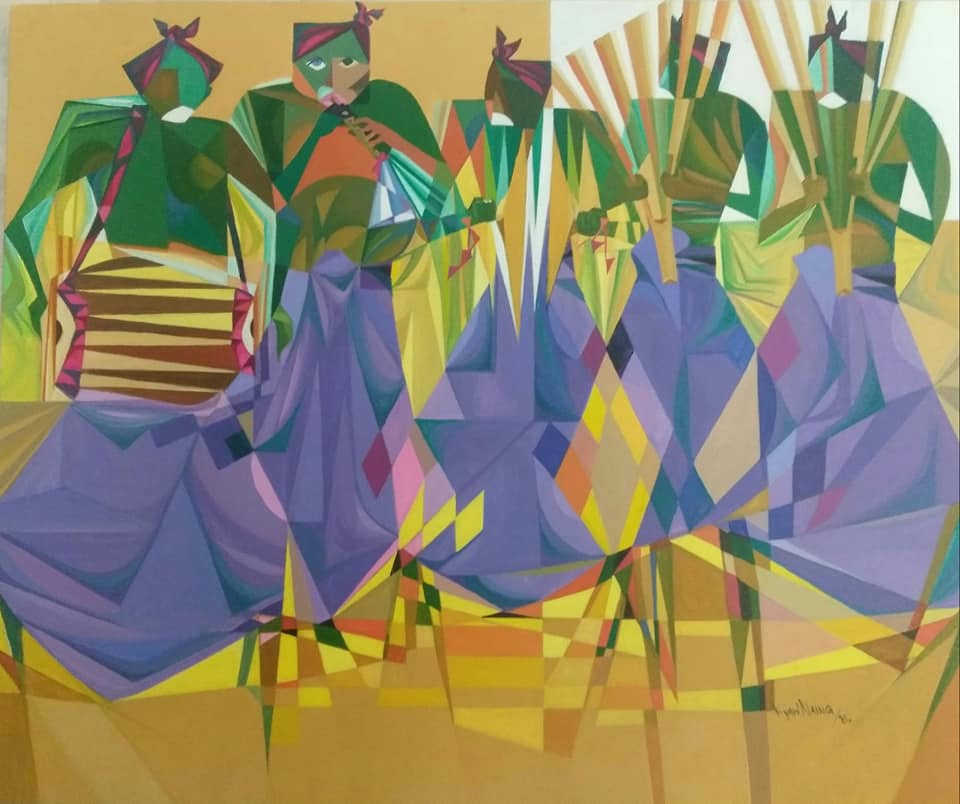
Some of the paintings on display at Kyaw Naing's solo exhibition at OK Art Gallery in Yangon.  / Photos supplied

The artist's subjects are not new—they include the Mingun Bell, Mandalay's city wall and moat, a cane-ball game, an elephant dance festival and traditional musical instrument players—but his innovative use of color and pattern catch the eye.

Kyaw Naing's use of grey square shapes to depict Yankin Hill foregrounded by toddy palms gives viewers a fresh perspective on the landmark.

Some of the paintings on display at Kyaw Naing's solo exhibition at OK Art Gallery in Yangon.  / Photos supplied

"The Sabbath Day at Phayagyi" instills peace of mind, rendering the best view of Mandalay's most famous place of worship in straight and curved lines, colored in yellow, green, blue and white.

The Mandalay Moat comes alive in dark blue, with red, green, yellow and brown cubes reflected in the water of the moat creating pleasing abstractions.

Some of the paintings on display at Kyaw Naing's solo exhibition at OK Art Gallery in Yangon.  / Photos supplied

"Yankin Hill is usually depicted in a lush green. But I have used grey and yellow colors to give viewers a new taste," said the 50-year-old artist. "As the city wall is stationary, I drew clouds in patterns to create a sense of movement," he said.

"Phayagyi is a beauty of peacefulness and purity," he added, referring to the Maha Myat Muni Buddha image by its local name.

The exhibition will run from Nov. 10-14. Kyaw Naing learned his beloved modernism from Mandalay-based painters. He has participated in group art exhibitions in Myanmar, Korea and Taiwan.

The post Re-Imagining the Beauty of Mandalay appeared first on The Irrawaddy.

Thursday, November 8, 2018

The Irrawaddy Magazine

The Irrawaddy Magazine


EU Commits $13.7M to Expand Peace Program In Kachin, Shan States

Posted: 08 Nov 2018 07:39 AM PST

CHIANG MAI, Thailand  — The European Union has committed 12 million euros ($13.7 million) to fund the second phase of its Durable Peace Program in Kachin State and expand it into northern Shan State through to February 2022.

The Durable Peace Program was launched in February 2015 to promote peace and development in Kachin with 7 million euros from the EU for seven local and international non-governmental organizations (NGOs) helping families in the state displaced by the country’s civil war.

Contacted by email on Thursday, EU Ambassador Kristian Schmidt said the need for peace was "particularly urgent" for the ethnic Kachin community, which has been caught up in renewed fighting between the Myanmar military and Kachin Independence Army since 2011.

Since then, more than 105,000 people have been displaced by the fighting in both Kachin and Shan states and taken shelter in 170 camps, according to figures the UN released in September.

The NGOs involved in the program have been teaching the camp managers how to run the facilities and foster peace and providing internally displaced people (IDPs) with a host of services, from vocational training to trauma counseling and legal aid.

Nang Raw Zahkung, director of policy and strategy at the Nyein Foundation, said the program has helped her group continue its work and even expand some of its services, namely trauma counseling.

"We have been working closely with the IDP communities in the camps, and starting this year we will work closely with both the IDPs and their host communities, like the churches,” where many of the families are sheltering, she told The Irrawaddy.

Some of the IDPs who have received training are now even helping the program as volunteers and staff, one of the highlights of their work, Nang Raw Zahkung said.

With the EU’s continued support, she added, the NGOs can also expand their services for IDPs into northern Shan, where until now they have been shouldering much of the burden on their own.

And of the new 12 million euros, a quarter will be granted to 25 local organizations to promote women’s empowerment and dialogue between the area’s many ethnic and religious communities.

Schmidt said the program “has done a great job in raising awareness among displaced communities on their stake in the peace process. The program also gave these people opportunities for a better livelihood. This is crucial — without the opportunity to make a living, displaced communities will lose their dignity and hopes for a better future."

At the launch of the program’s second phase on Wednesday in Myitkyina, the Kachin capital, the ambassador said the first phase had reached 85,000 people in 18 townships across the state. With Kachin State Chief Minister U Hket Aung in attendance, he urged authorities to remove any "unnecessary and unjustified restrictions on access for humanitarian and development assistance."

Military restrictions have prevented aid groups from reaching some of the war-torn areas of Kachin and Shan for the past few years.

"Civilians, women and children cannot become the main victims of this conflict. Nor is this a way to obtain a ceasefire agreement and peace eventually," Schmidt said.

The EU has committed a total 688 million euros ($786.3 million) to support peace and development in Myanmar between 2014 and 2020.

The post EU Commits $13.7M to Expand Peace Program In Kachin, Shan States appeared first on The Irrawaddy.

Gov’t Inks Agreement with Chinese Firm to Develop Kyaukphyu SEZ

Posted: 08 Nov 2018 05:56 AM PST

YANGON—After many rounds of negotiations, the Myanmar government and a Chinese company have inked a framework agreement for the development of a special economic zone (SEZ) in Rakhine State. The project will offer China access to the Bay of Bengal while enhancing its regional connectivity as part of Beijing's Belt and Road Initiative (BRI).

Thanks to its strategic location between three economically vibrant and dynamic markets—China, India and ASEAN—the Kyaukphyu SEZ is uniquely positioned to serve as a trade corridor connecting the three economies.

Identifying the SEZ project, which includes a deep seaport, as a part of the BRI, Commerce Minister U Than Myint said the signing of the agreement between the Kyaukphyu SEZ Management Committee and the China International Trust and Investment Corporation (CITIC) was an "initial success".

According to the initial master plan, the Kyaukphyu SEZ will cover a total of 520 hectares—20 for the port, 100 for housing and 400 for an industrial park. Some 50 percent of the land is allocated to fisheries, 30 percent to garment factories and the rest to other small enterprises.

"We are ready to proceed on many fronts. For those, we will have to negotiate for the good of both parties. I hope those negotiations will happen," the minister said at the signing ceremony in Naypyitaw on Thursday.

Since the 2015 elections that swept the National League for Democracy (NLD) to power, the government has been negotiating with the China International Trust and Investment Corporation (CITIC) to raise Myanmar's stake in the Kyaukphyu SEZ in Rakhine State.

CITIC struck a shareholders agreement with the previous government under President Thein Sein just before the 2015 election. It gave the Chinese developer an 85 percent stake in the project and Myanmar the rest. Critics of the project raised concerns that the deal could land Myanmar in a debt trap with China. After negotiations under the NLD government, China agreed that Myanmar would hold 30 percent of the shares.

The initial agreement called for a project worth US$9 billion or $10 billion, but current SEZ chairman Deputy Planning and Finance Minister U Set Aung earlier told The Irrawaddy that the two sides had since agreed that the project would start out on a small or medium-sized scale.

CITIC chairman Chang Zhenming said the framework agreement reflected the Myanmar government's wish to promote economic and social development in Kyaukphyu and attract foreign investment.

"This framework agreement is a major step for the SEZ and the deep seaport. It's historic," he said.

According to the framework agreement, Chang Zhenming said, a joint Myanmar-Chinese consortium will have concession rights to operate the port.

He added that the first phase of the project would be carried out after environmental and social impact assessments are conducted. Phase 1 will involve the construction of two jetties with a total investment of not more than $1.3 billion.

The term of the project was initially agreed at 50 years. Once the seaport and SEZ are in operation, they are expected to provide 100,000 jobs for local people. The government will earn $7.8 billion in revenue from the SEZ and $6.5 billion from deep seaport, according to CITIC.

The post Gov't Inks Agreement with Chinese Firm to Develop Kyaukphyu SEZ appeared first on The Irrawaddy.

Family Suspects Armed Group in Palaung Man’s Death in Shan State

Posted: 08 Nov 2018 04:43 AM PST

Mon State ­— The family of an ethnic Palaung man who went missing in northern Shan State last month says he was found dead on Wednesday.

San Mon, 32, also known as Mar Kan, went missing on Oct. 26 in Mang Bein Village, Lashio Township, according to his wife, Khun Mai. She said he has working in his vegetable garden when he heard fighting erupt between rival ethnic armed groups — The Restoration Council of Shan State (RCSS) and Shan State Progress Party — and headed back to their home to retrieve their four children.

"He went back home in the middle of the fighting to bring out our family. But he disappeared in the area where the two armed groups were fighting," she told The Irrawaddy.

Khun Mai said locals saw her husband heading back home and heard him shout at the armed groups to stop fighting long enough to let him bring his family to safety.

She said the children escaped the fighting unharmed but that the family found San Mon’s body in a shallow grave near the village on Wednesday morning while searching for him.

"The dead body was found on a hill by the village and it has been buried," she said.

A relative of San Mon who joined the search said the cause of death was not obvious because the body had already started to decompose but added that his skull appeared to have been fractured and that two military-style knives were found in the grave with him.

Khun Mai said police do not operate in the area because of the danger posed by the armed groups and that she had little hope that they would investigate her husband’s death. She said he had gone to China to earn money for the family but came back to visit on occasion and had not ties to any of the armed groups.

She suspected the RCSS in San Mon’s death because she saw the group taking up a position on the hill where his body was later found while she was fleeing the village herself. She said locals had also told her that they saw men in camouflage taking San Mon away but did not know which armed group they were with.

RCSS spokesman Colonel Sai Oo told The Irrawaddy that his group did not sanction the killing of innocent civilians and said it would investigate San Mon’s death if his family produced credible evidence of its involvement.

"It is difficult to know who was involved in the killing because it was on the frontlines," he said.

The post Family Suspects Armed Group in Palaung Man’s Death in Shan State appeared first on The Irrawaddy.

US Pretzel Chain Auntie Anne’s to Open in Yangon Next Year

Posted: 08 Nov 2018 02:40 AM PST

YANGON—Myanmar's first outlet of Auntie Anne's, the U.S. chain of pretzel shops, will open in Yangon next year.

Local partner Yoma Strategic and Auntie Anne's parent company, Focus Brands Inc., on Wednesday announced the signing of a franchise agreement to bring the chain to Myanmar.

In a joint release, the companies said Myanmar's first branch of the world's largest hand-rolled soft pretzel franchise is scheduled to open in Yangon in the coming months, with more outlets to be rolled out over the next five years.

Founded in 1988, Auntie Anne's has more than 1,800 outlets in 30 countries and has established a strong presence in Asia, gaining popularity in markets such as Singapore, Japan, Thailand, China, South Korea, the Philippines, Cambodia, Indonesia and Malaysia.

“We are seeing considerable growth in the market for freshly baked goods. While many street vendors do offer traditional Myanmar alternatives, the addition of an iconic international brand will only enrich the local 'foodscape,'" Yoma Strategic CEO Melvyn Pun said in the joint release.

Yoma already operates KFC fried chicken outlets in Myanmar. KFC first opened in Yangon in 2015, marking the first foray of a U.S. fast-food chain into the country. KFC now has 26 shops across Myanmar.

The post US Pretzel Chain Auntie Anne's to Open in Yangon Next Year appeared first on The Irrawaddy.

Daw Aung San Suu Kyi Buys Land in Naypyitaw for Her Foundation

Posted: 08 Nov 2018 02:36 AM PST

NAYPYITAW — State Counselor Daw Aung San Suu Kyi has bought more than 90 acres of land in the capital’s Ottarathiri Township for 700 million kyats ($444,000) for her Daw Khin Kyi Foundation to open a vocational training school and establish a forest.

Myanmar’s de facto leader filed the paperwork herself to buy the site from the Naypyitaw Development Committee.

The land itself cost 5 million kyats per acre and the land permit cost another 40 kyats per square foot.

"The land permit was granted about three months ago. The land was acquired in line with the law," a source with Daw Aung San Suu Kyi’s ruling National League for Democracy in Naypyitaw told The Irrawaddy, denying rumors that the state counselor had confiscated the property.

Any non-governmental organization can apply to buy land for 5 million kyats per acre in Naypyitaw, the source added.

"Land is not given away for free. There is vacant land. The applicant must show valid documents and must fence the land immediately after buying it," he said.

The Daw Khin Kyi Foundation confirmed the purchase. Spokesman U Thant Thaw Kaung said the foundation had planned to launch the project on Monday but has had to postpone it for several reasons.

"Daw Aung San Suu Kyi will launch it next year. We can only say this much for the time being. It is not yet ready," he told The Irrawaddy.

According to sources close to the foundation, a forest will be established on the 93 acres, which already has sparse tree cover, as part of an environmental conservation drive and that a vocational training school will open there. The school will teach landscaping to youth who have not completed their formal education.

"The leaders have not revealed the project because no preparation has been done on the ground," the source said. "It is Daw Aung San Suu Kyi's idea. But it is still an idea, and a lot of support will be needed."

In response to widespread flooding across Myanmar over the past few years, the project aims to raise public awareness of — and disseminate knowledge about — environmental conservation through landscaping.

"There is a need to educate the public about the environment. But it is not a profession that provides livelihoods. Daw Aung San Suu Kyi wants to create jobs that earn money and contribute to environmental conservation at the same time," a source told The Irrawaddy.

Lower House lawmaker U Soe Moe Thu, who represents Irrawaddy Region’s Myaungmya Township, said his constituents appreciate the foundation’s work.

"We opened a mobile library in cooperation with the Daw Khin Kyi Foundation in Myaungmya and it has been a success. The hospitality training school has also been successful. The foundation finds jobs for those who complete courses at the training school," he said.

The Irrawaddy visited the site the foundation has just purchased in Naypyitaw. It sits near Raja Thingaha Housing 2 and the Ocean Center and has yet to be prepared for development.

The foundation also plans to locate its headquarters on the site in the future.

Others who have bought up land in Naypyitaw include many of the top brass of the former State Peace and Development Council government including former Senior General Than Shwe, former Vice Senior General Maung Aye, former General Thiha Thura Tin Aung Myint Oo, former General Thura Shwe Mann, former General and ex-President U Thein Sein and former Union Election Commission chairman U Tin Aye. Some of them also live there.

The U Thein Sein government established Raja Thingaha Housing 1 and 2 for its ministers, deputy ministers, union-level officials and directors-general.

The Daw Khin Kyi Foundation was established in 2012 by Daw Aung San Suu Kyi in memory of her mother, Daw Khin Kyi, to improve health, education and living standards across the country.

Translated from Burmese by Thet Ko Ko.

The post Daw Aung San Suu Kyi Buys Land in Naypyitaw for Her Foundation appeared first on The Irrawaddy.

Military Chief Asks Visiting Chinese Diplomat for Continued Support

Posted: 08 Nov 2018 01:24 AM PST

YANGON—Myanmar's military chief told a visiting senior Chinese official that he hoped China would further promote its stand on political reforms in Myanmar and foster good relations between political forces, the public and ethnic groups in the country.

Song Tao, the head of the International Department of the Central Committee of the Communist Party of China, has been visiting Myanmar since Tuesday at the invitation of State Counselor's Office Minister U Kyaw Tint Swe.

During his stay in Naypyitaw, the Chinese official met with State Counselor Daw Aung San Suu Kyi, military chief Senior-General Min Aung Hlaing and the chairman of the country's main opposition Union Solidarity and Development Party (USDP), U Than Htay.

Song Tao's trip to Myanmar is his third since 2016. During his first trip, he held talks with several key leaders including former military supreme leader Senior-General Than Shwe, Daw Aung San Suu Kyi, Snr-Gen Min Aung Hlaing, former President U Thein Sein, National League for Democracy (NLD) spokesperson U Win Htein and representatives of the USDP, according to the official statement from the Chinese Embassy at the time.

In his meeting with the Myanmar military leader, the Chinese official said the political role of Myanmar's military (or Tatmadaw) was important for stability and development.

"The Communist Party of China emphasizes relations with the Myanmar Tatmadaw," he said, according to the military-run Myawady Daily.

During the meeting, the senior general called on China to provide assistance necessary for Myanmar's development, the paper added.

China has played an active role in Myanmar's politics and economy. When Western nations, including the U.S. and those in the European Union, imposed sanctions and condemned Myanmar's former military regime, China was the pariah government's main backer and largest investor.

And when Myanmar was condemned by other nations on the UN Security Council over the exodus of Rohingya to Bangladesh in the face of alleged atrocities committed by security forces, China continued to support Naypyitaw by blocking measures initiated by other member countries.

On the country's peace process with ethnic armed organizations (EAOs), Chinese Special Envoy Sun Guo-xiang has urged the groups to attend the government's peace conferences, including groups still engaged in fighting with the Tatmadaw and who have refused to sign the Nationwide Ceasefire Agreement (NCA). In May 2017 and July this year, Sun flew members of non-signatory groups from Kunming, China to Naypyitaw on a chartered Chinese plane. Many representatives of the EAOs said they attended solely because China pressured them to do so.

China has also provided Myanmar with aid and investment, much of it to help build strategic infrastructure projects including oil and gas pipelines, ports, and dams as part of Beijing's Belt and Road Initiative.

With several clear strategic interests in Myanmar—ranging from stability on its shared border to access to the Indian Ocean to a wide variety of economic interests—Beijing has played a key role in Naypyitaw's internal security affairs and in peace negotiations with ethnic armed groups. It has both a direct and indirect influence on the dynamics of conflict and peace in northern Myanmar. Beijing supports the Myanmar government and its peace process, but at the same time provides shelter, weapons and other assistance to some of the EAOs, according to a recent report by the United States Institute of Peace (USIP).

On Thursday, Special Envoy Sun made a donation of USD300,000 on behalf of the Chinese government to benefit Myanmar's peace process, the National Reconciliation and Peace Center said.

The post Military Chief Asks Visiting Chinese Diplomat for Continued Support appeared first on The Irrawaddy.

‘Skeletons Covered in Skin’: Inside Myanmar’s Prison Labor Camps

Posted: 07 Nov 2018 09:59 PM PST

Eight prisoners made a break for it, ignoring the pain in their emaciated bodies as they sprinted from the labor camp in Kabaw Valley in Myanmar's northern Sagaing Region.

They didn't get far. A rabble of guards and deputized inmates pursued them, picking them off in the barren fields that surrounded the camp and beating them mercilessly.

Four of the would-be escapees died. The rest, put back to work in shackles despite their severe injuries, wished they had. "Just kill us, we can't work anymore," one of them begged.

U Tin Aung, a prison officer at the Sayar San prison camp during the killings in 2001, saw the whole thing. "I could only watch," he told Myanmar Now. "I didn't have the authority to give them a break."

The four men were among 357 who died at the camp that year, Tin Aung said. Thousands more perished under torturous conditions in Myanmar's prison labor camps before the number of fatalities began to fall around the start of political reforms in 2011.

While the previous government disclosed some details about the camps, officials have remained evasive about the real reasons so many died.

But an investigation by Myanmar Now reveals for the first time an account of the horrors that unfolded within the gulag-like compounds from those who helped to oversee them.

They describe inmates perishing en masse from severe exhaustion, vicious beatings, and starvation at camps with no access to medical staff to treat the inevitable onset of disease.

Men used as cattle

The investigation – based on interviews with current and former prison officers, senior prison department officials, ex-inmates and village elders – also offers evidence that officials recorded false or incomplete causes of death on their paperwork in an attempt to hide the fact inmates had died from mistreatment amounting to torture.

U San Bala, who was administrator of Yazagyo Village in Sagaing Region from 1999 to 2003, had to sign as a witness every time an inmate died at the nearest of two prison camps in the area.

The two Yazagyo compounds, along with Sayar San, were among seven agricultural labor camps in Sagaing Region, each holding hundreds of prisoners.

During his first year as administrator "there wasn't a day without death," San Bala said. "Sometimes the number rose to six bodies a day."

"They gave the causes of death as diarrhea, dysentery or another illness, but most of the prisoners were tortured to death," he added, referring to the backbreaking forced labor and relentless beatings that inmates endured.

"They were asked to line up before starting work. They had to plant seedlings, and if a prisoner was slow, he was hit with a big stick."

At one point San Bala wondered aloud to prison officials about how so many could die from dysentery and diarrhea. "It isn't this bad in the village," he told them. "This is normal for us," an official replied.

In 2014, then-Deputy Home Affairs Minister U Kyaw Kyaw Tun admitted that more than 5,000 had died in the labor camps since 1978.

He failed to mention that prisoners were overworked, beaten and starved, instead blaming the deaths on "unhealthy lifestyles and accidents" as well as cold weather.

Prison department deputy director U Min Htun Soe, however, was more open about the inhumane working conditions.

Many died for want of medicine and because "prisoners were used in place of cattle and bulls to plough the fields," he told Myanmar Now.

Myanmar Now was unable to verify the figure given by Kyaw Kyaw Tun because the ministry refused or ignored multiple requests to provide a breakdown showing when and at which camps the deaths happened.

Whatever the true toll, it is likely that deaths began to soar from the early 1990s, when Senior General Than Shwe ordered the construction of some of the most notorious camps.

'Mental and physical improvement'

In May 1991, around two-dozen guards from Monywa Prison in Sagaing Region herded 300 inmates onto a boat and set sail along the Chindwin River, towards the Indian border.

These were the guinea pigs for a nativist scheme cooked up by Than Shwe to defend Myanmar's porous land border from the effects of illegal migration.

The plan was to bolster the population along the frontier by building agricultural labor camps. Prisoners were to convert wastelands to farms in and around the sparsely populated Kabaw Valley, where rocky ground and infertile soil presented a grueling obstacle.

After serving their sentences inmates would get land and cattle in exchange for settling in the region, Prisons Department documents seen by Myanmar Now stated.

While the scheme was overambitious, the consequences would have been far less deadly had generals not ordered the camps to meet unattainable targets for producing rice, said U Zaw Htun, who was deputy director-general of the Prisons Department for over a decade before retiring in 2014.

"The targets forced prisoners to overwork," he told Myanmar Now, adding that the absence of healthcare also contributed to the high death rate.

Because the camp was unable to produce enough rice, he said, prisoners were sent into the forest to harvest rattan to sell. Camp officials would then use the money they raised to buy rice that they would pass off to superiors as their own harvest, he added.

The generals setting the targets were keen for inmates whose labor was being "wasted" to help cover the costs of running the country's prisons by working in mines and on farms.

In 1998, an internal government notice explained how the Bawa Thit – or "New Life" – agricultural production camps in Sagaing were among those expected to raise revenues and contribute to rice stocks for the Prisons Department.

But the camps, the notice added, also had another purpose: to "mentally and physically improve the prisoners and build new lives for them."

'All skin and bone'

The 300 inmates who sailed from Monywa in 1991 were put to work building the Oak Pho Kanbaung camp near the town of Tamu, the first of the Bawa Thit facilities.

At the time, Tin Aung was working at Monywa prison, where he was put in charge of managing logistics for the camp from a distance. The budget he was given for food, he said, was miserly.

"If it was worth K300, the government would only give us K100," he said. His superiors suggested he buy meat but the budget was so tight "there was no way we could."

Before long, wardens at the Bawa Thit camps began sending sick inmates back to Monywa and other prisons. "The returning prisoners were all skin and bone, their bodies were covered with scabies. They died as soon as they got there," he said. "Arrive today, die tomorrow."

More than 600 sick and starving inmates were also sent back to the prison in Kalay in 2001, said U Khin Maung Myint, a prison officer there at the time. Five hundred of them died.

"They looked like skeletons covered in skin," he said. "Their BMIs [body mass indexes] were too low for them to survive."

It is unclear if the government's estimate of the number of deaths at Myanmar's labor camps covers only those who died on site, or if it also takes account of those who died after being transferred. The former would drastically underestimate the true toll.

Prisoners become guards

Ko Ye Htun was, relatively speaking, one of the lucky ones.

He was sent to the second of the two camps at Yazagyo in 1999 after being caught in Mandalay buying and selling electric meter boxes without a license, and helping people to illegally connect to the power grid.

It was December when he arrived to serve part of his six-month sentence, and the weather was frigid. He was sent every day with nine other inmates to climb a mountain and collect firewood for the entire camp, which held around 300 people.

"If we weren't able to get enough wood we were beaten on the gravel road," he said. "I was beaten 20 or 30 times when I first arrived." The firewood was never enough, and Ye Htun couldn't keep the cold out at night.

He survived on a starvation diet. A typical meal was a meager serving of thin, watery soup made with wild leaves and served with a lump of fish paste "the size of a gooseberry."

"We had to bathe in yellow water," he added. "We used mountain water for drinking. We drank it without boiling it because we were so thirsty." If someone got sick one day, he said, they would probably be dead the next.

At times local villagers came to the camp to inform the authorities they had found the bodies of escapees who had died in the jungle.

The prospects of survival inside the camp were little better. "Even on a good day at least two or three people died," he said. He is sure he would have died too was it not for a chance encounter with the man he credits with saving his life.

Not long after his arrival at the camp, a military officer from the nearby town of Kalay was driving along the road that passed near the compound when his car broke down. Ye Htun, who was good at tinkering with machines, was sent to help, and managed to restart the engine.

To show his gratitude, the officer asked the prison warden to take care of Ye Htun. It seemed clear that he knew people were dying in the camps and hoped to save the man who had fixed his car.

After that, Ye Htun was appointed as an enforcer, a role of relative privilege given to some inmates that involves helping the guards discipline other prisoners. He no longer had to endure the beatings; now it was his job to deliver the blows.

Eating frogs alive

He was spared the unbearable workload too. Men who before toiled beside him now worked under his supervision; inmates who had taken beatings with him now recoiled from the sharp thwack of his stick.

But it was better to be beaten by a sympathetic inmate enforcer that the regular guards who tended to show no mercy, he said. "When they heard that the superintendent was on an inspection round, some inmates would beg me to beat them before he could get to them."

The systematic violence at the camps was a means of extracting bribes as well a regime of punishment for missed targets. Inmates with families willing and able to pay off prison authorities were given jobs like Ye Htun's and spared beatings.

Guards worked on the assumption that the harder they beat the men, the more persuasive their pleas to their families to pay the money to spare them would be, said Ye Htun.

Part of Ye Htun's new role involved manning the prison entrance, where he was tasked with doing paperwork that included recording the deaths of inmates. After he had logged about 60 deaths, he recalls, the superintendent put in a request to the Prisons Department to send more inmates.

"The bodies were buried in a grave at the side of the road," he said.

On a recent visit to Yazagyo village, San Bala, now 70 years old, showed Myanmar Now a plot of land covered in wild grass where he said prisoners' bodies were buried.

There was little effort to hide the horrors at the camps from the villagers. In the paddy fields around the prison, starving inmates could at times be seen lunging at small wild animals.

"Some would just pick up these green frogs and eat them raw," said San Bala, the former village administrator who had to sign as a witness when inmates died. "If they got caught doing it they were beaten."

The horrors continue

From 2009, the government increased funding for prisons and instructed wardens to provide more food for inmates. The government also abolished its production targets for the camps. Fatalities began to plummet.

But while the mass death of prisoners during the pre-reform era has begun to fade into history, Myanmar still has 48 labor camps with around 20,000 inmates, according to the Prisons Department. Despite calls for reform, conditions remain torturous.

Men are still forced to work as slaves, often in shackles, and face constant beatings unless they can pay bribes, ex-inmates have told Myanmar Now.

At some camps, prisoners are rented out as laborers to private agribusinesses, with officials collecting the profits. And materials from rock quarries staffed with prison slave labor are sold to well-known local construction companies.

Nor have the deaths stopped entirely. At the 18 camps across Myanmar where prisoners are made to work as miners, being maimed or killed in an accident is a constant threat.

Earlier this year an inmate working in the rock quarry at Inn Byaung camp in Mon State died after falling from a cliff. Two hundred prisoners protested in response, calling for the camp to be closed and inmates to be sent back to regular prisons.

In August last year, a prisoner was grievously injured when a large rock fell onto the lower half of his body and crushed his legs at the same camp.

The prison warden failed to inform the Prisons Department about the incident, but the Myanmar National Human Rights Commission eventually directed the Home Affairs Ministry to take action after receiving a complaint.

Another prisoner narrowly survived having his skull cracked by a falling rock at the Marlar Phu mining camp in Kayin State last June.

He fell into a coma and was taken to Yangon General Hospital, about 270 km away, where surgeons had to remove fragments of skull from his head.

Prison records showed that he was arrested and sentenced to six years after being caught with a single tablet of an unspecified illegal drug.

After he woke from his coma, prison authorities sent him back to finish his sentence at the quarry in Kayin. He was released earlier this year.

Prisons Department Deputy Director Min Htun Soe said the warden at Marlar Phu camp has been transferred to another facility, while no action has been taken against the warden at the camp where the man had his legs crushed.

Myanmar's prison labor camps defy several local and international laws.

Under the Prisons Act, inmates are only supposed to be given labor if it forms part of their sentence, but authorities routinely send inmates whose sentences do not include labor to work in the camps.

In May, U Khun Win Thaung, a National League for Democracy lawmaker, took the Home Affairs Ministry to task over the Prison Department's use of forced and unpaid labor for private enterprises, which violates the Prisons Act as well as international conventions that Myanmar has signed.

In the pre-reform days, there was nobody to speak up on prisoners' behalf.

When San Bala was administrator at Yazagyo, the villagers did what they could to help the inmates, he said.

Sometimes they would take rice and curry to the camp, and they would occasionally take the risk of harboring escapees, feeding them and giving them money for transport before sending them on their way.

But there were limits to how far this help could go, he added, and no one dared raise their voice to defend the inmates. "In those days you didn't talk back."

The post 'Skeletons Covered in Skin': Inside Myanmar's Prison Labor Camps appeared first on The Irrawaddy.

Thai Junta Says No Need for Foreign Observers at Next Year’s Election

Posted: 07 Nov 2018 09:33 PM PST

BANGKOK — Thailand does not need international observers to monitor next year’s general elections, the foreign minister said on Tuesday, despite criticism from pro-democracy activists that the junta has restricted fundamental civil rights.

The government has promised to hold elections between February and May after repeated delays, a contest between supporters of the military and royalist establishment and the populist political forces now led by the Puea Thai Party that was ousted by the military in a 2014 coup.

Foreign Minister Don Pramudwinai said past elections in the Southeast Asian country have been credible.

“To have others observing means the country is having a problem,” he told reporters.

The last time Thailand held a successful election was in 2011 when Yingluck Shinawatra and her Puea Thai Party won by a landslide.

In February 2014, an election was disrupted by massive street protests that saw voting blocked in a fifth of the country’s constituencies and eventually led to the May 2014 coup.

Human Rights Watch said foreign observers should be allowed to monitor the 2019 vote and called on the government to lift the ban on political activities to ensure the election is free and fair.

“As the countdown for an election has begun, the Thai military government seems to care about seeking hand-shake and photo opportunities at major international events, but refuses to allow foreign allies to come and witness what is going on in the country where the environment for a free and fair election does not exist,” Sunai Phasuk, a senior Thailand researcher at Human Rights Watch, told Reuters.

The military government has recently relaxed some political restrictions by allowing political parties to organize but a ban on campaigning and gatherings of more than five people remains in place at least until December.

An election date has not been set but senior government officials have said that it would likely be on Feb. 24.

The post Thai Junta Says No Need for Foreign Observers at Next Year’s Election appeared first on The Irrawaddy.

Cambodia to Boost Clean Energy Use — But Coal Plants Planned Too

Posted: 07 Nov 2018 08:56 PM PST

PHNOM PENH — Cambodia will push ahead with plans to use hydropower and coal to electrify the entire country by 2020, but solar energy will play some role, especially in remote areas, an energy ministry official said on Wednesday.

The Southeast Asian nation has electrified rapidly since 2000, when only 16 percent of the population had access to power, according to the World Bank.

Today, 87 percent of villages and 73 percent of households are connected to the grid, said Victor Jona, a spokesman for the department of energy at the Ministry of Mines and Energy.

Hydropower accounts for 40 percent of the mix, while coal makes up 36 percent, with more plants being built, he said.

Power imports from neighboring countries contribute almost the entire remainder, with renewables such as solar accounting for less than 1 percent, he said.

But Jona said the government has plans to develop more clean energy, especially in hard-to-reach communities.

“We hope that solar home systems will do the role for the very remote areas, in case the grid cannot expand to them,” he said on the sidelines of a clean energy conference in the capital, Phnom Penh.

Some larger-scale solar is also being added to the mix. Jona said construction of a 60 MW solar plant in Kampong Speu Province, west of the capital, is scheduled to be completed by the end of 2019.

A 10 MW solar plant came online this year, he said,

But hydropower and coal are still projected to make up 80 percent of Cambodia’s energy needs once the country achieves full electrification, Jona said.

Coal-fired plants are under construction and will contribute another 150 MW by next year, he said.

Cheaper solar

Bridget McIntosh, the Cambodia director for Energy Lab, which works to promote clean electricity, said the country should consider adding more renewable energy to its mix, especially as the cost of solar power falls.

“It takes five years to build a coal-fired station or a dam, and in those five years the cost of solar will continue to decline,” she told the Thomson Reuters Foundation.

“So it makes more sense to now connect solar to the grid” to meet the country’s electrification goals, she said.

Moving away from coal can also help countries meet their Paris Agreement goals to reduce greenhouse gas emissions, and help curb worsening climate impacts, including more extreme floods, droughts and sea level rise.

Cambodia has committed to a 27 percent reduction in its climate-changing emissions by 2030, 16 percent of which will be achieved by promoting clean and more efficient energy.

However, to scale up solar and other power, Cambodia must create a more welcoming regulatory environment for investment in it, said Pheakdey Heng, a founder of the Enrich Institute, a Phnom Penh-based think tank.

That might include everything from providing greater transparency in issuing and revoking energy licenses to removing barriers to adopting solar energy, adopting energy efficiency standards and providing tax incentives for clean energy use, he said.

Cambodia’s electrification so far has been largely driven by dams, and more are under consideration, including the controversial Sambor dam across the Mekong River, which is still in the “preliminary study” stage, according to Jona.

But the benefits of dams have been highly overestimated, according to a study published this week by scientists from Michigan State University.

Dams, the study said, often uproot people from their homes and damage biodiversity, while also releasing “large amounts” of climate-changing gases from rotting vegetation when water is released through spillways or passes through turbines.

The post Cambodia to Boost Clean Energy Use — But Coal Plants Planned Too appeared first on The Irrawaddy.

Cambodia’s Hun Sen Eases Pressure on Unions, as EU Sanctions Threat Looms

Posted: 07 Nov 2018 08:46 PM PST

PHNOM PENH — Cambodian Prime Minister Hun Sen told his ministers to ease pressure on labor union leaders on Wednesday, after threats by the European Union to remove the Southeast Asian country’s duty-free trading access.

The EU began a formal procedure last month to strip Cambodia of its “Everything but Arms (EBA)” initiative, following a July general election that returned Hun Sen to power after 33 years in office and gave his party all parliamentary seats.

In a speech to 20,000 factory workers on Wednesday, Hun Sen urged his ministries of justice and labor to speed up or drop any pending court cases against union leaders.

“Cases that should be handled, handle them quickly. Cases that are not being handled, drop them, finish them, so that those union leaders don’t feel like hostages,” Hun Sen said.

“This will open up some freedom space for the unions,” he said. “Let’s make reconciliation and understanding of each other a priority.”

Hun Sen did not refer to the EU threat to remove trade preferences.

The world’s largest trading bloc has launched a six-month review of Cambodia’s duty-free access, meaning its garments, sugar and other exports could face tariffs within 12 months, under EU rules.

Representatives from major apparel and footwear companies, including Adidas, New Balance, Nike, Puma, Under Armour, and VF Corporation, met Cambodian government ministers on Oct. 19.

The companies urged the government to drop what are widely seen as politically motivated criminal charges against trade unionists.

“The prime minister has made a step towards honoring human rights obligations under the EBA agreement with the EU while wooing workers’ support for his rule,” said political analyst Lao Mong Hay said.

The repercussions of any EU sanctions on Cambodian garments could devastate an export industry, which accounts for about 40 percent of the country’s gross domestic product (GDP).

Ath Thon, the president of the Coalition of Cambodian Apparel Workers’ Democratic Union, who has 7 pending lawsuits against him and another 50 against his colleagues over labor strikes, said he welcomed Hun Sen’s comments.

“Let’s wait and see how they will resolve this,” Ath Thon told Reuters.

“It could be that, firstly, the election is over and the situation is better so they want to solve problems and, secondly, that they want to respond to what development partners want.”

The post Cambodia’s Hun Sen Eases Pressure on Unions, as EU Sanctions Threat Looms appeared first on The Irrawaddy.

Golden Triangle’s Drug Production Expands, Diversifies Amid Opioid Concerns

Posted: 07 Nov 2018 08:40 PM PST

JAKARTA — Organized crime groups are expanding and diversifying drug production in Southeast Asia’s Golden Triangle amid fears the region could emerge as a hub for synthetic opioids like fentanyl, according to the United Nations Office on Drugs and Crime (UNODC).

Asia Pacific counter-narcotics police met in Myanmar's capital, Naypyitaw, on Wednesday to negotiate a new strategy to strangle the supply of chemicals used in synthetic drug production.

The Golden Triangle, centered on Myanmar's conflict-ridden north, has exported illicit drugs to the world for decades. While opium cultivation and heroin trafficking has slumped in recent years, synthetic drug manufacturing — especially methamphetamine — has soared.

UNODC regional representative Jeremy Douglas said the boom was “like nothing we have ever seen before, and it has required a matching surge in precursor chemicals.”

Seizures of methamphetamine sourced from the region have leapt since 2016, with consignments of the highly addictive drug intercepted in South Korea and New Zealand and most countries in between.

The price of methamphetamine — both in crystal and pill form — has fallen in many countries according to UNODC data, indicating that large amounts of synthetic drugs are still hitting the streets undetected by law enforcers.

“While we are a significant source of illicit drugs, we are not a source of the chemicals,” said Myanmar Vice Minister of Home Affairs Major General Aung Thu in a press release.

The flow of precursor chemicals to northern Myanmar has continued mostly unimpeded. Precursors come mostly from neighboring China, although significant volumes of chemicals and cutting agents from India, Pakistan, Vietnam and Thailand have also been detected in Myanmar.

Synthetic opioids fear

Drug gangs are also starting to produce ketamine in Myanmar’s north, a party drug that requires different technical expertise to produce than methamphetamine, said Douglas.

“We have seen drug syndicates in the Golden Triangle scale up methamphetamine and add ketamine to their repertoire. There is increasing concern amongst officials here that they will soon go into manufacturing synthetic opioids,” Douglas told Reuters. “Given their sophistication, we think it is only a matter of time they do it. They are ruthless and the region has the conditions necessary for production and pre-existing market demand to capitalize on,” he told Reuters.

China, along with Mexico, is the major supplier of extremely potent opioids to North America, according to the US Drug Enforcement Administration (DEA). The DEA said in a report last week the country was gripped by an “ongoing fentanyl epidemic.”

There were more than 63,000 drug overdoses in the United States in 2016, a record high. Drug poisoning deaths are the leading cause of injury death in the United States and synthetic opioids are the “most lethal” contributor, the DEA report said.

China, which shares a border with northern Myanmar, has begun to crack down on illicit opioid production. It follows a largely successful campaign to clear out methamphetamine labs in southern China in 2013 and 2014.

Myanmar's surge in methamphetamine production followed the China crackdown.

Opioids have yet to have much impact on the Asia Pacific drug market, although fentanyl has been imported into Australia recently, Douglas said.

Law enforcement agencies from China, India, Southeast Asia, the US, Canada and Australia are attending the Naypyitaw conference. 

The post Golden Triangle’s Drug Production Expands, Diversifies Amid Opioid Concerns appeared first on The Irrawaddy.

Too Soon to Send Rohingya Back to Myanmar: UN Rights Envoy

Posted: 07 Nov 2018 08:35 PM PST

GENEVA — The United Nations’ human rights investigator on Myanmar urged Bangladesh on Tuesday to drop plans to start repatriating hundreds of thousands of Rohingya refugees to Rakhine state this month, warning they would face a “high risk of persecution."

More than 700,000 Rohingya refugees crossed into Bangladesh from western Myanmar, UN agencies say, after Rohingya insurgent attacks on Myanmar security forces in August 2017 triggered a sweeping military crackdown.

The two countries agreed on Oct. 30 to begin the returns to Myanmar in mid-November. The UN refugee agency has already said that conditions in Rakhine state were “not yet conducive for returns."

Yanghee Lee, UN special rapporteur on human rights in Myanmar, said in a statement that she had received credible information from the refugees in Cox's Bazar that “they are in deep fear of their names being on the list to be repatriated, causing distress and anguish."

She had not seen any evidence of the government of Myanmar creating an environment where the Rohingya can return to their place of origin and live in safety with their rights guaranteed.

It has “failed to provide guarantees they would not suffer the same persecution and horrific violence all over again,” Lee said.

The root causes of the crisis must first be dealt with, including the right to citizenship and freedom of movement, she said. Myanmar does not consider the Rohingya a native ethnic group. Many in the Buddhist-majority country call the Rohingya “Bengalis," suggesting they belong in Bangladesh.

The post Too Soon to Send Rohingya Back to Myanmar: UN Rights Envoy appeared first on The Irrawaddy.